Physics 5054/41 — October/November 2011
Cambridge O-Level · Alternative to Practical · worked solutions for every part, with the mark scheme
Topics Experimental Contexts · Use of Techniques, Apparatus and Materials · Analysis, Conclusions and Evaluation · Observations and Measurements
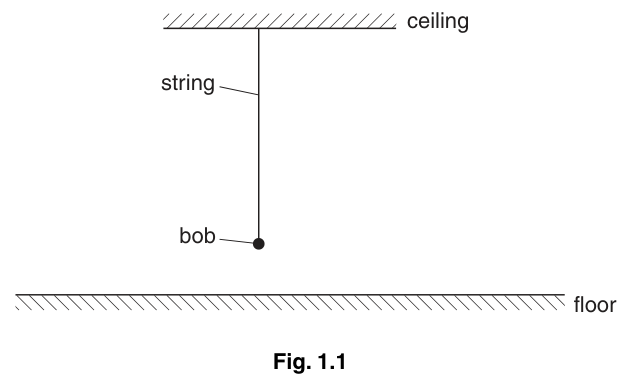
A long pendulum is attached to the ceiling, as shown in Fig. 1.1.
A student performs an experiment to investigate the relationship between the time for one complete swing of the pendulum bob and its height above the floor.
The vertical distance of the bottom of the pendulum bob above the floor is measured.
Mark and label on Fig. 1.1,
the vertical distance ,
the position of the eye of the observer when measuring .
The pendulum is made to swing freely and a stopwatch is used to determine the time for 5 complete swings.
The student takes a series of readings of for different values of .
Values of and are recorded in Fig. 1.2.
Fig. 1.2
| 5.0 | 15.31 | ||
| 15.0 | 14.96 | ||
| 25.0 | 14.59 | ||
| 35.0 | 14.23 | ||
| 45.0 | 13.87 | ||
| 55.0 | 13.49 |
Another student states that measuring the time for 50 complete swings is better.
Suggest one disadvantage of timing 50 complete swings.
______
Fig. 1.2 also contains columns for the time for one complete swing and for .
Complete Fig. 1.2.
Give the values of to three significant figures.
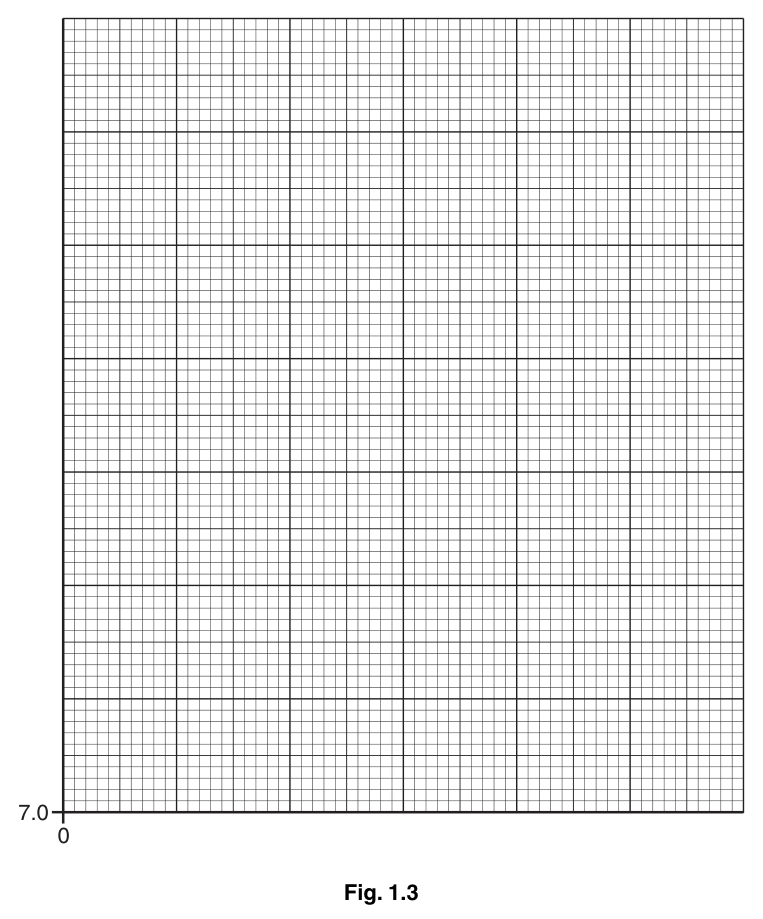
On Fig. 1.3, plot a graph of on the y-axis against on the x-axis.
Start your axes from and . Draw the line of best fit.
Describe the shape of your graph.
______
The rest of this paper
3 more questions- Q2Experimental Contexts · Observations and Measurements · Analysis, Conclusions and Evaluation · Use of Techniques, Apparatus and Materials6M
- Q3Use of Techniques, Apparatus and Materials · Experimental Contexts · Analysis, Conclusions and Evaluation6M
- Q4Experimental Contexts7M