Physics 5054/31 — October/November 2011
Cambridge O-Level · Practical Test · worked solutions for every part, with the mark scheme
Topics Experimental Contexts · Use of Techniques, Apparatus and Materials · Observations and Measurements · Analysis, Conclusions and Evaluation
In this experiment, you will investigate the equilibrium of a suspended mass.
You have been provided with
- a mass, labelled M, suspended from a stand and clamp by a length of string,
- a second length of string attached to the first length of string at one end and with a loop at the other end,
- a pulley supported above the bench,
- a mass with a hook,
- a metre rule,
- a set square.
Set up the apparatus as shown in Fig. 1.1.
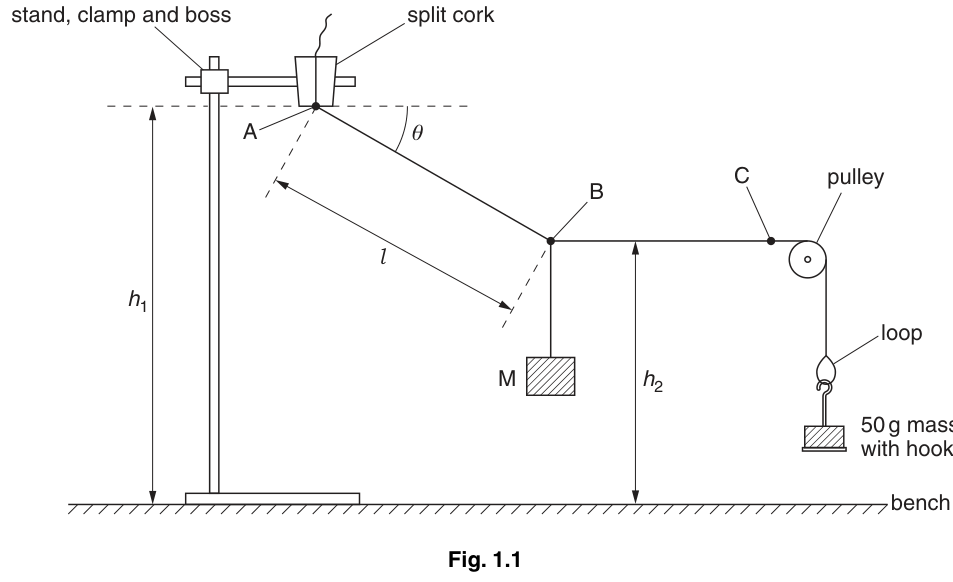
Pass the second length of string over the pulley and suspend the mass from the loop. Adjust the position and height of the pulley so that string BC is horizontal.
Answer
Apparatus set up as shown in Fig. 1.1, with string BC adjusted to be horizontal.
See Fig. 1.1
Walkthrough
The candidate is given a list of apparatus and asked to assemble it as shown in the diagram. The key feature to achieve is that the string segment BC, which runs over the pulley to the 50 g mass, must be horizontal. This is done by adjusting the position and height of the pulley.
Key Takeaways
Candidates must be able to follow instructions to assemble a practical apparatus and make fine adjustments to achieve a specific geometric condition (a horizontal string).
Common Mistakes
Failing to adjust the pulley height so that BC is truly horizontal, which will introduce errors in the angle and invalidate the equilibrium assumption used in later calculations.
Things to Be Careful About
This is a Paper 3 practical question. The candidate performs the setup themselves. Ensure the string is taut and the mass M hangs freely without touching the stand or bench.
Explain how you made sure that BC was horizontal. You may add to Fig. 1.1 if you wish.
Answer
Measured the height of the string BC above the bench at two different points using a metre rule and confirmed they were equal. Alternatively, placed a set square against the vertical stand and checked that the angle MBC was .
Measured the height of the string above the bench at two places and confirmed they were equal, or used a set square to check the angle MBC was .
Walkthrough
To ensure BC is horizontal, the candidate must use one of the provided tools (metre rule or set square) to verify the alignment. The most direct method is to measure the vertical distance from the bench to the string BC at two separate points along its length; if the distances are identical, the string is horizontal. Another valid method is to use the set square to check that the angle between the vertical stand (or a vertical line) and the string BC is exactly .
Key Takeaways
Practical skills involve using simple apparatus (rulers, set squares) to verify geometric conditions required for the experiment to be valid.
Common Mistakes
Saying 'looked along the string' without using an instrument, or suggesting 'aligned with the bench' without explaining how that measurement is made.
Things to Be Careful About
The mark scheme accepts either measuring heights at two points or using a set square. Both must be described as a method of verification, not just 'checking' visually.
Measure and record the vertical heights and shown in Fig. 1.1. Also measure and record the length of the string between the two points A and B.
= ______
= ______
= ______
Answer
(Note: These are representative values. Candidate readings must have between and , , and all lengths recorded to the nearest mm or better with units.)
Candidate-dependent readings (e.g. , , ), recorded to the nearest mm with units.
Walkthrough
The candidate uses a metre rule to measure three quantities from Fig. 1.1:
- : the vertical height from the bench to point A (the split cork).
- : the vertical height from the bench to point B (the junction of the strings).
- : the length of the string segment AB.
For the subsequent calculation of to fall in the acceptable range ( to ), the difference must be roughly to . Using , a suitable difference is , giving and .
Key Takeaways
Practical measurements must be taken to the precision of the instrument (nearest mm for a metre rule) and always include units. The values must also be physically consistent with the apparatus geometry ( must be greater than the vertical difference ).
Common Mistakes
Forgetting to include units, recording to the wrong precision (e.g. nearest cm instead of mm), or providing values where (which is geometrically impossible for a right-angled triangle with hypotenuse ).
Things to Be Careful About
The metre rule is read to the nearest mm, so a reading like (or ) is correct, but without the trailing zero may be penalised for precision. Ensure is explicitly checked.
Calculate the angle between the string AB and the horizontal, using the relationship
= ______
Working
Answer
(Note: Candidate-dependent calculation. Value of should be in the range to with units.)
Candidate-dependent calculation (e.g. ), value in range to with units.
Walkthrough
The candidate substitutes their recorded values from part (c) into the provided equation:
Using the representative values: , and .
Then, use the inverse sine function ( or ) on a calculator to find :
The mark scheme requires the candidate to show the calculation of and then the final angle in degrees, with the unit.
Key Takeaways
Candidates must correctly substitute measured values into a trigonometric relationship and use their calculator's inverse trig functions, remembering to include the unit () in the final answer.
Common Mistakes
Forgetting to use the inverse sine function (e.g. answering instead of ), forgetting the degree symbol in the final answer, or carrying forward an error from part (c) without showing the working for .
Things to Be Careful About
Ensure the calculator is in degree mode, not radian mode. The mark scheme awards a method mark (C1) for the correct calculation of and an answer mark (A1) for the final value of in the range to with the unit. Error carried forward (ecf) from part (c) is allowed if the method is correct.
The rest of this paper
3 more questions- Q2Use of Techniques, Apparatus and Materials · Experimental Contexts · Observations and Measurements · Analysis, Conclusions and Evaluation5M
- Q3Experimental Contexts · Use of Techniques, Apparatus and Materials · Observations and Measurements · Analysis, Conclusions and Evaluation5M
- Q4Experimental Contexts · Use of Techniques, Apparatus and Materials · Observations and Measurements · Analysis, Conclusions and Evaluation15M