Physics 5054/22 — October/November 2011
Cambridge O-Level · Theory · worked solutions for every part, with the mark scheme
Topics Energy, Work and Power · Mass, Weight and Density · Kinetic Particle Model of Matter · Current, Voltage and Resistance · Turning Effect of Forces · Pressure · +12 more
A builder needs to determine the density of a solid cube of wood.
He places the mark of a uniform metre rule on a pivot, so that the rule balances.
He then places the cube on the rule with its centre of gravity directly above the mark. A mass of is moved along the rule until balance is restored. This is shown in Fig. 1.1.
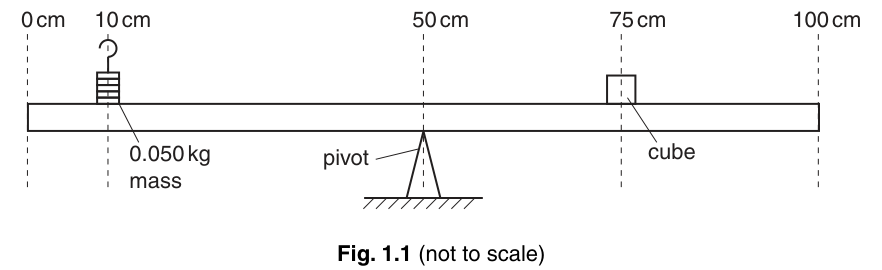
The rule is balanced when the mass is at the mark.
Calculate the mass of the cube.
mass = ______
Working
The rule is balanced, so the anticlockwise moment equals the clockwise moment about the pivot.
Distance of 0.050 kg mass from pivot =
Distance of cube from pivot =
Answer
0.080 kg
0.080 kg
Walkthrough
The metre rule is balanced on a pivot at the 50 cm mark. According to the principle of moments, for an object to be in rotational equilibrium, the sum of the anticlockwise moments about the pivot must equal the sum of the clockwise moments.
The 0.050 kg mass is placed at the 10 cm mark. Its distance from the pivot is . It creates an anticlockwise moment. The cube is placed at the 75 cm mark. Its distance from the pivot is . It creates a clockwise moment.
Moment = force perpendicular distance from the pivot. Since the force is the weight (), the equation is:
The gravitational field strength cancels out from both sides, leaving:
Solving for the mass of the cube :
Key Takeaways
- The principle of moments states that for a balanced object, anticlockwise moments equal clockwise moments.
- Distances in moment calculations must always be measured from the pivot, not from the end of the ruler.
- The gravitational field strength cancels out when comparing weights on a balance, so it is not needed to find the mass.
Common Mistakes
- Measuring the distance of the mass and cube from the end of the ruler (0 cm or 100 cm) instead of from the pivot (50 cm). Using 10 cm and 75 cm directly in the equation is a common error.
- Forgetting to cancel or incorrectly including in the final mass calculation, leading to an answer in Newtons instead of kilograms.
Things to Be Careful About
- Ensure distances are in consistent units. Here, using centimetres for both distances is perfectly fine because the units cancel out in the ratio .
- The final answer must include the unit kg. The mark scheme also accepts 80 g, but kg is the standard SI unit and matches the input mass.
The cube has a volume of . Determine the density of the wood.
density = ______
Working
Density is defined as mass per unit volume.
Substitute the mass from part (a) and the given volume:
Answer
500 kg/m^3
500 kg/m^3
Walkthrough
Density is calculated using the formula , where is the mass and is the volume.
From part (a), the mass of the wooden cube is . The volume is given as .
Substituting these values into the formula:
Alternatively, if mass is converted to grams () and volume to cubic centimetres (), the density is wait, . So . Both and are correct and equivalent.
Key Takeaways
- Density is mass divided by volume: .
- When mass is in kg and volume in m, the resulting density is in kg/m.
- Wood is less dense than water (), which is consistent with the calculated value of and explains why it floats.
Common Mistakes
- Inverting the formula and calculating instead of .
- Making errors with powers of ten when dividing by .
- Forgetting to include the correct units in the final answer.
Things to Be Careful About
- Pay attention to the power of ten in the volume. is a small number, so dividing by it will yield a larger number.
- The mark scheme accepts as an equivalent answer, but is the direct result of using SI units (kg and m). Always ensure your final units match the units used in your calculation.
The rest of this paper
10 more questions- Q2Mass, Weight and Density · Energy, Work and Power5M
- Q3Kinetic Particle Model of Matter · Pressure5M
- Q4Electromagnetic Spectrum · General Properties of Waves7M
- Q5Simple Magnetism and Magnetic Fields4M
- Q6Electric Circuits · Current, Voltage and Resistance7M
- Q7Practical Electricity · Current, Voltage and Resistance · Electromagnetic Induction and Transformers7M
- Q8Lenses and Dispersion5M
- Q9Kinematics · Forces15M
- Q10Thermal Properties of Matter · Energy, Work and Power · Kinetic Particle Model of Matter15M
- Q11Radioactivity · The Nuclear Atom · Energy, Work and Power15M