Physics 5054/21 — October/November 2011
Cambridge O-Level · Theory · worked solutions for every part, with the mark scheme
Topics Energy, Work and Power · Electric Circuits · Forces · Mass, Weight and Density · Thermal Properties of Matter · [Legacy] Temperature and Thermometry · +14 more
Fig. 1.1 shows an ice cube at .
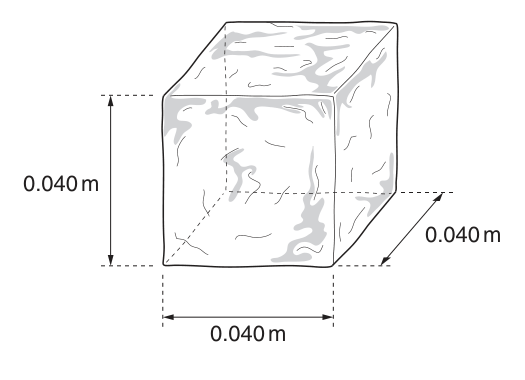
The sides of the cube are of length . Ice at has a density of .
Calculate
the mass of the ice cube,
mass = ______
Working
Answer
0.059 kg
0.059 kg
Walkthrough
First, find the volume of the ice cube. Since it is a cube with side length , the volume is . Next, use the density formula , rearranged to . Substitute the given density and the calculated volume: . Round to two significant figures to match the precision of the given side length, giving (or ).
Key Takeaways
The relationship between density, mass, and volume is . The volume of a cube is the side length cubed. Always ensure units are consistent (volume in when density is in ).
Common Mistakes
Forgetting to cube the side length to find the volume (e.g. using or ). Using inconsistent units, such as mixing and without converting. Rounding too early or to too many significant figures when the final answer is required.
Things to Be Careful About
The side length has two significant figures, so the final mass should be given to two significant figures (). Keep the unrounded value () in your calculator for use in subsequent parts to avoid round-off errors.
the weight of the ice cube.
weight = ______
Working
Answer
0.59 N
0.59 N
Walkthrough
Weight is the force of gravity acting on a mass. It is calculated using the formula , where is the mass in kg and is the gravitational field strength. At O Level, is taken as unless stated otherwise. Using the unrounded mass from part (i): . Rounding to two significant figures gives .
Key Takeaways
Weight is a force measured in newtons (N), calculated as mass times gravitational field strength (). Mass is a scalar quantity measured in kg, while weight is a vector pointing vertically downwards.
Common Mistakes
Confusing mass and weight. Using when the syllabus expects (though is often accepted, is standard for 5054 unless specified). Forgetting to include the unit N in the final answer.
Things to Be Careful About
Use the unrounded mass () for this calculation to maintain accuracy. The final answer should be rounded to two significant figures () to match the data given in the question.
The specific latent heat of fusion of ice is . Calculate the thermal energy (heat) absorbed by the ice cube as it melts.
thermal energy = ______
Working
Answer
J
2.0 x 10^4 J
Walkthrough
The thermal energy required to change the state of a substance without changing its temperature is given by , where is the mass and is the specific latent heat. Substitute the unrounded mass () and the given specific latent heat of fusion for ice (): . Expressing this in standard form to two significant figures gives . Note that using the rounded mass () gives , which is also accepted as or .
Key Takeaways
Specific latent heat is the energy needed to change the state of of a substance. The formula applies to melting (fusion) or boiling (vaporisation). During a change of state, the temperature remains constant while thermal energy is used to break intermolecular bonds.
Common Mistakes
Using the wrong formula (e.g. , which is for temperature changes, not state changes). Forgetting to convert the latent heat from correctly or misplacing the decimal point in scientific notation. Rounding the mass too early and getting a slightly different final answer.
Things to Be Careful About
The question asks for the energy absorbed as the ice melts at . Since there is no temperature change, only the latent heat formula is used. Ensure the final answer is given in joules (J) and to an appropriate number of significant figures (2 or 3).
The rest of this paper
10 more questions- Q2Energy, Work and Power5M
- Q3[Legacy] Temperature and Thermometry6M
- Q4Lenses and Dispersion · Reflection and Refraction of Light · General Properties of Waves · Electromagnetic Spectrum7M
- Q5Static Electricity6M
- Q6Electromagnetic Induction and Transformers · Current, Voltage and Resistance5M
- Q7Electric Circuits · Sound4M
- Q8Radioactivity6M
- Q9Energy, Work and Power · Kinematics · Forces15M
- Q10Electric Circuits · Practical Electricity15M
- Q11Turning Effect of Forces · Pressure · Forces · Kinetic Particle Model of Matter15M