Physics 5054/12 — October/November 2011
Cambridge O-Level · Multiple Choice · answer key with instant marking and worked solutions
Topics Forces · Energy, Work and Power · Magnetic Effect of a Current and the d.c. Motor · Electric Circuits · Physical Quantities and Measurement · Pressure · +17 more
Tap an option under each question to check it — your score builds as you go.
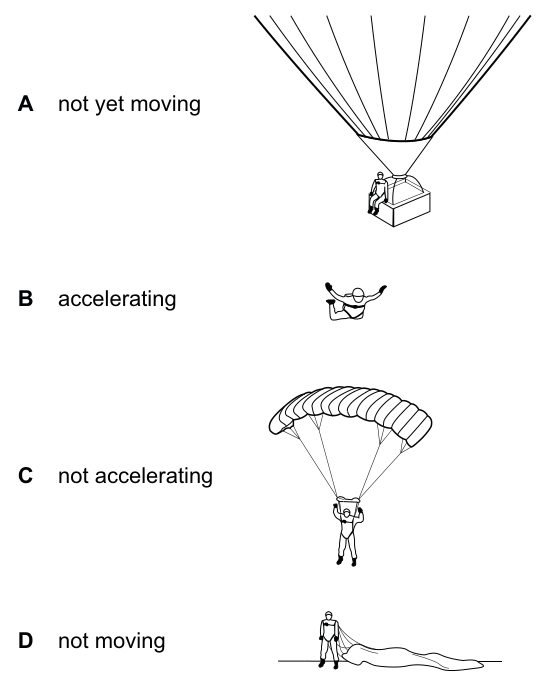
The diagrams show a parachutist in four positions after she jumps from a high balloon.
At which position does she have terminal velocity?
Options
Working
Terminal velocity is the constant speed reached by a falling object when the upward air resistance (drag) balances the downward weight. At this point, the resultant force is zero, so by Newton's first law, the acceleration is zero and the speed remains constant.
- Position A: The parachutist is not yet moving. Speed is zero.
- Position B: The parachutist is accelerating, meaning weight > drag. Speed is increasing.
- Position C: The parachutist is 'not accelerating' while falling. This means drag has increased (due to the open parachute) to equal weight. The speed is constant. This is terminal velocity.
- Position D: The parachutist is on the ground, not moving.
Answer
C
C
Walkthrough
Terminal velocity is defined as the maximum constant speed attained by an object falling through a fluid (like air). It occurs when the upward resistive force (drag or air resistance) becomes equal in magnitude to the downward driving force (weight).
- Analyze the forces: As a parachutist falls, gravity pulls them down (weight, ). Air resistance pushes up (drag, ). Initially, speed is low, so drag is small, and . There is a resultant downward force, so the parachutist accelerates.
- Effect of the parachute: When the parachute opens (Position C), the surface area increases dramatically, causing drag to increase rapidly. Eventually, increases enough to equal .
- Newton's First Law: When , the resultant force is zero. According to Newton's first law, an object with zero resultant force moves at a constant velocity. Since the parachutist is still falling, this constant velocity is the terminal velocity. The label 'not accelerating' confirms this state.
- Evaluate other positions:
- A (not yet moving): Speed is zero. Terminal velocity is a non-zero constant falling speed.
- B (accelerating): Resultant force is downwards (). Speed is increasing, not constant.
- D (not moving): The parachutist has landed. Speed is zero.
Key Takeaways
- Terminal velocity is a state of constant velocity, meaning acceleration is zero.
- It occurs when the resistive force (drag) equals the driving force (weight).
- 'Not accelerating' during a fall is the key indicator of terminal velocity.
Common Mistakes
- Confusing terminal velocity with zero speed: Students might choose A or D because they are 'not moving', but terminal velocity refers to the constant high speed of the fall, not being stationary.
- Choosing the moment the parachute opens: Students might think the moment the parachute opens is terminal velocity. Actually, opening the parachute causes a new, lower terminal velocity to be reached after a period of deceleration. Position C shows the steady state of 'not accelerating'.
- Ignoring Newton's First Law: Failing to link 'not accelerating' to 'resultant force is zero' and 'constant speed'.
Things to Be Careful About
- Context of 'not accelerating': While an object at rest (A and D) is also not accelerating, 'terminal velocity' specifically describes the constant speed reached during free fall through a fluid. Ensure the object is actually falling at a constant rate, not just stationary.
- Label interpretation: The diagram labels are crucial. 'Accelerating' means speed is changing. 'Not accelerating' means speed is constant. Match the physics definition to the label.
The rest of this paper
39 more questions- Q2Forces1M
- Q3Kinematics1M
- Q4Forces1M
- Q5Mass, Weight and Density1M
- Q6Physical Quantities and Measurement1M
- Q7Physical Quantities and Measurement1M
- Q8Energy, Work and Power1M
- Q9Energy, Work and Power1M
- Q10Energy, Work and Power1M
- Q11Forces1M
- Q12Turning Effect of Forces1M
- Q13Pressure1M
- Q14Pressure1M
- Q15Kinetic Particle Model of Matter1M
- Q16Thermal Properties of Matter1M
- Q17[Legacy] Temperature and Thermometry1M
- Q18Thermal Properties of Matter1M
- Q19Transfer of Thermal Energy1M
- Q20Reflection and Refraction of Light1M
- Q21Reflection and Refraction of Light1M
- Q22Electromagnetic Spectrum1M
- Q23Electromagnetic Spectrum1M
- Q24General Properties of Waves1M
- Q25Sound1M
- Q26Magnetic Effect of a Current and the d.c. Motor1M
- Q27Current, Voltage and Resistance1M
- Q28Electric Circuits1M
- Q29Electric Circuits1M
- Q30Practical Electricity1M
- Q31Practical Electricity1M
- Q32Electric Circuits1M
- Q33Static Electricity1M
- Q34Electromagnetic Induction and Transformers1M
- Q35Magnetic Effect of a Current and the d.c. Motor1M
- Q36Magnetic Effect of a Current and the d.c. Motor1M
- Q37Electromagnetic Induction and Transformers1M
- Q38Radioactivity1M
- Q39Radioactivity1M
- Q40The Nuclear Atom1M