Physics 5054/41 — May/June 2011
Cambridge O-Level · Alternative to Practical · worked solutions for every part, with the mark scheme
Topics Experimental Contexts · Analysis, Conclusions and Evaluation · Observations and Measurements · Use of Techniques, Apparatus and Materials · Planning Experiments and Investigations
A student investigates the behaviour of a capacitor as it is charged.
The student connects a capacitor C and a resistor R in series with an ammeter and a d.c. power supply, as shown in Fig. 1.1.
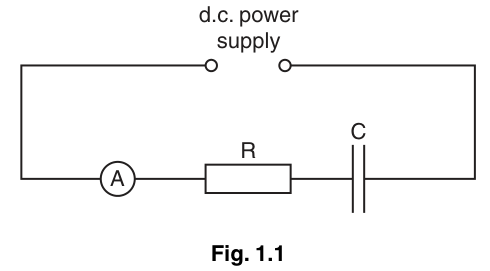
The student notices that the reading on the ammeter decreases to zero.
Explain why there is no current in the circuit after some time.
The student disconnects the circuit using a movable lead, as shown in Fig. 1.2.
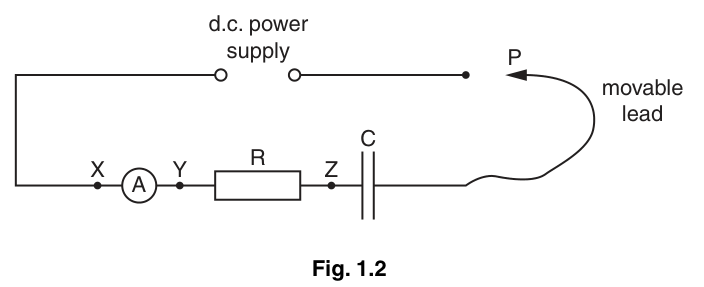
In order to discharge the capacitor, the student may connect the end P of the movable lead to either point X, Y or Z.
State and explain which connection will discharge the capacitor the fastest.
The capacitor is now fully discharged.
The student reconnects the circuit of Fig. 1.1 and observes the initial ammeter reading. The ammeter is shown in Fig. 1.3.
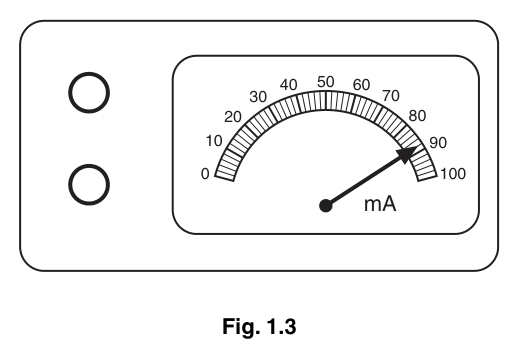
State the reading on the ammeter.
ammeter reading = ______
The student observes the needle as the current in the ammeter begins to fall and starts timing when the current is 80 mA.
The time for the current to fall from 80 mA to a value is measured. Readings of current and time are shown in Fig. 1.4.
Fig. 1.4
| 80 | 0 |
| 60 | 6.33 |
| 40 | 15.25 |
| 30 | 21.58 |
| 20 | 30.50 |
| 10 | 45.75 |
| 5 | 61.00 |
On Fig. 1.5, plot the graph of on the -axis against on the -axis. Draw the curved line of best fit.
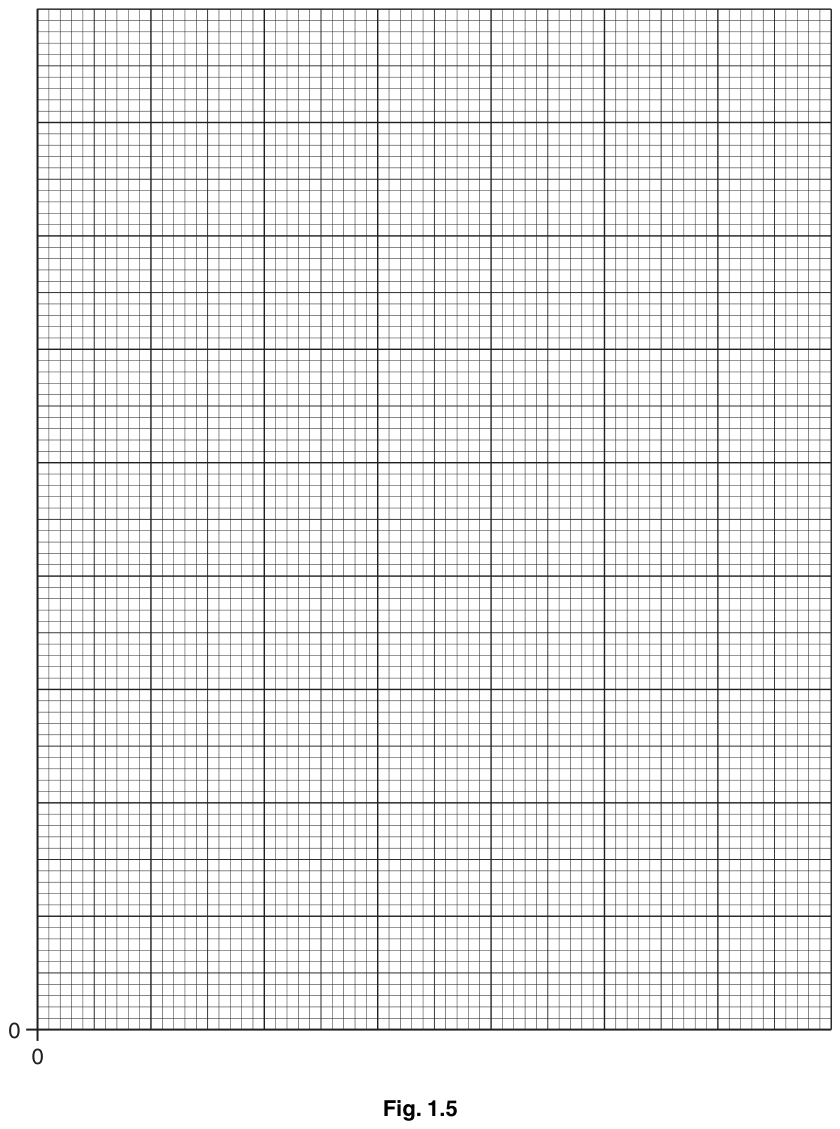
Use your graph to describe the relationship between and .
The resistance of resistor R is 100 .
Use your graph to find the potential difference across the resistor at time . You may use the relationship .
= ______
The rest of this paper
3 more questions- Q2Experimental Contexts · Analysis, Conclusions and Evaluation · Use of Techniques, Apparatus and Materials9M
- Q3Planning Experiments and Investigations · Analysis, Conclusions and Evaluation · Observations and Measurements7M
- Q4Experimental Contexts4M