Physics 5054/31 — May/June 2011
Cambridge O-Level · Practical Test · worked solutions for every part, with the mark scheme
Topics Experimental Contexts · Observations and Measurements · Use of Techniques, Apparatus and Materials · Analysis, Conclusions and Evaluation · Planning Experiments and Investigations
In this experiment, you will determine the mass of a metre rule using the principle of moments.
You have been provided with
- a metre rule with a hole at the mark,
- a knife-edge to act as a pivot in (a),
- a rod held in a boss to act as a pivot in (b),
- a pulley wheel held in a clamp and stand,
- a length of string with two loops,
- a mass and hook, labelled S,
- a card showing , the mass of S,
- a half-metre rule,
- a set square.
Balance the metre rule on the knife-edge and record the distance of the centre of mass of the metre rule from the mark on the rule.
= ______
Answer
(Any value in the range to , recorded to the nearest or with unit, is accepted.)
50.0 cm
Walkthrough
When a uniform or approximately uniform metre rule is balanced horizontally on a knife-edge, the upward normal reaction from the knife-edge acts directly through the centre of mass of the rule. The reading on the metre rule at the point of balance is the distance of the centre of mass from the end.
For a standard metre rule, the centre of mass is located close to the geometric centre, typically between and . In Cambridge O Level practical examinations, length readings from a millimetre scale must always be recorded to the nearest millimetre (), including a trailing zero if the reading falls exactly on a division (e.g. ), and must include the unit ( or ).
Key Takeaways
- Balancing an object freely identifies the line of action of its weight, which passes through the centre of mass.
- All measurements from a standard metre rule should be quoted to (or ) precision.
Common Mistakes
- Omitting the unit (e.g. writing instead of ).
- Writing values without proper decimal precision (e.g. instead of ).
Things to Be Careful About
- Ensure the knife-edge is placed perpendicular to the rule so the rule balances steadily without twisting.
Set up the apparatus shown in Fig. 1.1.
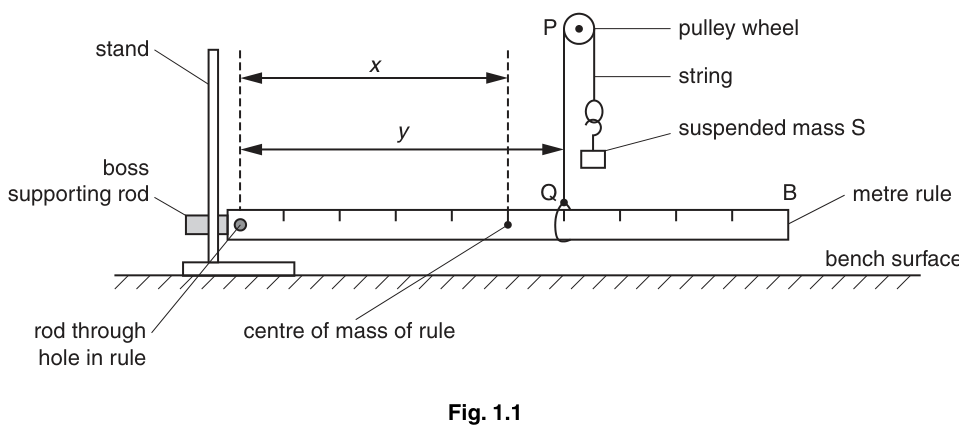
Pass the rod through the hole at the mark on the rule. Place the loop at one end of the string over the rule at the mark on the rule. Place the string over the pulley and suspend the mass S from the loop at the other end of the string using the hook. Initially, end B of the metre rule rests on the bench.
Move the loop along the metre rule towards end B. Keep the length PQ of the string vertical by moving the pulley horizontally. Eventually end B of the metre rule rises off the bench.
Adjust the positions of the loop and the pulley to make the rule horizontal and the string PQ vertical.
Answer
Apparatus assembled as shown in Fig. 1.1, with the rule horizontal and string section PQ vertical.
Apparatus set up as described
Walkthrough
This part requires setting up the apparatus according to Fig. 1.1:
- The supporting rod is passed through the hole at the mark to act as a fixed horizontal pivot.
- The loop of string is placed around the rule and passed over the pulley with suspended mass S.
- By shifting the loop along the rule towards end B and simultaneously moving the pulley horizontally, the rule is brought into a horizontal balanced position with string section PQ vertical.
This setup balances the clockwise moment of the rule's weight about the pivot with the anticlockwise moment produced by the upward tension in the string at Q.
Key Takeaways
- Setting up balancing apparatus correctly is essential for accurate distance measurements in moments experiments.
Common Mistakes
- Allowing the rule to remain tilted or string PQ to remain slanted, which introduces trigonometric errors into the moment arm calculations.
Things to Be Careful About
- Ensure the string moves freely over the pulley wheel without excessive friction.
Explain how you made sure that the string PQ is vertical. You may add to Fig. 1.1 if you wish.
Answer
Any one valid method:
- Align string PQ visually with the vertical section of string supporting the suspended mass S.
- Align string PQ with a known vertical reference in the laboratory (such as a plumb line, window frame, door frame, or the vertical stand rod).
- Place a half-metre rule vertically against the bench (checked using a set square) and verify that the horizontal distance from the rule to string PQ is the same at two different heights.
- Place a set square with one edge along the horizontal metre rule and align string PQ with the perpendicular edge.
Align string PQ with a vertical reference line or check perpendicularity using a set square
Walkthrough
For the upward tension force to act strictly perpendicular to the horizontal metre rule (giving a moment arm equal to distance ), the string section PQ must be vertical ( to the horizontal rule).
Candidates can verify that PQ is vertical by:
- Comparing with a vertical reference line: Looking past string PQ towards a known vertical line, such as a plumb line, the vertical stand rod, or a window/door frame.
- Using the suspended mass string: The portion of the string hanging freely under gravity supporting mass S is naturally vertical; sighting PQ so that it is parallel to this hanging string ensures PQ is also vertical.
- Using a set square or vertical rule: Placing a set square on the horizontal rule and checking that the string runs parallel to the vertical side, or measuring horizontal distances at two different heights with a half-metre rule.
Key Takeaways
- Ensuring forces act perpendicular to a lever arm simplifies moment calculations and prevents systematic angle errors.
Common Mistakes
- Giving vague responses like "I looked at it carefully" or "by eye" without mentioning a reference object or alignment method.
Things to Be Careful About
- Clearly name the reference object used (e.g. set square, window frame, or freely hanging string).
Measure and record
(i) the distance from the centre of the rod to the centre of mass of the metre rule,
= ______
(ii) the distance from the centre of the rod to the position of the string on the metre rule.
= ______
Answer
(i)
(Representative value; must be to less than , recorded to the nearest with unit.)
(ii)
(Representative value; must be in the sensible range to , recorded to the nearest with unit.)
x = 49.0 cm, y = 65.0 cm
Walkthrough
- Part (i): The distance is measured from the centre of the pivot rod to the centre of mass of the metre rule. Since the pivot hole is at the mark on the rule, the distance is equal to . If , then . The mark scheme checks that is between and less than the candidate's value of from part (a).
- Part (ii): The distance is measured from the centre of the pivot rod ( mark) to the position of the loop Q on the metre rule. Because the centre of mass lies at approximately from the pivot, and the mass of S is typically smaller than or comparable to the rule mass , the loop must be placed further along the rule (typically between and ) to balance the rule horizontally.
Both measurements must be recorded to the nearest millimetre () and include appropriate units (). A unit seen in either (i) or (ii) is credited.
Key Takeaways
- The moment arm is always measured from the pivot point, not necessarily from the zero mark of the measuring scale.
- Subtraction of the pivot offset () is essential when using the markings printed on the rule.
Common Mistakes
- Measuring directly from the end instead of the pivot at (forgetting to subtract ).
- Omitting units or omitting the trailing decimal zero (e.g. writing instead of ).
Things to Be Careful About
- Ensure consistency in units between and .
Calculate the mass of the rule using the relationship
where is the mass of S, and is written on the card.
= ______
Working
Given equation:
Using representative values (, , ):
Answer
133 g
Walkthrough
The experiment applies the principle of moments for an object in rotational equilibrium about a pivot:
- The weight of the metre rule acts downwards at the centre of mass, at perpendicular distance from the pivot. Clockwise moment .
- The upward tension force exerted by the vertical string PQ is equal to the weight of the suspended mass S (), acting at perpendicular distance from the pivot. Anticlockwise moment .
Equating moments:
Dividing both sides by and rearranging for :
Substituting the known mass (from the card, typically ) and the measured distances and gives the mass of the metre rule . The result is quoted with its unit (). Significant figures are not penalised, but 2 or 3 significant figures is standard.
Key Takeaways
- Rotational equilibrium occurs when the clockwise moments balance the anticlockwise moments about the pivot.
- In this configuration, the tension in the string equals the weight of the suspended mass S because the string passes smoothly over a pulley.
Common Mistakes
- Inverting the ratio (calculating instead of ).
- Forgetting to write the unit (or if converted).
Things to Be Careful About
- Ensure the units of and match (both in ) so that their units cancel, leaving in the same unit as .
The rest of this paper
3 more questions- Q2Observations and Measurements · Experimental Contexts5M
- Q3Experimental Contexts5M
- Q4Experimental Contexts · Use of Techniques, Apparatus and Materials · Observations and Measurements · Analysis, Conclusions and Evaluation · Planning Experiments and Investigations15M