Physics 5054/42 — October/November 2010
Cambridge O-Level · Alternative to Practical · worked solutions for every part, with the mark scheme
Topics Use of Techniques, Apparatus and Materials · Experimental Contexts · Observations and Measurements · Analysis, Conclusions and Evaluation
A student investigates the movement of a suspended metre rule.
Metre rule A is clamped horizontally above the bench, as shown in Fig. 1.1.
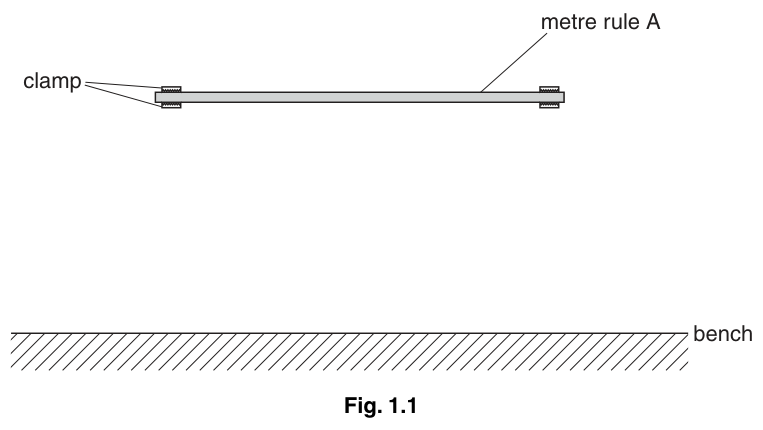
Describe how the student checks that A is horizontal. You may draw on Fig. 1.1.
A second metre rule B is suspended horizontally from A by two strings of equal length.
Both strings are placed a distance from the centres of the metre rules, as shown in Fig. 1.2.
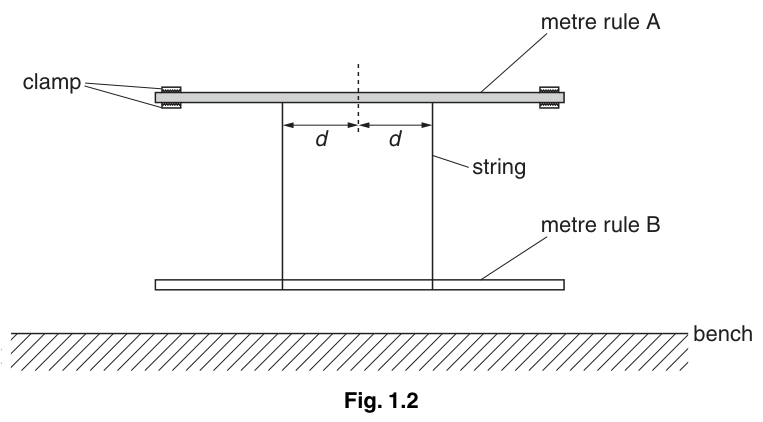
Describe how the student checks that the two strings are equal distances from the centre of metre rule B.
B is made to rotate backwards and forwards through a small angle in a horizontal plane about its centre, as shown in Fig. 1.3.
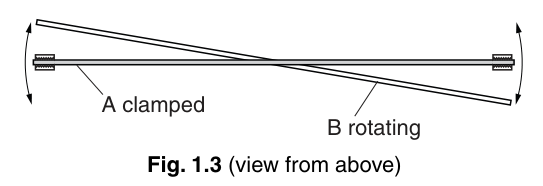
The student determines the time for B to rotate once, forwards and then backwards.
On Fig. 1.2, mark where the eye of the student is placed to observe the rotations.
Describe how the student determines accurately.
is determined for different values of . Values of and are recorded in Fig. 1.4.
Fig. 1.4
| 15.0 | 2.74 |
| 20.0 | 2.07 |
| 25.0 | 1.63 |
| 30.0 | 1.37 |
| 35.0 | 1.18 |
| 40.0 | 1.03 |
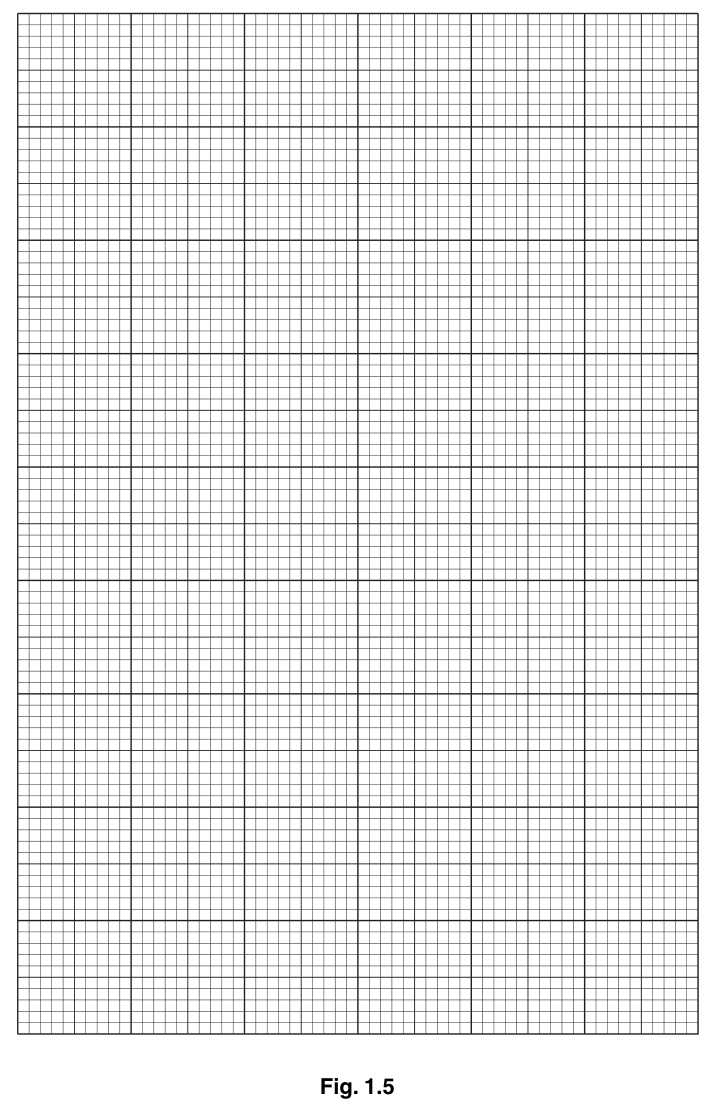
On Fig. 1.5, plot the graph of on the y-axis against on the x-axis.
Start your graph from and . Draw the curved line of best fit.
Use data from the table to show that is inversely proportional to .
Suggest a reason why values for smaller than 15 cm are not measured.
The rest of this paper
3 more questions- Q2Use of Techniques, Apparatus and Materials · Observations and Measurements · Analysis, Conclusions and Evaluation · Experimental Contexts7M
- Q3Experimental Contexts · Use of Techniques, Apparatus and Materials6M
- Q4Experimental Contexts4M