Physics 5054/41 — October/November 2010
Cambridge O-Level · Alternative to Practical · worked solutions for every part, with the mark scheme
Topics Experimental Contexts · Analysis, Conclusions and Evaluation · Use of Techniques, Apparatus and Materials · Observations and Measurements
A student performs an experiment to measure an elastic property of wood.
A metre rule is clamped with its mark at the edge of a bench, as shown in Fig. 1.1.
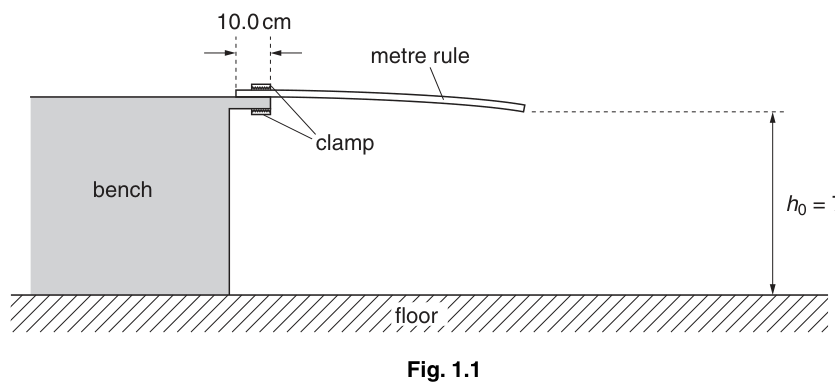
On Fig. 1.1, draw a second rule positioned to measure the height above the floor of the free end of the clamped metre rule.
On Fig. 1.1, draw the position of the eye of the student when measuring .
A mass is hung from the mark on the clamped metre rule, as shown in Fig. 1.2.
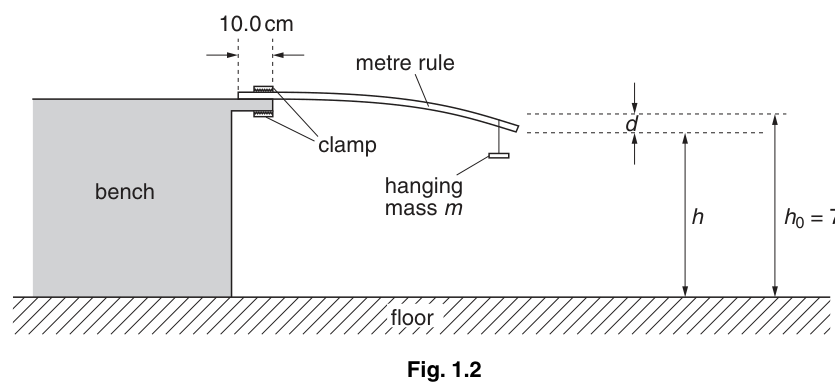
The end of the rule moves down a distance , where .
The student takes readings of for different values of .
Values of and are recorded in the table of Fig. 1.3.
Fig. 1.3
| 20.0 | 75.0 | |
| 40.0 | 74.2 | |
| 60.0 | 73.4 | |
| 80.0 | 72.7 | |
| 100.0 | 72.0 | |
| 120.0 | 71.2 |
Complete Fig. 1.3 to show the values of .
On Fig. 1.4, plot the graph of on the y-axis against on the x-axis.
Start your graph from the origin and draw the straight line of best fit.
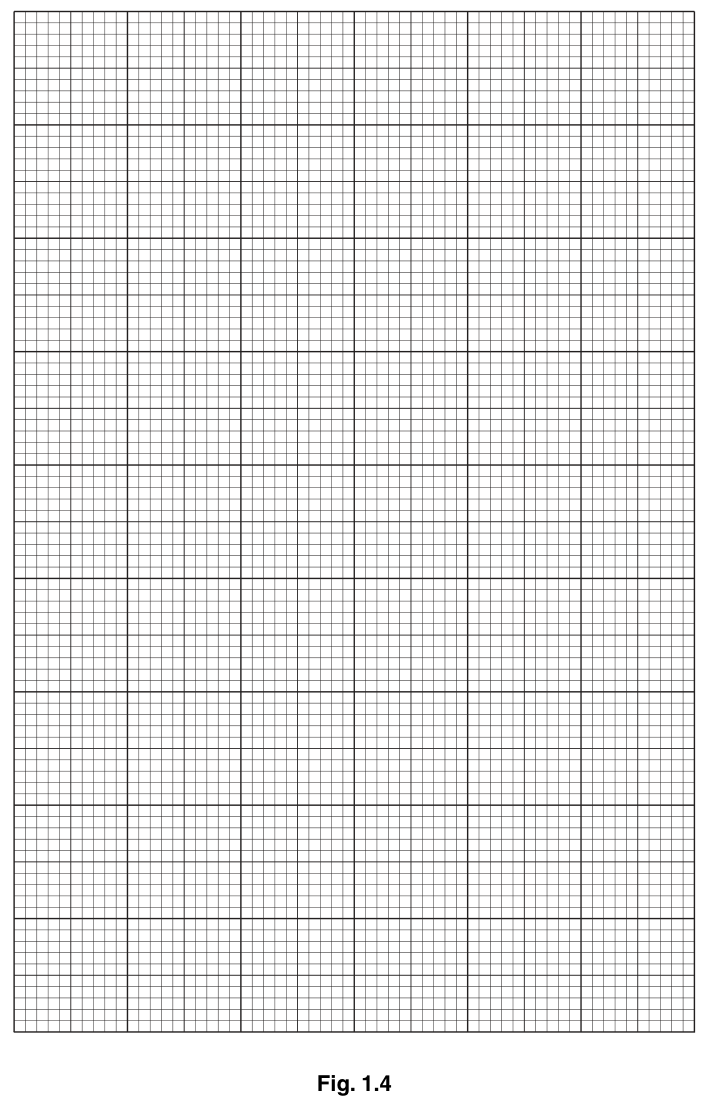
Explain how the graph shows that is not directly proportional to .
Find the gradient of your graph. Show your working clearly.
gradient = ______
Use information from (b) to find the length along the clamped metre rule from the edge of the bench to the point where the hanging mass is attached.
= ______
The elastic property of the wood is given by the relationship
Calculate the value of .
You do not need to give the unit of your answer.
= ______
The rest of this paper
3 more questions- Q2Analysis, Conclusions and Evaluation · Experimental Contexts9M
- Q3Experimental Contexts · Analysis, Conclusions and Evaluation6M
- Q4Experimental Contexts3M