Physics 5054/41 — May/June 2010
Cambridge O-Level · Alternative to Practical · worked solutions for every part, with the mark scheme
Topics Experimental Contexts · Analysis, Conclusions and Evaluation · Use of Techniques, Apparatus and Materials · Observations and Measurements · Planning Experiments and Investigations
A student performs an experiment to find a value for the specific latent heat of vaporisation of water.
An electric kettle, half-filled with water, is placed on a top-pan balance, as shown in Fig. 1.1.
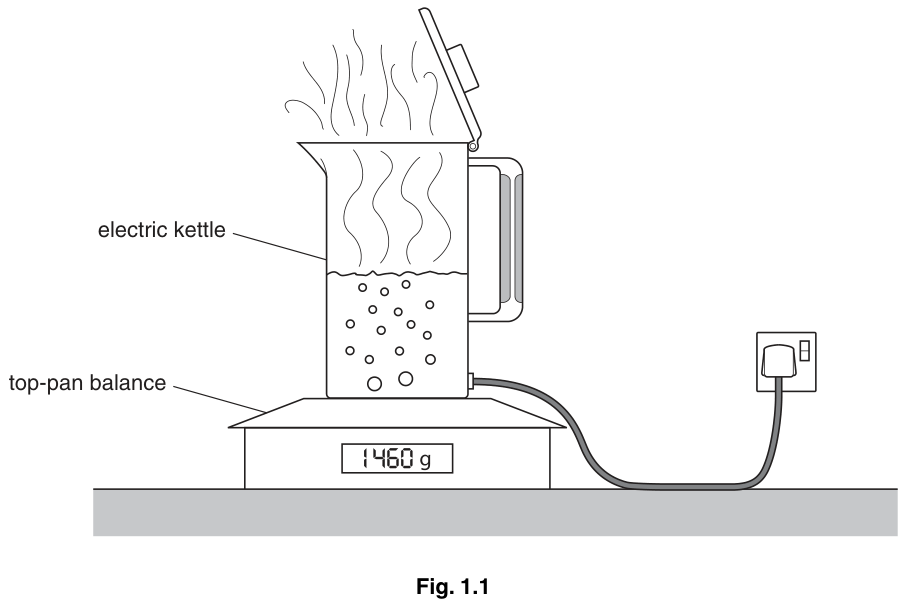
The kettle is switched on with the lid open.
When the water is boiling steadily, a stopwatch is started and the reading on the top-pan balance is recorded.
The total mass of the kettle and water is measured every 60 seconds. The readings are recorded in the table of Fig. 1.2.
Fig. 1.2
| time | ||
|---|---|---|
| 0 | 1460 | 0 |
| 60 | 1410 | 50 |
| 120 | 1359 | 101 |
| 180 | 1308 | |
| 240 | 1258 | |
| 300 | 1208 | |
| 360 | 1157 |
A column for the total loss in mass of water is also shown in Fig. 1.2.
Complete this column.
On Fig. 1.3, plot a graph of on the -axis against on the -axis.
Draw the line of best fit.
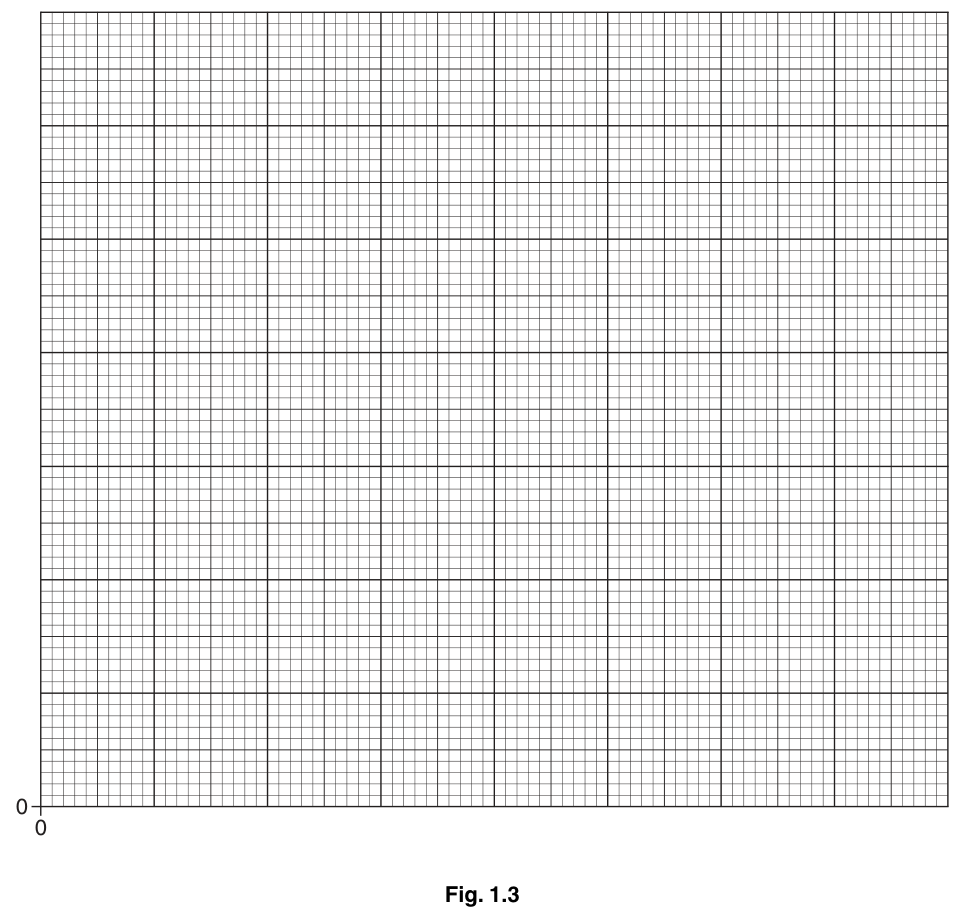
Describe the relationship between and .
Determine the gradient of the graph.
Show your working clearly.
gradient = ______
The specific latent heat of vaporisation of water is given by the relationship
Calculate .
= ______
The mass of the empty kettle is 860 g.
By using your graph, or otherwise, estimate how long it takes from the start of timing for the kettle to boil dry.
time to boil dry = ______
The student is careful not to touch the kettle during the experiment.
Suggest two reasons why this is sensible.
- ______
- ______
During the experiment, some steam condenses on the lid and water drips back into the kettle.
Explain what effect this has on the value obtained for .
The rest of this paper
3 more questions- Q2Experimental Contexts · Use of Techniques, Apparatus and Materials · Planning Experiments and Investigations · Analysis, Conclusions and Evaluation9M
- Q3Use of Techniques, Apparatus and Materials · Experimental Contexts · Analysis, Conclusions and Evaluation4M
- Q4Experimental Contexts4M