Physics 5054/32 — May/June 2010
Cambridge O-Level · Practical Test · worked solutions for every part, with the mark scheme
Topics Observations and Measurements · Experimental Contexts · Analysis, Conclusions and Evaluation · Use of Techniques, Apparatus and Materials · Planning Experiments and Investigations
In this experiment, you will determine the density of the material from which a sphere is made.
You have been provided with 20 glass spheres, two half-metre rules, two set squares and you have access to a top-pan balance.
Place the two half-metre rules parallel to one another, with a gap between the two, as shown in Fig. 1.1.
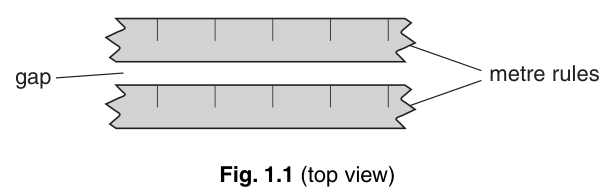
Ensure that the spheres are touching each other and are in a line.
Measure the total length occupied by the 20 spheres.
= ______
State, with the aid of a diagram, a technique that you used to ensure that was determined as accurately as possible.
(i) Use your value of to determine the average diameter of a sphere.
= ______
(ii) Use the top-pan balance to determine the average mass of a sphere.
= ______
(iii) Calculate the density of the material from which the sphere is made, using the relationship
density = ______
The rest of this paper
3 more questions- Q2Experimental Contexts · Observations and Measurements · Use of Techniques, Apparatus and Materials · Analysis, Conclusions and Evaluation5M
- Q3Observations and Measurements · Experimental Contexts · Analysis, Conclusions and Evaluation5M
- Q4Use of Techniques, Apparatus and Materials · Experimental Contexts · Observations and Measurements · Planning Experiments and Investigations · Analysis, Conclusions and Evaluation15M