Additional Mathematics 4037/21 — May/June 2026
Cambridge O-Level · Calculator · worked solutions for every part, with the mark scheme
Topics Trigonometry · Straight-line graphs · Calculus · Series · Equations, inequalities and graphs · Logarithmic and exponential functions · +3 more
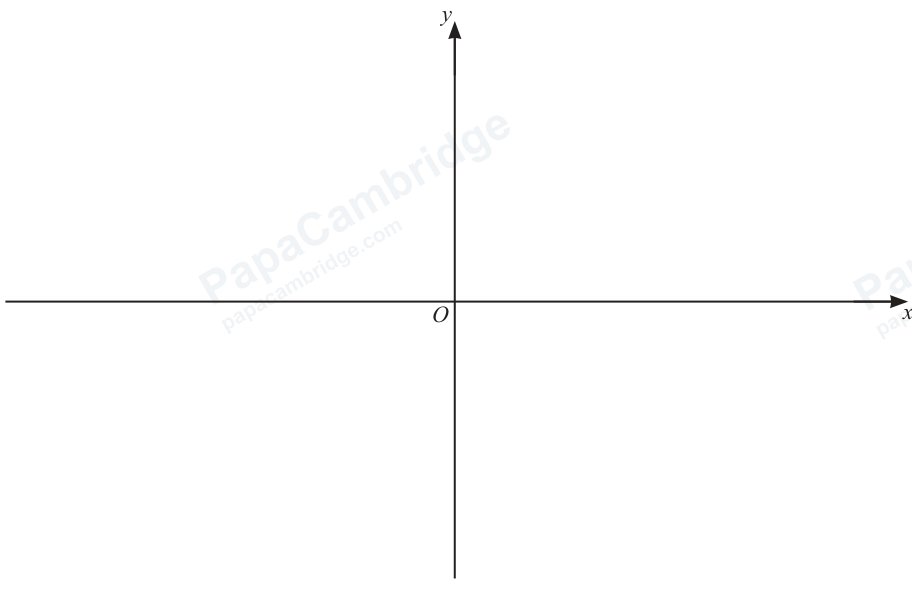
Approach
The cubic is already factorised, so the -intercepts come straight from the factors and the -intercept from substituting . The leading coefficient is positive, so the curve rises from bottom-left to top-right with a maximum then a minimum.
Working
The -intercepts occur where :
The -intercept occurs where :
Since the coefficient of is positive, the curve comes up from below on the left, has a local maximum in the second quadrant (between and ), a local minimum in the third quadrant (between and , passing through ), and rises away to the top right.
Answer
-intercepts: , , ; -intercept: , with the cubic sketched as described.
x-intercepts -3, -2.5, 0.5; y-intercept (0, -5); positive cubic with max in the 2nd quadrant and min in the 3rd quadrant
Walkthrough
The cubic is given in factorised form, which is a gift: each factor set to zero gives one -intercept immediately. Setting gives , setting gives , and setting gives . For the -intercept we substitute into the whole expression, giving , so the curve crosses the -axis at .
To get the shape right, note the leading term: , a positive cubic. A positive cubic starts low on the left and ends high on the right. With three distinct real roots it must cross the axis three times, so between consecutive roots it bulges: a local maximum between and (above the axis, hence in the second quadrant), then a local minimum between and . Since the -intercept is (negative), that minimum dips below the axis, placing it in the third quadrant. The curve must extend clearly beyond the outermost intercepts — it must not stop at or .
Key Takeaways
- A factorised polynomial hands you its -intercepts directly; set each factor to zero.
- The -intercept is always found by substituting .
- The sign of the leading coefficient fixes the overall cubic shape (positive: up on the right; negative: down on the right).
- The sign of the -intercept tells you which side of the axis the middle region sits on.
Common Mistakes
- Stopping the curve at the outermost intercepts — the mark scheme explicitly requires the 'ends' to extend beyond the -axis.
- Putting the minimum on the -axis (B0) instead of between and .
- Forgetting to solve properly and writing the intercept as instead of .
- Marking intercept values as table points rather than on the axes; the scheme condones values written beside the graph but they must clearly be intercepts.
- Getting the shape upside down (treating it as a negative cubic).
Things to Be Careful About
- The intercepts must be labelled on the sketch (or clearly beside it), not just listed in a table.
- : keep the exact value; either form is accepted.
- The curve must be a genuine cubic attempt — a parabola or a curve with only one turning point scores B0 for the intercepts.
Approach
holds exactly where the cubic sketched in part (a) lies above the -axis. Read off those intervals from the sketch.
Working
From the sketch, the curve is above the -axis:
- between the roots and (the hump containing the maximum in the second quadrant), and
- to the right of the root (the final rising branch).
The inequality is strict, so the roots themselves are excluded:
Answer
-3 < x < -5/2 and x > 1/2
Walkthrough
An inequality of the form (cubic) > 0 asks: where is the curve above the -axis? The sketch from part (a) answers this directly. The curve is above the axis in two places: the small hump between the first two roots, and , and everything to the right of the last root, . Because the inequality is strict (, not ), the roots themselves — where the curve equals zero — are not included, so we write strict inequalities: and .
Key Takeaways
- A polynomial inequality is solved by sketching (or sign-charting) the polynomial and reading where it is above or below the axis.
- Strict inequalities exclude the roots; inclusive ones include them.
- A positive cubic with three roots is positive on the first gap, negative on the second, and positive again beyond the last root.
Common Mistakes
- Using and instead of strict inequalities — the mark scheme awards SC1 only if 0 was otherwise scored, so the strict form is what earns the marks.
- Reversing an interval, e.g. writing , which is empty and wrong (though the reversed-but-correct form is accepted).
- Missing one of the two intervals, giving only or only .
- Solving by expanding the cubic instead of using the sketch — unnecessary work that invites arithmetic errors.
Things to Be Careful About
- Both intervals are required for full marks (B1 each).
- Any conjunction ('and', 'or', comma) between the two inequalities is accepted.
- The answer must be exact: (or ) and (or ).
Approach
For a function of the form , the amplitude is .
Working
Here , so and the amplitude is .
Answer
4
Walkthrough
The graph of oscillates between and . Multiplying by stretches it vertically so it oscillates between and ; adding shifts it up but does not change how far it swings either side of its midline. That swing, from midline to maximum, is the amplitude, which is simply the multiplier in front of the cosine. The vertical shift and the horizontal scaling have no effect on the amplitude.
Key Takeaways
- For (or sine), the amplitude is .
- The vertical translation moves the midline but never changes the amplitude.
Common Mistakes
- Giving (the maximum value) instead of : the amplitude is measured from the midline , not from the -axis.
- Confusing amplitude with period or with the range.
Things to Be Careful About
- This is a one-mark B1: no working is needed, just the value . The answer is exact, so no rounding issues arise.
Approach
For with in degrees, the period is .
Working
Here , so
Answer
2880 degrees
Walkthrough
Replacing by stretches the cosine graph horizontally by a factor of : every feature that used to happen at angle now happens at . Since ordinary cosine completes one full cycle over , this stretched version takes to complete one cycle. Equivalently, using the formula period with gives .
Key Takeaways
- Period of in degrees is .
- Dividing by a number stretches the graph horizontally by factor , multiplying the period by .
Common Mistakes
- Writing (i.e. computing instead of ): dividing by 8 makes the period longer, not shorter.
- Leaving the answer as or otherwise mixing radians into a degrees question.
Things to Be Careful About
- The question asks for the period in degrees, so the answer must be , not any radian equivalent.
Approach
Rearrange to make the cosine the subject, solve for , then multiply by and collect all solutions in .
Working
The base angle satisfies at , so
Multiplying through by :
Since the period is , the next solutions would lie at , far outside . So there are exactly two solutions.
Answer
x = -960 and x = 960
Walkthrough
First isolate the cosine: subtract and divide by to get . Cosine equals at , so cosine equals at (second quadrant) and at (third quadrant). These give , hence . Because the function has period , adding or subtracting from either solution leaves the interval , so these two are the only solutions — which matches the sketch in part (d), where the curve crosses the axis once on each side between and .
Key Takeaways
- Solve by finding the base angle from and reflecting into the second/third quadrants.
- When the argument is a multiple like , solve for the argument first, then scale up.
- Use the period to check whether further solutions fall inside the required interval.
Common Mistakes
- Taking instead of , forgetting the negative sign of the cosine.
- Stopping at and forgetting to multiply by .
- Finding only and missing the negative solution .
- Adding instead of when hunting for extra solutions, generating false extras inside the interval.
Things to Be Careful About
- The mark scheme awards M1 for reaching (or ), then A2 for both with no extras — one correct answer alone implies the M1 but only earns one A mark.
- Answers are exact here (); no rounding is needed.
- All solutions in are required, not just one.
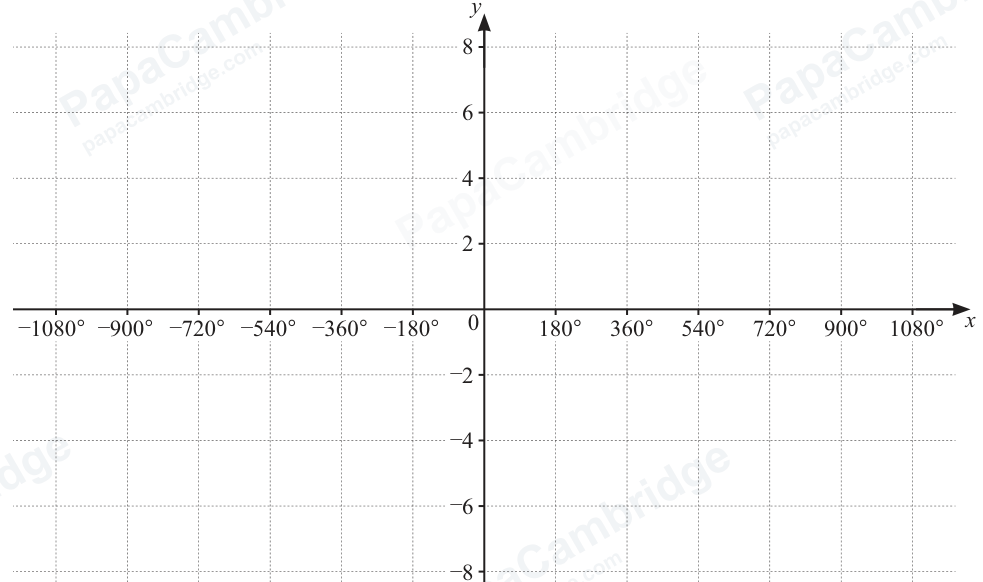
Approach
Use the results already found: amplitude , midline , period , and -intercepts at . Sketch one broad arch of the cosine curve centred on the -axis.
Working
- Maximum where , i.e. at : point .
- Midline ; minimum value would be , reached at , outside the domain.
- -intercepts at (from part (c)), which lie between and on the right and between and on the left.
- At the ends of the domain, : , so the curve ends slightly below the -axis (between and ).
Draw a single smooth, symmetric arch: rising from about ... reading left to right, the curve enters at below the axis, rises through , climbs to the maximum , falls through and exits at .
Answer
A smooth cosine-shaped arch, symmetric about the -axis, with a single maximum at , crossing the -axis at , and ending at approximately , just below the -axis.
Smooth symmetric cosine arch with maximum (0, 6), x-intercepts at +/-960 degrees, ending at about (+/-1080, -0.8) just below the x-axis
Walkthrough
Everything needed for the sketch has been established in the earlier parts. The amplitude and the shift mean the curve swings between and about the line . The period means that within the window to we see less than half a cycle: exactly one hump. The peak sits at with height . From part (c) the curve crosses the -axis at . At the edges of the window, , the height is , so the curve finishes just under the axis. Joining these features with a smooth, even curve gives the required sketch.
Key Takeaways
- A sketch is built from amplitude, midline, period, intercepts and end behaviour — all obtainable algebraically before drawing.
- When the interval shown is shorter than one period, the sketch shows only part of the wave, and the ends need not be turning points.
Common Mistakes
- Drawing more than one hump (forgetting the huge period ).
- Putting the maximum at instead of (ignoring the shift).
- Placing intercepts at (forgetting to scale by ) or at exactly.
- Ending the curve on the -axis rather than slightly below it at .
- Drawing a jagged or flicked-out curve rather than a smooth cosine shape.
Things to Be Careful About
- The mark scheme gives B1 for the correct shape with a maximum at and only one turning point, and B2 additionally requires the -intercepts strictly between and (and and ), with the ends at approximately where .
- Poor curvature or slight feathering at the ends is condoned, but the curve must be smooth and symmetric with exactly one turning point.
- Anything drawn outside is ignored.
An arithmetic progression has first term and common difference .
The 6th term is 1.5 times the 3rd term.
The sum of the first ten terms is 255.
Approach
Translate each condition into an equation using and , then solve the two simultaneous equations.
Working
The 6th term is 1.5 times the 3rd term:
The sum of the first ten terms is 255:
Substituting :
Answer
a = 12, d = 3
Walkthrough
The first condition compares two terms of the progression. Using the formula for the th term, , the 6th term is and the 3rd term is . Setting the first equal to 1.5 times the second and expanding gives , which rearranges to , i.e. .
The second condition uses the sum formula . With this is , so .
We now have two linear equations. Substituting into the second gives , so and then .
Key Takeaways
- The th term of an AP is ; the sum of the first terms is .
- Worded conditions about terms and sums translate directly into simultaneous equations.
- Elimination by substitution solves these quickly when one equation gives a simple relation like .
Common Mistakes
- Writing the 6th term as instead of (off-by-one error in ).
- Misreading 255 as 225 — the mark scheme has a special follow-through route for that error but it costs marks.
- Arithmetic slips when expanding ; note .
- Not showing the elimination step — the M1 requires solving their equations as far as finding or .
Things to Be Careful About
- Both equations must be formed correctly to earn the B1 marks; the scheme accepts equivalent forms ('oe').
- The A2 for , depends on a correct method being shown — answers from wrong working score nothing.
- Keep exact values (, ); no rounding issues arise here.
Using your values of and , find the least number of terms for the sum of this arithmetic progression to be greater than 40000.
Approach
Use the sum formula with and , set it greater than 40 000, rearrange into a solvable quadratic inequality, solve the corresponding equation, and take the next whole number above the positive root.
Working
With and :
Multiply both sides by 2 and simplify:
Solve the corresponding equation using the quadratic formula:
The positive root is
(The negative root is rejected since must be positive.)
Since must be a whole number of terms and the sum must exceed 40 000, round up:
Check: . ✓
Answer
160
Walkthrough
We need the smallest such that the sum of the first terms exceeds 40 000. Substituting and into gives .
Multiplying through by 2 and expanding the bracket: , i.e. .
To find where the quadratic changes sign we solve the equation with the quadratic formula. The discriminant is , whose square root is about . The positive root is .
Because counts terms, it must be a positive integer, and since falls just short while exceeds 40 000, the answer is . A quick check confirms .
Key Takeaways
- 'Least number of terms for the sum to exceed X' leads to a quadratic inequality in .
- Solve the corresponding equation, then interpret: the answer is the next integer above the positive root (round up, never down).
- Reject negative roots — they have no meaning as a count of terms.
Common Mistakes
- Rounding down to : at the sum is only 39 591, which does not exceed 40 000. The mark scheme explicitly penalises or .
- Forgetting to multiply by 2 before clearing the fraction, giving a wrong quadratic.
- Sign errors in the discriminant: , so .
- Stating both roots including the negative one incorrectly if a calculator is used — the negative root must be if quoted.
- Trial and improvement without showing both boundary values ( giving 39 591 and giving 40 080) loses marks under the special substitution rule.
Things to Be Careful About
- The final answer must be exactly reached from correct working ('nfww') — a correct-looking answer from flawed algebra scores nothing.
- is condoned, but or any inequality like earns M1 A0 only.
- Follow-through applies if part (a) values were wrong: use your own and consistently throughout.
It is given that and are variables.
When is plotted against a straight line is obtained.
This straight line passes through the points and .
Approach
Let and . The relationship between and is a straight line:
Calculate the gradient and the vertical intercept from the given coordinates , then convert the equation from logarithmic form to the required exponential form .
Working
The line passes through and .
- Find the gradient :
- Find the intercept using the point :
- Write the linear equation:
- Convert to exponential form:
This is in the form where (or ) and (or ).
Answer
y = (e^19.2 / 3)e^(-1.5x^2)
Walkthrough
When non-linear variables are plotted to produce a straight line, the relationship follows the standard straight-line equation . Here, the vertical axis is and the horizontal axis is .
- First, calculate the gradient of the straight line using the coordinates and :
- Next, find the -intercept by substituting one of the points and the gradient into :
- Substitute and back into the linear relation:
- Remove the natural logarithm by taking the exponential of both sides:
- Use index laws and divide by to isolate :
This gives and as exact constants.
Key Takeaways
- In non-linear reduction questions, treat the plotted variables as capital variables and .
- Exponentiating both sides is the inverse of taking the natural logarithm: .
- Ensure constants asked for in "exact" form are left with rather than converted to rounded decimals.
Common Mistakes
- Confusing and with and , leading to using standard linear equations in terms of and .
- Forgetting to divide by when isolating from .
- Converting to a decimal prematurely instead of keeping it in exact form as required.
Things to Be Careful About
- The question specifies exact constants and , so and (or fraction equivalents and ) should be retained.
Approach
Substitute into the equation found in part (a) and evaluate .
Working
Using :
Answer
99.6
Walkthrough
To find when , substitute into the derived equation (or into ):
Rounding to 3 significant figures gives .
Key Takeaways
- Substituting into either the linear transformed equation or the final exponential equation yields the same result.
- Unless exact form is specified, round final numerical answers to 3 significant figures.
Common Mistakes
- Forgetting to square , computing instead of .
- Rounding errors from using an approximate value of .
Things to Be Careful About
- Give the answer to 3 significant figures () or exact form ().
Approach
Substitute into the equation relating and , solve for , and take the positive and negative square roots to find both values of .
Working
Substitute into :
Rearrange to solve for :
Take both square roots:
Answer
±3.25
Walkthrough
- Substitute into the linear form :
- Rearrange the equation to isolate :
- Since the question asks for the "values of ", remember to include both the positive and negative square roots:
Key Takeaways
- When solving for , there are two solutions: .
- Working from the linear form is often algebraically simpler than rearranging the exponential form.
Common Mistakes
- Giving only the positive square root and missing the negative root .
- Forgetting that requires multiplying by before taking the natural logarithm (i.e. using instead of ).
Things to Be Careful About
- The wording "values of " explicitly indicates multiple solutions.
- Maintain intermediate accuracy before rounding to 3 significant figures.
It is given that .
Approach
Differentiate by the chain rule twice: first the cube of , then the inner of . Convert into so the answer is in terms of only.
Working
and
so
Using :
Answer
15 tan^2 5x (1 + tan^2 5x)
Walkthrough
The function is built in layers: the outermost layer is a cube, inside that is , and inside that is . The chain rule peels these off one at a time. Differentiating the cube gives ; differentiating gives (the derivative of is , multiplied by the inner derivative ). Multiplying gives . Since the question asks for the answer in terms of , we use the Pythagorean identity to replace , giving .
Key Takeaways
- For , the chain rule gives — here two applications are needed because there are three nested layers.
- , and the multiple angle contributes its coefficient: .
- The identity lets you rewrite answers in whichever form a question demands.
Common Mistakes
- Forgetting the factor from the inner derivative of — this loses most of the marks (the scheme awards B3 for but drops marks for a wrong constant).
- Writing without multiplying by the derivative of at all.
- Leaving the answer as when the question explicitly asks for it in terms of .
- Confusing with or misread as .
Things to Be Careful About
- The mark scheme says "nfww" for the final answer: no follow-through from wrong working, so every constant must be correct.
- "isw" applies: later incorrect simplification after the correct answer is ignored, but the printed target form should be reached.
- An equivalent unsimplified route via the quotient rule on giving also earns full credit.
Approach
Use the result from part (a): . Setting this to zero forces (since can never be zero), then find all values of in where .
Working
since always. So .
With , we need . Tangent is zero at multiples of :
Dividing by :
All four lie in the required interval .
Answer
x = 0, pi/5, 2pi/5, 3pi/5
Walkthrough
This part says "Hence", so we must use the derivative found in part (a). Setting gives a product of factors equal to zero. The factor is strictly positive for all real inputs (it equals ), so it can never be zero — the equation reduces to , i.e. . Because runs from up to (but not including) , the quantity runs from up to . In that range tangent vanishes at , , and — four values. Dividing each by gives the four solutions for : , , , .
Key Takeaways
- When a product equals zero, examine each factor; discard any factor that can never vanish ().
- Always rescale the interval before solving: if then , which contains four periods' worth of zeros for tangent.
- Undoing a multiple angle means dividing every solution by the coefficient.
Common Mistakes
- Trying to solve or and inventing spurious solutions — the scheme insists there must be NO such solutions for full marks (A3).
- Solving only in and finding just , forgetting the interval stretches across four periods of tangent.
- Forgetting to divide by , leaving answers as .
- Including , i.e. , which is excluded by the strict inequality.
- Not using the part (a) result despite the word "Hence".
Things to Be Careful About
- The scheme allows decimal equivalents (3 s.f.), but exact multiples of are cleaner and fully accepted ("oe").
- Follow-through is available if your part (a) answer was of the form or with positive constant .
- Extras from the impossible factor cost the third accuracy mark even if the four correct solutions are present; extras outside the interval are ignored.
- Angles here are in radians — do not convert to degrees.
A 5-digit number is to be formed from the digits 0, 1, 2, 3, 4, 5, 6, 7, 8 and 9.
No digit may be used more than once in any 5-digit number.
Find how many of these 5-digit numbers are greater than 40000 and divisible by 5.
Approach
A number divisible by 5 must end in or ; a number greater than must start with , , , , or . Split into two cases according to the final digit, count each with the multiplication principle, and add.
Working
Case 1: last digit is .
The first digit has choices (–), and the remaining three places are filled from the remaining , , digits:
Case 2: last digit is .
The first digit must be one of — only choices since is already used:
Adding the cases:
Answer
3696
Walkthrough
The question imposes three conditions at once: five distinct digits from 0–9, the number exceeds 40000, and it is divisible by 5. Divisibility by 5 fixes the units digit: it must be 0 or 5. This gives a natural split into two disjoint cases, which we count separately and add.
Case 1 ends in 0. Then the leading digit can be any of 4, 5, 6, 7, 8, 9 — six choices. After those two digits are used, eight digits remain for the second place, seven for the third, and six for the fourth, giving numbers.
Case 2 ends in 5. Now the leading digit cannot be 5 (already used), so only 4, 6, 7, 8, 9 work — five choices. The middle three places again give options, giving numbers.
Since every valid number falls into exactly one case, the total is .
Key Takeaways
- Divisibility conditions often fix one position (here the units digit) and suggest a case split.
- Restrictions interact: when the units digit is 5, the pool of allowed leading digits shrinks by one.
- The multiplication principle counts ordered arrangements; subtract used digits as you fill positions left to right.
Common Mistakes
- Using choices for the leading digit in Case 2 as well, forgetting that 5 is already taken as the units digit — this gives , double-counting.
- Forgetting that 0 cannot be a leading digit if you try a single combined count instead of casework.
- Allowing repetition of digits (e.g. writing style products).
- Adding the cases but mis-multiplying: the mark scheme awards M1 for either product alone and M2 for the complete method, so both cases must be handled correctly for full marks.
Things to Be Careful About
- The answer 3696 is cao (correct answer only) for A3; the method marks require the complete split shown.
- Keep the two cases clearly separated in your working so the examiner can award the M1 even if the other case is wrong.
- Check the interaction between conditions: 'divisible by 5' restricts the last digit AND indirectly restricts the first digit when the last digit is 5.
Find the term independent of in the expansion of .
Approach
To find the term independent of (the constant term) in the product :
- Expand up to the term in .
- Expand .
- Multiply corresponding pairs of terms whose powers of cancel to give , and sum them.
Working
First, find the first three terms of the expansion of :
Next, expand the second bracket:
Now, identify the products between and that result in terms independent of :
- The constant term from the first expansion multiplied by the constant term from the second:
- The term in multiplied by the term in :
- The term in multiplied by the term in :
Sum these constant contributions:
Answer
-89
Walkthrough
-
Expand the first expression, :
Using the Binomial Theorem, :- For :
- For :
- For :
Higher powers of (, etc.) are not needed because the highest negative power of in the second factor is .
-
Expand the second expression, :
-
Pair the terms that multiply to give a constant ():
-
Sum the results:
- .
Key Takeaways
- When multiplying two polynomial/rational expressions to find a specific power of (such as for the term independent of ), only expand up to the required degrees.
- Ensure powers that cancel are paired systematically: constant with constant, with , and with .
Common Mistakes
- Sign errors with negative terms: Forgetting that leads to , or forgetting that .
- Squaring the denominator incorrectly: Expanding as or instead of .
- Incomplete expansion: Missing the middle term when squaring , writing instead of .
Things to Be Careful About
- The term independent of means the constant term ().
- Do not include in the final answer; the question asks for the term independent of , which is a single numerical value.
In this question lengths are in centimetres and angles are in radians.
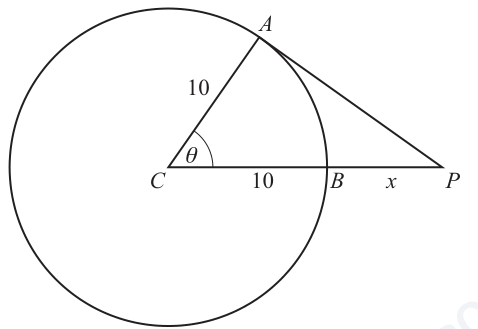
The diagram shows a circle, centre , radius 10.
The points and lie on the circumference of the circle.
The point is such that is a straight line.
The line has length .
The line is a tangent to the circle at .
Angle is .
The perimeter of the triangle is 38.
Approach
Since is a tangent to the circle at , the radius is perpendicular to , so triangle is right-angled at . Express in terms of using Pythagoras' theorem, then use the perimeter of triangle to form an equation in and solve it. Finally use the cosine ratio in the right-angled triangle to find .
Working
Since is a straight line with and :
By Pythagoras' theorem in right-angled triangle :
so
The perimeter of triangle is 38:
Squaring both sides:
Then . In right-angled triangle :
which is the required result.
Answer
theta = 0.885 radians (to 3 decimal places)
Walkthrough
The key geometric fact is that a tangent to a circle is perpendicular to the radius at the point of contact. So triangle has a right angle at , and Pythagoras' theorem applies: . Since , we get .
The perimeter condition then gives a second expression for : the three sides are , and , and these sum to 38, so .
Equating the two expressions for and squaring eliminates the square root. The terms cancel, leaving a simple linear equation , giving .
Finally, in the right-angled triangle, equals the adjacent side over the hypotenuse, i.e. . Substituting gives , so rad, confirming the printed result.
Key Takeaways
- A tangent is perpendicular to the radius at the point of contact, creating a right-angled triangle.
- Two different expressions for the same length (from Pythagoras and from a perimeter) can be equated to form an equation.
- Squaring removes a square root, and here the quadratic terms conveniently cancel.
- In a right-angled triangle, .
Common Mistakes
- Forgetting that the angle at is a right angle and trying to use the cosine rule unnecessarily (though the cosine rule route is accepted by the scheme).
- Using the perimeter as (counting instead of ) — the triangle sides are , and .
- Sign slips when expanding ; the scheme condones only one slip (two correct terms).
- Not showing sufficient working: this is a 'Show that' question, so the equation in , its solution, and the substitution into must all be seen.
- Rounding from a value computed to fewer than 4 decimal places — the scheme requires 4 dp or better before rounding to 3 dp.
Things to Be Careful About
- The answer must be shown as to 3 decimal places, computed from at least 4 decimal places of working.
- Follow-through is allowed on 'their' and 'their' provided they come from a valid method, but the final 'Show that' value must be reached correctly.
- Angles here are in radians, as stated in the stem — do not convert to degrees.
- Alternative accepted routes: or , or the cosine rule form .
Approach
Use the arc length formula with and from part (a).
Working
Answer
8.85 cm
Walkthrough
The arc length of a sector of radius and angle radians is . Using the unrounded value from part (a) and , the arc has length , which rounds to cm to 3 significant figures.
Key Takeaways
- Arc length only works when is in radians.
- Carry the unrounded value of forward rather than the rounded 0.885.
Common Mistakes
- Using the rounded instead of the more precise value (here it makes little difference, but it can cost accuracy marks elsewhere).
- Using with in degrees.
Things to Be Careful About
- The answer is a length, so the unit is cm; give it to 3 significant figures as cm.
Approach
Use the sector area formula with and from part (a).
Working
Answer
44.2 cm^2
Walkthrough
The area of a sector of radius and angle radians is . With and the unrounded , the area is , which is cm² to 3 significant figures (the scheme also accepts or ).
Key Takeaways
- Sector area requires in radians.
- Use the unrounded value of carried forward from part (a).
Common Mistakes
- Forgetting the factor of .
- Using the rounded and obtaining a slightly different third figure.
- Omitting the unit cm².
Things to Be Careful About
- The scheme accepts , or ; give the answer to 3 significant figures with the unit cm².
Solve the equation where is in radians and .
Approach
Rearrange to make the subject, then solve for over the corresponding interval , using the symmetry of the sine graph to catch every solution, and finally add the shift back.
Working
Rearrange the equation:
Since , the shifted variable satisfies:
Principal value:
Second solution from the symmetry :
Third solution by subtracting from the principal value (this lies inside ):
Adding back to each:
All three lie in , and no other solutions exist in the interval.
Answer
theta = 0.912, 3.23, -3.05
Walkthrough
The equation involves cosecant, so the first step is to convert it into a sine equation: rearranging gives , and since cosecant is the reciprocal of sine, this is .
Next, work out the interval for the shifted angle. Because runs from to , the quantity runs from to . This interval is more than one full period () wide, so we expect more than the usual two solutions.
The calculator gives the principal value . The second solution comes from the symmetry of the sine curve about : , giving . Because the interval extends below , we also subtract from the principal value to get , which lies inside . Adding to either solution leaves the interval, so there are exactly three solutions for .
Finally, undo the shift by adding to each value: , and , i.e. , and to 3 significant figures.
Key Takeaways
- Cosecant equations are solved by taking reciprocals to form a sine equation first.
- When the argument of the trig function is shifted, shift the interval bounds too, then solve in terms of the shifted variable and undo the shift at the end.
- The full set of solutions of is and ; generate candidates by adding/subtracting until you leave the interval.
- Always check each candidate against the stated interval and reject extras.
Common Mistakes
- Forgetting to shift the interval: solving instead of loses the third solution .
- Finding only the two standard solutions and and missing because the interval extends beyond .
- Adding the shift to the interval bounds instead of the solutions, or forgetting to add it at all.
- Working in degrees: the mark scheme awards no method marks until values are converted to radians.
- Giving extra solutions outside — extras inside the interval cost accuracy marks (A3 drops to A2 for two correct, A1 for one correct, ignoring extras).
Things to Be Careful About
- Answers are required to 3 significant figures (, , ); values to 2 significant figures are accepted, but do not round intermediate values before the final step.
- The mark scheme requires all three solutions with no extras within the interval for full A3 credit.
- Keep the calculator in radian mode throughout.
- Check the third candidate carefully: must satisfy , which it does.
A curve has equation .
The normal to the curve at the point where meets the -axis at the point and the -axis at the point .
Find the area of the triangle , where is the origin.
Give your answer correct to 3 significant figures.
Approach
Differentiate by the product rule (with chain rule inside the log), evaluate at to get the tangent gradient, take the negative reciprocal for the normal, form the normal's equation through , find where it cuts both axes, then use .
Working
By the product rule with and :
At :
Gradient of the normal:
Equation of the normal through :
Intercept on the -axis ():
Intercept on the -axis ():
Area of triangle :
Answer
12.8
Walkthrough
The curve is a product of two functions of : and , so the product rule is required. Differentiating also needs the chain rule, giving .
Substituting into the curve gives the point of contact: . Substituting into the derivative gives the tangent gradient . The normal is perpendicular to the tangent, so its gradient is the negative reciprocal: .
Using with point gives the normal's equation. Setting and solving for locates on the -axis (); setting locates on the -axis (). The triangle is right-angled at , so its area is half the product of the two intercept distances: .
Key Takeaways
- The product rule combined with the chain rule handles products involving composite functions like .
- A normal gradient is always the negative reciprocal of the tangent gradient at the same point.
- Axis intercepts of a straight line come from substituting or .
- A triangle formed by a line cutting both axes and the origin has area .
Common Mistakes
- Forgetting the chain rule inside the log: writing without multiplying by loses the B1.
- Sign slips in the negative reciprocal — the normal gradient must be positive here since the tangent gradient is negative.
- Using the tangent instead of the normal throughout.
- Dropping the negative sign on the -intercept when computing the area (the mark scheme condones , but the distance used must be consistent).
- Rounding intermediate values too early; keep full precision until the final answer, which must be exactly (cao).
- The scheme notes M0 if the correct value is stated but no evidence of a correct derivative is shown — working must be visible.
Things to Be Careful About
- The final area is 'cao' (correct answer only): to 3 significant figures.
- Follow-through applies to later marks if an earlier derivative is wrong, but the derivative itself must show correct product-rule structure (a sum with and correct) for the M1.
- Intermediate values accepted by the scheme: , gradient of normal , (awrt), (awrt).
- Any equivalent form of the normal equation is accepted, e.g. or .
- Keep decimals to at least 2–3 significant figures during working to avoid rounding drift before the final answer.
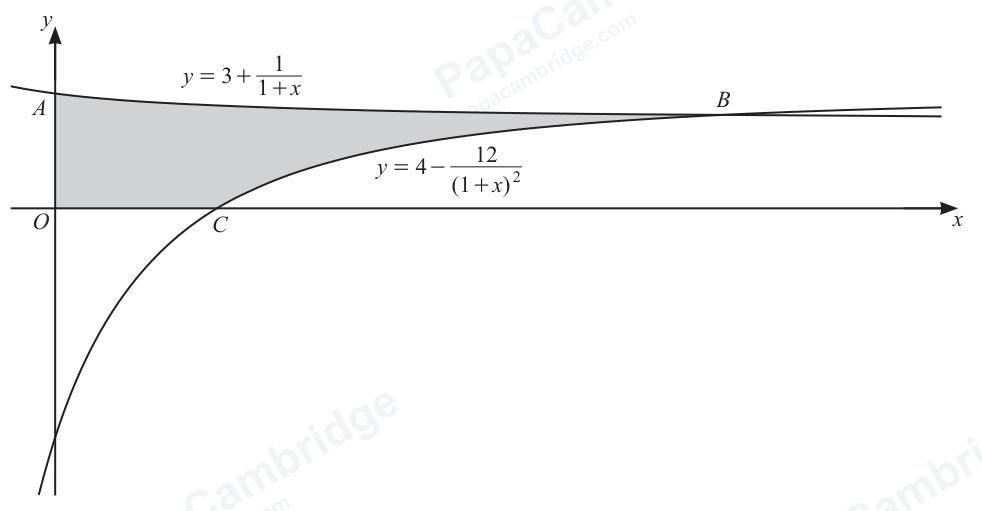
The diagram shows part of the curve and part of the curve .
The curve meets the -axis at the point .
The curve meets the -axis at the point .
The curves intersect at the point .
Find the area of the shaded region .
Give your answer in exact form.
Approach
The shaded region is bounded above by from to , below partly by the -axis (from to ) and partly by (from to ). So
First find (where the lower curve meets the -axis) and (where the curves intersect).
Working
Point : set :
Point : equate the curves. With :
Since for points on the curve, , so
Integrals:
Evaluate with limits:
(since ).
Area:
Answer
ln 4 + 8√3 − 10
Walkthrough
The region sits between two curves, so we need three things: where each boundary point is, which curve is on top over which stretch, and the antiderivatives.
Finding C. Point is where the lower curve crosses the -axis, so put in . This gives , so (taking the positive root since lies at positive ), giving .
Finding B. The curves meet where they are equal. Writing turns into , which factorises as . The negative root would give , off the region, so and .
Setting up the area. From to the upper curve forms the top of the region. Below it, from to the bottom is the -axis (), and from to the bottom is the lower curve. So the area equals the integral of the upper curve from to , minus the integral of the lower curve from to — exactly the plan in the mark scheme.
Integrating. The term integrates to ; the term integrates to because differentiating gives .
Evaluating. At the limits: . For the second integral, at : ; at : . Subtracting gives , and subtracting this from gives the final exact answer .
Key Takeaways
- Areas between curves are found by integrating (top curve − bottom curve); when the bottom boundary changes identity partway along, split the integral or subtract one curve's integral over only the stretch where it is the boundary.
- Intersections and intercepts come from solving equations — here a quadratic in after clearing fractions.
- and .
- Rationalise surds like before combining terms.
Common Mistakes
- Taking the negative root or and using or as a limit — the region lies entirely at positive .
- Integrating with the wrong sign: it must give , so the whole antiderivative of the lower curve is .
- Forgetting the term or writing instead of .
- Subtracting the integrals over the wrong intervals — the lower curve's integral runs from to , not from to .
- Leaving the answer as a decimal: the mark scheme says "Must be exact" and "M0 if only decimals seen" — decimals after exact values are ignored (isw), but decimals alone score nothing.
- Sign slips when evaluating at the lower limit, e.g. mishandling .
Things to Be Careful About
- The answer must be given in exact form: (equivalently ). A decimal approximation () may be added but never replaces the exact value.
- Both limits must be found correctly first — the mark scheme awards B1 for and A1 for , and later marks follow through on your values, but wrong limits lose the accuracy marks.
- Show the substituted expressions before evaluating (e.g. ) so method marks are visible.
- Check the geometry against the diagram: the upper curve is on top throughout , and the lower curve dips below the axis before , which is why its integral is subtracted only from to .