Additional Mathematics 4037/13 — October/November 2025
Cambridge O-Level · Non-calculator · worked solutions for every part, with the mark scheme
Topics Calculus · Quadratic functions · Trigonometry · Factors of polynomials · Series · Equations, inequalities and graphs · +4 more
Solve the following inequalities.
Approach
Factorise the quadratic to find its critical values, then take the region where the curve is on or above the -axis.
Working
Critical values: and .
Since the parabola opens upwards, outside the roots:
Answer
x >= 3 or x <= -2
Walkthrough
We need the values of for which is zero or positive. First factorise: we need two numbers multiplying to and adding to , namely and , so . The curve crosses the -axis at and . Since the coefficient of is positive, the parabola opens upwards, so it is above the axis (or touching it) to the left of the smaller root and to the right of the larger root. Hence or .
Key Takeaways
- Factorising a quadratic gives its roots, which are the critical values of any related inequality.
- For an upwards-opening parabola, a inequality gives the two outer regions; a inequality gives the region between the roots.
- The two parts of the answer must be joined by "or", not "and".
Common Mistakes
- Writing the answer as , which is impossible and is explicitly rejected by the mark scheme.
- Joining the two inequalities with "and" instead of "or" — the mark scheme disallows this.
- Sign errors in the factorisation (e.g. ).
- Reversing the inequality directions by forgetting the parabola opens upwards.
Things to Be Careful About
- The final answer must state both inequalities correctly oriented: and . The mark scheme is strict: "Do not allow and between inequalities" and "Do not accept ".
- Include equality (the roots themselves) since the inequality is , not .
Approach
Split into two cases: (so the modulus is ) and (so the modulus is ). Solve each linear inequality and combine.
Working
Case 1: , so :
This case requires , giving .
Case 2: , so :
This case requires , giving .
Combining both cases:
Answer
1/2 < x < 3
Walkthrough
The modulus equals when and when , so we solve the inequality in each region.
Case 1 (): the inequality rearranges to , so . Together with this contributes .
Case 2 (): the inequality rearranges to , so . Together with this contributes .
The union of the two contributions is the single interval .
Key Takeaways
- A modulus inequality splits into two cases according to the sign of the expression inside the modulus.
- Each case gives a linear inequality plus a domain restriction; the final answer is the union of the valid parts.
- Equivalently, (with ) means , which leads to the same interval.
Common Mistakes
- Solving only one case of the modulus and missing half the interval.
- Writing the answer as two disconnected inequalities such as ", " without "and" — the mark scheme explicitly rejects this.
- Sign slips when removing the modulus in the negative case (forgetting that there).
- Forgetting to check the domain restriction of each case, which here happens to merge cleanly but must be reasoned through.
Things to Be Careful About
- The final answer must be written as a single connected statement (or with "and"); the mark scheme says "Do not accept , unless and is between the inequalities".
- Strict inequalities throughout: the modulus inequality is , so the endpoints and are excluded.
- An alternative accepted method is squaring both sides to get , i.e. , giving the same critical values and — but squaring is only valid because both sides are non-negative on the solution set.
Differentiate with respect to .
Approach
Use the product rule on with and .
Working
(the derivative of uses the chain rule: multiply by the derivative of ).
Product rule:
Answer
3x^2 e^(3x) + 2x e^(3x)
Walkthrough
The expression is a product of two functions of : the power and the exponential , so the product rule applies: .
First differentiate each factor. The derivative of is . For , the chain rule gives the derivative as multiplied by the derivative of the exponent , which is , so the derivative is — this step earns the B1 in the mark scheme.
Substituting into the product rule:
giving , which may be left unsimplified or factored as — later mis-simplification is ignored (isw).
Key Takeaways
- Recognise when a function is a product and apply the product rule .
- Differentiate by multiplying by (chain rule).
- Either order of the two terms is acceptable; factoring is optional.
Common Mistakes
- Writing only or only — both parts of the product rule are needed for full marks.
- Forgetting the chain rule factor of when differentiating (giving just ), which loses the B1.
- Using the quotient rule or adding derivatives instead of applying the product rule structure.
- Sign slips are not an issue here, but mixing up and still yields the same sum here — the real trap is omitting a term entirely.
Things to Be Careful About
- The mark scheme awards B1 for , M1 for use of the product rule, and A1 FT for the correct combination with their — so even with a wrong exponential derivative, correct product-rule structure can earn follow-through marks.
- "isw" means subsequent incorrect simplification is ignored, so leaving the answer as is perfectly fine.
- Keep upright as it denotes the constant, matching the printed notation.
In this question you may use the values in the table below.
| radians | |||
|---|---|---|---|
Variables and are related by the equation where .
Use calculus to find the approximate change in when increases from by the small amount .
Approach
First find the value of at which , then differentiate to get there, and finally use to estimate .
Working
Solve for when :
Differentiate using the chain rule:
At , so that , and using from the table:
Use the small-change approximation with :
Answer
0.004
Walkthrough
The question asks how much changes when increases by a small amount, which is a small-increment (rates of change) problem: since is the rate of change of with respect to , we have .
Step 1 — locate the starting point. We are told increases from , so we need the where . From the table, when , so and . This lies inside the allowed range , confirming it is the right solution.
Step 2 — find the rate of change. Differentiating by the chain rule gives . At our point, and the table gives , so .
Step 3 — apply the approximation. Writing with gives , i.e. .
Key Takeaways
- The small-change formula links a tiny change in one variable to the resulting tiny change in the other; rearranged here it gives .
- The derivative must be evaluated at the point where the change starts, not left in general form.
- The chain rule is needed whenever the argument of a trig function is a multiple of : differentiate the outer function, then multiply by the derivative of the inner function.
Common Mistakes
- Forgetting the factor of 5 in the chain rule and writing instead of .
- Solving instead of , giving rather than .
- Evaluating at the wrong angle, or mixing up and when reading the table.
- Inverting the approximation, e.g. writing instead of dividing by the gradient.
- Giving a rounded or calculator-dependent decimal when an exact fraction () is available on this non-calculator paper.
Things to Be Careful About
- The mark scheme awards B1 for (or equivalently ), B1 for the correct differentiation, DM1 (dependent on the differentiation) for setting up , and A1 for or — every step must be visible.
- The final answer must be exact: or ; do not round further or express it via a calculator-only route.
- Check the solution sits within the stated domain ; does, but a candidate solving in degrees would leave the intended interval entirely.
- The dependent mark means the setup only scores if the derivative was found correctly.
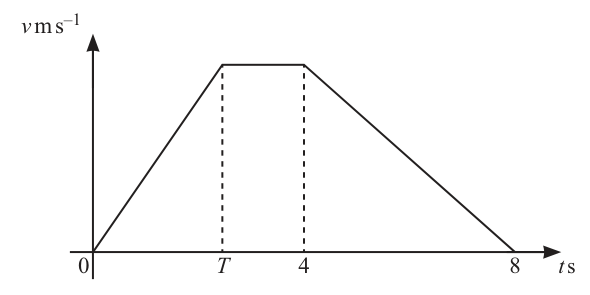
The velocity–time graph represents the motion of a particle moving in a straight line.
The acceleration during the first seconds of the motion is .
The total distance travelled is .
Approach
The particle accelerates uniformly at from rest for seconds, so its velocity at time is . The whole velocity–time graph is a trapezium with parallel sides of lengths and , and height ; since distance travelled equals the area under a velocity–time graph, set this area equal to .
Working
Velocity at time :
Area of the trapezium under the graph:
Simplify:
Factorise:
so or . Since the graph shows , only is admissible.
Answer
3
Walkthrough
The first stage of motion is uniform acceleration at starting from rest, so after seconds the velocity is . This is the height of the flat top of the graph. The whole graph is a trapezium: the parallel sides are the bottom edge (length , the full time) and the top edge (length , the time spent at constant velocity), and the perpendicular height is the maximum velocity . Distance is the area under a velocity–time graph, so we set the trapezium area equal to : . Simplifying gives , which factorises as . Both roots are positive, but the diagram requires (the constant-velocity section must have positive length), so is rejected and .
Key Takeaways
- On a velocity–time graph, distance travelled equals the area between the graph and the time axis.
- Uniform acceleration means the velocity rises linearly: .
- A trapezoidal velocity–time profile has area where the parallel sides are the total time and the constant-velocity duration.
- Quadratic equations arising from physical contexts often yield an extra root that must be checked against the conditions of the problem.
Common Mistakes
- Using the wrong parallel sides for the trapezium — the top side runs from to , so its length is , not or .
- Forgetting that distance is the area under the graph, not the final velocity or some other quantity.
- Sign slips when rearranging into the standard quadratic form; the scheme requires a correct 3-term quadratic before solving.
- Accepting both roots and without checking against the figure, which demands .
- Confusing distance with displacement — here they coincide because velocity never goes negative, but the reasoning should be explicit.
Things to Be Careful About
- The mark scheme awards B1 for stating the velocity at time is (seen or implied), M1 for setting up the trapezium (or three separate areas) equal to 27 using their , and a dependent M1 for correctly solving their quadratic — so every step must be visible.
- The root scores nothing: it contradicts the graph, where the deceleration starts at .
- Keep exact working throughout; the answer is the integer , so no rounding issues arise.
Approach
Acceleration is the gradient of the velocity–time graph. On the last section (from to ) the velocity falls from to .
Working
Using the result from part (a), the velocity at is . The gradient over the last 4 seconds is
Answer
-1.5 ms^-2
Walkthrough
On any straight section of a velocity–time graph, the acceleration is the gradient. The final section runs from to , during which the velocity drops from its maximum value down to . Carrying forward from part (a), the maximum velocity is . The gradient is therefore , giving a deceleration of magnitude but a negative acceleration, which must be reported as negative.
Key Takeaways
- Acceleration on a velocity–time graph is the gradient of the line.
- A decreasing velocity corresponds to a negative acceleration (deceleration).
- 'Hence'-style parts expect you to reuse the earlier answer rather than recompute.
Common Mistakes
- Giving the answer as — the mark scheme explicitly states the answer "must be negative"; the velocity is falling, so the acceleration is .
- Using the wrong time interval, e.g. dividing by instead of .
- Forgetting to substitute their own value of into before computing the gradient.
Things to Be Careful About
- The mark scheme's M1 is for an attempt at the gradient using their value of , so follow-through applies if your was wrong — but the sign requirement still holds.
- State the unit: the acceleration is .
The normal to the curve at the point where cuts the curve again at two other points.
Find the -coordinates of these two points.
Approach
Find the gradient of the curve at by differentiation, take the negative reciprocal to get the normal's gradient, write the normal's equation through , then set it equal to the curve and solve the resulting cubic.
Working
At :
The gradient of the normal is the negative reciprocal:
When , , so the normal passes through :
Intersect with the curve:
Multiply through by and factorise:
The root is the point of tangency, so the two other intersections are:
Answer
x = 1 and x = -5/2
Walkthrough
The curve is . Differentiating gives . At this equals , which is the gradient of the tangent. The normal is perpendicular to the tangent, so its gradient is the negative reciprocal: .
At the curve gives , so the normal passes through and its equation is , i.e. .
The normal cuts the curve again where the two equations are simultaneously true: set . Simplifying and multiplying by 2 gives , which factorises as . The root is the original point, so the two other intersection points have -coordinates and .
Key Takeaways
- The gradient of a normal is the negative reciprocal of the tangent's gradient, which itself comes from the derivative.
- Intersections of a curve and a line are found by equating the two expressions and solving.
- A cubic formed this way always contains the known intersection as a root; factorising isolates the remaining roots.
Common Mistakes
- Forgetting the negative reciprocal and using (or ) as the normal's gradient — the scheme marks the reciprocal step explicitly.
- Dropping the root from the factorisation but then reporting it as one of the answers, or failing to discard it since it is the given point.
- Sign errors when rearranging ; the scheme requires the factorisation from correct working (nfww).
- Arithmetic slips in differentiating — the scheme allows only one coefficient error at the M1 stage.
Things to Be Careful About
- Answers must come from correct working (nfww): a wrong normal equation that happens to give the right roots scores nothing.
- Show the substituted derivative value explicitly, as it is a separate accuracy mark.
- The quadratic factorises as ; check by expanding before concluding.
- Both roots are required — the question asks for two points, and omitting loses the final mark.
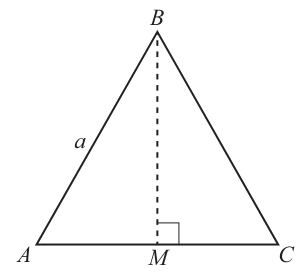
The diagram shows an equilateral triangle with side .
is the midpoint of and angle .
Use the diagram to find .
Approach
In the equilateral triangle of side , the midpoint of gives . The right-angled triangle has hypotenuse , so Pythagoras' theorem gives the height , from which and hence .
Working
Since is the midpoint of :
Applying Pythagoras' theorem in triangle :
In the right-angled triangle , the angle at is (each angle of an equilateral triangle is , and the altitude bisects it), so:
Therefore:
Alternatively, using the sides of triangle directly:
Answer
sec 30° = 2/√3 = 2√3/3
Walkthrough
The question asks us to derive the exact value of from the geometry of an equilateral triangle rather than quote it. The key observation is that dropping a perpendicular from a vertex of an equilateral triangle to the opposite side creates two congruent right-angled triangles with angles , and .
First, since is the midpoint of , we have — this is the side adjacent to the angle at . The hypotenuse is the full side .
Pythagoras' theorem then gives the opposite side (the height):
Now , and . Taking the reciprocal gives . Equivalently, using all three sides at once, , which rationalises to .
Key Takeaways
- The altitude of an equilateral triangle bisects the base and the vertex angle, producing the standard -- triangle with side ratios .
- Exact trigonometric values can be derived geometrically rather than memorised.
- , so in the relevant right-angled triangle.
Common Mistakes
- Using the whole base instead of the half-base in Pythagoras' theorem.
- Confusing which angle is : the angle at in triangle is because the altitude bisects the angle; taking instead gives .
- Leaving the answer as when the scheme also accepts it — both forms are credited, but rationalising to is preferred presentation.
- Arithmetic slips such as writing instead of .
Things to Be Careful About
- The mark scheme awards B1 for seeing (or equivalently ) and B2 for reaching or the equivalent identity route — so each stage must be visible in your working.
- The answer must be exact: or , not a decimal approximation.
- This is a non-calculator paper, so all arithmetic must be shown by hand with surds kept in exact form.
Approach
Add the two fractions over their common denominator , simplify the denominator as a difference of two squares, use , and finally convert to sines and cosines to reach .
Working
Adding the two fractions over the common denominator :
Expanding the denominator as a difference of two squares:
Using the identity , so that :
Splitting one factor of off and converting to sines and cosines:
and since :
which is the required result.
Answer
Shown: the expression equals 2 cosec x cot x
Walkthrough
This is a "show that" proof, so we must start from the given expression and derive forward to without ever assuming the result.
Step 1 — combine the fractions. The two denominators and have product as a natural common denominator. Adding gives numerator — notice how the constants cancel, leaving a clean single fraction.
Step 2 — simplify the denominator. The product is a difference of two squares: . This is exactly where the Pythagorean identity becomes useful, because rearranged it says . The expression is now .
Step 3 — convert to the target form. The target contains and . Splitting the denominator as lets us pair , while the remaining . Hence the expression equals , as required.
(The mark scheme also accepts an alternative route through throughout, ending at ; either route earns the same four marks.)
Key Takeaways
- To prove an identity, work on one side only, usually the more complicated one, and transform it into the other.
- Difference of two squares, , appears constantly with secant and tangent identities.
- The rearranged Pythagorean identity is often the bridge between a sec-based expression and a tan-based one.
- Converting everything to sines and cosines (, , , ) is a reliable way to finish a proof.
Common Mistakes
- Adding the numerators but forgetting the common denominator, e.g. writing just over nothing.
- Expanding incorrectly, e.g. as instead of .
- Using the identity the wrong way round: you need , not .
- Stopping at — the final B1 requires at least one further correct step reaching the printed answer, since the part is AG (answer given).
- Sign slips when combining ; the and must cancel.
Things to Be Careful About
- Every mark in this scheme is dependent on the previous one, so a single early error loses all subsequent marks — check each line before moving on.
- Because the answer is given (AG), you must show sufficient correct detail: no steps may be jumped or asserted without working.
- Keep the notation consistent with the paper: write (not csc) and keep function names upright.
- The identity holds only where the original expression is defined, i.e. and ; this need not be stated for the marks but explains why the manipulation is valid.
The point is the origin.
Two points and are such that is in the same direction as .
Approach
Since is in the same direction as , it is a positive scalar multiple of . We find the magnitude of and scale the vector so that its magnitude becomes .
Working
Let .
The magnitude of is:
Since is in the same direction as , we can write:
The magnitude of is given as :
Multiplying by :
Answer
-3i + 15j
Walkthrough
- Vectors in the same direction are positive scalar multiples of one another. We write with .
- We calculate the magnitude of the direction vector using the formula , giving .
- Since the required magnitude is , the scalar multiplier must be .
- Multiplying each component by gives or .
Key Takeaways
- A vector in the same direction as is given by where .
Common Mistakes
- Forgetting to square the negative sign properly: , not .
- Reversing the direction by using a negative scalar.
Things to Be Careful About
- Ensure the answer is left in standard vector form (in terms of and or column vector form).
Approach
Use the vector triangle relation . Express and as scalar multiples of their direction vectors, equate components to form simultaneous linear equations, solve for the scalars, and evaluate .
Working
Let and for constants .
Using the vector addition law:
Equating the and components gives the system of linear equations:
From equation (1), express in terms of :
Substitute into equation (2):
Then:
Now, find :
Answer
16i - 24j
Walkthrough
- From the vector triangle, the position vector can be reached by going from to and then to , so .
- We are given the direction vectors for and . We represent them as and .
- Equating the sum of these vectors to allows us to separate the -components and -components into two independent linear equations: and .
- Solving this system gives and .
- Finally, we substitute back into the expression for to get .
Key Takeaways
- Any position vector can be found via vector paths: .
- Two vectors are equal if and only if their corresponding and components are equal.
Common Mistakes
- Confusing with or setting .
- Finding only the scalar value without substituting it back to give the final vector .
- Sign errors when solving the simultaneous linear equations.
Things to Be Careful About
- Ensure the final answer is stated as a vector ( or ), not just the scalar .
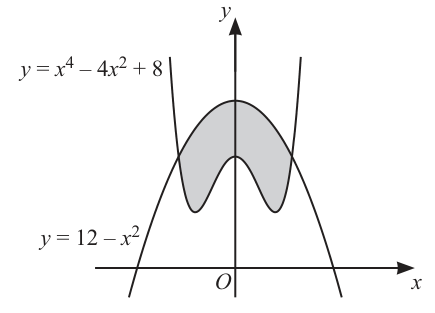
The diagram shows part of each of the curves and .
Find the area of the shaded region enclosed by the two curves.
Approach
The area between two curves is found by integrating (upper curve lower curve) between the intersection points. First find the intersections by equating the two curves, then integrate the difference from to .
Working
Solve simultaneously:
Factorise as a quadratic in :
Since gives no real solutions, , so
Between these points the parabola lies above the quartic, so the shaded area is
Integrate term by term:
Substitute the limits:
Answer
96/5 = 19.2
Walkthrough
To find where the two curves meet, set their equations equal: . Rearranging everything to one side gives . This is a quartic, but it contains only even powers of , so treating as the unknown turns it into a quadratic: , which factorises as . The factor cannot be zero for real , so , giving and .
The area between two curves is the integral of (upper lower). From the figure, the parabola sits above the quartic between the intersection points, so the integrand is . Integrating term by term gives . Evaluating at gives , and at it gives . Subtracting, the area is square units.
Key Takeaways
- The area between two curves is between their intersection points.
- Quartics containing only even powers can be solved by treating as the unknown and factorising as a quadratic.
- The integrand must be the correct way round: subtracting the curves the wrong way gives a negative answer, and its absolute value is not automatically the area unless you justify which curve is on top.
Common Mistakes
- Subtracting the curves in the wrong order and reporting a negative answer — the mark scheme requires the correct difference (or its negative with the limits reversed).
- Keeping both roots and also inventing roots from , or forgetting the negative root .
- Sign slips when integrating: the antiderivative is , and errors in the signs of or are common.
- Forgetting to substitute both limits, or substituting only and forgetting the curve is symmetric so the answer must be doubled if integrating from to .
- Arithmetic slips in — note the whole second bracket is subtracted, so both its signs flip.
Things to Be Careful About
- Show the factorisation explicitly — the mark scheme awards a method mark for solving the quadratic in .
- The integration mark requires at least one term correctly integrated; the evaluation mark requires the limits and (or to with doubling) substituted into your integral.
- The exact answer is ; the decimal is also accepted. Since a calculator is allowed on this paper, either exact or decimal form is fine, but show the substituted expression before the final value so the method marks are visible.
Solve the following equations.
Approach
Change to base , then use the laws of logarithms to combine everything into a single logarithm equal to , and solve the resulting quadratic.
Working
Using the change of base formula:
So the equation becomes
Multiplying through by :
Since and :
Removing the logarithm:
Factorising:
so or .
Checking validity: if then , so is not defined. This root must be rejected.
Answer
x = 4/5 only
Walkthrough
The equation mixes two different bases ( and ), so the first job is to put every logarithm on the same base. Since , the change-of-base formula gives , i.e. . Substituting this turns the whole equation into base- logarithms.
Next we tidy up with the laws of logarithms. Multiplying the equation by clears the halves, giving . The power law rewrites as , and the right-hand side is just . The subtraction law then combines the two left-hand logarithms into one: .
Now that a single logarithm equals , the arguments must be equal: . Expanding and multiplying by gives , which factorises as .
Both roots must be checked against the original equation, because logarithms are only defined for positive arguments. With , the quantity is negative, so that root is invalid. Only survives (it gives ).
Key Takeaways
- Change of base: , so .
- Power, product and quotient laws let you collapse a multi-logarithm equation into one single logarithm.
- Once you have , equate the arguments.
- Always check solutions against the domains of the original logarithms; extraneous roots from squaring or combining logs must be rejected.
Common Mistakes
- Writing instead of — the coefficient divides, it does not multiply.
- Forgetting that becomes , not .
- Giving both roots and without checking them — the mark scheme awards the final mark for only; keeping the invalid root loses the A1.
- Sign slips when expanding or when moving terms to form .
- Attempting to divide by early instead of multiplying through by .
Things to Be Careful About
- The final answer must be alone — the mark scheme explicitly says " only", so an unchecked second root scores nothing on the last mark.
- Every mark-scheme step (change of base, combining logs, forming the quadratic, solving) must be visible in your working; the M marks depend on correct use of the log rules.
- Keep exact fractions throughout — no decimals are needed here.
Approach
Multiply the equation by a suitable power of so that all terms become positive powers, then recognise the result as a quadratic in , factorise, and take natural logarithms.
Working
Start with
Multiply every term by :
Let , so . Then
Factorising:
So or . The second has no solution since always.
Taking natural logarithms of the first:
Answer
y = 4/3
Walkthrough
The equation contains , and — three different-looking exponentials, but they are related. Multiplying every term by clears the fraction on the right and, using the index law , produces .
The key observation is that , because . So if we write , the equation becomes the simple quadratic , which factorises as .
This gives or . An exponential can never be negative, so the second possibility is discarded immediately. For the first, taking natural logarithms gives , hence .
Key Takeaways
- Index laws turn products of exponentials into sums of indices — choose the multiplier that makes all exponents work out.
- Equations like are quadratics in disguise: substitute .
- , so any factorisation yielding a negative exponential value contributes no solution.
- finishes the problem without any calculator work.
Common Mistakes
- Getting the index arithmetic wrong when multiplying by — e.g. writing instead of ; check carefully.
- Not recognising the hidden quadratic and trying to take logs of individual terms, which does not work because .
- Keeping the root and attempting to take its logarithm — exponentials are strictly positive, so this yields no real solution.
- Sign errors when rearranging into the three-term form before factorising.
- Arithmetic slips in the final step, e.g. answering instead of .
Things to Be Careful About
- The mark scheme requires the equation arranged as a three-term quadratic (B1 dependent), so show the line explicitly.
- The answer is exact: , no decimals needed.
- Show the rejection of (or at least silently drop it correctly) — taking of a negative number is a serious error.
- All working here is doable by hand since ; no calculator evaluation is required.
An arithmetic progression has first term and common difference .
Given that , find in terms of .
Approach
Use the formula for both and , set , and solve for .
Working
Given :
Answer
a = (11/2)d
Walkthrough
The sum of the first terms of an arithmetic progression is . We write this out twice: once with , giving , and once with , giving . The condition turns these into a single linear equation in and . Expanding both sides gives . Collecting the terms on one side and the terms on the other gives , so dividing by 10 yields .
Key Takeaways
- The arithmetic series formula must be applied carefully — the multiplier on changes with each value of .
- A condition linking two partial sums usually reduces to a simple linear relation between and .
Common Mistakes
- Writing as instead of — the last term is the 20th term, but the bracket needs times .
- Expanding brackets incorrectly; the mark scheme awards a specific mark for correct removal of brackets ().
- Sign slips when collecting terms across the equals sign.
Things to Be Careful About
- The answer is an expression, not a number: leave it as (or any equivalent form such as ).
- Show the substituted formulas before simplifying so the method mark is clearly earned.
A geometric progression, A, has common ratio , where .
The terms of this progression are , , .
Another geometric progression, B, has terms , , , where
The sum to infinity of A is and the sum to infinity of B is .
Find in terms of .
Give your answer in its simplest form.
Approach
Progression A has first term and ratio , so its sum to infinity is . Progression B takes every second term of A, so its ratio is and its first term is . Write both sums to infinity and divide.
Working
Sum to infinity of A:
Since , , , each term of B is obtained from the previous by multiplying by :
First term of B: . Sum to infinity of B:
Forming the ratio:
Cancelling and factorising :
Answer
r / (1 + r)
Walkthrough
Progression A is geometric with first term and common ratio , where , so its sum to infinity exists and equals .
Progression B is built from the even-positioned terms of A: , , , and so on. Since consecutive terms of A differ by a factor of , skipping every other term means consecutive terms of B differ by a factor of : for example . So B is itself geometric with first term and ratio (and since , so its sum to infinity also converges).
Thus . Dividing gives
the factors cancel, and factorising lets cancel too, leaving .
Key Takeaways
- Taking every -th term of a geometric progression produces another geometric progression whose ratio is the original ratio raised to the power .
- The sum to infinity only applies when — here that condition guarantees both sums converge.
- Simplifying ratios of fractions often hinges on factorising a difference of squares.
Common Mistakes
- Using as the common ratio of B instead of .
- Taking the first term of B to be rather than .
- Forgetting to cancel or mis-cancelling the factors when forming the ratio.
- Failing to factorise and so leaving the answer as instead of the required simplest form .
Things to Be Careful About
- The final answer is 'cao' (correct answer only) and must be in simplest form: , not .
- The method mark for forming the ratio depends on having already stated both and the ratio correctly, so write those steps explicitly.
- Note ensures and , so no sign issues arise.
The lines , , and are tangents to a circle.
Approach
The vertical tangents and are parallel and equidistant from the centre, so the centre lies halfway between them; similarly for and . The radius is half the distance between each pair.
Working
Centre: midway between and , and between and :
Radius: half of (the gap between and , or between and ):
Equation:
Answer
(x - 2)^2 + (y - 1)^2 = 4
Walkthrough
Four tangent lines to a circle come in two parallel pairs: the pair and touch the circle on opposite sides, so the centre must sit exactly halfway between them at . Likewise and force the centre's -coordinate to be . The radius is the distance from the centre to any one tangent line: from to is units (and this matches the distance to every other tangent). Substituting centre and radius into gives the equation.
Key Takeaways
- Parallel tangent pairs straddle the circle symmetrically, so their midline passes through the centre.
- The radius equals the perpendicular distance from the centre to any tangent line.
- Standard form of a circle: with centre , radius .
Common Mistakes
- Writing the right-hand side as instead of — the mark scheme explicitly rejects leaving it as unexpanded... actually it requires the value , not the unsquared form.
- Taking the radius as the full gap () instead of half the gap ().
- Sign slips inside the brackets: instead of for centre .
Things to Be Careful About
- The answer must show the squared radius as ; an equivalent form (expanded) is accepted, but the unsquared "" alone is not.
- Follow-through applies only to your own correct centre and radius.
The line , where is a constant, is also a tangent to the circle.
Show that , and hence find the possible values of .
Give your answers in exact form.
Approach
Substitute into the circle equation from part (a); a tangent touches at exactly one point, so the resulting quadratic in has discriminant zero. Solve that condition for exactly.
Working
Substituting into :
Expanding:
Collecting terms (the constants cancel):
as required (AG).
For tangency there is exactly one solution, so the discriminant is zero:
Dividing by and expanding:
By the quadratic formula:
Answer
a = -3 +/- 2√5
Walkthrough
First we use the result of part (a): the circle is . Since the line meets the circle where both equations hold, we substitute the line's expression for directly into the circle equation. This removes and leaves a quadratic in whose coefficients involve the unknown constant .
Expanding carefully: , and . Adding these and setting equal to , the constant s cancel, giving — exactly the printed target, confirming our algebra.
Now the key geometric fact: a tangent touches the circle at exactly one point, so this quadratic must have exactly one root. A quadratic has a repeated root precisely when its discriminant equals zero. Applying this with , , gives .
Dividing through by and expanding both squares turns this into . This does not factorise over the integers, so we use the quadratic formula: . Simplifying gives the exact answers .
The two values correspond to the two parallel lines of gradient that touch the circle on opposite sides.
Key Takeaways
- Substituting a line into a circle converts a geometry problem into a quadratic in one variable.
- Tangency ⟺ the intersection quadratic has discriminant zero (one repeated root).
- Exact-form answers should stay as simplified surds: .
Common Mistakes
- Expanding incorrectly — the middle term is , not or .
- Forgetting the "show that" requirement: every algebraic line from the substitution to the printed quadratic must appear.
- Sign errors forming the discriminant, e.g. writing as .
- Giving decimal answers instead of exact surds — the question demands exact form.
- Stopping at without simplifying (this is accepted as "oe", but is cleanest).
Things to Be Careful About
- This is a calculator-permitted paper, but the answer must still be given in exact form — no decimals.
- The "AG" step means you must derive the quadratic forward from the substitution; starting from the target loses the method marks.
- "isw" applies after a correct : later slips are ignored, but the discriminant equation itself must be correct.
- Both values of are required — there are two parallel tangents of gradient .
Approach
In the expansion of , the term in comes from choosing exactly times from the factors, leaving chosen times.
Working
The general term is
Answer
59Cr * 2^(59-r) (i.e. C(59,r) 2^(59-r))
Walkthrough
The binomial expansion of has general term . Here and , so the coefficient of is , equivalently . No simplification is needed — the question only asks to write the coefficient down.
Key Takeaways
- The general term of is .
- The power of decreases as the power of increases, and the two powers always add to .
Common Mistakes
- Writing instead of — the power of the constant decreases as the power of increases.
- Writing , mixing up which factor gets which power.
- Omitting the binomial coefficient entirely.
Things to Be Careful About
- This is a 1-mark B1: the answer must be the complete coefficient, including both (or the factorial form) and the power of . An answer missing either element scores nothing.
For this expansion, find the value of for which the coefficient of is equal to the coefficient of .
Approach
Use the coefficient of from part (a) and the corresponding coefficient of , set them equal, and simplify the factorial ratio.
Working
The coefficient of is
Setting the two coefficients equal:
Dividing both sides by and by :
Cross-multiplying:
Answer
r = 19
Walkthrough
From part (a), the coefficient of is . Replacing by gives the coefficient of : . Setting them equal and cancelling the common factor from both sides leaves . Cross-multiplying gives , so and .
The key simplification is the factorial ratio: and , since each factorial is the one below it multiplied by one more integer.
Key Takeaways
- Consecutive binomial coefficients are related by — cancelling factorials is much faster than expanding them.
- Equating consecutive coefficients of a binomial expansion reduces to a simple linear equation.
Common Mistakes
- Writing the coefficient of with the wrong power of 2 (it is , not mis-simplified).
- Inverting the factorial ratio, giving instead.
- Arithmetic slips in ; the mark scheme makes the final B1 dependent on the earlier steps, so an error in the ratio loses everything downstream.
- Forgetting the factor of 2 difference between the powers of 2 and equating the binomial coefficients alone.
Things to Be Careful About
- The mark scheme awards B1 for the correct equated pair of coefficients, then B2 (dependent on that B1) for correctly obtaining either or , then a final B1 for dependent on the previous marks — so each stage must be shown.
- The scheme also allows working with general instead of ; either form is acceptable.
- Check the answer: with , the coefficients are and , and indeed , so they are equal.