Additional Mathematics 4037/22 — May/June 2025
Cambridge O-Level · Calculator · worked solutions for every part, with the mark scheme
Topics Calculus · Trigonometry · Series · Logarithmic and exponential functions · Equations, inequalities and graphs · Functions · +2 more
Solve the inequality .
Approach
The inequality means that is at least or at most . Split into two linear inequalities and solve each.
Working
Solving the first:
Solving the second:
Answer
x <= -1 or x >= 1/5
Walkthrough
The modulus measures the distance of from , so says that is at least units away from zero on either side. This gives two cases: (to the right) or (to the left). Each case is a simple linear inequality: subtracting gives , so , and , so . Because the original inequality is 'greater than or equal to', both branches keep their inequality directions and the answer is the union of the two outer regions — the middle region is exactly where the modulus is less than .
Key Takeaways
- splits into or ; the 'greater than' case points outwards.
- Critical values come from solving the boundary equations and .
- An alternative valid route is squaring both sides: , giving , with the same critical values.
Common Mistakes
- Reversing an inequality when dividing by a negative number — here we divide by positive , so no reversal is needed, but candidates often flip signs unnecessarily.
- Writing the answer as (the inner region), which is the solution of , not .
- Dropping the equality: the boundaries and must be included since the inequality is .
- Forgetting one of the two branches entirely.
Things to Be Careful About
- The mark scheme awards M1 for setting up the two inequalities (or the squared form), A2 for both critical values and , and A1 for the final combined answer in the correct directions — so the final line must show or , not just the critical values.
- Equivalent forms ('oe') are accepted, e.g. .
In this question, all lengths are in metres and time is in seconds.
A particle moves in a straight line such that its displacement from a fixed point at time is given by for .
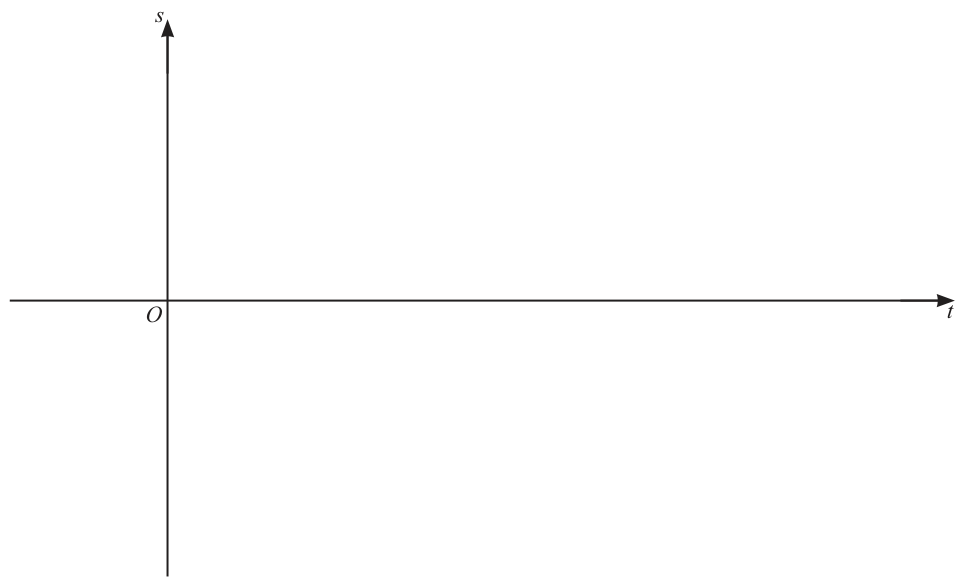
On the axes, sketch the displacement–time graph of , stating the intercepts with the axes.
Approach
Expand to find the -intercept, and read the roots from the factors to place the curve. The repeated factor means the curve touches the -axis at .
Working
Expand the displacement:
Intercepts:
- -intercept: gives , so the curve meets the -axis at .
- -intercepts: gives , so (crossing) and (tangency, since the factor is squared).
Shape: for the cubic starts at , rises through to a local maximum in the first quadrant, falls back to touch the -axis at the minimum , then rises into the first quadrant.
Answer
A cubic curve from crossing the -axis at , with a maximum in the first quadrant, then touching the -axis at before rising. Intercepts: -axis at ; -axis at and (tangent).
Cubic from (0, -16) crossing the t-axis at t = 1, maximum in the first quadrant, touching the t-axis at (4, 0); intercepts (0, -16), (1, 0), (4, 0)
Walkthrough
The displacement is given in factorised form, , which makes the roots easy to read: when or . Crucially, is a squared factor, so at the curve does not cross the axis — it touches it and turns back, giving a point of tangency (which is also a local minimum).
To find where the curve meets the -axis we set : . To be sure of the overall shape we can expand: , a positive cubic, so it rises steeply for large . Between the roots the curve is positive (both factors and have the same sign for ), so it bulges above the axis between and , forming a maximum in the first quadrant. Since , only the part of the curve from onwards is drawn.
Key Takeaways
- A repeated root of even multiplicity means the curve touches the axis (tangency) rather than crossing it.
- The -intercept is found by substituting into the displacement.
- For , only the right-hand portion of the cubic is sketched.
Common Mistakes
- Drawing the curve crossing the -axis at instead of touching it — the mark scheme explicitly requires "a point of tangency to the -axis at the minimum point".
- Forgetting the negative -intercept and starting the curve at the origin.
- Omitting the local maximum between and ; the scheme requires "maximum in the first quadrant".
- Sketching the curve for negative when the domain is .
Things to Be Careful About
- Both marks depend on attempting the correct cubic shape first; intercepts alone score nothing without the shape ("must have attempted the correct shape").
- State the intercepts explicitly as coordinates or values: , , .
- The curve must meet the -axis — start the sketch at , not to the right of it.
Approach
Velocity is the derivative of displacement. Differentiate by the product rule, then factorise.
Working
Using the product rule with and :
Factorise by taking out the common factor :
(Equivalently, expanding and differentiating gives .)
Answer
v = 3(t - 4)(t - 2)
Walkthrough
Velocity is defined as the rate of change of displacement, so . The displacement is a product of two factors of , so the product rule applies: differentiate to get and multiply by the untouched , then add times the derivative of , which is .
The result has a common factor of ; extracting it leaves . So the velocity factorises neatly as .
Alternatively, expanding the cubic first () and differentiating term by term gives , which factorises to the same answer. The question asks for factorised form, so the final answer must be left as .
Key Takeaways
- : velocity is the derivative of displacement with respect to time.
- The product rule: .
- Factorising before or after differentiating both work; the common-factor route is often quicker.
Common Mistakes
- Forgetting the second term of the product rule (writing only ).
- Leaving the answer unexpanded/unfactorised when the question demands factorised form.
- Sign slips when differentiating via the chain rule.
Things to Be Careful About
- The question explicitly says "Give your answer in a factorised form", so alone would not earn the final accuracy mark.
- Both the product-rule route and the expand-then-differentiate route are accepted by the mark scheme; either earns the method mark.
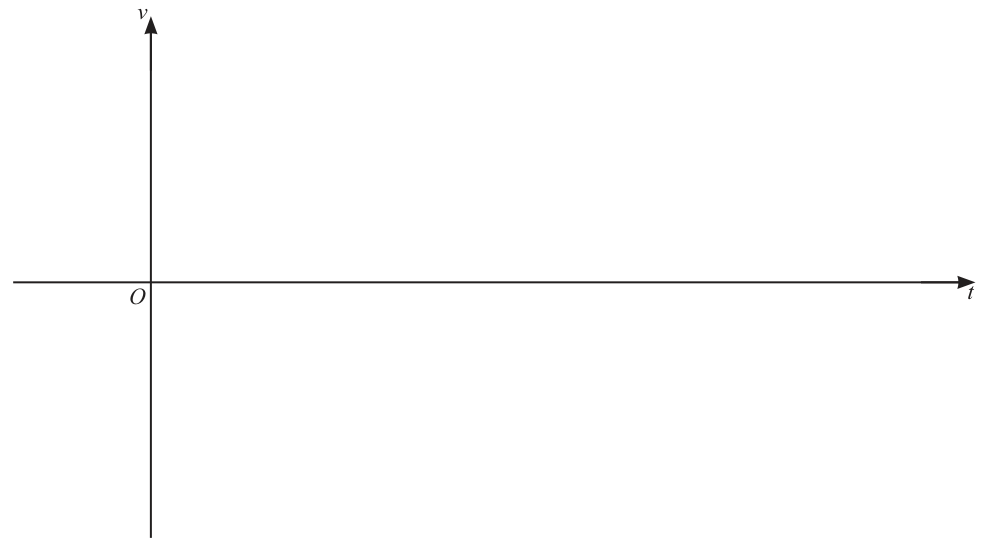
On the axes, sketch the velocity–time graph of , stating the intercepts with the axes.
Approach
The velocity is an upward-opening parabola with roots at and ; find the -intercept and sketch for .
Working
- -intercept: gives , so the curve meets the -axis at .
- -intercepts: gives and .
Since the coefficient of is positive (), the parabola opens upwards. Between and it dips below the -axis, so the minimum lies in the fourth quadrant (at , ).
Shape: from the curve falls, crosses the -axis at , reaches its minimum in the fourth quadrant, crosses again at , and rises into the first quadrant.
Answer
An upward parabola from crossing the -axis at and with its minimum in the fourth quadrant. Intercepts: -axis at ; -axis at and .
Upward parabola from (0, 24) crossing the t-axis at t = 2 and t = 4, minimum in the fourth quadrant; intercepts (0, 24), (2, 0), (4, 0)
Walkthrough
From part (b) the velocity is , a quadratic with a positive leading coefficient, so its graph is a parabola opening upwards. The factors give the -intercepts immediately: at and . The -intercept comes from setting : .
Because the parabola opens upwards and both roots are positive, the section of the curve between the roots (for ) lies below the -axis — this is where the minimum sits, in the fourth quadrant (at , ). For the curve starts high on the -axis at , descends through , bottoms out below the axis, and climbs back through into positive velocity.
Key Takeaways
- The sign of the leading coefficient determines whether a parabola opens up or down.
- Factorised form gives the roots directly; substituting gives the vertical intercept.
- A positive quadratic with two positive roots dips below the axis between them, placing the minimum in the fourth quadrant.
Common Mistakes
- Drawing a downward parabola (misreading the sign of ).
- Giving the wrong -intercept by a sign slip in .
- Placing the minimum above the axis or between the wrong roots.
- Sketching for negative when the domain is .
Things to Be Careful About
- The mark scheme requires the correct quadratic shape first — intercepts alone do not score.
- State all intercepts: on the -axis, and on the -axis.
- The curve must meet the -axis, so begin the sketch at .
Approach
Acceleration is the derivative of velocity. Differentiate term by term.
Working
Answer
a = 6t - 18
Walkthrough
Acceleration is the rate of change of velocity, so . Using the expanded velocity from part (b), differentiate term by term: the derivative of is , the derivative of is , and the constant differentiates to . This gives the linear acceleration .
Key Takeaways
- : acceleration is the derivative of velocity (the second derivative of displacement).
- Differentiating a quadratic gives a linear expression.
Common Mistakes
- Dropping the factor from and writing instead of .
- Leaving the constant in the answer.
- Differentiating the factorised form incorrectly rather than expanding first.
Things to Be Careful About
- The mark scheme allows follow-through from the candidate's own three-term quadratic velocity, so the working in part (b) must be consistent.
- This is a one-mark B1: the answer must be the correct linear expression.
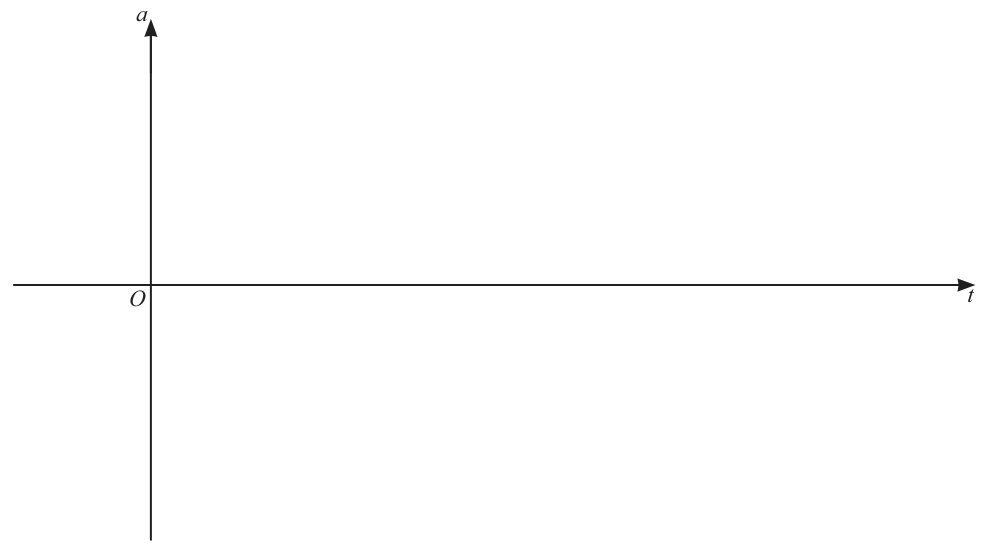
On the axes, sketch the acceleration–time graph of , stating the intercepts with the axes.
Approach
The acceleration is linear, so its graph is a straight line. Find the two intercepts and draw the line for .
Working
- -intercept: gives , so the line meets the -axis at .
- -intercept: gives , so .
The gradient is , so the line rises from , crosses the -axis at , and continues into the first quadrant.
Answer
A ruled straight line of positive gradient from crossing the -axis at and rising into the first quadrant. Intercepts: -axis at ; -axis at .
Ruled straight line from (0, -18) crossing the t-axis at t = 3 with positive gradient; intercepts (0, -18), (3, 0)
Walkthrough
From part (d) the acceleration is , which is of the form with gradient and intercept . Its graph is therefore a straight line. Setting gives the -intercept ; setting gives . Since the gradient is positive, the line climbs from below the axis, crosses at , and continues upward into the first quadrant. Only the part for is drawn, and the mark scheme requires the line to be ruled (drawn with a straight edge).
Key Takeaways
- A linear function of graphs as a straight line whose gradient and intercept are read directly from .
- The -intercept of is .
Common Mistakes
- Plotting the -intercept at or instead of (sign or division slip).
- Drawing a freehand curve instead of a ruled straight line.
- Omitting the negative -intercept .
Things to Be Careful About
- The mark scheme awards follow-through marks from the candidate's own linear acceleration: the -intercept must be and the -intercept .
- The line must meet the -axis and cross the -axis, and both intercepts must be stated.
- This part is worth 3 marks — shape (ruled line, positive gradient), -intercept, and -intercept each carry a mark.
Functions and are such that
Solve the equation .
Approach
The composite function means apply first, then : substitute into . Set the result equal to and solve.
Working
Setting this equal to :
Multiply both sides by :
Squaring both sides:
This satisfies the domain condition , so it is valid.
Answer
x = 2
Walkthrough
The notation means : first apply , then apply to the result. Since , we feed into in place of , giving . Setting this equal to and multiplying both sides by the denominator removes the fraction: . Collecting like terms gives , so . Squaring gives , hence . Finally we check that lies in the domain , which it does, so the solution is valid. (An alternative accepted route is to find , set , and solve .)
Key Takeaways
- means apply first, then — order matters in composites.
- An equation with an unknown inside an algebraic fraction can be solved by multiplying through by the denominator.
- Squaring a square-root equation can introduce extraneous roots, so always check the answer against the domain of the original functions.
Common Mistakes
- Computing instead of — the order of composition is reversed.
- Forgetting to substitute for every occurrence of in (e.g. leaving the denominator as ).
- Squaring incorrectly or forgetting to square at all after reaching .
- Not checking the solution against the domain restriction .
- The mark scheme awards the final mark "nfww" — no marks without correct working — so each step must be shown.
Things to Be Careful About
- The final answer must come from valid working ("nfww"): show the composite being formed and the clearing of the fraction.
- Keep the domain conditions in mind: requires and requires ; the solution satisfies both.
- Give the exact value ; no rounding issues arise here.
Approach
Differentiate by the product rule (with chain rule for each factor), simplify with the double-angle identity , then substitute .
Working
At :
Answer
-4
Walkthrough
The function is a product of two factors, and (or equivalently and ), so the product rule applies: differentiate one factor while holding the other fixed, then swap, and add. Each factor itself contains , so the chain rule gives an extra factor of 2 in each derivative — this is where marks are commonly lost if the inner derivative is forgotten.
The result simplifies neatly because ; here , so the derivative becomes . This simplification is not compulsory but makes the substitution trivial.
Substituting gives angle , whose cosine is (second-quadrant angle), so the derivative equals .
Key Takeaways
- The product rule combined with the chain rule handles products like .
- Recognising collapses the answer to a single term.
- Exact values such as must be known; no calculator rounding is needed.
Common Mistakes
- Forgetting the inner derivative of (writing ), which loses the structure mark.
- Sign slips when differentiating : its derivative is .
- Mis-evaluating as positive instead of .
- Leaving the answer as without evaluating it.
Things to Be Careful About
- The mark scheme requires the full product-rule structure before any credit for the final value, so show the expanded form explicitly.
- Work in radians throughout — the question gives in radians.
- The scheme allows follow-through only on derivatives of the form with positive integers , so keep coefficients integral.
A curve has equation .
The normal to the curve at the point where meets the -axis at the point .
Find the exact coordinates of .
Approach
Use the derivative from part (a). The normal's gradient is the negative reciprocal, . Find the point on the curve at , write the normal's equation, and set to locate .
Working
At :
Gradient of normal:
Equation of the normal through :
At , :
Answer
(π/6 − 4√3, 0)
Walkthrough
This part builds directly on part (a): the tangent gradient there was , so the normal — being perpendicular to the tangent — has gradient .
Next we need the actual point on the curve. Substituting into uses the special values and , giving exactly.
With a point and a gradient, the point–slope form gives the normal's equation: . Since lies on the -axis, set and solve: multiplying both sides by 4 gives , so .
Key Takeaways
- A normal's gradient is the negative reciprocal of the tangent's gradient: .
- Point–slope form is the quickest route to a line's equation.
- An -intercept is found by setting ; a -intercept by setting .
- Exact answers mixing and surds are expected on this paper.
Common Mistakes
- Using the tangent gradient instead of the normal gradient .
- Sign error in the negative reciprocal, e.g. writing instead of .
- Evaluating incorrectly, e.g. forgetting that when substituting.
- Giving a decimal approximation instead of the exact form .
- Dropping the term and answering .
Things to Be Careful About
- The final accuracy mark depends on part (a) being fully correct (or a correct derivative stated here), so carry forward carefully.
- The question demands exact coordinates — leave and unevaluated; decimals score nothing for the final mark.
- Keep radians throughout; the coordinates mix and surds precisely because the working stays exact.
A 4-digit number is to be formed using the digits 0, 2, 4, 5, 6 and 8.
The 4-digit number must not start with 0.
Any digit may be used at most once in the 4-digit number.
Approach
Fill the four positions in turn. The first digit cannot be , so it has choices; the remaining three positions are filled from the unused digits without repetition.
Working
Answer
300
Walkthrough
We build the number position by position. The thousands place is special: cannot go there or the result would not be a 4-digit number, so only the five non-zero digits may be used — that gives choices. Once the first digit is fixed, all six digits are still available except the one used, so the hundreds place has choices, the tens place , and the units place . Multiplying the independent choices gives the total.
Key Takeaways
- Counting arrangements without repetition multiplies the number of choices at each position.
- A restriction on one position (here "not 0") must be handled on that position first.
Common Mistakes
- Using choices for the first digit and forgetting to exclude .
- Dividing by something or subtracting cases unnecessarily — here a single product suffices.
Things to Be Careful About
- The answer is exact (); no rounding issues arise.
- The scheme awards B1 for only, so the product should be visible as working.
Approach
An even number must end in or . Split into two cases: ending in (which frees up all five non-zero digits for the front) and ending in or (where the front digit cannot be or the chosen units digit).
Working
Case 1: ends in . The first three places are filled from the five non-zero digits:
Case 2: ends in or . Choose the units digit ( ways). The first digit cannot be or the units digit, so ways; then and ways remain for the middle two places:
Total:
Answer
252
Walkthrough
Evenness depends only on the last digit, so we fix the units digit first. If it is , the leading-digit problem disappears entirely: any of the five non-zero digits can lead, giving numbers. If instead the units digit is one of (four choices), the first digit now has two forbidden values — and the digit already used at the end — leaving choices, then and for the middle positions, giving . The two cases cannot overlap, so adding them is valid.
Key Takeaways
- When a condition interacts with the "no leading zero" rule, split into cases so each case has a clean count.
- Disjoint cases may be added directly.
Common Mistakes
- Counting by treating every even units digit like the case — this double-counts numbers starting with .
- Forgetting that when the units digit is fixed, the first digit loses two options (zero and the used digit).
- Taking only one of the two cases.
Things to Be Careful About
- The scheme's alternative route (all possible minus those ending in : ) also earns full marks.
- The final answer is cao.
Approach
Divisible by means the number ends in or . Count each case separately and add.
Working
Case 1: ends in . The first three places use the five non-zero digits:
Case 2: ends in . The first digit cannot be or , so ways; then and ways for the middle places:
Total:
Answer
108
Walkthrough
A number is divisible by exactly when its units digit is or , so we split on the last digit. Ending in removes the leading-zero worry: numbers. Ending in means the first digit excludes both and , leaving choices, then and for the middle positions: . The cases are disjoint, so the total is .
Key Takeaways
- Divisibility conditions often pin down the last digit, making case-splitting natural.
- Each case must respect both the no-repetition rule and the no-leading-zero rule.
Common Mistakes
- Treating the two endings symmetrically and writing — wrong, because ending in forbids a leading .
- Forgetting that fixing the units digit removes it from the pool for other positions.
Things to Be Careful About
- The scheme accepts several equivalent routes (e.g. starts-with-5/ends-with-0 splits); any correct decomposition earning scores full marks.
- The answer is cao.
Approach
Write both binomial coefficients in factorial form, cancel the common factors of , and simplify until the equation reduces to .
Working
Divide both sides by (using ):
Since and :
Cancel and from both sides:
so
Taking the positive square root (since for the combinations to be defined):
Answer
n = 65
Walkthrough
The equation mixes binomial coefficients with algebraic factors, so the first job is to rewrite and as factorials. Expanding as lets us cancel across the equation, and expanding together with lets us cancel and too. What survives is remarkably clean: . Since must be large enough for the combinations to exist, is positive, so we take the positive root , giving . Note the negative root would be rejected anyway because appears on both sides and the original coefficients require .
Key Takeaways
- Converting to factorials is the standard way to solve equations involving binomial coefficients.
- Systematic cancellation of shared factorial blocks turns a messy equation into a simple one.
- Domain restrictions ( here) select the valid root.
Common Mistakes
- Writing with the wrong factorial pattern, e.g. misplacing the term.
- Failing to spot that cancels, and trying to expand everything instead.
- Keeping the negative root , which is invalid since binomial coefficients need .
- Arithmetic slips in ; it equals , and .
Things to Be Careful About
- The scheme marks the simplified equation as B2 nfww — it must come from correct working, not backwards substitution.
- The final B1 for is dependent on earning the B2, and must be the only solution given.
- Check the domain: comfortably satisfies .
The volume, , of a sphere is increasing at the constant rate of .
Find the rate of change of the surface area, , of this sphere when the volume of the sphere is .
Approach
The volume , radius and surface area of the sphere are all functions of time . Use the chain rule to connect to , then to .
Working
First find the radius when :
Differentiate both formulas with respect to :
At :
Using the chain rule with :
Then:
Answer
4.19 cm^2 s^-1 (exactly 4π/3)
Walkthrough
The question gives a rate () and asks for another rate (), but there is no direct formula linking to . The bridge is the radius: both and are simple functions of , so we go through using the chain rule.
First we need the actual value of at the moment in question. Setting gives , so cm. This value is needed because all the derivatives below depend on it.
Next differentiate the two standard formulas:
- Volume: gives , which at is .
- Surface area: gives , which at is .
The chain rule then links everything. Since , we get cm per second — the radius is growing slowly because the sphere is already large.
Finally, .
Key Takeaways
- Related-rates problems are solved by chaining derivatives through an intermediate variable (here ).
- You must evaluate every derivative at the specific instant given — here found from the volume condition.
- Knowing the standard results and and their derivatives is essential.
Common Mistakes
- Forgetting to find first and leaving answers in terms of — the mark scheme requires the numerical value "stated or very clearly implied" (nfww).
- Confusing with when applying the chain rule — the reciprocals must be handled correctly.
- Using but differentiating incorrectly, or mixing up which derivative multiplies which.
- Giving a decimal without showing the exact substitution — method marks require the working to be visible.
- Rounding too early; the accepted decimal forms are or to .
Things to Be Careful About
- The answer may be left as the exact form (isw applies after that), or as a decimal rounding to .
- Every mark-scheme step must appear: the value , both derivatives with their values, the correct chain-rule statement including , and the final multiplication.
- Units: the rate of change of surface area is in since is an area.
- Answers reached from wrong working score nothing (nfww on ).
The first three terms of an arithmetic progression can be written as
Given that , find the least number of terms for the sum of this progression to be greater than .
Approach
Use to write every term as a multiple of , identify and of the AP, then set up the sum-to--terms inequality.
Working
Using the laws of logarithms:
So the AP has first term and common difference .
The sum of terms must exceed :
Since , , so divide both sides by :
Divide by 2 and solve the quadratic equation :
The quadratic is positive for , so the least whole number of terms is .
Answer
22
Walkthrough
Each term is a logarithm of a power of , so the power law converts all three terms into multiples of one quantity, : they become , , . The differences are both , confirming this really is an arithmetic progression with first term and common difference .
The target is . Substituting into gives an inequality in which every term contains . Because we know , so dividing through by is safe and leaves a pure quadratic inequality: .
Solving the corresponding equation gives a positive root of about , so the inequality holds once . Since counts terms, it must be a whole number, giving the least value .
Key Takeaways
- Logarithm laws can turn a 'log-flavoured' progression into an ordinary numerical AP whose first term and difference are multiples of .
- Dividing an inequality by is only valid because guarantees ; if the sign would flip.
- A quadratic inequality in needs the positive root found, then rounding up to the next integer when the inequality is strict.
Common Mistakes
- Mis-simplifying the terms, e.g. writing as instead of — the mark scheme requires consistent powers of throughout.
- Forgetting that justifies dividing by without reversing the inequality.
- Taking the positive root itself, or rounding down to : the answer must be exactly ('cao, nfww').
- Sign slips forming , e.g. dropping the factor of 2 from .
- Using the wrong target, e.g. read as .
Things to Be Careful About
- The final answer is cao and nfww: scores nothing if reached from incorrect working.
- Show the substituted sum formula before simplifying — the M marks are for identifying and correctly and using them in .
- Keep exact working where possible; the root is only used to decide the integer, not as the answer.
- All solutions/conditions matter: state why before cancelling it.
Given that the 25th term of this progression is equal to 408, find the exact value of .
Approach
Carry forward and from part (a), form the 25th term, equate it to 408 and solve for .
Working
Using with and :
Given :
Converting to exponential form:
Answer
x = e^4
Walkthrough
This part reuses the results from part (a): the progression has first term and common difference . The 25th term follows from , giving .
Setting this equal to 408 gives a simple linear equation in : dividing by 102 yields . Exponentiating both sides converts this to , which is the exact value required.
Key Takeaways
- The nth-term formula applied with symbolic first term and difference still produces a clean linear equation.
- rearranges to — keep answers in exact exponential form unless told otherwise.
Common Mistakes
- Using instead of in the nth-term formula (writing ).
- Giving a decimal approximation such as instead of the exact — the mark scheme demands the exact form.
- Arithmetic slips collecting or dividing .
- Confusing with .
Things to Be Careful About
- The B1 is for a correct expression for as a genuine AP term; show the substitution before simplifying.
- The final answer must be the exact value (A1), not a rounded decimal.
- This part depends on the values of and established in part (a), so any error there carries through (the M1 is follow-through on a valid AP expression).
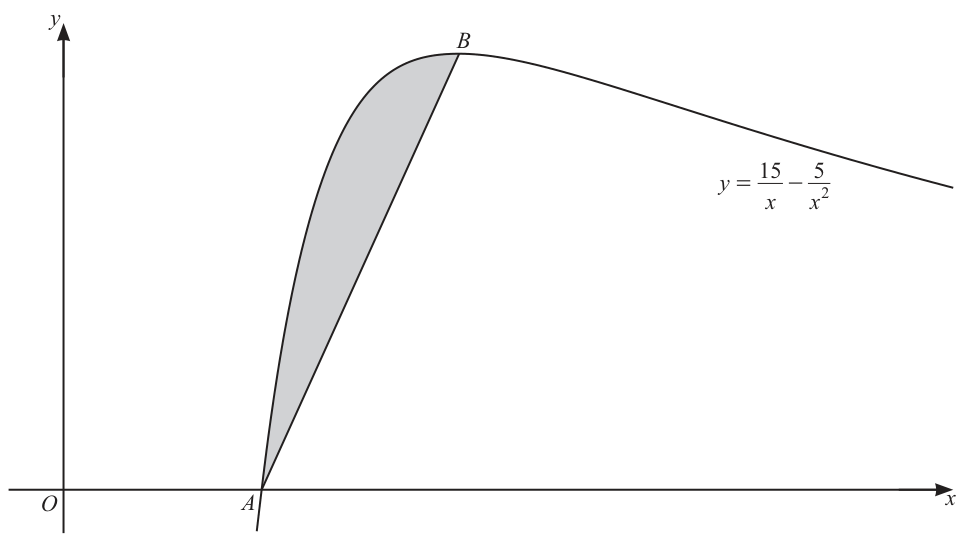
The diagram shows part of the curve .
The curve meets the -axis at the point .
The curve has a maximum at the point .
Find the area of the shaded region enclosed by the line and the curve.
Give your answer in exact form.
Approach
Find the -coordinate of by setting . Find the maximum point by differentiating and solving . The shaded area equals the area under the curve from to minus the area of the triangle formed by the chord and the -axis.
Working
Point : the curve meets the -axis where :
Point : differentiate:
At the maximum :
Then
so .
Area under the curve from to :
Area of the triangle under the chord :
Shaded area:
Answer
15 ln 2 - 75/8
Walkthrough
First we locate the two points that define the shaded region. Point is where the curve crosses the -axis, so we set : multiplying through by gives , hence .
Point is the maximum, so we differentiate. Writing and applying the power rule gives . Setting this to zero and multiplying by gives , so . Substituting back gives , so .
The shaded region sits between the curve and the straight chord . The standard strategy is: area under the curve minus area of the triangle formed by the chord and the -axis. The chord runs from up to , so the triangle has base and height , giving area .
The area under the curve uses the two standard integrals: and . Evaluating between the limits:
Subtracting the triangle's area and simplifying the logarithms with the quotient law, , and the rational terms give . The exact answer is .
Key Takeaways
- To find where a curve meets the -axis, set ; for rational functions, multiply through by the denominator (noting ).
- Stationary points come from solving ; negative powers differentiate by the power rule.
- Area between a curve and a chord = area under the curve (definite integral) minus the triangle under the chord, .
- and .
- Laws of logarithms () convert into the clean exact form .
Common Mistakes
- Forgetting to subtract the triangle under the chord, giving just the area under the curve.
- Getting the sign wrong on : it is , not .
- Writing and mishandling the modulus, or dropping the entirely.
- Arithmetic slips when evaluating at the limits: and .
- Giving a decimal answer (e.g. ) when the question demands exact form — the mark scheme requires .
- Sign errors in the final combination: the rational terms sum to , not .
- The final A1 is dependent on all previous marks being awarded, so an error anywhere upstream loses it.
Things to Be Careful About
- The answer must be in exact form: (equivalently is accepted as an exact equivalent since terminates, but the logarithm must remain as ).
- The mark scheme marks the derivative with B2 (one mark per correct term), then M1 for solving , then A2 for the coordinates of — show every step.
- The integration step carries B2 (one mark for , one for ), and the substitution of limits is a separate M1 — write the bracketed evaluation explicitly.
- The final A1 is dependent on all previous marks, so accuracy throughout matters, not just at the end.
- Keep fractions exact (, , ) rather than decimals during working to avoid rounding errors.
- Note throughout, so is well defined on the interval of integration.
Approach
Rewrite the equation in sines and cosines, rearrange to , find all values of in , then divide by 3.
Working
Cross-multiplying:
The basic angle is . Since , we need . The tangent is positive in the first and third quadrants, giving:
Dividing each by 3:
Answer
x = -110, -50, 10, 70 (degrees)
Walkthrough
The equation mixes secant and cosecant, so the first move is to rewrite both in terms of sine and cosine: and . That gives , which this mark scheme awards B1 for on its own.
Cross-multiplying brings everything into one ratio: . Dividing by (valid because would make the original equation undefined) turns it into a single tangent equation, , worth B2.
The reference angle with tangent is . Because the argument is and runs from to , the argument must run over a full sweep of to — twice the usual circle. Tangent is positive in the first and third quadrants, so within that sweep we get (M1).
Finally divide every value by 3 to undo the triple angle: , all of which lie inside the required interval, and there are no extras (A2).
Key Takeaways
- Convert sec and cosec to sine and cosine before solving — most trig equations become manageable once written in sin and cos only.
- When the argument is a multiple like , extend the solution interval by that factor: means .
- Divide by the multiple only at the very end, after all angles have been found.
Common Mistakes
- Solving only for and missing the negative-angle solutions and .
- Dividing by 3 too early, e.g. writing , which is wrong.
- Dividing the equation by without noting why no solutions are lost.
- Including extra angles such as whose thirds fall outside the interval.
- The A marks are 'no extras in range': listing a wrong extra angle loses accuracy marks even if the correct ones are present.
Things to Be Careful About
- The interval check must be done on , not on : generate all valid triple angles first.
- Answers are exact here (); no rounding issues arise, but all four values are required for full credit.
- The mark scheme allows radians for the M1 step, but degrees keep the arithmetic cleanest since the final answers are printed in degrees.
Approach
Factorise out to split the equation into two simpler equations, solve each for the compound angle, then subtract .
Working
Case 1:
Since , we have , so:
Case 2:
Within :
Answer
y = 0, 2π/3, 4π/3, 5π/3
Walkthrough
Both terms contain the factor , so instead of dividing by it (which would lose solutions), bring everything to one side and factorise:
A product is zero when either factor is zero, giving two cases.
Case 1: (B1). Sine vanishes at multiples of . The compound angle ranges over because starts at , not at — so the admissible zeros are and (M1). Subtracting gives and .
Case 2: (B1). Cosine equals at plus multiples of ; within the shifted interval the valid values are and . Subtracting gives and .
All four values lie in (A2, nfww).
Key Takeaways
- Never divide an equation by a trig factor — factorise instead, or you silently discard solutions.
- When the argument is , shift the interval endpoints by before listing candidate angles.
- Solve each factor of a product as its own equation and combine all results.
Common Mistakes
- Cancelling from both sides, losing the two roots and entirely.
- Forgetting that starts at , not , and wrongly including (which would give negative ).
- Missing the second cosine solution (i.e. taking only the principal value).
- Subtracting incorrectly, e.g. computing as instead of .
- Giving decimal approximations instead of exact multiples of .
Things to Be Careful About
- The answer must be exact ('oe' accepted but nfww — nothing scores from wrong working).
- Check every final value against ; note itself is excluded.
- Both factors must be solved — the mark scheme awards separate B1s for each factor set equal to zero, so omitting either case caps the score.
The first three terms, in descending powers of , in the expansion of can be written as , where , and are constants.
Find the values of , and .
Approach
Expand as far as the third term using the binomial theorem, expand fully, multiply matching powers of , and equate coefficients with .
Working
First term: the only way to get is :
Expansion of (first three terms):
Expansion of :
Multiply and collect by power of .
Coefficient of : ✓.
Coefficient of :
Coefficient of :
More explicitly, the terms come from , from , and from :
With :
Answer
n = 6, a = 1/3, b = -108
Walkthrough
The expression is a product of two binomial powers. To reach in the final answer, we need the highest power of the first factor times the constant of the second: . Setting this equal to gives , and since , we get .
Next we expand far enough to capture all contributions down to . The binomial theorem gives the first three terms:
The second factor is a simple square: .
Now multiply. The coefficient of receives two contributions: (from the second term of the first expansion times the constant 1) and . Equating their sum to 972 gives , so and .
The coefficient of receives three contributions: , , and . So . Substituting : .
Key Takeaways
- Matching the highest-degree term of a product of expansions pins down an unknown index immediately.
- When multiplying two expansions, each coefficient of the product collects contributions from several pairs of terms — track them by power of systematically.
- The binomial coefficient formula with signs carried inside is essential for the general-term approach.
- Unknowns must be found in order: first, then from the next coefficient, then — each depends on the previous one.
Common Mistakes
- Forgetting the sign alternation: writing instead of because was treated as positive; the scheme's answers are cao/nfww, so wrong working scores nothing even if numbers look close.
- Omitting the contribution of the second factor's and terms to the and coefficients — many candidates equate only the first expansion's terms.
- Using incorrectly or computing wrongly when forming the third term.
- Solving for before finding , or substituting the wrong value of into .
- Writing but mis-evaluating the power (e.g. taking ).
Things to Be Careful About
- The mark scheme states nfww (no follow-through from wrong working): every value must come from correct algebra, not adjusted guesses.
- Keep but — sign discipline throughout.
- All three values (, , ) are required; partial answers score only partially (B2/B2/B2 split across the parts).
- Check the final by substituting back: with the full coefficient equation should hold exactly.