Additional Mathematics 4037/21 — May/June 2025
Cambridge O-Level · Calculator · worked solutions for every part, with the mark scheme
Topics Quadratic functions · Calculus · Series · Equations, inequalities and graphs · Permutations and combinations · Straight-line graphs · +3 more
A curve has equation .
Use the method of completing the square to find the coordinates of the stationary point on the curve.
Approach
Complete the square on ; the squared bracket is zero at the stationary point, so the vertex is read directly from the completed-square form.
Working
Take half of the coefficient of and square it:
So
The minimum occurs when , i.e. when , giving .
Answer
(-1, -4)
Walkthrough
Completing the square rewrites a quadratic as a squared term plus a constant. For , we take half the coefficient of , which is , and write . Expanding gives , which is one more than what we want, so we subtract 1: . Substituting back, .
Since for all real , the smallest possible value of is , reached exactly when , that is . So the stationary point is .
Key Takeaways
- Completing the square converts into vertex form, from which the turning point can be read without differentiating.
- The vertex of is at — note the sign flip in the -coordinate.
Common Mistakes
- Writing the -coordinate as instead of : the vertex of sits where , so .
- Forgetting to subtract the squared half-coefficient () after forming .
- Dropping the constant when combining terms.
Things to Be Careful About
- The mark scheme awards B2 for the fully correct completed-square form (or equivalent), and only B1 if you stop at with an unspecified constant — so finish the constant.
- The answer must come from completing the square as instructed; the coordinates are cao (correct answer only).
Approach
Find the intercepts by factorising and substituting , then sketch the upward-opening parabola with its minimum at from part (a).
Working
Factorise:
So when or : the curve crosses the -axis at and .
When : , so the curve crosses the -axis at .
From part (a), the minimum point is , which lies in the third quadrant.
Answer
An upward-opening parabola crossing the -axis at and , crossing the -axis at , with its minimum at in the third quadrant.
Upward parabola with x-intercepts -3 and 1, y-intercept -3, minimum (-1, -4) in the third quadrant
Walkthrough
To sketch the parabola we need its key features. The coefficient of is positive, so it opens upwards. Factorising gives , so the roots are and — these are where the curve cuts the -axis. Setting gives , the -intercept. Part (a) already located the minimum at , which lies below the axis between the two roots, in the third quadrant. Plotting these four features and joining them with a smooth U-shaped curve completes the sketch.
Key Takeaways
- A quadratic sketch needs: direction of opening, both -intercepts, the -intercept, and the turning point.
- The roots of come straight from factorising; the -intercept is just the constant term .
Common Mistakes
- Marking the -intercept as instead of (sign slip on the constant).
- Drawing the parabola opening downwards despite the positive coefficient.
- Omitting one of the three intercepts — the mark scheme requires all of on the -axis and and on the -axis.
- Placing the minimum outside the third quadrant or drawing a curve confined to fewer than four quadrants.
Things to Be Careful About
- The first B1 requires the correct shape spanning all four quadrants with the minimum in the third quadrant; the second B1 requires the three intercepts clearly marked.
- This is a sketch, not a plot: a smooth freehand curve through correctly placed key points is expected, but every labelled point must be present.
In this question, is a constant.
It is given that has roots that are real and distinct.
Find the set of possible values of .
Approach
For real and distinct roots, the discriminant . Apply this to the given quadratic in , then solve the resulting quadratic inequality in .
Working
For , we have , , . Real and distinct roots require:
Factorise:
Critical values: and . Since the quadratic opens upwards, it is positive outside the roots:
Answer
k < 2/9 or k > 2
Walkthrough
The condition for a quadratic to have two real, distinct roots is . Here , and , so we form .
Expanding and subtracting gives the three-term quadratic . This factorises as .
The critical values are where each factor is zero: and . Since the parabola opens upwards, it is positive outside the interval between the roots, giving or .
Key Takeaways
- Real and distinct roots ⟺ ; equal roots ⟺ ; no real roots ⟺ .
- A quadratic inequality with an upward-opening parabola is satisfied outside the roots.
- Always identify , , carefully when itself contains the unknown constant.
Common Mistakes
- Using (equal roots) instead of (distinct roots).
- Sign errors expanding , e.g. writing and dropping the middle term.
- Giving — the inequality direction is reversed because the parabola opens upwards.
- Forgetting to divide by correctly when solving .
- The mark scheme marks the final answer, so the correct inequality signs are essential; a correct discriminant with wrong inequalities loses the last mark.
Things to Be Careful About
- The discriminant step earns the first method mark even with any inequality sign or equals, but the final answer must have the correct strict inequalities.
- Present the answer as a union of two regions: or ; writing a single interval between the values is wrong.
- Keep exact fractions: , not a decimal.
A sports club has the following members.
These members stand in a straight line.
Find the number of ways that this can be done when all the runners stand together, all the swimmers stand together and all the gymnasts stand together.
Approach
Keep all runners together, all swimmers together and all gymnasts together by treating each discipline as one block. Arrange the blocks, then arrange the members inside each block.
Working
Number of arrangements of the blocks:
Arrangements within the blocks:
Total number of ways:
Answer
103680
Walkthrough
The condition that all runners stand together, all swimmers stand together and all gymnasts stand together is handled by the 'block' method: glue each group into a single unit. There are then just units to line up, which can be done in orders. But the people inside each glued unit can still be shuffled among themselves: the runners in ways, the swimmers in ways, and the gymnasts in ways. Since every choice of block order combines independently with every internal ordering, multiply all four factorials together.
Key Takeaways
- When specified items must stay together, treat them as one block, arrange the blocks, then arrange within each block.
- The total is a product because the stages are independent choices.
Common Mistakes
- Forgetting to permute the blocks themselves ( instead of ), giving .
- Adding the factorials instead of multiplying them.
- Treating members within a group as indistinguishable and omitting the internal permutations.
Things to Be Careful About
- The answer must be the exact integer ; the mark scheme allows any multiplier times , but only satisfies the stated condition correctly here.
- Show the product structure clearly so the method mark is visible.
Four of these members are selected for an event.
Find the number of ways that this can be done when at least one runner, at least one swimmer and at least one gymnast must be selected.
Approach
Selecting members with at least one runner, one swimmer and one gymnast means the composition must be in some order. The possible splits are: 2 runners + 1 swimmer + 1 gymnast, or 1 runner + 2 swimmers + 1 gymnast, or 1 runner + 1 swimmer + 2 gymnasts. Count each with combinations and add.
Working
Case 1 — two runners, one swimmer, one gymnast:
Case 2 — one runner, two swimmers, one gymnast:
Case 3 — one runner, one swimmer, two gymnasts:
Total:
Answer
270
Walkthrough
Since we need at least one member from each of the three disciplines and only people are chosen, the extra person beyond the compulsory one-per-group must come from one of the disciplines. So there are exactly three possible compositions: an extra runner, an extra swimmer, or an extra gymnast. Each composition is counted using combinations (order does not matter when selecting for an event), and since the cases are mutually exclusive, the counts are added.
Key Takeaways
- 'At least one of each' with a fixed total forces a small set of compositions — enumerate them as disjoint cases.
- Use for selections where order does not matter, and add counts of mutually exclusive cases.
Common Mistakes
- Using permutations instead of combinations (multiplying by extra factors), which gives answers like — the mark scheme awards SC1 for .
- Missing one of the three cases, e.g. forgetting the two-gymnast case, giving — also SC1.
- Double-counting by treating the 'extra' person as special rather than simply choosing 2 from that group.
Things to Be Careful About
- The three cases are exhaustive and disjoint: check they sum consistently before adding.
- The final answer must be exactly ; wrong-working answers such as or score no marks beyond the single SC mark.
The coordinates of points , , and are as follows.
The line has equation .
The perpendicular bisector of the line meets at the point .
Find the area of triangle .
Approach
Find the perpendicular bisector of (its gradient is the negative reciprocal of and it passes through the midpoint of ), intersect it with to get , then compute the area of triangle from the coordinates.
Working
Gradient of :
Perpendicular gradient:
Midpoint of :
Equation of the perpendicular bisector:
Intersect with : .
Area of triangle with , , :
Answer
40
Walkthrough
The question builds the point in stages. First we need the perpendicular bisector of , which is the line through the midpoint of with gradient perpendicular to .
The gradient of uses difference in over difference in : . Perpendicular lines have gradients whose product is , so the perpendicular gradient is the negative reciprocal, .
The midpoint averages the coordinates: .
Using with at gives the bisector .
is where this meets : . Equating the two expressions for and clearing the fraction by multiplying by 6 gives , so and , giving , i.e. .
Finally the area of the triangle with vertices , , is computed with the coordinate (shoelace) formula, giving .
Key Takeaways
- Perpendicular gradients multiply to : flip the fraction and change the sign.
- A perpendicular bisector needs both the midpoint and the perpendicular gradient.
- Intersections of two lines are found by equating their expressions.
- The area of a triangle from three coordinates is .
Common Mistakes
- Sign slips in , which must give , not .
- Forgetting the negative in the negative reciprocal, giving instead of .
- Using the midpoint of the wrong pair of points, or using a point like or instead of the midpoint (the mark scheme explicitly disallows this).
- Arithmetic errors when clearing the fractions in ; multiplying everything by 6 avoids this.
- Dropping the modulus (absolute value) in the area formula, or halving incorrectly.
- The final area mark is dependent on all previous marks, so an early error in loses the area mark too.
Things to Be Careful About
- The mark scheme awards the perpendicular-gradient mark only if the gradient of was attempted as difference in over difference in .
- The midpoint must be the actual midpoint of — using , , or scores no mark.
- The area mark is 'dependent on all previous marks', so every earlier step must be correct for the final 40 to score.
- Keep exact fractions throughout; the answer 40 is exact and 'cao' applies.
Given that , use calculus to find the approximate change in as increases from to , where is small.
Approach
Differentiate using the product rule together with the chain rule for , evaluate the derivative at , and multiply by the small increment .
Working
Using the chain rule:
By the product rule:
At , so that with and :
For small , the small-change relationship gives
Answer
1.94h
Walkthrough
The question asks how much changes when increases by a tiny amount . The tool for this is the derivative: since measures the rate of change of with respect to , a small change in produces an approximate change , evaluated at the starting point .
First we need the derivative. The function is a product of two factors, and , so the product rule applies: differentiate each factor in turn while keeping the other fixed. Differentiating gives . Differentiating needs the chain rule: the derivative of is , and with we must multiply by , giving . Putting these together:
Next, substitute . Then , a special angle where and , so . Substituting:
Finally, multiplying this rate by the small increment gives the approximate change in : .
Key Takeaways
- The product rule handles products of different function types such as a polynomial times a trigonometric function.
- Chain rule inside trig functions: always multiply by the derivative of the inner argument, here the factor from .
- The small-change approximation estimates increments without recomputing the whole function.
- Special angles () allow exact evaluation before rounding to 3 significant figures.
Common Mistakes
- Forgetting the factor when differentiating — writing just loses the B1 mark.
- Misapplying the product rule, e.g. multiplying the derivatives instead of cross-multiplying ( alone).
- Evaluating at the wrong point, or substituting instead of into the derivative.
- Forgetting to multiply by at the end, leaving just the number as the answer.
- Rounding intermediate values too early instead of carrying exact forms like through to the final 3-significant-figure coefficient.
Things to Be Careful About
- The final answer must be expressed as a multiple of — the mark scheme's A1 is dependent on both the correct derivative (B2) and the correct small-change relationship (M1), so all three ingredients must appear.
- Work in radians throughout: the argument is a radian measure, and the special-angle values used are radian-based.
- Give the coefficient to 3 significant figures: (awrt ).
- 'oe' on the derivative means any equivalent correct form is accepted, but the structure of the product rule must be visible for the M1 FT mark.
Using an appropriate quadratic factorisation, find the first three terms in the binomial expansion of , in ascending powers of .
You must simplify your coefficients.
Approach
First, factorise the quadratic expression inside the bracket as a perfect square: .
Then apply the outer power of using index laws: .
Finally, expand in ascending powers of up to the term in .
Working
Factorising the quadratic base:
Raising to the power :
Expanding in ascending powers of :
Calculating each term:
Combining the first three terms:
Answer
1024 + 15360x + 103680x^2
Walkthrough
- Factorise the base: We are instructed to use an appropriate quadratic factorisation. Notice that is a perfect square trinomial, .
- Simplify using index laws: Raising to the power gives .
- Apply the binomial theorem: We write the binomial expansion in ascending powers of :
Here, , , and .
4. Evaluate each term:
- Constant term:
- Linear term:
- Quadratic term:
- State the simplified sum: Add these three terms together to get .
Key Takeaways
- Always look for algebraic simplifications before expanding high powers of polynomials.
- Perfect squares of the form simplify trinomial powers into standard binomial expansions.
- Remember that ascending powers means starting from the constant term () and going up.
Common Mistakes
- Expanding in descending powers of (e.g. starting with ), which does not answer the question's request for "ascending powers of ".
- Forgetting to square the coefficient in , writing instead of .
- Leaving terms as an unsummed list rather than a polynomial expression.
Things to Be Careful About
- Ensure powers of 2 and binomial coefficients are correctly evaluated and fully simplified without arithmetic slips.
Approach
Write down the general term in the expansion of . Determine the value of that makes the overall power of equal to zero (the term independent of ), then calculate the numerical value of that term.
Working
The general term in the expansion is:
Separating coefficients and powers of :
For the term independent of , the power of must be :
Substitute into the coefficient:
Answer
51963120
Walkthrough
- General term formula: The general term of is . Here , , and .
- Find the power of : Multiplying the powers of gives .
- Solve for : A term is "independent of " when the power of is . Setting yields .
- Evaluate the constant coefficient: Substitute into :
- Total product: .
Key Takeaways
- "Independent of " means the constant term ().
- Finding the general term in index form and solving for the power of avoids expanding unnecessary terms.
Common Mistakes
- Forgetting to apply the exponent to the constants in each term (e.g. forgetting or ).
- Sign errors when working with negative powers, such as writing instead of .
Things to Be Careful About
- Ensure the final answer is a single integer without any attached.
The function is defined by for .
On the axes, sketch the graph of and hence, on the same axes, sketch the graph of .
Show clearly
- the positions of any points where your graphs meet the coordinate axes
- the positions of any asymptotes.
Approach
The function is an exponential decay curve: as increases, decreases towards , so the curve falls towards the horizontal asymptote . Its inverse is obtained by reflecting this graph in the line , which swaps every point for — so the -intercept becomes an -intercept and the horizontal asymptote becomes a vertical one.
Working
For :
- At : , so the curve crosses the -axis at .
- As , , so there is a horizontal asymptote at .
- The curve is decreasing, starting high on the left (in the second quadrant it rises steeply) and flattening towards in the first quadrant.
For , reflect in :
- The point reflects to , so the inverse crosses the -axis at .
- The asymptote reflects to a vertical asymptote at .
- The reflected curve rises steeply near and then flattens out to the right.
Answer
A decreasing exponential curve through approaching the horizontal asymptote , together with its reflection in : a curve through approaching the vertical asymptote . The line itself need not be drawn.
Decreasing exponential curve through (0, 5) with horizontal asymptote y = 3, and its reflection in y = x through (5, 0) with vertical asymptote x = 3
Walkthrough
The equation tells us three things immediately. First, because decreases as increases, the whole curve is decreasing. Second, substituting gives , so the curve meets the -axis at — the mark scheme awards a specific mark for showing this point. Third, since as , the term vanishes and the curve approaches the line ; this horizontal asymptote earns another mark.
An inverse function's graph is always the mirror image of the original in the line , because swapping input and output swaps coordinates. So instead of computing explicitly, we simply reflect: the intercept becomes , and the horizontal asymptote becomes the vertical asymptote . The mark scheme allows the reflection of your curve, so even if your first sketch is slightly imperfect, a faithful reflection still scores that final mark.
Key Takeaways
- An exponential of the form has horizontal asymptote and -intercept .
- The graph of is the reflection of the graph of in the line ; intercepts and asymptotes swap axes under this reflection.
- Sketches are marked on features: correct shape, labelled intercepts, labelled asymptotes.
Common Mistakes
- Drawing an increasing exponential ( shape) instead of the decay shape demanded by — the B1 for shape is lost.
- Omitting or mislabelling the intercept , e.g. writing or instead of .
- Forgetting to state the asymptote , or drawing the curve crossing it.
- Reflecting incorrectly, e.g. reflecting in the -axis or -axis instead of the line ; the scheme gives a maximum of B3 if the pair of graphs is not fully correct.
- Not labelling which curve is which.
Things to Be Careful About
- Both curves must be on the same axes, each clearly identified.
- The asymptote must be shown as a dashed line or clearly indicated, and the curve must visibly tend towards it without crossing.
- The reflection mark is follow-through on your own curve, but the intercept and asymptote marks require the correct shape to have been attempted first.
- The line does not have to be drawn, though drawing it lightly can help you reflect accurately.
The function is defined by for .
Given that exists, find an expression for and state its domain.
Approach
Write , rearrange to make the subject, take natural logarithms to get in terms of , then swap variables. The domain of is the range of over .
Working
Let . Rearranging:
Taking natural logarithms and swapping variables:
Domain: is increasing, with , and as , so (never reaching it). Hence the range of is , so:
Answer
g^-1(x) = ln(3/(2-x) - 2), domain 1 <= x < 2
Walkthrough
To find an inverse we start from and solve for . The obstacle is that sits inside an exponential, so we isolate step by step: move the fraction across, invert both sides, subtract the , and combine into a single fraction to get . Taking natural logarithms of both sides then frees , giving ; swapping the variable names yields .
The domain of equals the range of . Since is defined only for , evaluate at the endpoint: . As grows, grows, so shrinks towards and climbs towards without ever reaching it. So the range is , giving the domain .
Key Takeaways
- To invert a function containing , isolate the exponential and take of both sides.
- Domain of the inverse = range of the original function; check endpoints of the restricted domain carefully, noting whether each end is included.
- A fraction like can be combined over a common denominator as an equivalent form.
Common Mistakes
- Sign slips when rearranging: e.g. writing or losing the minus sign on the .
- Forgetting to swap variables after solving for in terms of (the scheme accepts either route provided the swap happens).
- Giving the domain as or — the endpoint is included (since ) and is excluded (asymptote); the scheme awards B2 only for or equivalent, B1 for a partially correct bound such as alone or alone.
- Stating the domain of () instead of the domain of .
- Simplifying incorrectly afterwards — later mis-simplification is ignored (isw), but the printed form must be reached correctly first.
Things to Be Careful About
- The full answer needs all three elements: the rearranged exponential form (M1), the correct logarithmic expression (A1), and the complete domain (B2). An incomplete domain caps at B1.
- Equivalent forms of the answer are accepted (oe): or are fine.
- Check the direction of each inequality: exactly, so is included; is approached but never attained, so it is excluded.
Approach
The product is zero when either factor is zero. Solve each within .
Working
Either factor may be zero:
From , with :
From :
Both values lie in the given interval and there are no others.
Answer
x = pi/2 or x = 0.983
Walkthrough
The equation is a product of two factors set equal to zero, so at least one factor must vanish — this is the same logic as solving . Setting gives as the only solution in the interval (note that is excluded because the interval is strict at the lower end). Setting the second factor to zero gives ; since , this means , and taking the inverse tangent gives radians. Both solutions lie inside , so both are reported.
Key Takeaways
- A product equals zero exactly when one of its factors equals zero.
- converts a cotangent equation into a tangent equation.
- Radian-mode working is essential throughout this question.
Common Mistakes
- Dividing through by instead of treating the product as zero — this loses the solution entirely.
- Including from : the interval is , so it is excluded.
- Working in degrees instead of radians.
- Inverting incorrectly (writing ).
- The mark scheme penalises extra solutions in range (A2 only with none extra).
Things to Be Careful About
- Both solutions are required; giving only one scores A1 at most.
- Give exactly and to 3 significant figures.
- Check every candidate solution lies in before reporting it.
Approach
Write everything in terms of , solve the resulting quadratic, then find all angles in the range corresponding to , i.e. , and finally convert back to .
Working
Since with :
Multiply through by :
Factorise:
So or .
The interval corresponds to .
For :
For :
All four values lie in . Converting back via :
Answer
theta = -0.865, -0.374, 0.944, 1.44
Walkthrough
The equation mixes and . Using puts everything into one trigonometric function. Multiplying through by turns the equation into a quadratic in , which factorises neatly as , giving or .
Next we need every angle with (obtained by multiplying the bounds by 2 and adding 1). For the principal value is rad, and the sine graph symmetry gives the second solution rad. For the negative solution is rad, and the other solution in range is rad. All four lie between and .
Finally each angle is converted back with , giving , , and respectively.
Key Takeaways
- Rewrite reciprocal functions (, , ) in terms of the basic functions before solving.
- Multiplying by converts a cosec/sin mixture into a quadratic in .
- When the argument is a linear function like , transform the interval bounds first, solve for the argument, then invert the transformation.
- Sine symmetry: if is a solution of , so are and .
Common Mistakes
- Solving for directly with on without dividing by 2 afterwards.
- Missing solutions: taking only the principal value of each inverse sine instead of using the symmetry of the sine graph over the full transformed interval .
- Including out-of-range angles such as or , which fall outside .
- Sign errors when rearranging into the standard quadratic form.
- Working in degrees rather than radians.
- The mark scheme awards A2 only when there are no extra solutions in range; A1 allows two correct solutions ignoring extras.
Things to Be Careful About
- Four distinct answers are required; report them all to 3 significant figures: , , , .
- Check each final lies in — all four do here.
- Keep calculator in radian mode throughout.
- The quadratic step depends on correctly writing the equation in terms of alone first (M1), and the factorisation depends on that quadratic being correct.
In this question, all lengths are in centimetres and all angles are in radians.
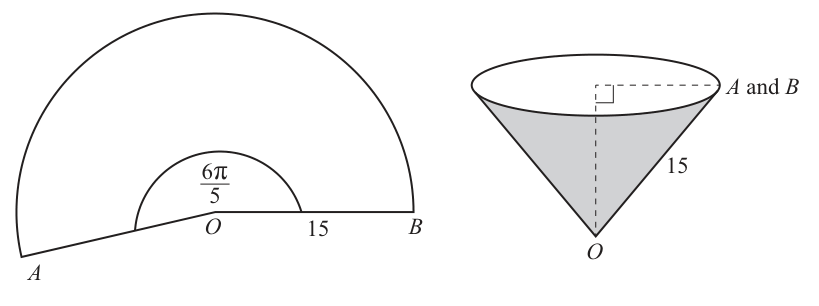
The diagram shows a sector of a circle, centre , radius 15.
Angle .
The sector is made into a cone with points and touching, as shown.
Approach
The curved surface of the cone is exactly the sector , so its area is the sector area with and .
Working
Answer
135π (≈ 424 cm²)
Walkthrough
When the sector is folded into a cone, the curved surface of the cone is the original sector, unchanged in area. The formula for the area of a sector of radius and angle (in radians) is . Substituting and :
Numerically this is about .
Key Takeaways
- The curved surface area of a cone formed from a sector equals the sector's area.
- Sector area in radians: .
Common Mistakes
- Using with in degrees — the angle here is in radians.
- Using (arc length) instead of (area).
- Rounding too early; is exact and to 3 s.f. is accepted.
Things to Be Careful About
- The mark scheme accepts (isw — later mis-simplification ignored) or to .
- Keep the angle in radians throughout; all angles in this question are radians by instruction.
The top of the cone is a horizontal circle.
Find the circumference of the circular top.
Approach
When the sector is folded, the arc becomes the circular rim (top) of the cone. Arc length is .
Working
Answer
18π (≈ 56.5 cm)
Walkthrough
The two straight edges and of the sector are glued together to form the cone, so the arc joining to wraps around to become the circular top of the cone. The arc length of a sector is with the angle in radians:
So the circumference of the circular top is .
Key Takeaways
- The arc of the sector becomes the circumference of the cone's base.
- Arc length in radians: .
Common Mistakes
- Using degrees for the angle.
- Confusing arc length with sector area.
Things to Be Careful About
- The mark scheme accepts or to .
- This value feeds part (c), so keep it exact () for the next step.
Approach
From part (b), the circumference of the top is , so gives the radius. The slant height is the sector radius 15, so the perpendicular height follows from Pythagoras.
Working
The slant height is 15 (the sector radius), so
Answer
radius = 9, height = 12
Walkthrough
The circular top has circumference (from part (b)). Since circumference :
The slant height of the cone is the radius of the original sector, . In the vertical cross-section through the axis, the radius, the perpendicular height and the slant height form a right-angled triangle, so by Pythagoras:
Key Takeaways
- Circumference converts the arc length into the base radius.
- In a cone, radius, height and slant height form a right-angled triangle: .
Common Mistakes
- Using the diameter instead of the radius in .
- Using the diameter where the radius is wanted in the Pythagoras step.
- Forgetting that the slant height is 15, not the height.
Things to Be Careful About
- The mark scheme gives B1 for radius = 9 and M1 for a correct Pythagoras statement using the candidate's radius.
- These values (, ) are needed in part (d), so carry them forward exactly.
Water is poured into the cone.
When the depth of the water in the cone is , the radius of the circular top of the water is .
Approach
In the vertical cross-section, the water surface and the cone's top are parallel, so the small triangle (radius , height ) is similar to the whole cone (radius 9, height 12).
Working
Answer
r = (3/4)h
Walkthrough
The cone is inverted with its vertex at the bottom. Water of depth has a flat circular surface of radius . In the cross-section through the axis, the triangle formed by the water (base , height ) is similar to the triangle formed by the whole cone (base , height ), because the water surface is parallel to the cone's top. Matching ratios of radius to height:
Key Takeaways
- Any horizontal slice of a cone is similar to the whole cone, so radius is proportional to depth from the vertex.
Common Mistakes
- Inverting the ratio () by matching the wrong sides.
- Using the diameter 18 against the radius without halving.
Things to Be Careful About
- The ratio uses the full cone values from part (c): radius 9, height 12.
- Any equivalent form of is accepted (oe).
The water is poured into the cone at a constant rate of per second.
Find the rate at which the depth of the water is rising when the depth of the water is 4.
Approach
Write the water volume using so it depends on alone, differentiate to get , then use the chain rule with and .
Working
Differentiate with respect to :
By the chain rule,
At with :
Answer
0.955 cm per second
Walkthrough
The water in the cone forms a smaller cone with radius (from part (i)) and depth . Its volume is
Writing in terms of only is the crucial move: it lets us differentiate with respect to directly:
The water is poured at , and we want . The chain rule links them:
Substituting and (so ):
Key Takeaways
- In related-rates problems, express the quantity in terms of a single variable before differentiating.
- The chain rule connects rates: .
Common Mistakes
- Forgetting to substitute , leaving in terms of two variables.
- Dropping the or mis-squaring .
- Dividing the wrong way round (computing ).
- Substituting before differentiating.
Things to Be Careful About
- The mark scheme allows follow-through on the candidate's own : B1 for , B1 for , B1 for the correct chain rule statement, M1 for the numerical substitution, A1 for (or ...).
- The answer is a rate, so units are ; 3 significant figures gives .
A particle moves in a straight line.
seconds after passing a fixed point, , the acceleration of , , is given by
When , the velocity of is and its displacement from is .
Approach
For , acceleration is . Integrate with respect to to find the velocity expression , then use the condition to determine the constant of integration. Finally, substitute .
Working
Using when :
Thus, the velocity function for is:
When :
Answer
10 ms^-1
Walkthrough
To find velocity from acceleration , we integrate acceleration with respect to time .
- Integrating yields .
- Substitute and to find the arbitrary constant .
- Evaluate by substituting into the specific velocity function, giving .
Key Takeaways
- Acceleration is the time derivative of velocity: , so .
- A boundary/initial condition allows us to solve for the constant of integration.
Common Mistakes
- Forgetting the constant of integration .
- Arithmetic slips when evaluating fractions like .
Things to Be Careful About
- Ensure you use the correct acceleration model for the given domain .
Approach
Integrate the velocity function with respect to to find displacement . Use the given boundary condition to find the constant of integration, then evaluate .
Working
Using when :
Thus, the displacement function for is:
When :
Answer
4 m
Walkthrough
- Integrate with respect to to get .
- Substitute the given condition to find .
- Substitute into the displacement formula to get the displacement at , which simplifies directly to .
Key Takeaways
- Velocity is the derivative of displacement: , so .
- Keep fractions exact to avoid premature rounding.
Common Mistakes
- Forgetting the constant of integration .
- Applying the boundary condition incorrectly (e.g. assuming ).
Things to Be Careful About
- Carry through the velocity equation from part (a)(i) accurately.
Approach
For , . Integrate to find , using the continuity of velocity at () to find the integration constant. Then integrate to find , using the continuity of displacement at () to determine the new integration constant. Finally, evaluate .
Working
Since when :
Thus, for :
Now integrate to obtain :
Since when :
Thus, the displacement function for is:
When :
Answer
392 m
Walkthrough
- In the interval , we integrate the new acceleration function . Integrating an exponential term divides by the constant , here , turning into .
- The particle's velocity is continuous at , so we use (from part (a)(i)) to find .
- Integrate the velocity function again to find displacement . Integrating gives .
- Use the displacement at found in part (a)(ii) () to find .
- Substitute into the expression. Since is extremely small, , which rounds to to 3 significant figures.
Key Takeaways
- When functions are defined piecewise in kinematics, velocity and displacement are continuous across the boundaries, allowing the values at the end of one interval to act as initial conditions for the next.
- .
Common Mistakes
- Sign errors when integrating (forgetting to divide by ).
- Forgetting that when substituting .
- Using or instead of the values found in part (a).
Things to Be Careful About
- Ensure you do not drop the exponential term when writing the exact formula, even though its value at is negligible numerically.
A geometric progression has first term and common ratio , where .
The sum of the 2nd and 3rd terms of the progression is 168.
The sum of the 4th and 5th terms of the progression is 94.5.
Approach
Write the 2nd and 3rd terms as and , and the 4th and 5th terms as and . The two given sums give two equations, and dividing them eliminates to give .
Working
Divide the second equation by the first:
Since :
Substitute back into the first equation:
The 6th term is:
Answer
243/8
Walkthrough
The terms of a geometric progression are , so the 2nd and 3rd terms are and , and the 4th and 5th are and . Translating the two given sums into equations gives and .
Each equation contains two unknowns, and , so we eliminate one. Both equations factor nicely: and . Dividing the second by the first cancels both and , leaving . Since the question states , we take only the positive root .
Substituting back into the first equation gives , so .
Finally the 6th term is .
Key Takeaways
- The th term of a GP is ; sums of specific terms translate directly into equations in and .
- Dividing two GP equations eliminates cleanly because both share the factor in this structure.
- The condition tells you to discard the negative square root.
Common Mistakes
- Using instead of for the th term, giving wrong powers of .
- Taking as well; the condition forbids it, and the mark scheme says only.
- Arithmetic slips in — it is exactly .
- Giving a decimal for instead of the exact ; the scheme accepts equivalent exact forms (isw after a correct exact answer).
Things to Be Careful About
- The answer is marked 'only, nfww' — it must come from correct working, not guessed and fitted.
- Keep exact; it feeds part (b).
- ; the exact fraction is the preferred printed form.
Approach
Use the sum-to-infinity formula with and from part (a).
Working
Answer
512
Walkthrough
Since satisfies , the sum to infinity exists and equals . Substituting and gives .
Key Takeaways
- applies only when .
- Dividing by a fraction means multiplying by its reciprocal.
Common Mistakes
- Using in the denominator instead of .
- Using a rounded value of or from part (a) instead of the exact values.
Things to Be Careful About
- This part depends entirely on part (a); carry forward and exactly.