Additional Mathematics 4037/12 — May/June 2025
Cambridge O-Level · Non-calculator · worked solutions for every part, with the mark scheme
Topics Calculus · Logarithmic and exponential functions · Equations, inequalities and graphs · [Legacy] Indices and surds · Coordinate geometry of the circle · Trigonometry · +6 more
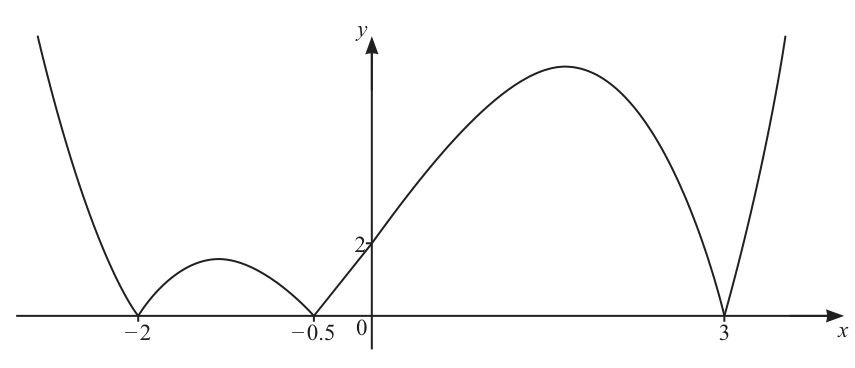
The diagram shows the graph of , where is a cubic polynomial.
Find expressions for the two possible functions .
Write each expression in fully factorised form.
Approach
The graph of meets the -axis exactly where , so the roots are read straight from the graph. The cubic is built from its factors, and the -intercept fixes the leading constant; the sign of the whole expression cannot be determined because the modulus makes give the same graph.
Working
From the graph, at , and , so
for some constant . Using the equivalent form with integer coefficients,
At the graph shows :
so .
Answer
f(x) = +/- (1/3)(x + 2)(2x + 1)(x - 3)
Walkthrough
The graph shown is of . Wherever this graph touches or crosses the -axis, we have , which happens exactly when . So the three marked points on the axis, , and , are the three roots of the cubic.
A cubic with roots , and has factors , and . Clearing the fraction by writing and absorbing the constant into a single unknown multiplier gives
To find , use the labelled point on the -axis: the graph passes through , so . Substituting :
Both and are possible: taking the modulus destroys the overall sign, so looks identical for either choice. Hence the two possible functions are
Key Takeaways
- The zeros of are exactly the zeros of ; a modulus only reflects negative parts above the axis.
- A polynomial can be reconstructed in factorised form directly from its roots.
- A single known point (here the -intercept) determines the vertical scale factor.
- Because the modulus erases an overall sign change, both and fit the same picture — hence the .
Common Mistakes
- Forgetting the : the mark scheme explicitly awards a mark for it, since the modulus graph cannot distinguish the two signs.
- Writing the root as the factor instead of or — signs inside factors must be reversed relative to the root.
- Dropping the scale factor entirely, or computing it without the modulus (getting only) and so missing one of the two functions.
- Adding extra terms beyond the product of the three linear factors — the scheme requires "no extra terms".
- Expanding the cubic when the question asks for fully factorised form.
Things to Be Careful About
- The answer must be left fully factorised: (equivalently ). An expanded cubic loses the final mark.
- The mark scheme says "isw": later incorrect simplification after a correct answer is ignored, but the printed exact form is what scores.
- Check the -intercept calculation carefully: at equals , so gives , not or .
Solve the equation .
Approach
Multiply both sides by to remove the fraction, giving a quadratic in . Factorise, solve for , then cube to find .
Working
Multiplying through by :
Factorising as a quadratic in :
So or .
Cubing each:
Answer
x = -27 or x = 8
Walkthrough
The equation contains in two places, one of them in a denominator. Multiplying every term by clears the fraction and turns the equation into . The key observation is that this is a quadratic in disguise: if we let , it reads , which factorises as . So or , meaning or . Cubing both sides of each gives or . Both must be kept — cubing is valid for negative numbers, so is a genuine solution (check: and ). Discarding loses an accuracy mark.
Key Takeaways
- Equations with fractional powers can often be converted into quadratics by multiplying through by the lowest power present.
- Cubing (unlike square-rooting) preserves sign, so negative roots are legitimate.
- Always check both roots back in the original equation rather than rejecting one by habit.
Common Mistakes
- Rejecting because cube roots "can't be negative" — the mark scheme explicitly gives A0 if is rejected.
- Squaring instead of cubing when recovering , e.g. writing from .
- Sign slips when factorising : it is , not .
- Forgetting to multiply the constant term by when clearing the fraction.
Things to Be Careful About
- Both answers are required; each carries its own A1 mark.
- Keep exact values throughout — no decimals are involved here.
- A quick check of each root in the original equation confirms validity and guards against accidental rejection of the negative root.
A circle with centre has the equation .
Approach
Complete the square to identify the circle, then substitute into the circle equation. If the resulting quadratic in has exactly one solution (discriminant zero), the line meets the circle once, so it is a tangent.
Working
Complete the square in the circle equation:
So the circle has centre and radius . Substitute :
The discriminant is
Since the discriminant is zero, the quadratic has exactly one (repeated) solution, so the line meets the circle at exactly one point and is a tangent.
Answer
The line is a tangent to the circle, because substituting it gives , whose discriminant is (one repeated solution).
The discriminant of 5x^2 - 30x + 45 = 0 is zero, so the line meets the circle at exactly one point and is a tangent
Walkthrough
First we need to know the circle we are working with. Completing the square on gives , and on gives . Moving the constants to the right-hand side gives , so the centre is and the radius is .
To test whether the line is a tangent, we find where it meets the circle. Substituting into the circle equation replaces every , leaving a quadratic in alone. Expanding carefully: and . Collecting terms gives .
A tangent touches the circle at exactly one point, which means this quadratic must have exactly one solution. The discriminant confirms a repeated root, so the line is a tangent. (Equivalently, has the single solution .)
Key Takeaways
- Completing the square converts a circle equation into centre-radius form.
- A line is a tangent to a circle exactly when substituting it produces a quadratic with discriminant zero (one repeated root).
Common Mistakes
- Sign slips when completing the square or expanding .
- Stopping at without stating the discriminant is zero or that there is one solution only — the mark scheme requires the conclusion.
- Arithmetic errors in collecting the linear terms ().
Things to Be Careful About
- The mark scheme awards the M1 for eliminating one variable and the A1 only with a stated conclusion (discriminant , or one solution only). Always finish the argument.
- Alternative accepted routes exist (perpendicular radius through , or the distance condition ), but the substitution route shown is the standard one.
Approach
Use the quadratic obtained in part (a). Since has a repeated root, solve it and substitute back into .
Working
From part (a):
Substitute into :
Answer
(3, 3)
Walkthrough
Part (a) produced . Factorising out the 5 gives , so the repeated root is . Because the line is , the -coordinate of the point of contact is . Hence the tangent touches the circle at .
Key Takeaways
- The point of tangency comes from the repeated root of the substituted quadratic.
- Always substitute back into the line equation to get the second coordinate.
Common Mistakes
- Giving only without finding .
- Substituting into the circle equation instead of the line (both work, but the line is quicker).
Things to Be Careful About
- Both coordinates are needed — the mark scheme awards B1 for each.
Approach
The new circle has centre and passes through the origin, so its radius is the distance from to . Then write the equation in centre-radius form.
Working
Radius:
Equation of the circle with centre :
Answer
(x - 3)^2 + (y - 3)^2 = 18
Walkthrough
A circle's equation in centre-radius form is . Here the centre is from part (b). Since the circle passes through the origin, the radius is the distance : . Squaring the radius gives , so the equation is .
Key Takeaways
- The radius of a circle through a given point is the distance from the centre to that point.
- Centre-radius form needs on the right-hand side, not .
Common Mistakes
- Writing but then putting (or ) on the right-hand side instead of .
- Sign errors: the equation uses and , not .
Things to Be Careful About
- The mark scheme allows any equivalent form (e.g. expanded), and ignores later expansion (ISW), but the centre-radius form is the cleanest exact answer.
- Follow-through is allowed on your own answer to part (b) only.
Approach
Integrate term by term to get , then substitute the limits and .
Working
Answer
2
Walkthrough
The integral of with respect to is , because differentiating gives . Writing the antiderivative in square-bracket form with the limits attached earns the first mark. Then evaluate at the top limit , where , and at the bottom limit , where , and subtract: .
Key Takeaways
- ; the minus sign is essential.
- Definite integrals are evaluated as (top limit) minus (bottom limit), and the constant of integration cancels so it is not needed.
Common Mistakes
- Writing as the antiderivative instead of .
- Substituting the limits in the wrong order, giving instead of .
- Misremembering ; it equals , not .
Things to Be Careful About
- The answer is exact; no decimal is needed.
- The angle is in radians here ( to ), which is consistent with the calculus result holding only in radians.
Approach
Rewrite , and in terms of and , combine the denominator into a single fraction, then use to simplify.
Working
Combine the two terms of the denominator over the common denominator :
using . Therefore
as required.
Answer
Shown: sec(alpha)/(cot(alpha) + tan(alpha)) = sin(alpha)
Walkthrough
The expression mixes three different trigonometric ratios, so the first step is to convert everything into sines and cosines: , and . This earns the first mark.
The denominator is then a sum of two fractions with different denominators, so put them over the common denominator : the numerator becomes , which equals by the Pythagorean identity. So the whole denominator collapses to the single term — this earns the second mark.
Finally, dividing by a fraction means multiplying by its reciprocal:
and multiplying by gives . Since , all the ratios are well defined and positive, so no sign issues arise. The target is reached, completing the proof.
Key Takeaways
- For identity proofs, converting every ratio to sines and cosines is the standard first move.
- is the tool that collapses a two-term denominator into one term.
- Dividing by a fraction is multiplying by its reciprocal: .
- A proof must run forward from the given expression to the target, showing every algebraic line.
Common Mistakes
- Writing (confusing it with ).
- Skipping the line where the denominator is combined into one fraction — the mark scheme requires sufficient correct detail, so jumping straight to the answer loses marks.
- Forgetting and leaving the numerator as .
- Dropping the when cancelling at the end, or leaving the answer as without simplifying.
- Working backwards from to the given expression, which is not a valid proof.
Things to Be Careful About
- "Show that" (AG) parts require every intermediate line to be written out; the mark scheme states "Must show sufficient correct detail".
- The condition guarantees , and are all non-zero, so no division by zero occurs and all ratios are positive.
- Keep the notation consistent: the angle is throughout, not or .
The polynomial is such that , where and are integers.
It is given that and that is a factor of .
Approach
Differentiate and use to find ; then use the factor theorem, , to find .
Working
Substituting :
Since is a factor, :
Answer
a = -2, b = 8
Walkthrough
The polynomial is . Differentiating each term gives . The condition means we substitute : the first two terms become and , so , giving .
For , the statement that is a factor invokes the factor theorem: a linear factor exists exactly when . So . With this reads , i.e. , so .
Key Takeaways
- Differentiating a cubic lowers each power by one and multiplies by the old index.
- The factor theorem converts 'is a factor' into an equation by substituting the root.
- Two independent conditions determine two unknown constants.
Common Mistakes
- Sign slips when substituting into (it becomes , not ).
- Forgetting to substitute the found value of before solving for .
- Misapplying the factor theorem by substituting instead of .
Things to Be Careful About
- Each mark scheme line requires the substituted expression to be simplified (, ), so show these lines explicitly.
- This is a non-calculator paper: all arithmetic here is small integer work.
Approach
With and , divide by the known factor , then factorise the quadratic quotient.
Working
Dividing by (e.g. by long division or comparing coefficients):
Factorising the quadratic:
since .
Answer
(x - 2)(x + 1)(3x - 4)
Walkthrough
Substituting and gives . Since part (a) established that is a factor, dividing the cubic by leaves a quadratic. Long division (or matching coefficients in ) gives the quotient .
To factorise , look for two numbers multiplying to and adding to : these are and . Splitting the middle term gives .
So the full factorisation is .
Key Takeaways
- A known linear factor reduces a cubic to a quadratic by division.
- Factorising a non-monic quadratic uses the product-sum method on .
Common Mistakes
- Arithmetic slips in the division, giving a wrong quadratic quotient.
- Failing to check that the factors multiply back to the original cubic.
- Leaving the answer as instead of fully factorising into linear factors as asked.
Things to Be Careful About
- The question says 'product of linear factors', so the quadratic must also be broken down.
- The mark scheme requires both accuracy marks to come from the correct and — carry forward the values from part (a).
Approach
Let . Then the equation becomes the cubic from part (b) in , whose roots are , , . Since , discard , then take logs.
Working
With and , :
Using part (b):
Since , reject . Converting back:
Answer
y = 0.5 ln 2 or y = 0.5 ln(4/3)
Walkthrough
The equation looks like the cubic from parts (a) and (b) if we write : then and . Substituting and gives exactly , which part (b) already factored as .
The roots are , and . But is always positive, so must be rejected — it corresponds to no real .
For each valid root, undo the substitution with natural logarithms: gives , so ; similarly gives .
Key Takeaways
- Equations in can be disguised polynomials under the substitution .
- Exponentials are strictly positive, so negative roots of the substituted equation are extraneous.
- Solving means taking of both sides and dividing by 2.
Common Mistakes
- Keeping the root and trying to take its logarithm.
- Forgetting to halve after taking , writing instead of .
- Not using the factorisation from part (b) and attempting to solve the cubic from scratch.
- Giving extra solutions or decimal approximations when exact log form is required.
Things to Be Careful About
- The mark scheme awards B2 only for both solutions with no extras — rejecting is essential.
- Answers may be given in any equivalent form ('oe'), but exact logarithmic form is expected on this non-calculator paper.
- This is a 'Hence'-style part: the factorisation from part (b) must actually be used.
When is plotted against , a straight line passing through the points and is obtained.
Approach
Since is plotted against , the relationship is a straight line of the form , where and .
Find the gradient and vertical intercept using the given points and , then convert the resulting equation for into an expression for in terms of .
Working
The straight line has the form:
Calculate the gradient from the two points and :
Substitute into the linear equation to find :
Thus, the linear relation is:
Exponentiate both sides with base to make the subject:
Answer
y = e^(9 - 2x^3)
Walkthrough
- When variables are plotted as a straight line, the vertical axis variable and horizontal axis variable are related by the standard equation . Here, and , so the relationship is:
- The line passes through and . Find the gradient :
- Using the point , find the intercept :
So .
- To express in terms of , take the natural exponential of both sides:
Alternatively, this can be written as .
Key Takeaways
- For linear law problems, identify the uppercase variables and corresponding to the plotted axes.
- The equation is always , where the given coordinates are values of , not .
- Invert the log function using the base: .
Common Mistakes
- Confusing the coordinates: treating as rather than .
- Sign errors when finding the gradient: .
- Incorrectly converting to exponential form, e.g. writing instead of .
Things to Be Careful About
- Ensure the final answer has explicitly in terms of , meaning with no remaining on the left-hand side.
Approach
Substitute into the relationship found in part (a), equate exponents, and solve for .
Working
From part (a), the equation is:
Substitute :
Equating the powers of :
Rearrange to solve for :
Taking the real cube root:
Answer
x = -2
Walkthrough
- We are given . Substituting this into our equation (or directly into ) gives:
- Rearrange the linear equation in :
- Take the cube root of :
Key Takeaways
- Equating powers when the bases are equal: .
- The cube root of a negative real number is a unique real negative number: .
Common Mistakes
- Sign errors during rearrangement, e.g. getting and .
- Forgetting to take the cube root and leaving the answer as .
Things to Be Careful About
- The question specifies "the value of ", so give the exact single real value .
A geometric progression has a 4th term of and a 6th term of , where is a constant.
The common ratio of this geometric progression is positive.
Find the common ratio in terms of and the value of the first term of this geometric progression.
Approach
Write the 4th and 6th terms as and . Dividing eliminates and gives ; the positive-ratio condition then fixes the sign of . Substitute back to find .
Working
The two terms give
Dividing the second by the first:
Since the common ratio is positive:
Substituting into :
Answer
r = 2k^2/3 and a = 1
Walkthrough
A geometric progression with first term and common ratio has th term , so the 4th term is and the 6th term is . Writing both given values in this form is the first mark. Dividing by cancels and leaves , which is the standard trick for finding from two non-consecutive terms. Simplifying the fraction gives , so ; the question states the common ratio is positive, so we take . Finally, substituting this into gives , so .
Key Takeaways
- The th term of a GP is ; terms two apart differ by a factor of .
- Dividing two term equations eliminates cleanly.
- A sign condition on decides which square root to take.
Common Mistakes
- Using and for the 4th and 6th terms (off-by-one in the index).
- Forgetting the positive-ratio condition and giving .
- Index slips when simplifying or .
Things to Be Careful About
- The mark scheme allows the 5th term as an implied route, but the division method shown is the standard one.
- must be expressed in terms of (an unsimplified numeric constant times earns the method mark); must be a non-zero constant.
- Leave as the exact fraction — it is needed in part (b).
Given that this geometric progression has a sum to infinity of 3, find the possible values of .
Approach
Use with and from part (a), set it equal to 3, and solve for .
Working
Using the sum to infinity formula with the values from part (a):
Answer
k = +/-1
Walkthrough
This part is a 'hence' question: it uses and found in part (a). The sum to infinity of a GP is , valid because is less than 1 for the values found. Setting this equal to 3 and multiplying both sides by the denominator gives , so and . Both signs are valid since depends on , so either way, which is positive as required.
Key Takeaways
- requires .
- Squaring in the ratio means both signs of give the same progression.
Common Mistakes
- Forgetting to use the part (a) values and inventing new ones.
- Giving only and missing .
- Sign slips when multiplying out .
Things to Be Careful About
- The mark scheme awards each value of only 'from correct work' — the equation must be seen.
- Both values are required; a single value scores only one of the two answer marks.
- Check consistency: with , , satisfying the condition in the stem.
It is given that .
Approach
Differentiate using the quotient rule, then substitute and simplify to a single logarithm.
Working
By the quotient rule,
since .
Substituting :
Writing as a single logarithm:
Answer
ln(1/2)
Walkthrough
The function is a quotient: a logarithm on top divided by a linear expression. The quotient rule gives the derivative as (bottom times derivative of top minus top times derivative of bottom) over bottom squared.
First find the derivative of the top using the chain rule: differentiating multiplies by the derivative of the inside bracket, giving .
Assembling the quotient rule:
Now substitute . The first term vanishes because it contains a factor , leaving . Finally use the law of logs in reverse: , since .
Key Takeaways
- The chain rule turns into .
- The quotient rule structure must be memorised exactly; sign errors are common.
- A coefficient multiplying a logarithm can be pulled inside as a power: .
Common Mistakes
- Writing the quotient rule with the terms reversed or adding instead of subtracting — the scheme requires all other terms correct for the A1.
- Forgetting the chain-rule factor (the B1 step).
- Leaving the answer as instead of converting to the required form .
- Sign slips when moving the negative index inside the logarithm: , not or .
Things to Be Careful About
- The final answer must be a single logarithm ; intermediate forms score method marks only if all earlier marks were earned (the scheme's dependency note).
- Substitution at must be shown explicitly — the M1 depends on substituting and reaching one log term from correct work.
Approach
For a small change in , the change in is approximately evaluated at .
Working
Using the result from part (a),
Answer
h ln(1/2)
Walkthrough
When increases by a small amount , the change in is approximately the gradient at that point multiplied by the change in : . From part (a) the gradient at is , so the approximate change in is .
Key Takeaways
- The derivative measures rate of change, so a small change in is estimated by multiplying the derivative by the change in .
- 'Write down' signals no further working is needed beyond this multiplication.
Common Mistakes
- Writing — the multiplies outside the logarithm, not inside. The mark scheme explicitly awards B0 for this.
- Omitting the factor entirely.
Things to Be Careful About
- Keep outside the logarithm: the answer is (or an equivalent form), not .
- Follow-through applies on your own single-log answer from part (a).
It is given that , for , and that exists.
Approach
For to be defined, the argument of the logarithm must be positive, so . The least value of is where the domain starts.
Working
So the least possible value of is .
Answer
a = 4/3
Walkthrough
A logarithm is only defined for a strictly positive argument, so exists only when . Solving this gives , so the smallest value of making the domain valid is .
Key Takeaways
The domain of a logarithmic function is dictated by requiring its argument to be positive; this condition defines the vertical asymptote of the graph.
Common Mistakes
Writing , which would wrongly allow where the logarithm of zero is undefined. Also confusing the least value of with the intercept found later in the question.
Things to Be Careful About
The inequality must be strict: does not exist, so is excluded from the domain. The answer must be given as , an exact value.
Approach
As runs over , the quantity takes every positive value, so takes every real value, and so does .
Working
The range of is all real numbers:
Answer
All real numbers (R)
Walkthrough
The logarithm maps the positive reals onto the whole of the real line: as runs from just above to infinity, runs from to . Multiplying by does not change this, so the range of is .
Key Takeaways
A logarithmic function with any positive coefficient has range ; this is exactly why the inverse function will have domain .
Common Mistakes
Stating the range in terms of (the mark scheme explicitly disallows this) or giving a restricted range such as .
Things to Be Careful About
The range must be stated in terms of or , not .
Approach
Write , interchange and , then solve for by exponentiating.
Working
Interchanging and :
Dividing by and exponentiating:
Solving for :
Answer
f^-1(x) = (4 + e^(x/2))/3
Walkthrough
To find an inverse, start from and swap the roles of and , giving . The logarithm is undone by exponentiating: dividing by gives , so . Finally, adding and dividing by isolates , giving . Note the domain of is , matching the range of found in part (b).
Key Takeaways
The inverse is found by interchanging and and solving; is the tool that undoes the logarithm. The domain of equals the range of .
Common Mistakes
Forgetting to divide by before exponentiating; writing instead of ; sign errors when moving the ; and omitting the notation, which the mark scheme requires.
Things to Be Careful About
The mark scheme allows one sign error for the method mark but the final answer must use correct notation. The constant is written upright and the exponent is , not .
It is given that the equation has two roots.
For your value of , sketch the graphs of and on the axes.
Label each graph.
State the intercepts of each graph with the axes.
State the equations of any asymptotes.
Approach
is a logarithmic curve with vertical asymptote , defined for . Its inverse is the reflection of it in the line , with horizontal asymptote . Find the intercepts, then sketch both curves showing their two intersections on .
Working
Intercept of : set :
So crosses the -axis at ; it has no -intercept since lies to the right of the asymptote and the curve is not defined at .
Intercept of : set :
So crosses the -axis at ; it has no -intercept since for all .
Asymptotes: has vertical asymptote ; has horizontal asymptote .
The two curves are reflections of each other in , so their intersections lie on . The equation has two roots, so the curves cross twice, both points on the line : one in the first quadrant (between and larger values) and one in the second quadrant (negative , positive ).
Answer
The sketch shows , a logarithmic curve in the first and fourth quadrants rising steeply, with vertical asymptote and -intercept ; and , an exponential-type curve in the first and second quadrants, with horizontal asymptote and -intercept . The curves intersect twice, both intersection points lying on the line .
Logarithmic curve y = f(x) with vertical asymptote x = 4/3 and x-intercept (5/3, 0); reflected exponential curve y = f^-1(x) with horizontal asymptote y = 4/3 and y-intercept (0, 5/3); the two curves intersect twice, both points on the line y = x
Walkthrough
The function is a standard logarithmic curve shifted right so that its vertical asymptote sits at , the domain boundary from part (a). It rises from near the asymptote, crosses the -axis where , i.e. where , giving , and then grows without bound.
The inverse is the mirror image of this curve in the line : the vertical asymptote becomes the horizontal asymptote , and the -intercept becomes the -intercept . This is why the same number appears on both axes — the mark scheme awards a mark for marking on each axis with no other intercepts.
Because the curves are reflections in , any point where they meet must be fixed by the reflection, i.e. must lie on itself. Since the equation has two roots, the sketch must show exactly two intersection points, both on : one in the first quadrant (where both coordinates are positive and greater than ) and one in the second quadrant (negative , positive ).
Key Takeaways
A function and its inverse are reflections of each other in the line ; consequently vertical and horizontal asymptotes swap, and intercepts swap coordinates. Intersections of a function with its inverse lie on .
Common Mistakes
Drawing only one intersection point; placing an intersection off the line ; marking a -intercept for (it has none, since its domain starts at ); drawing the exponential curve crossing below its asymptote ; forgetting to label the curves; and marking extra intercepts, which loses the intercept mark.
Things to Be Careful About
The mark scheme is dependent: the mark depends on the mark being correct, and the intercept mark depends on the first . The value must appear on each axis (or be stated) and no other intercepts may be marked. Both asymptote equations, and , must be given, on the graph or at the side. The curves must show correct asymptotic behaviour: plunging to near , and flattening towards as .
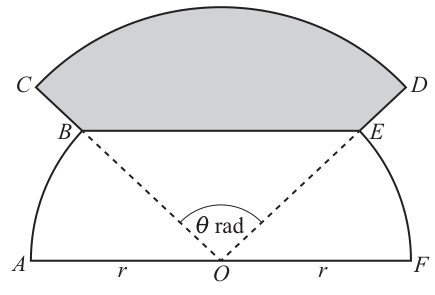
The diagram shows the shape .
is a straight line.
and are sectors of a circle with centre and radius .
Angle angle .
is a sector of a circle with centre and radius .
Angle is radians.
The point lies on the line and the point lies on the line .
The line is parallel to the line .
Approach
The shaded region is the sector of radius minus the triangle formed by the two radii and (each of length ) with included angle .
Working
Area of sector :
Since lies on and lies on , we have , so the area of triangle is:
Therefore the area of the shaded region is:
Answer
(1/2)(4r/3)^2(theta) - (1/2)r^2 sin(theta)
Walkthrough
The shaded region sits between the large arc and the straight segment . The natural way to find its area is to take the whole sector — a sector of radius and angle radians — and remove the unshaded triangle that lies underneath inside that sector. Because lies on the line and lies on the line , the sides and are exactly the radius of the smaller sectors, and the angle between them at is . A triangle with two known sides and the included angle has area , giving . Subtracting leaves the shaded area.
Key Takeaways
- Sector area in radians: .
- Triangle area with two sides and included angle: .
- Composite areas are found by subtracting a simpler inner region from an outer one.
Common Mistakes
- Using degrees instead of radians in the sector formula — the formula only works when is in radians.
- Forgetting to square the radius correctly; it gives , not .
- Subtracting a small sector instead of the triangle — the region below inside sector is a triangle, since and are straight segments.
Things to Be Careful About
- The mark scheme allows the answer unsimplified, so leaving as it stands earns full marks.
- Both B1 marks (sector area and triangle area) must be visible separately in your working.
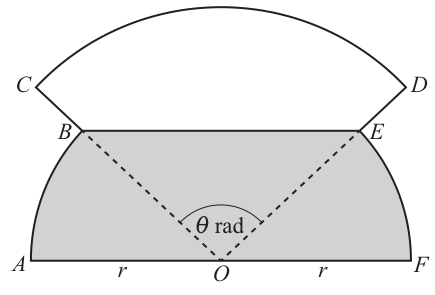
The diagram shows the shape from part (a) with region shaded.
Find, in terms of and , the perimeter of the shaded region.
Approach
The perimeter of the shaded region consists of: the two arcs and , the straight base (length ), and the straight top . Each arc subtends angle at (since and together with they make the straight angle ).
Working
Each of the angles and equals , so each arc length is:
For the chord : triangle has and included angle . By the cosine rule:
so
(equivalently ).
The perimeter is then the sum of both arcs, the base , and :
Answer
r(pi - theta) + 2r + sqrt(2r^2(1 - cos(theta)))
Walkthrough
To find the perimeter of the shaded lower region, walk around its boundary: arc , then the straight line , then arc , then the straight line back to the start.
First work out the angle of each small sector. Since is a straight line, the three angles at add to : the two equal sector angles plus . So each sector angle is , and each arc has length .
Next find the length . Triangle is isosceles with and vertex angle . The cosine rule gives , so . (Using the half-angle identity this also equals .)
Finally add up: two arcs give , the base is , and adding completes the perimeter.
Key Takeaways
- Arc length in radians: .
- Angles on a straight line sum to radians — used here to get each sector's angle.
- Cosine rule finds a chord from two radii and the included angle; the half-angle form is a useful shortcut for chords.
- Perimeters of composite shapes require identifying every boundary piece exactly once.
Common Mistakes
- Taking each sector angle to be instead of , doubling the arc contribution incorrectly.
- Forgetting to include both arcs, or including the outer arc which is not part of the shaded boundary.
- Making an algebra slip rearranging the cosine rule to get — the mark scheme awards A0 if this rearrangement is wrong.
- Working in degrees: all angles here are in radians because they come from the straight-line angle .
Things to Be Careful About
- The mark scheme allows unsimplified answers, so scores full marks.
- The M1 for requires a complete method (cosine rule, sine rule, or basic trigonometry) using and a correct angle — show the full working, not just the result.
- The final M1 is for a correct plan using your own earlier values, so even if was slightly wrong, assembling the perimeter correctly still earns the method mark.
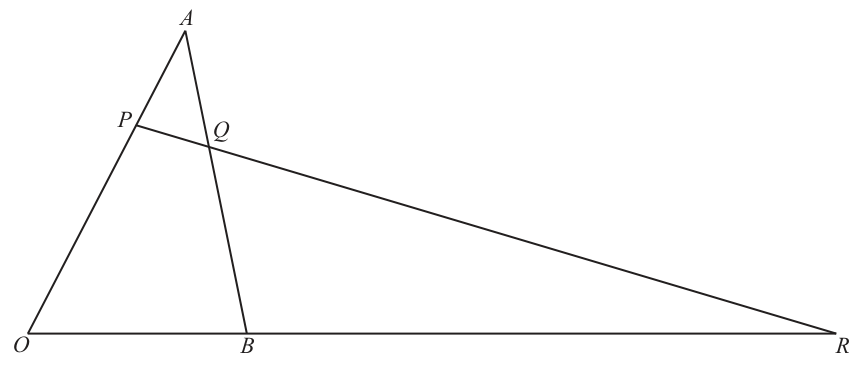
The diagram shows the triangle , where and .
The point lies on such that .
The point lies on such that .
The straight line through and meets the straight line through and at the point .
It is given that and , where and are constants.
Approach
First find by going from to and then a third of the way along . Then find , and finally write as .
Working
Since :
The route from to goes from to , then a multiple of :
Simplifying:
Answer
OR = (3/4 - mu/12)a + (mu/3)b
Walkthrough
The key idea in vector geometry questions like this is that any route between two points can be built by hopping through known points. We want , but is not directly connected to anything we know — except that it lies on the line through and . So we build the route : that is .
To get we first need . Since lies on with , we go from to () and then add one third of . Collecting terms gives .
Then , using given in the stem. Subtracting gives (note ).
Finally, , which simplifies to .
Key Takeaways
- A point dividing a segment in ratio has position vector found by adding times the direction vector to one endpoint's position vector.
- The vector from one point to another is 'destination minus start': .
- Any path through known points gives the same resultant vector — choose the route that uses what you know.
Common Mistakes
- Writing instead of — the direction must be measured from , not from .
- Sign errors when subtracting vectors: , not the other way round.
- Arithmetic slips combining fractions such as ; use a common denominator of 12.
- Leaving the final answer unsimplified — the mark scheme requires the simplified form.
Things to Be Careful About
- Keep and separate throughout; only collect like vectors at the end.
- The mark scheme allows unsimplified intermediate lines, but the final must be simplified ('Must be simplified').
- An equivalent alternative route via and earns the same marks.
Approach
Since lies on the line , we have : no component. Equate this with the expression from part (a) and match coefficients of and .
Working
From part (a):
and since lies on , .
Equating the coefficient of :
Equating the coefficient of to zero:
Then:
Answer
mu = 9, lambda = 3
Walkthrough
This part uses the result from part (a) — hence the word 'Hence'. Because lies on the straight line through and , its position vector must be a pure multiple of : there can be no component. Since and are independent vectors (they are not parallel), the only way two expressions in them can be equal is if their coefficients match separately.
Setting the coefficient to zero gives , so . Substituting into the coefficient gives .
Geometrically this says is three times as far from as is, i.e. — consistent with the diagram where sits beyond on the extension of .
Key Takeaways
- If two expressions in independent vectors are equal, their coefficients must be equal term by term.
- A point on the line through and has position vector with no component.
- 'Hence' signals that the previous answer should be carried forward rather than re-derived.
Common Mistakes
- Forgetting that the coefficient must equal zero, not just be ignored.
- Solving incorrectly; multiplying through by 12 gives .
- Not using the part (a) result and attempting a fresh derivation, which wastes time and invites errors.
Things to Be Careful About
- Both values are required for the final mark: AND .
- Check consistency: confirms lies beyond , matching the figure.
A curve is such that its gradient at the point is given by .
The curve passes through the point .
Find the coordinates of the stationary point on the curve.
Approach
At a stationary point , so set to find the -coordinate. Then integrate the gradient function to recover the equation of the curve, using the given point to find the constant of integration, and finally substitute the stationary -value into that equation.
Working
At a stationary point:
Integrate the gradient function:
Use the point :
Since :
So the curve is . At :
Answer
The stationary point is .
(2/5, 4)
Walkthrough
A stationary point is where the gradient is zero, so we begin by setting the given derivative equal to zero. A power equals zero only when its base is zero, giving , so .
To find the -coordinate at this point we need the equation of the curve itself, so we integrate the gradient function. The integrand is a linear expression raised to a power, which calls for the reverse chain rule: raise the power by one (from to ), divide by the new power, and also divide by the inner derivative . This gives .
The constant is found using the fact that the curve passes through : substituting gives , so , hence .
Finally, substitute into the full equation. Since , the whole bracket term vanishes and . The stationary point is therefore .
Key Takeaways
- A stationary point satisfies ; find its -coordinate directly from the derivative before integrating.
- Integrating gives — remember to divide by the coefficient of as well as the new power.
- A point on the curve fixes the constant of integration; always add when recovering an equation from a derivative.
- Substituting the stationary -value back into the completed equation gives the -coordinate.
Common Mistakes
- Forgetting to divide by when integrating , writing instead of — the mark scheme requires the correct in for M1.
- Omitting the constant of integration entirely, making it impossible to use the given point.
- Mis-evaluating : it is , not or similar.
- Stopping after finding without finding the -coordinate — the question asks for coordinates.
- Trying to find the stationary point from an integrated (second-derivative-type) route rather than setting the given first derivative to zero — the scheme explicitly requires the first derivative.
Things to Be Careful About
- The final B1 mark depends on the earlier marks: the answer must be with correctly found.
- The scheme allows an unsimplified fraction for , but the final coordinates should be given exactly — no decimals needed here since all values are exact.
- Show the substitution of the point explicitly, as the dependent M1 for finding requires this attempt to be visible.
- Keep the fractional-index arithmetic exact: is best done by taking the cube root first.