Additional Mathematics 4037/11 — May/June 2025
Cambridge O-Level · Non-calculator · worked solutions for every part, with the mark scheme
Topics Logarithmic and exponential functions · Trigonometry · Calculus · Vectors in two dimensions · Quadratic functions · Coordinate geometry of the circle · +7 more
Approach
Use the triangle relation , so .
Working
First find from the given scalar multiple:
Then
Answer
(-2.5, 5) as a column vector
Walkthrough
The three points , and form a triangle of vectors: going from to and then from to is the same as going directly from to . So , which rearranges to .
We are given , not itself, so first divide every component by : this gives .
Subtracting component by component gives for the top entry and for the bottom entry.
Key Takeaways
- The triangle law lets you express any one of , , in terms of the other two.
- Scalar multiplication of a vector multiplies each component; undo it by dividing each component.
- Vector subtraction is component-wise subtraction.
Common Mistakes
- Forgetting to divide by and using directly as .
- Subtracting in the wrong order (computing instead of ), which gives the negative vector.
- Sign slips when subtracting a negative component: , not .
Things to Be Careful About
The mark scheme awards B2 outright for the correct answer or B1 for the correct unsimplified expression , so showing the subtraction step protects your method mark even if an arithmetic slip follows.
The vectors , and are such that , and , where and are scalars.
Given that , find the values of and .
Approach
Write in terms of and , then equate the and components with those of to get two equations.
Working
Equating with :
From the equation:
Substituting into the equation:
Answer
alpha = 3, beta = -1
Walkthrough
Two vectors are equal only when their corresponding components are equal. First expand the combination : multiplying by gives , and multiplying by gives ; subtracting component-wise yields .
Setting this equal to produces one equation from the components () and one from the components ().
The equation contains only , so solve it first: . Substituting into the equation then gives , so .
Key Takeaways
- Equality of vectors means equality of each component — this converts one vector equation into two scalar equations.
- Solve the equation containing only one unknown first, then substitute.
Common Mistakes
- Sign errors when expanding , e.g. writing instead of .
- Equating unlike components (matching the part of one side with the part of the other).
- Solving only one of the two equations and leaving the other unknown unfound.
Things to Be Careful About
The mark scheme requires equating like vectors at least once for M1, then A1 for either value and full credit for both — so always show the component equations explicitly rather than jumping to the answers.
Solve the inequality .
Approach
Expand the left-hand side, bring everything to one side to form a three-term quadratic inequality, factorise it, and use the critical values to write down the solution interval.
Working
Expand the brackets:
So the inequality becomes
Move everything to one side (adding to both sides):
Divide through by :
Factorise:
The critical values are and . The quadratic is negative between its roots, so
Answer
-1 <= x <= 3
Walkthrough
The inequality compares a product of two brackets, , with the linear expression . The first step is to expand the product: multiply each term in the first bracket by each term in the second to get . Now the inequality reads . To solve a quadratic inequality we collect everything onto one side so that one side is zero. Moving all terms to the right (equivalently multiplying through by ) gives , which is exactly the three-term quadratic the mark scheme expects. Dividing by the common factor simplifies it to , which factorises neatly as .
The roots and are the critical values: they are where the quadratic equals zero, so they are always included in the solution of a inequality. Because the parabola opens upwards, it is below or on the -axis exactly between its two roots, giving . A quick check: at the original inequality reads , which is true, and lies in the interval — consistent.
Key Takeaways
- To solve a quadratic inequality, rearrange to a three-term quadratic on one side with zero on the other, factorise, and use the roots as critical values.
- For an upwards-opening quadratic, the expression is negative between the roots and positive outside them; the inequality sign tells you which region to keep.
- Critical values are included when the inequality is or (closed interval), excluded for or .
- Dividing by a positive common factor (here ) does not change the inequality direction.
Common Mistakes
- Sign errors when expanding — the term gives , and forgetting this sign wrecks the whole question.
- Moving terms to the wrong side and forgetting to flip the inequality when multiplying/dividing by a negative number; the mark scheme accepts any consistent rearrangement ("oe"), but the final interval must follow correctly.
- Solving as or — the wrong region; the upwards parabola is negative between the roots.
- Writing the answer as two separate inequalities without connecting them with "and" — the mark scheme explicitly rejects this ("Do not accept separate inequalities unless connected with 'and'").
- Excluding the endpoints and : since the inequality is , the critical values must be included with signs.
Things to Be Careful About
- The final answer must be a single connected statement, (or " and "); separate inequalities score A0.
- Check the rearrangement direction: the mark scheme's form is ; if you keep the negative quadratic instead, the inequality direction flips and the same interval must result — make sure your working is consistent throughout.
- Substituting a test value (e.g. ) into the original inequality is a quick way to confirm you have chosen the correct region.
- All working must be shown: the expansion, the rearrangement to the three-term quadratic, the factorisation, and the critical values each carry marks (M1, M1, A1, A1).
Point has coordinates .
A circle has equation .
Approach
Substitute and into the left-hand side of the circle equation and confirm it equals the radius squared, .
Working
Since the left-hand side equals the right-hand side, satisfies the equation of the circle.
Answer
, so lies on the circumference of the circle.
(3 - 4)^2 + (-1 + 3)^2 = 5, so A lies on the circumference
Walkthrough
The equation describes all points whose distance from the centre has square equal to . To show that lies on the circle we simply check that its coordinates satisfy this equation: substituting gives , which is true. Equivalently, the distance from to the centre is , exactly the radius.
Key Takeaways
A point lies on a circle if and only if its coordinates satisfy the circle's equation; checking this is a direct substitution.
Common Mistakes
Sign slips when substituting negative coordinates — note that becomes , not . Also remember the right-hand side is the radius squared (), not the radius.
Things to Be Careful About
The mark scheme also accepts showing that the distance from to the centre equals the radius, i.e. . Either route earns the B1; the substitution must be shown explicitly.
Approach
The centre of the circle is . Since is a diameter, is the midpoint of , so is the reflection of through : .
Working
The vector from to the centre is
Continuing the same displacement from the centre:
Equivalently, using the midpoint equations and gives , .
Answer
(5, -5)
Walkthrough
From the equation the centre is and the radius is . A diameter passes through the centre, so the centre is the midpoint of . Moving from to is a displacement of ; continuing the same displacement past the centre lands on . The same result follows from the midpoint formula: gives , and gives .
Key Takeaways
For a circle , the centre is . If is a diameter, the centre is the midpoint of , so each endpoint is found by reflecting the other through the centre.
Common Mistakes
Reading the centre as by forgetting the sign flip from and ; or subtracting instead of adding the displacement to get the wrong side of the centre. The mark scheme notes the M1 can also be earned by solving the line with the circle to reach .
Things to Be Careful About
Both coordinates must be correct for the A1; the answer is cao at . Show the midpoint reasoning (or equivalent working) so the M1 is clearly earned.
Approach
The tangent at is perpendicular to the radius joining the centre to . Find the radius gradient, take its negative reciprocal, then form the line through .
Working
Gradient of the radius :
Since the tangent is perpendicular to the radius:
Using the point :
Answer
y + 1 = 0.5(x - 3)
Walkthrough
A key geometric fact is that the tangent to a circle at a point is perpendicular to the radius drawn to that point. The radius runs from the centre to , so its gradient is . Perpendicular gradients multiply to , so the tangent's gradient is . Finally, using the straight-line form with and gives .
Key Takeaways
Tangent ⊥ radius at the point of contact; perpendicular gradients satisfy ; the point–gradient form builds the line once a point and gradient are known.
Common Mistakes
Taking the reciprocal without changing the sign (giving ); using the centre instead of as the point on the line; forgetting the sign when computing . The mark scheme allows differentiation routes too, but the radius method is simplest. ISW applies after a correct unsimplified answer.
Things to Be Careful About
The final A1 accepts any equivalent form ('oe'), e.g. or . Follow-through applies to the perpendicular step using your radius gradient, but the radius gradient itself must be correct.
Approach
Let . Then , so the equation becomes a quadratic in .
Working
Factorise:
so or , i.e.
The sixth root of a real number is never negative, so must be rejected.
From :
Check: . ✓
Answer
x = 64
Walkthrough
The equation mixes two different fractional powers of . The key observation is that , because multiplying indices gives . So if we write , the equation becomes , an ordinary quadratic.
Factorising: we need two numbers with product and sum : these are and , giving , so or .
Converting back: means raising both sides to the power 6, so . But is impossible — the sixth root of any real number is non-negative — so this root is rejected. A quick check confirms when .
Key Takeaways
- Equations in different powers of often hide a quadratic once you spot one power as the square of the other.
- Always convert back carefully using index laws: .
- Even-index roots are never negative, so negative candidate values of must be discarded.
Common Mistakes
- Raising every term to the sixth power directly: scores zero marks — it does not preserve the equation.
- Trying to combine the powers by subtracting indices ( style manipulation) also scores zero.
- Keeping the rejected root and answering and — the mark scheme explicitly requires rejecting (which would give ).
- Sign slips when factorising .
Things to Be Careful About
- The mark scheme awards a specific B1 for rejecting (or ignoring ), so state the rejection explicitly.
- Do not raise both sides to the sixth power term by term — that method earns nothing.
- Verify your answer by substitution where possible.
Approach
Use to turn the first equation into a linear relation between and , substitute into the second equation, and solve the resulting quadratic.
Working
Since :
Substitute into :
So or .
When : .
When : .
Check: : ✓ and ✓. : ✓ and ✓.
Answer
x = 1, y = 0 and x = 1/2, y = 1/4
Walkthrough
The first equation involves a base-10 logarithm. Since means , the equation simply says — a straight line.
Rearranging gives , which we substitute into the second (nonlinear) equation . Expanding and , everything collects neatly: the and cancel, leaving , i.e. .
This factors as , giving or . Substituting each back into gives the pairs and .
Key Takeaways
- converts a logarithmic equation into a linear one instantly.
- Substitution turns a line–curve system into a single quadratic in one variable.
- Nonlinear simultaneous equations can have more than one solution pair — find them all.
Common Mistakes
- Forgetting that and being unable to start.
- Expanding incorrectly (e.g. writing instead of ).
- Losing a factor when simplifying: the mark scheme expects the correct quadratic (or equivalently if eliminating instead).
- Finding only one solution pair instead of both.
- Dividing through by instead of factorising, which loses the solution.
Things to Be Careful About
- The elimination M-marks depend on having first obtained correctly (B1), so get the log step right before anything else.
- Both solution pairs are required for full marks; check each pair satisfies the original logarithmic equation (the argument must equal 1, which it does here, so no solutions need discarding on domain grounds).
- Exact fractions are expected: , .
Approach
Isolate , then split into the two cases and solve each linear equation.
Working
Case 1:
Case 2:
Answer
x = 2 or x = -1
Walkthrough
The equation contains a modulus, so we first isolate it: subtracting 8 from both sides gives , and dividing by 5 gives . The modulus of an expression equals 3 when the expression itself is either 3 or , so we split into two linear equations: gives , and gives . Both values check: at , ; at , .
Key Takeaways
- Always isolate the modulus before splitting into cases.
- (with ) means or — two solutions.
- Substituting back verifies both answers.
Common Mistakes
- Forgetting the negative case and giving only one solution (the mark scheme awards A1 for either correct, A2 for both).
- Dividing by 5 incorrectly or forgetting to divide at all.
- Squaring both sides to form a quadratic is an accepted alternative route, but sign slips in lose marks.
Things to Be Careful About
- Both solutions are required for full credit — the scheme explicitly allows A1 for just one.
- Answers must come from correct working (nfww applies to the alternative quadratic route).
- Check each root in the original equation as a quick error check.
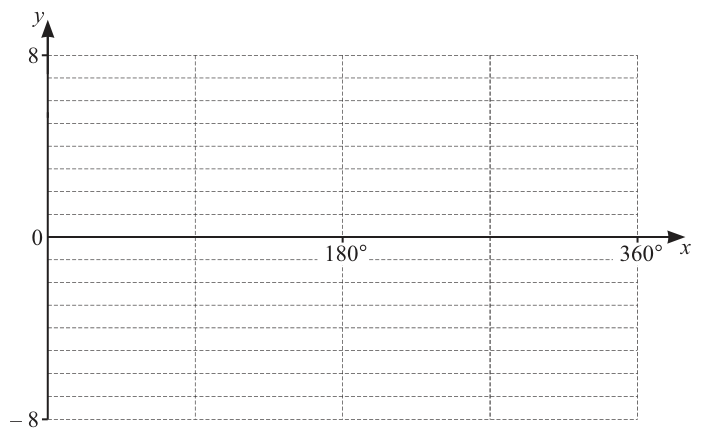
Approach
The graph of is the ordinary sine wave stretched vertically by a factor of 5 and translated 2 units down. One full cycle on : start at , peak at , midline crossing at , trough at , end at .
Working
Amplitude , midline , so the curve oscillates between and .
Key points:
It crosses the -axis where , i.e. at approximately and .
Answer
One full cycle of a sine wave with midline , amplitude 5: starting at , maximum 3 at , minimum at , returning to .
Sine curve over 0 to 360 degrees with midline y = -2, maximum 3 at 90 degrees, minimum -7 at 270 degrees, passing through (0, -2) and (360, -2)
Walkthrough
Multiplying by 5 stretches the wave so its values run from to instead of to ; subtracting 2 then slides everything down by 2, giving a midline of and a range from to . The sine shape starts at its midline value at , rises to its maximum at , returns to the midline at , dips to its minimum at , and returns to the midline at — exactly one cycle on the given interval.
Key Takeaways
- In , the amplitude is and the midline is .
- The maxima/minima of a shifted sine occur at the same -values as the unshifted curve ( and ).
- A sketch needs correct shape, correct turning points, and correct start/end values.
Common Mistakes
- Drawing the wave oscillating about instead of (the mark scheme pays B1 specifically for the correct midline).
- Using amplitude 5 but centring wrongly, giving maxima 5 and minima instead of 3 and (B1 requires the correct amplitudes 3 and ).
- Drawing more than one cycle or an inverted (cosine-like) shape.
- Marking the maximum at instead of .
Things to Be Careful About
- The mark scheme awards two separate B1s: one for the correct amplitude values ( and ) and one for the correct midline — both features must be visible.
- Exactly one cycle between and is required.
- The curve must pass through and , not through the origin.
A curve has equation
Approach
Use the chain rule on , where , and differentiate the inner function with respect to using the quotient rule.
Working
Let . By the quotient rule,
By the chain rule,
This matches the required form with .
Answer
16
Walkthrough
To find for the given function , we recognise it as a composite function of the form .
- First, we differentiate the inside function using the quotient rule :
- Next, we apply the chain rule :
- Multiplying the numerators and denominators together:
- Numerator:
- Denominator:
This gives the required expression with .
Key Takeaways
- When differentiating powers of a fraction, combining the chain rule with the quotient rule provides a systematic approach.
- Simplify the derivative of the inner function first to avoid cumbersome algebra when multiplying terms out.
Common Mistakes
- Sign errors in the numerator of the quotient rule, e.g. writing instead of subtracting.
- Forgetting to multiply by the derivative of the inner function (omitting the chain rule step entirely).
- Incorrectly combining powers of in the denominator (e.g. adding exponents incorrectly).
Things to Be Careful About
- Ensure all steps of the algebraic simplification are clearly shown, as this is a "Show that" question where the target form is given.
Approach
Stationary points occur where . Equate the derivative found in part (a) to zero and solve for .
Working
Since the denominator for all real , this simplifies to:
Thus, the stationary points occur at , , and .
Answer
x = -1, x = 0 and x = 1
Walkthrough
A stationary point on a curve is a point where the gradient is zero, i.e., .
From part (a), the derivative is:
Setting , a rational expression equals zero when its numerator is zero and its denominator is non-zero.
- The denominator is never zero for real .
- Setting the numerator to zero: .
This gives two factors:
Hence, the curve has stationary points at , , and .
Key Takeaways
- For rational functions, setting corresponds to setting the numerator equal to zero (provided the denominator is non-zero).
Common Mistakes
- Forgetting the negative root when solving , leading to only and .
Things to Be Careful About
- Ensure you clearly state each factor giving its corresponding root to justify all three stationary values.
Use the first derivative test to determine which two stationary points have the same nature and state whether they are maximum or minimum points.
Approach
Use the first derivative test by determining the sign of in the intervals around the stationary points , , and .
Note that the denominator is strictly positive for all , so the sign of is determined entirely by the numerator .
Working
Test the sign of in each region:
- For (e.g. ): and , so (negative).
- For (e.g. ): and , so (positive).
- For (e.g. ): and , so (negative).
- For (e.g. ): and , so (positive).
Summarising the sign changes across each stationary point:
- Around : the sign changes from negative to positive minimum point.
- Around : the sign changes from positive to negative maximum point.
- Around : the sign changes from negative to positive minimum point.
Therefore, the two stationary points with the same nature are and , and they are both minimum points.
Answer
x = -1 and x = 1 are minimum points
Walkthrough
The question explicitly requires the use of the first derivative test.
- Recall the first derivative from part (a):
-
Since for all real , the sign of depends only on the sign of , which has the same sign as :
- In : is negative and is positive .
- In : is negative and is negative .
- In : is positive and is negative .
- In : is positive and is positive .
-
Interpreting the behaviour:
- At , the gradient changes from negative (decreasing) to positive (increasing), meaning is a local minimum.
- At , the gradient changes from positive to negative, meaning is a local maximum.
- At , the gradient changes from negative to positive, meaning is a local minimum.
-
Thus, and share the same nature: they are both minimum points.
Key Takeaways
- In the first derivative test:
- A change from negative to positive indicates a local minimum.
- A change from positive to negative indicates a local maximum.
- No change in sign indicates a point of inflection.
- Testing the sign of factors separately makes sign determination much simpler than calculating exact values.
Common Mistakes
- Using the second derivative test instead of the first derivative test; the mark scheme specifies M0 if only the second derivative is used because the question explicitly requested the first derivative test.
- Picking test points incorrectly or confusing the signs of for values between and .
Things to Be Careful About
- Ensure you clearly state which two stationary points share the same nature ( and ) and specify that they are minimum points.
Solutions to this question by accurate drawing will not be accepted.
Find the -coordinates of the points where the curve cuts the -axis.
Approach
The curve cuts the -axis where . Expand into a cubic, find one linear factor using the factor theorem, divide out to get a quadratic, then factorise the quadratic.
Working
Set :
Expand:
Test : , so is a factor. Dividing:
Factorise the quadratic:
So
Answer
x = 1/2, 1, 3
Walkthrough
The curve meets the -axis exactly where , so we need to solve . First expand fully: multiplying out gives , and adding gives .
To factorise a cubic, look for an integer root by testing small values with the factor theorem. Trying : , so is a factor. Dividing the cubic by (by inspection or long division) gives the quadratic , which factorises as since .
So the equation becomes , giving , and .
Key Takeaways
- Setting converts a curve-intercept question into an equation-solving question.
- The factor theorem: if substituting gives zero, then is a factor.
- A cubic with three real roots splits completely into three linear factors; each factor gives one -coordinate of an intercept.
Common Mistakes
- Forgetting to add the when expanding, leaving instead of — every later step then fails.
- Testing only style values carelessly; arithmetic slips in evaluating give a wrong 'factor'.
- Sign errors when dividing the cubic by ; check by re-multiplying the factors back.
- Factorising incorrectly — the factors must multiply to give first term and constant .
- Giving only some of the three roots; all three intercepts are required for full marks.
Things to Be Careful About
- The final answers must come from correct working ('nfww' applies): expanding correctly, showing the factor found, the quadratic factor, its factorisation, and the roots.
- The mark scheme accepts any of the three linear factors first (, or ), but the corresponding quadratic must match.
- State all three values clearly: , , .
Approach
A logarithm only exists when its argument is strictly positive, so require .
Working
Answer
x > 1/3
Walkthrough
The logarithm is defined only when its argument is positive, i.e. . Solving this linear inequality gives , which simplifies to .
Key Takeaways
- The argument of any logarithm must be strictly positive.
- This condition often restricts which roots of a later equation are acceptable.
Common Mistakes
- Writing instead of — the logarithm of zero does not exist.
- Leaving the answer as unsimplified (this is allowed as "oe", but simplifying is safer).
Things to Be Careful About
- The inequality is strict: itself makes the argument zero and is excluded.
- Keep this condition in mind for part (b): any root found there must satisfy it.
Approach
Use the change-of-base formula to rewrite in base 5, so that every term shares one base. Then combine the right-hand side into a single logarithm, drop the logs to get a quadratic, solve it, and keep only roots satisfying part (a).
Working
By change of base,
since . Hence
The equation becomes
Write and use the power and product laws:
Equating arguments:
Factorise:
Both roots satisfy the domain condition from part (a), so both are valid.
Answer
x = 0.4 or x = 2
Walkthrough
The equation mixes two different bases ( and ), so the first job is to put everything into one base. The change-of-base formula gives , and since , the numerator is , so . Dividing by this gives .
The equation is now entirely in base 5: . Using the power law, , and writing as , the product law combines the right-hand side into .
With a single logarithm on each side and the same base, the arguments must be equal: . Rearranging gives the quadratic , which factorises as , giving or .
Finally, both candidates are checked against the domain from part (a): and , so both are accepted.
Key Takeaways
- Change of base converts an unfamiliar base into a workable one: .
- — dividing by a fraction multiplies by its reciprocal.
- Combining logs with the product/power laws lets you drop the logarithms and solve a polynomial equation.
- Every root of a log equation must be checked against the domain conditions (argument positive, base positive and not equal to 1).
Common Mistakes
- Misapplying change of base, e.g. writing (inverted).
- Treating as incorrectly without handling the factor correctly.
- Forgetting that when combining terms on the right-hand side.
- Equating coefficients instead of arguments after combining logs.
- Sign errors forming from .
- Accepting a root that violates the domain (here both survive, but the check must be made).
Things to Be Careful About
- The mark scheme awards B1 marks dependent on a correct change of base being seen — show it explicitly.
- Both answers here are exact decimals/fractions; give (i.e. ) and .
- The base must also be positive and ; both solutions satisfy this automatically since they exceed and neither equals 1.
- "Dep" notes mean later marks are lost if the change of base was wrong, so the first step must be correct.
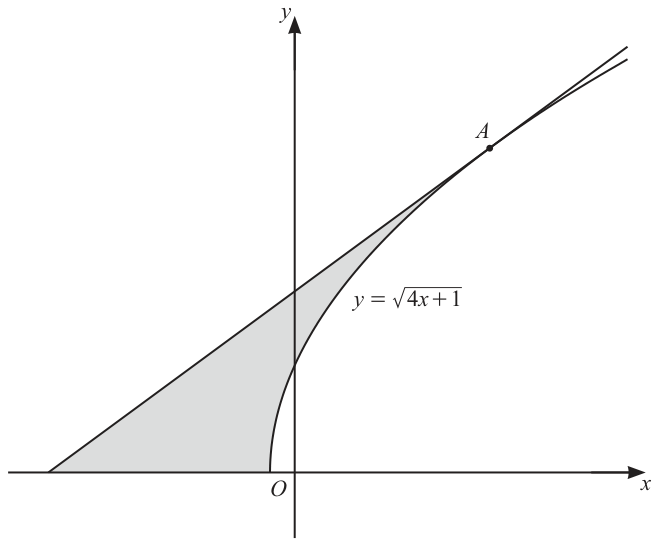
The point with -coordinate lies on the curve .
The diagram shows part of this curve and the tangent to the curve at .
Find the area of the shaded region enclosed by the curve, the tangent and the -axis.
Approach
The shaded region is bounded above by the tangent at and below by the curve, sitting on the -axis. Its area equals the area of the large triangle formed by the tangent and the -axis, minus the area under the curve from its -intercept to .
Working
At , where :
so .
Differentiate using the chain rule:
Gradient of the tangent at :
Equation of the tangent:
Its -intercept ():
Area of the triangle under the tangent from to :
The curve meets the -axis where :
Area under the curve from to :
Shaded area:
Answer
9/4 square units
Walkthrough
First find the coordinates of : substituting into gives , so .
To draw the tangent we need its gradient, so differentiate. Since is a square root of a linear expression, the chain rule applies: differentiate to get , then multiply by the derivative of the inside, . This gives , which at is .
Using the point–slope form, the tangent is . Setting gives its -intercept: .
The shaded region sits between the tangent (above) and the curve (below), both meeting the -axis. So:
The triangle has base from to (length ) and height , giving area .
The curve hits the -axis where , i.e. . The area under it from there to uses the power rule for integration: raise the power from to and divide by . Evaluating gives .
Subtracting: .
Key Takeaways
- The chain rule is needed whenever differentiating a function of a linear expression such as — do not forget the inner factor of .
- Areas between a curve and a line can be found by decomposition: here a triangle minus an integral.
- Integrating means dividing by as well as increasing the power.
- Intercepts anchor the limits: the tangent's intercept sets the triangle's base; the curve's intercept sets the integral's lower limit.
Common Mistakes
- Forgetting the inner derivative when applying the chain rule, giving gradient instead of — the mark scheme requires the form with .
- Using the wrong lower limit in the integral (e.g. instead of ); the mark scheme allows wrong limits only if correct substitution into the integrated form is shown.
- Dividing by but forgetting the extra factor when integrating, giving instead of .
- Taking the base of the triangle as rather than — the base runs from to .
- Subtracting the areas the wrong way round, or computing area under the curve from to only.
- Arithmetic slips in or in combining quarters and halves.
Things to Be Careful About
- The final answer must be exactly (or an equivalent exact form); decimals are acceptable on this calculator paper but the exact fraction is safest.
- The tangent's -intercept mark requires the correct straight-line equation — follow-through on your own gradient and point is allowed, but the intercept must come from a valid line.
- Show every step: the scheme awards separate marks for the derivative structure, the substitution at , the line equation, each intercept, the triangle area, the integrated form, and the limit evaluation.
- Check that the shaded region really is triangle-minus-curve-area by looking at the figure: the tangent lies above the curve throughout the interval, so no splitting into multiple integrals is needed.
Approach
Use on the first denominator and on the second. Since , all of , , are non-negative, so each square root simplifies without a modulus sign. Then combine into a single fraction.
Working
Since and for :
Write in terms of sines and cosines:
Combine over a common denominator:
which is the required result (AG).
Answer
The expression equals , as required.
Shown: the expression simplifies to sec(theta)
Walkthrough
The expression contains two square roots of expressions built from trig functions, so the natural first move is to convert what is under each root into a single squared function. The Pythagorean identity rearranges to , so the first root is ; similarly , so the second root is .
Taking a square root normally introduces a modulus sign, but here we are told — the first quadrant — where every trig function is positive. So and with no ambiguity. The first fraction becomes (since dividing by multiplies by ), and the second becomes .
Now write everything over one denominator: , so adding gives . The fundamental identity collapses the numerator to , leaving , exactly the printed target.
Key Takeaways
- The three Pythagorean identities (, , ) are the toolkit for simplifying anything involving or .
- ; you may drop the modulus only when the question's interval guarantees positivity.
- Writing everything in terms of and before combining fractions avoids most algebra errors.
Common Mistakes
- Dropping the modulus sign without quoting or using the interval — the mark scheme requires the range to justify this.
- Omitting the argument throughout the working: the scheme states the last mark is not available if is persistently missing.
- Misremembering the identity as instead of .
- Sign slips when combining over the common denominator .
- Working backwards from : for an AG part you must derive forward to the target, never start from it.
Things to Be Careful About
- This is a "show that" (AG) item: every intermediate line must be shown — the scheme awards B1 for each stage and the final B1 depends on all three previous marks being earned.
- Keep attached to every trig function at every line; persistent omission forfeits the final mark.
- State explicitly why the roots simplify (first-quadrant positivity) rather than silently writing .
Approach
Convert to , then use . Since is the fourth quadrant, , so take the negative root.
Working
Using :
so
In the fourth quadrant (), sine is negative, hence
Answer
-√(1 - 1/α²)
Walkthrough
We are given and want . The link between secant and sine runs through cosine: since , we get . Then the Pythagorean identity gives , so .
Choosing the sign is where the interval matters. The interval is the fourth quadrant, where cosine is positive but sine is negative. So we must take the negative root: .
(Equivalently, one may picture a right triangle with hypotenuse and adjacent side , giving opposite and , which is the same answer.)
Key Takeaways
- Reciprocal functions convert cleanly: .
- The Pythagorean identity lets you move between any two of , , up to a sign.
- The quadrant stated in the question exists precisely to fix that sign — always use it.
Common Mistakes
- Giving by ignoring the fourth quadrant, where sine is negative — the A1 requires the negative sign.
- Forgetting the at the squaring stage and only later realising a sign choice was needed.
- Writing instead of (confusing secant with cosine).
- Algebra slips such as writing as instead of .
Things to Be Careful About
- The final answer must carry the negative sign; the equivalent form is also accepted (oe).
- Leave the answer in exact surd form in terms of — no decimal evaluation is wanted.
- Check consistency: in the fourth quadrant , which matches , i.e. ; the given interval already encodes this.
An arithmetic progression has common difference .
The 3rd term of this progression is 10.
Write down expressions for the 1st term and the 2nd term of this progression.
Give your answers in terms of only.
Approach
Each term of an arithmetic progression is obtained from the previous one by adding , so earlier terms are found by subtracting .
Working
The 3rd term is , so
Answer
The 1st term is and the 2nd term is .
1st term: 10 - 2d, 2nd term: 10 - d
Walkthrough
In an arithmetic progression consecutive terms differ by the common difference . Since the 3rd term is given as , moving back one place means subtracting : the 2nd term is . Moving back another place subtracts again: the 1st term is . Both answers are required in terms of only, which they are.
Key Takeaways
- In an AP with common difference , each step backwards subtracts .
- The th term formula works in reverse: .
Common Mistakes
- Adding instead of subtracting it when working backwards.
- Giving answers still containing the number 3 (e.g. writing them as functions of ) instead of in terms of only.
- Swapping the two answers between the labels — the mark scheme allows either labelling (B1 for either), but both expressions must appear.
Things to Be Careful About
- The mark scheme awards B2 for both correct, B1 for either, so both must be stated.
- Keep the answers exactly as and ; these feed directly into part (b).
When each of the first 3 terms is squared, the sum of these squares is 140 .
There are two possible values for .
Using your answer to part (a), find the sum of the first 200 terms of the progression with the smaller value of .
Approach
Using part (a), the first three terms are , and . Square each, set the sum equal to , solve the resulting quadratic for , take the smaller value (), recover the first term, then use the sum formula with .
Working
Squaring each of the three terms and summing:
Expanding:
Collecting terms:
Dividing by 5 and factorising:
The smaller value is . Then the first term is
Sum of the first 200 terms:
Answer
80000
Walkthrough
First we carry forward the results from part (a): the three terms are , and . Squaring each term gives , and , and their sum is stated to be . Expanding the squares using produces a quadratic in alone. Simplifying to and dividing by 5 gives , which factorises neatly as , so or . The question asks for the progression with the smaller value of , so we take . Substituting back into the expression from part (a), the first term is . Finally, the sum of the first terms of an AP is ; with , and this gives .
Key Takeaways
- Squaring AP terms turns a linear condition into a quadratic equation in .
- When a quadratic yields two valid roots, re-read the question to decide which one applies.
- The sum formula needs both the first term and the common difference — recover from the earlier part rather than guessing.
Common Mistakes
- Forgetting to square the third term (the constant ), giving and wrong roots.
- Sign errors when expanding or .
- Taking instead of the smaller value .
- Using (the third term) instead of the actual first term in the sum formula.
- Writing — the last term correction uses , not .
- Arithmetic slips in the final evaluation; the mark scheme requires the fully correct .
Things to Be Careful About
- Follow-through applies at several stages (the scheme says FT from their terms in (a), their quadratic, their and their ), but the final answer must come from correct working.
- The equation must be reduced to a solvable three-term quadratic form before factorising to earn the method marks.
- Check the final answer's size: with positive terms should be large — is consistent with an average term of about .
In this question .
Use an algebraic method to show that can be written as .
Approach
Write both combinations in terms of factorials, take out the common factor , simplify what remains, and show the result equals .
Working
Since and , factor out :
Simplify the bracket:
So
Since :
Answer
Shown: nC5 - (n-1)C5 = (n-1)C4
Walkthrough
The question asks for an algebraic proof that choosing 5 objects from and subtracting those choices that exclude one particular object leaves exactly the number of ways to choose 4 from the remaining — but we must prove it with factorials, not by argument alone.
First convert each combination to its factorial definition:
Both fractions share the building blocks on top and below, because and . Factoring out the common piece gives
The bracket simplifies over the common denominator :
Multiplying through, the extra factor of turns the into (since ), and the factor of combines with back into :
This is precisely the factorial form of , completing the argument. The condition guarantees every factorial involved is defined.
Key Takeaways
- The factorial definition is the tool for proving identities between combinations algebraically.
- Factorials telescope: and , so common factors can always be extracted.
- The identity is worth remembering; this proof establishes it for .
Common Mistakes
- Cancelling factorials incorrectly, e.g. treating as if it were unrelated to instead of using .
- Using the identity itself (i.e. quoting properties) to simplify the left-hand side — the mark scheme explicitly disallows this; the proof must be self-contained via factorials.
- Sign slips in the bracket: , not or similar.
- Forgetting that when tidying the final fraction.
- Not completing the final line: the mark scheme requires the last expression to be recognised as , not left as an unevaluated fraction.
Things to Be Careful About
- This is an "AG"-style show-that part: derive forward from the given left-hand side to the printed target; never start from and work backwards.
- Every intermediate algebraic line must be shown — the scheme awards M1 for substituting the factorial forms, M1 for factorising, M1 for simplifying the fraction, and A1 only for the completed argument ending at .
- The second and third M marks are dependent on earlier ones, so a wrong substitution early loses the whole chain even if later algebra is correct.
- Keep all working exact in factorials; no decimals or numerical values of may be used since is general ().