Additional Mathematics 4037/23 — October/November 2024
Cambridge O-Level · Calculator · worked solutions for every part, with the mark scheme
Topics Calculus · Trigonometry · Series · Equations, inequalities and graphs · Quadratic functions · Functions · +5 more
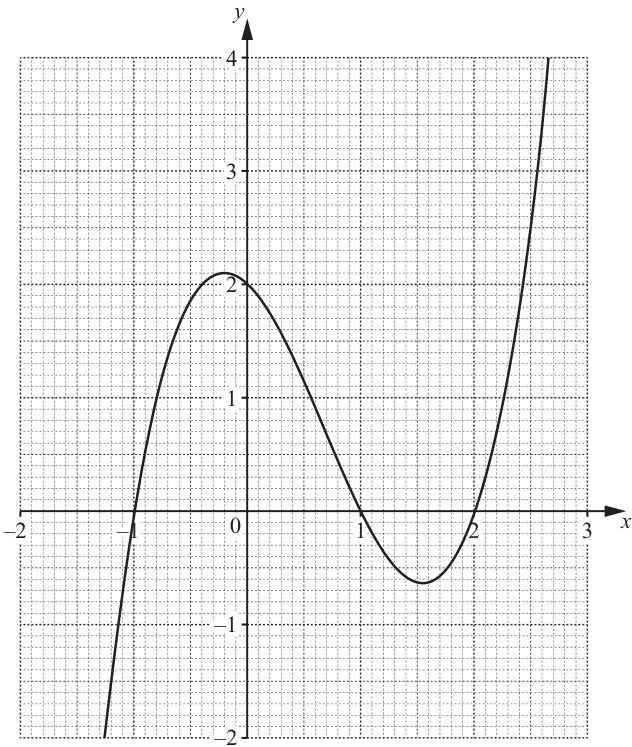
The diagram shows the graph of . Use the graph to solve the inequality
Approach
The inequality asks for the values of where the given cubic curve lies below the horizontal line . Draw on the graph, find where it meets the curve, then read off the intervals.
Working
Draw the horizontal line across the grid. It cuts the cubic at three points; reading from the graph:
The curve is below :
- to the left of the first crossing (the curve rises steeply from below), i.e. for ;
- between the second and third crossings (the curve dips through its local minimum near before rising again), i.e. for ;
- between and the curve is above the line (it passes through the local maximum near ), so this interval is excluded.
Answer
x < -0.8 or 0.55 < x < 2.25
Walkthrough
The graph shows , a positive cubic with roots at , , . To solve we compare the curve with the constant function : wherever the curve sits below height , the inequality holds.
Step 1: draw the horizontal line on the same axes. This line crosses the cubic three times because the curve's local maximum (about ) is above and its local minimum (about ) is below .
Step 2: read the -coordinates of the three intersection points from the grid: approximately , and .
Step 3: decide on which side of each crossing the curve is below the line. Coming from far left, the cubic comes up from very negative values, so it is below until . Between and it bulges above the line (through the maximum). It dips back under at , stays below through the minimum, and climbs above again at . Hence the solution set is together with .
Key Takeaways
- A one-variable inequality can be solved graphically by comparing the curve with an appropriate horizontal line.
- The number of solutions of equals the number of times the line crosses the curve — here three, since lies between the local maximum and minimum.
- The solution set of a strict inequality uses strict inequalities () and excludes the boundary points themselves.
Common Mistakes
- Giving only one or two of the three intervals — the mark scheme awards B1 for either correct inequality but B2 needs both, so all three intersection readings must be used.
- Including the boundary values with instead of : the question asks for strictly less than , so , , are excluded.
- Taking the middle interval the wrong way round (e.g. writing ), which happens if you forget that between those crossings the curve is above the line near the local maximum.
- Reading the intersection coordinates inaccurately from the grid — values should be read to about the nearest small division (, , ).
Things to Be Careful About
- The answer must come from the graph as instructed — do not attempt to expand and solve the cubic algebraically.
- Strict inequality: exclude the endpoints exactly as read.
- Both pieces of the solution set are required for full credit (B2); a single correct piece earns B1.
The function is defined by for all real values of .
Approach
Complete the square for , keeping the negative outside the bracket so the result has the form .
Working
Group the terms in :
Complete the square inside the bracket: half of is , and , so
Substitute back:
Answer
f(x) = 5 - (x+2)^2
Walkthrough
The question asks us to rewrite as . Because the coefficient of is negative, we first factor it out of the two terms containing : write . Then complete the square inside the bracket: take half the coefficient of (), form , and correct for the extra constant introduced — since , we have . Substituting gives . So and .
Key Takeaways
- Completing the square rewrites any quadratic in vertex form, revealing its maximum or minimum directly.
- With a negative leading coefficient, keep the minus sign outside the bracket so the squared term is subtracted.
- The correction constant inside the bracket is ; here that is .
Common Mistakes
- Writing without adjusting the constant, losing the correction and getting instead of .
- Giving only part of the answer: the mark scheme awards B1 for just or just , but both are needed for B2.
- Sign slips when distributing the outer minus over the bracketed expression.
Things to Be Careful About
- The answer must be exactly for full marks (B2); partial forms earn B1 only.
- Check by expanding: , which matches the original.
Approach
Use the completed-square form from part (a): since for all real , the largest value of occurs when the square is zero.
Working
Therefore
The maximum value is , attained at .
Answer
f(x) <= 5
Walkthrough
From part (a), . A square is never negative, so is never positive, meaning can be at most — reached exactly when . Hence the range of is all values .
Key Takeaways
- The completed-square form makes the maximum value of a downward-opening quadratic immediate: it is the constant in .
- The range of a quadratic with negative leading coefficient is .
Common Mistakes
- Stating only the maximum value instead of the full range .
- Using the wrong sign direction (e.g. ), which would suit an upward-opening quadratic.
Things to Be Careful About
- The mark scheme accepts or (B1, follow-through on their constant). The inequality must express that the function's values are bounded above by the maximum.
The function is defined by for , where is a constant.
State the least possible value of such that has an inverse.
Approach
A function has an inverse only if it is one-to-one. The parabola turns around at its vertex , so restricting the domain to works only if is at least the position of the turning point.
Working
From part (a), , which has its maximum at . For to capture a single monotonic (decreasing) branch, we need ; the least such value is
Answer
-2
Walkthrough
The quadratic is not one-to-one over all real numbers because every output below occurs twice. To define an inverse we restrict the domain to one side of the turning point. Since the domain must be , the smallest usable cut-off is exactly the -coordinate of the vertex, ; then decreases steadily on and is one-to-one there.
Key Takeaways
- A function possesses an inverse only where it is one-to-one (strictly increasing or strictly decreasing).
- For a parabola, the natural restriction is the vertex's -coordinate.
Common Mistakes
- Giving (the value of rather than ).
- Confusing the vertex's -coordinate () with the required -value.
Things to Be Careful About
- The mark scheme gives B1 for with follow-through from their part (a) constant. The reasoning (one-to-one requirement) should be understood even though only the value is credited.
Approach
Write using the completed-square form, swap the variables, and solve for . Choose the positive square root because the restricted domain forces . The domain of is the range of , and its range is the restricted domain of .
Working
Let
Swap variables:
Rearrange:
Since in the domain of , we need , i.e. , so take the positive root:
Hence
Domain: the outputs of on run from downwards, so
Range: the inputs to produce values from upwards, so
Answer
g^-1(x) = -2 + sqrt(5-x), domain x <= 5, range g^-1(x) >= -2
Walkthrough
To invert , start from (using the completed-square form from part (a)) and interchange and , giving . Rearranging isolates the square: , so . The choice of sign matters: because the domain of was restricted to , the inverse must return values , so and we take the positive root, giving . The domain of the inverse is the range of the original restricted function: on , takes every value up to and including , so the domain is . The range of the inverse mirrors the restricted domain: .
Key Takeaways
- To find an inverse algebraically: set , swap variables, solve for .
- When taking a square root during inversion, the restricted domain tells you which branch to keep.
- Domain of = range of ; range of = (restricted) domain of .
Common Mistakes
- Keeping both roots — this scores only A1, not A2, because the function would not be one-to-one.
- Taking the negative root, giving values below , contradicting the restricted domain.
- Swapping the domain and range statements (writing as the domain of the inverse).
- Forgetting to state the domain and range at all — each carries a separate mark.
- Starting from the uncompleted form and misapplying the quadratic formula signs.
Things to Be Careful About
- The mark scheme requires the swap-and-rearrange method (M1) and the exact answer (A2, with A1 for the version); later simplification errors are ignored (isw).
- Domain and range each carry a B1 with follow-through from earlier parts, provided they are stated in the correct inequality form.
- Check consistency: substituting into gives , matching .
Approach
Expand the left-hand side as a difference of squares, then use the identity to reduce everything to tangents.
Working
Using :
which is the required result.
Answer
(2 tan theta + sec theta)(2 tan theta - sec theta) = 3 tan^2 theta - 1, shown by expanding and using sec^2 theta = 1 + tan^2 theta
Walkthrough
The left-hand side has the shape with and , so it collapses immediately to a difference of squares: . The target answer contains only , so the next job is to remove the . The Pythagorean identity does exactly that. Substituting gives , and collecting like terms leaves , matching the printed result.
Key Takeaways
- Recognising a difference of squares saves work — never multiply out four terms when is visible.
- The identity converts any expression in into one purely in .
Common Mistakes
- Expanding all four products instead of spotting the difference of squares — slower and more error-prone.
- Using by confusing it with ; the sign is wrong.
- Forgetting to square the coefficient: , not .
- In a "show that" question, starting from the given answer and working backwards scores nothing — every line must run forward from the left-hand side.
Things to Be Careful About
This is an AG (Answer Given) part: the mark scheme requires sufficient correct detail, so both the expansion step () and the justified use of the identity must appear explicitly. Do not skip straight from the product to .
Approach
Use the result of part (a): the equation becomes . Solve for , then find both angles in .
Working
By part (a):
Taking the square root:
For :
For , the angle lies in the second quadrant:
Both values lie in and there are no others.
Answer
theta = 39.2 degrees or 140.8 degrees
Walkthrough
The word "Hence" tells us to use the identity just proved: the left-hand side of the equation is exactly . Setting this equal to gives , so . Because squaring loses sign information, taking the square root produces two branches, and ; keeping only the positive root would lose half the solutions. The positive branch gives an acute angle, . Tangent is negative in the second quadrant, so the negative branch gives . Both lie inside , and since tangent has exactly one solution per branch in this interval, these are the only answers.
Key Takeaways
- "Hence" questions are designed so the earlier result substitutes directly — always reuse it rather than re-expanding.
- Solving yields , giving one angle in each of the two quadrants where the relevant sign occurs.
- For tangent, the supplementary-angle relation is (unlike sine's and cosine's patterns).
Common Mistakes
- Discarding the negative root of and reporting only — the mark scheme awards A1 for one correct value but A2 requires both with no extras.
- Using instead of : outside the interval and wrong quadrant logic for tangent.
- Re-expanding from scratch instead of quoting part (a).
- Rounding too early: keep unrounded until the final answer, then give (angles in degrees to 1 decimal place).
Things to Be Careful About
The mark scheme demands both correct values and no extras in range (A2); one correct value ignoring extras earns only A1. Give angles to 1 decimal place: and . Both solutions in are required, not just the principal one.
The diagram shows a design for a logo. The logo is a sector of a circle, radius , with angle radians.
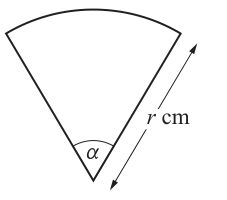
The area of the logo is .
Approach
The logo is a sector of radius and angle radians. Use the sector area formula to eliminate from the perimeter formula .
Working
The area of a sector is
so
The perimeter of the sector is the two radii plus the arc:
Substituting :
as required.
Answer
P = 2r + 18/r (shown)
Walkthrough
A sector's area is half the product of the two radii and the angle between them: . Setting this equal to the given area of gives an equation linking and , which we solve for .
The perimeter consists of two straight sides, each of length , plus the curved arc. The arc length is , so . Substituting the expression for gives , which is exactly the printed target — so the derivation is complete.
Key Takeaways
- Sector formulas only hold when the angle is in radians: and .
- When asked to show a given result, derive forward from the data; never start from the target.
- Eliminating one variable using a second equation is the key move here.
Common Mistakes
- Using degree-based sector formulas () instead of the radian forms.
- Forgetting that the perimeter includes both straight radii as well as the arc.
- Algebra slips when cancelling: , not or similar.
- Starting from the printed answer and working backwards — this scores nothing on a 'show that' part.
Things to Be Careful About
- This is an AG (Answer Given) part: every algebraic line between the given information and the target must appear, with sufficient correct detail.
- Keep the angle symbol clearly in radians throughout.
- The final line must match the printed form exactly.
Approach
Differentiate with respect to , set the derivative to zero to find the stationary value, then use the second derivative to determine its nature.
Working
Differentiate:
At a stationary point:
(taking the positive root since ).
Substitute into :
Determine the nature using the second derivative:
At :
Since the second derivative is positive at , the stationary value is a minimum.
Answer
Minimum stationary value P = 12, at r = 3
Walkthrough
We treat as a function of alone (the angle has already been eliminated). Writing as and differentiating gives .
A stationary point occurs where the gradient is zero, so we set . Rearranging gives , so (we reject because a radius must be positive). Substituting back into the original formula gives .
To decide whether this is a maximum or minimum, differentiate again: . At this equals , and a positive second derivative means the curve is concave up there — so is a minimum.
Key Takeaways
- To find stationary values, set the first derivative to zero, solve, then substitute back into the original function.
- The second derivative test classifies the point: positive means minimum, negative means maximum.
- Physical context matters: selects which root is valid.
Common Mistakes
- Keeping both roots — the negative radius is invalid in this context.
- Forgetting to substitute back to find the stationary value of , not just where it occurs.
- Differentiating incorrectly (e.g. getting instead of ).
- Stating 'minimum' without justification — the mark scheme requires the second derivative evaluated (or a sign-change argument), dependent on having found and no other value.
Things to Be Careful About
- The mark scheme awards the final A1 only if it depends on being the sole solution — check no extra roots are claimed.
- The derivative answer is marked 'isw' (ignore subsequent working), but the classification step needs explicit evaluation such as .
- State the conclusion clearly: the stationary value is and it is a minimum.
The tangent to the curve at the point where meets the line at the point . Find the coordinates of .
Approach
Find the -coordinate on the curve at , differentiate the curve by the quotient rule to get the gradient there, form the equation of the tangent, then solve it simultaneously with to locate .
Working
At :
Differentiate using the quotient rule:
Gradient at :
Tangent through :
Intersect with :
Then , so .
Answer
A(15, -1)
Walkthrough
The question threads three ideas together. First we need the actual point of tangency: substituting into gives .
Next we need the gradient of the curve at that point. The function is a quotient — a square root divided by — so the quotient rule is the right tool: differentiate top times bottom minus bottom times derivative of top, all over the bottom squared. Writing and , we get and , giving
Substituting : the numerator is , and dividing by gives gradient .
With a point and a gradient we write the tangent as , which rearranges to .
Finally, the meeting point with the line is found by setting the two expressions for equal: . Collecting terms gives , so and then .
Key Takeaways
- The quotient rule applies whenever one function is divided by another; here the numerator itself needed the chain rule for .
- A tangent needs two ingredients: the point on the curve (from substitution) and the gradient there (from the derivative).
- The intersection of two lines is found by equating their -expressions and solving the resulting linear equation.
Common Mistakes
- Forgetting to subtract in the correct order in the quotient rule, or writing instead of underneath.
- Mis-evaluating — it equals , not or .
- Sign slips when expanding ; the constant term must come out as .
- Solving incorrectly by adding instead of subtracting .
- The mark scheme awards the final B2 only if all earlier marks are earned, so an arithmetic slip early loses marks twice over.
Things to Be Careful About
- The mark scheme says "isw" after : later mis-simplification of that value is ignored, but the value itself must be exact.
- The final B2 depends on all previous marks being awarded, so every step matters — show the substituted derivative before evaluating it.
- The tangent equation may be given in any equivalent form ("oe"), e.g. or .
- Keep fractions exact throughout; decimals such as for the gradient risk accuracy loss.
Approach
Rewrite as and integrate using the reverse chain rule: raise the power by one and divide by (new power derivative of the inner function).
Working
Answer
(2/3)(3x + 2)^(1/2) + c
Walkthrough
The integrand looks awkward with its square root, so the first move is to write it in index form: , so the reciprocal is . Now it has the form (linear function), which integrates by the reverse chain rule: increase the power by one to get , then divide by the new power multiplied by the derivative of the inside function, which is . That gives . Because this is an indefinite integral, the constant of integration must be included — the mark scheme explicitly shows it.
Key Takeaways
- Convert roots and reciprocals to fractional/negative indices before integrating.
- The reverse chain rule: .
- Always append to an indefinite integral.
Common Mistakes
- Forgetting to divide by the derivative of the inner function (), giving — the mark scheme only awards the B1 for and the final mark requires the correct .
- Omitting the constant of integration.
- Sign or index slips when converting to .
Things to Be Careful About
- The answer is accepted "oe" (or equivalent), so forms like are fine, but is expected.
- The B1 is for any non-zero constant multiple , so the method mark survives a wrong coefficient — but the final accuracy mark needs exactly.
Approach
Integrate by dividing by the derivative of the exponent, then evaluate between the limits and .
Working
Evaluate from to :
Since and :
Answer
1/2 - (1/2)e^(1-2a)
Walkthrough
The integrand is , an exponential whose index is a linear function of . Integrating it uses the reverse chain rule: since the derivative of the index is , the antiderivative is divided by , i.e. . This earns the B2 in the mark scheme. Then the square-bracket evaluation form applies: substitute the upper limit and the lower limit and subtract. At the lower limit the index becomes , and , so the lower-limit term is . Subtracting gives , an exact answer in terms of as the question requires.
Key Takeaways
- — divide by the coefficient of in the index.
- Definite integration: evaluate the antiderivative at the upper limit minus the lower limit.
- makes the lower limit here collapse to a simple constant.
Common Mistakes
- Forgetting the minus sign from the in the index, giving — the mark scheme's B1 still credits for any non-zero , but the final answer then has the wrong sign.
- Subtracting the limits in the wrong order, giving .
- Mis-evaluating or forgetting .
- Leaving a in a definite integral (harmless but unnecessary) or giving a decimal approximation instead of the exact form in terms of .
Things to Be Careful About
- The answer must be exact and in terms of — do not substitute a numerical value for .
- The mark scheme says "isw": later mis-simplification after the correct answer is ignored, but the correct exact form (or equivalent) is required for all 3 marks.
- Keep the bracket evaluation clearly shown: upper limit minus lower limit, so the sign of the term is visible.
In the expansion of in ascending powers of , the 3rd and 6th terms are equal.
Find the value of .
Approach
Write the general term of the expansion of using the binomial theorem, pick out the 3rd and 6th terms, set them equal and solve for .
Working
The general term is
3rd term ():
6th term ():
Setting them equal:
Answer
x = cube root of 1/2
Walkthrough
In any binomial expansion , the general -th term is . Here and , so each term carries a power — the powers increase by 1 per term because the second part of the binomial itself contains an .
The 3rd term corresponds to : its coefficient is , giving . The 6th term corresponds to : its coefficient is , giving .
Equating them gives . Dividing both sides by leaves , so and .
Key Takeaways
- The general term formula lets you jump straight to any term without expanding fully.
- When the binomial contains powers of in both parts, add the exponents carefully: here the power rises by 1 each term, not by 1 in one place and down elsewhere.
- Equating two terms often reduces to a simple power equation after cancelling common factors.
Common Mistakes
- Using instead of as the term number: the 3rd term has , not .
- Getting the power wrong: forgetting that contributes , so the total power is , not or .
- Cancelling incorrectly when equating — dividing by must leave on one side only.
- Giving a decimal approximation instead of the exact cube root; the mark scheme requires the exact form (nfww).
Things to Be Careful About
- The answer must be exact: (or equivalent), not a rounded decimal.
- Check coefficients: and ; a slip here makes the final equation unsolvable cleanly.
- The mark scheme notes "isw" — later incorrect simplification is ignored once the correct value is reached.
In the expansion of in decreasing powers of , the 6th term is a constant.
Approach
Write the 6th term of using the general term formula; it is constant exactly when the net power of is zero.
Working
The 6th term corresponds to :
For this term to be constant, the power of must be zero:
Answer
n = 10
Walkthrough
The 6th term of uses in the general term with and . This gives . Simplifying the powers: .
A term is constant precisely when no remains, i.e. the exponent is zero: , giving .
Key Takeaways
- A "constant term" means the power of is zero — set the exponent equal to zero.
- In a binomial like , the power of decreases by 2 per term, so the middle term (when is even) is the constant one.
Common Mistakes
- Using for the 6th term instead of .
- Writing the power as incorrectly, e.g. forgetting the from .
- Setting the coefficient rather than the power of to zero.
Things to Be Careful About
- Counting terms: the -th term has index , so the 6th term always uses .
- The mark scheme accepts the correct term in any form, but the reasoning (power of first part equals power taken from second part) must be visible.
Approach
Substitute into the 6th term found in part (i) and evaluate.
Working
Using the result from part (i), the 6th term is
Now
so
Answer
8064
Walkthrough
Carrying forward from part (i), the 6th term becomes . Since , the term is purely numerical. Computing the pieces: and . Multiplying, .
Key Takeaways
- Once the constant-term condition fixes , evaluating the term is straightforward substitution.
- Knowing standard binomial coefficients such as speeds up evaluation.
Common Mistakes
- Using instead of (term-number off-by-one again).
- Forgetting the factor from .
- Arithmetic slip in .
Things to Be Careful About
- The mark scheme awards B1 for seeing (or ) and B1 for the final value 8064 — show both the expression and the product.
- This is a calculator paper, so the multiplication may be done electronically, but the substituted expression must still be visible.
Approach
Let . The range becomes , in which has exactly two solutions.
Working
Dividing by 4:
Both lie in , and no further solutions exist in this interval.
Answer
x = pi/24 and x = 5pi/24
Walkthrough
The equation involves , so we first treat as a single angle . Since runs from to , the angle runs from to — exactly one full positive half-cycle of the sine curve, in which is attained twice. The first solution is the standard special angle ; the second uses the symmetry , giving . Finally, dividing each by converts back to , giving and .
Key Takeaways
- For , solve for the angle first, then divide by at the very end.
- The second solution of in a half-cycle is .
- Always transform the given interval for into an interval for the substituted angle so you know how many solutions to expect.
Common Mistakes
- Dividing by 4 too early: writing and solving for directly gives wrong angles.
- Finding only and missing the second solution .
- Including extra solutions such as , which lie outside the given range — the mark scheme penalises extras.
Things to Be Careful About
- Answers must be exact, in terms of — no decimals.
- The range is , so only reaches : exactly two solutions, no more.
- The mark scheme awards one mark for either correct value (or for seen) and the second only for both values with no extras in range.
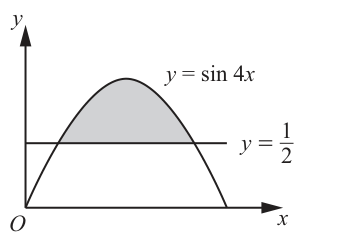
The diagram shows parts of the graphs of and .
Find the exact area of the shaded region enclosed by the curve and the line.
Approach
The shaded region lies between the curve (above) and the line (below), between the intersection points found in part (a): and . Its area is the integral of the difference of the two functions between those limits.
Working
Integrating term by term:
Substituting the exact limits:
Answer
√3/4 − π/12
Walkthrough
The shaded area sits between two graphs: the curve on top and the horizontal line underneath. Wherever one curve lies above another, the area of the strip between them is found by integrating (top function) − (bottom function). The strip exists only between the two crossing points, which part (a) gave us as and — this is why the parts are threaded together.
The integral of needs the chain rule in reverse: differentiating brings down the inner derivative , which cancels the , giving back . The line integrates to .
At the upper limit, , and ; at the lower limit, , and . Substituting and subtracting, the two cosine terms each contribute (total ), while the -terms give .
Key Takeaways
- Area between two curves between their intersection points.
- — divide by the inner coefficient.
- Exact limits and exact trig values of special angles give an exact answer in surds and .
Common Mistakes
- Integrating as or , forgetting the factor (the mark scheme gives B1 only for with or ).
- Subtracting in the wrong order at the limits, or using the limits and (the values) instead of the values from part (a).
- Integrating alone and forgetting to subtract the area under the line .
- Using decimal approximations for instead of the exact , losing the exact form.
- Sign slips when is negative.
Things to Be Careful About
- The limits must be the -values and from part (a), in radians, in the correct (increasing) order — the scheme awards the substitution mark only for exact limits in correct order.
- The final answer must be exact: or an exact equivalent; a decimal answer scores A0.
- The plan mark requires the integral of the difference (or the equivalent split ); integrating only the curve does not earn it.
- Follow-through applies to the limits from part (a), but only if at least the integration B1 was earned.
DO NOT USE A CALCULATOR IN THIS QUESTION.
Write in the form , where and are integers.
Approach
First add the by writing it over the common denominator, then rationalise the denominator by multiplying top and bottom by the conjugate , and simplify.
Working
Rationalise by multiplying by :
Expand the numerator and use :
This is of the form with integers and .
Answer
14 - √10
Walkthrough
The expression is a surd fraction plus . The first move is to combine them into a single fraction: writing as gives , since and .
The denominator is irrational, so we rationalise it. Multiplying numerator and denominator by the conjugate leaves the value unchanged but turns the denominator into a rational number: .
Expanding the numerator with the distributive law: , , , and . Collecting terms gives over .
Dividing each term by : and , so the value is , which is of the required form with , .
Key Takeaways
- To add a whole number to a surd fraction, put everything over the common denominator first.
- Rationalising a denominator of the form means multiplying top and bottom by the conjugate , using the difference of two squares.
- Expand surd products term by term, remembering that .
- Divide every term of the numerator by the denominator separately at the end.
Common Mistakes
- Adding the only to the numerator instead of forming a proper common denominator.
- Sign slips in the conjugate: using again instead of , which changes nothing.
- Arithmetic errors in the expansion, especially (not ) and the denominator (not ).
- Forgetting to divide the surd term by , leaving instead of .
- The mark scheme awards the final mark only if all previous steps are correct (nfww), so a wrong expansion followed by a 'correct-looking' answer scores nothing.
Things to Be Careful About
- The question is non-calculator: all arithmetic must be shown exactly, with no decimal approximations.
- The final answer must be in the exact form with integers and — here and , so is a legitimate term with .
- Keep the denominator sign straight: , and dividing by flips both signs.
- Show every expansion line; the scheme requires sufficient correct detail for each mark.
Suzma is training for a marathon. In the first week she runs . Then each week she runs a distance that is 10% greater than the week before.
The total distance that Suzma has run by the end of whole weeks is more than . Find the smallest possible value of .
Approach
The distance run each week forms a geometric progression with first term and common ratio .
Set the formula for the sum of the first terms , simplify the expression, and use logarithms to solve for the smallest integer .
Working
The sum of the first terms is given by:
Substituting and :
Take logarithms of both sides:
Since must be a whole number of weeks, the smallest possible integer value of is .
Answer
12
Walkthrough
- Identify the progression: Suzma starts with in week 1, so . Increasing by each week means multiplying the previous week's distance by , so .
- Set up the sum inequality: We require the total distance over whole weeks to exceed , so .
Using , we have . - Simplify the inequality:
- Solve using logarithms: Taking the base-10 log (or natural log) of both sides gives , which yields .
- Find the integer answer: Since represents whole weeks, we round up to the next integer, giving .
Key Takeaways
- For a percentage increase of , the common ratio is .
- When solving an inequality of the form where , taking logarithms preserves the inequality direction because .
- Read carefully whether the question asks for a single term or a cumulative total .
Common Mistakes
- Using the th term formula instead of the sum formula .
- Incorrect common ratio, e.g. taking instead of .
- Rounding down to instead of rounding up to to satisfy the strict inequality .
Things to Be Careful About
- Ensure the inequality sign is maintained properly. Since , dividing by does not flip the inequality sign.
- The question specifically asks for whole weeks, requiring the smallest integer satisfying the condition.
A geometric progression has 1st term and common ratio , where and . The 1st, 2nd and 3rd terms of the geometric progression are the 1st, 3rd and 7th terms of an arithmetic progression. Find the value of .
Approach
Let the geometric progression have terms , , and .
Let the arithmetic progression have first term and common difference . Since the 1st term of the GP is the 1st term of the AP, .
Express the 3rd and 7th terms of the AP in terms of and , equate them to the GP terms, eliminate , and solve for .
Working
From the arithmetic progression:
- 1st term:
- 3rd term:
- 7th term:
From the equation for the 3rd term:
From the equation for the 7th term:
Substitute into the 7th term equation:
Since , we can divide by :
This gives or .
Since it is given that , we have:
Answer
2
Walkthrough
- Define the terms of both progressions:
- GP terms: , , .
- AP terms: , , .
- Equate the corresponding terms:
- Eliminate the variable :
- Multiply the first equation by : .
- Equate with the second equation: .
- Solve for :
- Since , divide both sides by : .
- Rearrange into standard quadratic form: .
- Factorise: , giving or .
- Apply restrictions:
- The question states , so we discard and conclude .
Key Takeaways
- Setting up simultaneous equations using standard term definitions ( for GP, for AP) is the standard method for linking progressions.
- Eliminating nuisance variables (like ) allows you to isolate the desired parameter ().
Common Mistakes
- Forgetting that the th term of an AP is and writing or instead of and .
- Dividing by without acknowledging that .
- Leaving both and as the final answer, ignoring the given condition .
Things to Be Careful About
- Ensure you clearly reject based on the problem statement .
- Take care with arithmetic when eliminating to avoid algebraic sign errors.
There are 3 girls and 2 boys standing in a straight line. Find the number of possible orders in each of the following cases.
Approach
There are 3 girls and 2 boys in total (5 positions). For no two girls to stand next to each other, the 3 girls must occupy the 1st, 3rd, and 5th positions, and the 2 boys must occupy the 2nd and 4th positions, giving the unique pattern .
Working
Arrange the 3 girls in their 3 positions:
Arrange the 2 boys in their 2 positions:
Multiply the number of arrangements:
Answer
12
Walkthrough
We have 5 people in total: 3 girls and 2 boys. We want to find how many ways they can stand in a line such that no two girls are adjacent.
Because there are 3 girls and only 2 boys, the only way to separate all 3 girls is to alternate them with the boys, giving the exact gender pattern:
- The 3 distinct girls can be arranged among the 3 girl spots in ways.
- The 2 distinct boys can be arranged among the 2 boy spots in ways.
Multiplying these independent choices gives:
Key Takeaways
- When the number of separated items is and the separators are , there is only one alternating template that works.
- The number of permutations is obtained by arranging the distinct individuals within their designated positions using factorials.
Common Mistakes
- Assuming the pattern can start with a boy (e.g. ), which would leave two girls adjacent.
- Forgetting to multiply by for the boys' arrangements.
Things to Be Careful About
- Ensure you calculate the exact number of permutations for both groups of distinct individuals.
Approach
Use complementary counting: subtract the number of arrangements where the 2 boys are next to each other from the total number of unrestricted arrangements of the 5 people.
Working
Total unrestricted arrangements of the 5 people:
Treat the 2 boys as a single unit . This creates 4 units to arrange (3 girls and 1 boy-pair):
The 2 boys can be arranged within their unit in ways:
Subtract the arrangements where the boys are together from the total:
Answer
72
Walkthrough
We want to find the number of ways to arrange 3 girls and 2 boys in a line such that the 2 boys are not next to each other.
Method: Complementary Counting (Subtraction)
- First, find the total number of ways to arrange all 5 people without any restrictions:
- Next, calculate the number of arrangements where the 2 boys are standing next to each other. Treat the two boys as a single "block" or unit. We now have 4 items to arrange: the 3 girls and the single boy-block. There are ways to arrange these 4 items.
- Inside the boy-block, the 2 boys can be ordered in ways.
- Therefore, the number of arrangements where the boys are together is:
- Finally, subtract this from the total:
(Alternative approach using the gap method): Arrange the 3 girls first in ways. This creates 4 possible gaps (before the first girl, between girls, and after the last girl). Choose 2 distinct gaps for the 2 boys in ways. Total ways .
Key Takeaways
- When asked for items "not next to each other", complementary counting (Total minus Together) or the gap method are the two standard and reliable methods.
Common Mistakes
- Forgetting to multiply by for the internal arrangement of the two boys in the block.
- Incorrectly computing instead of treating the boys as a single entity among the 5 items.
Things to Be Careful About
- Ensure the difference between the total permutations and the bundled permutations is fully evaluated.
12 people, including Anjie and Bubay, are divided into 3 groups of 4 people. Anjie and Bubay must not be in the same group.
Find the number of ways in which the 3 groups can be selected.
Approach
12 people are divided into 3 groups of 4. Since Anjie and Bubay must be in different groups, place Anjie into Group 1 and Bubay into Group 2. Group 3 contains neither of them.
Group 1 needs 3 more people chosen from the remaining 10.
Group 2 needs 3 more people chosen from the remaining 7.
Group 3 will automatically take the remaining 4 people.
Working
Number of ways to choose 3 additional people for Anjie's group from the 10 available people:
Number of ways to choose 3 additional people for Bubay's group from the remaining 7 people:
The remaining 4 people form the third group in way.
Multiply these combinations:
Answer
4200
Walkthrough
We have 12 people to divide into 3 unnamed groups of 4 people each, with the restriction that Anjie (A) and Bubay (B) must not be in the same group.
-
Distinguish the groups by their special members:
Because A and B are in different groups, we can uniquely identify the three groups as:- Anjie's group (contains A plus 3 others)
- Bubay's group (contains B plus 3 others)
- The third group (contains neither A nor B, so it has 4 people)
-
Select members for each group from the remaining 10 people:
- For Anjie's group, we need to choose 3 more people from the 10 remaining people: .
- For Bubay's group, we need to choose 3 more people from the 7 remaining people: .
- The third group is automatically filled with the final 4 people: .
-
Calculate the total:
Note: We do not need to divide by any group factorial because the presence of A in one group, B in another, and neither in the third makes all three groups distinct.
Key Takeaways
- Placing fixed individuals into groups naturally breaks the symmetry among otherwise identical/unlabelled groups.
- When groups are rendered distinct by the members assigned to them, standard sequential selection via combinations can be multiplied directly.
Common Mistakes
- Dividing by erroneously after distinguishing the groups with Anjie and Bubay.
- Forgetting that Anjie's and Bubay's groups only require 3 additional members each, not 4.
Things to Be Careful About
- Ensure the pool of remaining people decreases appropriately at each step ().
A particle moves in a straight line. Its velocity, , at time seconds is given by
Approach
Acceleration is the derivative of velocity with respect to time, so differentiate and substitute .
Working
At :
Answer
-(1 + √3)/2 ms^-2 (≈ -1.37 ms^-2)
Walkthrough
The acceleration is the rate of change of velocity, so we differentiate with respect to . Differentiating gives , and differentiating gives , so . Substituting the special-angle values and gives the exact answer, which may also be quoted as the decimal to 3 significant figures.
Key Takeaways
- Acceleration is in kinematics.
- The derivatives of sine and cosine alternate signs: , .
Common Mistakes
- Dropping a sign when differentiating: writing instead of loses the accuracy mark.
- Mixing up and values.
- Rounding too early or giving fewer than 3 significant figures if using decimals.
Things to Be Careful About
- The mark scheme accepts or the decimal rounded to at least 3 decimal places; the final answer mark is for the value itself.
- Keep angles in radians throughout — the question is stated in radians and no degree conversion should appear.
The displacement of the particle from a fixed point at time is metres. The particle passes through when .
Find the displacement at the time when the particle first changes direction after passing through .
Approach
The particle first changes direction when its velocity first becomes zero after . Solve to find that time, integrate to get (using at to fix the constant), then substitute the time into .
Working
First find when the particle changes direction:
The first positive solution is
Now integrate the velocity to get displacement:
Use the condition that the particle passes through () when :
So
At :
Answer
√2 − 1 m (≈ 0.414 m)
Walkthrough
A particle changes direction exactly when its velocity passes through zero, so step one is to solve . Rearranging gives , whose first positive solution is — this is the first time after passing through that the particle turns around.
Step two is to recover displacement from velocity by integration. Since is the integral of , integrating term by term gives . The constant is unknown until we use the given information that when : substituting gives , so and the displacement equation is .
Finally, substitute : both sine and cosine equal there, so metres. An equivalent route is to evaluate the definite integral , which gives the same result directly.
Key Takeaways
- Direction changes occur where (and changes sign).
- Displacement from velocity requires integration plus an initial condition to pin down the constant of integration.
- Special-angle values such as give exact answers.
Common Mistakes
- Forgetting the constant of integration — without it the final substitution gives instead of .
- Solving incorrectly, e.g. dividing by without recognising it becomes .
- Working in degrees instead of radians when finding or evaluating the integral.
- Confusing displacement with distance travelled — here they coincide on since there, but the method must still be via .
- Using degrees-equivalent () inside radian-mode expressions inconsistently.
Things to Be Careful About
- The final accuracy mark depends on all previous marks being correct (dep on all previous marks awarded), so check each stage.
- Angles must be in radians: the mark scheme explicitly requires this for the definite-integral alternative.
- The answer may be left as the exact form or as ; later mis-simplification is ignored (isw).
Approach
From part (a), . From part (b), , so . Substitute to eliminate .
Working
Since , we have , hence
Answer
a = −s − 1
Walkthrough
Part (a) gave acceleration as , which is just the negative of . Part (b) gave the displacement as , so rearranging shows . Substituting this into the expression for removes all dependence on , leaving . This makes sense physically: the acceleration is proportional to how far the particle is from the point , pulling it back like a spring.
Key Takeaways
- To express one kinematic quantity in terms of another, eliminate the parameter between their equations.
- Recognising that is the negative of the bracket appearing in makes the elimination immediate.
Common Mistakes
- Sign slips: writing instead of .
- Attempting to re-differentiate or re-integrate rather than simply eliminating using earlier results.
Things to Be Careful About
- This part relies on both earlier results — carry forward and exactly as established.
- Equivalent forms such as are accepted (oe), and later mis-simplification is ignored (isw).