Additional Mathematics 4037/13 — October/November 2024
Cambridge O-Level · Calculator · worked solutions for every part, with the mark scheme
Topics Calculus · Trigonometry · Logarithmic and exponential functions · Straight-line graphs · Equations, inequalities and graphs · Quadratic functions · +4 more
Approach
Expand the product into a quadratic, differentiate, set the derivative to zero, and substitute back to find the -coordinate.
Working
At a stationary point :
Substituting back:
Answer
(1/2, -49/4)
Walkthrough
The curve is given as a product of two linear factors. Expanding gives , a quadratic whose derivative is easy to find: . A stationary point occurs where the gradient is zero, so gives . Substituting this back into the expanded quadratic gives . (Equivalently, one could complete the square: , which shows the minimum directly.)
Key Takeaways
- A stationary point is found by setting .
- For a quadratic, completing the square gives the stationary point immediately.
- Always substitute the -value back into the original curve to get the -coordinate.
Common Mistakes
- Forgetting to substitute back to find the -coordinate (giving only scores only 2 of the 3 marks).
- Sign slips when expanding — the constant term is , not .
- Arithmetic errors in ; write all terms over a common denominator of 4.
Things to Be Careful About
- The answer must be a coordinate pair; the exact form (or the equivalent decimal ) is accepted ("oe" in the scheme).
- This is a non-calculator paper, so keep the working in exact fractions.
Approach
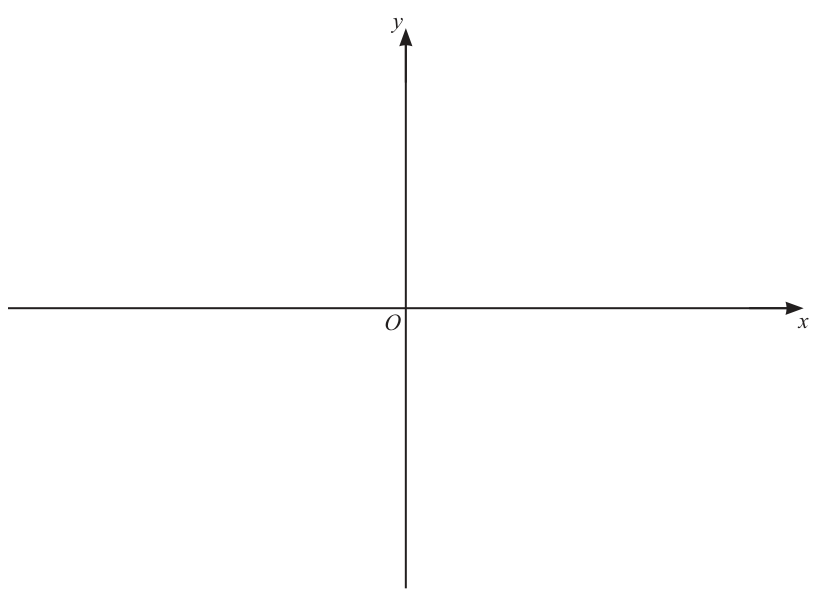
The curve is a parabola with roots at and , a minimum at and -intercept . Taking the modulus reflects the part below the -axis upwards, turning the minimum into a maximum and the roots into cusps.
Working
- Roots: gives and , so the graph touches the -axis at cusps and .
- -intercept: , so the curve crosses the -axis at .
- The reflected minimum becomes a maximum at , which lies in the first quadrant.
- Outside the original parabola was already positive, so those arms stay unchanged, rising steeply on both sides.
Answer
A W-shaped curve lying entirely on or above the -axis: two upward arms with cusps on the -axis at and , and a reflected parabolic arc between them peaking at and crossing the -axis at .
W-shaped curve on or above the x-axis with cusps at (-3, 0) and (4, 0), y-intercept (0, 12), and maximum (1/2, 49/4)
Walkthrough
The modulus takes every negative output of and makes it positive, which geometrically means reflecting the below-axis portion of the graph in the -axis. The parabola has roots and and lies below the axis between them (its minimum is from part (a)). So only the middle arc is reflected: it becomes an upward arch peaking at , while the outer arms are unchanged. At the roots the reflected arc meets the unchanged arms, creating sharp cusps on the -axis. The -intercept is .
Key Takeaways
- reflects the negative parts of in the -axis; positive parts are unchanged.
- Roots of become cusps (sharp corners) on the -axis.
- Intercepts are found by substituting (for the -intercept) and solving (for -intercepts).
Common Mistakes
- Drawing the whole parabola reflected (an upside-down U) instead of only the below-axis part — the outer arms must still rise.
- Drawing smooth turning points at the roots instead of cusps.
- Giving the -intercept as (forgetting the modulus makes it ).
- Marking the maximum below the axis or mislabelling it — the scheme ignores incorrect labels on the maximum, but the shape must be right.
Things to Be Careful About
- The scheme awards B1 for the correct shape (cusps on the -axis, maximum in the first quadrant) and B1 for the correct intercepts, and the intercepts mark depends on the shape being correct.
- The intercepts must be stated: , and .
- This is a sketch, not a plot: correct shape and key features matter, not plotted accuracy.
Given that , write down the values of for which the equation has exactly 2 distinct real roots.
Approach
The equation is solved by intersecting the sketch from part (b) with the horizontal line . Count intersections for different heights .
Working
From the sketch in part (b):
- For , the line cuts the curve in 4 points.
- At , the line touches the maximum: 3 points.
- For , the line cuts only the two outer arms: exactly 2 points.
Answer
k > 49/4
Walkthrough
Solving means finding where the horizontal line meets the W-shaped graph from part (b). For small positive the line crosses four branches (two outer arms plus the arch twice). As increases past the peak value , the arch is no longer reached, and only the two outer arms are cut — giving exactly 2 distinct real roots. So the condition is .
Key Takeaways
- The number of real roots of equals the number of intersections of with the horizontal line .
- Critical values of occur at turning points of the graph.
Common Mistakes
- Giving (using the -intercept instead of the maximum value ) — the scheme explicitly excludes this.
- Including , where the line touches the maximum and gives 3 roots, not 2.
- Forgetting is given, so no need to discuss .
Things to Be Careful About
- The answer is a strict inequality: gives 3 roots, so it must be excluded.
- Follow-through is allowed on the magnitude of the candidate's maximum from part (a), but scores nothing.
On the axes, sketch the graph of , for . State the intercept with the -axis.
Approach
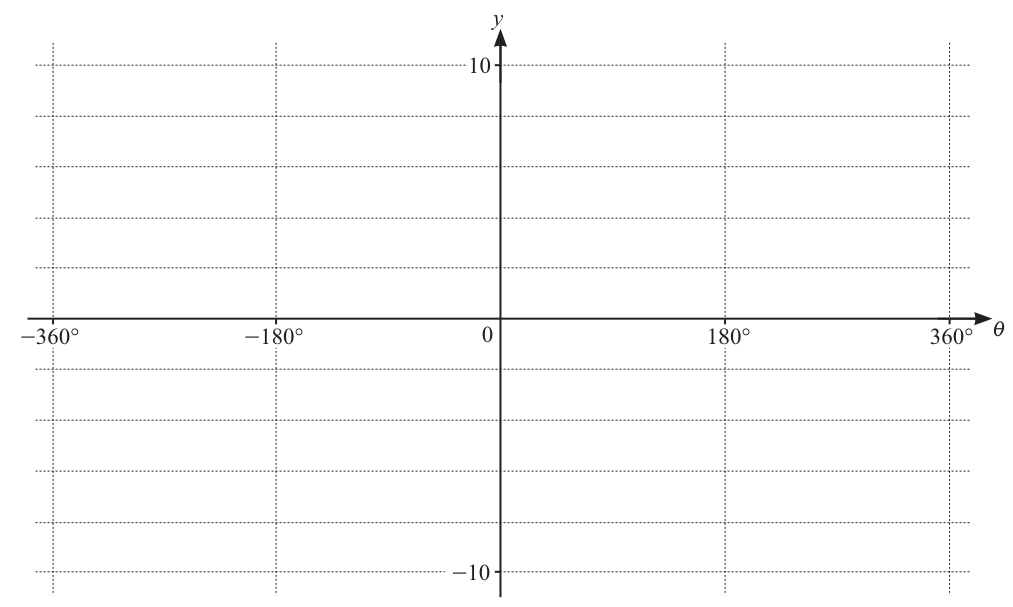
The graph of is the ordinary sine wave stretched vertically by a factor of (amplitude ), translated units up, and stretched horizontally by a factor of (period ). Evaluate the key points, then sketch one smooth wave across .
Working
Midline: , oscillating between and .
Key values:
So the curve starts at , falls to its minimum in the third quadrant region, rises through the -intercept , reaches its maximum in the first quadrant region, and returns to .
The intercept with the -axis is .
Answer
A single smooth sinusoidal curve from down to the minimum , up through to the maximum , and back down to . The -axis intercept is .
Sinusoidal curve with minimum (-180, -1), y-intercept 4, maximum (180, 9), endpoints (-360, 4) and (360, 4)
Walkthrough
The function is built from the basic sine graph by three transformations. The factor stretches the wave so it swings units either side of its centre; adding lifts that centre to the line , so the wave runs between and . Dividing the angle by inside the sine stretches the graph horizontally, doubling the period from to — which is why only one full 'up-and-down' pattern fits across the interval to .
To place the turning points, evaluate the function where takes its special values. At the inner angle is , giving and hence : this is the minimum. At the inner angle is , giving and hence : this is the maximum. At , and the inner angle is a multiple of , so and — these are the endpoints and the -intercept. Joining these points with one smooth S-shaped wave gives the required sketch.
Key Takeaways
- For , the midline is , the amplitude is , and the period is .
- A horizontal stretch changes where maxima and minima occur, so key points must be found by substituting into the whole argument , not read off an untransformed sine graph.
- Sketches are marked on shape plus correctly placed key points: endpoints, intercepts, maximum and minimum.
Common Mistakes
- Forgetting the horizontal stretch and drawing a full period of , which puts the minimum at and maximum at instead of and .
- Reading the amplitude as or the midline as instead of amplitude about .
- Marking the maximum or minimum at wrong coordinates — the mark scheme requires them at exactly and .
- Drawing straight-line segments instead of a smooth curve — the mark scheme demands a curve.
- Omitting the stated -intercept of , which carries its own dependent mark.
Things to Be Careful About
- All four marks are dependent on having the correct overall shape: a wrong shape scores nothing even if individual points are marked.
- The maximum must sit at and the minimum at — mislabelled coordinates lose those marks.
- State the -intercept explicitly as well as showing it on the sketch, since the question asks you to state it.
- Keep the curve smooth and continuous across the whole interval, ending exactly at and .
Find the values of for which the equation has no real roots.
Approach
Rearrange the equation into the form in , then impose the condition for no real roots: discriminant negative. This gives a quadratic inequality in , which is solved using its critical values.
Working
Rearrange into standard form:
For no real roots, the discriminant must be negative:
With , , :
Divide by 16:
Find the critical values by solving :
Since the quadratic opens upwards and we need it below zero:
Answer
-2 < k < 1
Walkthrough
The equation mixes powers of and the parameter , so the first job is to collect everything on one side so it reads as a quadratic in : subtracting and adding gives . A quadratic has no real roots exactly when its discriminant is negative — that is the key condition this question tests.
Identifying , and , the discriminant becomes . Setting this less than zero and dividing through by 16 leaves the much simpler inequality .
To solve a quadratic inequality, first solve the corresponding equation: factorising gives critical values and . Because the parabola opens upwards, its values are negative strictly between the roots, giving .
Key Takeaways
- The condition for a quadratic to have no real roots is (negative discriminant).
- When the coefficients contain a parameter, treat the parameter as constant while collecting terms in the variable ( here), then switch roles and solve an inequality in the parameter.
- Quadratic inequalities are solved via their critical values plus a sign argument (here, upward-opening parabola means the solution lies between the roots).
Common Mistakes
- Writing the inequality as or instead of — only a strict negative discriminant gives no real roots.
- Sign slips when computing ; forgetting the double negative loses the term.
- Giving the answer as or (outside the roots) — that is where is positive, not negative.
- Using non-strict inequalities : at or the discriminant is zero and there is one repeated real root, which contradicts "no real roots". The mark scheme explicitly demands strict inequality.
- Dividing the discriminant inequality incorrectly, e.g. dropping the factor of 16 inconsistently.
Things to Be Careful About
- The final answer must use strict inequalities: (the mark scheme notes "Strict inequality" for the A1 mark).
- Show the rearranged three-term quadratic explicitly — the B1 mark is awarded for seeing this form.
- Keep exact values throughout; no decimals are involved here.
- Check your sign work in the discriminant expansion carefully: and .
Approach
Write the constant 3 as a base-2 logarithm, convert the coefficient 4 into a power, then combine using the product and quotient rules.
Working
Using the power rule, :
Combining with the product and quotient rules:
Answer
log2(8a^4/b)
Walkthrough
The three terms must become one logarithm to base 2. First, the constant 3 is rewritten as , since — this makes every term a logarithm of the same base. Next, the coefficient 4 in front of is moved inside using the power rule, giving . Finally, the sum of two logarithms becomes the logarithm of a product, and the subtracted one becomes division: .
Key Takeaways
- Any constant can be written as .
- The power rule moves coefficients inside the log.
- Sums and differences of logs of the same base combine into products and quotients.
Common Mistakes
- Writing as instead of .
- Forgetting to convert the 3 into before combining, which loses the 8 in the answer.
- Leaving the answer as a sum of logs rather than a single logarithm, which the question forbids.
Things to Be Careful About
- The mark scheme awards the method mark for correctly using two of the multiplication, division or power rules, and the accuracy mark only if the final logarithm is to base 2 — a base-10 or base-e answer scores nothing.
- The answer must be a single logarithm, so all combining must be completed.
Approach
Use the change-of-base rule to write in terms of , turning the equation into a quadratic in .
Working
By the change-of-base rule, :
Multiplying both sides by :
Taking square roots:
Converting back to :
Both values are positive, so both are valid.
Answer
x = 100 or x = 0.01
Walkthrough
The equation mixes two different bases: is base 10, while has base . The change-of-base rule converts it, and since , the equation becomes . Multiplying through by gives , a quadratic in the quantity . Square rooting gives — both signs must be kept. Finally, undoing the logarithm with base 10 gives and . Both are positive, so both are valid solutions of the original equation.
Key Takeaways
- The change-of-base rule lets you express any logarithm in terms of one common base.
- An equation like is a disguised quadratic in .
- Squaring means two roots, so both and must be solved.
Common Mistakes
- Writing as — the mark scheme explicitly rejects this; the square is on the whole logarithm.
- Losing the negative root and giving only .
- Giving instead of for .
- Forgetting that must be positive (both answers here satisfy this).
Things to Be Careful About
- The mark scheme makes each mark dependent on a correct change of base, so the line must appear.
- Both solutions are required; giving only one loses the final mark.
- is an acceptable equivalent form for .
The polynomial is such that , where , and are integers. It is given that is a factor of . When is divided by the remainder is 20.
Approach
Since is a factor of , the factor theorem gives . Since division by leaves remainder 20, the remainder theorem gives . Write both equations and eliminate .
Working
Subtract equation (2) from equation (1):
Answer
7a - 3b = 39 (shown)
Walkthrough
The stem defines with integer coefficients. Part (a) asks us to show that , so we must derive this from the two given facts about .
First fact: is a factor. By the factor theorem, if is a factor then ; here . Substituting : , , and , giving .
Second fact: dividing by leaves remainder 20. By the remainder theorem, . Substituting : , , , giving .
Both equations contain the unknown , so subtracting them eliminates it: subtracting gives , , , and the right side is . So , hence , i.e. , exactly the printed target — so the derivation is complete.
Key Takeaways
- The factor theorem: a factor means .
- The remainder theorem: dividing by leaves remainder equal to .
- When two equations share an unwanted unknown ( here), eliminate it by adding or subtracting.
Common Mistakes
- Sign slips when substituting negative values: not , and not . The mark scheme allows only one sign error for the M marks.
- Forgetting that "remainder 20" means , not .
- Subtracting in the wrong order and getting without rearranging to the printed form — the AG mark requires the exact target reached from correct work.
Things to Be Careful About
- This is an AG (Answer Given) part: every algebraic line between the substitutions and must be shown — insufficient detail loses the A1 even if the answer matches.
- Keep all terms on one side consistently to avoid sign confusion when eliminating .
It is also given that when is divided by the remainder is 1.
Find the values of , and .
Approach
Differentiate to get , use the remainder theorem on at to form a second linear equation in and , solve it together with from part (a), then back-substitute into either earlier equation to find .
Working
Differentiate:
Remainder theorem on divided by :
Solve (3) with from part (a). Multiply (3) by 3 and the other by 2:
Adding:
Substitute into :
Find using :
Answer
a = 6, b = 1, c = 6
Walkthrough
We now know from part (a). The new information is that dividing by leaves remainder 1, so by the remainder theorem .
Differentiating term by term gives (the constant differentiates to zero). Substituting and equating to 1 gives , i.e. .
Now we have two linear equations in and . Eliminating : multiply by 3 to get , and multiply by 2 to get . Adding removes : , so . Substituting back: gives , so .
Finally, find by substituting and into any earlier true statement — using : , so . (Using instead: also gives .)
Key Takeaways
- The remainder theorem applies to any polynomial, including a derivative: equals the remainder when is divided by .
- Differentiating a cubic kills the constant term, so never appears in — that is why must be recovered afterwards from an original equation.
- Simultaneous linear equations are solved cleanly by matching coefficients before adding or subtracting.
Common Mistakes
- Writing incorrectly, e.g. forgetting to reduce each power or keeping the constant .
- Setting out of habit from factor questions — here the remainder is 1.
- Solving the simultaneous equations with sign errors; the dependent M1 requires correctly solving their equation with .
- Stopping after finding and and forgetting to go back for .
- Using or other wrong conditions to find .
Things to Be Careful About
- The final M1 is dependent: it is awarded only for solving the candidate's own equation from this part together with the result from part (a), so the link between the parts must actually be used.
- Check the values satisfy both original conditions as a sanity check: ✓ and ✓.
The table shows the variables and which are related by the equation , where and are constants.
| 1 | 1.5 | 2 | 2.5 | 3 | |
|---|---|---|---|---|---|
| 14 | 33.3 | 112 | 532.8 | 3584 |
Approach
Take natural logarithms of every value and square every value, then plot the pairs on the printed grid and draw a single straight line of best fit.
Working
Compute and for each data point:
For example, , , , and , all to 3 significant figures.
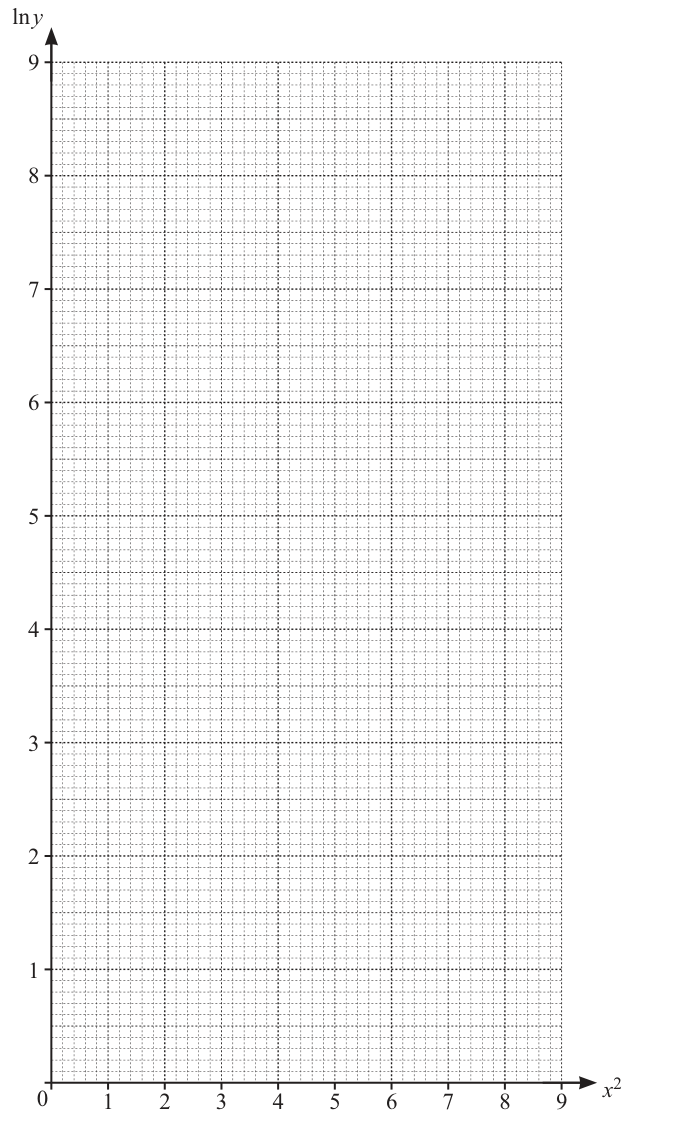
Plot these five points on the grid and draw a straight line passing as close as possible to all of them — the points lie very nearly on one line.
Answer
The completed table is : and : , and these five points are plotted and joined by a straight line of best fit rising from about to .
Points (1, 2.64), (2.25, 3.51), (4, 4.72), (6.25, 6.28), (9, 8.18) plotted on the ln y vs x^2 grid with a straight line of best fit through them
Walkthrough
The equation is not linear in and , so it cannot be tested directly on ordinary graph paper. Taking natural logarithms of both sides gives . If we treat as the horizontal variable and as the vertical variable, this has exactly the form of a straight line with gradient and intercept . So the first job is purely mechanical: square each () and take of each (). Then plot each pair carefully on the millimetre grid — accuracy here matters because parts (b) and (c) read their answers off this same line. Finally lay a ruler along the points; they lie almost perfectly straight, so the line of best fit passes essentially through all five.
Key Takeaways
- Taking logs converts an exponential-type relationship into a linear one whose gradient and intercept reveal the constants.
- Here the log is taken of only, while is squared first — the choice of which variables to transform comes from matching the equation to .
- Careful plotting pays off twice: the same graph supplies answers to all three parts.
Common Mistakes
- Plotting instead of , or instead of — the whole point of the transformation is lost.
- Using (base 10) instead of ; either would give a straight line, but the mark scheme's values are natural logs, so mixing bases corrupts later readings.
- Joining the points with a zig-zag instead of drawing one straight line of best fit.
- Rounding too coarsely so the points drift off the true line.
Things to Be Careful About
- The mark scheme awards M1 for plotting with at most one error, so all five points must be plotted accurately to the small grid squares.
- Give values to 3 significant figures before plotting.
- The line must be genuinely straight and pass through the scatter of points, not forced through the origin.
Use your graph to estimate the values of and . Give your answers correct to 1 significant figure.
Approach
Taking natural logs of gives a straight-line form in which the gradient of the graph equals and the intercept equals . Read these two features off the line drawn in part (a), then exponentiate.
Working
Taking of both sides:
so the graph of against has gradient and intercept .
From the line of best fit, using the end points and :
Hence
Extending the line back to gives the intercept:
Answer
A = 7, b = 2
Walkthrough
First establish why the graph works: applying the log law and the power law turns into . Comparing with , the slope of the plotted line is and where it cuts the vertical axis is . From the drawn line, the rise over the full run is about over a run of , giving a gradient near . So . Reading where the line meets the axis gives about , so . Both answers are wanted to 1 significant figure, which conveniently absorbs any small reading error.
Key Takeaways
- In a log-linear plot of , gradient and intercept — the constants come out of the log, so you must exponentiate at the end.
- Always write down the linear form explicitly before reading the graph; mixing up which feature gives which constant is the classic error.
- The question asks for 1 significant figure precisely because graph readings carry uncertainty.
Common Mistakes
- Reporting and — forgetting that these are and , so the final step , is essential.
- Swapping the roles: treating the intercept as and the gradient as .
- Computing the gradient from the original data rather than from the transformed line — the mark scheme insists the gradient comes from the linear graph.
- Giving more significant figures than asked; the answer must be 1 s.f.
Things to Be Careful About
- The mark scheme allows the linear form to be credited even if first seen in part (a).
- Answers follow through from your own line, but the final values must round to and at 1 s.f.
- Use natural logs throughout to match the scheme's values and .
Use your graph to estimate the value of when . Give your answer correct to 2 significant figures.
Approach
Convert into , read the corresponding from the line drawn in part (a), then take the square root.
Working
Reading across from on the line of best fit gives
Therefore
Since takes positive values in the table, reject the negative root.
Answer
x = 2.2
Walkthrough
The graph plots , so first convert the target value: . Find on the vertical axis, move horizontally until you meet your line of best fit, then drop down to read . Since the horizontal variable is , recover by taking the positive square root: . The negative root also satisfies the algebra, but the data only involves positive , so it is rejected — the mark scheme explicitly penalises leaving both roots.
Key Takeaways
- To use a log-linear graph for interpolation, convert the target into first, never read directly off the axis.
- Remember the horizontal axis holds , so a final square root recovers .
- Context determines whether negative roots are valid.
Common Mistakes
- Reading directly without taking the square root.
- Substituting into the axis as though the axis were rather than .
- Giving — the mark scheme awards A0 unless is rejected.
- Reading from extrapolated portions of the line far outside the plotted data.
Things to Be Careful About
- Follow-through applies: the M1 is for using your line with , so small plotting errors do not lose the method mark.
- The accepted answer is , with or allowed for reading tolerance.
- Give the answer to 2 significant figures as instructed.
Approach
is a product of and , so differentiate using the product rule.
Working
Answer
x^2 + 3x^2 ln x
Walkthrough
The function is a product of two functions of , so the product rule is the right tool: if then . Taking and , we get and . Substituting gives , and the second term simplifies to .
Key Takeaways
- The product rule: .
- The derivative of is .
- by the laws of indices.
Common Mistakes
- Differentiating each factor separately and multiplying the derivatives, giving — this ignores the product rule entirely.
- Forgetting the second term and writing only .
- Mis-simplifying as instead of .
Things to Be Careful About
- The mark scheme allows the unsimplified form for full marks, but the simplified form is the expected answer.
- Keep the two terms of the product rule in the correct positions; either order is acceptable since addition commutes.
Hence find , giving your answer in the form , where is an integer and is a rational number.
Approach
The word "Hence" signals that part (a) must be used. Since , rearranging gives . Integrate both sides, then substitute the limits exactly.
Working
Integrating the rearranged identity:
Evaluating between the limits and :
Since :
Using the law of logarithms :
Answer
ln 256 - 7/3
Walkthrough
The instruction "Hence" tells us to build on part (a). There we found . Rearranging this identity isolates the integrand: . Integrating both sides with respect to turns the derivative back into the function, giving . The remaining integral is a standard power rule: .
Now evaluate the definite integral between and using the square-bracket form. At the upper limit : . At the lower limit : , since . Subtracting the lower from the upper gives .
Finally, the answer must be in the form with an integer. The law converts into , so the answer is , with and .
Key Takeaways
- "Hence" questions expect you to reuse the previous part's result — here the product-rule derivative becomes an integration-by-parts result read backwards.
- Integration by parts in the form with always reduces the problem to integrating a power of .
- The logarithm law converts a coefficient into a power inside the log.
- is used constantly in definite integrals with lower limit .
Common Mistakes
- Ignoring the "Hence" and attempting integration by parts from scratch — this wastes time and often introduces sign errors, though the same result should emerge.
- Forgetting to subtract the lower limit, or forgetting that the lower limit contributes .
- Writing as instead of .
- Leaving the answer as , which is not in the required form .
- Sign slips when combining ; the correct result is , not or .
Things to Be Careful About
- The mark scheme's B1 is specifically for the line , so that rearrangement step must be visible.
- The first M1 depends on the B1, and the second M1 is for correct use of the limits — show both substitutions explicitly.
- The A1 is for one correct term of the final answer, and the answer must be exact: , not a decimal approximation.
- Keep the exact form throughout; do not evaluate numerically.
The straight line intersects the curve at the points and . The point with coordinates lies on the perpendicular bisector of .
Approach
Substitute into the curve equation to get a quadratic in , solve it to find and , then build the perpendicular bisector from the midpoint of and the negative reciprocal gradient, and evaluate it at .
Working
Substituting into :
Factorising:
Using :
So and are and .
Midpoint of :
The gradient of is (from ), so the perpendicular bisector has gradient :
At :
Answer
k = -4/5
Walkthrough
The line meets the curve where both equations hold together, so we substitute into the curve's equation. This removes and leaves a quadratic in alone: collecting terms gives . Factorising as gives the two intersection -coordinates and . Each is fed back into to recover the full coordinates of and : and .
The perpendicular bisector of passes through the midpoint of and — found by averaging the coordinates — which is . Since lies on a line of gradient , any perpendicular line has gradient (the negative reciprocal). The point-sense form then gives the bisector's equation, and substituting yields .
Key Takeaways
- Intersections of a line and a curve are found by substitution, producing a quadratic whose roots give the intersection points.
- The perpendicular bisector combines two ideas: the midpoint formula and the negative reciprocal gradient rule ().
- Exact fractions should be kept throughout so the final value of is exact.
Common Mistakes
- Expanding incorrectly or dropping the constant term when collecting the quadratic.
- Finding only one root of the quadratic and hence only one intersection point — both are needed for the midpoint.
- Using the gradient instead of for the bisector, or forgetting the sign flip in (it is because the midpoint's is negative).
- Arithmetic slips combining fractions such as .
Things to Be Careful About
- The mark scheme requires the correct midpoint and the correct perpendicular gradient specifically (both are B1 marks), so check these before proceeding.
- Keep all values as exact fractions — no decimals — since the question asks for the exact value of .
- Show every algebraic step between substitution and the quadratic, since method marks depend on the working being visible.
The point lies on the perpendicular bisector of such that its perpendicular distance from is twice that of the point from . Find the possible coordinates of .
Approach
Since lies on the perpendicular bisector, its displacement from the midpoint of is along that bisector. Doubling the perpendicular distance from means taking a displacement from twice as large, in either direction along the bisector.
Working
From part (a), and .
Displacement from to :
Doubling this displacement and going both ways from :
Answer
(9/2, -2) or (-51/10, 14/5)
Walkthrough
All points on the perpendicular bisector lie on a straight line through the midpoint . The point sits a certain perpendicular distance from the line ; moving from towards covers exactly that distance. So a point twice as far from is reached by stepping from twice as far along the same line — either continuing past (giving ) or stepping the same doubled amount in the opposite direction (giving ).
Computing , the two candidates follow directly: and .
Key Takeaways
- Distances measured perpendicularly from a line correspond to displacements along the perpendicular direction, so scaling the distance scales the displacement from the foot/midpoint.
- "Possible coordinates" signals two answers: the scaled displacement can be applied in either direction along the bisector.
Common Mistakes
- Giving only one of the two possible points — the mark scheme awards one mark each, so both are needed for full credit.
- Scaling the wrong quantity, e.g. doubling only one coordinate instead of the whole displacement vector from the midpoint.
- Measuring from rather than from the midpoint , which does not place on the bisector at the right distance.
- Sign errors when subtracting the fractional coordinates of and .
Things to Be Careful About
- The mark scheme allows follow-through on the candidate's own and midpoint, but the structure must be (and similarly for ) — i.e. the displacement must be taken from the midpoint, not from .
- Both points must be given as exact fractions; decimals are not required here and lose the exact-form intent.
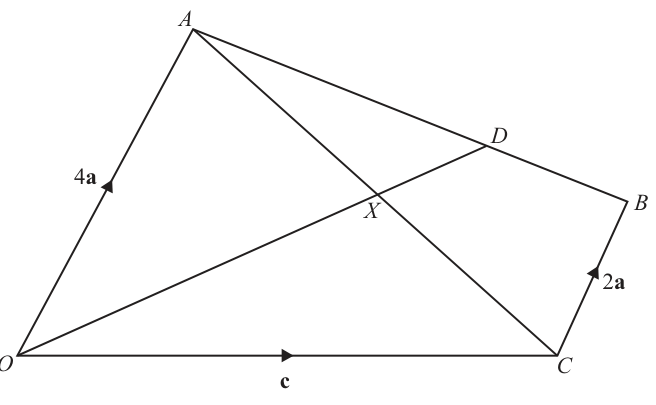
The diagram shows the trapezium , where , , and . The point lies on such that . The point is the point of intersection of the lines and . It is given that and .
Find in terms of and
Approach
Travel from to via : , where .
Working
Answer
c - 2a
Walkthrough
The vectors , and are given. To get from to we can go from to (which is ) and then from to (). Adding these gives .
Key Takeaways
Any vector between two points can be built as a path of known vectors; .
Common Mistakes
Reversing the direction of subtraction, e.g. writing instead of , giving sign errors in the terms.
Things to Be Careful About
Keep the order of letters consistent: the end point minus the start point. This answer is carried forward into parts (b) and (e).
Approach
Since , we have . Then travel .
Working
Answer
(8/3)a + (2/3)c
Walkthrough
The ratio means sits of the way along , so using the result of part (a). Adding this to gives ; collecting the terms gives .
Key Takeaways
A point dividing a segment in ratio is a fraction of the way along it.
Common Mistakes
Using or instead of for ; forgetting to simplify the collected coefficients.
Things to Be Careful About
Unsimplified forms are allowed by the mark scheme, but the final collected form is used in later parts.
Approach
lies on with , so substitute the result of part (b).
Working
Answer
(8μ/3)a + (2μ/3)c
Walkthrough
Since is on the line , its position vector is a scalar multiple of . Substituting the answer to part (b) and distributing over both terms gives the required expression.
Key Takeaways
If lies on line , then for some scalar — this is how collinearity is encoded in vector questions.
Common Mistakes
Forgetting to multiply both components by .
Things to Be Careful About
This expression must be kept in terms of and — it will be equated with the expression from part (d) in part (e).
Approach
First find , then use .
Working
Answer
λ(c - 4a)
Walkthrough
The vector from to is . Since lies on with , multiplying by gives the answer.
Key Takeaways
Points on a line segment are expressed as scalar multiples of the segment's direction vector.
Common Mistakes
Writing (reversed direction).
Things to Be Careful About
Keep the unsimplified product form too — both forms are accepted, but consistency matters when equating in part (e).
Approach
Use , substitute the expressions from parts (c) and (d), then equate coefficients of the independent vectors and .
Working
Equate coefficients of :
Equate coefficients of :
Substitute :
Answer
λ = 1/2, μ = 3/4
Walkthrough
Because is the same point reached two ways, . The left side uses part (c): . The right side combines with part (d): . Since and are independent (not parallel), their coefficients must match separately — this turns one vector equation into two scalar equations. Solving them simultaneously gives and then .
Key Takeaways
When two expressions for the same vector are written in terms of two non-parallel basis vectors, coefficients can be equated. This is the standard technique for intersection-point problems in vector geometry.
Common Mistakes
Equating the whole vectors incorrectly by mixing up which side carries ; making sign errors when moving the term; solving only one equation and guessing the other value.
Things to Be Careful About
The mark scheme requires the equation oe to be formed first, then equating like vectors, then an attempt at solving the pair — all three method marks depend on correct earlier answers being carried forward. Exact fractions are expected: , .
Approach
Treat as the unknown and factorise the quadratic , then solve each resulting equation for in .
Working
Factorise:
So either or .
For : the principal value is
The tangent is also positive in the third quadrant, giving the solution one full period back:
For : the principal value is , and the other solution in range is
Answer
theta = -164.1, -45, 15.9, 135 degrees
Walkthrough
The equation is quadratic in . Since and we need two numbers multiplying to and adding to , these are and . Splitting the middle term gives , which factors as . Setting each factor to zero gives and .
For , taking inverse tangent gives . Tangent has period , so subtracting stays within the interval and gives .
For , the principal value is (fourth quadrant), and adding gives the second-quadrant solution . All four values lie inside .
Key Takeaways
- A quadratic in is solved exactly like any quadratic once you substitute mentally .
- Tangent repeats every , so each root generates a partner angle by adding or subtracting .
- Always check every candidate against the stated interval and reject extras.
Common Mistakes
- Dividing through by instead of factorising, which loses solutions.
- Finding only the principal value for each root and missing the second angle from the periodicity ( and ).
- Including angles outside the interval such as or — the mark scheme penalises extras.
- Rounding incorrectly; angles in degrees are required to 1 decimal place.
Things to Be Careful About
- The interval includes both endpoints here, but no endpoint happens to be a solution.
- Give angles to 1 decimal place as required for degree answers; not .
- All four solutions must be listed with no extras in range for full accuracy marks.
Approach
Rearrange to make the subject, take the inverse sine in radians, then use the symmetry and periodicity of sine to find all values of lying in the range generated by , before dividing through to recover .
Working
Rearrange:
Taking the inverse sine (in radians):
Since , the inner expression satisfies . The further values of the argument come from the symmetry and adding :
(The value exceeds , so it is rejected.)
Now solve each for :
Answer
phi = 0.743, 1.30, 2.84
Walkthrough
First isolate the sine: adding 2 and dividing by 3 turns the equation into . Taking the inverse tangent-style first step, radians — this must be done in radians because the question states is in radians.
Next work out how far the inner expression can travel: multiplying the inequality by 3 and subtracting 1.5 gives . This window is wider than one full period of sine (), so up to three solutions exist.
Starting from the principal value : sine's symmetry about gives the second solution ; adding to the principal value gives , which still lies below . Adding to would give , outside the window, so it is discarded.
Finally undo the transformation: add 1.5 to each argument value and divide by 3, giving , , .
Key Takeaways
- For equations of the form , always find the range of the inner expression first — it tells you how many solutions to expect.
- Sine solutions come in pairs and , repeated every .
- Inverse sine must be evaluated in radians when the variable is measured in radians; converting through degrees introduces rounding errors.
- Undo a linear transformation in reverse order: add/subtract last-applied constant, then divide by the multiplier.
Common Mistakes
- Working in degrees instead of radians — the mark scheme explicitly rejects degree answers.
- Forgetting to extend the search window beyond : since reaches , the third solution at is easily missed.
- Keeping the extra solution which lies outside the window, producing an invalid fourth answer.
- Solving by dividing only part of the left side by 3 (e.g. writing ).
- Rounding too early: keep unrounded until the final division, then round answers to 3 significant figures.
Things to Be Careful About
- The mark scheme awards a dependent method mark for the correct order of operations when recovering — show explicitly.
- Answers must be given to 3 significant figures in radians: , , .
- Check the final answers lie strictly inside — all three do, but verify rather than assume.
The first 3 terms of an arithmetic progression are , , . Find the sum to terms, giving your answer in the form , where is in terms of .
Approach
Rewrite each term as a multiple of using , identify the common difference, then apply the arithmetic series sum formula.
Working
So the progression is , , , which is arithmetic with common difference
Using the sum formula with first term :
Answer
(n/2)(3n - 1) log_x 3
Walkthrough
The three terms look like unrelated logarithms, but the numbers 3, 81 and 2187 are all powers of 3: and . By the law , the terms become , and . The coefficients increase by each time, so this is an arithmetic progression with first term and common difference .
The sum of an arithmetic progression is . Substituting gives , and since every term contains the factor , we can factor it out and simplify the bracket: . This leaves exactly the required form with .
Key Takeaways
- Powers inside a logarithm come out as multipliers: .
- A sequence whose terms are all multiples of one quantity can be recognised as arithmetic from its coefficients.
- The sum formula works for any quantities, including logarithms.
Common Mistakes
- Writing as instead of — the power comes down as a multiplier, not the number itself.
- Miscounting the powers (, not ).
- Leaving the answer unexpanded or not in the form ; the mark scheme requires the factored form (or equivalent), and wrong working scores nothing (nfww).
- Forgetting that must be expressed as a multiple of before substituting into the sum formula.
Things to Be Careful About
- The mark scheme says "Must be exact" for and "nfww" (no follow-through from wrong working) on both the difference and the sum — so check and carefully.
- Acceptable equivalent forms include ; any correct form with in terms of multiplying earns the final mark.
The first 3 terms of a geometric progression are , , , for .
Find the values of for which this geometric progression has a sum to infinity.
Approach
A geometric progression has a sum to infinity only when . Read off the common ratio, impose the condition, then solve the inequality for in .
Working
The common ratio is
For a sum to infinity we need
Since , , so taking square roots:
Since and increases on :
Answer
0 < theta < pi/6
Walkthrough
Each term of a geometric progression is obtained by multiplying the previous one by the common ratio. Here and , confirming .
An infinite geometric series only converges when . Since , the modulus condition becomes , i.e. .
Because the interval is , is positive, so taking the positive square root gives . On this interval is strictly increasing, and , so the solution is .
Key Takeaways
- A geometric series has a finite sum to infinity if and only if .
- Squared trigonometric inequalities must be solved with care about signs; here positivity of on the given interval simplifies matters.
- Standard exact values such as convert inequality boundaries into angle boundaries.
Common Mistakes
- Forgetting the modulus and writing only without checking the lower side — though here always, the condition must still be stated correctly as .
- Taking the negative root and including angles outside the quadrant, instead of using to restrict to positive values.
- Confusing with , giving the wrong boundary angle.
- Giving as included; at , and the series does not converge, so strict inequalities are required.
Things to Be Careful About
- All four marks are B marks: state , state the condition , reduce to , then give the final interval — each step must be visible.
- Work in radians throughout, as the interval is given in radians; the answer must be , not a degree value.
- The endpoint must be excluded because there.