Additional Mathematics 4037/12 — October/November 2024
Cambridge O-Level · Calculator · worked solutions for every part, with the mark scheme
Topics Calculus · Trigonometry · Logarithmic and exponential functions · Series · Equations, inequalities and graphs · Quadratic functions · +3 more
The curve , where , and are integers, passes through the points and . The curve has a period of .
Approach
The period of is , so equate this to to find . Then substitute each given point into the equation to get two equations in and .
Working
Substitute into :
Substitute :
Answer
a = 5, b = 3, c = -2
Walkthrough
The curve is a cosine wave with amplitude , midline , and period (the full cosine cycle to is compressed by the factor ). Since the period is given as , we set and read off .
Now the equation is , with two unknowns and . Each given point gives one equation. The point is chosen first because , where the cosine is exactly — so that equation contains only , giving immediately.
The second point gives , where , so , which rearranges to .
Key Takeaways
- For : amplitude , vertical shift , period .
- Choosing which point to substitute first can make the algebra trivial — pick the point whose angle gives a special value of cosine (, , ).
- Two unknowns need two equations; each coordinate pair supplies one.
Common Mistakes
- Using period instead of , giving or similar.
- Substituting degrees instead of radians: here all angles are in radians, so and must be used as exact radian values.
- Sign slips: , but here the argument makes the cosine zero anyway.
- Mixing up which constant is (the vertical shift) and which is (the multiplier of the cosine).
Things to Be Careful About
- All angles are in radians throughout — special values such as should be known exactly.
- The mark scheme requires both points to be used (or at least one, with correct); using only one point cannot determine both and .
- Answers are exact integers here — no rounding involved.
Find the least value of on the curve for , and state the value of at which this occurs.
Approach
With , the minimum of occurs when . Solve for in , then evaluate .
Working
Minimum when
Within , i.e. , this gives
Then
Answer
Least value y = -7 at x = pi/3
Walkthrough
Since is positive, the smallest possible value of occurs when takes its minimum value of . So we need (within the allowed range of , namely to ), giving , which lies inside .
Substituting back: . This matches the structure of the curve: the minimum equals .
An alternative route (accepted by the mark scheme) is calculus: differentiate to get , set it to zero giving , then evaluate .
Key Takeaways
- For with : maximum is , minimum is .
- The minimum of occurs where (plus multiples of ); always check the candidate lies in the stated interval for .
- A quick check on range: doubling the interval gives , which contains exactly one minimum of cosine.
Common Mistakes
- Solving as (confusing with sine's maximum) or forgetting to divide by .
- Giving instead of — the question asks for , not .
- Not checking that the solution lies in .
- Computing the minimum as or instead of .
- If using calculus, forgetting to confirm it is a minimum rather than a maximum (here changes sign through , confirming a minimum).
Things to Be Careful About
- The answer must be exact: and , not decimal approximations.
- Both parts of the answer are required: the least value of AND the value of at which it occurs — omitting either loses a mark.
- The mark scheme allows follow-through on earlier values, but with the correct , , the answers are , .
It is given that , where .
Approach
Differentiate by the product rule, set the derivative to zero, solve for , then substitute each value into .
Working
Using the product rule with and :
Setting :
Substituting back:
Answer
The stationary points are and .
(1, 0) and (2, -1)
Walkthrough
The curve is a product of two factors, so the product rule is the natural tool: differentiate one factor while holding the other, then swap. Writing , both terms share a factor of , so factoring it out gives a very simple quadratic: . Stationary points occur where the gradient is zero, so we set this equal to zero; since it is already factored, the roots and are immediate. Each root must then be substituted into the original function to obtain the full coordinates — note that makes the squared factor zero, giving , which is why the curve touches the axis there rather than crossing it.
Key Takeaways
- The product rule: if then .
- Always factorise the derivative before solving — it makes finding the roots much easier.
- A stationary point at a repeated root of the original cubic lies on the -axis (a touch point).
- Coordinates need both values: substitute back into , not into .
Common Mistakes
- Forgetting the second term of the product rule or differentiating incorrectly (the chain rule gives , not ).
- Giving only the -values without substituting back for — the question asks for coordinates.
- Sign slips when evaluating .
- The mark scheme awards accuracy marks only from correct working, so an unsupported correct answer scores less.
Things to Be Careful About
- Both stationary points are required — the scheme gives A2 for both pairs, A1 for any one correct pair from correct working.
- Keep exact integer values throughout; no rounding is involved here.
- These points feed directly into parts (b) and (c), so they must be right.
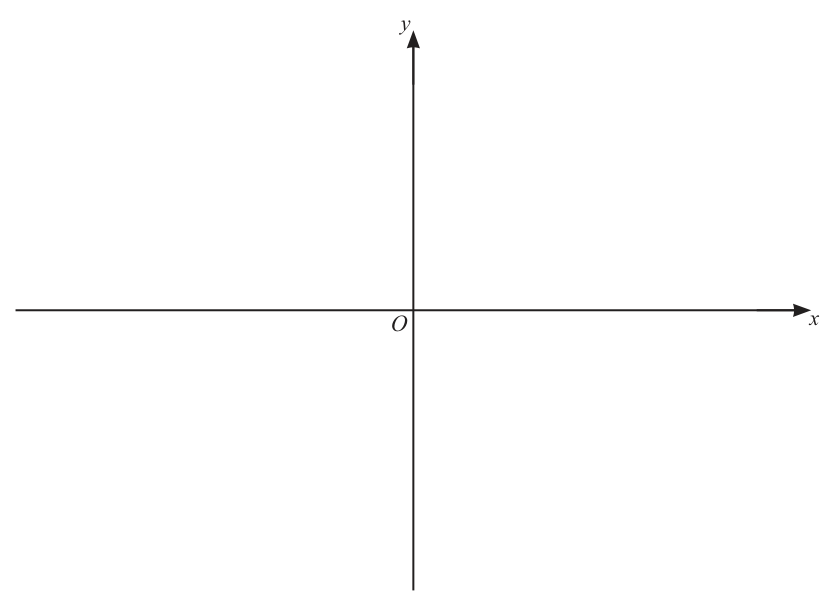
Approach
Use the factors to find the intercepts and the stationary points from part (a) to place the turning points, then sketch the cubic.
Working
Intercepts:
- -axis: when or , i.e. (crossing) and (touching).
- -axis: , so the curve passes through .
From part (a), the stationary points are a local maximum at — on the -axis — and a local minimum at in the fourth quadrant. Since the leading coefficient is positive, the curve rises to the right and falls to the left.
Answer
A positive cubic passing through , rising to touch the -axis at (local maximum), dipping to the local minimum below the -axis, then crossing the -axis at and rising steeply.
Positive cubic through (0, -5), touching the x-axis at (1, 0), local minimum (2, -1) in the fourth quadrant, crossing the x-axis at (2.5, 0)
Walkthrough
The factors of tell us where the curve meets the -axis: the single factor gives a simple root at where the curve crosses, while the repeated factor gives a double root at where the curve touches. Setting gives the -intercept . From part (a) we know the turning points sit exactly at and , so the maximum lies on the axis and the minimum is just below it in the fourth quadrant. Because the coefficient of is positive, the overall shape rises to the right. Joining these features smoothly completes the sketch.
Key Takeaways
- A repeated linear factor produces a touch point (no sign change); a simple factor produces a crossing.
- The -intercept comes from evaluating .
- Stationary points found earlier pin down the shape between the roots.
- Positive leading coefficient means the cubic falls to the left and rises to the right.
Common Mistakes
- Drawing the curve crossing at instead of touching it.
- Omitting the -intercept or adding spurious extra intercepts — the third B1 requires all intercepts and no extras.
- Placing the minimum above the axis or mislabelling which root is the touch point.
- Getting the overall cubic orientation wrong (falling to the right).
Things to Be Careful About
- The mark scheme pays B1 for correct cubic shape, B1 for correct position (touching once in the fourth quadrant region and intersecting the positive -axis once), and B1 for all intercepts with no extras — all three features must appear.
- Label the intercepts clearly: , and .
Approach
has exactly one solution when the horizontal line cuts the sketch from part (b) exactly once. Read off the relevant ranges of .
Working
From the sketch: the local maximum has and the local minimum has . A horizontal line meets the cubic exactly once when it lies entirely above the local maximum or entirely below the local minimum:
- Above the maximum: — the line cuts only the far-right branch.
- Below the minimum: — the line cuts only the far-left branch.
(Between and the line cuts three times; at or it cuts twice counting the touch.)
Answer
k < -1 or k > 0
Walkthrough
Solving geometrically means finding where the horizontal line intersects the sketched curve. Looking at the sketch from part (b): the curve's highest turning point is at height and its lowest at height . If the line sits above , it can only meet the steeply rising right-hand branch — one solution. If it sits below , it only meets the falling left-hand branch — again one solution. Between these heights the line weaves through the wiggle and meets the curve three times (or twice at the boundary heights, because of the touch at the maximum). Hence the answer is or .
Key Takeaways
- The number of real solutions of equals the number of intersections of with the graph of .
- Turning-point heights are the critical boundary values for such questions.
- Strict inequalities apply here because at and there are two solutions, not one.
Common Mistakes
- Including the boundary values ( or ) — at those heights the line meets the curve twice, not once.
- Reversing the inequalities or reading the minimum height as instead of .
- Not using the sketch ('Hence') and instead attempting algebra, which is far harder for a cubic.
Things to Be Careful About
- Both B1 marks are strict: and separately, each worth one mark.
- This part says 'Hence', so the argument must be based on the graph from part (b) — the turning points and supply the critical values.
In this question, all lengths are in centimetres and all angles are in radians.
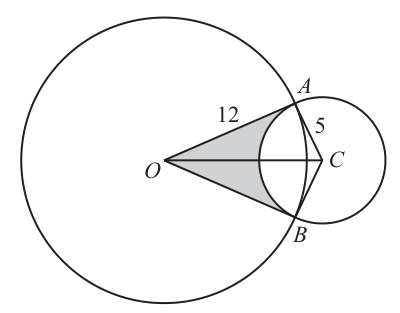
The diagram shows a circle with centre and radius 12, and a circle with centre and radius 5.
The circles intersect at the points and , such that and are tangents to the circle with centre .
Approach
Since is a tangent to the circle with centre at point , the angle . In the right-angled triangle , and . By symmetry, .
Working
In right-angled triangle :
By symmetry about line :
Answer
2.35 rad
Walkthrough
- Tangent-radius property: is tangent to the circle centre at , so the radius is perpendicular to , making a right-angled triangle at .
- Right-angled trigonometry: With opposite side and adjacent side , we have .
- Calculate the angle in radians: .
- Double the angle: Since the figure is symmetric across , the total angle to .
Key Takeaways
- The angle between a tangent and radius at the point of contact is .
- Ensure your calculator is in radian mode when solving geometric problems specified in radians.
Common Mistakes
- Calculating the angle in degrees rather than radians.
- Showing insufficient intermediate precision before rounding to (the mark scheme requires showing at least ).
Things to Be Careful About
- For "Show that" questions, always provide the unrounded value (e.g. or ) before stating the rounded target to gain full credit.
Approach
The perimeter of the shaded region consists of the two straight tangent edges and , and the minor arc of the circle with centre .
Working
The arc length of minor arc of the circle with centre (radius , subtending angle ) is:
Using the value :
The total perimeter is:
Answer
35.8 cm
Walkthrough
- Identify the boundaries of the shaded region: the straight line (length 12), the straight line (length 12), and the minor circular arc on the circle with centre (radius 5).
- Use the arc length formula (or ).
- Add all three lengths: .
Key Takeaways
- The perimeter of a shaded region is the sum of all its bounding edges.
- Arc length in radians is given by .
Common Mistakes
- Using radius 12 instead of radius 5 for the arc .
- Forgetting one of the straight edges or .
Things to Be Careful About
- Give the final answer to 3 significant figures ().
Approach
The area of the shaded region is found by taking the area of the quadrilateral (kite) and subtracting the area of the sector of the circle with centre .
Working
The area of quadrilateral is the sum of the areas of the two congruent right-angled triangles and :
The area of sector with radius and angle is:
Using :
Subtract the sector area from the quadrilateral area:
Answer
30.6 cm^2
Walkthrough
- Break the enclosing polygon into two congruent right-angled triangles, and .
- Each triangle has base and height , so its area is . The total area of kite is .
- Calculate the area of sector using the formula .
- Subtract the sector area from the kite area: , which rounds to (3 s.f.).
Key Takeaways
- Composite areas are frequently found by subtracting a circular sector from a polygon composed of right-angled triangles.
- Sector area formula in radians: .
Common Mistakes
- Subtracting from the area of sector of the large circle instead of the kite .
- Leaving answers as fractions when decimals are expected.
Things to Be Careful About
- Ensure correct substitution of into the sector formula, not .
- Round the final answer appropriately to 3 significant figures ().
The function is such that , for , where is as small as possible.
Approach
The logarithm is defined only when its argument is strictly positive, so .
Working
The smallest possible value of is therefore (with strictly greater than it).
Answer
a = 2/3
Walkthrough
A logarithm is only defined for a positive argument. Since , we need , which gives . The smallest value can take, so that the domain makes valid, is .
Key Takeaways
- The domain of is found by requiring the expression to be strictly positive.
- The boundary value itself is excluded: , not .
Common Mistakes
- Writing as — the mark scheme accepts or , but not alone.
- Solving incorrectly or forgetting to divide by 3.
Things to Be Careful About
- The inequality is strict: the logarithm of zero is undefined, so the asymptote is not part of the domain.
Approach
As runs over , the expression runs over all real numbers, and multiplying by 4 does not change this.
Working
Since takes every positive value, takes every real value, and so does .
Answer
Range of f is all real numbers (R)
Walkthrough
The logarithm function maps positive inputs onto the whole of the real line: as its argument tends to the logarithm tends to , and as the argument grows the logarithm grows without bound. Multiplying by 4 stretches this vertically but the set of values is still all of . So the range of is .
Key Takeaways
- The range of is always for .
- Range answers must be stated in correct notation, e.g. or .
Common Mistakes
- Writing the range as — that is the domain condition of the logarithm, not the range.
- Giving the range in words or loose notation that the mark scheme does not accept ('Must be using correct notation').
Things to Be Careful About
- Use proper set/interval notation: , or an equivalent such as .
Approach
Write , make the subject by exponentiating, then swap and . The domain of equals the range of , and the range of equals the domain of .
Working
Exponentiating both sides:
Swapping and :
Since the range of is , the domain of is . Since the domain of is , the range of is .
Answer
f^-1(x) = (1/3)(e^(x/4) + 2), domain x in R, range f^-1(x) > 2/3
Walkthrough
To find an inverse, set and solve for . Dividing by 4 gives . Exponentiating removes the logarithm: , so . Swapping and gives the inverse function. The domain of the inverse is the range of the original (), and the range of the inverse is the domain of the original ().
Key Takeaways
- The standard inversion routine: set , rearrange, swap.
- is the tool that undoes a logarithm.
- Domain and range of a function swap to become range and domain of its inverse.
Common Mistakes
- Forgetting to divide by 4 before exponentiating, giving instead of .
- Adding 2 before dividing by 3, i.e. writing incorrectly as .
- Stating the domain and range of the wrong way round.
- Not using correct notation for the domain and range (the mark scheme requires proper notation for the B2).
Things to Be Careful About
- The mark scheme awards M1 for reaching (or with / swapped) and A1 for the correct final form — show both stages.
- The range must be written as , not loosely attached to the wrong variable.
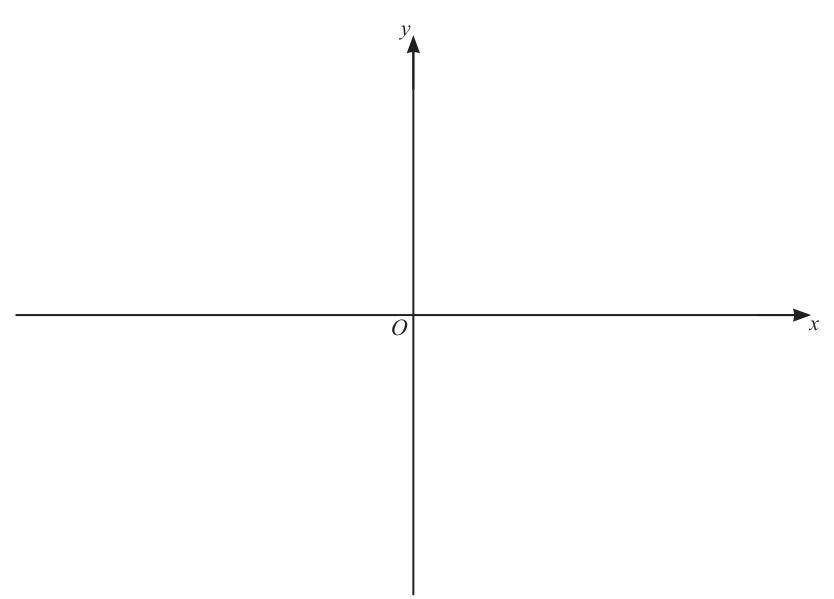
Approach
is a logarithmic curve with vertical asymptote , crossing the -axis where , i.e. at . Its inverse is the reflection in the line , with horizontal asymptote and -intercept . The two curves meet on the line .
Working
For : the -intercept satisfies , so and , giving . The curve rises slowly to the right of the asymptote , lying in the first quadrant (and dropping steeply in the fourth just right of the asymptote).
For : the -intercept is , giving . The curve approaches the horizontal asymptote as and grows exponentially for large .
The curves intersect where , which lies on ; solving gives , so they cross at approximately in the first quadrant.
Answer
A logarithmic curve through with vertical asymptote , and its reflection, an exponential curve through with horizontal asymptote , the two curves intersecting once in the first quadrant on the line .
Log curve through (1, 0) with asymptote x = 2/3; inverse exponential curve through (0, 1) with asymptote y = 2/3; the curves intersect once in the first quadrant on y = x
Walkthrough
The graph of a logarithm has a vertical asymptote where the argument vanishes, , and crosses the -axis where the logarithm is zero, i.e. where , giving . The inverse function's graph is the mirror image in the line , so its asymptote is the reflection of , namely the horizontal line , and its intercept is the reflection of , namely . Because a function and its inverse swap and , any point where they intersect must lie on ; here they cross once, at approximately .
Key Takeaways
- The graph of is the reflection of the graph of in the line .
- Asymptotes and intercepts reflect too: a vertical asymptote becomes a horizontal asymptote .
- A function and its inverse can only intersect on the line .
Common Mistakes
- Drawing the logarithmic curve to the left of its asymptote, or in the second/third quadrants — the mark scheme awards B1 only for the correct shape in the first and fourth quadrants.
- Omitting the intercept (B1 dependent on the shape being right) or the intercept .
- Not showing the two curves intersecting in the first quadrant — the final B1 requires at least one correct intersection point.
- Reflecting in the wrong line, or sketching the inverse with a vertical instead of horizontal asymptote.
Things to Be Careful About
- The intercept marks are dependent on the curve shape being correct first, so get the shape right before labelling points.
- The asymptotes and should be shown (dashed) to make the shapes clear.
- State the intercepts explicitly: for and for .
Approach
Form the composite by substituting into itself, set it equal to 9, and solve by peeling off the outer layers.
Working
Setting this equal to 9:
Squaring:
Squaring again:
Squaring a third time:
Alternatively, using the inverse route: gives , so ; then gives , so and .
Answer
x = 2449.5
Walkthrough
The composite means applying twice: substitute the whole expression in place of inside . Setting the result equal to 9, we undo the function layer by layer: subtract 4, square, subtract 1, divide by 2, square, subtract 4, divide by 2, square. Each squaring removes one square root. This yields , so and . The mark scheme's alternative route works backwards through then ... but the direct composite route shown is the primary one.
Key Takeaways
- means applied to — substitute the entire output expression back into the function.
- Radical equations are solved by isolating the root and squaring, one layer at a time.
Common Mistakes
- Treating as instead of the composition.
- Making an arithmetic slip when expanding the nested composite — the mark scheme's B1 is for the correct composite expression.
- Squaring without isolating the root first, introducing spurious terms.
- Forgetting the domain restriction (satisfied here since ).
Things to Be Careful About
- The final B1 is dependent on both earlier B marks, so the composite must be formed correctly before solving.
- Check the answer lies in the stated domain — it does.
Approach
Rewrite the left-hand side using , then convert everything into sines and cosines and simplify.
Working
Using and :
This is exactly the required result.
Answer
(1 + cot^2 theta)/cot^2 theta = sec^2 theta, shown by writing the numerator as cosec^2 theta and simplifying to 1/cos^2 theta
Walkthrough
The key identity here is the Pythagorean identity , which is just divided through by . Replacing the numerator gives . Then both functions are converted to their definitions: and . Dividing by a fraction means multiplying by its reciprocal, so the factors cancel, leaving , which is by definition .
Key Takeaways
- The three Pythagorean identities (, , ) are interchangeable via division by or .
- Converting everything to sine and cosine almost always simplifies a trigonometric fraction.
Common Mistakes
- Omitting the argument throughout — the mark scheme explicitly says the mark is not awarded if is consistently omitted.
- Misquoting the identity as or similar.
- Cancelling incorrectly when dividing by the compound fraction .
- Not showing sufficient intermediate detail — the scheme requires every algebraic line between the given expression and the target.
Things to Be Careful About
This is an "Answer Given" (AG) part: you must derive forward from the printed left-hand side to exactly ; starting from the answer loses the mark. Write on every line, keep each step visible, and finish at rather than stopping at without stating the equality.
Approach
Recall the standard result for the derivative of the tangent function.
Working
Answer
sec^2 theta
Walkthrough
This is pure recall of a standard derivative listed in the formula booklet: differentiating with respect to gives . It is asked separately so that part (c) can use it directly after part (a) has rewritten the integrand as .
Key Takeaways
- The derivative of is ; this pairs with the identity used in integration questions.
Common Mistakes
- Writing or instead of .
- Forgetting that the differentiation variable is , not .
Things to Be Careful About
The answer must be given in terms of : write , not just .
Approach
Use part (a) to replace with , integrate using part (b), then substitute the exact limits and .
Working
Using part (a), the integrand becomes:
Integrating term by term, using part (b) for the first term:
Evaluating at the limits:
Answer
√3 − 1/2
Walkthrough
The question says "using part (a) and part (b)", so the first step is to carry those results forward: part (a) showed that , so the integrand is simply . Part (b) gave the antiderivative of as , and the standard integral of is , so subtracting contributes . The definite integral is therefore evaluated between and . At the upper limit, the special values give and ; at the lower limit, and . Subtracting gives .
Key Takeaways
- "Hence/using" questions expect earlier results to be reused, not re-derived.
- and are core standard integrals.
- Definite integrals of trig functions need the angle limits treated in radians, with special-angle values recalled exactly.
Common Mistakes
- Integrating as instead of , which flips the sign of the whole answer.
- Substituting degree values such as while the limits are written in radians — the working must stay consistent in radians.
- Forgetting to evaluate at the lower limit , giving instead of .
- Giving a decimal approximation instead of the exact surd form demanded by the non-calculator paper.
- Re-deriving the identity of part (a) inside part (c) instead of quoting it.
Things to Be Careful About
The final B1 mark depends on all three previous marks being earned, and the answer must be exact: (or an exact equivalent). Show the substituted expression before the evaluated value so the method is visible, and quote the special values , explicitly.
Find, in descending powers of , the first 3 terms in the expansion of . Simplify each term as far as possible.
Approach
Use the binomial theorem on , taking terms with and simplifying each power of .
Working
First term ():
Second term ():
Third term ():
Answer
x^10 + 20x^7 + 180x^4
Walkthrough
The binomial theorem gives each term of as . Here , and . The first three terms come from .
For : the coefficient is and we get .
For : the coefficient is , giving , since by subtracting indices.
For : the coefficient is , and , so the term is .
Key Takeaways
- The general term of is ; the first three terms use .
- Powers of combine by subtracting indices: .
- Binomial coefficients needed: , , .
Common Mistakes
- Starting at instead of , losing the term (the mark scheme awards B1 per correct term).
- Writing as instead of — the 2 must be squared too.
- Adding indices instead of subtracting when dividing powers of .
- Using or other arithmetic slips in the coefficients.
Things to Be Careful About
- Each term is marked separately (B1 each), so even if one term is wrong, correct terms still score.
- Simplify fully: the scheme expects and , not unsimplified products like .
- Keep the answer in descending powers of as asked.
Approach
Write the general term of , set the total power of to zero to find which term is independent of , then evaluate it.
Working
The general term is
The power of in this term is . For the term independent of :
So the required term is
Evaluating:
Answer
1120
Walkthrough
A term is 'independent of ' when all the powers of cancel out. The general term of is .
The first factor contributes and the second contributes , so the total power of is . Setting this equal to zero gives — this is the M1 step, and it may be implied by working that reaches .
With the term is . The 's cancel completely: and , leaving . With , the term equals .
Key Takeaways
- To find a term independent of , form the general term, write its total power of , and solve for the value of making that power zero.
- Both the numerical factors and the powers of must be handled: here .
- is a standard coefficient worth knowing.
Common Mistakes
- Solving incorrectly, e.g. getting or .
- Forgetting to raise the whole of to the fourth power, i.e. writing instead of .
- Computing wrongly (it is 70, not 56).
- Leaving the answer as an expression rather than evaluating the single number.
Things to Be Careful About
- The A1 requires the answer from correct working ('From correct working'), so the step must be shown or clearly implied.
- Check the cancellation: over must vanish entirely — any surviving power of means the wrong term was chosen.
It is given that
for . When , is increasing at the rate of units per second. Find, in terms of , the corresponding rate of change in , giving your answer in exact form.
Approach
Differentiate using the quotient rule (with the chain rule for ), evaluate at , then use with to find .
Working
By the quotient rule,
since by the chain rule.
When :
Using the chain rule for related rates:
so
Answer
dx/dt = 9h/(9 - ln 2) units per second
Walkthrough
The question gives as a function of , tells us how fast is changing with time ( units per second when ), and asks how fast is changing with time. The bridge between these is the chain rule for related rates: .
First we need . Since is one function divided by another, the quotient rule applies: differentiate the top times the bottom minus the top times the derivative of the bottom, all over the bottom squared. The numerator's derivative is , which needs the chain rule: differentiate the outer log to get , then multiply by the derivative of the inside, , giving . The denominator's derivative is just . So
Next substitute . The inside of the log becomes , so its derivative is , and gives in the first term. The denominator is . Hence — note this stays exact; no decimal approximation is made.
Finally rearrange the rate equation: since , dividing both sides by gives , which is the required exact answer.
Key Takeaways
- The quotient rule: — order matters in the numerator.
- The chain rule on logarithms: .
- Related rates: connect and through evaluated at the given instant.
- Exact answers involving must be left as logs, not converted to decimals.
Common Mistakes
- Subtracting the wrong way round in the quotient rule ( instead of ).
- Forgetting the chain rule factor when differentiating , writing just .
- Squaring only part of the denominator, e.g. writing as or forgetting to square it entirely.
- Using small changes () instead of the exact rate relation — the mark scheme explicitly awards A0 for this.
- Giving a decimal approximation such as without showing it came from the correct exact derivative; the substitution into must be visible.
- Inverting incorrectly at the end, e.g. writing instead of dividing by that factor.
Things to Be Careful About
- The answer must be in exact form: , with left as a logarithm. A decimal-only answer loses the accuracy marks.
- Show the full substituted expression before evaluating — the M1 for using requires the substitution to be seen.
- Do not use the small-increment approximation here; the question asks for an exact rate relation, and the mark scheme awards A0 for small-changes working.
- Check the domain condition : it guarantees so the logarithm is defined, and satisfies it.
The tangent to the curve at the point where meets the -axis at the point and the -axis at the point . Find the coordinates of the mid-point of , giving your answer in exact form.
Approach
Differentiate by the product rule (with the chain rule on the square root), evaluate the gradient and the -coordinate at , form the tangent line, then read off its intercepts with the axes and average them.
Working
By the product rule:
At , so that :
The point of contact has
Tangent at :
At the tangent meets the -axis ():
At the tangent meets the -axis ():
Mid-point of :
Answer
(11/20, -11e^2/6)
Walkthrough
The curve is a product of two functions of : the exponential and the square root . The product rule gives the derivative as 'first times derivative of second plus second times derivative of first'. Differentiating needs the chain rule: bring down the power , reduce the power to , and multiply by the derivative of the bracket, which is . The factors and cancel, leaving .
At the bracket is , so its square root is and its reciprocal square root is . The gradient is therefore , and the point of contact is since .
Using the point–gradient form gives the tangent . To find where it cuts the -axis set : dividing both sides by gives , so and . To find where it cuts the -axis set : .
The mid-point averages the coordinates of and , giving . Everything stays in exact form because the question demands it.
Key Takeaways
- The product rule combined with the chain rule handles products like ; note how the inner factor cancels the outer .
- A tangent at a point uses the point–gradient form with the exact gradient evaluated from the derivative.
- Axis intercepts come from substituting and into the tangent's equation.
- The mid-point formula is just coordinate averaging.
- Exact answers with should be kept unsimplified-decimals are not wanted here.
Common Mistakes
- Forgetting the chain rule factor when differentiating , or forgetting to cancel the correctly.
- Writing the derivative of incorrectly or dropping one term of the product rule.
- Using the wrong point for the tangent — the point must be on the curve at , i.e. , not .
- Sign slips when solving for the -intercept: leads to , not .
- Giving decimal approximations instead of the exact simplified forms required ('Must be simplified', 'must be exact').
- Averaging only the non-zero coordinates — the mid-point must average each coordinate pair including the zeros.
Things to Be Careful About
- The mark scheme requires the intercept values in simplified exact form: and ; unsimplified equivalents may lose the accuracy marks.
- The final answer is marked FT on earlier coordinates but must be exact and simplified: .
- Keep as a factor throughout rather than evaluating numerically — the answer is demanded in exact form.
- Show every step: the differentiated form, the evaluated gradient, the curve point, the tangent equation, both intercepts and the averaging, since each earns a separate mark.
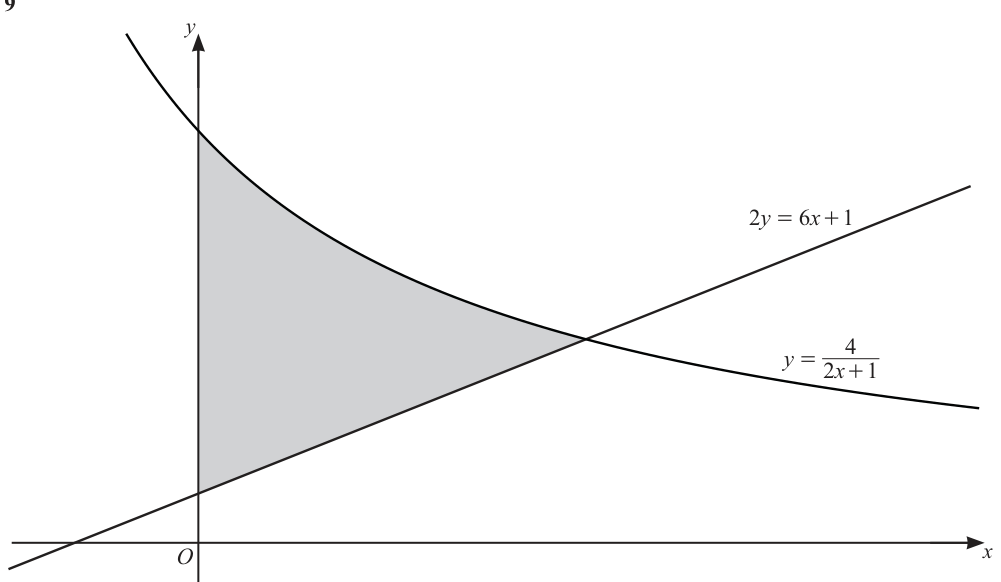
The diagram shows part of the curve and the straight line . Find the area of the shaded region, giving your answer in the form , where is an integer and is a rational number.
Approach
Find where the curve meets the line by equating them, then compute the shaded area as (area under the curve from to the intersection) minus (area under the line over the same interval).
Working
The line is . At the intersection point:
Factorising:
so (the positive root in the first quadrant).
Area under the curve from to :
Area under the line from to :
Shaded area:
Answer
ln 4 - 5/8
Walkthrough
First find the intersection point of the curve and the line, since that gives the upper limit of integration. Writing the line as and setting it equal to , we multiply both sides by to clear the fraction, giving the three-term quadratic . Factorising as gives or ; only lies in the first quadrant shown.
Next, integrate the curve between and . The standard result gives . Applying the limits: at this is , and at it is , so the area under the curve is using the log law .
Then integrate the line over the same interval: , which evaluates to .
Since the curve lies above the line throughout the interval, the shaded region's area is the difference: , which is exactly the required form with integer and rational .
Key Takeaways
- The intersection of a curve and a line is found by equating their equations and solving; this supplies the limits of integration.
- Integrals of the form produce logarithms: .
- Log laws convert into to match a requested "" form.
- When one boundary curve lies above another, the enclosed area is the difference of the two definite integrals.
Common Mistakes
- Forgetting the factor when integrating — writing instead of loses accuracy marks.
- Taking the negative root as the limit instead of .
- Forgetting that the lower limit contributes — it must still be shown applied.
- Subtracting in the wrong order (line minus curve), giving a negative answer.
- Leaving the answer as when the question demands the form with integer .
- The mark scheme states both final A1 marks are "Not from incorrect work" (nfww): a correct-looking answer reached through wrong working scores nothing.
Things to Be Careful About
- Show every step: the M1 marks are for forming the three-term quadratic, solving it, writing , and applying the limits correctly — each must be visible.
- The answer must be left in exact form ; do not give a decimal approximation.
- The mark scheme allows an alternative method integrating with respect to (using and with limits to ), but the primary route above is simpler.
- The equation has two roots; check which root fits the diagram (first quadrant, positive ).
The first 3 terms of an arithmetic progression are , , . Find the values of , where , for which the sum to 30 terms is .
Approach
The progression has first term and common difference . Use with , set it equal to , solve for , then find all values of in .
Working
Set equal to :
The principal solution is . Since the tangent function has period :
Dividing by 2:
All four lie in .
Answer
x = -165°, -75°, 15°, 105°
Walkthrough
An arithmetic progression is identified by checking that consecutive terms differ by a constant amount: here each term increases by , so and . The sum formula then converts the whole 30-term sum into a single expression in : substituting gives . Setting this equal to and dividing by 1365 gives , which is the exact value . Because we solved for , the interval for is doubled: . Within two full periods of tangent, the solutions of are , obtained by repeatedly adding or subtracting from the principal value. Halving each gives the four answers for .
Key Takeaways
- Always extract and from the printed terms before using any series formula.
- When the unknown sits inside , double the solution interval before listing angles, then halve at the end.
- Tangent repeats every , so exactly one extra solution per half-turn appears in a doubled interval.
- Recognising special values such as avoids calculator dependence.
Common Mistakes
- Using (the second term) instead of the common difference .
- Forgetting to double the interval when solving for , finding only one or two solutions.
- Adding instead of when generating further tangent solutions.
- Giving decimal answers like from a rounded value of ; the scheme accepts these only partially.
- Including extra solutions outside — the scheme penalises extras.
Things to Be Careful About
- All four solutions must be listed with no extras in range; the scheme awards A3 only for the complete correct set.
- Answers in radians or from earn limited credit (M1/A1 route), so keep exact values.
- Check each answer lies inside the stated interval before finishing.
The first 3 terms of a geometric progression are
where .
Find the values of for which this geometric progression has a sum to infinity.
Approach
Find the common ratio by dividing the second term by the first. A geometric progression has a sum to infinity when . Solve the resulting trigonometric inequality for in .
Working
For a sum to infinity to exist:
Since means , the critical values satisfy:
With ranging over , the critical values are , i.e.
Between these critical values, holds near and near (i.e. where is small). So:
At (and ): , which is not allowed since the condition requires strictly (with the progression is not genuinely geometric with a convergent sum).
Answer
-π/6 < θ < π/6 excluding θ = 0, and 5π/6 < θ < 7π/6 excluding θ = π
Walkthrough
First confirm the terms really form a geometric progression and find its ratio: dividing the second term by the first cancels one power of and leaves (the third divided by second confirms the same ratio). A geometric series converges to a finite sum only when ; since a square is never negative this becomes , i.e. . The boundary cases come from with ; converting back gives the four critical values . Testing between them shows the inequality holds in two open intervals around and . However, at those midpoints , and a sum to infinity needs , so and must be excluded from the intervals.
Key Takeaways
- The common ratio of a GP is found by dividing any term by the previous one.
- A sum to infinity exists if and only if ; here that becomes a squared-cosine inequality.
- Solving is best done through and critical values, not by blindly square-rooting both sides of an inequality.
- Boundary behaviour matters: endpoints where fail, and interior points where must also be excluded.
Common Mistakes
- Writing without squaring, losing the power when dividing.
- Solving as only, missing the negative branch and half the critical values.
- Including the endpoints , where and no sum to infinity exists.
- Forgetting to exclude and , where .
- Working in degrees when the question is set in radians.
Things to Be Careful About
- The scheme marks the critical values separately (M1 dep for one, A1 for all four with no extras), so list all four explicitly.
- Each final interval earns A1; both the strict inequalities and the exclusions (, ) are needed.
- Keep everything in radians as printed; the interval is .