Additional Mathematics 4037/22 — May/June 2024
Cambridge O-Level · Calculator · worked solutions for every part, with the mark scheme
Topics Calculus · Trigonometry · Straight-line graphs · Equations, inequalities and graphs · Logarithmic and exponential functions · Quadratic functions · +4 more
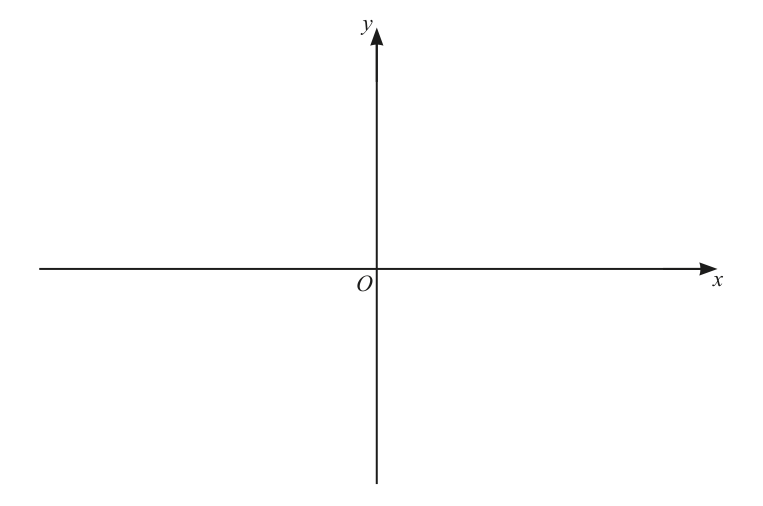
Approach
The cubic is already factorised, so read off the roots from the factors, evaluate the -intercept at , and use the leading coefficient to fix the end behaviour before sketching.
Working
Roots: set each factor to zero.
-intercept: substitute .
End behaviour: expanding the leading terms gives , so the curve rises from below on the left and falls below the -axis on the right.
Answer
A cubic sketch crossing the -axis at , and , with -intercept , coming from below on the left and going to below on the right.
Cubic sketch with x-intercepts at x = -3, 1 and 2.5 and y-intercept (0, -15)
Walkthrough
Because the cubic is given fully factorised, the roots come straight from setting each bracket to zero: , and . The -intercept is the value when : substituting gives . To get the overall shape, look at the leading term: multiplying the highest powers of each factor, , a negative cubic. So as , and as , : the curve enters from the top left and leaves at the bottom right, crossing the axis at (downwards), turning, crossing at (upwards), reaching a maximum, then crossing at (downwards). Note that lies between and , consistent with the negative -intercept.
Key Takeaways
- A factorised cubic gives its roots directly from the brackets.
- The -intercept is found by substituting .
- The sign of the leading coefficient determines the end behaviour: negative cubic means top-left to bottom-right.
Common Mistakes
- Reading instead of from the factor .
- Drawing a positive cubic shape (bottom-left to top-right) by ignoring the factor .
- Forgetting to state the -intercept, which carries its own mark.
- Not extending the curve above and below the -axis — the mark scheme requires the ends to leave the axis region.
Things to Be Careful About
- The sketch must show a genuine cubic shape with two turning points, and all three roots plus the intercept must be labelled.
- The curve must extend above the -axis on the far left and below it on the far right.
Hence
Approach
Use the sketch from part (a): where the curve is on or below the -axis.
Working
From the sketch, the curve is below or on the -axis between the roots and , and again from the root onwards to the right. Since the inequality is , the endpoints are included.
Answer
-3 <= x <= 1 or x >= 2.5
Walkthrough
The inequality asks where the cubic is negative or zero. On the sketch from part (a), the curve dips below the axis between and , and again for all beyond . Because the inequality uses (not strict ), the roots themselves — where the curve equals zero — must be included, so the intervals are written with and signs.
Key Takeaways
- An inequality in a factorised polynomial is solved by reading where its graph lies on the required side of the -axis.
- or means the boundary roots are included; or means they are excluded.
Common Mistakes
- Using strict inequalities , — the mark scheme awards only a special-casing SC1 for this, not full marks.
- Giving only one of the two intervals (earns B1 only).
- Including the interval between and , where the curve is above the axis.
Things to Be Careful About
- Both intervals are required for full marks, and the endpoints must be inclusive to match the sign. The answer is marked on the final statement, so a correct sketch with a wrong final line scores nothing.
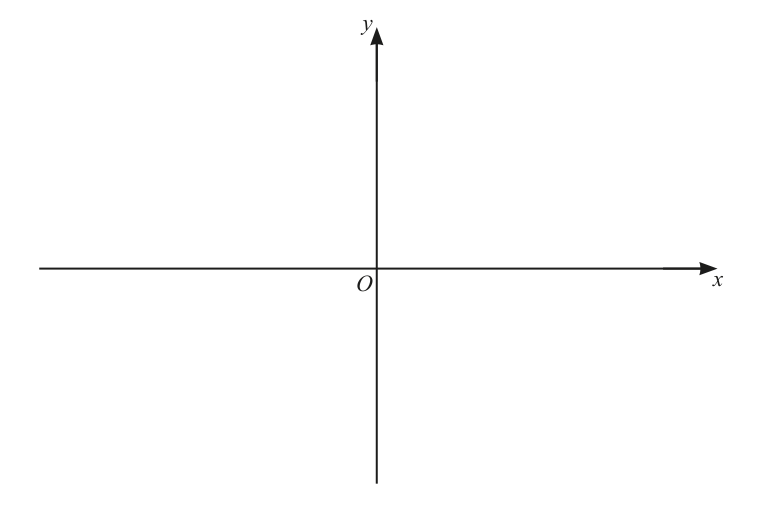
Approach
The graph of is the graph of with every part below the -axis reflected above it; parts already above stay unchanged.
Working
From part (a), the cubic lies below the -axis for and between and beyond, and also in the dip between and near the origin. Reflecting these portions in the -axis produces sharp cusps at , and , and turns the -intercept into .
Answer
The modulus graph: the whole cubic lies on or above the -axis, with cusps at , and , a positive -intercept of , and the same -intercepts as part (a).
Modulus curve entirely on or above the x-axis with cusps at x = -3, 1 and 2.5 and y-intercept 15
Walkthrough
Taking a modulus makes every output non-negative. Graphically, any part of the curve sitting below the -axis is flipped (reflected) above the axis, while the parts already above are untouched. For this cubic, the left-hand branch (below the axis for ), the dip containing the -intercept , and the right-hand branch (below the axis for ) are all reflected. Where the curve crosses the axis, the original and reflected pieces meet at a sharp point — a cusp — so cusps appear at , and . The -intercept becomes , positive as the mark scheme requires.
Key Takeaways
- reflects only the below-axis portions of .
- Cusps form at the -intercepts where reflection meets the unchanged part.
- -intercepts are unchanged; -values become their absolute values.
Common Mistakes
- Reflecting the whole curve (as in ) instead of only the below-axis parts.
- Leaving the -intercept negative — the mark scheme explicitly requires a positive -intercept.
- Drawing smooth turning points instead of cusps at the intercepts.
Things to Be Careful About
- The sketch must match the roots from part (a) (follow-through allowed on an equivalent cubic), show cusps at the intercepts, and never dip below the -axis.
Approach
Integrate by dividing by the coefficient of inside the cosine, giving , then evaluate between the limits and .
Working
So the definite integral is
Substituting the limits:
Evaluating:
Answer
0.495
Walkthrough
The integral is of , where the angle is . When integrating , the result is — you divide by the coefficient of to undo the chain rule. Here , so dividing by is the same as multiplying by , giving . This is the step the mark scheme rewards with B2.
Next we write the definite integral in square-bracket form with the limits attached, then substitute the upper limit and subtract the value at the lower limit . This gives , which is the M1 step.
Finally we evaluate each sine (angles are in radians, as the limits are multiples of ) and subtract: , which rounds to to 3 significant figures.
Key Takeaways
- Integrating gives ; the coefficient inside the trig function must be divided out.
- Definite integrals are evaluated as (value at upper limit) − (value at lower limit).
- Radian limits such as and must be evaluated in radian mode.
Common Mistakes
- Forgetting to divide by , writing instead of — this loses the B2 (only B1 is awarded for with ).
- Writing (wrong sign on the integrated cosine).
- Evaluating the sines in degree mode instead of radian mode.
- Subtracting in the wrong order (lower limit minus upper limit), giving .
- Rounding too early or giving fewer than 3 significant figures.
Things to Be Careful About
- The mark scheme requires all working to be shown: the integrated form, the substituted expression , and the final value. Jumping straight to loses method marks.
- The final A1 depends on all previous marks being earned (dep on previous marks), so the integration must be correct.
- The answer is a decimal here (calculator paper); give it to at least 3 significant figures — the scheme accepts answers rounding to or to 4 or more sf.
Approach
Integrate each term separately. The reciprocal of a linear function integrates to a logarithm (dividing by the coefficient of ), and integrates by the power rule. Include the constant of integration.
Working
For the first term, since :
For the second term, rewrite and apply the power rule :
Combining, with the constant of integration:
Answer
(1/4)ln(4x-3) - x^(-2)/2 + c
Walkthrough
The integrand has two terms, so we integrate each one separately.
First term: is the reciprocal of a linear function. The standard result is that : the logarithm comes from integrating a reciprocal, and we must divide by the coefficient to compensate for the chain rule. This gives . Writing is an equivalent accepted form, since and the constant absorbs .
Second term: is rewritten as so the power rule applies. Raising the power by one gives , and dividing by the new power gives . A common slip is dividing by instead of .
Finally, because this is an indefinite integral, the constant of integration must be included.
Key Takeaways
- — the coefficient of must be divided out.
- Negative powers integrate by the same power rule: .
- Indefinite integrals always need .
Common Mistakes
- Writing without the factor — the scheme awards only B1 for with .
- Writing (the outside the logarithm) — this also scores only B1.
- Dividing by instead of in the power term, giving .
- Writing but failing to simplify the double negative, or integrating as .
- Omitting the constant of integration .
Things to Be Careful About
- The mark scheme says "isw" (ignore subsequent working), so an arithmetic slip after a correct answer is not penalised, but the printed answer form is what earns full marks.
- The modulus bars are not required by the scheme here, but the argument of the logarithm must be (or ), not with outside.
- Both terms must be integrated correctly to score all 3 marks: B2 for the logarithm term and B1 for the power term.
Determine whether the equation
has two distinct real roots, two equal roots or no real roots.
Approach
Clear the fraction by multiplying both sides by , expand both sides, collect everything onto one side to get a quadratic, then examine its discriminant.
Working
Multiply both sides by :
Expand each side:
Collect all terms on the left:
Evaluate the discriminant with , , :
Since , the quadratic has no real roots.
Answer
The equation has no real roots, because the discriminant is .
No real roots (discriminant = -59 < 0)
Walkthrough
The equation has a fraction, so the first move is to multiply both sides by the denominator . This is valid as long as , i.e. ; any root we find must be checked against this, though here none will exist anyway.
Expanding the left side gives . Expanding the right side gives .
Subtracting the right side from the left collects everything into one quadratic: .
Now the nature of the roots is decided entirely by the discriminant : positive means two distinct real roots, zero means two equal roots, negative means no real roots. Here , which is negative, so there are no real roots.
Key Takeaways
- To classify the roots of an equation that is not obviously quadratic, first rearrange it into the form .
- The sign of alone determines whether the roots are distinct real, equal real, or non-real — you never need to solve the equation.
- Careful expansion of both products before collecting like terms prevents sign errors.
Common Mistakes
- Expanding only one side or forgetting to multiply the whole right-hand side by .
- Sign slips when moving terms across: the scheme accepts either or , but mixing signs mid-collection gives a wrong quadratic.
- Computing as (forgetting to multiply fully).
- Concluding 'no real roots' without stating the discriminant value or its sign — the A1 requires the negative value shown.
Things to Be Careful About
- The mark scheme awards B2 for the correct three-term quadratic (B1 for two terms correct), so show the full expansion before collecting.
- The M1 is follow-through on your own three-term quadratic, but the final A1 needs the correct discriminant together with the conclusion 'no real roots'.
- State the conclusion explicitly in words ('no real roots') — the discriminant value alone does not answer the question asked.
Approach
Let . Then the equation becomes a quadratic in , which factorises; solve for and cube each value to recover .
Working
Substitute :
Multiply through by :
Rearrange into standard form:
Factorise:
So or . Cubing each:
Answer
x = 8 or x = -216
Walkthrough
The equation contains and — the same quantity appearing once 'on top' and once 'below'. Substituting converts it into an ordinary equation in one variable: .
Multiplying every term by clears the fraction: . Rearranging all terms to one side gives the quadratic , which factorises neatly since and : .
So or , meaning or . Cubing reverses the cube root: or . Note that cubing preserves the sign, so the negative root gives a valid negative solution — unlike square roots, cube roots are defined for negative numbers.
Key Takeaways
- When an equation involves a root and its reciprocal, substituting a single letter for the root reduces it to a quadratic.
- Cube roots are defined for all real numbers, so negative values of give valid solutions.
- Always finish by undoing the substitution: cube each root to return to .
Common Mistakes
- Forgetting to rearrange into standard form before factorising, e.g. trying to factorise directly.
- Sign errors when moving terms: the scheme expects (or equivalent), not .
- Discarding because it looks 'invalid' — cube roots of negatives are fine, so must be kept.
- Stopping at and without cubing; the scheme awards A1 for these but the final A marks need and .
Things to Be Careful About
- The B1 is awarded for the correct substituted quadratic ( or equivalent), seen or implied.
- The M1 follows through on your own three-term quadratic, but the A2 requires both final values and ; losing the negative root costs an accuracy mark.
- Check by substitution if unsure: ✓ and ✓.
The polynomial is such that .
Approach
By the remainder theorem, the remainder when is divided by is .
Working
Answer
33
Walkthrough
The remainder theorem says that dividing a polynomial by leaves a remainder equal to the value of the polynomial at . Here , so we simply substitute into : powers first, then combine. This gives .
Key Takeaways
- The remainder on division by is — no long division needed.
Common Mistakes
- Arithmetic slips when evaluating the powers, especially .
- Using long division unnecessarily and making sign errors along the way.
Things to Be Careful About
- The answer is exact and cao: it must be , reached from correct working.
Approach
By the factor theorem, is a factor of if . Substitute into .
Working
Since , by the factor theorem is a factor of .
Answer
, so is a factor of .
p(1/2) = 0, so 2x - 1 is a factor of p(x)
Walkthrough
The factor theorem states that is a factor of a polynomial exactly when the polynomial equals zero at . For that root is . Substituting gives , confirming the factor.
Key Takeaways
- To show is a factor, evaluate at (not or ).
- The conclusion must be stated: zero value implies factor.
Common Mistakes
- Substituting instead of .
- Showing the value is 0 but forgetting to state the factor-theorem conclusion.
Things to Be Careful About
- All three printed equivalent forms in the mark scheme are accepted (oe), but the substitution must be shown with sufficient detail.
Approach
Divide by the known factor to obtain a quadratic, then factorise that quadratic.
Working
Divide by :
- ; subtract , leaving .
- ; subtract , leaving .
- ; subtract , leaving remainder .
So the quadratic factor is
Factorise: , since , , and .
Hence
Answer
(2x - 1)(3x + 5)(x - 1)
Walkthrough
Since part (i) established that is a factor, we divide the cubic by it (by algebraic long division or by equating coefficients) to find what remains. Each step of the division brings down the next term: the quotient builds up as , then , then , giving with zero remainder — as expected since is an exact factor. That quadratic factors by inspection into because the numbers multiply to and add to . Combining everything gives the full product of linear factors.
Key Takeaways
- A known linear factor reduces a cubic to a quadratic by division.
- Factorise the quadratic by finding two numbers with the right product and sum.
- Always check the final expansion matches the original cubic.
Common Mistakes
- Sign errors during the subtraction steps of the division.
- Writing and stopping without fully factorising.
- Mis-factorising the quadratic, e.g. getting the signs of and swapped.
Things to Be Careful About
- The mark scheme awards M2 for the correct quadratic factor (M1 for any two terms correct) and A1 for the complete product of three linear factors.
- If nothing else scores, SC2 exists for justifying as a factor and writing down with no incorrect work seen.
- Equivalent forms (oe) are accepted, but the answer must come from correct working.
Approach
The equation has the same form as with . Use the factorisation from part (ii):
Then solve each factor for .
Working
which is impossible since , so this factor gives no solution.
Answer
theta = 30, 90
Walkthrough
The equation is exactly , so the factorisation from part (ii) applies directly with replaced by : each linear factor set to zero gives either , , or . Within , the first gives and the second gives ; the third is impossible because sine cannot be less than . Both valid angles lie inside the interval, so both are answers.
Key Takeaways
- 'Hence' means reuse the factorisation from part (ii) rather than solving from scratch.
- Every factor must be checked: some give no real solution in range.
Common Mistakes
- Ignoring the factor entirely instead of noting it yields no solution.
- Missing from the factor .
- Giving angles outside (e.g. ).
Things to Be Careful About
- The mark scheme marks each angle nfww (not from wrong working): and each earn B1 only if they follow correctly.
- B1 alternatives: or ; or or .
- Angles are required in degrees here, matching the interval given.
A curve has equation . The tangent to the curve at the point where cuts the -axis at the point .
Find the equation of the tangent in the form , where and are exact values, and hence find the -coordinate of .
Approach
Differentiate the curve to find the gradient function, evaluate the gradient and the -coordinate at , then build the tangent equation from the point-gradient form. Finally set to find where the tangent cuts the -axis.
Working
Differentiate term by term:
At :
The -coordinate on the curve at :
Tangent through with gradient :
At the tangent cuts the -axis, so :
Answer
The tangent is , and the -coordinate of is .
y = 10ex - 4e; x-coordinate of P is 0.4
Walkthrough
The curve is . To find the tangent at we need two things at that point: the gradient and the coordinates of the point itself.
The gradient function comes from differentiating. The derivative of is by the chain rule (the inner function differentiates to ), so the first term gives . The second term is a constant, so its derivative is .
At the exponent is , so the gradient is , and the point on the curve is .
Using the point-gradient form with and :
Expanding and collecting the constant terms gives , which is the required form with exact values and .
The point is where the tangent meets the -axis, so we substitute and solve for . The factors of cancel, giving .
Key Takeaways
- Differentiating gives — the chain rule brings down the coefficient of .
- A constant term like differentiates to zero; do not treat as a variable.
- A tangent needs both the gradient (from the derivative) and the point (from the original curve) evaluated at the given -value.
- The -intercept of a line is found by setting ; here the factors cancel, leaving a clean exact value.
Common Mistakes
- Writing , forgetting the chain-rule factor of (the scheme gives M1 for any with , but the final accuracy marks need ).
- Adding a spurious constant of integration-style term, e.g. — the scheme explicitly penalises this (SCM1 only).
- Using incorrectly or forgetting the term when finding the point on the curve.
- Substituting into the derivative instead of the curve (or vice versa) when finding the gradient and the point.
- Giving a decimal approximation of in the tangent equation — the question demands exact values, so and must stay in terms of .
- Sign slips when expanding , giving instead of before collecting constants.
Things to Be Careful About
- The question requires exact values of and : leave them as and , not and . The final A1 for the -coordinate is "isw", so later mis-simplification after is ignored, but the tangent equation itself must be exact.
- The scheme's A1 for the gradient and -value is FT on your derivative only if the M1 (or SCM1) was earned — so the chain-rule factor of matters from the very first line.
- The final A1 depends on the tangent equation being correct with exact values, so an earlier error propagates.
- Show the substituted expressions (, ) before the simplified values so each method mark is visible.
Approach
Rewrite and in terms of and , simplify the fraction, and cancel to reach the printed target.
Working
Using and :
Dividing by multiplies by its reciprocal:
as required.
Answer
Shown: sin^3 x (cosec x / cot x) = sin^2 x tan x
Walkthrough
The bracket contains two reciprocal trigonometric functions, so the first move is to express them using their definitions: and . Dividing by means multiplying by its reciprocal , which is exactly . The in the numerator of the reciprocal cancels the from , leaving . Multiplying by gives , and splitting this as recognises , producing the target . Since the question says "show that", the working must run forward from the given expression to the printed answer, with every cancellation line visible.
Key Takeaways
- The definitions , convert any compound trig fraction into sines and cosines.
- Dividing by a fraction means multiplying by its reciprocal.
- "Show that" proofs must be derived forward, showing all intermediate algebra.
Common Mistakes
- Cancelling with the inside incorrectly, e.g. writing without showing the intermediate step — the scheme requires a convincing correct statement.
- Treating as instead of dividing.
- Omitting intermediate lines: the mark scheme demands "convincing correct detail", so jumping straight to the answer loses the method mark.
Things to Be Careful About
- This is an "Answer Given" (AG) part: the target is printed, so the marks are for the derivation, not the final line. Every algebraic step between the given expression and must appear.
- Keep trigonometric function names upright and use , not , matching 4037 notation.
Approach
Factorise out the common factor , set each factor to zero, and solve each resulting equation for .
Working
Factorise:
First factor:
Second factor:
For :
For :
All values lie in .
Answer
x = 0, +/-pi/4, +/-3pi/4
Walkthrough
Both terms of contain the factor , so the equation factorises as . A product is zero when either factor is zero. The first factor gives , whose only solution in is . The second factor gives , so . The positive value occurs at and the negative value at (equivalently , but lies outside the interval, and its reflection is the in-range solution). Collecting all five values gives the complete solution set. Crucially, the equation must be factorised, not divided by : dividing would destroy the solution.
Key Takeaways
- Never divide a trigonometric equation by a trig function — factorise instead, so no solutions are lost.
- From you get , doubling the number of angle families.
- In a symmetric interval , solutions come in pairs plus possibly .
Common Mistakes
- Dividing both sides by — the mark scheme explicitly awards M0 for this, and it loses the solution .
- Dividing by after rewriting in terms of — also M0 for the same reason.
- Finding only and missing the , losing .
- Giving instead of , or including values outside — the A2 requires no extras in range.
- Forgetting from the factor.
- Writing instead of (forgetting the square root).
Things to Be Careful About
- The mark scheme notes the A2 is "nfww" — no marks from wrong working — and requires no extra solutions in the interval; one error costs one of the two accuracy marks.
- The interval is in radians, so answers must be given in radians (, ); exact multiples of are the cleanest form.
- Check every solution lies strictly inside — endpoints are excluded.
Find the number of different ways the 9 letters of the word POLYMATHS can be arranged when
Approach
All 9 letters of POLYMATHS are distinct, so there are arrangements in total. Count the arrangements where O and A ARE together (treat OA as one block, so ), then subtract from the total.
Working
Arrangements with O and A together (as a block, in either order):
Subtracting:
Answer
282240
Walkthrough
Since all 9 letters are different, the total number of arrangements is . It is easier to count the unwanted arrangements — those with O and A next to each other — and subtract. Glue O and A into a single block; the block plus the other 7 letters make 8 objects, arrangeable in ways, and within the block O and A can swap, giving a factor . So the unwanted count is , and the wanted count is .
Key Takeaways
- "Not next to each other" counting is almost always done by the complement: total minus together.
- Treating adjacent letters as a single block reduces the number of objects to arrange.
Common Mistakes
- Forgetting the internal for the order of O and A inside the block.
- Using instead of (forgetting the block counts as one object).
- Subtracting the wrong way round.
Things to Be Careful About
- The answer must come from correct working (nfww): the method must be visible.
- All letters are distinct here — no division for repeats is needed.
Approach
The letters MATHS must stay together in that exact order, so they form one fixed block. This block plus the letters P, O, L, Y give 5 objects to arrange.
Working
(Equivalently .) No extra factor is needed inside the block because the order MATHS is fixed.
Answer
120
Walkthrough
Because MATHS must appear together and in that order, the five letters act as one unbreakable, unswappable block. The objects to arrange are then: [MATHS], P, O, L, Y — five distinct objects, giving arrangements. Unlike part (a), there is no internal factor, since the order within the block is prescribed.
Key Takeaways
- A block with a fixed internal order contributes no internal permutations.
- Count the objects (block + remaining letters) and arrange them.
Common Mistakes
- Multiplying by for the internal order of MATHS — wrong, since the order is fixed.
- Counting 9 objects instead of 5.
Things to Be Careful About
- The mark scheme accepts or ; the answer 120 must follow from correct working (nfww).
An experiment was carried out and values of for certain values of were recorded. The table shows the values recorded.
| 15 | 30 | 45 | 60 | 75 | |
|---|---|---|---|---|---|
| 10 | 13 | 22 | 35 | 50 |
The relationship between and is modelled by , where and are constants.
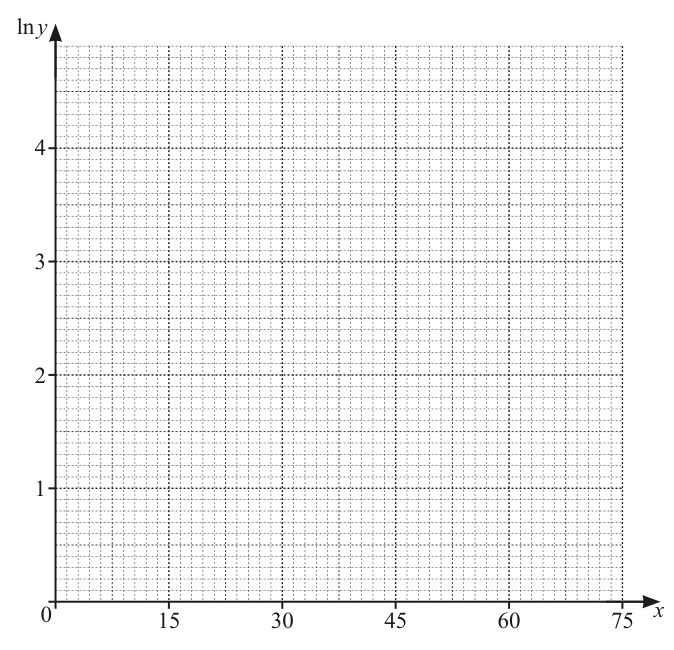
Approach
Taking natural logs of gives , so plotting against should give a straight line. Compute each value, plot the points on the given grid, and draw a single ruled line of best fit.
Working
The transformed values are:
Each point is plotted on the grid: , , , , . A single straight line is then ruled through them as a line of best fit, passing close to all five points.
Answer
Five points plotted at , , , , with a single ruled straight line of best fit drawn through them.
Points plotted at (15, 2.3), (30, 2.6), (45, 3.1), (60, 3.6), (75, 3.9) with a single ruled straight line of best fit
Walkthrough
The model is exponential, so a direct plot of against would be a curve. Taking natural logarithms converts it to linear form:
so if we plot (vertical axis) against (horizontal axis), the points should lie near a straight line with gradient and intercept . Each recorded value is converted using natural logs: , , , , . These five points are plotted on the printed grid and a single straight line is ruled so that it passes as close as possible to all of them.
Key Takeaways
- An exponential model becomes the straight line when is plotted against .
- The gradient of such a plot estimates and the vertical intercept estimates .
- A line of best fit should be a single ruled line passing close to all plotted points, not point-to-point segments.
Common Mistakes
- Using base-10 logarithms () instead of natural logarithms (); the model uses , so natural logs are required.
- Plotting instead of on the vertical axis.
- Drawing a jagged line joining the points instead of one straight line of best fit.
- Misreading the small grid subdivisions when locating values like 2.56 or 3.09.
Things to Be Careful About
- The mark scheme awards B1 for at least four correctly plotted points and B1 for a single ruled straight line of best fit — both features must be present.
- Values read to 2 decimal places are sufficient; the scheme accepts e.g. 2.5 or 2.6 for and 3.5 or 3.6 for .
- The line must be ruled (use a ruler) and must not be forced through the origin.
Find the equation of the line in part (a) and hence find the values of and . Give each value correct to 1 significant figure.
Approach
Since , the gradient of the line in part (a) is and the vertical intercept is . Read both from the drawn line, write the equation, then find and round each value to 1 significant figure.
Working
From the line of best fit, take two well-separated points on the line, e.g. and :
The vertical intercept is . So the equation of the line is:
Comparing with :
Rounded to 1 significant figure: and .
Answer
ln y = 0.03x + 1.8, A = 6, k = 0.03
Walkthrough
Taking logs of the model gave , which matches the straight-line form with gradient and intercept . So everything needed comes straight off the graph. Choosing two widely separated points that lie on the ruled line, such as and , the gradient is the change in divided by the change in : . The point where the line crosses the vertical axis gives . Hence the equation of the line is . To recover we undo the logarithm by exponentiating: , which rounds to to 1 significant figure, while is already given to 1 significant figure.
Key Takeaways
- In a log-linear plot of an exponential model, gradient = and vertical intercept = .
- Use two far-apart points on the line (not necessarily data points) to compute the gradient accurately.
- Undo with to return to the original exponential model.
Common Mistakes
- Reading the intercept as itself instead of (giving ).
- Computing the gradient from two adjacent data points, which amplifies plotting error.
- Forgetting to round to 1 significant figure — the mark scheme caps the marks at 2 if either value is not rounded to 1 sf.
- Writing the line equation with instead of as the constant term.
Things to Be Careful About
- The final answers must be quoted to 1 significant figure: (or 7) and (or 0.02); unrounded answers lose marks.
- The values must come from the linear graph or linear equation — values found directly from the original data score only SC marks.
- Follow-through applies: your and may follow your own readings of gradient and intercept within the accepted ranges.
Approach
Substitute into the linear equation from part (b), evaluate , and solve for .
Working
Using the equation of the line from part (b):
Answer
34.4
Walkthrough
Part (b) established that the data satisfy . To find where , substitute into this equation rather than the original exponential form: taking gives . Subtracting the intercept leaves , and dividing by the gradient gives . This sits comfortably inside the accepted range , confirming consistency with the graph readings.
Key Takeaways
- Once a relationship has been linearised, further questions are answered most easily in the linear form.
- Solving for is just solving a linear equation: isolate the term and divide.
Common Mistakes
- Substituting without taking its logarithm first (i.e. writing ).
- Using rounded intermediate values too aggressively; keep until the division.
- Sign errors when moving the intercept across the equation.
Things to Be Careful About
- The answer must be nfww (not from wrong working): the method must use the transformed equation correctly.
- The accepted answer range is roughly because it depends on the candidate's own gradient and intercept; later mis-simplification is ignored (isw).
- Give the answer to 3 significant figures: .
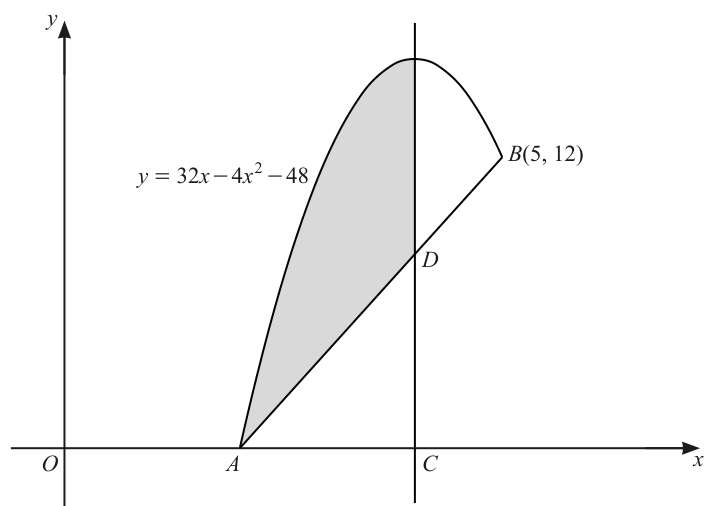
The diagram shows part of the curve and the line .
The curve and the line meet the -axis at and meet again at the point .
The line extended is parallel to the -axis and passes through the maximum point of the curve.
Find the area of the shaded region.
Approach
Find where the curve meets the -axis at , locate the maximum point (giving the vertical line ), find on the line , then compute the shaded area as the integral of the curve from 's -coordinate to minus the area of the triangle under .
Working
Point : solve
so or . Since lies to the right, .
Maximum point: by symmetry about (or differentiating ), so is the line .
Line : gradient , so , i.e. . At : .
Area under the curve from to :
Triangle under from to :
Shaded area:
Answer
40/3 (13.3)
Walkthrough
The shaded region is bounded above by the parabola, below by the straight line , on the left by their meeting point , and on the right by the vertical line through the curve's maximum. So its area equals the area under the curve minus the area under the line over the same interval.
First we need . Setting gives ; dividing by gives , which factorises as . The diagram shows is the left-hand intercept, so .
Next, the vertical line passes through the maximum of the parabola. A parabola is symmetric, so the vertex sits midway between the roots: . Equivalently, differentiating gives , again .
To find we need the equation of . It passes through and , so its gradient is , giving . At this gives , so .
Now integrate the curve from to : the antiderivative is , which evaluates to across these limits. The region under the line over the same interval is simply a right triangle with base and height , area . Subtracting gives the shaded area .
Key Takeaways
- Areas between a curve and a chord are found by integrating the curve and subtracting the area under the line (or integrating the difference directly).
- The vertex of a parabola lies midway between its -intercepts — a quick alternative to differentiating.
- When one boundary is a straight line, a triangle area formula can replace an integration.
Common Mistakes
- Taking instead of for (the diagram shows left of the vertex).
- Forgetting to subtract the triangle under , giving just the area under the curve ().
- Sign slips when evaluating the antiderivative at the lower limit ; the bracketed evaluation must be done carefully.
- Using the wrong height for the triangle (e.g. using from rather than at ).
- The mark scheme notes "isw" for later mis-simplification but "nfww" for : a decimal answer scores nothing unless reached from correct working — keep the exact fraction .
Things to Be Careful About
- Every mark-scheme step must be visible: solving the quadratic for , finding , obtaining or , writing the integrated expression with limits shown, and the subtraction plan.
- Give the exact answer ; decimals are accepted only if they follow correct working.
- The final accuracy mark depends on all earlier marks being earned, so check each stage.
The functions and are defined by
Approach
An inverse function exists only when the function is one-one (each output comes from exactly one input). Check whether is one-one on its given domain.
Working
For , is strictly decreasing as increases towards , so takes each value exactly once, and hence also takes each value exactly once.
Therefore is one-one on its domain , so exists.
Answer
is one-one for (each value of arises from exactly one value of ), so its inverse exists.
f is one-one on its domain x < 0, so f^-1 exists
Walkthrough
A function has an inverse function precisely when it is one-one: no horizontal line cuts its graph more than once. The formula on its own would not be one-one over all real numbers, because and both give . But the domain here is restricted to , which keeps only the left-hand branch of the parabola inside the exponent. On that branch, as increases, decreases, so every output value occurs exactly once — the function is strictly decreasing and therefore one-one.
Key Takeaways
- An inverse function exists if and only if the function is one-one.
- A restricted domain can rescue an otherwise many-one formula by keeping just one branch.
Common Mistakes
- Simply saying "because f is one-one" without connecting it to the given domain ; the mark scheme wants a valid explanation using itself.
- Ignoring the restriction and claiming is one-one everywhere — it is not, since repeats values for .
Things to Be Careful About
The explanation must reference the actual function and its restricted domain; a bare assertion scores nothing.
Approach
To find , write , swap the variables, then solve for using logarithms. The sign of the square root is fixed by the fact that the range of equals the domain of , namely .
Working
Let
Swap the variables:
Take natural logarithms of both sides:
Since the range of must equal the domain of , which is , we take the negative square root:
For this square root to be defined we need , i.e. , i.e. . Since never actually attains the value (as for ), the domain is .
Domain of : .
Range of : .
Answer
f^-1(x) = -sqrt(ln x - 3), domain x > e^3, range f^-1(x) < 0
Walkthrough
The standard method for finding an inverse is to write , interchange and , and then make the subject again. Swapping gives . Because the variable sits in an exponent, the correct tool is the natural logarithm, which undoes : taking of both sides gives . Rearranging, , so .
Which sign? The inverse's outputs are the original function's inputs, and the domain of was . So must be negative, forcing the minus sign: .
The domain of the inverse is the range of the original. Since for , we have , so the inverse accepts inputs — consistent with needing under the root. Its range is all negative numbers.
Key Takeaways
- Inverse method: swap variables, rearrange, swap back into notation.
- Logarithms invert exponentials; .
- Domain of = range of ; range of = domain of .
- The sign of a square root in an inverse is dictated by the original domain restriction.
Common Mistakes
- Writing or — the A marks require the negative root specifically.
- Giving the domain as instead of .
- Stating the range as through sign confusion.
- Forgetting to state the domain and range at all — they carry two separate B1 marks.
- Sign or arithmetic slips in reaching lose accuracy marks unless the order of operations is right.
Things to Be Careful About
The scheme allows follow-through after one sign or arithmetic error provided the order of operations is correct, but the final answer must be the negative root. Answers may equivalently be written as . Later mis-simplification is ignored (isw).
Approach
Since , applying to both sides gives . Substitute into the expression found in part (b).
Working
Using the result of part (b):
Since :
This is consistent with the given condition , which ensures .
Answer
g(x) = -sqrt(2x - 3)
Walkthrough
The composite means "apply first, then ": . To undo the outer function , apply its inverse to both sides: . This is why the question says "Hence" — the answer must use the found in part (b).
Substituting in place of in gives . The key simplification is , since and cancel. So .
As a check, feeding this back: , as required. The condition guarantees the quantity under the root is positive.
Key Takeaways
- undoes : applying it to a composite isolates the inner function.
- for any real .
- Composite-function conditions (like ) often exist to keep expressions well-defined.
Common Mistakes
- Trying to find from scratch rather than using from part (b) — the word "Hence" signals the intended route.
- Dropping the minus sign and writing .
- Mishandling , e.g. writing or incorrectly simplified.
Things to Be Careful About
The M1 follows through on the candidate's own expression, but the A1 requires the exact form . If scored zero, a special case mark (SCB1) is available for obtaining by solving and arguing the root must be negative from the existence of the composite.
In the binomial expansion of , the first three terms in increasing powers of are
Find the values of the constants , and .
Approach
Expand using the general binomial term , match the first three terms to , and use the ratio of consecutive coefficients to eliminate and and find .
Working
The general term is
So the first three terms are
Matching with :
Taking the ratio of the coefficient of to that of eliminates both and :
Simplifying the left-hand side:
so , giving
Then
and from the coefficient of ,
Answer
n = 10, a = 5/2, b = 1024
Walkthrough
The binomial expansion of has general term . Here and , so each term is . Since , the power of 2 in each term is , giving coefficients , and for , and respectively.
Matching these against : the constant term gives directly. The other two equations involve all three unknowns, so instead of solving them simultaneously we take the ratio of the last two coefficients — this cancels both and at once, leaving an equation in alone. The ratio simplifies because and one factor of cancels, leaving , hence .
With known, . The middle coefficient then reads , so .
Key Takeaways
- The general binomial term lets you write down any term without expanding fully.
- When several unknowns appear, ratios of consecutive coefficients often eliminate them cleanly — here one ratio removed both and .
- Powers of 2 combine by index laws: .
Common Mistakes
- Writing the general term as (powers swapped) or forgetting that contributes its own power of 2.
- Trying to solve three simultaneous equations in , , directly instead of using the ratio trick — possible but far more error-prone.
- Arithmetic slips in : with it is , not or .
- Cancelling incorrectly in the ratio, e.g. losing the factor from .
- Giving as the value of instead of dividing by .
Things to Be Careful About
- The answer must be exact: , not rounded, and exactly.
- The ratio method depends on matching like powers of ; check that the constant term is matched with before writing any ratio.
- Every mark-scheme step here is earned through working (M1/A1/B1 structure), so the expansion terms must be written out explicitly — a bare answer scores nothing (nfww).