Additional Mathematics 4037/21 — May/June 2024
Cambridge O-Level · Calculator · worked solutions for every part, with the mark scheme
Topics Quadratic functions · Calculus · Functions · Equations, inequalities and graphs · Coordinate geometry of the circle · Simultaneous equations · +6 more
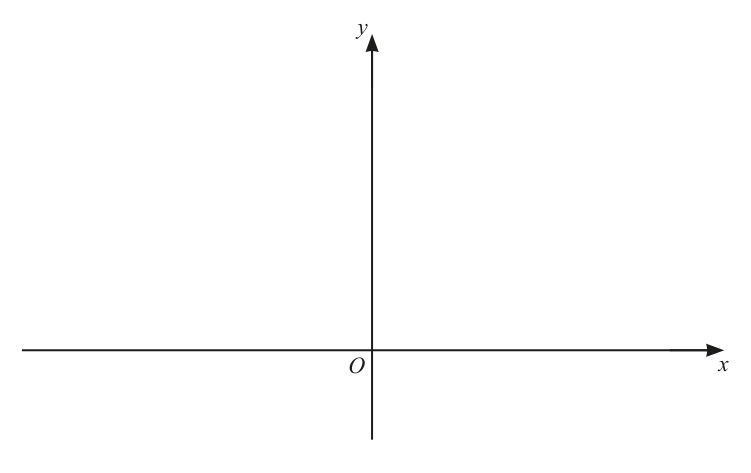
Approach
The graph of is V-shaped. The vertex occurs where , and the -intercept is found by putting .
Working
Vertex: solve , giving . So the vertex is at — it lies on the -axis.
-intercept: at ,
so the graph passes through .
Answer
A V-shaped graph with its vertex on the -axis at and left branch crossing the -axis at ; both branches rise upwards away from the vertex.
V-shaped graph with vertex (1.5, 0) on the x-axis and y-intercept (0, 6)
Walkthrough
The modulus function takes the linear expression and reflects any negative values to positive ones. This produces the characteristic V shape: for the graph is the straight line with gradient , and for it is the reflected line with gradient .
The turning point of the V sits exactly where the inside of the modulus changes sign, i.e. where , so . Because the question's expression equals zero there, the vertex lies on the -axis at — this is also the only -intercept.
For the -intercept we substitute : , so the left branch crosses the -axis at . Both branches extend upward into the first quadrant as drawn in the mark scheme figure.
Key Takeaways
- A graph of is always V-shaped with vertex where .
- The vertex of this particular modulus lies on the -axis because the constant term makes the zero occur at a real value of with no vertical shift.
- Intercepts are found by direct substitution: gives the -intercept, and solving gives the -intercept(s).
Common Mistakes
- Drawing two separate lines instead of one continuous V that meets at the vertex.
- Placing the vertex at or through sign slips when solving .
- Forgetting to mark the intercepts — the mark scheme awards B2 only for the fully correct graph with intercepts marked; B1 is available for correct shape with the vertex on the -axis.
- Reflecting the wrong branch: the reflection happens below , not above.
Things to Be Careful About
- The mark scheme requires the intercepts and to be clearly labelled for full marks (B2); without them you cap at B1.
- The vertex must sit exactly on the -axis — a V floating above or below loses the accuracy mark.
- Sketches should show correct shape and key coordinates; they need not be to scale, but the relative positions (vertex right of the origin, -intercept above the origin) must be right.
Approach
An equation of the form splits into two cases: and . Solve each linear equation.
Working
Case 1:
Case 2:
Check: at , ✓; at , ✓.
Answer
x = 1 or x = 3
Walkthrough
The equation says two quantities have equal size. This happens in exactly two ways: the insides are equal (), or the insides are opposites (). Solving each case gives one linear equation apiece.
Case 1: gives , so .
Case 2: gives , so .
Both check out in the original equation, so both are valid solutions. (The mark scheme also accepts squaring both sides to get , which factorises to give the same roots.)
Key Takeaways
- means or — always two cases.
- Each case here reduces to a simple linear equation.
- Substituting solutions back confirms neither case produced an extraneous root.
Common Mistakes
- Only solving one case and giving a single answer — the equation has two solutions and A2 requires both (A1 for either one alone).
- Sign slips when moving terms across, e.g. writing incorrectly in case 2.
- Squaring route errors: expanding wrongly or losing a factor when simplifying to .
Things to Be Careful About
- Both solutions must be given; the scheme awards A2 for both correct and only A1 if just one is right.
- "oe" applies: equivalent correct working (such as the squaring method shown in the alternative) earns the same marks.
- Answers should be exact integers here — no rounding issues arise.
Approach
Factor out of the terms in , complete the square inside the bracket, then multiply back through and simplify.
Working
Complete the square on :
Substitute back and expand:
This is of the form with , and .
Answer
5 - 2(x - 1)^2
Walkthrough
The expression has a negative coefficient of , so we first pull that factor out of the two terms containing : , leaving the constant outside.
Inside the bracket we complete the square: half of is , so . The corrects for the extra created by squaring .
Multiplying the back through gives , and adding the original constant gives . This matches the required form with integers , , — note that with is exactly .
Key Takeaways
- When completing the square with a non-unit leading coefficient, always factor it out of the -terms first, then multiply it back through afterwards.
- The form allows negative and : here and .
- Checking by expanding the final expression confirms no sign slips.
Common Mistakes
- Forgetting to carry the factor into the correction term, giving instead of .
- Writing instead of — both signs wrong at once.
- Giving because the printed bracket reads ; in the form we need .
- The mark scheme awards B2 for just and B1 for just or for stating , , so partial answers still earn credit but the full expression is needed for all 3 marks.
Things to Be Careful About
- The answer must be the complete expression ; the mark scheme marks the final expression only, so an incorrect constant loses the accuracy mark even if the squared term is right.
- All of , , must be integers as demanded by the question — they are here (, , ).
- Verify by expanding: .
Approach
Use the completed-square form from part (a): since for all real , the function never exceeds its constant term.
Working
From part (a),
Since for all , we have , so
with equality when .
Answer
f(x) <= 5
Walkthrough
The point of part (a) was to write the quadratic in completed-square form, which makes the range visible immediately. In , the squared term is never negative, so multiplying by makes it never positive: the largest value of occurs when , i.e. at , giving . Every other input subtracts something positive, so the outputs are all at most . Hence the range is .
Key Takeaways
- Completed-square form reveals the maximum (if ) or minimum (if ) directly as the value .
- The range of a quadratic over all reals is a one-sided inequality bounded by the turning-point value.
Common Mistakes
- Writing — the parabola opens downwards because , so is a maximum, not a minimum.
- Omitting the equality and writing ; the value is attained at , so is required.
- The mark scheme applies strict follow-through: the bound must be their value of from part (a), so an error in part (a) carries forward here.
Things to Be Careful About
- State the range as (or equivalently ); the mark scheme's B1 is strict follow-through on the part (a) constant.
- Since this says "Hence", the completed-square result must actually be used rather than re-deriving the vertex another way.
Use algebra to show that the equation has no real solutions.
Approach
Rearrange the equation into the standard form , then show that the discriminant is negative, which means the quadratic has no real roots.
Working
Expand and collect all terms on one side:
Here , , . Compute the discriminant:
Since , the discriminant is negative, so the quadratic equation has no real solutions.
Answer
The discriminant of is , so the equation has no real solutions.
The discriminant is -120 < 0, so the equation has no real solutions.
Walkthrough
The equation is not in standard quadratic form, so the first step is to expand the left-hand side and bring every term to one side. Expanding gives , and subtracting and adding gives .
To decide whether a quadratic equation has real solutions, we examine the discriminant . With , and , the discriminant is . A negative discriminant means the square root in the quadratic formula would be the square root of a negative number, which is not real — so the equation has no real solutions. That completes the proof.
(An accepted alternative is to complete the square: , whose minimum point lies above the -axis, so the curve never meets the -axis and there are no real roots.)
Key Takeaways
- To use the discriminant, the equation must first be written as with all terms collected on one side.
- gives two distinct real roots, gives one repeated root, and gives no real roots.
- Completing the square is an equivalent way to prove no real roots: a minimum above the -axis means no -intercepts.
Common Mistakes
- Sign slips when collecting terms: the equation must become ; forgetting to move the across (leaving as ) changes the discriminant.
- Sign errors in the discriminant itself: , not .
- Concluding without stating the meaning of the negative discriminant — the mark scheme requires the correct conclusion, not just the value .
- The mark scheme condones one slip in expansion or collection, but the follow-through only works if the discriminant for the candidate's equation is still negative.
Things to Be Careful About
- This is a "show that" question, so every algebraic line must be visible: the rearranged equation, the substituted discriminant, and the conclusion.
- The final answer is a statement, not a number — the value alone does not answer the question; you must state that a negative discriminant means no real solutions.
- Keep the exact value ; no rounding or decimal is involved.
DO NOT USE A CALCULATOR IN THIS QUESTION.
Approach
The curve cuts the -axis where . Substitute into the equation, solve for exactly, and take the difference of the two -values as the distance.
Working
Substituting :
The distance between the two points is the difference of these -values:
Answer
3√3
Walkthrough
Setting finds where the curve meets the -axis, because every point on that axis has first coordinate zero. The substitution leaves a quadratic in : after moving the across, , so taking square roots gives . The two intersection points sit vertically above one another, so the distance between them is simply the larger minus the smaller — the two s cancel, leaving twice the square-root term. Finally, since , doubling gives .
Key Takeaways
- To find where a curve crosses an axis, substitute the other coordinate as zero.
- The distance between two points with the same -coordinate is just the difference of their -coordinates.
- Surds should be simplified fully: .
Common Mistakes
- Forgetting the term still contributes when ; writing loses the M1.
- Giving decimal answers instead of the exact surd form demanded by "DO NOT USE A CALCULATOR".
- Leaving the answer as without simplifying, or halving/doubling incorrectly when subtracting the roots.
Things to Be Careful About
- The mark scheme requires the exact form ( or equivalent), and "nfww" means no marks if reached from wrong working.
- Show each algebraic step: forming the quadratic, the exact roots, and the subtraction are separately credited.
Find the coordinates of the points where the curve with equation intersects the curve with equation . Give each of your answers in the form , where and are rational and is the smallest integer possible.
Approach
At any intersection point the same pair satisfies both equations, so substitute into the cubic equation. Multiplying through by removes the fractions and produces a quadratic in , whose exact roots give the -coordinates; then find and rationalise.
Working
Substituting into :
Rearranging:
By the quadratic formula:
Now . Rationalising with (and similarly for the other sign):
So the two points are:
Answer
Points: (-10 + √17, -(10+√17)/83) and (-10 - √17, (√17 - 10)/83)
Walkthrough
Two curves intersect where their equations hold simultaneously. Since the second curve fixes , replacing everywhere in the first equation eliminates at once. The terms and become plain numbers because , giving , which rearranges to the three-term quadratic . The discriminant is not a perfect square, so the roots stay as surds: (since ). Each -value then determines its partner via ; multiplying top and bottom by the conjugate makes the denominator , giving . Note the sign pairing: the point with has , and vice versa.
Key Takeaways
- Substitution is the standard way to solve simultaneous equations when one equation already gives one variable explicitly.
- A quadratic formula result like must be simplified by cancelling the common factor before extracting squares from the surd.
- Rationalising with the conjugate converts into the required form.
Common Mistakes
- Cancelling from terms like incorrectly, or dividing the whole equation by and losing solutions — here multiplying out is safe because is not on the curve .
- Sign slips in the discriminant ( must be , not negative).
- Leaving unsimplified instead of .
- Mismatching the signs between and : the in runs opposite to the in .
- Rationalising wrongly, e.g. using denominator instead of .
Things to Be Careful About
- The final accuracy mark depends on all earlier marks, so every step must be correct — check the conjugate multiplication carefully.
- The question demands the form with smallest possible : here cannot be reduced further.
- Keep everything exact throughout; decimals score nothing under the no-calculator instruction.
There are 3 women, 2 men and 4 children in a choir.
The choir stands in a single straight line.
Find the number of possible arrangements if the first person and last person are both women.
Approach
There are people. The first and last positions must both be women, so choose an ordered pair of women for the ends, then arrange the remaining people in the middle.
Working
Choose the woman for the first position and then the woman for the last position:
Arrange the remaining people in the middle positions:
Multiply:
Answer
30240
Walkthrough
The choir has 9 distinct people in total. The condition fixes only the two end positions: both must be women. For the first position there are 3 choices of woman; once she is placed, 2 women remain for the last position. The remaining 7 people (1 woman, 2 men, 4 children) can stand in any order in the 7 middle positions, giving arrangements. Since these choices are independent, multiply them together: .
Key Takeaways
- In line-up problems, deal with restricted positions first, then permute everyone else.
- Ordered placement at specific spots uses permutations (), not combinations.
- Independent stages of a count are multiplied.
Common Mistakes
- Using instead of ordered placements — the two end slots are distinguishable (first vs last), so order matters.
- Permuting all 9 people instead of the remaining 7 after fixing the ends.
- Forgetting that after placing one woman at one end, only 2 remain for the other end.
Things to Be Careful About
- The answer is exact, so no rounding issues; but the method mark requires seeing or equivalent, so show the structure of the count rather than just the final number.
Find the number of possible arrangements if all the children stand next to each other.
Approach
Tie the 4 children together as one block. Then there are non-children plus this block, making units to arrange; finally arrange the children within their block.
Working
Arrange the units (5 adults + 1 child-block):
Arrange the 4 children within the block:
Multiply:
Answer
17280
Walkthrough
'All the children next to each other' is handled by the block method: imagine the 4 children tied together into a single object. The objects to line up are then the 3 women, 2 men and this block — 6 objects in total, which can be arranged in ways. Within the block the 4 children can be in any order, contributing a factor of . Multiplying gives .
Key Takeaways
- 'Together' conditions are solved by treating the group as one unit, permuting the units, then permuting inside the group.
- The total number of units drops by (group size − 1).
Common Mistakes
- Arranging 9 individuals and multiplying by something else instead of using the block reduction to 6 units.
- Forgetting the internal factor for the children's own order.
- Treating the block as if it could be split at the ends of the line — it cannot; the block occupies 4 consecutive positions automatically.
Things to Be Careful About
- Show the product explicitly to earn the method mark; the final value alone may not suffice.
Four of the choir are selected to sing in a group.
Approach
With no man chosen, the 4 singers come from the women and children — people. Order does not matter, so use combinations.
Working
Answer
35
Walkthrough
Excluding the 2 men leaves 7 people (3 women and 4 children). Choosing 4 of them for a singing group ignores order, so the count is simply . Equivalently you could sum over how many women are chosen: , corresponding to 0, 1, 2 or 3 women respectively.
Key Takeaways
- Selections (groups) use combinations; arrangements (line-ups) use permutations.
- A restriction like 'no man' simply shrinks the pool before counting.
Common Mistakes
- Using — order within the group does not matter here.
- Including the men in the pool.
Things to Be Careful About
- This is a selection, not an arrangement — combinations are required, and the mark scheme accepts either the single binomial coefficient or the case-by-case sum.
Approach
'At least 2 women' means exactly 2 women or exactly 3 women. Count each case with combinations and add.
Working
Exactly 2 women (and 2 of the remaining 6 people):
Exactly 3 women (and 1 of the remaining 6):
Add the disjoint cases:
Answer
51
Walkthrough
The phrase 'at least 2 women' splits into two disjoint cases: exactly 2 women, or exactly 3 women (there are only 3 women available). For exactly 2 women, choose which 2 of the 3 ( ways) and fill the other 2 places from the 6 non-women ( ways), giving 45. For exactly 3 women, take all 3 and choose 1 more from the 6 others, giving 6. The cases cannot overlap, so add: .
Key Takeaways
- 'At least' conditions are handled by splitting into mutually exclusive cases and adding (or by complement when that is shorter).
- Each case is counted independently with combinations, choosing separately from each category.
Common Mistakes
- Counting only the exactly-2 case and forgetting the exactly-3 case.
- Subtracting from the wrong total if attempting the complement route.
- Multiplying the cases instead of adding them.
Things to Be Careful About
- The mark scheme also accepts the full enumeration ; any correct decomposition earns the method mark, but the final total must be 51.
Variables and are such that . Use differentiation to find the approximate change in as increases from 3 to , where is small.
Approach
Differentiate using the product rule together with the chain rule for , then use the small-increment approximation evaluated at .
Working
First differentiate by the chain rule:
Now apply the product rule to :
For small , the approximate change in is:
Evaluating the derivative at :
Therefore:
Answer
0.274h
Walkthrough
The question asks how much changes when increases by a tiny amount . The tool for this is the derivative as a rate of change: if is small, then . So everything hinges on finding correctly.
The function is a product of two factors of : and . Before we can use the product rule we need the derivative of the second factor. Since is a function of a function (, squared), the chain rule gives — differentiate the outer square to get , then multiply by the derivative of the inner function, .
Applying the product rule, 'first times derivative of second plus second times derivative of first':
which simplifies to .
Finally substitute (radians, since no degree symbol appears): , so the approximate change in is .
Key Takeaways
- For a small change in , the change in is estimated by evaluated at the given point.
- Products of trig functions need the product rule; powers of trig functions need the chain rule.
- Trigonometric arguments without a degree symbol are in radians.
Common Mistakes
- Differentiating incorrectly, e.g. writing or forgetting the inner from the chain rule.
- Sign slip on the derivative of : it is , so the second product-rule term is negative.
- Forgetting to multiply by , or leaving the answer as just the value of the derivative at .
- Working in degrees instead of radians when evaluating at .
- Rounding too early: the mark scheme requires the coefficient correct or rounded/truncated to 4 or more significant figures before the final answer, and the A1 depends on the derivative being correct.
Things to Be Careful About
- The final accuracy mark is dependent ('dep') on a fully correct derivative being seen — an error in differentiation loses the last mark even if the approximation step is right.
- Give the coefficient to at least 4 significant figures in working () and state the answer as ; later mis-simplification is ignored (isw).
- Keep the answer in terms of — the question asks for the change as increases from to , not a numerical value.
It is given that , where and are non-zero constants. It is also given that
for all values of . Find the values of and .
Approach
Differentiate twice, substitute both derivatives and itself into the given identity, then compare coefficients of , and the constant term.
Working
Substituting into :
This holds for all values of , so equate coefficients:
Coefficient of : , so (since ).
Coefficient of : — consistent.
Constant term:
Answer
m = 1/4, n = -5/4
Walkthrough
The equation given must be true for every value of , not just one value. That is the key idea: after substituting the derivatives, we get an identity in , which means the coefficients of each power of on both sides must match.
First differentiate: the derivative of is , the derivative of is , and the derivative of the constant is zero. Differentiating again gives .
Substituting these into gives a quadratic expression in that must equal the constant for all . Expanding gives .
Since the left side has no or terms, their coefficients on the right must vanish: gives (rejecting because the question says is non-zero), and confirms it. Finally, matching constant terms, , so with we get .
Key Takeaways
- An equation that holds "for all values of " is an identity: equate coefficients of like powers of .
- Second derivatives of polynomials are found by repeated term-by-term differentiation.
- The condition that is non-zero lets you discard the root from .
Common Mistakes
- Forgetting to square the whole of — writing only loses the cross term and the constant .
- Keeping the root , which the question explicitly excludes ( non-zero); the mark scheme requires no other values.
- Only using one coefficient comparison and guessing instead of solving the constant-term equation.
- Sign slips when moving terms across when solving .
Things to Be Careful About
- The mark scheme awards B1 for each correct derivative, M1 for the correct substitution, and then 2 marks for and with no other values — so check consistency between the and coefficient equations rather than reporting extra roots.
- Answers must be exact fractions here; decimal forms are not needed since the arithmetic is simple by hand.
- The identity must hold for all — this is what justifies equating coefficients, so state that reasoning.
In an arithmetic progression, the sum of the first 30 terms is .
The sum of the next 20 terms is .
Find the first term and the common difference.
Approach
Use the formula twice. The first condition gives directly. The sum of the next 20 terms is , so . Solve the two linear equations for and .
Working
The sum of the next 20 terms:
Multiply the first equation by to match the coefficient of : equivalently, subtract. From and :
Substitute into :
Answer
First term a = 8, common difference d = -3
Walkthrough
The sum of an arithmetic progression with first term and common difference is . The first sentence of the question translates straight into this formula with .
The second condition needs care: "the sum of the next 20 terms" means terms 31 to 50, not the first 20 terms. The cleanest way to express that is as a difference of two totals: . Since is already known, we get , which feeds into the same formula with .
We now have two linear equations in and . Eliminating (multiply the first equation through so both have the same coefficient of , then subtract) leaves a single equation in , giving . Substituting back recovers .
Key Takeaways
- The AP sum formula converts any "sum of the first terms" statement into a linear equation in and .
- A phrase like "the sum of the next terms" must be translated as , not as .
- Two conditions on an AP give two simultaneous linear equations — solve by elimination.
Common Mistakes
- Treating "the next 20 terms" as instead of — this produces wrong equations entirely.
- Arithmetic slips when expanding ; note it is , not .
- Sign errors when moving across the equation to find .
- The mark scheme awards A1 for each of and , so both values must be correct; a single slip costs one mark even if the method was sound.
Things to Be Careful About
- The M1 for solving depends on having formed at least one equation using a sum formula, so always show the substituted formula before simplifying.
- Check your answer: with , , ✓ and ✓.
- Keep exact integer working throughout; no rounding issues arise here.
A geometric progression is such that the first term is 4 and the sum of the first three terms is 7.
Find the two possible values of the common ratio and find the sum to infinity for the convergent progression.
Approach
Write the sum of the first three terms , rearrange into a quadratic, factorise to get the two possible ratios, then use to identify the convergent one and apply .
Working
Factorise:
A geometric progression converges only if , so only qualifies. Then
Answer
The two possible common ratios are and ; the sum to infinity of the convergent progression is .
r = 0.5 or r = -1.5; sum to infinity = 8
Walkthrough
In a geometric progression with first term and common ratio , the first three terms are , , . Their sum being gives the quadratic , i.e. .
This factorises neatly as , giving or . Both are valid ratios for the finite sum condition — that is why the question asks for two possible values.
However, a sum to infinity exists only when . Since , that progression diverges; only is convergent. Applying with gives .
Key Takeaways
- The sum of the first three GP terms leads directly to a quadratic in .
- A quadratic can yield two legitimate common ratios; both should be reported when asked.
- The sum to infinity is valid only for — always check which root satisfies this.
Common Mistakes
- Computing for as well — the mark scheme awards the final A1 for only, nfww (no marks from wrong working).
- Sign errors forming the quadratic: , not .
- Factorising incorrectly or misreading the roots of .
- Forgetting to state both values of and giving only the convergent one.
Things to Be Careful About
- The final mark requires the correct value reached from correct working — an answer of obtained via scores nothing.
- State the convergence condition explicitly () to justify discarding .
- Exact fractions are preferred here: and are equivalent to and .
The functions and are defined by
Approach
For to exist, every output of must be an acceptable input to . Compare the range of with the domain of .
Working
For , is always positive, so the range of is .
But is defined only for , so it cannot accept any output of .
Answer
The range of is , which lies entirely outside the domain of , so does not exist.
The range of g is g > 0, which is outside the domain x < 0 of f, so fg does not exist
Walkthrough
A composite function means 'apply first, then apply '. For this to make sense, each value produced by must lie within the set of inputs that accepts.
Since squares its input before taking the reciprocal, every output is strictly positive — the range of is all values greater than . However, is only defined for negative inputs (). No positive number can be fed into , so the composition fails at every point and does not exist.
Key Takeaways
- A composite function exists only when the range of the inner function fits inside the domain of the outer function.
- Squaring followed by reciprocating always gives positive outputs.
Common Mistakes
- Checking the domains instead of comparing the range of with the domain of .
- Stating ' does not exist' without giving the valid reason (the scheme requires the range argument).
Things to Be Careful About
- The order matters: applies first. The question's part (b) confirms does exist, so do not mix up the two orders.
- A bare assertion earns nothing here — the explanation 'range of is ' (or equivalent) is what carries the B1.
Approach
means apply first, then . Substitute into and simplify.
Working
Note this is valid: for , so the input to is acceptable.
Simplify:
Answer
(4x - 1)^2 / (9x^4)
Walkthrough
The composite is found by feeding into : wherever has an , write instead. Since , we get .
Substituting :
Squaring the fraction gives , so dividing by it multiplies by its reciprocal:
This composite does exist because when (positive numerator over negative denominator), and negative numbers are valid inputs to .
Key Takeaways
- In , the function written second () acts first.
- Dividing by a fraction means multiplying by its reciprocal.
Common Mistakes
- Computing instead of (order reversed).
- Writing instead of — the whole expression including the 3 is squared's denominator.
- Leaving the answer unsimplified; the scheme allows 'isw' after a correct simplified form but the simplified form itself carries the A1.
Things to Be Careful About
- The M1 is for the correct substitution structure; the A1 requires the fully simplified single fraction or an equivalent.
Approach
To find , write , rearrange into a quadratic in , solve for using the quadratic formula, and choose the root consistent with .
Working
Let . Then
This is a quadratic in . Applying the quadratic formula:
Factorising under the root and simplifying:
Since throughout the domain of , we must take the negative square root: with already negative (as ), adding could give a non-negative result, whereas subtracting guarantees .
Swapping letters to express the inverse as a function of :
This has the required form with integers , , .
Answer
f^-1(x) = (2x - sqrt(x(4x - 3))) / 3, i.e. p = 2, q = 4, r = -3
Walkthrough
An inverse function swaps the roles of input and output. Starting from , multiply both sides by and collect everything on one side:
This is a quadratic equation in (with acting as a constant), so the quadratic formula solves it:
Extracting the factor from under the square root and cancelling the common factor gives .
Now the crucial step: the original function only accepts , so the inverse must also produce negative outputs. Since is negative on this domain (positive numerator, negative denominator), the term is negative. Taking the plus sign risks producing a zero or positive result; taking the minus sign keeps the whole numerator negative. Hence the negative square root is chosen.
Finally, relabelling as gives the inverse in standard form, matching with , , .
Key Takeaways
- To invert a function algebraically, set , rearrange to make the subject, then swap the letters.
- When a quadratic formula produces two branches, the domain restriction of the original function tells you which branch belongs to the inverse.
- A quadratic in with coefficients involving is still solved by the standard formula.
Common Mistakes
- Taking the wrong (plus) square root branch — the scheme explicitly awards a B1 for justifying the negative root.
- Sign errors in the discriminant: , not .
- Failing to simplify down to , so the printed target form is never reached.
- Forgetting to swap and at the end, leaving the answer in terms of .
Things to Be Careful About
- This is a 'show that' (AG) part: derive forward to exactly and confirm the match — never start from the printed answer.
- The justification of the negative root must reference the domain (equivalently the range of being negative); simply picking a root without reason loses the B1.
- The final A1 requires exactly or an equivalent exact form — no decimals.
Approach
Express and in terms of and , combine the terms under a single denominator, apply the identity , and factorise the denominator as a difference of two squares to cancel the common factor .
Working
Answer
(1 + sin x)/(1 - sin x)
Walkthrough
- Replace and inside the bracket.
- Since both terms share the denominator , combine them to get .
- Squaring numerator and denominator gives .
- Use the fundamental Pythagorean identity in the denominator to rewrite the expression entirely in terms of .
- Recognise that is a difference of two squares, factorising into .
- Cancel the common factor from numerator and denominator, which leaves the target expression .
Key Takeaways
- Expressing compound trigonometric expressions in terms of and is often the most direct route to algebraic simplification.
- Always look to apply when relating squared trigonometric functions.
- Difference of two squares () frequently allows simplification of trigonometric fractions.
Common Mistakes
- Incomplete factorisation step: omitting the visible cancellation step can lose the final accuracy mark on "Show that" questions requiring full justification.
- Squaring errors: mis-expanding as .
Things to Be Careful About
- Every intermediate step must be shown cleanly forward from the left-hand side to the right-hand side; do not assume the result or work backwards without showing the proper forward derivation.
Approach
Use the identity established in part (a) by setting to replace with . Solve this linear equation for , find all possible values of in the range , and then divide by to obtain .
Working
Using the result from part (a) with :
Multiply through by :
For , the interval for is .
Find the principal angle and all solutions in :
Dividing each by :
Answer
15.2°, 44.8°, 135.2°, 164.8°
Walkthrough
- The word "Hence" directs us to apply the identity from part (a). Setting gives .
- Multiply both sides by and collect terms to find .
- Determine the required interval for the angle : since , multiplying by 3 gives .
- Compute the principal angle: .
- Find all values of in the range : in the first revolution (), the values are and . In the next half-revolution (), add to each to get and .
- Divide each of these four values by to obtain the values of , giving , , , and to 1 decimal place.
Key Takeaways
- When solving trigonometric equations with a multiple angle such as , adjust the domain interval before finding all solution branches.
- In degrees, final angles must be given to 1 decimal place unless otherwise stated.
Common Mistakes
- Finding only the first two solutions in for , thereby missing the solutions and .
- Dividing by 3 before finding the other quadrant solutions in the full domain.
- Premature rounding of intermediate values of , which can introduce rounding errors into the 1 decimal place final answers.
Things to Be Careful About
- Ensure all four solutions lie strictly within the given domain and no extraneous solutions are included.
- Remember that Cambridge Additional Mathematics requires angles in degrees to be given to 1 decimal place.
In this question all lengths are in centimetres.
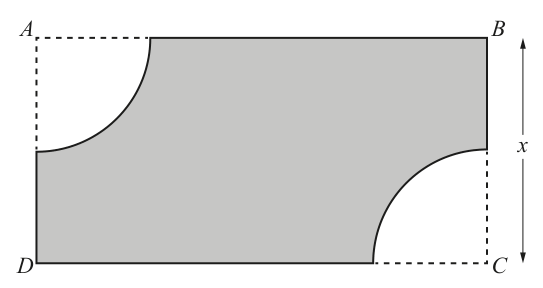
The diagram shows a rectangle with .
The area of the rectangle is .
Two identical quarter-circles of radius , with centres and , are removed from the rectangle to make the shaded shape.
Given that can vary, find the value of that gives the minimum value of the perimeter of the shaded shape and hence find this minimum value.
Approach
The rectangle has height and area , so its length is . The shaded shape's perimeter consists of two quarter-circle arcs (radius ) plus the remaining straight portions of the sides. Form in terms of , differentiate, set to zero, solve, then substitute back.
Working
Each quarter-circle has radius , so each arc length is
Two such arcs contribute .
The two vertical sides each lose a length to the removed quarter-circles, leaving each, while the full side remains intact. Hence
Differentiate:
Set equal to zero and solve:
Substitute back:
Since for , this is a minimum.
Answer
x = 22.6 cm, minimum perimeter = 70.9 cm
Walkthrough
The rectangle's area fixes its length: since and the area is , the horizontal length must be . This is the key first step — everything else hangs on expressing both dimensions in terms of the single variable .
Next we build the perimeter of the shaded shape by walking around it. Two pieces are curved: the quarter-circle arcs centred at and . Each has radius , so each arc is a quarter of a full circumference: , giving for both together. Note this only works because the angle is measured in radians — arc length with .
The straight pieces: looking at the figure, the two vertical sides have had a length eaten away by the quarter-circles, so each contributes . One full side of length survives untouched. Adding everything:
(the and cancel). To minimise, differentiate: . Setting this to zero gives , so (taking the positive root, since a length cannot be negative).
Substituting back gives . The second derivative is positive, confirming a minimum rather than a maximum.
Key Takeaways
- When a quantity depends on one variable through a constraint (here the fixed area), use the constraint to eliminate the other dimension before differentiating.
- Arc length requires radians: a quarter circle of radius has arc .
- Perimeter optimisation problems follow the pattern: form the function, differentiate, set to zero, solve, substitute back, and justify the nature of the stationary point.
Common Mistakes
- Using the diameter instead of the radius in the arc length formula, or forgetting the arcs are quarter-circles (a factor-of-4 error).
- Misidentifying which straight edges survive: the mark scheme expects for the straight portions — taking all four full sides or omitting the cut-outs gives a wrong .
- Forgetting to convert the area into the length before forming .
- Keeping the negative root : a length must be positive.
- Rounding too early (e.g. using in the substitution) instead of the exact , which can shift the final answer off 3 significant figures.
- Omitting units or failing to confirm the stationary point is a minimum when the question asks for the minimum value.
Things to Be Careful About
- The final answers should be given to 3 significant figures: and ; the exact forms are and .
- The mark scheme awards B2 for the correct perimeter expression (with B1 for seeing the rectangle length ), so the expression itself carries significant weight — show it clearly before differentiating.
- Follow-through applies to the differentiation and solving steps provided your is of the form , but the printed answers require correct working throughout (nfww).
- All lengths here are in centimetres, so state the unit with the final answers.
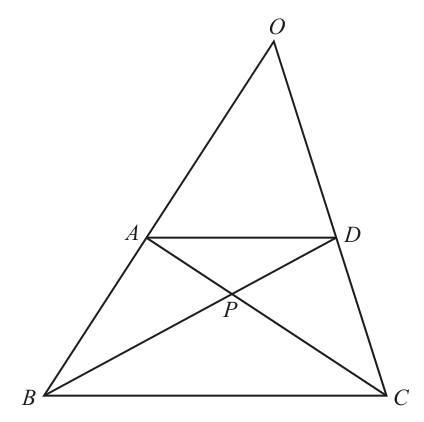
The diagram shows a triangle .
and .
The point is the point of intersection of and such that and where and are scalars.
Find two expressions for , each in terms of , and a scalar, and hence show that divides both and in the ratio .
Approach
Since , we have , and since , we have . Write in two ways: once travelling from to then part of the way along , and once from to then part of the way along . Equate the two expressions and compare coefficients of the independent vectors and .
Working
First expression, via on the line :
Second expression, via on the line :
Equating the two expressions and collecting the coefficients of and :
Comparing coefficients of the independent vectors and :
Substituting into the first equation:
Interpreting the parameters as ratios:
Answer
divides in the ratio and divides in the ratio , as required.
P divides AC in the ratio AP : PC = 4 : 7 and divides DB in the ratio DP : PB = 4 : 7
Walkthrough
The key idea is that any point on a straight line can be reached by going to one end of the line and then travelling a fraction of the way to the other end. Since lies on with , the position vector of is of , i.e. . Similarly has position vector .
The point lies on both lines and . Going via : , where . This gives the first expression. Going via : , since .
Both expressions describe the same point , so they are equal. Because and are independent vectors (not parallel), their coefficients must match separately — this is why we get two simultaneous equations rather than just one. Solving gives and .
Finally, the parameter tells us how far along each line sits: means is of , so is the remaining , giving . Likewise of and of , so reading from , .
Key Takeaways
- A point dividing a line internally can be written as one end plus a scalar multiple of the direction vector.
- If two expressions for the same vector involve independent vectors, equating coefficients gives simultaneous equations.
- A parameter on segment converts directly to the ratio .
Common Mistakes
- Writing or back-to-front, giving sign errors in the direction vectors.
- Equating the whole expressions but forgetting that and must be compared coefficient by coefficient.
- Reporting instead of converting it to the asked ratio — the conclusion must state the ratio in which divides the line.
- Arithmetic slips when clearing fractions; keep exact fractions throughout.
Things to Be Careful About
- The final A marks require both the values of and AND an explicit concluding statement about the ratios — stopping at loses marks.
- Note the asymmetry: on the parameter is measured from , but on the ratio is quoted from , so corresponds to , not .
- Keep all working in exact fractional form; no decimals are needed.
The point is such that .
Use a vector method to show that , and are collinear. Justify your answer.
Approach
Use the result of part (a): substitute into the first expression for and simplify. Then compare with .
Working
Using the 'Hence' route, substitute into
Now , so
Thus is a scalar multiple of , meaning is parallel to ; and since both vectors start at the common point , the points , and lie on the same straight line.
Answer
and , so is parallel to and they share the point ; hence , and are collinear.
OQ = (11/14)OP, so OQ is parallel to OP and they share point O; therefore O, Q and P are collinear
Walkthrough
This part says 'Hence', so we must use the value found in part (a) rather than re-solving anything. Substituting it into the first expression for and collecting terms gives the tidy form .
Meanwhile was defined by . Both position vectors are multiples of the same vector , so the lines and are parallel. Two parallel lines through the same point must be the same line, so , and all lie on one straight line. The justification ('scalar multiples with a common point') is what earns the second mark — stating only that they are parallel is not enough.
Key Takeaways
- Collinearity of three points is proved by showing two position vectors from a common point are scalar multiples of each other.
- The common-point condition is essential: parallel alone does not imply collinear.
Common Mistakes
- Saying only ' is a scalar multiple of ' without mentioning the shared point — the mark scheme explicitly requires 'and have a point in common'.
- Not using the 'Hence' route: re-deriving from scratch wastes time and risks errors.
- Arithmetic slips combining and ; use a common denominator of 77.
Things to Be Careful About
- The mark scheme awards M1 for reaching and the final mark for the full collinearity justification including the common point.
- Keep the answer exact; no decimals should appear.