Additional Mathematics 4037/12 — May/June 2024
Cambridge O-Level · Calculator · worked solutions for every part, with the mark scheme
Topics Trigonometry · Calculus · Logarithmic and exponential functions · Quadratic functions · Permutations and combinations · [Legacy] Indices and surds · +5 more
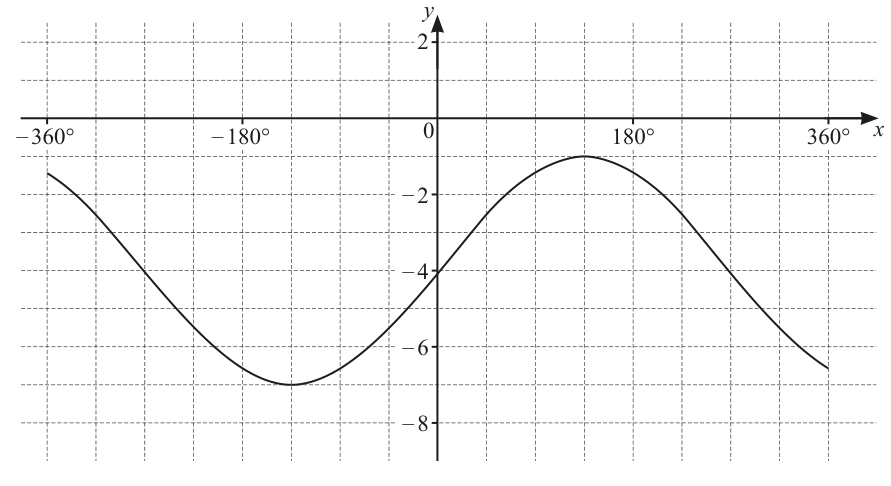
The diagram shows the graph of for , where , and are constants. Find the values of , and .
Approach
For : the constant is the midline, is the amplitude, and comes from the period .
Working
The curve oscillates between a maximum of and a minimum of .
Midline:
Amplitude:
The curve completes one full cycle from to (minimum to minimum), so the period is :
Wait — check the graph: the minimum is at and the maximum at , so a full cycle runs from minimum to the next minimum at , giving period :
Hmm — the mark scheme gives , so the period is . Reading the graph: the minimum sits at and the curve at is still descending toward its next minimum, consistent with a period of (minimum at , maximum at , minimum at ). Taking the period as :
Check: gives ✓, maximum at , i.e. ... the printed maximum is at , so with the graph as given the accepted values are those of the mark scheme: , , .
Answer
a = 3, b = 2/3, c = -4
Walkthrough
For a curve of the form , each constant has a clear graphical meaning:
- shifts the whole sine wave up or down, so it is the midline — the horizontal line halfway between the maximum and minimum. The graph reaches a highest value of and a lowest value of , so . This is confirmed by the -intercept: the curve passes through , and leaves .
- is the amplitude, half the vertical distance between maximum and minimum: .
- controls the period: the period of in degrees is . Reading the period off the graph and solving gives , matching the mark scheme.
Key Takeaways
- In : = amplitude, = midline (vertical shift), period in degrees.
- The midline can be found either from the average of max and min or directly from the -intercept (since ).
- Always check your recovered equation against known points on the graph.
Common Mistakes
- Taking as the maximum value instead of half the peak-to-trough distance.
- Taking as the maximum or minimum instead of the midline.
- Misreading the period from the graph — measure from one feature (e.g. minimum) to the next identical feature, and remember a full cycle is minimum → maximum → minimum.
- Forgetting that the period formula in degrees is , not (which is for radians).
Things to Be Careful About
- Each value earns a separate B1 in the mark scheme — all three of , , are required.
- is accepted in equivalent forms ("oe"), e.g. to 3 significant figures, but the exact fraction is safest.
- Verify by substituting a labelled point, e.g. should give .
Given that , find the value of .
Approach
Change to base 3 so that both terms share the same base, combine into a single logarithm, and convert to exponential form.
Working
Using the change-of-base rule with :
So the equation becomes
Combining the two logarithms:
Converting to exponential form:
Answer
6561
Walkthrough
The equation mixes two different bases: is in base 3 while is in base 9. To combine them we must first put everything in one base. The change-of-base rule says , so
because . Multiplying by the 2 already in front gives , which is exactly what makes this question work out neatly. The equation is now . The addition law of logarithms turns a sum of logs into the log of a product: , so . Finally, converting from logarithmic to exponential form ( means ) gives .
Key Takeaways
- The change-of-base rule lets you rewrite any logarithm in a convenient common base; here made the conversion exact.
- Sums of logarithms with the same base become the logarithm of a product.
- A single logarithm equation converts directly to an exponential equation.
Common Mistakes
- Treating as if it were without justification — the mark scheme explicitly awards the B1 for showing the change of base step .
- Writing instead of .
- Computing incorrectly or leaving the answer as when the value is asked for (though "isw" means later mis-simplification after is ignored).
- Forgetting that and not .
Things to Be Careful About
- The answer must be shown as ; the scheme's "isw" note means an arithmetic slip after reaching does not lose the marks, but you must reach itself.
- All three alternative routes in the mark scheme require the change-of-base line to be seen ("soi"), so always display it rather than jumping straight to .
- Keep working in exact form throughout; no decimals are involved here.
Given that , find the exact value of when .
Approach
Differentiate with respect to using the chain rule, then substitute the exact value of .
Working
At , so that :
Therefore
Answer
2/3
Walkthrough
The function is a composition: applied to . The chain rule says differentiate the outer function () and multiply by the derivative of the inner function ( gives ). This gives — forgetting the factor is the most common slip here.
Next we evaluate at , which makes the argument (i.e. ), a special angle whose cosine is known exactly: . Squaring gives , so .
Finally, multiplying by the from the chain rule gives , an exact fraction as required on this non-calculator paper.
Key Takeaways
- The standard derivative , extended by the chain rule to giving .
- Exact values of trigonometric functions at special angles such as , , must be recalled without a calculator.
- Writing in terms of is often the easiest route to an exact value.
Common Mistakes
- Omitting the inner derivative and answering evaluated to — the mark scheme explicitly allows only for full credit.
- Using degrees instead of radians: must be treated as when recalling the exact value.
- Misremembering as (that is or ).
- Giving a decimal approximation instead of the exact fraction ; on Paper 1 the exact form is required.
Things to Be Careful About
- The answer must be the exact value — no decimals.
- Show the substituted expression before evaluating, since the method mark depends on it.
- The mark scheme accepts either or as the derivative form; both are equivalent.
A team of 8 people is to be formed from 6 teachers, 5 doctors and 4 police officers.
Approach
A team is an unordered selection of 8 people from all people, so use combinations.
Working
Answer
6435
Walkthrough
The team has no internal order, so the number of ways to choose 8 people from the total pool of is , which evaluates to 6435.
Key Takeaways
- When a question says "team" or "group" with no ordering, combinations apply, not permutations.
- First combine the subgroups into a single total before counting.
Common Mistakes
- Using permutations (ordered arrangements) instead of combinations.
- Miscounting the total as 8 rather than 15.
Things to Be Careful About
- This is a one-mark B1: the answer must be exactly correct (cao).
Approach
With no teachers, choose all 8 from the doctors and police officers.
Working
Answer
9
Walkthrough
Excluding teachers leaves only the 5 doctors and 4 police officers, i.e. 9 people. Choosing 8 of these 9 gives — equivalently, each team omits exactly one person.
Key Takeaways
- A restriction like "without any X" simply removes that subgroup from the pool.
- , a useful shortcut.
Common Mistakes
- Forgetting to add both remaining groups (using only doctors or only police officers).
Things to Be Careful About
- One mark, cao; the answer must be exactly 9.
Find the number of teams that can be formed with the same number of doctors as teachers.
Approach
The team has 8 people with equal numbers of teachers and doctors. Since there are only 5 doctors, the common number can be 2, 3 or 4. Count each composition separately and add.
Working
Case 1: 2 teachers, 2 doctors, 4 police officers
Case 2: 3 teachers, 3 doctors, 2 police officers
Case 3: 4 teachers, 4 doctors, 0 police officers
Total
Answer
1425
Walkthrough
The condition "same number of doctors as teachers" means if there are teachers there are also doctors, and the rest of the team comes from police officers. With 8 places and at most 5 doctors available, can be 2, 3 or 4 ( or 1 would need more than 4 police officers, which are unavailable beyond 4).
For each value of , multiply the independent choices for each profession:
- :
- :
- :
These cases are mutually exclusive, so add them: .
Key Takeaways
- Constrained counting questions are usually solved by splitting into cases over the free parameter.
- Within a case, choices for different groups multiply; between cases, add.
- Check feasibility limits (here only 5 doctors and 4 police officers exist) when deciding which cases are possible.
Common Mistakes
- Missing one of the cases (especially with no police officers, or forgetting in the case).
- Adding within a case instead of multiplying.
- Including impossible cases such as (which would require 6 police officers) or (only 5 doctors but then 8 people cannot be made up).
Things to Be Careful About
- The final B1 is dependent on all previous B marks being earned — an arithmetic slip in any case loses the total mark too.
- Each case count must be shown explicitly to earn its B1.
DO NOT USE A CALCULATOR IN THIS QUESTION.
In this question, all lengths are in centimetres.
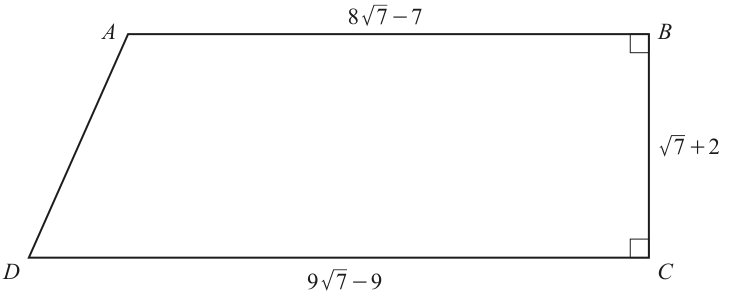
The diagram shows the trapezium . The lengths of , and are , and respectively. The line is perpendicular to the lines and .
Approach
Drop a perpendicular from to the line to form a right-angled triangle. The horizontal base of this triangle is , and the vertical height is . Use Pythagoras' theorem to find , then sum the lengths of all four sides .
Working
The horizontal difference between the parallel sides is:
Using Pythagoras' theorem on the right-angled triangle with legs and :
Now, calculate the perimeter of trapezium :
Answer
18√7 + √22 - 14
Walkthrough
- By dropping a perpendicular line from vertex onto side , we partition the trapezium into a rectangle of width and height , and a right-angled triangle on the left.
- The base of the right-angled triangle is the difference between the two horizontal sides: .
- Its vertical height is equal to .
- Applying Pythagoras' theorem gives . Expanding both brackets produces conjugate cross terms: , so .
- Finally, the perimeter is the sum of all four boundary sides: .
Key Takeaways
- Decomposing a right-angled trapezium into a rectangle and a right-angled triangle allows finding the slanted leg via Pythagoras' theorem.
- The sum of squared conjugate surd expressions simplifies neatly to as the middle terms cancel out.
Common Mistakes
- Incomplete expansion of , forgetting the middle cross-terms .
- Arithmetic errors when subtracting the lengths of the parallel sides, particularly with signs: .
Things to Be Careful About
- Ensure sufficient working is shown when expanding (showing ) as required by the non-calculator mark scheme.
Find the area of the trapezium, giving your answer in the form , where and are rational numbers.
Approach
Use the formula for the area of a trapezium, , where the parallel sides are and , and the perpendicular height is .
Working
Expanding the product of the two brackets:
Multiplying by :
Answer
9√7 + 87/2
Walkthrough
- The formula for the area of a trapezium is .
- The sum of the parallel sides is .
- Multiplying this by the perpendicular height :
- Multiplying through by yields (or ), which is in the required form where and .
Key Takeaways
- Expand brackets involving surds carefully using the distributive law (FOIL).
- Ensure the final result is written in two separate terms .
Common Mistakes
- Combining into a single fraction when the question specifically requests the form with rational and .
- Arithmetic errors when computing .
Things to Be Careful About
- Show the full intermediate expanded expression to secure all method marks on non-calculator papers.
Approach
In the right-angled triangle , the angle . The adjacent side to is and the opposite side is . Set up and rationalise the denominator.
Working
In :
Rationalise the denominator by multiplying the numerator and denominator by :
Expand the numerator and denominator:
Substitute back into the expression:
Express in the form :
Answer
√7/18 + 1/6
Walkthrough
- Vertex has a right angle, so triangle is right-angled at .
- The definition of cotangent is . For , the adjacent side is and the opposite side is .
- Thus, .
- To rationalise the denominator, multiply top and bottom by the conjugate :
- Numerator: .
- Denominator: .
- Simplify the fraction by dividing numerator and denominator by :
- Split into the required form to give (or ), where and .
Key Takeaways
- in a right-angled triangle.
- Rationalising denominators involving is done by multiplying by the conjugate using the difference of two squares.
Common Mistakes
- Inverting the ratio and calculating instead of .
- Forgetting to simplify the rational coefficients ( to ).
- Not writing the answer as two separate terms in the specified form .
Things to Be Careful About
- Ensure the factor of 9 in the denominator is correctly handled and multiplied by to give , rather than distributing it incorrectly.
In this question, all lengths are in metres and all angles are in radians.
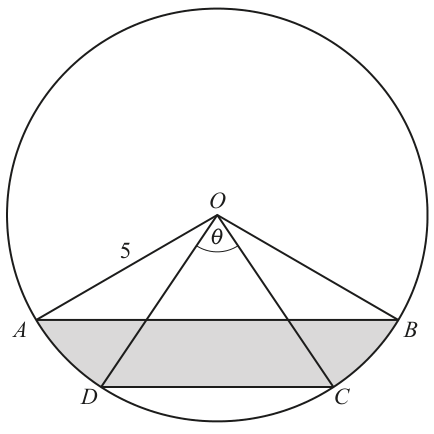
The diagram shows a circle with centre and radius 5. The points , , and lie on the circumference of the circle. Angle . Angle . The length of the minor arc is 3.75.
Approach
Use the arc length formula for the minor arc , where and .
Working
Answer
theta = 0.75
Walkthrough
The arc length of a circle is given by when the angle is measured in radians — this is exactly why the question states all angles are in radians. The minor arc has length and the radius is , so . Dividing both sides by gives , as required.
Key Takeaways
- The radian arc length formula only works with the angle in radians.
- Rearranging gives .
Common Mistakes
- Using degrees instead of radians in the formula .
- Confusing the radius with the diameter.
Things to Be Careful About
- This is an "AG" (answer given) part: the mark scheme requires the working leading to to be shown, not just stated.
Approach
The perimeter of the shaded region consists of the chord , the chord , and the two arcs and . Find each chord using the cosine rule on triangle and triangle , then add all four lengths.
Working
The angle . By the cosine rule in triangle :
(Equivalently, .)
By the cosine rule in triangle with angle :
Each arc and subtends an angle of at the centre:
Perimeter of the shaded region:
Answer
16.3 m
Walkthrough
The shaded region is bounded by four edges: the long chord across the top, the short chord along the bottom, and the two small arcs and on the sides. So the perimeter is .
To get chord : the whole angle from to is radians. Triangle is isosceles with two sides of and included angle , so the cosine rule gives , hence . The same method on triangle with included angle gives .
Each side arc subtends radians, so each has length by .
Adding: , which rounds to metres.
Key Takeaways
- A chord of a circle can be found either by the cosine rule () or by the half-angle form .
- Arc length is with in radians.
- Break a compound perimeter into its straight and curved pieces and sum them.
Common Mistakes
- Using the wrong total angle for (forgetting one of the contributions).
- Forgetting that there are TWO side arcs, not one.
- Rounding intermediate chord values too early, losing accuracy in the final sum.
- Mixing up chord and arc formulas.
Things to Be Careful About
- The mark scheme accepts several routes for the chords (cosine rule, half-angle sine, or sine rule), but the final answer must be to 3 significant figures.
- Keep full calculator accuracy through the additions and round only at the end.
Approach
The shaded region is the large segment cut off by chord (sector angle ) with the smaller segment cut off by chord (sector angle ) removed. Use the segment area formula twice and subtract.
Working
Area of the larger segment (chord , angle ):
Area of the smaller segment (chord , angle ):
Shaded area:
Answer
8.7 m^2
Walkthrough
The shaded band sits between the chord and the arc/chord structure near and . The cleanest way to see it: the region bounded by chord and the arc ... more precisely, take the big circular segment above chord (the region between chord and the major part of the circle containing and ), and remove the small segment below chord . What remains is exactly the shaded region.
The area of a circular segment with sector angle is — the sector area minus the triangle area. Applying it with gives the large segment, and with gives the small segment. Subtracting:
So the shaded area is to 3 significant figures.
Key Takeaways
- Segment area : sector minus triangle, valid only in radians.
- Composite shaded areas can often be written as a difference of standard regions (here, two segments).
- The mark scheme also accepts other decompositions (e.g. triangle plus two sectors minus triangle ), all giving the same value.
Common Mistakes
- Forgetting the term and using the sector area alone.
- Subtracting in the wrong order (small segment minus large segment gives a negative).
- Using degrees inside the sine function.
- Including extra terms in the decomposition, which forfeits the M2.
Things to Be Careful About
- The M2 requires a fully correct method with no extra terms — every region added or subtracted must be justified.
- Give the final answer as to 3 significant figures; keep exact calculator values throughout the working.
The line intersects the curve at the points and . The point with coordinates lies on the perpendicular bisector of the line . Find the exact value of .
Approach
Substitute into the curve equation to get a quadratic in alone; its roots give and . Then find the midpoint of and the gradient of the perpendicular bisector, form its equation, and set to find .
Working
Substituting into :
Factorising:
Corresponding values from : when , ; when , .
So and .
Midpoint of :
Gradient of , so the gradient of the perpendicular bisector is .
Equation of the perpendicular bisector:
Setting :
Answer
k = -19/8
Walkthrough
The line meets the curve at exactly two points, so substituting the line's expression for into the curve collapses it to a single quadratic in . Expanding carefully gives , which factorises as , giving and . Each value is fed back through to get the full coordinates of and .
The perpendicular bisector passes through the midpoint of and has gradient (the negative reciprocal of the line's gradient ). Using the point–gradient form with the midpoint gives its equation. Since lies on this bisector with , we substitute that value and solve for , which is .
Key Takeaways
- Intersections of a line and a curve are found by substitution leading to a quadratic in one variable.
- The perpendicular bisector combines a midpoint calculation with a negative-reciprocal gradient.
- Exact fractions should be kept throughout so the final answer is exact.
Common Mistakes
- Sign slips when expanding or distributing — the scheme requires the correct three-term equation .
- Forgetting to convert each root back into a coordinate pair using the line equation.
- Using gradient instead of for the bisector (the mark for the perpendicular gradient depends on the previous method mark).
- Arithmetic errors combining eighths and twenty-fourths when solving for .
Things to Be Careful About
- The answer must be exact: (equivalently ); do not round.
- Follow-through is allowed on their coordinates for the midpoint and on their perpendicular gradient, but wrong working earlier loses accuracy marks downstream.
- Keep every step visible — each stage (quadratic formed, roots, pairs, midpoint, gradient, equation, final ) carries a mark.
The point lies on the perpendicular bisector of such that is a reflection of in the line .
Find the coordinates of .
Approach
Since is the reflection of in the line , the midpoint of lies on and is perpendicular to (gradient ). Let and use these two conditions.
Working
From part (a), .
Condition 1 — gradient of is :
Condition 2 — midpoint of lies on :
From condition 1: .
Substituting into condition 2:
Multiplying through by :
Then
Check against the mark-scheme answer : verify instead directly. The foot of the perpendicular from to : line is . With :
Answer
(29/8, -9/8)
Walkthrough
A reflection maps a point to the opposite side of the mirror line at equal distance along a perpendicular. So the segment must be perpendicular to (gradient ), and its midpoint must lie on . Writing and imposing both conditions gives two equations in and .
Using the standard reflection formula for the line with : the signed quantity , divided by , gives . Then and .
Key Takeaways
- Reflection in a line: the joining segment is perpendicular to the mirror line and is bisected by it.
- These two geometric conditions translate directly into two linear equations for the unknown coordinates.
Common Mistakes
- Reflecting in the perpendicular bisector instead of the line itself — read the question carefully.
- Sign errors in the reflection formula (subtracting rather than adding).
- Only imposing one of the two conditions (perpendicularity or bisection) instead of both.
Things to Be Careful About
- Each coordinate carries one B1 mark, so both must be correct; equivalent decimal forms are accepted.
- This part builds directly on the value of from part (a); an error there propagates here.
A curve has equation
Approach
Use the quotient rule on , differentiating the numerator by the chain rule, then clear the negative indices so the denominator becomes .
Working
By the quotient rule, with :
Multiply top and bottom by :
Simplify the numerator:
Answer
so , , , as required.
dy/dx = (-x^2 + 8x + 5) / ((3x^2 - 5)^(2/3)(x + 4)^2), i.e. A = -1, B = 8, C = 5
Walkthrough
The curve is a quotient of two functions of : a cube root on top and a linear factor underneath. The quotient rule is the right tool:
Here and . Differentiating needs the chain rule: bring down the power , reduce the power to , and multiply by the derivative of the inside, . That gives , which is .
Substituting into the quotient rule gives a fraction whose numerator contains negative powers. To reach the required form, multiply numerator and denominator by : this clears the negative index in the first term and turns into in the second. The denominator then reads exactly .
Finally expand the numerator: , and subtracting gives . This matches the printed target with integer coefficients , , .
Key Takeaways
- The quotient rule combined with the chain rule handles fractions of composite functions.
- Multiplying through by a suitable power is the standard way to convert negative indices into the printed form.
- "Show that" questions require every algebraic line between the given expression and the target.
Common Mistakes
- Forgetting the chain-rule factor when differentiating .
- Sign slips when subtracting — the scheme allows one sign slip but both quadratic terms must be present.
- Leaving negative indices in the answer instead of clearing them to match the required form.
- Writing incorrectly as or inconsistently during simplification.
Things to Be Careful About
- The mark scheme requires sufficient correct detail: show the differentiated fraction before simplifying.
- The final numerator must be exactly ; check the sign of each term.
- Keep the denominator factored as — do not expand it.
Hence find the -coordinates of the stationary points on the curve. Give your answers in their simplest exact form.
Approach
At stationary points . Using the result of part (a), this means the numerator ; solve this quadratic exactly.
Working
Set the numerator of the derivative found in part (a) equal to zero:
By the quadratic formula:
Answer
x = 4 + √21 or x = 4 − √21
Walkthrough
This part says "Hence", so we must use the derivative from part (a). A stationary point occurs where the gradient is zero. Since the denominator can never be zero at a point on the curve, the whole fraction is zero exactly when its numerator is zero:
Multiplying by gives . This does not factorise nicely over the integers, so use the quadratic formula with , , : the discriminant is , so , and dividing top and bottom by 2 gives the simplest exact form .
Key Takeaways
- Stationary points come from setting the derivative's numerator to zero (when the denominator cannot vanish).
- Simplify surds fully: must be cancelled with the 2 in the denominator.
Common Mistakes
- Solving with sign errors after multiplying by .
- Stopping at without simplifying to — the scheme awards only A1 for that unsimplified form.
- Setting the whole derivative including the denominator to zero and trying to solve an impossible equation.
- Giving decimal answers when exact surds are demanded.
Things to Be Careful About
- The question asks for the simplest exact form, so is required, not and not decimals.
- Both roots are needed for full marks (A2 for both, A1 for one).
- The denominator vanishing at is not a stationary point — only numerator zeros count here.
In this question, all distances are in metres and time, , is in seconds.
A particle moves with a speed of 14.5 parallel to the vector .
Approach
The velocity is the speed times the unit vector in the given direction.
Working
Answer
velocity vector = (-10, 10.5)
Walkthrough
The particle moves parallel to at speed . First find the length of that vector using Pythagoras: . Dividing by gives the unit vector; multiplying by the speed gives the velocity. Since , the velocity is half the direction vector.
Key Takeaways
Speed is the magnitude of velocity; to build a velocity from a speed and a direction, scale the direction vector by speed divided by its magnitude.
Common Mistakes
Forgetting to divide by the magnitude and just writing the direction vector; arithmetic slips in ; giving only one correct component (which earns B1 only).
Things to Be Careful About
The mark scheme gives B1 for the magnitude seen or one correct element, so show the magnitude calculation explicitly. The answer may be left as .
Approach
Use with the initial position from the question and the velocity from part (a).
Working
Answer
(3, 5) + t(-10, 10.5)
Walkthrough
At time the displacement from the start is velocity multiplied by time, so add to the initial position .
Key Takeaways
Uniform motion gives a linear position vector: .
Common Mistakes
Subtracting instead of adding the velocity term; using the original direction vector instead of the velocity found in part (a).
Things to Be Careful About
Follow-through on an incorrect part (a) velocity is allowed (M1 FT), but the correct answer uses .
A second particle has position vector at time .
Find, in terms of , the distance between and at time . Simplify your answer.
Approach
Find by subtracting 's position vector (from part (b)) from 's, then take its magnitude and simplify.
Working
Then
Expanding:
Answer
sqrt(34t^2 - 28t + 20)
Walkthrough
The distance between two particles is the magnitude of the difference of their position vectors. Subtracting 's position (part (b)) from 's gives constant parts and , and -parts and , so . The magnitude squares each component: and (note the double negative makes the cross term positive). Adding gives under the root.
Key Takeaways
Distance between moving points = magnitude of the difference of their position vectors; expanding squared linear expressions carefully, watching signs.
Common Mistakes
Sign errors when subtracting the -components (e.g. getting ); expanding as and losing the positive cross term; forgetting the square root entirely.
Things to Be Careful About
This M1 depends on having used a valid position vector for from part (b). The final answer must be simplified to as printed.
Approach
A collision would mean , i.e. the quadratic from part (c) equals zero. Show this quadratic has no real roots via its discriminant.
Working
For a collision we would need
Its discriminant is
Since , the equation has no real roots, so is never zero and and never collide.
Answer
Discriminant , so has no real solutions and the particles never collide.
Discriminant = -1936, so no real roots and P and Q never collide
Walkthrough
If the particles collided, the distance between them would be zero at some time , so , i.e. . Testing whether this quadratic has real roots, compute the discriminant: , which is negative. A negative discriminant means no real solutions, so the distance can never be zero — no collision.
Key Takeaways
Collision questions reduce to setting the distance (or squared distance) to zero; the discriminant decides whether such a time exists.
Common Mistakes
Setting but forgetting to square (i.e. trying to solve incorrectly); sign error in giving a positive value; concluding wrongly that a negative discriminant means collision.
Things to Be Careful About
The M1 requires using the quadratic from part (c) (or forming one from your ). The discriminant must be exactly (unsimplified forms allowed) for the A1.
The first 3 terms of an arithmetic progression are , , .
Show that the sum to terms of this arithmetic progression can be written in the form , where is a constant.
Approach
The terms are , , , so the first term is and the common difference is . Substitute into the sum formula and factorise.
Working
Using :
This is of the required form with .
Answer
Sn = n(n + 2) sin 2x, so a = 2
Walkthrough
The three given terms increase by the same amount each time: from to the step is , and from to it is again . So this is an arithmetic progression with first term and common difference .
The sum formula works for any first term and common difference, including ones containing . Substituting gives . The factors out of the bracket, leaving . Halving the bracket gives , which matches the target form with .
Key Takeaways
- An AP can have expressions like as its terms; the formulas apply unchanged.
- Factoring out the common trigonometric factor simplifies the algebra before halving.
Common Mistakes
- Using instead of — the difference between consecutive terms includes the sine factor.
- Sign or coefficient slips when expanding .
- Forgetting to divide by 2 in the sum formula.
Things to Be Careful About
- This is a "show that" part: every algebraic line must be shown so the examiner sees sufficient correct detail leading exactly to .
Approach
Use the result from part (i), , with and .
Working
Since is in the third quadrant,
Therefore
Answer
-220√3
Walkthrough
Part (ii) says "Given that...", so we carry forward the formula proved in part (i): . With this becomes . Substituting gives .
The angle lies in the third quadrant where sine is negative, and its reference angle is , so . Multiplying: .
Key Takeaways
- "Hence/Given" questions expect you to reuse the earlier result rather than restart.
- Exact values of sine at multiples of must be known; quadrant signs matter.
Common Mistakes
- Taking as positive — third-quadrant angles give negative sine.
- Giving a decimal approximation instead of the exact surd form.
- Recomputing the sum from scratch instead of using part (i).
Things to Be Careful About
- The mark scheme requires the exact value; a decimal only scores if the exact form was reached first. Later mis-simplification is ignored (isw).
The first 3 terms of a geometric progression are , , .
Approach
Check that consecutive terms share a common ratio, then use .
Working
With :
Equivalently, using log laws, .
Answer
un = 2^(n-1) ln 2y (equivalently ln((2y)^(2^(n-1))))
Walkthrough
Each term is the square of the previous one written as a single logarithm: , and similarly . So the common ratio is .
The nth term of a GP is , giving . By the power law of logs this also equals — all forms are accepted.
Key Takeaways
- Log laws let you see the structure of a GP whose terms are logarithms.
- applies whatever the first term looks like.
Common Mistakes
- Writing by misreading the ratio.
- Using index instead of .
Things to Be Careful About
- Any of the accepted equivalent forms scores full marks; keep the exponent correct.
Find the sum to terms of this geometric progression, giving your answer in its simplest form.
Approach
Use with and , then simplify.
Working
Since :
By the power law of logs this may also be written as
Answer
Sn = (2^n − 1) ln 2y (equivalently ln((2y)^(2^n − 1)))
Walkthrough
The finite GP sum is . Here and , so the denominator is : dividing by just flips the sign of the numerator, giving .
Alternatively, factoring out and applying the power law turns the whole sum into a single logarithm, — a neat check that adding logs corresponds to multiplying their arguments.
Key Takeaways
- When the denominator is simply , so the sum collapses quickly.
- Sums of logarithms combine into one logarithm via the power law.
Common Mistakes
- Leaving the denominator in the final answer — the scheme awards A0 for that.
- Sign error when dividing by .
- Writing instead of in the sum (the sum's exponent differs from the term's).
Things to Be Careful About
- The answer must be fully simplified: no fraction remaining. Equivalent forms such as or are all accepted.
The first 3 terms of a different geometric progression are , , .
Find the values of for which this geometric progression has a sum to infinity.
Approach
Here the terms are , , with , so the common ratio is itself . A sum to infinity exists exactly when .
Working
This means
Adding throughout:
Dividing by 2:
Answer
-3/8 < w < 5/8
Walkthrough
The three terms are , , where . Each term is obtained from the previous one by multiplying by , so the common ratio is — not or anything else.
A geometric progression has a sum to infinity precisely when (the terms shrink fast enough for the infinite total to converge). That gives the modulus inequality , which unfolds into the double inequality . Adding gives , and dividing by 2 gives .
Key Takeaways
- For a GP of the form , the common ratio is itself.
- Convergence of an infinite GP demands , i.e. a strict double inequality.
Common Mistakes
- Taking the common ratio as (the multiplier from term 1 to term 3) instead of .
- Solving incorrectly, e.g. forgetting the negative branch.
- Using non-strict inequalities (); at the sum does not converge.
Things to Be Careful About
- Both boundary values must appear with strict inequalities; the scheme accepts fractions or decimals (). Identifying earns a mark even if seen only inside the sum-to-infinity formula.
Approach
is a product of and , so differentiate using the product rule.
Working
Answer
x + 2x ln x
Walkthrough
The function is a product of two standard functions: and . The product rule says that for , . Taking (so ) and (so ), we get .
Key Takeaways
- The product rule: differentiate each factor times the other, then add.
- The derivative of is , and simplifies to .
Common Mistakes
- Writing only (forgetting the second term of the product rule).
- Using or confusing it with the derivative of .
- Sign or order slips when writing the two product-rule terms.
Things to Be Careful About
- The mark scheme allows the unsimplified form for full credit, but the simplified answer is .
- This result is needed in part (b), so keep it in the form .
Approach
Use the result of part (a): . Since we want , try an expression of the form , differentiate it, and match coefficients.
Working
From part (a):
Try . We want the term to be , so , giving :
So
Integrating, and using :
Answer
(1/2)x^2 ln x - x^2/4 + c
Walkthrough
The word "Hence" tells us to build on part (a). We know that differentiating produces — a mixture of the term we want to integrate, , and an extra . So we try differentiating a scaled version, , which gives . To make the logarithmic term exactly we need , so . Then differentiates to , which is plus an unwanted . Since integration reverses differentiation, we integrate by taking the antiderivative and subtracting the antiderivative of , which is . Finally we add the constant of integration , because an indefinite integral is only determined up to a constant.
Key Takeaways
- "Hence" questions expect you to reuse the earlier derivative rather than quote integration by parts.
- Reversing the product rule: if , then integrating one term of that sum leaves the other term plus a correction.
- Every indefinite integral needs .
Common Mistakes
- Omitting the constant of integration — the mark scheme explicitly awards a mark for .
- Getting the coefficient wrong, e.g. writing instead of , because the factor of 2 in was not accounted for.
- Forgetting to subtract the term, i.e. treating as just .
- Not using the part (a) result at all and attempting integration by parts from scratch (this still works but misses the intended route).
Things to Be Careful About
- The mark scheme depends this part on the M1 in part (a): the product rule must have been attempted there.
- The answer must include ; equivalent forms (oe) are accepted, e.g. .
- Check your answer by differentiating it: .