Additional Mathematics 4037/11 — May/June 2024
Cambridge O-Level · Calculator · worked solutions for every part, with the mark scheme
Topics Trigonometry · Calculus · Logarithmic and exponential functions · Equations, inequalities and graphs · Factors of polynomials · Series · +3 more
Approach
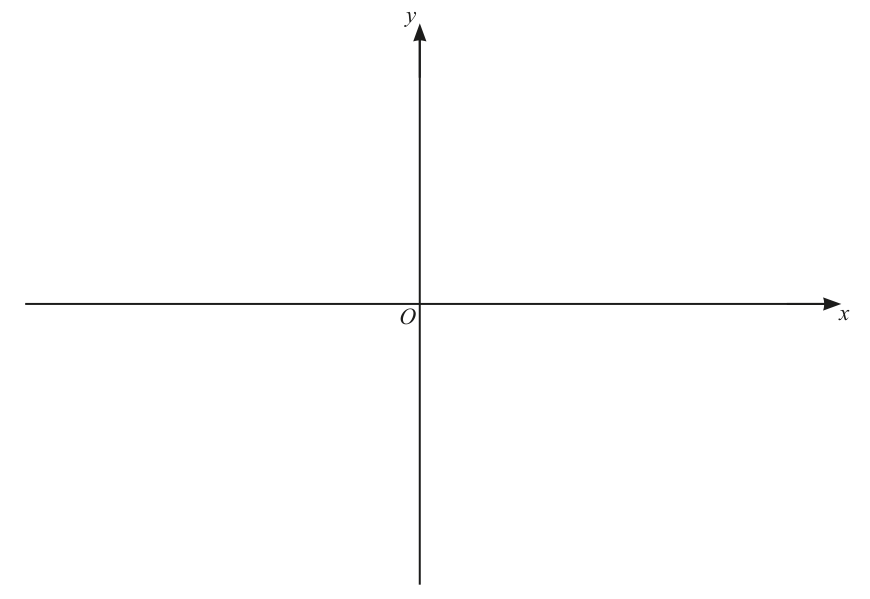
The curve is a cubic with leading term , so it has the negative-cubic shape: it comes down from the top left and goes down to the bottom right. The -intercepts come from the factors and the -intercept from substituting .
Working
-intercepts: solve :
-intercept: put :
Since the leading coefficient is negative, the curve starts high on the left, falls to a local minimum between and (in the second quadrant), rises to a local maximum between and (in the first quadrant), passing through , then falls again after .
Answer
A negative cubic crossing the -axis at , and , crossing the -axis at , with a local minimum in the second quadrant and a local maximum in the first quadrant.
Negative cubic crossing the x-axis at -5, -2 and 1/2, the y-axis at 2, with a minimum in the second quadrant and a maximum in the first quadrant
Walkthrough
The factors of the cubic give the -intercepts immediately: each bracket equals zero at , and . To get the -intercept we substitute into the whole expression, which gives . Finally, the overall shape is fixed by the leading term: multiplying the -terms of the brackets gives , a negative cubic, which falls from the top left, rises, then falls to the bottom right. That fixes where the local minimum (between and , below the axis) and local maximum (between and , above the axis) sit.
Key Takeaways
- The roots of a factorised polynomial are read straight from the brackets.
- The sign of the leading coefficient determines the end behaviour of a cubic.
- The -intercept is found by substituting .
Common Mistakes
- Drawing a positive cubic shape (up on the left) instead of a negative one — the mark scheme requires the cubic shape for the intercept marks.
- Forgetting the factor gives the root , not .
- Sign errors when evaluating the -intercept: , and the minus sign in front makes it .
- Placing the maximum and minimum in the wrong quadrants.
Things to Be Careful About
- The mark scheme awards the intercept marks only if the curve has a correct cubic shape, so get the shape right first.
- The intercepts must actually be marked on the axes (, , on the -axis and on the -axis), not just listed.
Approach
Using the sketch from part (a), holds where the curve is on or above the -axis. From the sketch this happens to the left of and between and , endpoints included.
Working
The curve is above the -axis for and for , and touches zero at , , . Since the inequality is , the endpoints are included:
Answer
x <= -5, -2 <= x <= 1/2
Walkthrough
The inequality asks where the cubic takes values that are zero or positive, i.e. where the sketch sits on or above the -axis. From part (a) the curve is above the axis for and for , and it equals zero exactly at , and . Because the inequality uses (not ), those three points must be included, giving together with .
Key Takeaways
- A polynomial inequality can be solved by reading the sign regions off its graph — this is exactly what 'Hence' is asking for.
- The type of inequality sign ( versus ) decides whether endpoints are included.
Common Mistakes
- Writing strict inequalities , : the mark scheme gives this SC1 only, since the endpoints must be included for .
- Reading the wrong regions (where the curve is below the axis) instead of above.
- Omitting one of the two solution intervals.
Things to Be Careful About
- Both intervals are required — a single interval scores only one of the two B1 marks.
- 'Hence' means the sketch from part (a) must actually be used; the answer follows from where that curve is non-negative.
DO NOT USE A CALCULATOR IN THIS QUESTION.
The polynomial is such that .
Approach
Divide by using algebraic long division; the quotient is and the constant left over is .
Working
So
Answer
q(x) = 3x^2 - 10x - 8, r = 5
Walkthrough
We are asked to write the cubic in the form . This is exactly what division by produces: the quotient is and the remainder is the constant .
Long division proceeds term by term. First, divide the leading term by to get ; multiply back to get and subtract, leaving . Next, ; multiply back to get and subtract, leaving . Finally, ; multiply back to get and subtract, leaving remainder .
So , giving both required quantities. As a check, the remainder theorem says the remainder on division by is , which indeed equals .
Key Takeaways
- Dividing a polynomial by a linear factor gives a quotient plus a remainder, matching the form divisor × quotient + remainder.
- The remainder theorem offers a quick check of the remainder value.
Common Mistakes
- Sign slips when subtracting each product during long division — every subtraction must flip both signs.
- Forgetting that the divisor has leading coefficient , so terms like must be divided by , not .
- Stopping at the quadratic without stating the remainder .
Things to Be Careful About
- The mark scheme awards M1 for any valid method (long division, synthetic division, or forming an identity) and A1 for each of and — both values must be stated.
- This paper is non-calculator, so all arithmetic here is exact integer work.
Approach
From part (a), . Factorise the quadratic into two linear factors.
Working
Using part (a):
Factorise : we need two numbers multiplying to and adding to : these are and .
Therefore
Answer
(3x + 2)(x - 4)(2x - 5)
Walkthrough
The word 'Hence' tells us to use part (a): since , subtracting removes the remainder term entirely, giving .
The quadratic factorises by splitting the middle term: we seek two numbers with product (that is ) and sum , namely and . Splitting gives .
So the whole expression becomes a product of three linear factors, as required.
Key Takeaways
- 'Hence' questions expect you to build on the earlier answer rather than start again.
- Factoring a quadratic with non-unit leading coefficient via splitting the middle term (product–sum method).
Common Mistakes
- Re-dividing the original cubic instead of simply subtracting from the part (a) form.
- Choosing the wrong pair of numbers for the split (e.g. and versus and ).
- Leaving one factor as a quadratic — the question demands linear factors only.
Things to Be Careful About
- The mark scheme requires seeing expressed fully as a product of three linear factors for the final A1.
- Check by expanding mentally: the constant term should be , and . ✓
Approach
means . Using part (b), set each linear factor to zero.
Working
Answer
x = -2/3, 4, 5/2
Walkthrough
The equation rearranges to , and part (b) already wrote this difference as a product of three linear factors. A product equals zero exactly when at least one factor is zero, so we solve each factor separately: gives , gives , and gives .
Key Takeaways
- Solving is equivalent to solving , which factorisation turns into simple linear equations.
- A cubic has up to three real solutions — here all three exist.
Common Mistakes
- Only giving one solution instead of all three.
- Sign errors when solving (answer , not ).
Things to Be Careful About
- The mark scheme allows follow-through on the candidate's own quadratic from part (b), but the printed exact fractions are expected here.
- All three solutions must be listed; omitting any loses the mark.
Write , where , as a single logarithm to base 10. Give your answer in its simplest form.
Approach
Write the constant 1 as , move the coefficient 2 into the logarithm as a power, then combine everything into one logarithm using the multiplication and division rules, and simplify the algebra inside.
Working
Since :
Combining using the multiplication and division rules:
Factorise and cancel the common factor (valid since ):
Answer
lg(10(x + 1)/(x - 1))
Walkthrough
The expression mixes a plain number with logarithms, so the first move is to write as , since . The term has a coefficient in front of a logarithm, so the power rule turns it into , putting everything inside logarithms. Then the multiplication rule and the division rule collapse the three logarithms into one. Finally the algebra inside is simplified: factorises as , and because the factor is non-zero and cancels with one power of in the denominator.
Key Takeaways
- The three laws of logarithms: power rule, product rule, quotient rule.
- Any constant can be written as , so .
- Simplifying the argument of a logarithm (factorising and cancelling) is part of giving the answer "in its simplest form".
Common Mistakes
- Forgetting to write as and leaving a stray constant.
- Writing as instead of — the power rule multiplies the exponent, not the argument.
- Cancelling without noting guarantees it is non-zero.
- Leaving the answer as — the mark scheme requires the simplified form, so the factorisation and cancellation step earns its own mark.
Things to Be Careful About
- The final answer must be the single simplified logarithm ; an unsimplified but otherwise correct form loses the final accuracy mark.
- The condition is what makes the cancellation legitimate — quote it or at least ensure the cancellation is shown.
- "oe" in the mark scheme means an equivalent single-logarithm form is accepted, but it must be a single logarithm in simplest form.
Approach
Use the change-of-base rule to write both logarithms in the same base, giving a quadratic in . Solve it, then undo the logarithm by raising 5 to each side.
Working
By the change-of-base rule, , so the equation becomes
Multiplying both sides by :
Taking the square root (keeping both signs):
Undoing the logarithm:
Evaluating each root:
Answer
x = -1 + 5√5 or x = -1 + √5/25
Walkthrough
The equation has logarithms with two different bases, and . The change-of-base rule shows that and are reciprocals, so the equation becomes where . Multiplying through by gives the quadratic , so — both signs must be kept. Each value of is then converted back to by writing as . Finally and (rationalising by multiplying top and bottom by ), and subtracting 1 gives both answers in the required form .
Key Takeaways
- Change of base: , which turns mixed-base equations into one variable.
- A quadratic in has two roots, and each must be converted back through the exponential.
- Negative fractional indices: , and surds are rationalised to match the form .
Common Mistakes
- Dropping the negative root and giving only — the mark scheme explicitly allows the to be carried through but both answers are needed for the accuracy mark.
- Writing as upside down — the change-of-base fraction must be .
- Forgetting to subtract the 1 when converting back to .
- Leaving as without rationalising to , which is not in the form .
Things to Be Careful About
- Both answers are required; the mark scheme awards the final accuracy mark only when both and appear.
- Answers must be exact surd form — no decimals.
- The method marks are dependent: the quadratic must come from a correct change of base, and the exponentiation step depends on the logarithms having been handled correctly, so each stage must be shown.
The first three terms, in ascending powers of , in the expansion of are , where , and are constants. Find the values of , and .
Approach
Expand using the binomial theorem and match each printed term with the corresponding coefficient.
Working
The first three terms are
Matching the constant term:
Matching the coefficient of , using :
Matching the coefficient of , using and :
Answer
n = 5, p = 2, q = 1080
Walkthrough
The binomial theorem gives the opening terms of as . The question hands us these three terms, so we compare them one at a time.
First, the constant term is , and this must equal . Since , we get immediately.
Second, the coefficient of is . Setting gives .
Third, the coefficient of is , so .
Key Takeaways
- The binomial expansion
- Matching coefficients term by term lets you recover unknown constants one after another.
- Each found value feeds into the next equation, so an early error propagates.
Common Mistakes
- Writing the second term as forgetting that the power of 3 drops to .
- Using incorrectly, e.g. taking it as without dividing by 2.
- Squaring in the third term but forgetting to square it when solving for .
- Misreading as a power of another base.
Things to Be Careful About
- The mark scheme allows follow-through on their and their , so even if one value is wrong, later correct method still earns method marks.
- Keep exact integer arithmetic throughout; all values here come out exactly.
Approach
Write the general term of and choose the term in which the powers of cancel.
Working
The general term is
The power of is . For independence from :
So the required term is
Answer
80/3
Walkthrough
In any binomial expansion, the general term combines powers of both parts of the bracket. Here the first part contributes and the second part contributes , so the total power of is . We want the term with no at all, so set , giving .
Substituting : the coefficient is , the first part gives , and the second gives (the sign disappears because the power is even). Multiplying: .
Key Takeaways
- The general term is the tool for picking out a specific term without expanding fully.
- A negative power of arises from ; adding positive and negative exponents finds the independent term.
- An even power makes the minus sign vanish.
Common Mistakes
- Choosing instead of by counting from the wrong end of the expansion (though equals , mixing up which factor gets which exponent changes the answer).
- Forgetting to square the denominator's 3, writing instead of .
- Keeping a spurious minus sign despite the even power.
- Giving a rounded decimal such as 26.7 instead of the exact fraction — the mark scheme demands the exact form.
Things to Be Careful About
- The mark scheme condones small bracket or coefficient slips at M1 level but the final answer must be exact: , or are accepted.
- Check the exponent arithmetic carefully: is the whole key to the question.
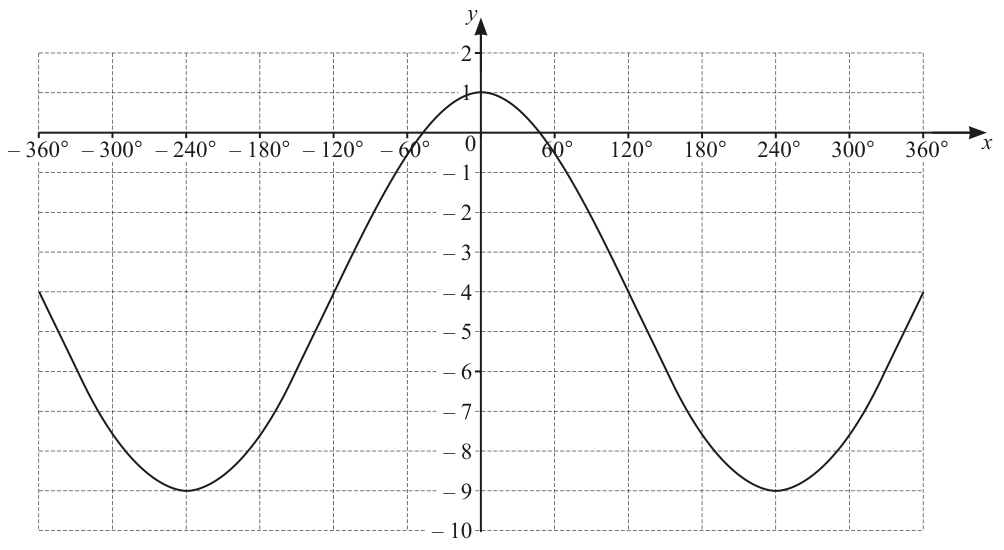
The diagram shows the graph of , for , where , and are constants. Find the values of , and .
Approach
For , the amplitude is , the midline is , and the period is . Read each feature off the graph.
Working
Maximum value is at ; minimum value is .
Amplitude:
Midline:
The curve completes one full cycle between the minima at and , so the period is :
Answer
a = 5, b = 3/4, c = -4
Walkthrough
A cosine curve of the form oscillates about the horizontal line with height above and below that line. The graph reaches a highest point of and a lowest point of , so the middle of the oscillation sits halfway between them: , and the distance from the middle to either extreme is . Since the maximum occurs at with a positive peak (not inverted), itself is positive. Finally, consecutive minima occur at and , so one whole cycle spans . Since the standard cosine has period , the factor compresses or stretches the period to , giving .
Key Takeaways
- For : amplitude , midline , period .
- The sign of tells you whether the curve starts at a maximum () or minimum () at .
- Period can be measured between any two corresponding points one full cycle apart, such as successive minima.
Common Mistakes
- Taking as the maximum value () instead of half the difference between maximum and minimum.
- Taking as the minimum instead of the midline.
- Measuring the period incorrectly — e.g. reading as the period when it is only the distance from the origin to a minimum (half of three-quarters of a cycle).
- Forgetting that divides into : writing instead of .
Things to Be Careful About
- Each of , , carries its own B1 mark — state all three clearly.
- The mark scheme allows any equivalent form for (oe), e.g. .
- Check consistency: substituting back, , matching the printed minimum.
Approach
Since , the curve lies between fixed bounds. A horizontal line can be tangent to the curve only where it touches a maximum or minimum.
Working
The sine term satisfies
so
and therefore
The maximum value occurs when , and the minimum value occurs when . At these points the tangent to the curve is horizontal, i.e. the line with or .
Answer
p = 1 or p = 5
Walkthrough
The expression takes every value between and . The sine wave turns around smoothly at these extremes, so the gradient there is zero — meaning the tangent line is horizontal, of the form . No other horizontal line can touch the curve, because everywhere else the curve is strictly climbing or falling through intermediate values. Hence the two possible tangents are and .
Key Takeaways
- For , the range runs from to .
- Horizontal tangents to a sine or cosine curve occur exactly at its maximum and minimum points.
Common Mistakes
- Giving an inequality such as — the mark scheme explicitly does not allow this; only the two boundary values are tangents.
- Sign slips: forgetting that subtracting makes the maximum occur when sine equals .
- Reporting only one of the two values.
Things to Be Careful About
- Both values earn separate B1 marks — give both.
- Write equalities (, ), not inequalities, as inequalities score zero per the mark scheme.
Find
giving your answer in exact form.
Approach
Integrate each term separately: the reciprocal of a linear function integrates to a logarithm, and the squared reciprocal integrates to a negative power. Then apply the limits and and simplify to the exact form.
Working
So
At :
At :
Subtracting:
Answer
ln 5 - 6/7
Walkthrough
The integral splits into two standard pieces. The first term, , is a constant over a linear function: its integral is , because the coefficient on top exactly matches the derivative of the inside, , so no adjustment factor is needed. The second term, , is a negative power: write it as and integrate using the rule that , giving .
Applying the limits: at , ; at , . The difference is , which is exact as required.
Key Takeaways
- when the numerator matches the derivative of the denominator.
- — divide by the coefficient of when integrating a function of a linear expression.
- Definite integrals are evaluated with the square-bracket form: substitute the upper limit, subtract the lower limit.
- , so the lower-limit logarithm vanishes here.
Common Mistakes
- Writing without checking the numerator matches the derivative — here it does, but a wrong coefficient (e.g. ) loses the B1.
- Sign or coefficient slips in the second term: the integral of is , not or .
- Forgetting to subtract the lower-limit value, or evaluating as instead of .
- Giving a decimal answer: the question demands exact form, cao.
Things to Be Careful About
- The answer must be the exact form (cao) — a decimal approximation scores nothing.
- The mark scheme allows unsimplified intermediate forms, so earns the method mark, but the final line must be fully simplified.
- Keep the antiderivative in the form before substituting limits so the method mark is visible.
Given that and , find in terms of .
Approach
Use the identity together with , then substitute and .
Working
From :
Using and :
Since , we have :
Taking reciprocals:
Answer
y = 1 / ((3x - 2)^2 + 1)
Walkthrough
The question gives two pieces of information involving the same angle: and . The goal is to eliminate entirely and produce an equation linking only and .
The key tool is the Pythagorean identity , because it connects (which we can write in terms of ) directly to , which is just the reciprocal of — and is given in terms of . This is why this identity is the right one here rather than, say, : it links exactly the two quantities we know about.
First rearrange the first equation to isolate . Squaring gives , so the identity yields . Since , squaring gives , and because we get . So , and inverting both sides gives the final answer. Note that writing (squaring before isolating ) loses the cross term and scores nothing unless recovered — always isolate first.
An alternative route uses to get , then , leading to the same result after solving .
Key Takeaways
- The identity is the bridge between cotangent and cosecant; combined with it converts a statement about into one about .
- Eliminating a shared parameter () from two equations is a recurring technique in Additional Mathematics.
- Isolate the trig function before squaring or applying identities — squaring a sum like directly destroys information.
Common Mistakes
- Squaring as : the mark scheme explicitly awards B0 M0 A0 for this unless recovered, since the cross term is lost.
- Forgetting to square when converting into .
- Writing instead of .
- Sign slips when rearranging to .
- Leaving the answer as without finishing by expressing in terms of , which is what was asked.
Things to Be Careful About
- The final answer must have as the subject: (equivalent forms are accepted, "oe").
- Keep the exact fractional form — no decimals are involved or wanted here.
- Check the algebra at each step: the identity applies to squares, so both sides must be squared consistently.
Solve the equation
for . Give your answers in terms of .
Approach
Take the square root of both sides to get . Transform the interval for into an interval for the inner angle , find every angle in that interval with sine , then convert back to .
Working
Taking the square root:
Let . Since :
The angles in with are:
(Note also has sine but lies outside the interval, since .)
Solving for each:
All four values lie in .
Answer
alpha = -5pi/12, -pi/4, pi/12, pi/4
Walkthrough
The equation has a squared sine, so the first move is to take the square root. This gives two equations at once: and . Forgetting the negative case is the most common way to lose solutions here.
Next, work out what values the inner angle can actually take. Because runs from to , doubling gives to , and subtracting shifts this to . Doing this interval transformation first tells you exactly how far around the circle to hunt for solutions, so you neither miss any nor include extras.
Within that interval, the angles with sine are and (note is just outside, since ), and the angles with sine are and . That gives four values of in total.
Finally, undo the substitution: . Applying this to each of the four values gives , all of which lie inside the required range, so all four are kept.
Key Takeaways
- Squared trig equations must be split with a square root before solving.
- When the unknown sits inside a function of the angle (here ), transform the given interval for the outer variable into an interval for the inner angle first — this fixes exactly which solutions exist.
- Solve for the inner angle completely, then back-substitute; do not try to solve for directly.
- Always check each candidate against the original range and discard extras (here had to be rejected).
Common Mistakes
- Omitting the when taking the square root, losing the two negative-sine solutions (the mark scheme condones a missing only on the first B1, but the solutions themselves are still needed for the A marks).
- Solving only in the principal range and missing and .
- Failing to transform the interval, then either including (which gives , outside the range) or missing solutions near the lower end.
- Dividing by 2 before adding — the order of operations must be add first, then halve.
- Giving decimal answers instead of exact multiples of , when the question explicitly demands answers in terms of .
Things to Be Careful About
- The question requires answers in terms of — exact fractions of , not decimals.
- All four solutions must be found and no extras included: the scheme awards A3 for four correct solutions with no extras in range, A2 for three, A1 for two.
- Check the boundary values carefully: exceeds and must be rejected, while is legitimately inside the range even though it is easy to miss.
- The mark scheme's first mark (B1) is for stating , so that line must be visible in the working; the M1 requires a correct attempt at one solution with the correct order of operations (add , then divide by 2).
Approach
Use index laws to combine the left-hand side of the first equation into a single power of , then use to obtain a linear equation in and . Substitute this into to get a cubic in one variable.
Working
Combine the powers:
Since and :
Substitute into :
Then:
Answer
x = 4, y = 16
Walkthrough
The first equation multiplies two powers of . The index law lets us add the exponents, giving . Since raised to any nonzero power is never equal to , the exponent must be zero: , so . This converts the exponential equation into a linear relation between and .
Substituting into the second equation gives , so and (the real cube root). Then .
Key Takeaways
- Index laws turn products of exponentials into a single exponential.
- forces — this is the standard way to convert an exponential equation into a linear one.
- A linear relation can be substituted into a nonlinear equation to reduce it to one variable.
Common Mistakes
- Writing : taking both cube roots or sign slips when substituting back. The mark scheme explicitly awards A0 for — since and , only positive values work.
- Forgetting that means the exponent is , not .
- Arithmetic errors combining .
Things to Be Careful About
- Both answers must be given: and , each worth an accuracy mark.
- The cubic has exactly one real root here (); do not invent complex or negative solutions.
- Show the substitution step explicitly — it carries the method mark.
Approach
Use to rewrite the equation as a quadratic in , solve it, discard the negative root, then take natural logs.
Working
Since , let . The equation becomes:
Multiply through by :
Factorise:
Since always, reject . So:
Taking natural logarithms:
Answer
x = 1/2 + (1/2)ln(3/2)
Walkthrough
The equation contains and — exponents that are negatives of each other. Using the reciprocal property , we write . Substituting turns the equation into , which after multiplying by becomes the quadratic .
Factorising gives , so or . But an exponential is always strictly positive, so must be rejected. Taking of both sides of gives , hence .
Key Takeaways
- When an equation involves and , substitute to obtain a quadratic.
- Exponentials are always positive, so any negative root for is extraneous and must be discarded.
- Undoing requires taking of both sides: .
Common Mistakes
- Keeping the negative root and 'solving' it — the mark scheme awards A0 if the negative root is not discounted.
- Sign errors when forming the quadratic, e.g. writing instead of .
- Forgetting to divide by 2 at the end, giving .
- Giving a decimal answer instead of the exact form required.
Things to Be Careful About
- The answer must be exact: , equivalently or — all are accepted.
- Explicitly state why the negative root is rejected (), as this justifies discarding it.
- Show each stage: the reciprocal step (B1), the quadratic formation (M1), solving it (M1), and the final log step (A1).
In this question, all distances are in metres and time, , is in seconds.
A particle is at a fixed point at time .
The velocity, , of is given by for .
Find the exact value of for which the velocity is zero for the first time after leaves .
Approach
The velocity is zero when . Solve for in radians and take the first positive value after .
Working
The first time after leaves () is:
Answer
t = pi/2
Walkthrough
Velocity is zero exactly where the sine factor vanishes. Setting gives , whose solutions are . Dividing by 2 gives . Since the question asks for the first zero after leaves , we discard and take .
Key Takeaways
- Solving means , so solutions come at intervals of .
- Time in this question is measured in radians-based units because the argument of sine is with in seconds — answers must be given as multiples of , not degrees.
Common Mistakes
- Giving (degrees): the mark scheme explicitly awards A0 for — angles here must be in radians.
- Giving : that is the starting instant, not 'after P leaves O'.
Things to Be Careful About
- The answer must be exact: , not a decimal.
- The mark scheme's M1 is implied by seeing or from solving ; show the equation being solved.
Approach
Displacement is the integral of velocity. Integrate with respect to , then use at to find the constant.
Working
Since is at at , so when :
Therefore:
Answer
s = 3/2 - (3/2)cos 2t
Walkthrough
Displacement is found by integrating velocity: . Integrating gives — dividing by the coefficient 2 of inside the sine. The result carries an unknown constant , which we pin down using the condition that the particle starts at : substituting and gives .
Key Takeaways
- .
- An indefinite integral always needs an extra condition (here at ) to determine the constant.
Common Mistakes
- Forgetting the constant of integration entirely, leaving .
- Forgetting to divide by 2 (the inner coefficient), giving .
- Sign error: integrating sine gives minus cosine.
Things to Be Careful About
- The mark scheme requires the final expression for (A1), not just the antiderivative before finding .
- The M1 for the constant depends on actually using their with at — show the substitution.
Approach
From parts (a) and (b): moves forward until (where ), then returns. By symmetry the distance travelled on each leg is equal, so the total distance is twice the displacement gained over .
Working
Using the expression for from part (b):
Evaluate the bracket:
Doubling by symmetry:
Answer
6
Walkthrough
Distance travelled is not the same as displacement when the particle changes direction. Part (a) showed the velocity is zero at — that is the turning point. From part (b), the displacement grows from to metres by , then shrinks back to by (since ). So the particle goes out 3 m and comes back 3 m. Using the symmetry of the motion, the total distance is twice the outward leg: metres.
Key Takeaways
- Total distance requires splitting the motion at every point where and adding the magnitudes of each leg.
- Symmetry of about its zeros lets you double one leg instead of computing both.
- Displacement over would be — very different from the distance .
Common Mistakes
- Computing only the net displacement over , getting instead of .
- Using limits to directly without accounting for the reversal of direction (the scheme condones writing those limits but the symmetry/doubling must be correct).
- Getting limits the wrong way round when evaluating the square bracket.
- Not using the from part (b) — the M1 depends on it unless the candidate restarts properly.
Things to Be Careful About
- The answer must be exactly (metres); no decimals involved.
- The second M1 is dependent on correct substitution of limits at least once AND correct use of symmetry — both must be visible.
- Remember the unit: distances are in metres.
The tangent to the curve at the point where meets the coordinate axes at the points and . The point with coordinates lies on the perpendicular bisector of the line . Find the exact value of .
Approach
Find the point on the curve at , differentiate using the chain rule to get the tangent's gradient, write the tangent equation, read off its intercepts and , then build the perpendicular bisector of and impose on it.
Working
When :
Differentiate by the chain rule:
At :
Tangent at :
Intercepts: setting gives , so and . Setting gives . So and .
Midpoint of :
The tangent has gradient , so the perpendicular bisector has gradient :
The point lies on this line, so substitute :
Answer
a = -15/8
Walkthrough
First we locate the point of tangency: substituting into gives , so the tangent touches the curve at .
Next we need the gradient of the tangent. The curve is a function of a linear expression, so the chain rule applies: differentiate the outer power to get , then multiply by the derivative of the inner function , which is . The factors and cancel, leaving . At this is , since .
With the point and gradient , the tangent is . To find where it cuts the axes, set (giving ) and (giving ). These are the points and .
The perpendicular bisector of passes through the midpoint and is perpendicular to , which is the tangent itself. Since the tangent's gradient is , the perpendicular gradient is the negative reciprocal, . Its equation is .
Finally, the point has equal coordinates, so putting and into this equation gives , hence and .
Key Takeaways
- The chain rule on : outer derivative times inner derivative, with the cancellation.
- Fractional indices are evaluated as root then power: .
- A tangent needs a point and a gradient; intercepts follow by setting and .
- A perpendicular bisector combines the midpoint of the segment with the negative reciprocal gradient.
- A point on a line means substituting the same value for both and .
Common Mistakes
- Forgetting the chain rule factor and writing without multiplying by (the scheme allows for the M1 but the A1 for needs the correct value).
- Mis-evaluating — it is , not or .
- Sign slips when finding the -intercept: gives , not .
- Taking the perpendicular gradient as instead of (the negative reciprocal of ).
- Using the midpoint of the wrong points, or forgetting that the bisector must pass through the midpoint, not through or .
- Giving a decimal only; the question demands the exact value (the scheme accepts as equivalent, but the exact fraction is the required form).
Things to Be Careful About
- The question says "exact value", so keep everything in fractions throughout; do not round intermediate values.
- The mark scheme's later M marks depend on earlier ones (the midpoint mark depends on the tangent equation mark; the substitution of depends on the bisector equation), so each stage must be shown explicitly.
- Check the final equation carefully: requires adding to both sides and to both sides — sign errors here are the most common way to lose the final A1.
- The perpendicular bisector is perpendicular to , and is the tangent line — not the curve — so its gradient comes from , not from the curve at any other point.
Approach
Use the quotient rule on , noting that by the chain rule.
Working
Simplify the numerator and cancel one factor of :
Answer
(1 - 2 ln 3x) / x^3
Walkthrough
We differentiate using the quotient rule, which states that for ,
Here and . By the chain rule, , and . Substituting gives
The numerator simplifies to , and cancelling a factor of top and bottom leaves the required form with integers and .
Key Takeaways
- The derivative of is always for any positive constant , because the chain rule brings down the constant which cancels.
- The quotient rule structure must be memorised exactly; mixing up the order in the numerator is the classic error.
- Answers should be simplified into the requested form so the constants are clearly visible.
Common Mistakes
- Writing the derivative of as without multiplying by 3 — this loses the B1 mark for or .
- Reversing the order in the quotient rule numerator ( instead of ), giving the wrong sign throughout.
- Failing to cancel the common factor of , leaving an unsimplified answer that does not match the required form .
Things to Be Careful About
- The mark scheme awards B1 specifically for seeing or as the log derivative, M1 for a correct quotient or product rule attempt, A1 for all non-log terms correct, and a final A1 for — every step must be shown.
- The final answer must be in the exact form (or equivalent); an unsimplified expression may not earn the last accuracy mark.
Approach
From part (a), . Integrating both sides reverses the differentiation, and rearranging isolates the required integral.
Working
Since , integrating the result of part (a) gives
Splitting the integral and solving for the required one:
Now integrate the power of :
Therefore
Dividing by 2 and adding the constant of integration:
Answer
-1/(4x^2) - ln(3x)/(2x^2) + c
Walkthrough
This part says "Hence", so we must build on part (a). We know from part (a) that differentiating produced . Integration undoes differentiation, so integrating that derivative must give back (plus a constant):
Splitting the right-hand side into two integrals and moving the known quantity across isolates the integral we want:
The remaining integral is a simple power: . Substituting and dividing everything by 2 gives the final answer, remembering the constant of integration .
Key Takeaways
- "Hence" signals that the previous result is the intended tool: integration is the reverse of differentiation, so a hard-looking integral can be read off from a derivative already found.
- Rearranging an equation between integrals is a legitimate technique — treat as an unknown to be solved for.
- Every indefinite integral needs a constant of integration.
Common Mistakes
- Forgetting the constant of integration — the mark scheme explicitly requires it for the final A1.
- Forgetting to divide by 2 when isolating the integral, leaving coefficients twice too large.
- Adding extra terms or misusing their own part (a) result — the scheme allows follow-through on their and but not any extra terms added or subtracted.
- Sign errors when integrating : the power increases to and the coefficient divides by the new power , giving , not .
Things to Be Careful About
- The mark scheme requires the method to run through the part (a) result (reverse differentiation); a completely independent route is not what "Hence" asks for.
- The B1 for is "nfww" — no marks from wrong working — so the integration of must be shown correctly.
- The final answer must include ; the M1 for rearranging/integrating is allowed even if is missing, but the A1 is not.
- Keep exact fractional coefficients; do not convert to decimals.