Additional Mathematics 4037/12 — October/November 2023
Cambridge O-Level · Calculator · worked solutions for every part, with the mark scheme
Topics Trigonometry · Factors of polynomials · Equations, inequalities and graphs · Logarithmic and exponential functions · Calculus · Straight-line graphs · +6 more
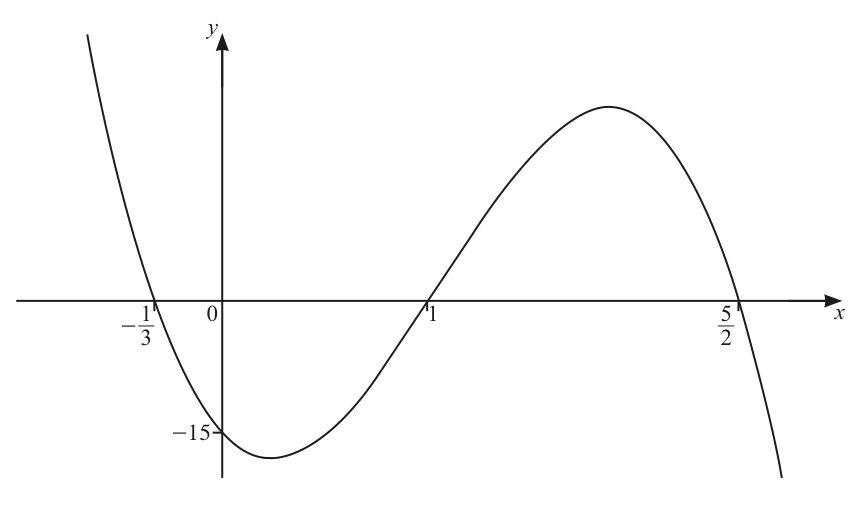
The diagram shows the graph of the cubic polynomial .
Find an expression for in factorised form. Write each linear factor with its coefficients as integers.
Approach
The curve crosses the -axis at , and , so these are the roots of . Write and use the -intercept to find , then clear the fractions so each factor has integer coefficients.
Working
Using the point :
So
Distributing into the fractional factors to make integer coefficients: and , giving
Check at : . ✓
Answer
f(x) = -3(3x+1)(x-1)(2x-5)
Walkthrough
The graph gives us all three places where the cubic equals zero: , and . Each root contributes a factor , so the polynomial must be a constant multiple of . The constant is not yet known because stretching the whole cubic vertically does not move its -intercepts. To pin it down we use the one other piece of information on the graph: the curve passes through . Substituting into the factored form gives , so . Finally the question insists each linear factor has integer coefficients, so we absorb the fractions: multiplying out across the factors as turns into and into , leaving . A quick check at confirms .
Key Takeaways
- A cubic's -intercepts give its linear factors; the leading constant is fixed by any additional point such as the -intercept.
- Fractions inside factors can always be cleared by folding the scale factor into them.
- Always verify with the given point after clearing fractions.
Common Mistakes
- Writing instead of — sign slips when converting a negative root into a factor are the most common error here.
- Forgetting the vertical stretch constant entirely (giving only B1 for ).
- Finding but not evaluating (capped at B2 in the mark scheme).
- Sign errors when distributing into the factors; the final answer must give at .
Things to Be Careful About
- The answer must be fully factorised with integer coefficients in every linear factor — the form scores only partial credit per the scheme.
- Check your final expression reproduces before moving on.
Write down the values of such that .
Approach
wherever the curve is below the -axis. Read those intervals straight off the sketch.
Working
From , the curve is below the -axis between the first two roots and again after the third root:
Strict inequalities are used because at the roots themselves, which is not less than zero.
Answer
-1/3 < x < 1 or x > 5/2
Walkthrough
An inequality like asks: for which is the curve below the horizontal axis? Looking at the sketch, the curve dips below the axis immediately after crossing at , stays below through the minimum near , and comes back above the axis at . That gives the interval . Then the curve rises to its local maximum and falls again, crossing the axis at and staying below thereafter, giving . Both pieces together form the complete answer. Strict inequality signs are correct because at the roots the function equals exactly zero, which does not satisfy "less than zero".
Key Takeaways
- Solving graphically means identifying the intervals where the curve sits below the -axis.
- Roots are excluded when the inequality is strict ( or ).
Common Mistakes
- Using instead of at the endpoints — the function is zero there, not negative.
- Including the middle interval , where the curve is actually above the axis.
- Giving answers in terms of or describing points rather than writing intervals in terms of — the mark scheme explicitly requires the answer in terms of .
- Missing the second interval beyond entirely.
Things to Be Careful About
- Both intervals must be stated; each carries its own B1 mark.
- Write the answer using strict inequalities in terms of , matching the scheme exactly.
The rest of this paper
11 more questions- Q2Trigonometry5M
- Q3Logarithmic and exponential functions · Straight-line graphs5M
- Q4Series7M
- Q5Trigonometry5M
- Q6Factors of polynomials · Calculus · Quadratic functions10M
- Q7Permutations and combinations8M
- Q8Functions · Logarithmic and exponential functions9M
- Q9Equations, inequalities and graphs4M
- Q10Circular measure · Trigonometry7M
- Q11Vectors in two dimensions9M
- Q12Calculus6M