Additional Mathematics 4037/12 — October/November 2019
Cambridge O-Level · Calculator · worked solutions for every part, with the mark scheme
Topics Calculus · Logarithmic and exponential functions · Trigonometry · Straight-line graphs · Series · Equations, inequalities and graphs · +5 more
On the axes below, sketch the graph of for .
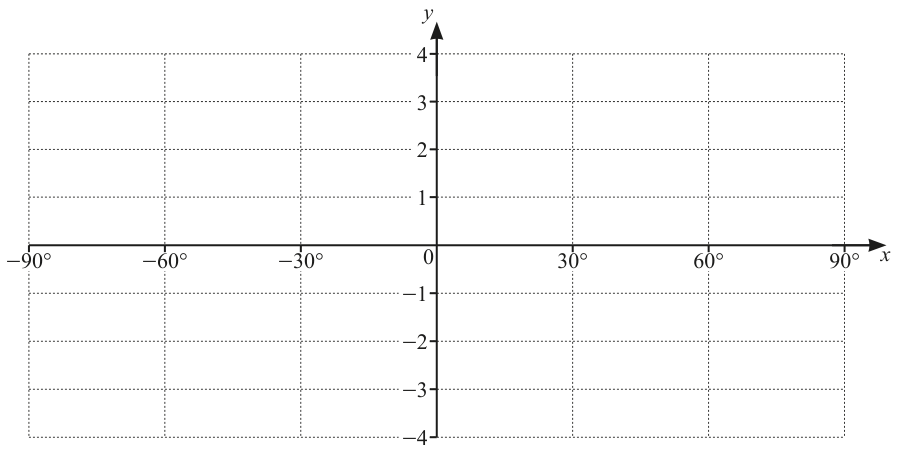
Approach
The graph of is the cosine wave stretched vertically by a factor of (so it oscillates between and ), compressed horizontally by a factor of , and translated unit down. Evaluate at key angles across and sketch the smooth curve through them.
Working
At : (maximum).
At : .
At : (minima).
At : (end points).
Plot these points and join them with a smooth symmetric curve: rising from to the maximum , falling through to the minimum , and rising again to , with the mirror image on the negative side.
Answer
A smooth symmetric cosine-shaped curve with maximum , passing through , minima at , and ending at .
Cosine-shaped curve on -90 to 90 degrees with maximum (0, 1), passing through (+/-30, -1), minima at (+/-60, -3), and endpoints (+/-90, -1)
Walkthrough
The function is built from the basic cosine wave by three transformations. The factor in front stretches the wave vertically, so instead of running from to it runs from to . The at the end slides the whole wave down one unit, so the wave now oscillates between and about the midline . The factor inside compresses the wave horizontally, so one full cycle takes instead of — the interval to contains one and a half cycles.
To place the curve accurately, evaluate at the grid angles:
Since cosine is even, the curve is symmetric about the -axis. Join the points smoothly: the curve starts at , rises to its peak , falls through to the trough , and rises back to .
Key Takeaways
- For : the amplitude is , the period is , and the midline is .
- A horizontal compression by means more cycles fit in the same interval.
- Evaluating at equally spaced key angles (multiples of a quarter period) gives reliable anchor points for a sketch.
Common Mistakes
- Forgetting the vertical translation and sketching the wave oscillating between and instead of and .
- Ignoring the factor of and drawing a wave with period , which would not reach the minima at .
- Drawing straight line segments between points instead of a smooth curve — the mark scheme requires "attempt at a curve".
- Missing the end points at ; the mark scheme awards a specific mark for starting and finishing there.
- Marking the -intercept incorrectly — it is , not or .
Things to Be Careful About
- The mark scheme pays one mark for the -intercept (with a graph present), one for the correct end points , and one for the whole curve passing through and — all these features must appear.
- The curve must be smooth and symmetric about the -axis; a jagged or asymmetric sketch loses the final mark.
- Work in degrees here, since the axis is marked in degrees.
Write down the amplitude of .
Approach
For the amplitude is , the coefficient of the cosine.
Working
Here , so the wave oscillates units either side of its midline (from to ).
Answer
2
Walkthrough
The amplitude of a cosine (or sine) wave is half the vertical distance between its maximum and minimum — equivalently, the multiplier of the trig function. In the multiplier is , so the wave reaches above and below its midline , i.e. between and . The translation and the inside the cosine do not affect the amplitude.
Key Takeaways
- Amplitude in ; translations and horizontal scaling do not change it.
Common Mistakes
- Giving (the horizontal factor) or (the vertical shift) instead of .
- Giving the range to or half the full height instead of the amplitude .
Things to Be Careful About
- This is a single B1 mark — the answer must be exactly .
Write down the period of .
Approach
For the period is .
Working
Here , so
Answer
120 degrees
Walkthrough
The factor inside the cosine compresses the basic cycle into one third of the space, so the period is . This matches the sketch in part (i): the curve completes one full up-and-down pattern every , so the interval from to contains one and a half cycles.
Key Takeaways
- Period (or in radians) for .
- The amplitude and vertical shift do not affect the period.
Common Mistakes
- Multiplying by instead of dividing, giving .
- Giving the amplitude or the vertical shift instead of the period.
Things to Be Careful About
- The mark scheme accepts or — either exact form scores the B1.
The rest of this paper
10 more questions- Q2Logarithmic and exponential functions · Straight-line graphs5M
- Q3Series6M
- Q4Equations, inequalities and graphs · Quadratic functions7M
- Q5Functions · Calculus7M
- Q6[Legacy] Indices and surds · Logarithmic and exponential functions7M
- Q7Calculus7M
- Q8[Legacy] Matrices9M
- Q9Calculus8M
- Q10Circular measure11M
- Q11Calculus8M