Additional Mathematics 4037/12 — May/June 2017
Cambridge O-Level · Calculator · worked solutions for every part, with the mark scheme
Topics Calculus · Trigonometry · Logarithmic and exponential functions · [Legacy] Set language and notation · Vectors in two dimensions · Series · +4 more
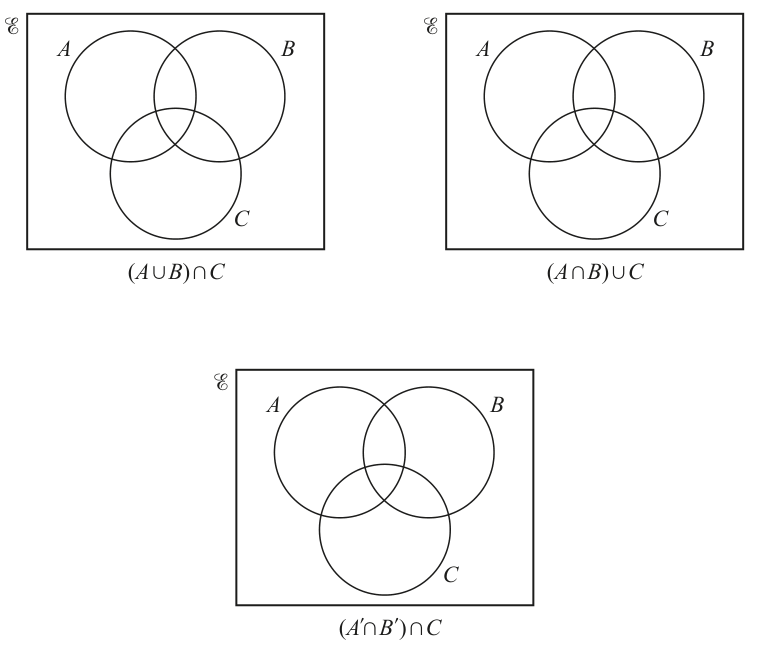
On each of the Venn diagrams below, shade the region which represents the given set.
Approach
Work out each expression from the inside out: first identify the inner set (a union, an intersection, or a pair of complements), then combine it with as the outer operation demands.
Working
First diagram:
is everything in or or both. Intersecting this with keeps only those parts of that also lie in or in : shade the two lens-shaped regions where overlaps , and where overlaps — including the small central region common to all three circles. The part of outside both and stays unshaded.
Second diagram:
is the overlap of just and . Taking the union with shades all of circle together with the whole overlap (including its portion inside , which is already shaded). Only the parts of alone and alone remain unshaded.
Third diagram:
means outside and outside . Intersecting with leaves only the part of lying strictly outside both and : shade the bottom crescent of only.
Answer
Diagram 1: the two overlapping lenses of with and with (and their shared central region) are shaded.
Diagram 2: the whole of circle plus the entire overlap are shaded.
Diagram 3: only the crescent of outside both and is shaded.
Three Venn diagrams: (1) C's overlaps with A and B shaded; (2) all of C plus the A-and-B overlap shaded; (3) only the part of C outside both A and B shaded
Walkthrough
This question tests reading set expressions onto a three-circle Venn diagram. Each diagram earns one mark.
For : build the inner set first. covers every point in either circle. The intersection with then acts like a filter: keep only what lies inside as well. So the shaded area is exactly the portions of circle that touch or touch — two lens shapes meeting at the central triple-overlap. The bottom sliver of , which belongs to neither nor , is excluded.
For : again start inside. is the single lens where and cross. The union with merges that lens with the whole of circle , so effectively everything except the 'only ' and 'only ' crescents is shaded.
For : the complement notation flips things. is outside , is outside , so is the region belonging to neither. Intersecting with traps us inside , leaving just the crescent of that avoids both other circles.
Key Takeaways
- Work compound set expressions from the inside out, exactly like nested brackets in algebra.
- Union = shade everything in either set; intersection = shade only the common part; complement = everything outside.
- On a three-circle diagram there are eight distinct regions; each expression selects a specific combination of them.
Common Mistakes
- Shading all of for instead of only the parts of meeting or — forgetting the intersection filter.
- For , shading only the lens and forgetting to include the whole of .
- Misreading as ' and ' rather than 'outside both and ', which would wrongly shade the triple overlap.
- Including the triple-overlap region when it should be excluded (or vice versa) — check each of the eight regions against the expression before finishing.
Things to Be Careful About
- The mark scheme awards B1 for each correct diagram (B3 total), so each of the three shadings must be complete and exact — a partially correct shading scores zero for that diagram.
- The boundary between shaded and unshaded must follow the circle edges precisely; shading that spills into a neighbouring region loses the mark.
- Remember means the complement (everything outside ), not the set itself.
The rest of this paper
10 more questions- Q2Calculus5M
- Q3Vectors in two dimensions4M
- Q4Series5M
- Q5Calculus · Trigonometry6M
- Q6Trigonometry · Calculus8M
- Q7Logarithmic and exponential functions · Straight-line graphs9M
- Q8Permutations and combinations11M
- Q9[Legacy] Matrices10M
- Q10Circular measure11M
- Q11Calculus · Logarithmic and exponential functions8M