Additional Mathematics 4037/12 — May/June 2013
Cambridge O-Level · Calculator · worked solutions for every part, with the mark scheme
Topics Calculus · Trigonometry · Quadratic functions · Straight-line graphs · [Legacy] Set language and notation · Permutations and combinations · +4 more
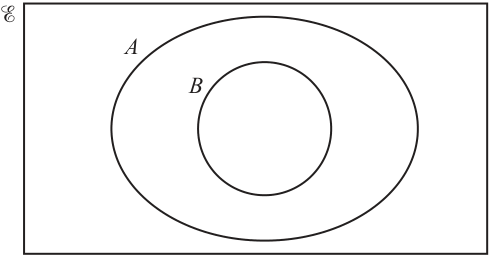
The Venn diagram shows the universal set , the set and the set . Given that , and , find
,
Approach
From the Venn diagram, lies entirely inside , so . Therefore every element of is also in , and .
Working
Answer
5
Walkthrough
The diagram shows the circle for drawn completely inside the oval for , which means is a subset of . The intersection of a set with its own subset is just the subset itself, so . Since , we get .
Key Takeaways
- If , then and .
- Reading the containment relationship from the picture is the whole task here.
Common Mistakes
- Treating and as overlapping sets and trying to compute the intersection from totals.
- Confusing with .
Things to Be Careful About
- The answer is exact (a B1 mark, cao): it must be , not any other value.
- Note the diagram shows strictly inside — there is no region of outside .
,
Approach
The complement contains all elements of the universal set that are not in , so .
Working
Answer
16
Walkthrough
The universal set has elements and of them lie outside (in ). The elements of are therefore the remaining .
Key Takeaways
- for any set .
Common Mistakes
- Subtracting the wrong way round, or using unnecessarily.
Things to Be Careful About
- The value is not needed in this part — do not mix it in.
.
Approach
The region is the part of that lies outside — the crescent between the oval and the inner circle . Its count is .
Working
Answer
11
Walkthrough
Since , the set splits into two disjoint pieces: the part inside (with elements) and the part of outside , which is exactly . So , using from part (ii).
Key Takeaways
- means 'in but not in '; when its count is .
- Parts of a multi-part Venn question build on each other — the value is carried forward.
Common Mistakes
- Using instead of .
- Misreading as the whole of .
Things to Be Careful About
- The answer must be exactly (B1, cao). Keep the intermediate value exact — no rounding issues arise here.
The rest of this paper
11 more questions- Q2Permutations and combinations5M
- Q3Trigonometry3M
- Q4Quadratic functions4M
- Q5Simultaneous equations · Straight-line graphs6M
- Q6Calculus · Straight-line graphs6M
- Q7Factors of polynomials · Quadratic functions8M
- Q8[Legacy] Matrices9M
- Q9Series7M
- Q10Calculus9M
- Q11Trigonometry9M
- Q12Calculus11M