Additional Mathematics 4037/11 — May/June 2013
Cambridge O-Level · Calculator · worked solutions for every part, with the mark scheme
Topics Trigonometry · Logarithmic and exponential functions · Straight-line graphs · Calculus · Permutations and combinations · [Legacy] Matrices · +5 more
On the axes below sketch, for , the graph of
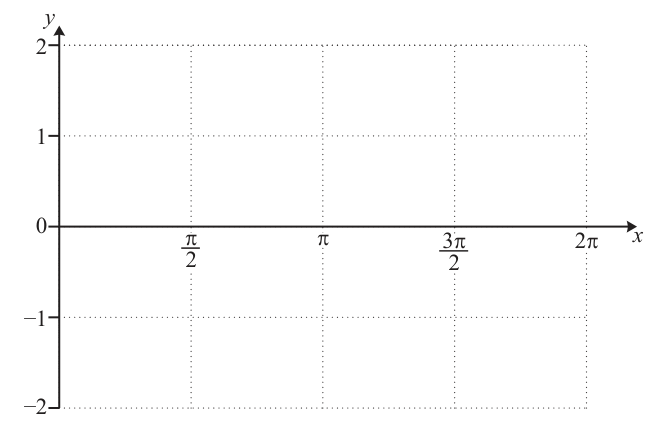
,
Approach
is the ordinary cosine curve shifted down by . Mark the key points and sketch one full cosine pattern across .
Working
Key values:
Zeros where , i.e. at and only. The curve touches the -axis at these points and dips to its minimum at , passing through at and .
Answer
A cosine-shaped curve oscillating between a maximum of (touching the -axis at and ) and a minimum of at , with midline .
Cosine curve shifted down 1 unit: touching the x-axis at x = 0 and x = 2π, minimum -2 at x = π
Walkthrough
The graph of is obtained from the basic cosine wave by subtracting from every output value — a translation of unit downwards. So instead of oscillating between and , it oscillates between and . The curve starts at , falls through at to its minimum at , rises back through at , and returns to at . Because the maximum value is exactly , the curve just touches the -axis at the two ends rather than crossing it.
Key Takeaways
- A vertical shift moves every point of the graph up or down by without changing its shape.
- Key features to mark on any trig sketch: start/end values, maximum, minimum, and where the curve meets the axes.
Common Mistakes
- Drawing the unshifted cosine curve (maximum instead of ).
- Shifting up instead of down — the minus sign means translate down.
- Making the curve cross the -axis; here it only touches it at and .
- Not covering the whole interval .
Things to Be Careful About
The mark scheme gives B1 for the correct shape and B1 for 'all correct' — so both the shape and the key positions (start at , minimum at , return to at ) must be right for full marks. Sketch smoothly; do not join key points with straight lines.
.
Approach
is a sine wave with amplitude but period , so exactly two complete sine waves fit into .
Working
Zeros occur when , i.e.
Maxima () where , i.e. .
Minima () where , i.e. .
Plot these and join with a smooth sine shape repeated twice.
Answer
Two complete sine waves between and : zeros at , maxima at and , minima at and .
Sine wave of period π drawn twice over 0 to 2π: zeros at 0, π/2, π, 3π/2, 2π; maxima 1 at π/4 and 5π/4; minima -1 at 3π/4 and 7π/4
Walkthrough
For , the input to the sine function is , so everything happens twice as fast as for : the period is , while the amplitude stays . Over the interval to there is room for exactly two full waves. To place them accurately, find where hits the special angles: zeros of sine occur at multiples of , giving ; peaks where and , giving and ; troughs where and , giving and .
Key Takeaways
- For the period is — a larger coefficient squeezes the wave horizontally.
- Amplitude is unaffected by the coefficient inside the argument.
- Counting how many periods fit in the given interval tells you how many times the pattern repeats.
Common Mistakes
- Drawing only one wave (forgetting the period halves).
- Doubling the amplitude instead of halving the period.
- Putting the maxima/minima at the wrong quarter-points (e.g. at rather than ).
- Joining key points with straight segments instead of a smooth curve.
Things to Be Careful About
The mark scheme again awards B1 for correct shape and B1 for all correct — the five zeros, two peaks and two troughs must all sit at the correct -values. Keep the amplitude exactly within the printed grid.
State the number of solutions of the equation , for .
Approach
Rearrange into . Solutions are the -values where the part (i) curve meets the part (ii) curve, so count intersection points on the sketches.
Working
From the sketches: the curve lies between and ; the curve oscillates between and . They meet where the descending first half-wave of cuts the falling cosine branch once (between and ), where the rising second half-wave cuts the cosine branch once (between and ), and once more in the interval around where descends through the cosine branch near ... checking each half-wave against the always-negative curve gives exactly three crossings in total.
Answer
3
Walkthrough
The equation can be rewritten by moving the term: . The left-hand side is exactly the curve from part (i) and the right-hand side is exactly the curve from part (ii). So each solution of the equation corresponds to a point where the two sketched graphs intersect. Looking at the two curves on the same axes: the cosine-minus-one curve sits entirely at or below the -axis, dipping to at ; the sine-double-angle curve swings between and twice. Tracing across, the curves cross once on the way down near the start, once near region, and once more past — three intersections altogether, so the equation has solutions.
Key Takeaways
- An equation of the form can be solved graphically by counting intersections of the two graphs.
- Rearranging an equation so each side matches a curve you have already drawn turns algebra into a counting exercise.
Common Mistakes
- Counting intersections with the -axis instead of between the two curves.
- Missing an intersection in the second half of the interval where the sine wave dips negative.
- Trying to solve the equation algebraically when the graphical route is intended ('State the number' signals a count).
Things to Be Careful About
This is a B1 answer-only mark: the count must be exactly . It depends on parts (i) and (ii) being sketched correctly, which is why accurate sketches matter beyond their own 2 marks each.
The rest of this paper
10 more questions- Q2Logarithmic and exponential functions · Straight-line graphs5M
- Q3Permutations and combinations6M
- Q4Logarithmic and exponential functions5M
- Q5Calculus6M
- Q6[Legacy] Matrices7M
- Q7Trigonometry · [Legacy] Indices and surds7M
- Q8Circular measure · Trigonometry9M
- Q9Vectors in two dimensions8M
- Q10Calculus · Factors of polynomials · Simultaneous equations · Straight-line graphs12M
- Q11Trigonometry10M