Additional Mathematics 4037/22 — October/November 2011
Cambridge O-Level · Calculator · worked solutions for every part, with the mark scheme
Topics Trigonometry · Quadratic functions · Calculus · [Legacy] Set language and notation · Factors of polynomials · [Legacy] Matrices · +5 more
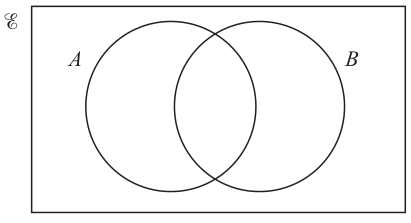
The universal set and the sets and shown in the Venn diagram below are such that
In the Venn diagram below insert the number of elements in the set represented by each of the four regions.
Approach
Work from the given counts inward: is the part of outside , so subtracting it from gives the intersection, then subtracting that from gives the part of alone, and finally the universal-set total gives the region outside both circles.
Working
The region in but not in has elements.
Answer
In the two-circle Venn diagram: only , intersection , only , outside both circles .
A only: 1, intersection: 14, B only: 6, outside both circles: 9
Walkthrough
The four regions of a two-circle Venn diagram are: inside only, inside both (the intersection), inside only, and outside both circles.
First, means exactly 6 elements lie in but not in . Since all of contains 20 elements, the remaining elements of must be in the overlap:
Next, as a whole contains 15 elements, of which 14 are already accounted for in the overlap, so the part of outside holds just element.
Finally, the universal set holds 30 elements in total. Adding the three regions inside the circles gives , so the region outside both circles contains elements.
Key Takeaways
- Each number given about a set pins down one or more regions by subtraction.
- is read directly as "in but not in ".
- The universal-set total lets you find the outside region once every other region is known.
- Always check that the four region values sum to .
Common Mistakes
- Writing 6 in the intersection instead of the " only" region — excludes .
- Putting straight into the " only" region without subtracting the overlap.
- Forgetting to find the outside region at all, so losing the final B1FT mark.
- Mark scheme notes: each value must be correctly positioned — a correct number in the wrong region scores nothing.
Things to Be Careful About
- The last value () is marked B1FT: it follows from your own three earlier values, so an arithmetic slip earlier still earns this mark if your subtraction is consistent.
- Check the sum: confirms the diagram.
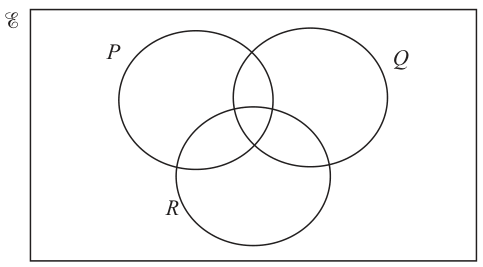
In the Venn diagram below shade the region that represents .
Approach
is everything in or (or both); is everything outside . Intersecting them shades the parts of and that lie outside .
Working
Shade all of circles and except any part lying inside circle : that is, the whole of outside together with the whole of outside , including the overlap where it does not meet .
Answer
The shaded region consists of the portions of and lying outside circle .
The parts of P and Q outside R are shaded (P union Q excluding R)
Walkthrough
Build the expression in two stages. First, covers both upper circles completely, including their overlap. Second, removes everything belonging to , so intersecting with deletes from that union every piece that falls inside the lower circle . What remains — and what should be shaded — is the whole of and the whole of apart from their portions inside .
Key Takeaways
- Union means "or": shade everything in either set.
- Complement means "not": intersecting with erases anything inside .
- Overlap regions between and stay shaded provided they do not touch .
Common Mistakes
- Shading only and forgetting (or vice versa).
- Leaving unshaded the overlap because it looks like a separate region — it belongs to and stays shaded unless it meets .
- Shading inside by misreading the complement.
Things to Be Careful About
- This is a single B1 mark: the entire region must be shaded correctly; partial shading scores zero.
The rest of this paper
10 more questions- Q2Trigonometry5M
- Q3Factors of polynomials6M
- Q4[Legacy] Matrices6M
- Q5Permutations and combinations6M
- Q6Quadratic functions6M
- Q7Circular measure8M
- Q8Calculus · Trigonometry9M
- Q9Quadratic functions · Equations, inequalities and graphs9M
- Q10Calculus · Straight-line graphs10M
- Q11Vectors in two dimensions20M