Mathematics (Syllabus D) 4024/22 — October/November 2025
Cambridge O-Level · Calculator · worked solutions for every part, with the mark scheme
Topics Number · Algebra and Graphs · Mensuration · Statistics · Geometry · Trigonometry · +3 more
Work out
Give your answer correct to 2 decimal places.
______
Approach
Evaluate the expression inside the parentheses first (numerator), then divide by the denominator. Finally, round the result to two decimal places.
Working
First, calculate the difference in the numerator:
Next, divide this result by the denominator :
To perform this division, we can shift the decimal point two places to the right for both numbers to make the divisor an integer:
Now, perform the long division or use the calculator:
Answer
Round to two decimal places. The third decimal digit is , which is greater than or equal to , so we round up the second digit:
16.18
Walkthrough
The problem asks us to evaluate a fraction with decimals. The standard order of operations tells us to handle the numerator first.
Step 1: Subtraction
We subtract from . Aligning the decimal points makes this straightforward:
So the expression simplifies to .
Step 2: Division
We need to divide by . Since both numbers have two decimal places, we can multiply both by to convert them into whole numbers without changing the value of the quotient:
Using a calculator (as permitted by Component 2) or performing long division:
Step 3: Rounding
The question requires the answer correct to two decimal places. We look at the digit in the third decimal place to decide whether to round up or down.
The digits are
The third digit is . Since , we round the previous digit () up to .
Result: .
Key Takeaways
- Always follow the order of operations (BODMAS/PEMDAS): brackets/nested fractions first, then division/multiplication.
- When dividing decimals, shifting the decimal point to make the divisor an integer simplifies the calculation.
- "Correct to 2 decimal places" means keeping exactly two digits after the dot and rounding based on the third digit.
Common Mistakes
- Order of Operations: Subtracting only the integers () and ignoring the decimals initially, or subtracting across the division incorrectly.
- Rounding Errors: Stopping at one decimal place () or three decimal places (). Or failing to round up when the next digit is 5 or more (e.g., writing ).
- Calculator Entry Error: Entering without brackets would give , which is wrong because division takes precedence over subtraction.
Things to Be Careful About
- Exact Form vs Rounded: The mark scheme specifies "cao" (correct answer only) with B1 for seeing or . Ensure you provide the rounded final answer unless asked otherwise.
- Calculator Precision: If using a calculator, ensure you don't accidentally press clear or mistype digits. It is good practice to check if .
These are the scores for 12 students in a quiz.
16 27 20 15 25 21 10 24 35 16 32 22
Approach
To find the median, we must first arrange the scores in ascending order. Since there are 12 values (an even number), the median is the average of the two middle values.
Working
The given scores are:
Arranging them in ascending order:
There are scores. The middle positions are the -th and -th terms.
Position :
Position :
The median is the mean of these two values:
Answer
21.5
Walkthrough
First, list all the numbers provided in the question. Then, sort them from smallest to largest. This ordering is crucial because the median is defined by position, not magnitude.
Count the total number of items. Here, there are 12 scores. Because 12 is an even number, there isn't a single middle score. Instead, the median lies halfway between the two central scores. These are the 6th and 7th scores in the ordered list.
Looking at our sorted list:
- 10
- 15
- 16
- 16
- 20
- 21
- 22
- 24
- 25
- 27
- 32
- 35
The two middle values are 21 and 22. To find the exact middle, add them together and divide by 2: .
Key Takeaways
- Always order your data before finding the median.
- If the count is odd, the median is the -th term.
- If the count is even, the median is the average of the -th and -th terms.
Common Mistakes
- Forgetting to order the data first.
- Picking only one of the middle numbers instead of averaging them.
- Counting from the wrong end or miscounting the position.
Things to Be Careful About
- Ensure you have included every number from the original list in your sorted version. Duplicates (like the two 16s here) must both be counted.
Approach
The range is calculated by subtracting the lowest value in the data set from the highest value.
Working
From the ordered list established in part (a):
Lowest value () =
Highest value () =
Calculate the range:
Answer
25
Walkthrough
The range is a measure of spread that tells us how far apart the extreme values are. To calculate it, identify the largest number and the smallest number in the data set. Subtract the smallest from the largest.
In this data set:
- The largest score is 35.
- The smallest score is 10.
Calculation: .
Key Takeaways
- Range = Highest Value - Lowest Value.
- It indicates the variability of the data.
Common Mistakes
- Adding the values instead of subtracting.
- Using the median or mode instead of the extremes.
- Calculation errors in simple subtraction.
Things to Be Careful About
- Make sure you pick the absolute highest and lowest values. Sometimes students mistake a large digit for the largest number if they haven't fully scanned the list.
Idris has of rice.
He cooks rice for 12 people.
He uses of rice for each person.
Work out how much rice Idris has left over.
Give your answer in grams.
______
Approach
First, convert the initial mass of rice from kilograms to grams so that all units are consistent. Then, calculate the total amount of rice cooked for the 12 people. Finally, subtract the amount cooked from the initial amount to find what is left over.
Working
Convert the initial mass:
Calculate the total rice used for 12 people at each:
Subtract the used amount from the initial amount:
Answer
4100
Walkthrough
The problem asks for the remaining rice in grams. The starting amount is given in kilograms (), while the consumption rate is in grams ( per person). To perform subtraction, both quantities must be in the same unit.
Step 1: Convert kilograms to grams. Since , we multiply the mass in kg by 1000.
Step 2: Calculate how much rice was used. Idris cooks for 12 people, using for each. This requires multiplication.
Step 3: Find the remainder. Subtract the total used from the total available.
Key Takeaways
- Always check units before performing calculations involving addition or subtraction.
- Remember the conversion factor between kilograms and grams: .
- "Left over" implies subtraction from the original total.
Common Mistakes
- Forgetting to convert kilograms to grams before subtracting (e.g., calculating ).
- Incorrectly multiplying . A common error is miscalculating the product.
- Dividing instead of multiplying when finding the total used.
Things to Be Careful About
- Ensure the final answer is in the requested unit (grams). If the question asked for kg, the answer would be .
- Be careful with place value when subtracting large numbers.
In triangle , , and .

Approach
To construct triangle with , , and using only a ruler and compasses, we use the given side and draw arcs from and with radii equal to and respectively. Their intersection locates point .
Working
- The side is already drawn.
- Set the compass to a radius of . Place the compass point on and draw an arc above (or below) the line .
- Set the compass to a radius of . Place the compass point on and draw another arc intersecting the first arc.
- Label the intersection point .
- Use the ruler to draw straight lines and to complete the triangle.
Answer
Triangle constructed with intersecting arcs at .
Triangle ABC constructed with arcs from A (radius 6 cm) and B (radius 7 cm) intersecting at C.
Walkthrough
To construct a triangle when all three side lengths are known (SSS construction), we start with one side and use compass arcs to find the third vertex. The side is already drawn with length . Since , every possible location for must be from , which forms a circle of radius centred at . We draw an arc of this radius. Similarly, since , must be from , forming an arc of radius centred at . The intersection of these two arcs is the unique point that satisfies both conditions. Connecting to and to with a ruler completes the triangle.
Note: The mark scheme awards credit if a candidate accidentally swaps the radii (constructing and ) as long as the arcs are correctly drawn for those swapped lengths, because the construction method is the same and the resulting triangle is congruent (just mirrored).
Key Takeaways
- SSS triangle construction uses two compass arcs from the endpoints of the base side to locate the third vertex.
- The compass radius must be set to the exact length of the side opposite the vertex from which the arc is drawn.
- Intersecting arcs are essential for full construction marks.
Common Mistakes
- Setting the compass to the wrong radius (e.g., using for both arcs).
- Forgetting to draw the arcs entirely, which loses the method mark for the construction.
- Swapping the radii for and (though the mark scheme accepts this with correct arcs for the swapped lengths).
Things to Be Careful About
- Use a sharp pencil for compass arcs so the intersection is precise.
- Ensure the compass width is not altered between setting the radius and drawing the arc.
- The question specifies "ruler and compasses only"; do not use a protractor or set square in part (a).
Approach
Using the triangle constructed in part (a), place a protractor at vertex with its baseline along and read the angle where crosses the protractor scale.
Working
The theoretical value of can be verified using the cosine rule:
A well-constructed triangle will yield a measurement between and .
Answer
54° (accept 53° to 55°)
Walkthrough
Once the triangle is constructed, measuring the angle is a straightforward procedure. Place the centre of the protractor at vertex , align the baseline with the side , and read the value on the protractor scale where the side crosses it. Because this is a physical construction, small errors in arc intersection or protractor placement mean the measured angle may vary slightly from the exact theoretical value. The cosine rule confirms the exact angle is approximately , so any measurement from to is accepted as correct for the constructed figure.
Key Takeaways
- Angle measurement in a constructed figure relies on accurate protractor placement.
- Construction errors naturally lead to a small tolerance in measured angles.
- The cosine rule can be used to verify the expected measured value.
Common Mistakes
- Reading the wrong scale on the protractor (using the inner scale instead of the outer, or vice versa), which would give .
- Not aligning the protractor centre exactly with vertex .
- Forgetting that the answer must be "their" angle from part (a), so a theoretically perfect is not required if the construction was slightly off.
Things to Be Careful About
- Always align the protractor baseline with the side starting from the vertex (here, from ).
- Round the final answer to the nearest degree unless the question specifies otherwise.
- The mark scheme accepts a range (typically ) to account for construction and measurement inaccuracies.
Sofia invests $400 in a savings account.
The account pays simple interest at a rate of 2.8% per year.
Calculate the total amount of interest Sofia receives at the end of 3 years.
$ ______
Approach
Use the simple interest formula where is the principal amount, is the annual interest rate in percent, and is the number of years. The question asks specifically for the total interest received.
Working
Given:
Substitute these values into the formula:
First, multiply the numerator terms:
Now divide by 100:
The total interest received is $33.60.
Answer
33.60
Walkthrough
The problem involves calculating simple interest over a period of 3 years. Simple interest is calculated only on the original principal amount, unlike compound interest which includes previously earned interest.
Step 1: Identify the variables from the text.
The principal investment () is $400. The annual interest rate () is 2.8%. The time period () is 3 years.
Step 2: Apply the simple interest formula.
The standard formula is . This formula calculates the total interest accumulated over years.
Step 3: Perform the calculation.
Substituting the values gives .
It is often easier to simplify before multiplying. Since , the expression becomes .
.
.
The mark scheme awards method marks (M1) for setting up this fraction correctly. It also notes that if a student mistakenly calculates the final total amount (Principal + Interest = ), they may receive partial credit (SC1). However, the question explicitly asks for the "total amount of interest", so 33.60 is the correct final answer.
Key Takeaways
- Distinguish between Interest () and Total Amount (). The formula gives only the interest. To get the total amount, you must add the principal back ().
- Simple interest is linear; the same amount of interest is added each year.
- Always check the units and what is being asked for (interest vs. total balance).
Common Mistakes
- Calculating the total amount () instead of just the interest. This is a common error when students confuse the formula for interest with the formula for compound growth or simply forget to isolate the interest component.
- Forgetting to divide by 100 (calculating ).
- Using compound interest formulas instead of simple interest.
Things to Be Careful About
- The question asks for the "total amount of interest", not the final balance. Ensure you do not add the $400 back to the result.
- Financial answers should ideally be written to two decimal places (e.g., 33.60) although 33.6 is mathematically equivalent. The mark scheme accepts cao (correct answer only), so exact value is key.
- In Component 2 (Calculator), ensure you enter the percentage correctly depending on your calculator's mode, but showing the full fraction setup protects against input errors.
Luis invests $400 in a different savings account that also pays simple interest.
The rate of interest for this account is 0.4% per year more than the rate for Sofia's account.
Calculate how much more interest Luis receives each year than Sofia receives each year.
$ ______
Approach
Luis's account has an interest rate that is 0.4% higher than Sofia's. We need to find the additional interest Luis earns per year compared to Sofia. Since the principal is the same for both, we can calculate the interest directly from the difference in rates.
Working
Difference in rate ():
Principal ():
Time (): 1 year (since we are comparing interest each year).
Calculate the extra interest per year:
Substitute the values:
Simplify:
So, Luis receives $1.60 more each year.
Alternatively, calculate Sofia's yearly interest and Luis's yearly interest separately:
Sofia's yearly interest:
Luis's rate:
Luis's yearly interest:
Difference:
Answer
1.60
Walkthrough
This part asks for the difference in annual interest between two accounts with different rates but the same principal.
Method 1 (Efficient): Calculate the interest generated by the difference in rates alone.
Since both invest the same $400, the extra money Luis gets is simply the interest on that extra 0.4%.
Formula: .
. Then .
Method 2 (Comparison): Calculate each person's yearly interest and subtract.
Sofia: Rate 2.8%. Interest = .
Luis: Rate . Interest = .
Difference: .
Both methods yield $1.60. Method 1 is faster and less prone to arithmetic errors.
Key Takeaways
- When principals are identical, the difference in interest is proportional to the difference in rates.
- "Each year" implies .
- Understanding that adding percentages of rates works linearly for simple interest.
Common Mistakes
- Adding the 0.4% to the dollar amount instead of the rate.
- Confusing simple and compound interest effects (though here, since it's per year, the distinction matters less for the difference, but the base calculation must be simple interest).
- Arithmetic errors with decimals (e.g., calculating as 16 or 0.16).
Things to Be Careful About
- Read carefully: "how much more interest... each year". This confirms we are looking at an annual difference, not a total over multiple years.
- Ensure the rate difference is used correctly (0.4, not 4 or 0.04 in the fraction formula unless adjusted).
The scale of a map is .
The length of a path on the map is .
Work out the actual length of the path.
Give your answer in metres.
______
Approach
The map scale is , which means that on the map represents in reality. To find the actual length in centimetres, multiply the map length by . Then convert the result from centimetres to metres by dividing by .
Working
Given:
- Map scale =
- Map length =
Calculate the actual length in cm:
Convert cm to m ():
Alternatively, combine the steps:
Answer
415
Walkthrough
The problem gives us a map with a specific scale and a measured length on that map. We need to find the real-world distance.
-
Understand the Scale: The scale tells us that every unit of length on the map corresponds to of the same units in real life. Since the map measurement is in centimeters, the real distance will initially be calculated in centimeters.
-
Calculate Real Distance in cm: Multiply the given map length () by the scale factor ().
-
Convert Units: The question asks for the answer in metres. There are centimeters in meter. Therefore, we divide the value in centimeters by .
Key Takeaways
- A scale of means you multiply the map measurement by to get the real measurement in the same units.
- Always check the required units for your final answer. If the calculation gives centimeters but the answer requires meters, remember to divide by .
Common Mistakes
- Forgetting to convert the final answer from cm to m. This would result in an answer of , which is incorrect because the question specifically asks for metres.
- Multiplying by instead of dividing when converting cm to m.
- Misinterpreting the scale, e.g., dividing by instead of multiplying.
Things to Be Careful About
- Ensure you read the units requested in the final line of the question carefully ("Give your answer in metres").
- When calculating , it can be helpful to think of it as or to avoid decimal place errors.
Factorise.
______
Approach
To factorise the expression , we look for the Highest Common Factor (HCF) shared by both terms. This involves finding the largest number that divides both coefficients and the variable(s) that appear in every term.
Working
First, examine the numerical coefficients: and . The largest number that divides into both is .
Next, examine the variable parts: and . Both terms contain at least one . Therefore, is a common variable factor.
Combining these, the overall Highest Common Factor is .
Now, divide each term in the original expression by to find what remains inside the brackets:
Place the HCF outside the bracket and the results of the division inside:
Answer
5x(4x - y)
Walkthrough
Factorising is the reverse process of expanding brackets. To factorise an algebraic expression, we need to find what can be taken "out" of every term.
- Find the common number: Look at and . Since and , the greatest common divisor is .
- Find the common letter: Look at and . Both have an . The first has two (), the second has one (). We can only take out the amount present in every term, so we take just one .
- Combine them: The factor to pull out is .
- Check the remainder: What do we multiply by to get back to the start?
So the remaining part is .
Key Takeaways
- Always check both numbers and letters when looking for a common factor.
- The common factor goes outside the bracket; the result of dividing each term by the common factor goes inside.
- You can verify your answer by expanding the brackets again to see if you get the original expression.
Common Mistakes
- Forgetting to include the variable in the factor (writing instead of ).
- Dividing incorrectly inside the bracket (e.g., writing or ).
- Writing the factors as separate terms like instead of using brackets.
Things to Be Careful About
- Ensure you take out the highest common factor. If you only took out , you would get , which is technically correct but not fully factorised because and still share a factor of .
- Watch the signs. Since the second term was negative, the term inside the bracket must remain negative.
Expand and simplify.
______
Approach
Expand each set of brackets by distributing the multiplier across the terms inside, then combine all like terms (the terms together and the constant terms together) to reach the simplest form.
Working
First, expand the term :
So, .
Next, expand the term :
So, .
Now, write out the full expanded expression:
Group the terms and the constant terms together:
Add them up:
Answer
17x + 13
Walkthrough
The problem asks us to expand and simplify an algebraic expression. The expression consists of two parts added together: and .
First, we deal with the brackets. To expand a bracket, we multiply every term inside the bracket by the number sitting immediately outside it.
- For , we multiply by to get , and by to get . This gives .
- For , we multiply by to get , and by to get . This gives .
Next, we put these expanded parts back into the original expression:
To simplify, we look for "like terms". Like terms are terms that have exactly the same variable part. Here, and are like terms because they both contain the variable . The numbers and are also like terms (they are constants).
We add the terms: .
We add the constants: .
Combining these results gives our final simplified answer: .
Key Takeaways
- Expansion: Always distribute the outside multiplier to every term inside the bracket. A common error is to forget one of the terms (e.g., writing as ).
- Collecting Like Terms: You can only add or subtract terms if they have the exact same variables and powers. You cannot add terms directly to constant numbers.
- Order of Operations: Expansion must happen before adding the terms together.
Common Mistakes
- Incomplete Expansion: Students often forget to multiply the second term in the bracket (e.g., getting instead of ).
- Sign Errors: If there were negative signs, forgetting to carry them through would lead to wrong answers. In this specific question, all signs are positive, so this trap is avoided.
- Adding Constants to Variables: Trying to add and numbers together (e.g., saying ), which is mathematically invalid.
- Arithmetic Errors: Simple addition mistakes when combining or .
Things to Be Careful About
- Ensure you check your work by re-multiplying the factors to see if you get the expanded terms back.
- The mark scheme awards partial credit (M1) if the student correctly expands to but makes a mistake in the final addition, so showing the intermediate step is crucial for securing method marks even if the final arithmetic is wrong.
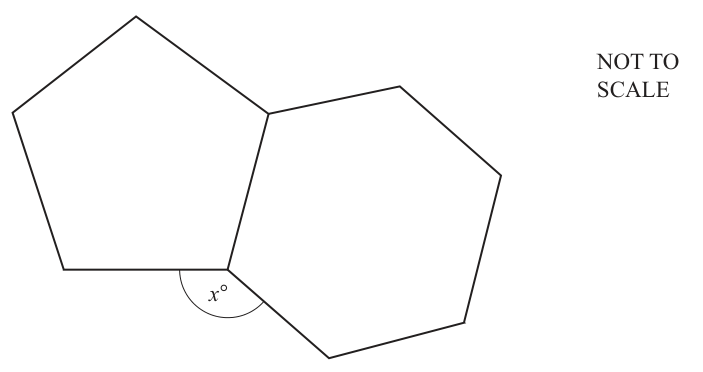
The diagram shows a regular pentagon and a regular hexagon joined along one edge.
Find the value of .
= ______
Approach
Identify the interior angles of the regular pentagon and regular hexagon using the standard formula. Then use the property that angles around a point sum to to find .
Working
The interior angle of a regular pentagon is:
The interior angle of a regular hexagon is:
At the bottom vertex, the interior angles of the pentagon and hexagon, together with , form a full angle around the point. Therefore:
Alternatively, using exterior angles:
Exterior angle of regular pentagon
Exterior angle of regular hexagon
Answer
132
Walkthrough
The problem involves two regular polygons sharing an edge. We need to find the angle at the vertex where they meet. First, we calculate the interior angle of each polygon using the formula , where is the number of sides. For the pentagon (), the interior angle is . For the hexagon (), the interior angle is . At the shared bottom vertex, the two interior angles and meet at a single point. Since the angles around a point sum to , we subtract the two interior angles from to find . This gives .
Alternatively, we can use exterior angles. The exterior angle of a regular polygon is . For the pentagon, this is , and for the hexagon, it is . The angle is exactly the sum of these two exterior angles, giving .
Key Takeaways
- The interior angle of a regular -sided polygon is degrees.
- The exterior angle of a regular -sided polygon is degrees.
- Angles around a single point always sum to .
Common Mistakes
- Using the wrong formula for interior angles (e.g., forgetting to multiply by or dividing by the wrong number).
- Forgetting that angles around a point sum to rather than .
- Calculating only one interior angle and stopping there.
Things to Be Careful About
- Ensure the correct number of sides is used for each polygon (pentagon = 5, hexagon = 6).
- The diagram is not to scale, so do not estimate angles visually; rely entirely on the formulas.
- Final answer is a plain number without units in this context, as represents the numerical value of the angle in degrees.
Approach
To find , first multiply vector by the scalar , then subtract vector from the result component-wise.
Working
Given:
First, calculate :
Next, subtract from this result:
Perform the subtraction for each component:
Top component:
Bottom component:
Thus:
Answer
(-17, 14)
Walkthrough
The question asks for a linear combination of two column vectors. We handle the multiplication before the subtraction. Multiplying a vector by a scalar means multiplying every element inside the vector by that number. So, becomes . Then we subtract the components of from these values. Subtracting a negative number is equivalent to adding its positive counterpart, which is why the bottom calculation becomes .
Key Takeaways
Scalar multiplication distributes over every component of the vector. Vector subtraction is performed component-wise (top minus top, bottom minus bottom).
Common Mistakes
- Forgetting to multiply both components by the scalar 3.
- Sign errors when subtracting a negative number (e.g., calculating instead of ).
- Mixing up the order of vectors in the subtraction.
Things to Be Careful About
Ensure you are careful with signs, especially when dealing with negative coordinates or subtracting negative values.
Approach
First, find the sum of vectors and . Then, calculate the magnitude (length) of the resulting vector using the formula .
Working
Calculate :
Now, find the magnitude :
Evaluate the squares:
Add the numbers inside the square root:
Calculate the numerical value:
Rounding to 3 significant figures (standard for calculator papers unless specified otherwise):
Answer
5.39
Walkthrough
The vertical bars denote the magnitude of a vector. To find it, we first need the resultant vector . Adding vectors involves adding their corresponding horizontal () and vertical () components. Once we have the single vector , we treat its components as the legs of a right-angled triangle. The magnitude is the length of the hypotenuse, found using Pythagoras' theorem: .
Key Takeaways
Vector addition is component-wise. The magnitude of a vector is always . This represents the distance from the origin to the point .
Common Mistakes
- Adding the magnitudes of and directly instead of adding the vectors first.
- Forgetting to take the square root at the end.
- Arithmetic errors in squaring the numbers or adding them under the root.
Things to Be Careful About
Check if the question requires an exact answer (like ) or a decimal approximation. On Calculator paper (Component 2), decimal answers to 3 significant figures are standard unless "exact form" is requested.
A factory makes batteries.
A batch of 2000 batteries are tested and 28 are found to be faulty.
The factory makes 125 000 batteries.
Calculate the number of these 125 000 batteries that are expected to be faulty.
______
Approach
The number of faulty batteries is proportional to the total number of batteries produced. We can find the expected number of faulty batteries in the larger batch by calculating the ratio of faulty to total in the test batch and applying it to the factory's total output.
Working
First, determine the proportion of faulty batteries from the test batch:
Next, apply this proportion to the total production of 125,000 batteries:
We can simplify the calculation. First, divide 125,000 by 2,000:
Then multiply by 28:
Calculation:
Alternatively, using fractions directly:
Answer
1750
Walkthrough
This question asks us to predict an outcome based on a sample rate. The core assumption is that the fault rate remains constant between the small test batch and the large production run.
Step 1: Find the fault rate.
In the test batch, there were 2000 batteries, and 28 were faulty. This gives us a ratio (or fraction) of faulty batteries:
Step 2: Apply the ratio to the new total.
The factory produces 125,000 batteries. To find the expected number of faulty ones, we multiply the total production by the faulty ratio:
Step 3: Calculate the value.
It is often easier to simplify before multiplying. Notice that simplifies nicely:
Now multiply the numerator (28) by this result:
So, out of 125,000 batteries, we expect 1,750 to be faulty.
Key Takeaways
- Proportional Reasoning: When a sample is representative, the ratio of a specific characteristic (like 'faulty') holds true for the entire population.
- Formula: .
- Simplification: Dividing the larger number by the denominator first often makes manual or calculator arithmetic simpler and less prone to error.
Common Mistakes
- Incorrect Operation: Multiplying 28 by 125,000 without dividing by 2,000, or dividing 28 by 125,000.
- Rounding Errors: Rounding the intermediate decimal too early if not handled carefully, although in this case is exact.
- Calculator Input: Entering the sequence incorrectly on a calculator (e.g., forgetting parentheses if doing division last).
Things to Be Careful About
- Ensure you are multiplying the fraction by the total, not just adding them or doing something else.
- The answer must be an integer (you can't have half a battery), so if your calculation results in a non-integer, check your arithmetic. In this case, 1750 is a whole number.
- No units are strictly required for the final box unless specified, but "batteries" is implied.
Approach
Standard form is written as , where and is an integer. For a large number, the decimal point moves to the left until it sits immediately after the first non-zero digit.
Working
The number is . The first non-zero digit is . Place the decimal point after the :
To get back to the original number, we must move the decimal point 8 places to the right. Therefore, .
Answer
3.72 x 10^8
Walkthrough
To write a number in standard form, we look for two things: a coefficient () between 1 and 10, and a power of ten ().
- Identify the first significant digit (in this case, 3).
- Place a decimal point immediately after that digit to create the coefficient . Note that , so this condition is met.
- Count how many places the decimal point has moved from its original position at the end of the integer to its new position. Here, it moved 8 places to the left.
- Since the original number was greater than 1, the exponent is positive. Thus, .
Key Takeaways
- Standard form requires . If your is less than 1 or 10 or greater, adjust the power of 10 accordingly.
- For numbers larger than 1, the exponent is positive.
Common Mistakes
- Writing the wrong number of zeros in the power of 10 (e.g., counting only the digits after the 3 instead of all places moved).
- Writing or , which are not valid standard forms because is not between 1 and 10.
Things to Be Careful About
- Ensure you count the movement of the decimal point correctly. It starts at the end of the integer () and ends after the 3.
Approach
Separate the division into two parts: the coefficients () and the powers of ten (). Calculate each part separately and then combine them, ensuring the final answer is in correct standard form.
Working
Rewrite the expression to group the coefficients and the powers of ten:
First, divide the coefficients:
Next, divide the powers of ten using index laws ():
Combine the results:
This is currently in the form , but is not between 1 and 10. To convert to standard form, move the decimal point one place to the right (multiplying by 10) and decrease the power of ten by 1 (dividing by 10):
Alternatively, calculate the decimal value first:
Then convert to standard form:
Answer
3.4 x 10^-2
Walkthrough
When dividing numbers in standard form, treat the coefficients (the numbers before the ) and the powers of ten independently.
- Divide Coefficients: Calculate . This gives .
- Divide Powers of Ten: Use the rule for dividing indices: subtract the bottom power from the top power. , so we have .
- Combine: Put them together to get .
- Check Standard Form: Is between 1 and 10? No. We need to shift the decimal point. Moving it one place to the right makes it . To keep the value the same, we must multiply by 10, so we divide the power of ten by 10 (subtract 1 from the exponent). . The final answer is .
Key Takeaways
- Always check if your final coefficient satisfies . If not, adjust the exponent.
- Remember that means . Multiplying by shifts the decimal point one place to the left.
Common Mistakes
- Forgetting to adjust the power of ten when fixing the coefficient (leaving it as ).
- Subtracting exponents incorrectly (e.g., calculating instead of ).
- Arithmetic errors in dividing decimals ().
Things to Be Careful About
- The mark scheme accepts as the primary answer. It also awards a mark for the intermediate decimal or for a follow-through error on the coefficient provided the final power of ten is adjusted correctly relative to their own coefficient.
These are the first five terms of a sequence.
3 8 13 18 23
Approach
The sequence increases by the same amount each time, so find the common difference and add it to the fifth term.
Working
Consecutive differences:
The common difference is , so the next term is:
Answer
28
Walkthrough
Look at the gaps between consecutive terms. Each term is more than the previous one, so the sequence is arithmetic. Since the last given term is , add to get .
Key Takeaways
Recognising a constant difference lets you extend an arithmetic sequence. The common difference will also be the coefficient of in the th term.
Common Mistakes
Using the wrong difference, or multiplying instead of adding. The difference here is , not .
Things to Be Careful About
This is an arithmetic sequence, so the difference is constant. Do not confuse the first term, , with the common difference, .
Approach
The sequence is arithmetic, so its th term has the form , where is the common difference. Use the first term to find .
Working
Common difference:
So the th term begins with . When , , but the first term is , so subtract :
Check: gives , gives , gives .
Answer
5n - 2
Walkthrough
Find the common difference between consecutive terms: . A linear sequence has the form . Substitute : , so . Therefore the th term is .
Key Takeaways
The th term of an arithmetic sequence is the common difference multiplied by , plus a constant adjustment found from the first term.
Common Mistakes
Forgetting to adjust the constant and writing , or using the first term as the coefficient. Always check your formula with the first few terms.
Things to Be Careful About
The mark scheme accepts equivalent forms, but the simplest final answer is . Make sure the formula gives every listed term.
is the th term of a different sequence.
These are the first five terms of this sequence.
Find .
= ______
Approach
The terms are fractions, so look at the numerators and denominators separately. The numerators follow the sequence from part (a), and the denominators are consecutive squares. Form a general expression for , then substitute .
Working
Numerators:
Denominators:
Therefore
Substitute :
Answer
123/676
Walkthrough
Write the numerators and denominators in separate rows. The numerators are exactly the sequence from part (a), so they have th term . The denominators are , so for term number the denominator is . This gives . Substitute : numerator , denominator . The fraction is already in simplest form.
Key Takeaways
When a sequence is made of fractions, the numerator and denominator may each follow their own pattern. Use a previous part if it gives one of the patterns.
Common Mistakes
Using instead of for the denominator, or forgetting to subtract from . Also check that the fraction is simplified; and have no common factor.
Things to Be Careful About
The mark scheme gives credit for substituting into the correct numerator expression and for identifying as the denominator, so show both patterns clearly. The answer must be left as the exact fraction , not a rounded decimal.
The lowest common multiple (LCM) of and 360 is 16 200.
Approach
We are given and told that . To find and , we first need to express all numbers (360, 16200, and consequently ) in their prime factorised forms. Then, we use the property of the lowest common multiple: for any prime , the exponent of in the LCM is the maximum of its exponents in the two numbers.
Working
First, we prime factorise 360:
Next, we prime factorise 16200:
We are given . Let's compare the exponents of each prime in , 360, and their LCM.
For the prime base 2:
Exponent in : 1
Exponent in 360: 3
Exponent in LCM: 3
Check: . This matches the LCM (). No new information about unknowns here.
For the prime base 3:
Exponent in :
Exponent in 360: 2
Exponent in LCM: 4
The LCM takes the highest power. So, .
Since 2 is not 4, it must be that .
For the prime base 5:
Exponent in :
Exponent in 360: 1
Exponent in LCM: 2
The LCM takes the highest power. So, .
Since 1 is not 2, it must be that .
Thus, and .
Answer
x = 4, y = 2
Walkthrough
To solve this problem, we need to understand how the Lowest Common Multiple (LCM) is constructed from prime factors. The LCM of two numbers contains every prime factor present in either number, raised to the highest power that appears in either of them.
-
Prime Factorisation: We start by breaking down the known numbers into their prime building blocks.
- For 360: .
- For 16200: It helps to notice . . . So .
-
Comparison: Now we look at alongside .
- Look at the base 3. In 360, the power is . In the LCM, the power is . Since the LCM takes the maximum power, one of the numbers must have . Since 360 only has , must provide the . Therefore, .
- Look at the base 5. In 360, the power is . In the LCM, the power is . Similarly, 360 cannot provide the , so must. Therefore, .
This method avoids guessing and relies on the fundamental definition of LCM.
Key Takeaways
- LCM Rule: The exponent of a prime in an LCM is always the largest exponent found in the original numbers.
- Factorisation Strategy: Always break large numbers down systematically (e.g., splitting into small factors like 10, 100, 4, 9) to avoid errors.
- Unique Identification: By comparing the prime factors, we can uniquely identify the unknown exponents in .
Common Mistakes
- Confusing LCM and HCF: Students might try to take the minimum power (which is for HCF) instead of the maximum.
- Incorrect Factorisation: Miscalculating or leads to wrong powers.
- Ignoring Base 2: Failing to check the base 2 consistency can sometimes reveal if a student has guessed rather than calculated, though here base 2 doesn't help find or directly.
Things to Be Careful About
- Ensure you write the full prime factorisation with correct indices (e.g., not just ).
- Remember that already has a . If the LCM had a lower power of 2 than 360, there would be a contradiction, but here which fits perfectly.
Approach
The Highest Common Factor (HCF) of two numbers is found by taking the product of the common prime bases raised to their lowest exponent found in either number.
From part (a), we know:
Working
Identify the common primes: 2, 3, and 5 are present in both.
- Base 2: Exponents are 1 (in ) and 3 (in 360). The lowest is 1.
- Base 3: Exponents are 4 (in ) and 2 (in 360). The lowest is 2.
- Base 5: Exponents are 2 (in ) and 1 (in 360). The lowest is 1.
Construct the HCF:
Calculate the value:
Answer
90
90
Walkthrough
Having determined that in the previous step, we now calculate the HCF with 360 (). The rule for HCF is to select the common prime factors and raise them to the smallest power they appear with in either number.
- For the prime 2, we compare and . The smaller power is .
- For the prime 3, we compare and . The smaller power is .
- For the prime 5, we compare and . The smaller power is .
Multiplying these together gives .
Key Takeaways
- HCF vs LCM: A handy mnemonic is that HCF is 'High' for the 'Highest' common factor? No, actually, HCF uses the Lowest powers because the factor must divide both. LCM uses the Highest powers because the multiple must be divisible by both.
- Calculation: , so . Using simple grouping makes mental math easier.
Common Mistakes
- Taking the highest power again by mistake.
- Forgetting to include all common bases (e.g. forgetting the 5).
- Arithmetic errors in multiplying the final factors.
Things to Be Careful About
- The question asks for the numerical value, not the prime factorisation form. Make sure to calculate .
is a positive integer.
is a cube number.
Find the smallest possible value of .
= ______
Approach
A number is a perfect cube if and only if the exponent of every prime factor in its prime factorisation is a multiple of 3. We have . We need to find the smallest positive integer such that is a cube number.
Working
Let's examine the exponents of the primes in :
- Prime 2: exponent is 1. The next multiple of 3 is 3. We need to add to the exponent. So we need a factor of .
- Prime 3: exponent is 4. The next multiple of 3 is 6. We need to add to the exponent. So we need a factor of .
- Prime 5: exponent is 2. The next multiple of 3 is 3. We need to add to the exponent. So we need a factor of .
Therefore, the smallest integer must supply these missing factors:
Calculate :
Let's verify: . All exponents (3, 6, 3) are multiples of 3, so it is a perfect cube.
Answer
180
Walkthrough
To make a number a perfect cube, every prime factor must appear with an exponent that is a multiple of 3 (like etc.).
Currently, .
- For the base 2: We have . To get to the nearest multiple of 3 (which is 3), we need another because .
- For the base 3: We have . The next multiple of 3 is 6. We need another because .
- For the base 5: We have . The next multiple of 3 is 3. We need another because .
So, must be . Multiplying these out: .
Key Takeaways
- Cube Condition: A number is a perfect cube iff where are primes and are integers.
- Smallest Multiplier: When asked for the smallest , we simply bump each exponent up to the immediate next multiple of 3. We do not skip to 6, 9, etc., unless necessary.
Common Mistakes
- Thinking must be a cube itself (it doesn't, the product must be).
- Incorrectly identifying the next multiple of 3 (e.g., thinking the next multiple after 4 is 5).
- Calculation errors when multiplying .
Things to Be Careful About
- Ensure you calculate correctly. , and is often easier than , .
The mass of a bag of potatoes is , correct to the nearest .
Write down the upper bound and the lower bound for the mass of a bag of potatoes.
Upper bound = ______
Lower bound = ______
Approach
The mass is given as , correct to the nearest . The degree of accuracy is . To find the upper and lower bounds, we add and subtract half of this unit () from the given value.
Working
Answer
Upper bound = 2.55 kg, Lower bound = 2.45 kg
Walkthrough
The measurement is rounded to the nearest . This means the true value could be anywhere in an interval around . The 'step' size for rounding is . The boundary between what rounds up to and what rounds down to (or up to ) is exactly half of that step.
Half of is .
The upper bound is the highest possible value before it would round up to the next stated value (). So we add to :
The lower bound is the lowest possible value before it would round down to the previous stated value (). So we subtract from :
So any mass such that would round to (assuming standard rounding rules where .05 rounds up, though bounds usually define the inclusive/exclusive limits carefully; in Cambridge O Level, the bounds are simply calculated as ).
Key Takeaways
- Identify the unit of accuracy (e.g., nearest , nearest ).
- Divide that unit by to find the margin of error.
- Add the margin to get the upper bound; subtract it to get the lower bound.
Common Mistakes
- Forgetting to divide the unit of accuracy by (using instead of ).
- Reversing the upper and lower bounds.
- Rounding the final answer incorrectly (bounds should be exact values based on the precision).
Things to Be Careful About
- Ensure you use the correct unit of accuracy. Here it is , not or .
- The mark scheme awards B1 for one correct value OR both correct but reversed. However, it is best practice to label them clearly.
The mass of a box is , correct to the nearest .
Bags of potatoes are packed into the box.
Calculate the upper bound for the total mass of a box containing 12 bags of potatoes.
______
Approach
We need to calculate the upper bound for the total mass of a box containing 12 bags of potatoes. To maximize the total mass, we must use the upper bound for the mass of each individual bag and the upper bound for the mass of the empty box.
From part (a), the upper bound for one bag is .
The box mass is , correct to the nearest . Its upper bound is .
Working
Answer
38.65 kg
Walkthrough
To find the upper bound of a combined mass, we assume every component contributing to that mass is at its heaviest possible value within its tolerance.
- Identify the components: There are 12 identical bags of potatoes and 1 box.
- Find the upper bound for a bag: From part (a), the upper bound for one bag is .
- Find the upper bound for the box: The box is to the nearest . Half of is . Upper bound = .
- Calculate total mass: Multiply the number of bags by the upper bound of one bag, then add the upper bound of the box.
Key Takeaways
- When finding the upper bound of a sum or product involving measured quantities, always use the upper bound for each quantity.
- Don't forget to include the mass of the container if it's part of the total.
Common Mistakes
- Using the lower bound for the bags (which would give the minimum total mass).
- Forgetting to add the mass of the box.
- Arithmetic errors in multiplication or addition.
- Not recognizing that the box itself has an uncertainty (upper bound ).
Things to Be Careful About
- The question asks specifically for the upper bound. If it asked for the lower bound, we would use for the bags and for the box.
- The mark scheme accepts 'cao' (correct answer only) for B1 if the calculation is clear, or M1 for the method . Ensure your working shows these substituted values.
The population of a town decreases exponentially at a rate of % per year.
The population of the town on 1 January 2020 was 120 000.
The population of the town on 1 January 2023 was 102 885.
Approach
We use the compound interest (exponential growth/decay) formula , where:
- is the initial population.
- is the final population after years.
- is the multiplier per year ( for decay).
- is the number of years elapsed.
First, determine the number of years between 1 January 2020 and 1 January 2023. Then substitute the known values into the formula and solve for .
Working
The time period is:
Let the decay rate be % per year. The multiplier each year is:
Substitute , , and into the formula:
Divide both sides by :
Calculate the fraction on the left side:
So:
Take the cube root of both sides to isolate the term with :
Using a calculator:
Rearrange to solve for :
Multiply by 100 to find :
Answer
5
Walkthrough
The problem describes a quantity decreasing by a fixed percentage each year. This is modeled by the formula .
- Identify the variables: We start with a population of 120,000 in 2020. Three years later (in 2023), it is 102,885. So , , and .
- Set up the equation: The annual multiplier is . After 3 years, this multiplier is cubed. Thus, .
- Isolate the power: Divide the final amount by the initial amount. . This represents the total factor of decay over the 3 years.
- Undo the power: Since the multiplier was cubed, we take the cube root of to find the single-year multiplier. .
- Find the percentage: A multiplier of means the population retains of its previous value, so it decreased by . Therefore, .
Key Takeaways
- Exponential change uses the formula . For decay, .
- To find the rate from the total change over years, you must divide by first, then take the -th root.
- Always check if the question asks for the rate () or the multiplier (). Here it asks for .
Common Mistakes
- Forgetting to take the cube root. Students might stop at or assume the rate is simply the difference divided by the years.
- Confusing the multiplier with the rate. If the multiplier is , the rate is not , but (or ).
- Calculation errors when dividing large numbers like by .
Things to Be Careful About
- Ensure the time period is calculated correctly as the difference between the years ().
- The mark scheme accepts the expression for method marks, so showing this step clearly is important.
After 1 January 2023 the population of the town starts to increase exponentially at a rate of 1.6% per year.
Find the year in which the population on 1 January first becomes more than 120 000.
______
Approach
Now the population starts increasing from the 2023 level () at a rate of per year. We need to find how many years () it takes for the population to exceed .
We can use the formula and solve for , or simply calculate the population year-by-year until it exceeds . Given the small number of years expected, iteration is safe, but algebraic solution is more robust.
Working
New parameters:
- Initial population (on 1 Jan 2023)
- Growth rate = per year
- Target population
- Multiplier
Formula:
Divide by :
Calculate the ratio:
We can test integer values for or use logarithms. Let's test values near where the population might cross the threshold.
Try :
This is less than .
Try :
This is greater than .
So, it takes years after 1 January 2023 for the population to exceed .
The date will be:
Answer
2033
Walkthrough
- Reset the baseline: The growth now starts from the 2023 population, which is . It does NOT start from the original 120,000 or the 2020 value.
- Determine the multiplier: An increase of means the multiplier is .
- Set up the inequality: We want to find the smallest integer such that .
- Solve for :
- Algebraically: . Taking logs: . Since must be a whole number of years, .
- Iteratively: Calculate year by year. Year 9 gives approx 118,603 (still under). Year 10 gives approx 120,499 (over).
- Calculate the final year: Add the number of years () to the start year of this phase (). .
Key Takeaways
- When a problem has multiple phases (decay then growth), the end value of the first phase becomes the start value of the second.
- "More than" implies a strict inequality (). If the value equals 120,000 exactly, it hasn't become more than yet, though in continuous yearly steps this edge case rarely hits exactly.
- Always add the duration to the correct base year. Here, the clock starts ticking from Jan 2023, not Jan 2020.
Common Mistakes
- Using the wrong starting population (e.g., using 120,000 again or 0).
- Adding 10 years to 2020 instead of 2023, resulting in 2030.
- Rounding errors during intermediate steps. It is better to keep the full calculator precision for until the final comparison.
- Thinking the answer is 9 years because rounds to 10? No, you must round UP to the next whole year because at year 9 it hasn't reached the target yet.
Things to Be Careful About
- The question asks for the year on 1 January. So if it happens during the 10th year, specifically on the anniversary, the label is simply .
- Check the accuracy requirements. The mark scheme notes 'nfww' (no further work required) for 2033. Showing the calculation for and provides clear evidence.
Sketch the graph of each function.
Show the value where each graph intersects the -axis.
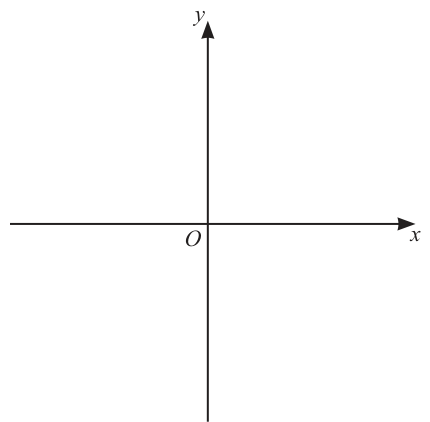
Approach
To sketch , first find the y-intercept by substituting . Then, recognize that this is the standard cubic curve shifted downwards by 3 units. The curve is strictly increasing with an inflection point at the y-intercept.
Working
Find the y-intercept by setting :
The graph intersects the y-axis at . This is also the point of inflection. As , . As , . The curve crosses the x-axis when , i.e., .
Answer
A sketch of the cubic curve crossing the y-axis at .
Sketch with y-intercept at (0, -3)
Walkthrough
First, determine where the graph crosses the y-axis. This happens when . Substituting into the equation gives . So the y-intercept is at .
Next, consider the shape of the graph. The base function is a cubic curve that passes through the origin, is increasing everywhere, and has a point of inflection at . The equation represents this same shape shifted vertically downwards by 3 units. Therefore, the point of inflection moves to .
The curve comes from the bottom left (third quadrant), passes through the inflection point , crosses the positive x-axis at , and continues upwards into the first quadrant.
Key Takeaways
- The y-intercept of any function is found by setting .
- The graph of is a cubic curve shifted vertically by units, retaining the inflection point at .
- Sketches must show the correct general shape (increasing cubic) and the correct intercept.
Common Mistakes
- Forgetting to shift the graph down and drawing instead, which crosses at the origin.
- Drawing a cubic with local maximum and minimum points (like ); is strictly increasing and has no turning points.
- Not indicating the y-intercept value clearly on the sketch.
Things to Be Careful About
- The question asks for a sketch, not a precise plot, but the shape and intercept must be correct.
- The y-intercept is , not .
- Ensure the axes are labelled and the intercept is clearly marked.
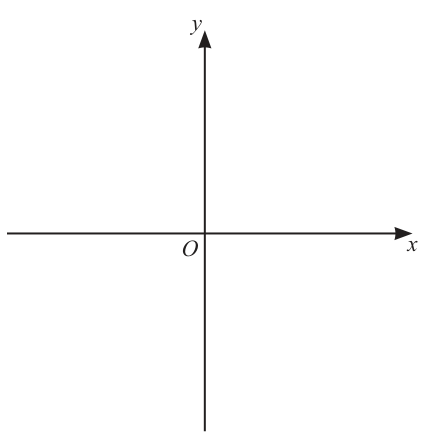
Approach
To sketch , find the y-intercept by substituting . Recognize that this is an exponential growth function with a horizontal asymptote at the x-axis ().
Working
Find the y-intercept by setting :
The graph intersects the y-axis at . As increases, increases rapidly. As , (the x-axis is a horizontal asymptote). The curve is always positive ().
Answer
A sketch of the exponential curve crossing the y-axis at .
Sketch with y-intercept at (0, 1)
Walkthrough
First, find the y-intercept by setting . Any non-zero number to the power of 0 is 1, so . The graph crosses the y-axis at .
Next, consider the shape. The function is an exponential growth function because the base . Key features:
- It passes through .
- It passes through and .
- As becomes large positive, grows very rapidly.
- As becomes large negative, gets closer and closer to 0 but never touches or crosses the x-axis. Thus, the x-axis () is a horizontal asymptote.
- The entire graph lies above the x-axis ().
Key Takeaways
- For exponential functions (), the y-intercept is always .
- Exponential growth curves have a horizontal asymptote at (the x-axis).
- Sketches should show the curve approaching the asymptote on the left and rising steeply on the right.
Common Mistakes
- Drawing the curve crossing the x-axis or going below it (exponential functions are always positive).
- Not showing the horizontal asymptote behaviour (curve should flatten out near the x-axis on the left side).
- Incorrectly calculating the y-intercept as 0 or 3.
Things to Be Careful About
- The y-intercept is 1, not 0.
- The curve never touches the x-axis; it only approaches it.
- Ensure the sketch shows rapid growth for positive and flattening for negative .
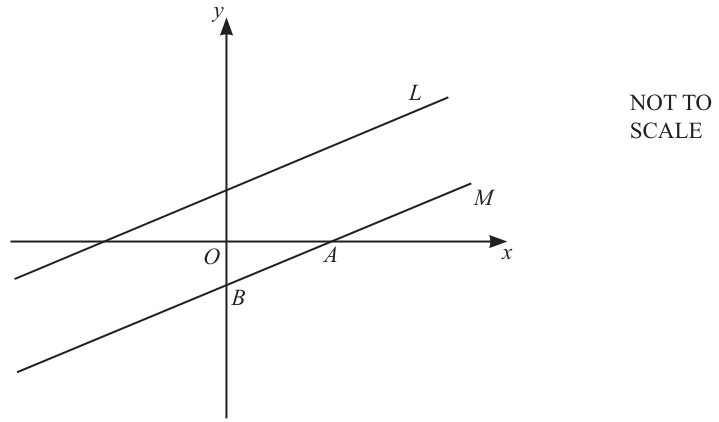
The equation of line is .
Approach
The equation of line is given in the form , where is the gradient.
Working
Comparing with , the gradient is .
Answer
1/5
Walkthrough
The equation of a straight line is often written as , where represents the gradient (or slope) and is the y-intercept. The given equation is , which can be rewritten as . By direct comparison, the gradient is .
Key Takeaways
- The gradient of a line in the form is the coefficient of .
- Parallel lines have the same gradient.
Common Mistakes
- Forgetting to rewrite as and missing the gradient.
- Giving the y-intercept () instead of the gradient.
Things to Be Careful About
- The question asks to "write down", so no working is required, but the form must be correct.
- The mark scheme accepts or any equivalent form (oe), such as .
Line is parallel to line .
Line crosses the -axis at point and the -axis at point .
The coordinates of point are .
Approach
Since line is parallel to line , it has the same gradient. Use the gradient and the coordinates of point to find the equation of line , then find the y-intercept (point ).
Working
The gradient of line is the same as line :
Line passes through . Using the point-slope form :
Point is where line crosses the y-axis, so set :
Thus, the coordinates of point are .
Answer
Coordinates of are as required.
(0, -3)
Walkthrough
Parallel lines have identical gradients. Since line has gradient , line also has gradient . We are given that line passes through . We can form the equation of line using the point-slope formula . Substituting , , and gives . Point is the y-intercept, found by setting , which yields . This confirms the coordinates are .
Key Takeaways
- Parallel lines share the same gradient .
- The point-slope form is useful for finding a line's equation when you know a point and the gradient.
- The y-intercept occurs where .
Common Mistakes
- Using the wrong gradient for line .
- Making algebraic errors when expanding , leading to an incorrect y-intercept.
- Forgetting that the y-intercept has an x-coordinate of .
Things to Be Careful About
- The mark scheme requires showing working (www) to earn the method marks (M1, M1) and the final answer mark (A1).
- Ensure the final coordinates are written as an ordered pair .
Line is the perpendicular bisector of the line joining point and point .
Line crosses the -axis at point .
Find the coordinates of point .
( ______ , ______ )
Approach
Line is the perpendicular bisector of . Find the midpoint of and the gradient of . The gradient of is the negative reciprocal of . Use the midpoint and gradient of to find its equation, then find where it crosses the x-axis (point ).
Working
Step 1: Find the midpoint of
and .
Step 2: Find the gradient of line
Line is line , which has gradient . The gradient of the perpendicular bisector is the negative reciprocal:
Step 3: Find the equation of line
Using the midpoint and gradient :
Step 4: Find the coordinates of point
Point is where line crosses the x-axis, so set :
Thus, the coordinates of point are .
Answer
(7.2, 0)
Walkthrough
The perpendicular bisector of a line segment passes through its midpoint and is perpendicular to it. First, calculate the midpoint of using the average of the x-coordinates and the average of the y-coordinates: . Next, determine the gradient of the perpendicular bisector. Since has gradient , the perpendicular gradient is (negative reciprocal). Now, form the equation of the perpendicular bisector using the midpoint and gradient : , which simplifies to . Finally, find point by setting (x-intercept): . The coordinates are .
Key Takeaways
- The midpoint formula is .
- Perpendicular lines have gradients that are negative reciprocals: .
- The x-intercept is found by setting in the line equation.
Common Mistakes
- Calculating the midpoint incorrectly (e.g., forgetting to divide by 2, or mixing up x and y coordinates).
- Using the wrong perpendicular gradient (e.g., instead of , or instead of ).
- Algebraic errors when expanding , leading to an incorrect constant term in the equation.
- Setting instead of when finding the x-intercept.
Things to Be Careful About
- The mark scheme awards marks for the correct equation of line (B4 for ) or for the midpoint and subsequent steps (B1, M1, M1, M1dep).
- Ensure all intermediate steps are shown clearly to earn method marks.
- The final answer must be an ordered pair .
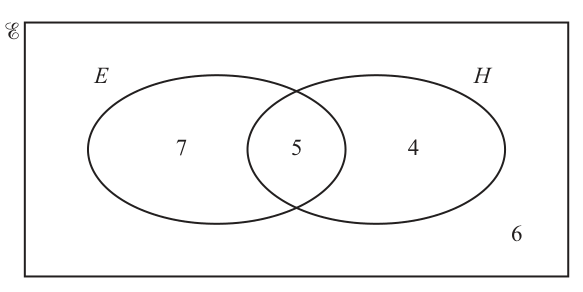
A group of 22 students are asked if they study Economics () or History ().
The Venn diagram shows the results.
Approach
Identify the region in the Venn diagram that represents students studying both Economics and History, which is the intersection of the two circles.
Working
The intersection is the overlapping region of circles and . Reading directly from the diagram:
Answer
5
Walkthrough
The question asks for the number of students who study both Economics and History. In set notation, this is the intersection . On a Venn diagram, the intersection is the region where the two circles overlap. Reading directly from the diagram, the number in this overlapping region is 5.
Key Takeaways
The intersection of two sets in a Venn diagram represents elements that belong to both sets. This value is read directly from the overlapping region.
Common Mistakes
Reading the value from the wrong region, such as the total for one circle or the number outside both circles.
Things to Be Careful About
Ensure you are reading the intersection region, not the "E only" or "H only" regions. The question asks for "both", which strictly means the overlap.
Approach
Interpret the set notation and locate the corresponding region on the Venn diagram.
Working
represents the set of students who study Economics () but not History (). This corresponds to the region inside circle but outside circle ("E only"). Reading from the diagram:
Answer
7
Walkthrough
The notation asks for the number of elements in set but not in set . The prime symbol () denotes the complement, so means "not History". The intersection therefore means "Economics and not History", which is the region inside circle but outside circle . From the diagram, this region contains 7 students.
Key Takeaways
The complement of a set contains all elements not in . The intersection isolates the part of that does not overlap with .
Common Mistakes
Confusing with , which would give the total number of History students instead of those studying only Economics.
Things to Be Careful About
Remember that the prime symbol () means complement (not in the set). is not the same as (the intersection) or (the union).
Three of the students from the group are selected at random.
Find the probability that they all study History.
______
Approach
Find the total number of students studying History, then use the probability of dependent events (selection without replacement) to find the probability that all three randomly selected students study History.
Working
Total number of students = 22.
Number of students studying History, :
Since three students are selected at random, this is without replacement. The probabilities for each selection are:
- Probability the first student studies History:
- Probability the second student studies History:
- Probability the third student studies History:
The probability that all three study History is:
Simplify by cancelling common factors before multiplying:
Answer
3/55
Walkthrough
First, find the total number of students studying History by adding the "H only" region and the intersection: . Since three students are selected at random from the group of 22, the selections are dependent (without replacement). The probability the first student studies History is . After one History student is removed, 8 History students remain out of 21 total, giving . After another, 7 remain out of 20, giving . Multiply these probabilities together: . Simplifying by cancelling common factors (9 and 21 share a factor of 3; 8 and 20 share a factor of 4; 7 and 21 share a factor of 7) yields .
Key Takeaways
When selecting items without replacement, the total number of items and the number of favourable items decrease by 1 after each selection. Multiply the individual probabilities to find the combined probability.
Common Mistakes
Using the same denominator for all three fractions (e.g., ), which assumes selection with replacement. Forgetting to reduce the final fraction to its simplest form.
Things to Be Careful About
Ensure the total number of History students is correctly calculated from the Venn diagram (intersection + H only). The mark scheme accepts any equivalent unsimplified fraction such as or , but the final answer should be given as .
is inversely proportional to .
when .
Find the value of when .
= ______
Approach
Since is inversely proportional to , we can write the relationship as:
where is a constant. We use the given pair of values () to find , and then substitute to find the corresponding value of .
Working
First, substitute and into the equation:
Simplify the denominator:
So,
Multiply both sides by 16 to solve for :
The specific equation is:
Now, find when . Substitute into the equation:
Simplify the denominator:
So,
Convert to decimal form:
Answer
2.56
Walkthrough
The problem states that is inversely proportional to . This means that equals some constant divided by . The first step is to write this general formula: .
Next, we are given a set of known values: when , . We substitute these numbers into our formula to create an equation with only one unknown, .
Substituting gives . Simplifying inside the bracket gives , and squaring it gives 16. So, . To isolate , we multiply 4 by 16, which gives .
Now that we have the constant , we know the specific rule linking and : . The final part asks for the value of when . We simply plug into the equation in place of .
This gives . Inside the bracket, . Squaring gives (remember that a negative number squared becomes positive). So, . Converting this fraction to a decimal gives 2.56.
Key Takeaways
- Inverse Proportion: If A is inversely proportional to B, write . Do not forget the constant .
- Order of Operations: When substituting, always simplify the term inside brackets before applying powers. For example, calculate first, then square the result.
- Negative Numbers: Be careful with signs. is positive 25, but would be negative 25. Always keep brackets when substituting negative values into expressions.
Common Mistakes
- Incorrect Formula: Writing (direct proportion) instead of dividing by it.
- Arithmetic Errors: Calculating as or similar errors. It must be calculated as .
- Sign Errors: Substituting incorrectly, e.g., forgetting the negative sign or failing to square the negative result properly.
- Final Calculation: Dividing incorrectly at the end. is exactly 2.56.
Things to Be Careful About
- Ensure you identify the correct subject of proportionality. Here it is , not just or .
- The question allows "oe" (other equivalent), so fractions like are also acceptable, though decimals are often preferred if exact.
- Check that your final answer makes sense in context. Since moved further from 3 (from distance 4 to distance 5), and it's inverse proportion, should decrease (from 4 to 2.56). This confirms the direction of change is correct.
Solve the equation.
You must show all your working and give your answers correct to 2 decimal places.
= ______ or = ______
Approach
Multiply every term by to clear the fraction, expand all brackets, collect terms to form a quadratic equation in standard form , and then solve using the quadratic formula.
Working
The given equation is:
Multiply through by :
Expand the brackets:
Combine like terms on the left side:
Rearrange to make positive and equal to zero (subtract and from both sides):
This is a quadratic equation where , , and . Use the quadratic formula:
Substitute the values:
Calculate the discriminant:
Calculate the numerical values ():
Round to 2 decimal places as required:
Answer
x = 6.32 or x = -3.32
Walkthrough
First, we need to remove the fraction to make the equation easier to handle. We do this by multiplying every single term in the equation by the denominator, which is . This gives us .
Next, we expand the brackets. On the left, becomes . On the right, becomes . Combining the linear terms on the left (), we get .
To use the quadratic formula, the equation must be in the form . We subtract and from both sides to move everything to the right. This results in . Here, , , and .
We apply the quadratic formula: . Substituting our values gives , which simplifies to .
Finally, we calculate the two possible values for using a calculator and round them to 2 decimal places as requested in the question.
Key Takeaways
- When clearing fractions, multiply every term, including constants and terms on the other side of the equals sign, by the denominator.
- The standard form of a quadratic is . Be careful with signs when moving terms across the equals sign.
- The quadratic formula works for any quadratic that cannot be easily factorised. Ensure you substitute , , and correctly, especially negative values.
Common Mistakes
- Forgetting to multiply the constant term '5' by .
- Incorrectly expanding brackets, e.g., writing instead of .
- Sign errors when rearranging the equation to standard form (e.g., getting ).
- Arithmetic errors in the discriminant calculation (). Specifically, forgetting that minus times minus is plus ().
- Rounding too early or to the wrong number of decimal places.
Things to Be Careful About
- The question explicitly asks for answers correct to 2 decimal places. Do not leave the answer in surd form unless asked.
- Check that the denominator does not become zero for your solutions. Since for either solution found, both are valid.
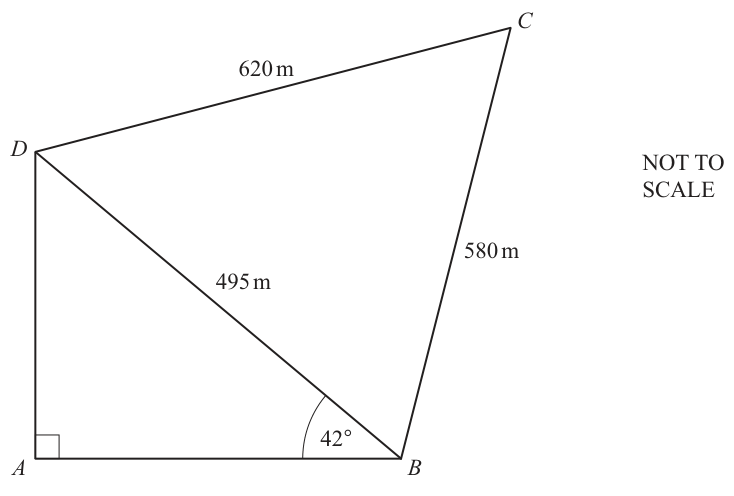
is a field.
A straight path crosses the field from to .
Approach
In right-angled triangle , the angle at is , the angle at is , and the hypotenuse is m. We need to find the adjacent side .
Working
Rearrange to make the subject:
Evaluate using a calculator:
Rounding to the nearest metre:
Answer
368
Walkthrough
We are looking at triangle , which is right-angled at . The angle is given as and the hypotenuse is m. We want to find the length of the side adjacent to the angle, which is .
The cosine ratio in a right-angled triangle is defined as the adjacent side divided by the hypotenuse: . Substituting our values gives . Multiplying both sides by isolates , yielding . Evaluating this on a calculator gives approximately m, which rounds to m.
Key Takeaways
- In a right-angled triangle, the cosine of an angle is the ratio of the adjacent side to the hypotenuse.
- Always identify which side is adjacent, opposite, or the hypotenuse relative to the given angle before choosing a trigonometric ratio.
Common Mistakes
- Using sine or tangent instead of cosine when the opposite side is not involved.
- Forgetting to round to a sensible number of decimal places or significant figures as appropriate for the context (nearest metre here).
Things to Be Careful About
- Ensure the calculator is in degree mode, not radian mode.
- The diagram is marked NOT TO SCALE, so do not measure from the diagram; always use the given numerical values.
Approach
In triangle , all three side lengths are known: m, m, and m. To find the angle , we use the cosine rule.
Working
The cosine rule states: . Rearranging to solve for the angle:
Substitute the given values:
Calculate the squares and the products:
Find the angle using the inverse cosine function:
Rounding to 1 decimal place:
This matches the required value.
Answer
61.5
Walkthrough
We focus on triangle , where we know all three sides: , , and . Since we want to find the angle at () and we have the side opposite to it (), the cosine rule is the perfect tool.
The cosine rule formula rearranged for an angle is , where is the side opposite the angle. Here, . Plugging in the numbers gives . Evaluating this fraction yields approximately . Taking the inverse cosine () of this value gives , which rounds to to 1 decimal place.
Key Takeaways
- The cosine rule is used when you know all three sides of a triangle and want to find an angle, or when you know two sides and the included angle and want to find the third side.
- Always place the side opposite the angle you are finding in the numerator's subtraction term ().
Common Mistakes
- Forgetting to square the side lengths before adding/subtracting them.
- Mixing up the sides in the formula, particularly placing the wrong side in the position.
- Rounding intermediate values too early; keep the full calculator value for until the final inverse cosine step.
Things to Be Careful About
- The question asks to show the angle is correct to 1 decimal place. You must show the unrounded value before rounding to to earn the final mark.
- Ensure your calculator is in degree mode.
A second path crosses the field from to meet path at point .
is the shortest distance from to .
Lara takes 6 minutes 24 seconds to walk along path .
Calculate Lara's average speed.
Give your answer in kilometres per hour.
______
Approach
The shortest distance from a point to a line is the perpendicular distance. Thus, is perpendicular to , making triangle right-angled at . We can use the sine ratio in triangle to find . Then, we calculate Lara's speed using , ensuring all units are converted to km and hours.
Working
Step 1: Find the length of
In right-angled triangle , the hypotenuse is m, and the angle (using the value from part (b)).
Step 2: Convert the time to hours
Lara takes 6 minutes 24 seconds. Convert 24 seconds to minutes:
Total time in minutes:
Convert minutes to hours:
Step 3: Calculate the average speed
Convert metres per hour to kilometres per hour by dividing by 1000:
Rounding to 3 significant figures:
Answer
5.11
Walkthrough
First, we recognize that the shortest distance from point to the line is the perpendicular dropped from to , meeting it at . This creates a right-angled triangle with the right angle at . We know the hypotenuse m and the angle from part (b). Using the sine ratio (), we find m.
Next, we calculate Lara's speed. Speed is distance divided by time. The distance is m. The time is 6 minutes 24 seconds. We convert this entirely to hours: 24 seconds is minutes, so the total time is minutes. In hours, this is hours.
Dividing the distance in metres by the time in hours gives the speed in m/h: m/h. Finally, we convert to km/h by dividing by 1000, giving km/h, which rounds to km/h.
Key Takeaways
- The shortest distance from a point to a line is always the perpendicular distance.
- When calculating speed, ensure distance and time units are consistent with the required output units (km and hours here).
- Time conversions involving seconds require dividing by 60 to get minutes, and then dividing by 60 again to get hours.
Common Mistakes
- Forgetting that the shortest distance is the perpendicular, and trying to use the full length or as the distance walked.
- Incorrectly converting 6 minutes 24 seconds to hours (e.g., treating it as 6.24 hours or 6.4 hours without dividing by 60).
- Forgetting to convert metres to kilometres at the end, giving an answer of instead of .
- Using the rounded value instead of the more precise from the cosine rule, which can slightly alter the final answer (though both round to here).
Things to Be Careful About
- The mark scheme accepts follow-through from the exact angle value () or the rounded value (). Both yield km/h to 3 significant figures.
- Always check the required units for the final answer. The question asks for km/h, not m/s or m/h.
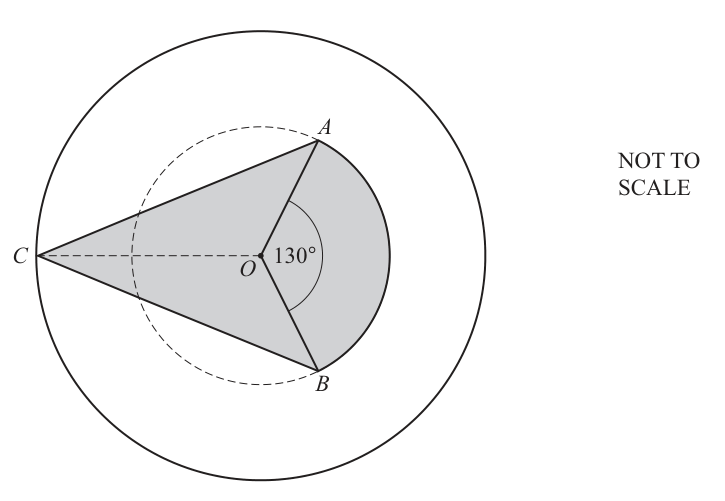
The diagram shows a shaded area in a large circle, centre .
The radius of the large circle is .
is a sector of a small circle, centre .
The radius of the small circle is and the sector angle is .
is on the circumference of the large circle and .
Calculate the percentage of the area of the large circle that is shaded.
______ %
Approach
The shaded region is composed of two parts: the sector of the small circle and the triangle . We calculate the area of each part separately, add them to find the total shaded area, and then express this as a percentage of the area of the large circle.
Working
Step 1: Area of the sector
The sector belongs to the small circle with radius and has a central angle of .
Step 2: Angles for the triangle
Point lies on the large circle, and . Since and , the line is an axis of symmetry for the figure. It bisects the reflex angle .
The reflex angle .
Step 3: Area of the triangle
The triangle can be split into two congruent triangles, and , by the line . We use the sine area formula for each:
Total area of :
Step 4: Total shaded area
Step 5: Percentage of the large circle
The area of the large circle (radius ) is:
The percentage is:
(Note: Depending on rounding during intermediate steps, answers in the range to are accepted by the mark scheme.)
Answer
38.0
Walkthrough
The problem asks for the percentage of the large circle's area that is shaded. The shaded region is explicitly stated to be the combination of the sector and the triangle .
-
Sector Area: The sector is part of the small circle (radius ) with a central angle of . We use the standard sector area formula to find this area, which is approximately .
-
Triangle Area: To find the area of triangle , we notice that is on the large circle () and . Because (both are radii of the small circle) and is common, triangles and are congruent. This means bisects the reflex angle . The reflex angle is , so . We can then calculate the area of using the sine area formula with sides , , and included angle . Doubling this gives the total area of , approximately .
-
Total and Percentage: Adding the sector and triangle areas gives the total shaded area (). We divide this by the total area of the large circle () and multiply by to get the percentage, which is approximately .
Key Takeaways
- The area of a sector is found using .
- When a triangle shares a vertex with the centre of a circle and has equal sides from that vertex, symmetry can be used to find unknown angles.
- The area of a triangle can be calculated using when two sides and the included angle are known.
- To find a percentage of an area, divide the part by the whole and multiply by .
Common Mistakes
- Using the wrong radius: Using instead of for the sector area, or instead of for the triangle sides .
- Incorrect angle: Forgetting to use the reflex angle () to find and , or using directly in the sine formula for the triangle.
- Partial triangle area: Calculating the area of only and forgetting to double it to get the full area of .
- Percentage calculation: Forgetting to multiply by at the end, or dividing the shaded area by the small circle's area instead of the large circle's area.
- Rounding too early: Rounding intermediate areas to 1 decimal place before adding them can lead to answers outside the accepted mark scheme range (e.g., ).
Things to Be Careful About
- Symmetry argument: Ensure you clearly state or imply why . The mark scheme awards a B1 for stating or .
- Exact form vs decimal: The mark scheme accepts answers in the range to (and the complement if calculating unshaded). Keep at least 3-4 decimal places during intermediate calculations to avoid rounding errors.
- Units: All lengths are in cm, so areas are in cm. The percentage is unitless.
- Diagram reference: shows the shaded region clearly. The dashed line is the axis of symmetry that splits the reflex angle into two angles.
Owen records the mass of each of 250 onions.
The histogram shows the results.
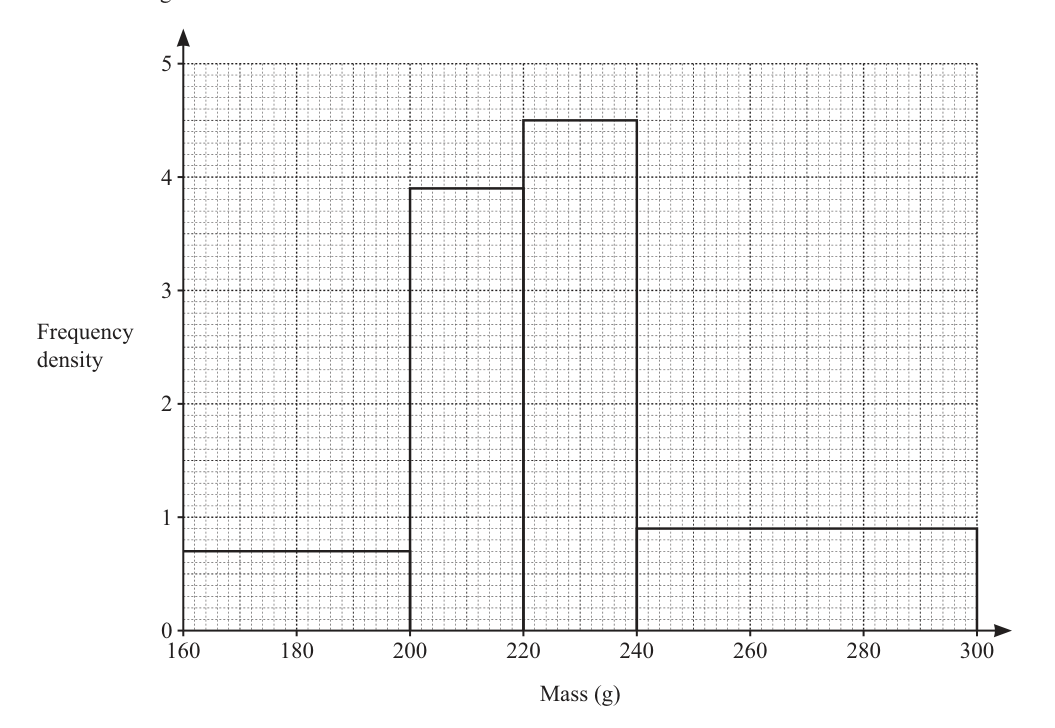
Approach
The number of onions in an interval equals the frequency density multiplied by the class width. Only the first bar (160–200 g) represents onions with mass 200 g or less.
Working
The first bar covers the interval 160 to 200 g with frequency density 0.7.
There are 28 onions with a mass of 200 g or less.
Answer
28 onions
Walkthrough
The histogram shows frequency density on the vertical axis and mass on the horizontal axis. To find the number of onions (frequency) in any interval, we multiply the frequency density by the class width.
The question asks to show that 28 onions have mass 200 g or less. Looking at the histogram, only the first bar (from 160 g to 200 g) falls within this range. The bar has:
- Lower boundary: 160 g
- Upper boundary: 200 g
- Class width: 200 − 160 = 40 g
- Frequency density: 0.7
Multiplying these gives:
This confirms there are 28 onions with mass 200 g or less.
Key Takeaways
- Frequency in a histogram = frequency density × class width
- The area of each bar represents the frequency
- When asked to show a specific number, identify which intervals contribute to that total
Common Mistakes
- Using the wrong class width (e.g., using 20 instead of 40 for the 160–200 interval)
- Reading the frequency directly from the vertical axis instead of using frequency density
- Forgetting that only the first bar is ≤ 200 g
Things to Be Careful About
- The vertical axis is frequency density, not frequency
- Class width must be calculated from the horizontal axis boundaries
- The answer must show the working to earn the mark
Approach
To estimate the mean from a histogram with frequency density, first calculate the frequency for each interval using frequency density × class width. Then find the midpoint of each interval, multiply each frequency by its midpoint to get , sum these products, and divide by the total frequency (250).
Working
Step 1: Calculate frequencies for each interval
Check: ✓
Step 2: Find midpoints of each interval
Step 3: Calculate for each interval
Step 4: Sum the values
Step 5: Calculate the mean
Answer
226.8
Walkthrough
To estimate the mean mass from a histogram, we treat each interval as if all onions in that interval have the midpoint mass. This requires several steps:
Step 1: Find frequencies
The histogram shows frequency density, not frequency. To get the actual number of onions in each interval, multiply frequency density by class width:
- 160–200 g: class width = 40, frequency density = 0.7, so frequency = 0.7 × 40 = 28
- 200–220 g: class width = 20, frequency density = 3.9, so frequency = 3.9 × 20 = 78
- 220–240 g: class width = 20, frequency density = 4.5, so frequency = 4.5 × 20 = 90
- 240–300 g: class width = 60, frequency density = 0.9, so frequency = 0.9 × 60 = 54
Adding these: 28 + 78 + 90 + 54 = 250, which matches the total given.
Step 2: Find midpoints
The midpoint represents the assumed mass for all onions in that interval:
- 160–200: midpoint = (160 + 200) / 2 = 180
- 200–220: midpoint = (200 + 220) / 2 = 210
- 220–240: midpoint = (220 + 240) / 2 = 230
- 240–300: midpoint = (240 + 300) / 2 = 270
Step 3: Calculate fx products
Multiply each frequency by its midpoint:
- 28 × 180 = 5040
- 78 × 210 = 16380
- 90 × 230 = 20700
- 54 × 270 = 14580
Step 4: Sum and divide
Total Σfx = 5040 + 16380 + 20700 + 14580 = 56700
Mean = 56700 / 250 = 226.8 g
Key Takeaways
- Mean from grouped data = Σ(fx) / Σf, where x is the midpoint
- Frequency in a histogram = frequency density × class width
- Always verify that frequencies sum to the given total
- The mean is an estimate because we assume all values in an interval equal the midpoint
Common Mistakes
- Using frequency density directly instead of calculating frequencies
- Wrong class width (e.g., using 20 for the 240–300 interval when it's 60)
- Wrong midpoints (e.g., using the lower or upper boundary instead)
- Arithmetic errors in multiplying or summing
- Forgetting to divide by total frequency (250)
- Rounding too early or to wrong accuracy (answer should be 226.8, not 227)
Things to Be Careful About
- The last interval (240–300) has width 60, not 20 — this is a common trap
- Show all working: frequencies, midpoints, fx products, sum, and final division
- The mark scheme requires nfww (no follow through wrong), so each step must be correct
- Answer is 226.8 g (3 significant figures is acceptable, but 226.8 is exact)