Mathematics (Syllabus D) 4024/21 — October/November 2025
Cambridge O-Level · Calculator · worked solutions for every part, with the mark scheme
Topics Number · Algebra and Graphs · Geometry · Statistics · Coordinate Geometry · Trigonometry · +3 more
| 52 | 27 | 49 |
|---|
From the list, write down
Approach
A square number is a number of the form for an integer . Check each item in the given list to see which one is a perfect square.
Working
- is not a square number.
- , which is not a square number.
- is not a square number.
- is not a square number.
- is not a square number.
- , so is a square number.
Answer
49
Walkthrough
The list contains , , , , and . A square number is an integer that can be written as the square of another integer.
First evaluate . Since , , which is not a square number. Next, is not a square because there is no integer whose square is . Also is not an integer and is a fraction. The only perfect square in the list is , because .
Key Takeaways
- A square number is the result of squaring an integer.
- Recognising squares such as helps you identify square numbers quickly.
Common Mistakes
- Thinking is a square number; actually it simplifies to , so it is not a perfect square.
- Confusing square numbers with powers, or believing is a square because it is close to .
Things to Be Careful About
- The question asks for one item from the list, so the answer must be , the actual listed square number.
Approach
A cube number is a number of the form for an integer . Check each value in the list to identify which one is a perfect cube.
Working
- , so is a cube number.
- The other listed values are not perfect cubes.
Answer
27
Walkthrough
From the list, we check each number to see whether it is a perfect cube.
, so is clearly a cube number. None of , , , , or is the cube of an integer. Therefore the required item is .
Key Takeaways
- A cube number is the result of raising an integer to the power .
- Common cubes include and so on.
Common Mistakes
- Confusing with a cube number. Since is not an integer, it cannot be a cube number in this sense.
- Thinking is a cube number because it is a square; is not a perfect cube.
Things to Be Careful About
The answer is the listed item ; since the prompt says “from the list”, do not give or as the final selection.
Approach
A factor of is a positive integer that divides exactly into . First evaluate the listed square root, then check which list item is a factor of .
Working
Since , the number is a factor of . Therefore the listed item is the required factor.
Answer
sqrt(169)
Walkthrough
We need to find a listed number that divides exactly.
First evaluate : since , . Then check divisibility: , so is a factor of .
Of the other listed values, , , , , and are not factors of . Therefore the correct listed item is .
Key Takeaways
- A factor divides a number exactly, leaving no remainder.
- can be written as , so its factors are , , and .
Common Mistakes
- Writing instead of the listed item . The question says “from the list”, so the answer should be the item shown in the list.
- Including as a factor: is a multiple of , not a factor of .
Things to Be Careful About
- is not useful here because factors of an integer must be integers.
- The answer is , not or alone.
Approach
An irrational number cannot be written as with integers and . Check which listed number is not rational.
Working
is a square root of a non-perfect square, so it is irrational.
All the other values are whole numbers or fractions, so they are rational.
Answer
sqrt(8)
Walkthrough
An irrational number cannot be written as a fraction of two integers. Check each item:
- is rational.
- , so it is rational.
- is rational.
- cannot be written as an exact fraction. Since is not a perfect square, is irrational.
- is a rational number.
- is rational.
Therefore the only irrational number in the list is .
Key Takeaways
- A rational number can be written in the form , where and are integers and .
- The square root of a non-perfect square is irrational.
Common Mistakes
- Writing is irrational because it contains a root sign; since it simplifies to , it is rational.
- Confusing a recurring decimal with an irrational number; recurring and terminating decimals are rational.
Things to Be Careful About
- The answer is the listed item , not an approximate decimal such as .
- Do not simplify to and then think it becomes rational; is still irrational.
Approach
First, evaluate the expression as written using the standard order of operations (BODMAS/PEMDAS). Then, try inserting a pair of brackets in different positions to see which one produces the required answer of .
Working
Without brackets, multiplication is performed first:
The result is , not . We need to group terms before the multiplication or addition.
Let's try grouping :
Calculate inside the brackets first:
Then multiply by :
Finally, add :
This matches the target value.
Answer
(4.2 - 3) x 5 + 1.2 = 7.2
Walkthrough
The question asks us to insert one set of brackets to make the equation true. The key is understanding how brackets override the standard order of operations (Multiplication before Addition/Subtraction).
- Check original: Without brackets, we multiply first. This gives . Then . This is incorrect.
- Trial: We need a larger positive number (). Notice that if we can get from the first part , then multiplying by gives , and adding gives exactly .
- Verification:
- Bracket:
- Inside bracket:
- Multiply:
- Add:
The equation holds.
Key Takeaways
- Brackets change the priority of operations. Operations inside brackets are always done first.
- In expressions with mixed operations, identifying where a specific intermediate result is needed can guide you to the correct bracket placement.
Common Mistakes
- Forgetting to apply the multiplication after evaluating the bracketed term.
- Placing brackets around the wrong numbers, e.g., , which yields the same result as no brackets because multiplication already has higher precedence.
Things to Be Careful About
- Ensure you follow the order of operations strictly: Brackets, then Indices/Multiplication/Division, then Addition/Subtraction.
- Check your final calculation carefully to ensure it equals the target number exactly.
Approach
Evaluate the known values ( and ) first. Then, evaluate the expression as written without brackets. Compare the result with the target (). Insert brackets to change the order of operations to reach the target.
Working
First, calculate the powers and roots:
Substitute these back into the expression:
Evaluate left to right (no brackets):
The result is , but we need . We are too high. To get a smaller number, we likely need to subtract a larger amount. This suggests grouping the last two terms so they are subtracted together.
Try grouping :
Substitute the values again:
Calculate inside the brackets first:
Now perform the subtractions:
This matches the target value.
Answer
5 - 3^2 - (cube root of 64 + 2) = -10
Walkthrough
- Simplify Constants: Identify that and . The expression becomes .
- Initial Calculation: Without brackets, . The target is .
- Analyze Difference: The difference between and is . This means we need to reduce the total by more than the current calculation does.
- Bracket Strategy: If we place brackets around , the expression effectively becomes . Since subtraction distributes over the bracket, this is equivalent to . Comparing (original) with (with brackets), the change is from to , a difference of . This confirms the bracket placement.
- Final Verification:
- . Correct.
Key Takeaways
- Always simplify indices and roots first.
- Brackets can change the sign of subsequent terms when preceded by a minus sign (e.g., ).
- Estimating the gap between the calculated value and the target helps identify whether you need to increase or decrease the magnitude of a term.
Common Mistakes
- Evaluating incorrectly (e.g., thinking it is or ).
- Forgetting that a minus sign outside brackets affects all terms inside.
- Incorrectly applying order of operations within the bracketed section.
Things to Be Careful About
- Remember that is the cube root, not the square root ().
- Ensure the final answer is exactly , checking signs carefully during subtraction.
In this question, all lengths are in centimetres.
The diagram shows the net of a cuboid.
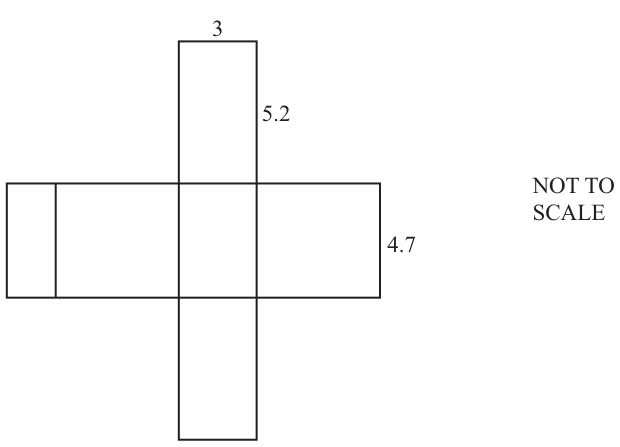
Approach
The diagram shows the net of a cuboid. By analysing the net, we can identify the three dimensions (length, width, height) of the cuboid. The total surface area is the sum of the areas of all six rectangular faces, which can be calculated as .
Working
From the net and the markings:
- One pair of faces has dimensions .
- Another pair has dimensions .
- The third pair has dimensions .
Using the surface area formula with , , :
Answer
108.28
Walkthrough
The problem asks for the total surface area of a cuboid given its net. A net is a 2D pattern that can be folded to make a 3D shape. By looking at the net, we can see three pairs of identical rectangles, which correspond to the three pairs of opposite faces of the cuboid.
- Identify dimensions: The vertical column of rectangles has a width of . The heights are and another dimension. The horizontal row has a height of . By matching the edges that would fold together, we determine the cuboid has dimensions , , and .
- Calculate areas:
- Two faces are .
- Two faces are .
- Two faces are .
- Sum them up: Total area .
Key Takeaways
- A net of a cuboid consists of 6 rectangles in 3 pairs of equal size.
- The surface area is the sum of the areas of these rectangles, or equivalently .
- Care must be taken to correctly identify which dimensions correspond to length, width, and height from the net.
Common Mistakes
- Calculation errors: Forgetting to multiply by 2 (calculating the area of only one set of faces).
- Arithmetic errors: Mistakes in multiplying decimals, e.g., .
- Wrong dimensions: Misreading the net and using incorrect side lengths.
Things to Be Careful About
- The question is on the Calculator component, so decimal arithmetic is expected and allowed.
- Ensure all intermediate products are calculated accurately before summing.
- The final answer is a number; the unit is already provided in the question text next to the answer line.
Approach
A cuboid (rectangular prism) with three different dimensions (length width height) has planes of symmetry that cut through the midpoints of opposite faces, parallel to those faces.
Working
There are three pairs of opposite faces. Each pair defines a plane of symmetry that is parallel to the faces and passes through the centre of the cuboid.
- One plane parallel to the faces.
- One plane parallel to the faces.
- One plane parallel to the faces.
Total number of planes of symmetry = .
Answer
3
Walkthrough
The question asks for the number of planes of symmetry of the cuboid.
- Understand planes of symmetry: A plane of symmetry divides a 3D shape into two identical halves that are mirror images of each other.
- Apply to cuboid: For a general cuboid (where length, width, and height are all different, as in this case: ), there are exactly 3 planes of symmetry.
- One plane cuts horizontally through the middle (parallel to the top and bottom faces).
- One plane cuts vertically front-to-back (parallel to the front and back faces).
- One plane cuts vertically side-to-side (parallel to the left and right faces).
Key Takeaways
- A cube has 9 planes of symmetry.
- A cuboid with at least two equal dimensions (e.g., a square prism) has more planes of symmetry.
- A cuboid with all three dimensions different has exactly 3 planes of symmetry.
Common Mistakes
- Confusing with 2D symmetry: Thinking of lines of symmetry instead of planes.
- Assuming more symmetry: Thinking a cuboid has 4 or 6 planes like a cube (a cube has 3 planes through faces, 3 through diagonals, total 9).
- Confusing with axes of rotation: A cuboid has 3 axes of rotational symmetry (order 2), but the question asks for planes.
Things to Be Careful About
- Ensure the dimensions are all different. If two dimensions were equal (e.g., ), there would be 4 planes of symmetry. Here, , so there are exactly 3.
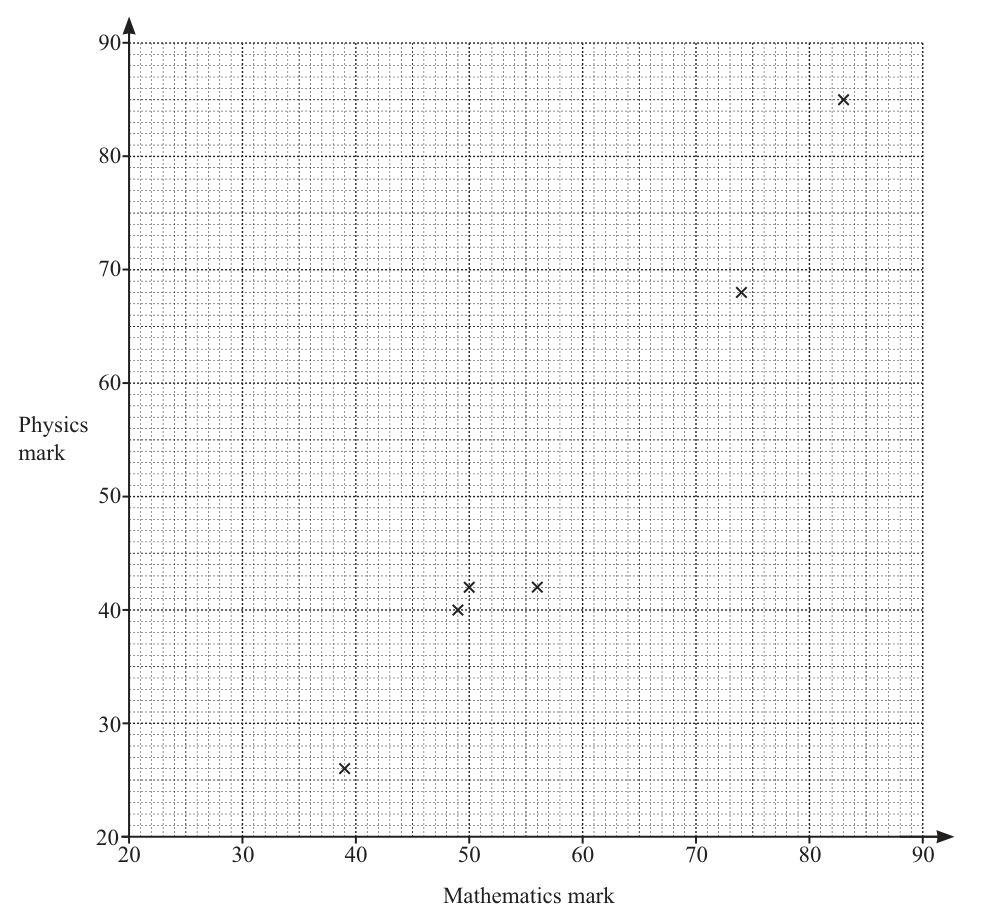
The table shows the examination marks for mathematics and physics for each of 9 students.
| Mathematics mark | 56 | 39 | 83 | 49 | 50 | 74 | 60 | 45 | 78 |
|---|---|---|---|---|---|---|---|---|---|
| Physics mark | 42 | 26 | 85 | 40 | 42 | 68 | 55 | 37 | 71 |
Approach
The table gives nine (Mathematics mark, Physics mark) pairs. Six points are already plotted. Identify the three remaining pairs and plot them at the correct coordinates on the grid.
Working
The nine data pairs from the table are:
The six already plotted points are:
The three remaining points to plot are:
Locate each on the grid by reading the Mathematics mark along the horizontal axis and the Physics mark up the vertical axis, then mark with a cross.
Answer
The three points to plot are , and .
Plot (45, 37), (60, 55) and (78, 71)
Walkthrough
The question provides a table of nine paired marks and a scatter diagram with six points already drawn. The candidate must identify the three missing pairs and plot them.
Step 1 — List all nine pairs. Read across each column of the table: the top row is the Mathematics mark (x-coordinate) and the bottom row is the Physics mark (y-coordinate). This gives the nine coordinate pairs listed in the working.
Step 2 — Identify which are already plotted. The six points given in the question description are , , , , and . Cross these off the full list.
Step 3 — Plot the remaining three. The leftover pairs are , and . For each, find the Mathematics value on the horizontal axis and the Physics value on the vertical axis, then mark the intersection with a cross.
Key Takeaways
- A scatter diagram plots paired data as points with one variable on each axis.
- The coordinates of each point are read directly from the corresponding columns of the data table.
- Always check which points are already plotted before drawing new ones.
Common Mistakes
- Plotting the coordinates in the wrong order (swapping Mathematics and Physics marks). Remember Mathematics is on the horizontal axis and Physics is on the vertical axis.
- Reading the wrong grid value — the axes start at 20, not 0, and each major division is 10 units with 10 small squares between, so each small square represents 1 unit.
- Forgetting to mark the points with a cross as shown in the already-plotted points.
Things to Be Careful About
- The axes begin at 20, not 0. A point at is not near the origin — it is 25 units right and 17 units up from the bottom-left corner of the grid.
- Each small square on the grid represents 1 unit on both axes (10 small squares = 10 units = one major division).
- The answer must be plotted, not just written down — the mark is awarded for correct placement on the grid.
Approach
A line of best fit for a scatter diagram is a straight line that shows the general trend of the data. It should have points roughly equally distributed on either side and pass through the middle of the cluster.
Working
The nine plotted points show a clear positive correlation: as Mathematics marks increase, Physics marks also increase. The points lie roughly along a line with a positive gradient.
Draw a straight ruled line through the middle of the data cloud, ensuring:
- The line has a positive gradient (rising from left to right).
- Points are roughly equally spread above and below the line.
- The line extends across the grid to be useful for estimation in part (c).
Answer
A straight ruled line of best fit with positive gradient passing through the central region of the plotted points.
Straight ruled line of best fit with positive gradient through the data
Walkthrough
Step 1 — Observe the trend. Look at the nine plotted points. Low Mathematics marks (39–50) are paired with low Physics marks (26–42), and high Mathematics marks (74–83) are paired with high Physics marks (68–85). This indicates a positive correlation.
Step 2 — Draw the line. Using a ruler, draw a straight line that passes through the middle of the data. The line should have roughly the same number of points above it as below it. It does not need to pass through any particular point — it represents the overall trend.
Step 3 — Check the gradient. The line must rise from left to right (positive gradient). A line that is horizontal or falls from left to right would be incorrect.
Key Takeaways
- A line of best fit summarises the trend in a scatter diagram.
- It is a straight line (for linear correlation) drawn by eye with a ruler.
- Points should be roughly balanced above and below the line.
- The line must extend far enough across the grid to be used for estimation.
Common Mistakes
- Drawing a curved line or a jagged line connecting points — the line of best fit must be straight.
- Drawing a line with the wrong gradient (horizontal or negative) when the data clearly shows positive correlation.
- Drawing the line too close to one end of the data, making it useless for estimation at the other end.
- Not using a ruler — the line must be straight and ruled.
Things to Be Careful About
- The line is drawn by eye; there is no single correct answer, but it must be a straight ruled line with positive gradient that passes through the central region of the data.
- The mark scheme awards the mark for a 'ruled line of best fit' — so a straight line is essential.
- This line will be used in part (c), so it must extend far enough to read off a value at Physics mark = 75.
Xavier scored 75 marks in the physics exam but was absent for the mathematics exam.
Use your line of best fit to find an estimate of his mathematics mark.
______
Approach
Xavier's Physics mark is 75. We need to find the corresponding Mathematics mark using the line of best fit drawn in part (b). Since Physics is on the vertical axis, we locate 75 on that axis, move horizontally to the line of best fit, then move vertically down to read the Mathematics mark on the horizontal axis.
Working
- Locate on the vertical (Physics mark) axis.
- Draw a horizontal line from on the vertical axis to the line of best fit.
- From that intersection point, draw a vertical line down to the horizontal (Mathematics mark) axis.
- Read the value on the horizontal axis.
Using the line of best fit from part (b), the Mathematics mark corresponding to a Physics mark of is approximately:
Answer
(Accept any value from approximately to , depending on the line drawn in part (b).)
78
Walkthrough
Step 1 — Identify which axis to read from. Xavier's Physics mark is 75. Physics is plotted on the vertical axis, so we start at 75 on the vertical axis.
Step 2 — Move horizontally to the line of best fit. From the point 75 on the vertical axis, draw a horizontal line across to where it meets the line of best fit drawn in part (b).
Step 3 — Move vertically down to the horizontal axis. From that intersection point, draw a vertical line down to the horizontal (Mathematics mark) axis.
Step 4 — Read the value. The value on the horizontal axis where the vertical line lands is the estimated Mathematics mark. For a reasonable line of best fit, this value is approximately 77 to 80.
Key Takeaways
- To estimate a value from a scatter diagram using a line of best fit, locate the known value on its axis, move to the line, then read the unknown value on the other axis.
- The answer depends on the line of best fit drawn in part (b), so follow-through marks are awarded based on the candidate's own line.
- The mark scheme accepts a range of values (typically 77–80) because the line is drawn by eye.
Common Mistakes
- Reading from the wrong axis: starting at 75 on the horizontal (Mathematics) axis instead of the vertical (Physics) axis. Remember Physics is on the vertical axis.
- Moving vertically first instead of horizontally: the candidate must move horizontally from 75 on the vertical axis to the line, then vertically down to the horizontal axis.
- Reading the value at the wrong point on the line — must read from the line of best fit, not from a plotted data point.
- Giving an answer outside the reasonable range (e.g., 65 or 90) which would indicate the line of best fit was drawn incorrectly.
Things to Be Careful About
- The answer is a reading from the candidate's own line of best fit, so it must be consistent with that line. The mark scheme says 'reading from their straight line of best fit'.
- The value must be reasonable — looking at the data, Physics mark 75 is near the high end, so the Mathematics mark should be in the range 75–82.
- Give the answer to the nearest integer; no units are required since the marks are already in marks.
- If the line of best fit in part (b) was drawn incorrectly (e.g., wrong gradient), the reading in part (c) may be outside the acceptable range and would not score.
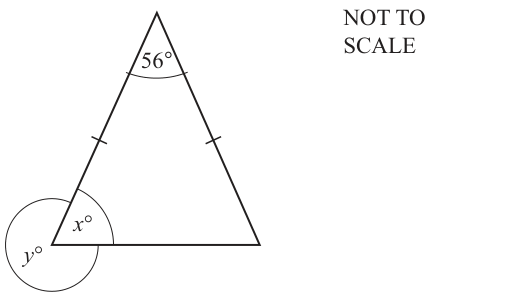
The diagram shows an isosceles triangle.
Approach
The triangle is isosceles, meaning the two base angles are equal. The sum of interior angles in any triangle is .
Working
Let the base angles be . Since the triangle is isosceles with the top angle :
Alternatively, directly:
Answer
62
Walkthrough
The problem gives an isosceles triangle with a top angle of . An isosceles triangle has two equal sides (marked with ticks in the diagram) and the angles opposite these equal sides (the base angles) are also equal. Here, both base angles are marked as .
The sum of the interior angles of a triangle is always . Therefore, we can set up the equation:
Subtract from to find the total remaining for the two base angles:
Since the two base angles are equal, divide this remainder by 2:
Key Takeaways
- In an isosceles triangle, the angles opposite the equal sides are equal (base angles are equal).
- The sum of angles in a triangle is .
Common Mistakes
- Forgetting to divide the remaining angle sum by 2 (giving 124 instead of 62).
- Assuming the base angles are (confusing the vertex angle with base angles).
Things to Be Careful About
- Ensure you identify which sides are equal from the tick marks. The equal sides meet at the top, so the base angles are the equal ones.
- The diagram is marked NOT TO SCALE, so do not measure angles; rely on the given value and properties.
Approach
The angles around a single point add up to . In the diagram, the interior angle and the reflex angle at the bottom-left vertex complete the full circle.
Working
From part (a), . The angles and are angles at a point:
Substitute :
Answer
298
Walkthrough
At the bottom-left vertex of the triangle, there are two angles marked: the interior angle and the reflex angle (the angle outside the triangle going all the way around). Together, these two angles make a full turn around the point.
The sum of angles at a point is . Therefore:
Using the value found in part (a):
Key Takeaways
- Angles around a point add up to .
- A reflex angle is an angle greater than and less than .
Common Mistakes
- Confusing the reflex angle with an exterior angle (which would be ). The diagram clearly shows a circle around the vertex for , indicating it is the reflex angle completing the full .
- Using the wrong value for (follow-through error).
Things to Be Careful About
- The mark scheme awards follow-through (FT) marks if the candidate uses their own value from part (a), even if it was incorrect (e.g., if they got , then would be accepted). However, the correct working uses .
- Ensure the answer is an integer as required by the context.
Work out.
Give your answer correct to 2 decimal places.
______
Approach
Calculate the value of the cube root and the square separately, perform the subtraction in the numerator, then divide by the result of the denominator. Finally, round the answer to 2 decimal places.
Working
First, evaluate the terms in the expression:
Substitute these values back into the expression:
Perform the subtraction in the numerator:
Now divide by the denominator:
Round the result to 2 decimal places. The third decimal digit is , so we round down (keep the second digit as is):
Answer
113.14
Walkthrough
This question tests your ability to use a calculator correctly for non-calculator components where specific values are given or simple powers/roots are involved, combined with standard order of operations.
- Identify the parts: The expression is a fraction. The top part (numerator) is minus the cube root of . The bottom part (denominator) is squared.
- Evaluate the roots and powers:
- Calculate . Using a calculator, this is approximately
- Calculate . This is .
- Simplify the numerator: Subtract the cube root from :
- Divide: Divide the simplified numerator by the denominator: .
- Rounding: The question asks for the answer correct to 2 decimal places. Look at the third decimal place (). Since it is less than , leave the second decimal place unchanged. The result is .
Key Takeaways
- Be comfortable calculating cube roots () and squares () on your calculator.
- Always evaluate the numerator and denominator completely before dividing.
- Pay attention to the required precision (decimal places vs significant figures).
Common Mistakes
- Order of Operations: Subtracting from first to get , then taking the cube root (), which is incorrect. The cube root only applies to the .
- Squaring Errors: Writing as instead of .
- Rounding: Rounding too early (e.g., using for the cube root) might lead to slight inaccuracies, though here it might still land on the same 2dp. It is safer to keep full calculator precision until the end.
- Division by Decimal: Forgetting that dividing by increases the number significantly.
Things to Be Careful About
- Calculator Mode: Ensure you are entering the cube root correctly. On some calculators, you press
shift+cube rootor type6^(1/3). - Accuracy: The mark scheme awards a B1 for intermediate answers like or , but the final answer must be rounded correctly to for full marks (cao - correct answer only).
- Significant Figures vs Decimal Places: The question specifically asks for "2 decimal places", not 3 significant figures.
Work out the size of the interior angle of a regular decagon.
______
Approach
To find the size of an interior angle of a regular decagon, we can use the formula for the sum of interior angles of an -sided polygon and divide by the number of sides (since all angles are equal in a regular polygon). Alternatively, we can use the exterior angle method.
Working
A decagon has sides.
Method 1: Using the interior angle sum
The sum of the interior angles of a polygon with sides is given by:
Substituting :
Since the decagon is regular, all 10 interior angles are equal. Therefore, the size of one interior angle is:
Method 2: Using exterior angles
The sum of exterior angles of any convex polygon is . For a regular polygon with sides, each exterior angle is:
For a decagon ():
The interior angle and exterior angle at each vertex add up to (angles on a straight line):
Answer
144°
Walkthrough
A regular decagon is a ten-sided polygon where all sides are equal in length and all interior angles are equal in measure.
Step 1: Identify the number of sides.
A decagon has 10 sides, so .
Step 2: Choose a method to calculate the interior angle.
There are two common ways to do this:
Method A (Interior Angle Sum):
The total sum of interior angles in any polygon is calculated as . This comes from dividing the polygon into triangles by drawing diagonals from one vertex; an -gon can be split into triangles. Since each triangle has angles summing to , the total is .
For : .
Because it is a regular decagon, every interior angle is the same. So we divide the total sum by the number of angles (which equals the number of sides):
.
Method B (Exterior Angles):
The sum of the exterior angles of any convex polygon is always . For a regular polygon, each exterior angle is simply .
For : .
An interior angle and its corresponding exterior angle lie on a straight line, so they add up to .
Therefore, Interior Angle .
Both methods lead to the same result. The mark scheme accepts either approach (M1 for showing the correct formulaic step).
Key Takeaways
- Know the formula for the sum of interior angles: .
- Know that the sum of exterior angles is always .
- Remember that "regular" means all sides and all angles are equal, allowing you to divide the total sum by .
- Be able to switch between interior and exterior angles using the relationship.
Common Mistakes
- Confusing the number of sides: forgetting that a decagon has 10 sides.
- Forgetting to divide by : calculating the total sum () but stopping there instead of finding the single angle.
- Incorrectly applying the formula: e.g., using instead of .
- Arithmetic errors in multiplication or division.
- Not providing the degree symbol () if required by context (though usually numerical answers are accepted, units are good practice).
Things to Be Careful About
- Ensure you distinguish between "interior" and "exterior" angles.
- Check if the question asks for the sum of all angles or just one angle. This question asks for "the size of the interior angle" (singular), implying one angle.
- Accuracy: The answer is exact, so no rounding is needed.
- Units: Include in the final answer if the space allows or if standard convention for the exam board requires it, though often just the number is marked correct if unambiguous.
John invests $240 in an account that pays simple interest at a rate of 2.35% per year.
Calculate the total amount of interest he receives at the end of 5 years.
$ ______
Approach
The account pays simple interest, so the same amount of interest is earned each year. Find the annual interest using the given rate, then multiply by 5 years.
Working
One year's interest is
So each year John receives $5.64. Over 5 years, the total interest is
Equivalently, using the simple interest formula,
Answer
$28.20
$28.20
Walkthrough
This is a simple interest question. The key feature of simple interest is that the interest is calculated on the original deposit, so it is the same every year. John starts with $240 and the rate is 2.35% per year. Converting 2.35% to a fraction gives , so one year's interest is:
The question asks for 5 years, so multiply the annual interest by 5:
The question asks for the interest only, not the total amount in the account. Adding the interest to the principal would give $268.20, but that is not what is asked.
Key Takeaways
- Simple interest is calculated using the formula , where is the principal, is the annual interest rate and is the time in years.
- Because simple interest is the same each year, total interest = annual interest number of years.
- A percentage such as 2.35% must be written as before substitution into the formula.
Common Mistakes
- Giving the total amount in the account after 5 years instead of the interest: $240 + $28.20 = $268.20. The mark scheme gives special case credit (SC1) only for this total amount, not full marks.
- Converting 2.35% incorrectly, for example using 0.235 or 235 instead of 0.0235.
- Forgetting to multiply by 5, which would give only one year's interest, $5.64.
- Using a compound interest approach, which is not what the question requires.
Things to Be Careful About
The answer must clearly show or the equivalent single formula, because this is the method mark. The time period is already in years, so no unit conversion is needed. No rounding is required: and are the same value, but the usual money form is $28.20. Remember to include the dollar sign in the final answer. This is a calculator paper, so may be keyed straight into a calculator, but the substituted formula should still be written down to show the working.
The exchange rate between euros (€) and pounds (£) is €1 = £0.88 .
The exchange rate between dollars ($) and pounds (£) is $1 = £.
Ling changes €500 into dollars.
She receives $536.58 .
Work out the value of .
= ______
Approach
Convert the euros into pounds using the first exchange rate. Then use the second exchange rate to write the received dollars as a pound amount and equate it to the same total.
Working
Convert €500 to pounds:
So Ling has £440.
Since $1 = £, receiving $536.58 means:
Divide both sides by 536.58:
Answer
0.82
Walkthrough
Start by converting the €500 into pounds. Since each euro is worth £0.88, multiply:
So Ling has £440 before changing into dollars.
Now use the second exchange rate. If $1 = £, then $536.58 is worth £. This must be the same £440 she had, so:
Divide both sides by 536.58:
This is the number of pounds you get for 1 dollar.
Key Takeaways
- Exchange rates convert one currency into another by multiplying or dividing.
- When a rate is written as “1 unit of currency A = units of currency B”, the total value in B is the amount in A multiplied by .
- To find an unknown exchange rate, equate the two expressions for the same amount in pounds.
Common Mistakes
- Using the wrong direction: computing gives about 1.22, which is the number of dollars per pound, not the required .
- Forgetting to convert the euros to pounds first.
- Rounding too early; keep the division as until the end.
- Giving the answer as a ratio reversed, e.g. instead of .
Things to Be Careful About
- The answer is (or 0.820), meaning $1 = £0.82.
- This is a calculator paper, so you can evaluate directly, but show the equation you are solving.
- The mark scheme accepts equivalent forms, e.g. .
- Do not round to fewer than the required accuracy; 0.82 is enough here, but 0.820 is also acceptable.
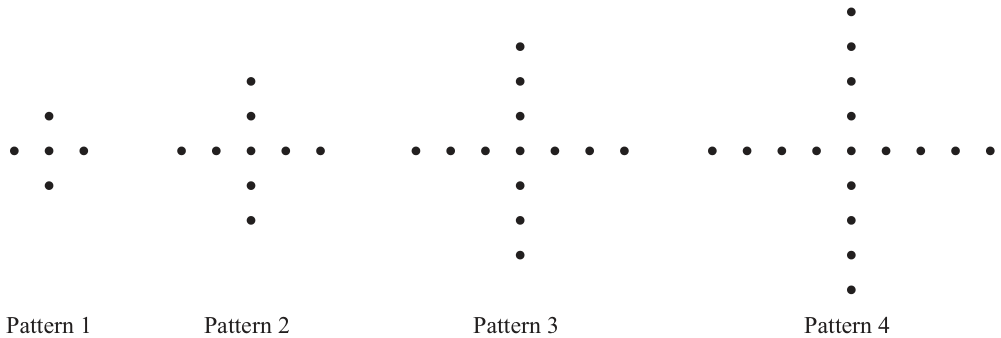
Here are the first four patterns in a sequence using dots.
Approach
Each pattern has one central dot and four arms, each containing dots for pattern . The total number of dots is . Use this to find the values for patterns 4 and 5.
Working
Pattern 4:
Pattern 5:
Answer
Pattern 4 = 17, Pattern 5 = 21
17 and 21
Walkthrough
The image shows four cross-shaped patterns. Each pattern has a single dot at the centre and four arms extending outwards (up, down, left, right). For pattern , each arm contains dots, so the total number of dots is:
For part (a), we simply apply this rule:
- Pattern 4: dots
- Pattern 5: dots
These fill the two blank cells in the table.
Key Takeaways
- Visual patterns often follow an arithmetic sequence where the number of elements grows linearly with the pattern number.
- Counting a central element plus repeating arms gives a formula of the form .
Common Mistakes
- Forgetting the central dot and writing instead of .
- Miscounting the dots in the given patterns, leading to an incorrect common difference.
Things to Be Careful About
- The table asks for two values; both must be given to score the mark.
- The values 17 and 21 must match the established pattern exactly.
Approach
The sequence of dot counts is . This is an arithmetic sequence with common difference . The nth term of an arithmetic sequence with first term and common difference is .
Working
Common difference:
First term:
nth term:
Answer
4n + 1
Walkthrough
The number of dots in each pattern forms the sequence:
The difference between consecutive terms is constant:
Since the common difference is , the coefficient of in the nth term is , giving a partial expression .
To find the constant term, substitute :
So the nth term is .
This matches the visual rule: one central dot plus dots in each of four directions, giving .
Key Takeaways
- The coefficient of in the nth term equals the common difference of the sequence.
- The constant term is found by subtracting the common difference from the first term: .
- The nth term formula can be verified by checking it against known terms.
Common Mistakes
- Writing instead of (forgetting the central dot).
- Writing or another incorrect constant.
- Not showing the method that leads to .
Things to Be Careful About
- The mark scheme accepts or any equivalent form such as where the working shows .
- The expression must be in terms of , not or another variable.
Approach
Use the expression from part (b), , and set it equal to to find the pattern number .
Working
Subtract from both sides:
Divide by :
Answer
276
Walkthrough
Part (b) established that the number of dots in pattern is . Nada needs dots, so we set:
Subtract from both sides:
Divide both sides by :
Check: . ✓
Key Takeaways
- The nth term formula can be used in reverse: given a term value, solve for .
- Always check the answer by substituting back into the formula.
Common Mistakes
- Forgetting to subtract before dividing, giving .
- Not showing the working steps; the mark scheme requires the equation to be shown.
- Arithmetic errors when dividing by .
Things to Be Careful About
- The mark scheme awards a method mark for setting up their , so the equation must be written explicitly.
- The final answer must be an integer; if it is not, recheck the calculation.
is the point and is the point .
Approach
The vector goes from to , so it is found by subtracting the coordinates of from the coordinates of .
Working
Answer
column vector (6, -10)
Walkthrough
We need the vector from to . A vector tells us how to get from to : start at , move horizontally and vertically to reach . So we subtract the coordinates of the starting point from the coordinates of the ending point. The -component is , meaning move 6 units right. The -component is , meaning move 10 units down. This gives the column vector.
Key Takeaways
Understand the order in vector notation: means from to , so subtract from . Column vectors record horizontal and vertical movement.
Common Mistakes
- Subtracting in the wrong order: , not . If you compute you get , which is .
- Forgetting to subtract a negative correctly: , not .
Things to Be Careful About
The vector is a column vector, so the top entry is the -component and the bottom entry is the -component. Keep the signs correct. This part is a single mark, so the final vector must be written correctly.
Approach
The midpoint of a line segment has coordinates equal to the average of the corresponding coordinates of its endpoints.
Working
Answer
(-1, -2)
Walkthrough
The midpoint of a segment is halfway between its endpoints. To find its -coordinate, average the -coordinates of and : . To find its -coordinate, average the -coordinates: . Hence the midpoint is .
Key Takeaways
The midpoint formula is . It gives the point halfway between two points.
Common Mistakes
- Using subtraction instead of addition in the midpoint formula.
- Mixing up the order of coordinates.
- Forgetting to divide by 2.
Things to Be Careful About
The mark scheme gives B1 for each correct coordinate, so even if one coordinate is wrong, the other can still gain a mark. Show both averages clearly.
Approach
The magnitude of a column vector is . Apply this to .
Working
Rounded to 3 significant figures:
Answer
12.1 (3 s.f.)
Walkthrough
The magnitude (length) of a vector is found by Pythagoras' theorem: square each component, add the squares, then take the square root. For , the components are and . Squaring gives and , which sum to . The square root is . Since this is a calculator paper and no other accuracy is stated, give 3 significant figures: .
Key Takeaways
The magnitude of a column vector is . Squaring a negative component gives a positive value.
Common Mistakes
- Forgetting to square the negative sign: , not .
- Stopping at when a decimal answer is expected, or rounding incorrectly.
- Confusing magnitude with the vector itself: magnitude is a length, always positive.
Things to Be Careful About
The mark scheme awards M1 for , so write this line before evaluating. On the calculator component, give the final answer to 3 significant figures unless the question says otherwise; the mark scheme accepts or .
Approach
To write a number in standard form, we express it as , where and is an integer.
Working
The number is .
To make fall between and , we move the decimal point two places to the right:
The exponent is negative because the original number is less than .
Answer
1.42 x 10^-2
Walkthrough
Standard form requires the leading number (coefficient) to be at least but strictly less than .
Starting with , we look for the first non-zero digit (). We place the decimal point after this digit to get .
We then count how many places the decimal point moved. It moved from its position between the two zeros to between the and the . This is a shift of places to the right. Because we made the number bigger by moving right, the power of must be negative to compensate. Hence, the power is .
Key Takeaways
- The coefficient must satisfy .
- Positive powers of represent numbers greater than or equal to .
- Negative powers of represent numbers strictly between and .
Common Mistakes
- Writing the coefficient as (not large enough).
- Writing the coefficient as (too large).
- Getting the sign of the index wrong (e.g., writing instead of ).
Things to Be Careful About
Ensure you count the decimal shifts correctly. Remember that means dividing by , which moves the decimal point left, so multiplying by effectively moves it back to the correct spot.
The numbers in the calculation are written in standard form.
Find the value of and the value of .
= ______
= ______
Approach
Isolate the unknown term by dividing both sides by . Then separate the numerical division from the index arithmetic to find and .
Working
Given:
Divide by :
Separate the coefficients and the powers of :
Calculate the coefficient part:
So,
This result is not yet in strict standard form because . To convert to standard form ():
Move the decimal point one place to the right to get . This makes the number larger, so we must decrease the power of by :
Comparing this to :
Answer
x = 8.125, y = 6
Walkthrough
First, isolate the unknown expression by treating as a single multiplier and dividing the total product by it. This gives an expression equal to .
Next, split the fraction into two parts: the numbers () and the powers of ten ().
When dividing powers with the same base, subtract the bottom index from the top index: .
The calculation yields . However, the problem implies finding specific values for and that correspond to the components of the term on the LHS. Since the LHS structure usually mirrors standard form conventions in these questions (and is typically expected to be the coefficient ), we adjust into proper standard form.
Moving the decimal in one place right creates . To keep the value the same, we reduce the exponent by : becomes .
Thus, matches the coefficient and matches the exponent .
Key Takeaways
- Division of standard form terms involves dividing coefficients and subtracting indices.
- . Subtracting a negative index is adding.
- Intermediate results may not be in standard form; conversion is required before identifying final parameters if they must fit the rule.
Common Mistakes
- Adding indices instead of subtracting them ().
- Forgetting to adjust the coefficient when changing the power of ten (writing instead of ).
- Arithmetic error in . Note that .
Things to Be Careful About
Calculator users should check their output carefully. Some calculators might show directly, while others might show . Ensure you interpret the result correctly according to the definition of standard form ().
Solve the simultaneous equations.
You must show all your working.
= ______
= ______
Approach
To solve the simultaneous equations, we can use the elimination method. We aim to eliminate one variable by making the coefficients of that variable equal in magnitude but opposite in sign (or equal) in both equations.
Given:
Notice that equation (1) has and equation (2) has . If we multiply equation (1) by 2, the coefficient of becomes , which will cancel out with the in equation (2).
Working
Multiply equation (1) by 2:
Now add equation (3) and equation (2) to eliminate :
Solve for :
Substitute into equation (1) to find :
Subtract 13 from both sides:
Divide by 5:
Answer
The values are:
Check in equation (2):
a = 6.5, b = -2.3
Walkthrough
This question asks us to solve a pair of simultaneous equations. Simultaneous equations are two or more equations that share the same variables and must be true at the same time. The goal is to find the specific values of those variables that satisfy all equations.
Step 1: Choose a method.
The most common methods are substitution and elimination. In this case, elimination is efficient because the coefficients of ( and ) are related. Specifically, if we double the first equation, the term becomes , which is the negative of the term in the second equation.
Step 2: Eliminate one variable.
We multiply the entire first equation by 2:
Now we have:
Adding these two equations together cancels out the terms:
Step 3: Solve for the remaining variable.
Divide by 7 to isolate :
Step 4: Substitute back to find the other variable.
We substitute back into one of the original equations. Equation (1) is simpler:
Subtract 13 from both sides:
Divide by 5:
Step 5: Check the solution.
It is good practice to check the values in the second equation:
Since this matches the right-hand side of the second equation, the solution is correct.
Key Takeaways
- Elimination Method: Look for coefficients that are multiples of each other. Multiply one or both equations to make them equal (or opposite), then add or subtract to eliminate a variable.
- Decimal Arithmetic: Be careful with decimal addition and subtraction. Aligning decimal points helps avoid errors (e.g., ).
- Verification: Always substitute your answers back into one of the original equations to ensure they are correct.
Common Mistakes
- Sign Errors: Forgetting that subtracting a negative number is adding (e.g., ). Or incorrectly handling signs when subtracting equations.
- Incorrect Substitution: Plugging the value of into the wrong equation or making arithmetic mistakes during substitution.
- Rounding Errors: The mark scheme specifies "oe" (other equivalents) for exact decimals, but rounding too early in intermediate steps could lead to inaccuracies if fractions were involved. Here, the decimals terminate exactly.
- Arithmetic Mistakes: Simple calculation errors like or .
Things to Be Careful About
- Accuracy: The mark scheme accepts 'oe' (other equivalents), implying exact answers are preferred. Ensure your division results in the exact terminating decimal.
- Showing Working: The question explicitly states "You must show all your working." Even if you use a calculator, write down the steps (like forming the new equation, the elimination step, and the substitution) to earn method marks (M1).
- Negative Signs: Pay close attention to negative numbers, especially when dealing with and the final negative value for .
The population of a country increases exponentially at a rate of 3.6% per year.
On 1st January 2024 the population of the country is 5.4 million.
Calculate the number of complete years it will take for the population to reach 8 million.
______
Approach
The population grows exponentially at a fixed percentage rate per year. We use the compound interest (exponential growth) formula , where is the final population, is the initial population, is the annual growth rate as a decimal, and is the number of years. We need to find the smallest integer such that the population reaches or exceeds 8 million.
Working
Given:
- Initial population million
- Final population million
- Annual growth rate
Substitute these values into the formula:
Simplify the term in the brackets:
Divide both sides by to isolate the exponential term:
Simplify the fraction :
So,
Take the logarithm (base 10 or natural log) of both sides to solve for :
Calculate the value:
The question asks for the number of complete years it will take for the population to reach 8 million.
At years, the population is:
This is less than 8 million.
At years, the population is:
This exceeds 8 million. Therefore, it takes 12 complete years for the population to reach 8 million.
Answer
12
Walkthrough
The problem describes exponential growth because the population increases by a fixed percentage each year. This is modeled by the formula , similar to compound interest.
-
Identify the variables: The starting amount () is 5.4 million. The target amount () is 8 million. The rate () is 3.6%, which must be converted to a decimal (0.036) for calculation. The time () is unknown.
-
Set up the equation: Substitute the known values into the formula: , which simplifies to .
-
Isolate the exponential term: Divide both sides by 5.4. This gives . It is often cleaner to simplify this fraction to before taking logs, although decimal division works too.
-
Solve for n: Since is in the exponent, we use logarithms. The property allows us to bring down to the front: . Then, divide by to get . Calculating this yields approximately .
-
Interpret the result: The calculated is approximately 11.24 years. The question asks for the number of complete years it will take to reach 8 million. After 11 complete years, the population has not yet reached 8 million (it is approx 7.86m). It crosses the 8 million threshold during the 12th year. Therefore, 12 complete years are required for the condition to be met. Note: If the question asked "how many full years pass before it exceeds", one might argue 11, but "time it will take... to reach" implies the duration until the event happens, rounded up to the next whole year if it hasn't happened exactly at an integer boundary. However, standard convention for "number of complete years it will take" usually means the smallest integer such that . Here .
Key Takeaways
- Exponential growth/decay problems use the formula .
- Logarithms are the standard tool for solving for an exponent.
- Always check the context of the answer. For "complete years", you often need to round up if the fractional part indicates the target hasn't been reached yet within the previous integer year.
Common Mistakes
- Using simple interest formula instead of compound/exponential.
- Forgetting to convert the percentage rate to a decimal (using 3.6 instead of 0.036).
- Rounding down to 11, ignoring that at 11 years the population is still below 8 million.
- Calculation errors when evaluating logarithms.
Things to Be Careful About
- The phrase "complete years" can be tricky. Does it mean how many full years have passed when it hits 8m? Or the integer number of years required to ensure it is above 8m? In Cambridge exams, "calculate the number of complete years it will take to reach X" typically asks for the smallest integer such that the value is . Since , 11 years is not enough. 12 years is enough. So the answer is 12.
- Ensure you use the correct base for the growth factor: for growth, for decay.
- Calculator component: You may use the calculator's power function or logs directly.
is a positive integer greater than 2.
Find the highest common factor (HCF) of and .
Write your answer as the product of prime factors in terms of .
______
Approach
To find the Highest Common Factor (HCF) of two numbers given in their prime factorised forms, we identify all the prime bases that appear in both expressions. For each common prime base, we select the one with the smallest exponent. The HCF is the product of these selected prime powers.
Working
We are given:
The prime factors involved are 2, 3, and 7.
- Base 2: Appears in as and in as . Since , the smaller exponent is 2. So we take .
- Base 3: Appears in as and in as . Since is positive, , so the smaller exponent is . We take .
- Base 7: Appears in as (which is ) and in as . The smaller exponent is 1. So we take or simply .
Combining these, the HCF is:
Answer
2^2 * 3^n * 7
Walkthrough
The problem asks for the Highest Common Factor (HCF) of two integers, and , which are already expressed as products of prime factors.
The rule for finding the HCF from prime factorizations is straightforward: look at every prime number that appears in the factorization of both numbers. For each such prime, pick the version with the lower exponent (power). Multiply these chosen powers together to get the final answer.
Let's look at the primes individually:
- The prime 2 is present in both () and (). We need to compare the exponents 2 and . The problem states that is a positive integer greater than 2 (). Therefore, 2 is less than . The lower power is .
- The prime 3 is present in both () and (). We compare the exponents and . Clearly, is smaller than . The lower power is .
- The prime 7 is present in both () and (). We compare the exponents 1 and 4. The lower power is , which is just 7.
Putting it all together, the HCF is the product of these lowest powers: .
Key Takeaways
- HCF from Prime Factors: To find the HCF of two numbers given in prime factorized form, identify the common prime bases and multiply them raised to their minimum exponents.
- Inequalities: Pay attention to conditions like . They determine which exponent is smaller when comparing variables.
Common Mistakes
- Choosing the larger exponent instead of the smaller one (confusing HCF with LCM).
- Failing to recognize that is .
- Incorrectly assuming despite the question stating .
- Not writing the final answer as a product of prime factors.
Things to Be Careful About
- Ensure you check the condition given for (here, ) to correctly compare the exponents of the base 2.
- The answer must be written as a product of prime factors. Leaving it as a single calculated number (if were known) might not fit the "in terms of " requirement, though here it remains algebraic.
- Remember that B1 marks are awarded for partial credit, such as identifying just one of the correct components (, , or ), so showing your logic helps even if the final combination is missed.
is the point and is the point .
Approach
First, calculate the gradient () of the line passing through and using the formula . Then, use one of the points and the calculated gradient to find the -intercept () in the equation .
Working
Calculate the gradient :
Now we have the equation in the form . To find , substitute the coordinates of point into the equation (using point would give the same result):
Subtract 9 from both sides:
So, the equation of the line is:
Answer
y = 3x - 11
Walkthrough
To find the equation of a straight line, we need its gradient () and its -intercept (). The standard form requested is .
Step 1: Find the gradient. The gradient measures how steep the line is. It is defined as the change in divided by the change in between any two points on the line. We are given and .
Using the formula :
Numerator (change in ): .
Denominator (change in ): .
Gradient .
Step 2: Find the -intercept (). Now that we know the line looks like , we can plug in the and values of either point or because both lie on the line. Using means and .
Equation: .
Simplify: .
Solve for : Subtract 9 from both sides to isolate , giving .
The final equation is .
Key Takeaways
- Always use the gradient formula when given two coordinates.
- Be careful with negative signs when subtracting coordinates (e.g., becomes ).
- Once you have , substituting one point allows you to solve for algebraically.
Common Mistakes
- Incorrectly calculating the difference in , especially forgetting that subtracting a negative number adds (e.g., writing instead of ).
- Swapping the and values in the substitution step.
- Arithmetic errors when isolating (e.g., adding 9 instead of subtracting it).
Things to Be Careful About
- Ensure the final answer is in the specific form requested (). Do not leave it as or similar forms unless asked.
- Double-check the sign of the intercept; here it is negative.
Approach
Two lines are perpendicular if the product of their gradients is . If the gradient of the first line is , the gradient of the perpendicular line is .
Working
From part (a), the gradient of line is .
The gradient of a line perpendicular to is the negative reciprocal of .
Answer
-1/3
Walkthrough
The key property of perpendicular lines in coordinate geometry is that their gradients are negative reciprocals of each other. This means if one line has a gradient , the perpendicular line has a gradient . Another way to remember this is that the product of the two gradients must be ().
Since we found the gradient of line to be in part (a), we simply take the reciprocal () and change the sign to get .
Key Takeaways
- Perpendicular lines have gradients that are negative reciprocals.
- Vertical lines have undefined gradients and horizontal lines have zero gradient; they are perpendicular to each other.
Common Mistakes
- Forgetting to change the sign (writing instead of ).
- Inverting the wrong value or confusing parallel lines (same gradient) with perpendicular lines.
Things to Be Careful About
- The question asks to "Write down", implying no working is strictly required, but understanding the negative reciprocal rule is essential.
The table shows the times taken by 80 people to complete a race.
| Time ( minutes) | ||||
|---|---|---|---|---|
| Frequency | 20 | 26 | 29 | 5 |
Approach
To estimate the mean from grouped data, we assume that all values within a class interval are located at the midpoint of that interval. We calculate the midpoint () for each time interval, multiply it by the frequency () of that interval, and then divide the total of these products () by the total number of people ().
Working
Step 1: Find the midpoints () for each interval.
The midpoint is calculated as .
- For :
- For :
- For :
- For :
Step 2: Multiply each midpoint by its frequency ().
Step 3: Calculate the sum of ().
Step 4: Divide by the total frequency to find the estimated mean.
The total number of people is given as 80 (and confirmed by ).
Answer
43.875
Walkthrough
When data is presented in groups or intervals (grouped frequency), we cannot know the exact value of every individual entry. To estimate the mean, we use the midpoint of each group as a representative value for all items in that group.
- Find Midpoints: For each time interval (e.g., ), find the average of the lower and upper limits. This gives us the assumed time taken for everyone in that group. For example, the midpoint of 20 to 30 is 25.
- Weight by Frequency: Not all groups have the same number of people. A group with 26 people contributes more to the total time than a group with 5 people. Therefore, we multiply each midpoint by the frequency of its group ().
- Sum and Average: Add up all these products to get the estimated total time for all 80 runners. Finally, divide this total by the total number of runners (80) to get the average (mean) time per person.
Key Takeaways
- The formula for the estimated mean of grouped data is .
- Always verify that the sum of frequencies () matches the total given in the question.
- The result is an estimate because we assume all values are exactly at the midpoint.
Common Mistakes
- Using the lower or upper boundary instead of the midpoint for .
- Failing to multiply the midpoint by the frequency before summing.
- Dividing by the wrong total (e.g., dividing by the largest frequency instead of the sum of all frequencies).
Things to Be Careful About
- Ensure you calculate the midpoints correctly (add the bounds and divide by 2).
- Check your arithmetic when adding large numbers like 500, 1040, 1595, and 375.
- The mark scheme accepts "oe" (other equivalent forms), so decimal answers are expected here.
Two of the 80 people are selected at random.
Find the probability that one takes 30 minutes or less and the other takes more than 60 minutes to complete the race.
______
Approach
We need to select two people such that one comes from the "30 minutes or less" group and the other comes from the "more than 60 minutes" group. Since we are selecting two people from the same pool of 80 without putting them back, the events are dependent (the total number of people decreases after the first selection). There are two possible scenarios:
- Person A takes mins AND Person B takes mins.
- Person A takes mins AND Person B takes mins.
Working
Step 1: Identify the number of people in each relevant group.
From the table:
- Time corresponds to the interval . The frequency is 20.
- Time corresponds to the interval . The frequency is 5.
- Total people = 80.
Step 2: Calculate the probability for Scenario 1 (First , Second ).
- Probability the first person is :
- After selecting one person, there are now 79 people left. The number of people remains 5.
- Probability the second person is :
Step 3: Calculate the probability for Scenario 2 (First , Second ).
- Probability the first person is :
- After selecting one person, there are now 79 people left. The number of people remains 20.
- Probability the second person is :
Step 4: Add the probabilities of the two mutually exclusive scenarios.
Notice that the two calculations above are identical:
Total Probability =
Step 5: Simplify the fraction.
Divide numerator and denominator by 10:
Divide by 4:
Answer
5/158
Walkthrough
This problem involves selecting two people from a fixed group. Because the second person is chosen from the remaining people, the total population drops from 80 to 79. This makes the events dependent.
There are two ways this outcome can happen:
- You pick a fast runner (under 30 mins) first, then a slow runner (over 60 mins) second.
- You pick a slow runner (over 60 mins) first, then a fast runner (under 30 mins) second.
Since either order satisfies the condition "one takes 30 mins or less and the other takes more than 60", we must calculate the probability for both sequences and add them together. Alternatively, you can calculate the probability of one sequence and multiply by 2, as the math is symmetric.
Key detail on denominators: The first selection has 80 options. The second selection has 79 options. Do not use 80 for both denominators unless you are explicitly told the person is replaced (which is not standard for "selecting people").
Key Takeaways
- Sampling without replacement: When picking multiple items/people from a single group, the denominator decreases by 1 for each subsequent pick.
- Mutually exclusive outcomes: If the order matters for calculation but the final state is the same (e.g., AB vs BA), add the probabilities of the separate paths.
- Interpreting inequalities: Correctly mapping "" to the correct column in the table is crucial.
Common Mistakes
- Using : This assumes the first person is put back into the pool, which is incorrect for selecting two distinct people.
- Forgetting to double the answer: Calculating only the probability of "Fast then Slow" and forgetting "Slow then Fast".
- Misidentifying the groups: Including the group in the "30 minutes or less" category, or missing the group.
Things to Be Careful About
- The mark scheme awards method marks for seeing fractions like or . Ensure you write these out clearly.
- Simplify your final fraction. is the simplest form.
- Check that people are involved in these specific outcomes, leaving 55 people in other categories who are not selected.
Write as a single fraction in its simplest form.
Approach
To divide by a fraction, we multiply by its reciprocal. We then multiply the numerators together and the denominators together, and finally simplify the resulting expression by cancelling any common factors.
Working
The expression is:
Step 1: Rewrite the division as multiplication by the reciprocal of the second fraction (M1):
Step 2: Multiply the numerators and the denominators:
Step 3: Perform the multiplications in the numerator and denominator:
Step 4: Simplify the fraction by cancelling common factors. Both and are divisible by , and both have an term (B2/cao):
Combining these cancellations with the remaining in the denominator:
Answer
3/(4y)
Walkthrough
First, recall the rule for dividing fractions: . Here, we keep the first fraction and flip the second fraction to get .
Next, we multiply across: top times top () and bottom times bottom (). This gives us the intermediate fraction .
Finally, we simplify. We look for numbers that divide both and (which is ) and variables that appear in both the top and bottom (which is ). Dividing by gives , and by gives . The on top cancels the on the bottom completely. The remains on the bottom.
Key Takeaways
- Division by a fraction is equivalent to multiplication by its reciprocal.
- When simplifying algebraic fractions, treat coefficients and variables separately but simultaneously.
- Always check if you can cancel terms before multiplying large numbers out, which can save time and reduce errors.
Common Mistakes
- Not flipping the second fraction: Students sometimes multiply straight across without inverting, leading to .
- Partial cancellation: Cancelling but forgetting to simplify the numbers , or vice versa.
- Dropping variables: Writing the answer as just and forgetting the in the denominator.
Things to Be Careful About
- Ensure the final answer is in its simplest form. is mathematically correct but not the required simplest form.
- Pay attention to the mark scheme's allowance for partial answers like or , which indicate you found the right structure but missed the final cancellation step.
Approach
To simplify this complex algebraic fraction, we must factorise both the numerator and the denominator completely. Once factorised, we look for any identical bracketed terms (common factors) that can be cancelled out.
Working
The expression is:
Step 1: Factorise the numerator .
We need two numbers that multiply to and add to . These numbers are and .
Rewrite the middle term:
Group terms:
Factor out the common binomial :
Step 2: Factorise the denominator .
This is a difference of two squares, since and . The formula is .
Step 3: Write the fraction with the factorised forms:
Step 4: Cancel the common factor from the top and bottom:
Answer
(x+10)/(2x+5)
Walkthrough
The key to simplifying rational expressions is factorisation. We cannot simply cancel individual terms like or ; we can only cancel entire factors that multiply the rest of the expression.
For the numerator , we use the 'splitting the middle term' method. We look for factors of (here ) that sum to (). The pair and works. We split into , group them, and pull out common brackets to get .
For the denominator , we recognise it immediately as a difference of two squares. There is no middle term, so it fits the pattern perfectly, where and . This factors directly into .
Now that both parts are broken down into brackets, we see that appears in both the top and the bottom. We cross it out, leaving on top and on the bottom.
Key Takeaways
- Difference of Two Squares: Any expression in the form factors into . Recognising this saves significant time compared to splitting the middle term.
- Factorising Quadratics: For quadratics with a leading coefficient other than 1 (like ), splitting the middle term is a reliable method.
- Cancellation Rule: You can only cancel factors (terms inside brackets that are multiplied), never terms (terms separated by addition or subtraction).
Common Mistakes
- Incorrect factorisation of the numerator: Getting signs wrong, e.g., , which expands to .
- Failing to spot the difference of two squares: Trying to force the denominator into a grouping method when it has only two terms.
- Canceling incorrectly: Canceling the from the numerator and denominator individually instead of the whole bracket .
Things to Be Careful About
- Verify your factorisation by expanding the brackets at the end to ensure they match the original expression.
- The final answer must be fully simplified. If you stopped at , you would lose marks for not completing the cancellation.
A car travels , correct to the nearest .
This journey takes , correct to the nearest .
Calculate the lower bound for the average speed of the car.
______
Approach
Average speed is calculated as . To find the lower bound for the average speed, we must use the smallest possible numerator (lower bound of distance) and the largest possible denominator (upper bound of time). This is because dividing by a larger number makes the result smaller.
Working
First, determine the bounds for the given values:
-
Distance: , correct to the nearest .
- The interval size is .
- The error limit is .
- Lower bound for distance () .
- Upper bound for distance () .
-
Time: , correct to the nearest .
- The interval size is .
- The error limit is .
- Lower bound for time () .
- Upper bound for time () .
Next, calculate the lower bound for the average speed ():
Substitute the values:
Perform the division:
Divide both numerator and denominator by 25:
Divide by 21:
Answer
The lower bound for the average speed is .
60 km/h
Walkthrough
To find the lower bound of a calculated quantity like speed, we need to consider how the bounds of the input variables affect the final result. Speed is defined as .
-
Understand the Effect of Bounds:
- To make a fraction as small as possible (the lower bound), the numerator (distance) should be as small as possible.
- To make a fraction as small as possible, the denominator (time) should be as large as possible.
- Therefore, we need the Lower Bound of Distance divided by the Upper Bound of Time.
-
Calculate the Bounds:
- Distance: Given as km to the nearest km. The maximum error is half of the rounding unit: km.
- Lower Bound () km.
- Upper Bound () km.
- Time: Given as hours to the nearest hour. The maximum error is half of the rounding unit: hours.
- Lower Bound () hours.
- Upper Bound () hours.
- Distance: Given as km to the nearest km. The maximum error is half of the rounding unit: km.
-
Compute the Result:
- We calculate .
- .
Key Takeaways
- Minimising Fractions: When finding the lower bound of a quotient, divide the lower bound of the numerator by the upper bound of the denominator.
- Rounding Intervals: Always determine the error limit by taking half of the rounding unit (e.g., nearest 10 means error is 5).
- Units: Ensure the final answer includes the correct units (km/h in this case).
Common Mistakes
- Using the wrong combination of bounds (e.g., gives the upper bound, not the lower).
- Calculating the simple average () instead of dealing with bounds.
- Incorrectly determining the error limits (e.g., using or instead of and ).
- Arithmetic errors when dividing decimals.
Things to Be Careful About
- Direction of Inequality: Remember that increasing the denominator decreases the value of the fraction. This is the most common conceptual trap.
- Precision: Keep intermediate values precise until the final step if necessary, though here the division is exact. Do not round prematurely.
- Units: The question asks for km/h; ensure your calculation reflects these units.
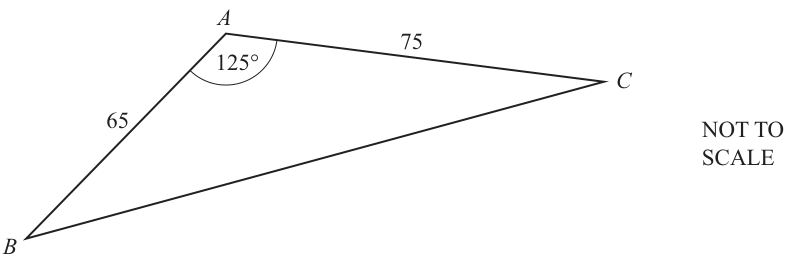
The diagram shows a triangular field, .
, and angle .
Approach
Use the cosine rule to find the length of side given sides , and the included angle .
Working
Take the square root:
Rounding to 1 decimal place:
Answer
124.3
Walkthrough
The cosine rule relates the lengths of the sides of a triangle to the cosine of one of its angles. Since we know two sides ( and ) and the included angle (), we can directly find the third side .
We substitute the known values into the formula . Evaluating the squares and the cosine of (which is negative, making the last term positive), we get . Taking the square root gives , which rounds to to 1 decimal place, matching the required result.
Key Takeaways
- The cosine rule is used when you know two sides and the included angle (SAS) to find the third side.
- Always ensure your calculator is in degree mode when using trigonometric functions with degree inputs.
- Keep extra decimal places during intermediate steps and only round at the final answer to avoid rounding errors.
Common Mistakes
- Forgetting to square the side lengths before subtracting.
- Using the wrong angle or mixing up the sides in the cosine rule formula.
- Rounding intermediate results too early, which can lead to an incorrect final value.
- Forgetting that is negative, which means the term becomes positive.
Things to Be Careful About
- The question asks to show the answer correct to 1 decimal place. Ensure your final answer is exactly and not rounded to 2 decimal places like .
- The diagram is marked NOT TO SCALE, so do not attempt to measure lengths or angles from the diagram; rely entirely on the given numerical values.
Approach
Use the sine rule to find angle . We know side , side , and angle . Angle is opposite side .
Working
Rearrange to solve for :
Evaluate the right-hand side:
Find angle using the inverse sine function:
Rounding to 1 decimal place:
Answer
29.6
Walkthrough
The sine rule states that the ratio of the length of a side to the sine of its opposite angle is constant for all three sides of a triangle: . Here, we want to find angle (which is ). We know its opposite side , and we know another pair: side and its opposite angle .
We set up the equation . Cross-multiplying and rearranging gives . Calculating this value gives approximately . Taking the inverse sine () of this value gives the angle .
Alternatively, the cosine rule can be used: , which yields the same result.
Key Takeaways
- The sine rule is useful when you know a side and its opposite angle, plus another side or angle.
- When using the sine rule to find an angle, always use the inverse sine function.
- In an obtuse triangle, the other two angles must be acute, so there is no ambiguity when using for angle (unlike when finding an obtuse angle).
Common Mistakes
- Setting up the sine rule incorrectly by mixing up which side is opposite which angle (e.g., using instead of for ).
- Forgetting to use the inverse sine function and just outputting instead of the angle.
- Calculator in radian mode instead of degree mode, giving a wildly incorrect angle.
Things to Be Careful About
- The question asks for the angle, so the final answer must be in degrees.
- If using the cosine rule for this part, ensure the formula is correctly rearranged for : .
- Keep the value of as (or use the unrounded ) as given in part (a). Using a rounded value from an earlier step can sometimes cause minor discrepancies, though is accepted here.
Approach
The shortest distance from a point to a line is the perpendicular distance. Let be the perpendicular height from to . We can find by equating two expressions for the area of triangle .
Working
The area of a triangle can be calculated using two sides and the included angle:
The area can also be calculated using the base and the perpendicular height :
Equating the two expressions for the area:
Cancel the from both sides and solve for :
Evaluate the numerator:
Rounding to 1 decimal place:
Answer
32.1
Walkthrough
The shortest distance from point to the line segment is the perpendicular height dropped from to . To find this, we can use the area of the triangle in two different ways.
First, using the two known sides and the included angle: . This gives a numerical value for the area.
Second, using the base and the unknown height : .
Setting these equal allows us to solve for : .
Alternatively, you could use right-angled triangle trigonometry. Drop a perpendicular from to at point . In the right-angled triangle , . Using the angle found in part (b), .
Key Takeaways
- The shortest distance from a point to a line is always the perpendicular distance.
- The area formula is a powerful tool for finding heights or other missing information in triangles.
- Equating two different expressions for the same quantity (like the area of a triangle) is a common and effective problem-solving strategy.
Common Mistakes
- Assuming the shortest distance is one of the given sides ( or ) rather than the perpendicular height.
- Forgetting to cancel the on both sides of the area equation, leading to a height that is twice the correct value.
- Using the wrong angle or side in the right-angled triangle method (e.g., using instead of for the height).
Things to Be Careful About
- The question asks for the distance in metres, so ensure the final answer includes the unit or is clearly understood to be in metres.
- If using the right-angled triangle method, remember to use the unrounded value of angle (from part b) to avoid compounding rounding errors. Using exactly gives , which still rounds to , but it is safer to use more decimal places.
Rearrange the formula to make the subject.
= ______
Approach
To make the subject, we need to isolate on one side of the equation. Since appears in both the numerator and the denominator of the fraction on the right-hand side, the first step is to remove the fraction by multiplying through by the denominator .
Working
Start with the given equation:
Multiply both sides by to clear the denominator:
Expand the bracket on the left-hand side:
Group all terms containing on one side (the left) and all other terms on the other side (the right). Subtract from both sides and add to both sides:
Factorise out of the terms on the left-hand side:
Divide both sides by to isolate :
Answer
(w + 5) / (3w - 2)
Walkthrough
The goal is to change the subject of the formula from to . This means we want an expression of the form .
- Clear the fraction: The variable is currently trapped inside a fraction. To free it, we multiply the entire equation by the denominator, which is . This is equivalent to cross-multiplication. The mark scheme awards a method mark (M1) for this correct setup: .
- Expand: We must distribute the into the bracket. This gives . Another method mark (M1) is awarded for this expansion.
- Group terms: We need all terms containing on one side of the equals sign. Currently, we have on the left and on the right. We subtract from both sides and add to both sides to move the non- terms ( and ) to opposite sides. This results in . This grouping step earns a method mark (M1).
- Factorise and Divide: Now that is common to the left-hand side, we factorise it out: . Finally, to leave alone, we divide the entire equation by the term in the bracket, . This yields the final answer. This final division earns the last method mark (M1).
Key Takeaways
When a variable appears in both the numerator and the denominator of a fraction, you cannot simply "move it across". You must first eliminate the fraction by multiplying by the denominator. Once the fraction is gone, treat it like any other linear equation: expand, collect like terms, factorise, and divide.
Common Mistakes
- Forgetting to multiply the RHS constant: When clearing fractions, students sometimes forget that the multiplies the entire left side, or they fail to distribute it correctly during expansion.
- Sign errors when grouping: Moving to the left makes it , and moving to the right makes it . Getting these signs wrong leads to incorrect factors.
- Incorrect factorisation: Failing to pull out of both and .
Things to Be Careful About
- The final answer must be written as a single fraction.
- The mark scheme accepts equivalent forms such as , which arises if you choose to group terms differently (e.g., putting terms on the right). However, is the standard result. Ensure your denominator is not zero if domain restrictions were asked (though not required here).
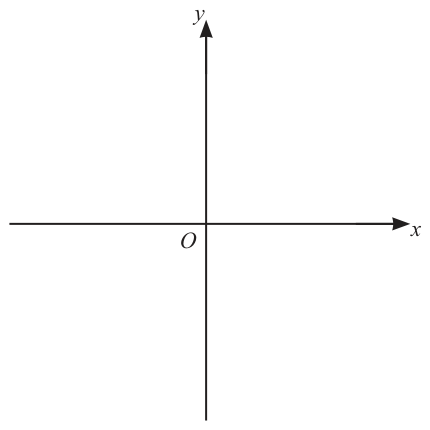
Approach
To sketch the line , find the -intercept and the -intercept, then draw a straight line through them.
Working
The -intercept is found by setting :
So the line crosses the -axis at .
The -intercept is found by setting :
So the line crosses the -axis at .
Draw a straight line through and . The line has a negative gradient of and a positive -intercept.
Answer
A straight line with negative gradient, passing through and .
Straight line with y-intercept 2 and x-intercept 2/3
Walkthrough
To sketch a straight line, we only need two points. The easiest points to find are the intercepts. Setting gives the -intercept, which is . Setting gives the -intercept, which is . Drawing a straight line through these two points produces the correct sketch. The negative coefficient of means the line slopes downwards from left to right.
Key Takeaways
- The -intercept of is .
- The -intercept is found by setting and solving for .
- A sketch of a straight line only needs to show the correct gradient and intercepts, not necessarily exact scale.
Common Mistakes
- Forgetting that a sketch does not require exact scale, but must show the correct shape (straight line) and approximate intercept positions.
- Calculating the -intercept incorrectly, e.g., (sign error).
Things to Be Careful About
- Ensure the line is drawn straight, not curved.
- The gradient is negative, so the line must go down from left to right.
- The -intercept is positive (), so it must cross the -axis above the origin.
Approach
To write in the form , factor out the coefficient of from the first two terms, complete the square inside the bracket, and then simplify the constant terms outside.
Working
Factor out from the and terms:
Complete the square for . Half of is , so:
Substitute this back into the expression:
Expand the outer bracket:
Simplify the constants:
Answer
2(x - 1)^2 - 5
Walkthrough
We want to express in the form . First, factor out the coefficient of (which is ) from the and terms: . Next, complete the square inside the bracket. Half of the coefficient of (which is ) is , so becomes . Substitute this back: . Multiply the by the outside: . Finally, combine the constants: . The result is .
Key Takeaways
- Always factor out the leading coefficient before completing the square if it is not .
- Remember to multiply the completed square constant by the factored-out coefficient when simplifying.
- The form directly gives the turning point .
Common Mistakes
- Forgetting to multiply the from the completed square by the outside the bracket.
- Incorrectly calculating half of the coefficient of .
- Sign errors when expanding .
Things to Be Careful About
- The question asks for the form , so ensure the final answer matches this structure exactly.
- Working must be shown (www) to earn method marks.
Sketch the graph of .
On your sketch, label the -intercept and the coordinates of the turning point.
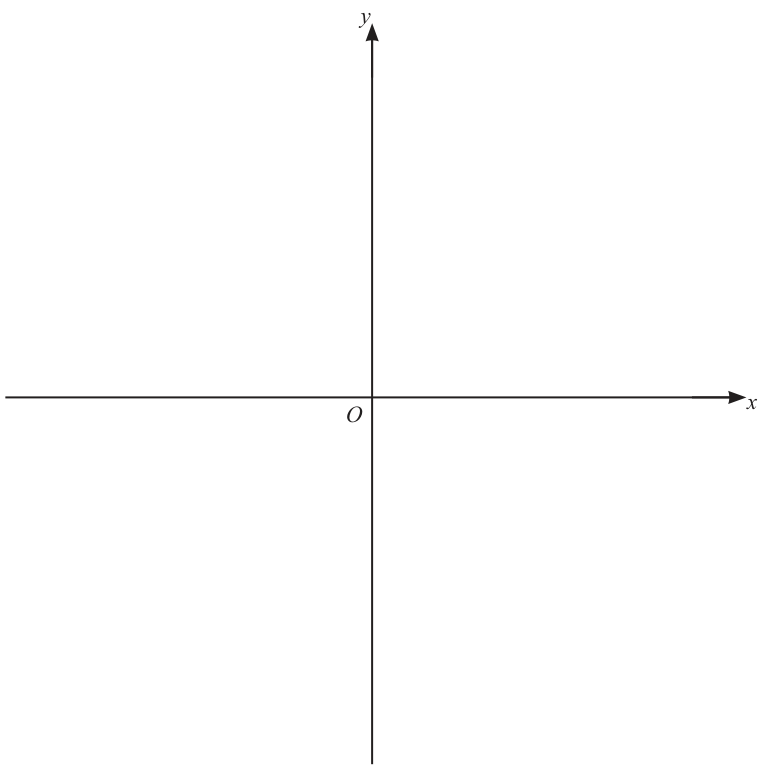
Approach
Use the completed square form from part (b)(i) to identify the turning point, and substitute into the original equation to find the -intercept. Then sketch the parabola.
Working
From part (b)(i), the equation in completed square form is:
The turning point (vertex) is at .
To find the -intercept, set in the original equation :
So the -intercept is at .
Sketch a U-shaped parabola (since the coefficient of is positive) with the turning point at and passing through the -intercept at .
Answer
Sketch of a parabola with turning point at and -intercept at .
Parabola with turning point (1, -5) and y-intercept -3
Walkthrough
The completed square form tells us the turning point is at . Since the coefficient of is positive (), the parabola opens upwards (U-shape). To find the -intercept, we substitute into the original equation , giving . We sketch a smooth U-shaped curve with its minimum at that crosses the -axis at . By symmetry, it will also cross the -axis at .
Key Takeaways
- The completed square form directly gives the turning point .
- The sign of determines whether the parabola opens upwards (positive) or downwards (negative).
- The -intercept is always found by setting .
Common Mistakes
- Misreading the turning point coordinates from the completed square form (e.g., writing instead of ).
- Forgetting to label both the turning point and the -intercept as required.
- Drawing a straight line instead of a curve.
Things to Be Careful About
- The sketch must clearly show the turning point and -intercept with their coordinates or values marked.
- The parabola must be U-shaped (positive coefficient of ).
- Follow-through marks are awarded for the turning point if it is incorrect in part (b)(i), but the -intercept must be calculated correctly from the original equation.
Solve.
= ______
Approach
To solve the equation with in the denominators, we first combine the two fractions on the left-hand side over a common denominator. Then, we multiply through by this denominator to clear the fractions and obtain a standard linear equation.
Working
The given equation is:
Find a common denominator, which is :
Multiply both sides by the denominator to clear the fraction (Method mark M1/M2):
Expand the brackets on both sides (Method mark M1):
Left Hand Side:
Right Hand Side:
Set them equal:
Subtract from both sides to eliminate the quadratic term:
Rearrange to solve for . Add to both sides and add to both sides:
Divide by 7:
Check validity: The original denominators are and . If , neither is zero, so the solution is valid.
Answer
3/7
Walkthrough
The problem asks us to solve an equation containing algebraic fractions. The key strategy is to eliminate the fractions early on to make the equation easier to handle.
-
Common Denominator: We look at the two terms on the left: and . To subtract them, they must have the same bottom part (denominator). We multiply the top and bottom of the first fraction by and the second by . This gives us a combined numerator of over the combined denominator .
-
Clearing Fractions: Since the whole left side equals 1, we can multiply the entire equation by the denominator . This cancels the denominator on the left and leaves just 1 times that expression on the right. This step transforms a complex fraction equation into a polynomial equation.
-
Expansion: We expand the brackets. On the left, becomes and becomes . On the right, expands to .
-
Simplification: Notice that we have on both sides. Subtracting removes the quadratic nature of the problem, leaving a simple linear equation (). This is a crucial simplification step.
-
Solving: Finally, we group the terms on one side and the constant numbers on the other. Adding and results in , giving .
Key Takeaways
- When adding or subtracting fractions, always find a common denominator first.
- Multiplying by the denominator is the most efficient way to clear fractions in an equation.
- Always check if the highest power of cancels out; here the quadratic terms cancelled, making it a linear equation.
Common Mistakes
- Incorrect Expansion: Forgetting to distribute the negative sign when expanding , leading to instead of .
- Wrong Cross-Multiplication: Trying to cross-multiply directly without combining the left side first, which is not applicable for three-term equations like .
- Algebra Errors: Incorrectly expanding the product as (ignoring the middle terms).
Things to Be Careful About
- Ensure you expand ALL brackets correctly. The mark scheme awards marks for correct expansion.
- Check that your final answer does not make any original denominator zero. Here is safe.
- The answer should be in exact form (fraction), not a rounded decimal.
Expand and simplify.
______
Approach
We expand the expression in stages. First, multiply the first two binomials and . Then, multiply that quadratic result by the remaining factor . Finally, collect all like terms to write the polynomial in standard form.
Working
First, expand :
Now substitute this back into the original expression:
Multiply each term in the quadratic by :
Multiply each term in the quadratic by :
Add these two results together:
Group the like terms:
Simplify:
Answer
3x^3 + 2x^2 - 17x + 12
Walkthrough
The problem asks us to simplify a product of three brackets. Since we cannot combine them all at once, we break it down.
Step 1: Expand the first two brackets . We use the FOIL method (First, Outer, Inner, Last) or simply distribute each term. , , , and . Combining and gives . So the intermediate result is .
Step 2: Multiply this new quadratic expression by the remaining bracket . This requires distributing every term in the quadratic to both and .
- Multiplying by : , , .
- Multiplying by : , , .
Step 3: Collect like terms. We have one cubic term (), two quadratic terms ( and ), two linear terms ( and ), and one constant (). Adding the quadratics gives . Adding the linear terms gives . The final answer is the sum of these parts.
Key Takeaways
When expanding more than two brackets, always work from left to right, expanding two brackets at a time. After each expansion, check that you haven't lost any terms before moving to the next multiplication. Be very careful with negative signs when multiplying by a negative number (e.g., ).
Common Mistakes
- Incorrectly combining like terms during the first expansion (e.g., getting instead of ).
- Forgetting to multiply every term in the quadratic by both and (missing terms is a common error).
- Sign errors, particularly when multiplying negative numbers (e.g., writing instead of , or as ).
- Failing to collect like terms correctly at the end.
Things to Be Careful About
Ensure your final answer is written in descending powers of . The mark scheme awards marks for correct unsimplified forms, but the simplified standard form is required for full credit. Double-check arithmetic on the middle terms, as small sign errors there often lead to incorrect final answers.
The diagram shows a cuboid.
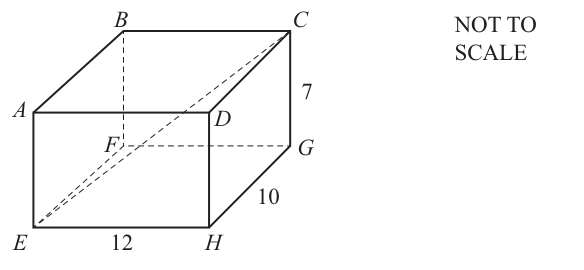
, and .
Approach
To find the length of the space diagonal , apply Pythagoras' theorem twice: first to find the diagonal of the base , then to find the space diagonal using the vertical height . Alternatively, use the direct 3D formula .
Working
Substitute the given lengths , , :
Rounding to 1 decimal place:
This matches the required result.
Answer
17.1 cm
Walkthrough
The problem asks for the length of the space diagonal of a cuboid. The cuboid has length , width , and height . In a cuboid, the square of the space diagonal is equal to the sum of the squares of its three dimensions. We can derive this by first finding the diagonal of the base rectangle , which is . In right-angled triangle , . Then, in right-angled triangle (right-angled at because is perpendicular to the base), . Taking the square root gives . Rounding to 1 decimal place gives cm.
Key Takeaways
- The length of a space diagonal in a cuboid with dimensions is .
- Always verify which triangle is right-angled before applying Pythagoras' theorem.
- Round only at the final stage to avoid accumulation of rounding errors.
Common Mistakes
- Using only two dimensions instead of three (e.g., calculating the base diagonal and stopping there).
- Forgetting to square the numbers before adding them.
- Rounding intermediate results (like ) too early, which can lead to an incorrect final answer.
- Not rounding the final answer to the required 1 decimal place.
Things to Be Careful About
- The mark scheme accepts directly as a method mark, showing that the 3D Pythagorean formula is expected.
- Ensure the final answer is rounded correctly to 1 decimal place: rounds to , not .
- Units must be included in the final answer as requested ().
Approach
The angle between a line and a plane is the angle between the line and its projection onto that plane. The projection of onto the base is (since is vertical). Thus, the projection of onto the base is , and the required angle is . In right-angled triangle (right-angled at ), we know the opposite side and the hypotenuse .
Working
Substitute the values:
Rounding to 1 decimal place (or as appropriate):
(Note: using from part (a) gives .)
Answer
24.2 degrees
Walkthrough
To find the angle between the line and the base , we need to find the angle between and its projection onto the base. Since is perpendicular to the base, the point is the projection of onto the base. Therefore, the projection of the line onto the base is the line segment . The angle we want is .
Consider the triangle . Since is a vertical edge of the cuboid, it is perpendicular to any line in the base passing through , including . Thus, triangle is right-angled at .
We know:
- Opposite side to is cm.
- Hypotenuse is cm (from part a).
Using the sine ratio:
Calculate the angle:
Rounding to 1 decimal place gives . If a student uses the rounded value from part (a), they get , which also rounds to .
Key Takeaways
- The angle between a line and a plane is measured between the line and its orthogonal projection onto the plane.
- In a cuboid, vertical edges are perpendicular to the base, creating right-angled triangles for 3D angle calculations.
- Use the correct trigonometric ratio (sine, cosine, or tangent) based on the known sides of the right-angled triangle.
Common Mistakes
- Identifying the wrong angle (e.g., using but measuring from the wrong vertex, or confusing it with the angle between and a vertical edge).
- Using the wrong trigonometric ratio (e.g., using tangent instead of sine when the hypotenuse is known).
- Rounding the length too early or incorrectly, leading to a slightly different angle.
- Forgetting to use the inverse trigonometric function (arc sine) to find the angle.
Things to Be Careful About
- The mark scheme accepts or recognising the angle . Ensure the angle is clearly identified as .
- Accuracy: the mark scheme allows or . Using exact values gives . Using gives . Both are acceptable.
- Always include the degree symbol in the final answer for angles.