Mathematics (Syllabus D) 4024/11 — October/November 2025
Cambridge O-Level · Non-calculator · worked solutions for every part, with the mark scheme
Topics Number · Algebra and Graphs · Mensuration · Statistics · Geometry · Transformations and Vectors · +3 more
Write down the reciprocal of .
______
Approach
The reciprocal of a fraction is found by swapping the numerator and the denominator, resulting in . This is equivalent to raising the fraction to the power of .
Working
Answer
2/7
Walkthrough
To find the reciprocal of a number, we are looking for a value that, when multiplied by the original number, gives a product of 1. For a fraction , the reciprocal is simply the fraction flipped upside down: .
In this question, the given fraction is . The numerator is 7 and the denominator is 2. To get the reciprocal, we swap these positions so that 2 becomes the numerator and 7 becomes the denominator.
Thus, the reciprocal is .
Key Takeaways
- The reciprocal of any non-zero number is .
- For a fraction , the reciprocal is .
- A number multiplied by its reciprocal always equals 1.
Common Mistakes
- Not flipping correctly: Writing the same fraction back or confusing it with the negative (e.g., ).
- Incorrect simplification: Trying to simplify further, which is already in its simplest form.
- Decimal conversion errors: Attempting to convert to decimals () and then finding the reciprocal () instead of keeping the exact fractional form required.
Things to Be Careful About
- Ensure the answer is in the correct form. The mark scheme specifies "cao" (correct answer only), meaning the exact fraction is expected. Do not round or provide a decimal approximation unless asked.
- Remember that the reciprocal of an integer is , not .
Some children record the number of hours they each spend watching television one day.
These are the results.
Approach
To find the mode, we identify which value occurs most frequently in the given data set.
Working
The data set representing the hours spent watching television is:
We count the frequency of each value:
- appears time
- appears times
- appears time
- appears times
- appears time
- appears time
The value has the highest frequency ().
Answer
2
Walkthrough
The mode is defined as the value in a data set that appears most often. To find it, look at the list of numbers: . By counting how many times each number appears, we see that the number appears three times, while every other number appears either once or twice. Therefore, the mode is .
Key Takeaways
- The mode is the most common value.
- A data set can have more than one mode (bimodal, multimodal) or no mode if all values appear with the same frequency.
Common Mistakes
- Confusing the mode with the median (the middle value) or the mean (the average). For this data, the median is and the mean is approximately , so choosing those would be incorrect.
- Selecting the number that appears second-most often (, which appears twice).
Things to Be Careful About
- Ensure you are looking for the value itself, not the frequency count. The answer is the number of hours (), not how many children watched for 2 hours ().
One of the 9 children is chosen at random.
Find the probability that this child spends more than 6 hours watching television on this day.
______
Approach
Calculate the probability by dividing the number of children who satisfy the condition by the total number of children. The condition is spending more than 6 hours watching television.
Working
First, determine the total number of children recorded in the data set. Counting the entries:
There are values in total, so the denominator is .
Next, identify the values that are strictly greater than . Looking at the list:
- is not
- is not
- is not (it is equal to 6)
- is
- is
- is
- is
The values satisfying the condition are and . There are such values.
Therefore, the probability is:
Answer
4/9
Walkthrough
The probability of an event is calculated as the ratio of favorable outcomes to total possible outcomes.
- Total outcomes: The problem states "One of the 9 children is chosen", confirming there are 9 items in our sample space. We can also verify this by counting the numbers in the list provided.
- Favorable outcomes: The condition is "more than 6 hours". This means we must exclude any child who watched exactly 6 hours. We scan the list for numbers strictly larger than 6. The numbers are 7, 7, 8, and 10. Counting these gives us 4 children.
- Form the fraction: Place the count of favorable outcomes (4) over the total count (9).
Key Takeaways
- Probability is always .
- Read inequality conditions carefully: "more than" means , while "at least" means .
Common Mistakes
- Including the value '6' in the count. The question asks for more than 6, so 6 is excluded. If included, the numerator would incorrectly become 5.
- Miscounting the total number of children.
- Writing the decimal approximation instead of the exact fraction (though usually acceptable unless specified otherwise, fractions are preferred in 4024 non-calculator papers).
Things to Be Careful About
- The phrase "more than" excludes the boundary value. If the question said "6 hours or more", the answer would be .
A shirt costs $24.
In a sale the cost is reduced by 15%.
Work out the cost of the shirt in the sale.
$ ______
Approach
The shirt originally costs $24. It is reduced by 15%. We need to calculate the sale price.
There are two common methods:
- Calculate the discount amount (15% of $24) and subtract it from the original price.
- Calculate the remaining percentage (100% - 15% = 85%) and multiply the original price by this decimal/fraction.
We will use Method 1 as it aligns directly with the mark scheme's primary method route.
Working
Method 1: Subtract the discount
First, find 15% of $24.
Calculate the value:
Break down the multiplication for clarity:
So the discount is $3.60.
Now, subtract the discount from the original cost:
Method 2: Multiply by the remaining percentage
The sale price is of the original price.
Calculation:
Answer
20.40
Walkthrough
The problem asks for the new price of an item after a percentage reduction. The original price is $24, and the reduction is 15%.
Step 1: Understand what "reduced by 15%" means.
It means we take away 15% of the original $24 from the $24. Alternatively, it means we keep 85% of the original price.
Step 2: Calculate the discount amount.
Using the fraction method: .
Discount = .
, so . The discount is $3.60.
Step 3: Calculate the final sale price.
Original Price - Discount = Sale Price.
.
Alternatively, using the multiplier method:
Remaining percentage = .
Sale Price = .
.
Both methods yield $20.40.
Key Takeaways
- To reduce a quantity by a percentage, you can either subtract the calculated percentage amount from the original, or multiply the original by .
- can be easily calculated as . of 24 is 2.4, and is half of that, which is 1.2. Summing them gives 3.6.
- Always include the currency symbol and correct decimal places in the final answer when dealing with money.
Common Mistakes
- Adding 15% instead of subtracting it (calculating an increase).
- Calculating 15% correctly but forgetting to subtract it from the original price (stopping at 3.60).
- Arithmetic errors in multiplying decimals (e.g., ).
- Rounding errors (though here the answer is exact).
Things to Be Careful About
- The question involves money, so the answer should ideally be given to two decimal places ($20.40), although $20.4 is mathematically equivalent. The mark scheme accepts .
- Ensure you are calculating the sale price, not just the discount amount.
- In non-calculator exams, show your working clearly for the percentage calculation (e.g., ) to secure method marks if the final answer is wrong.
The diagram shows five straight lines.
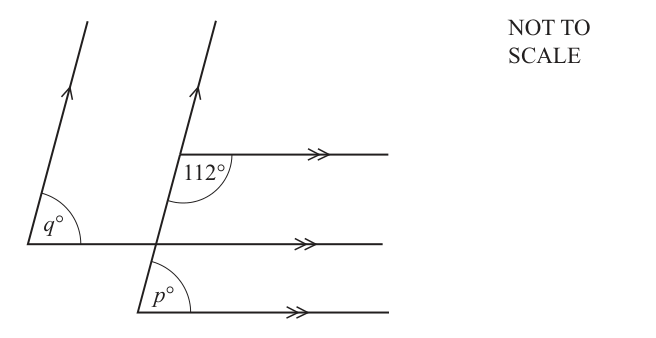
The diagram shows three horizontal parallel lines and two sloping parallel lines.
Find the value of .
Give a geometrical reason to explain your answer.
= ______ because ______
Approach
The top and bottom horizontal lines are parallel, and the right-hand sloping line acts as a transversal cutting through them. The angle marked and the angle marked lie between these two parallel lines and on the same side of the transversal, making them co-interior (or allied) angles. Co-interior angles between parallel lines sum to .
Working
Subtract from both sides:
Answer
because co-interior angles sum to .
p = 68, co-interior angles sum to 180
Walkthrough
The question provides a diagram with three horizontal parallel lines and two sloping parallel lines. For part (a), we focus on the top horizontal line, the bottom horizontal line, and the right-hand sloping line that intersects both. These two horizontal lines are parallel, and the sloping line is a transversal. The angle is below the top line and to the left of the transversal. The angle is above the bottom line and also to the left of the transversal. Because they are on the same side of the transversal and between the parallel lines, they are co-interior angles (also called allied angles or consecutive interior angles). A key property of parallel lines cut by a transversal is that co-interior angles add up to . Therefore, we set up the equation and solve for to get .
Key Takeaways
- Co-interior angles (angles on the same side of a transversal and between parallel lines) always sum to .
- When applying parallel line rules, clearly identify which two lines are parallel and which line is the transversal cutting through them.
Common Mistakes
- Confusing co-interior angles with alternate interior angles (which are equal) or corresponding angles (which are also equal). Always check the position: if they are on the same side and between the parallels, they sum to .
- Forgetting to state the geometrical reason clearly; the mark scheme awards one mark for the value and one mark for the correct reason ("co-interior angles sum to 180").
Things to Be Careful About
- Ensure the reason is stated precisely. Saying "angles on a straight line" or "angles in a triangle" will not earn the method mark. The exact reason required is that co-interior angles sum to .
- The diagram is marked "NOT TO SCALE", so do not estimate angles by eye; rely only on the given values and parallel line properties.
Find the value of .
Give a geometrical reason to explain your answer.
= ______ because ______
Approach
We now use the value found in part (a). Consider the two sloping lines, which are parallel to each other, and the bottom horizontal line as a transversal. The angle is above the bottom horizontal line and to the left of the right-hand sloping line. By the property of corresponding angles between parallel lines, the angle in the same position at the intersection of the left-hand sloping line and the bottom horizontal line is also . Alternatively, and more directly, consider the two parallel sloping lines cut by the middle horizontal line. The angle at the right-hand sloping line and middle horizontal line (above the middle line, left of the transversal) is equal to because they are corresponding angles between the top and bottom parallel lines cut by the right-hand sloping transversal. Then, and this angle are corresponding angles between the parallel sloping lines cut by the middle horizontal transversal. Thus, .
A simpler route accepted by the mark scheme: The angle and the angle are corresponding angles. To see this, note that the angle corresponding to on the left-hand sloping line (above the bottom horizontal line, left of the left-hand sloping line) is equal to . Then, using the middle horizontal line as a transversal cutting the parallel sloping lines, is in the corresponding position to that angle. Ultimately, .
Working
Substitute :
Answer
because corresponding angles are equal.
q = 68, corresponding angles are equal
Walkthrough
For part (b), we need to find . The mark scheme indicates that is equal to by corresponding angles, with follow-through from the value found in part (a). To justify this geometrically: the two sloping lines are parallel. The horizontal lines act as transversals. The angle is at the intersection of the right-hand sloping line and the bottom horizontal line (above the horizontal, left of the sloping line). The angle is at the intersection of the left-hand sloping line and the middle horizontal line (above the horizontal, left of the sloping line). Because the sloping lines are parallel and the horizontal lines are parallel, the angle is in the exact same relative position to its intersection as is to its intersection. Therefore, they are corresponding angles and are equal. Substituting the value from part (a), .
Key Takeaways
- Corresponding angles are equal when two parallel lines are cut by a transversal. They are in the same relative position at each intersection.
- When a problem has multiple parts, always check if an earlier result can be used directly in a later part (follow-through).
Common Mistakes
- Not using the value from part (a); the mark scheme explicitly allows follow-through (FT) on their , so if a student got wrong in part (a), they can still get the mark for if they correctly state and use their own value. However, since is correctly , must be .
- Stating the wrong reason, such as "alternate angles are equal" or "co-interior angles sum to 180". The angles and are on the same side of the transversal and in the same position relative to the parallel lines, making them corresponding.
Things to Be Careful About
- The geometrical reason must be specific: "corresponding angles are equal". Vague reasons like "angles are equal" will not earn the mark.
- Ensure the follow-through from part (a) is clearly stated if using it, though here the value is simply .
The table shows how some people travel to work.
| Type of travel | Number of people | Pie chart angle |
|---|---|---|
| Cycle | 20 | |
| Walk | 12 | |
| Car | ||
| Bus | 5 |
Approach
Find the angle per person using the Cycle row, then find the total number of people, and use these to calculate the missing values for Car and Bus.
Working
From the Cycle row, 20 people correspond to .
The total angle in a pie chart is , so the total number of people is:
For the Bus row, there are 5 people:
For the Car row, the number of people is the total minus the others:
The angle for Car is:
Answer
| Type of travel | Number of people | Pie chart angle |
|---|---|---|
| Cycle | 20 | |
| Walk | 12 | |
| Car | 23 | |
| Bus | 5 |
Car: 23 people, 138°; Bus: 30°
Walkthrough
First, determine the scale of the pie chart by dividing the given angle by the given frequency. For Cycle, represents 20 people, so person represents . Next, find the total number of people by dividing the full circle angle () by the angle per person (), giving people. Then, calculate the missing angle for Bus by multiplying its frequency () by , which gives . Finally, find the missing frequency for Car by subtracting the known frequencies from the total (), and calculate its angle by multiplying by , giving .
Key Takeaways
- In a pie chart, the total angle is always and represents the total frequency.
- You can find the scale (angle per unit) by dividing a known angle by its corresponding frequency.
- Missing frequencies and angles can be found by using the scale and the total frequency.
Common Mistakes
- Forgetting that the total angle in a pie chart is .
- Calculating the total frequency incorrectly by not using the scale.
- Forgetting to subtract all known frequencies from the total to find the missing frequency.
- Not showing working for the calculated values (mark scheme requires "www" or at least the total/ scale to be visible for method marks).
Things to Be Careful About
- Ensure all angles sum to exactly ().
- Ensure all frequencies sum to the total ().
- The mark scheme awards method marks for finding the total number of people () or the scale ( represents person), so show these intermediate steps clearly.
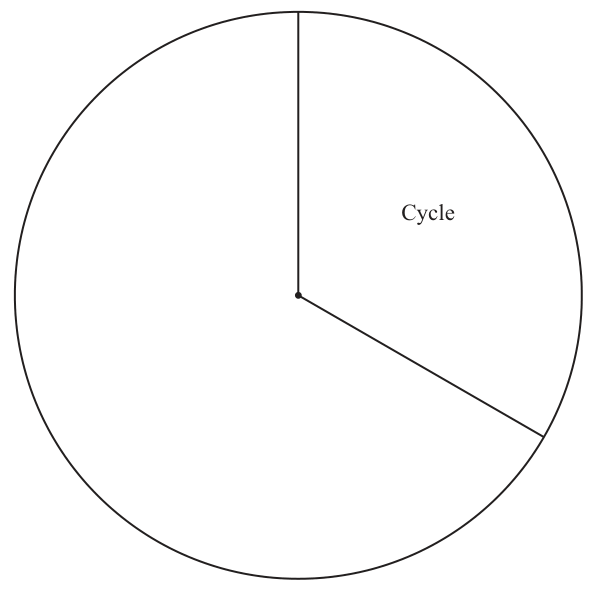
Approach
Use the angles calculated in part (a) to draw the remaining sectors on the pie chart, starting from the existing Cycle sector.
Working
The angles for each sector are:
- Cycle: (already drawn)
- Walk:
- Car:
- Bus:
Total angle: .
Draw the sectors in order, labeling each with the type of travel.
Answer
Pie chart with sectors: Cycle (), Walk (), Car (), Bus ().
Pie chart with sectors Cycle (120°), Walk (72°), Car (138°), Bus (30°)
Walkthrough
The pie chart already has the Cycle sector drawn (). Starting from the end of the Cycle sector, draw the Walk sector with an angle of . Next, draw the Car sector with an angle of . Finally, draw the Bus sector with an angle of to complete the circle. Label each sector with its corresponding type of travel. Ensure the angles sum to .
Key Takeaways
- A pie chart must have sectors that sum to .
- Sectors should be drawn in order and labeled clearly.
- The size of each sector is proportional to the frequency it represents.
Common Mistakes
- Drawing sectors with incorrect angles.
- Forgetting to label the sectors.
- Not starting from the correct position or drawing sectors in the wrong order, leading to a messy diagram.
- Not completing the circle (remaining angle should be exactly ).
Things to Be Careful About
- Use a protractor to measure the angles accurately.
- The mark scheme awards follow-through marks (B1 FT) if one sector is drawn correctly based on part (a), so ensure the angles from part (a) are correct.
- Labels should be clear and not overlap with the sector lines.
Sam buys some chocolate.
He eats of the chocolate.
The mass of the remaining chocolate is .
Work out the mass of the chocolate Sam buys.
______
Approach
Sam eats of the chocolate. We first determine what fraction of the chocolate remains. Then, using the fact that this remaining fraction equals , we calculate the total mass by dividing by the numerator and multiplying by the denominator (the unitary method).
Working
The fraction of chocolate eaten is:
The fraction of chocolate remaining is:
We are given that the mass of the remaining chocolate is . Therefore:
To find the total mass, we divide by to find the value of :
Now, multiply by to find the full mass ():
Answer
490
Walkthrough
First, identify the portion of the chocolate that was not eaten. Since Sam ate of the total, the remaining part is the complement of this fraction with respect to the whole ( or ). Subtracting from gives .
Next, link this fraction to the physical quantity provided. The problem states that the remaining mass is . This means that parts out of every parts of the total mass equal .
To find the total mass, use the unitary method: divide the known mass by the number of parts it represents () to find the mass of a single part (), then multiply by the total number of parts ().
Calculation steps:
- Remaining fraction:
- Value of one part ():
- Total value ():
Key Takeaways
- When a fraction of a quantity is used or removed, subtract that fraction from to find the remainder.
- To find a total from a fractional part, divide the part's value by the fraction's numerator, then multiply by the denominator.
Common Mistakes
- Incorrect subtraction: Calculating as incorrectly (e.g., , but forgetting the denominator stays the same, or getting the wrong sum).
- Multiplying instead of dividing: Multiplying by or instead of finding the total. This leads to a smaller number than the part itself.
- Scaling error: Dividing by correctly but then multiplying by the wrong number (e.g., multiplying by again or by ).
- Confusing 'eaten' with 'remaining': Using directly with the figure, assuming is the amount eaten.
Things to Be Careful About
- Ensure you answer for the total mass bought, not just the remaining mass or the eaten mass.
- Check your arithmetic: and .
- The mark scheme awards a specific shortcut mark (B1) for writing , so showing this division explicitly helps secure partial credit if the final multiplication is incorrect.
| Car hire |
|---|
| $40 per day plus $0.30 per kilometre |
Amy hires a car for 10 days.
She pays a total of $670.
Work out the number of kilometres Amy travels in the car.
______
Approach
The total cost consists of two parts: a fixed daily hire fee and a variable mileage fee. We need to isolate the mileage fee by removing the fixed cost from the total amount paid, then divide by the cost per kilometre to find the distance.
Working
First, calculate the total fixed cost for hiring the car for 10 days at $40 per day:
Next, determine how much of the total $670 was spent on the mileage fee by subtracting the fixed cost:
Finally, since the cost is $0.30 per kilometre, divide the total mileage fee by the rate per kilometre to find the number of kilometres travelled:
To perform this division easily without a calculator, multiply both numerator and denominator by 10:
Answer
900 km
Walkthrough
This question describes a linear relationship between cost and distance: Total Cost = (Daily Rate × Days) + (Rate per km × Kilometres).
-
Calculate the fixed portion: The car hire charges $40 for every day. Amy hires the car for 10 days. So, the base cost is . This amount is paid regardless of how far she drives.
-
Isolate the variable portion: Amy pays a total of $670. Since $400 of that covers the daily hire, the rest must cover the distance driven. We subtract the fixed cost from the total: . This means $270 was spent solely on mileage.
-
Calculate the distance: The mileage charge is $0.30 per kilometre. To find out how many kilometres correspond to $270, we divide the mileage money by the cost per kilometre: .
On a non-calculator paper, dividing by a decimal like 0.3 can be tricky. A good method is to convert the divisor into a whole number. Multiply 0.3 by 10 to get 3. Do the same to the dividend (270 becomes 2700). Now the calculation is simply , which is 900.
Key Takeaways
- Structure of Costs: Many real-world problems involve a 'fixed cost' plus a 'variable cost'. Understanding this structure allows you to separate the components using subtraction.
- Division by Decimals: When dividing by a decimal (like 0.3), converting it to an integer (multiplying top and bottom by 10, 100, etc.) makes the arithmetic much simpler and less prone to error.
Common Mistakes
- Incorrect Order of Operations: Subtracting 40 from 670 first () ignores that the $40 is a daily rate for 10 days. You must multiply the daily rate by the number of days before subtracting.
- Multiplication Error: Calculating incorrectly.
- Decimal Division: Struggling with or misplacing the decimal point in the final answer.
Things to Be Careful About
- Units: Ensure you are calculating kilometres, not dollars. The question asks for "number of kilometres".
- Non-Calculator Component: Remember to show your working for the decimal division clearly (e.g., converting to ) rather than just stating the result.
- Total vs Daily: Always check if a rate given in the question is per item/day/unit or a lump sum. Here, $40 is 'per day', so it must be scaled by the number of days.
The diagram shows triangle and triangle .
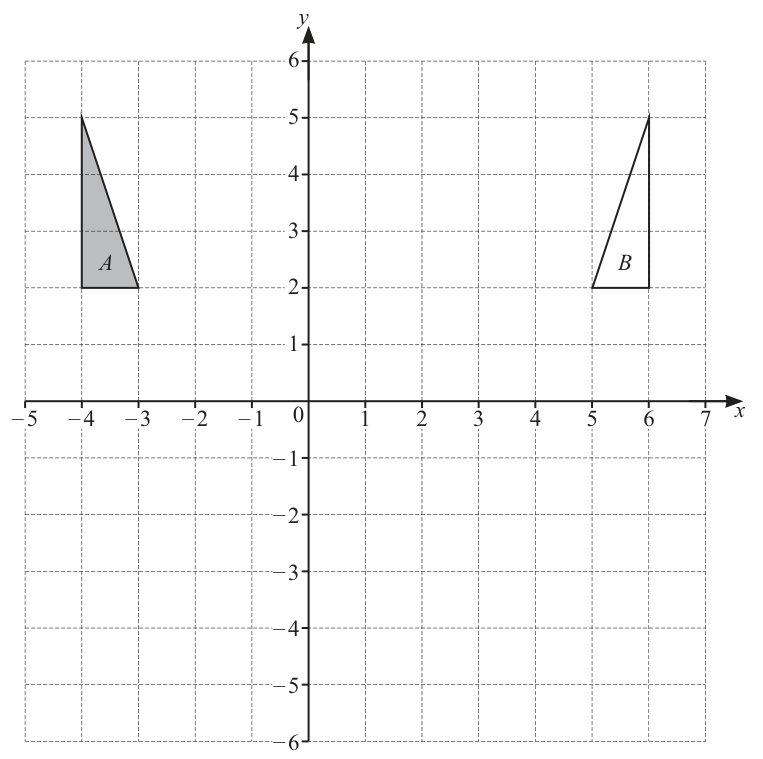
Approach
Compare corresponding vertices of triangle and triangle to determine the type of transformation and its parameters.
Working
Triangle has vertices at , and . Triangle has vertices at , and .
The -coordinates are unchanged, and the -coordinates change from negative to positive, indicating a reflection in a vertical line.
The midpoint of the -coordinates of corresponding points gives the line of reflection:
Checking with another pair:
The transformation is a reflection in the line .
Answer
Reflection in the line .
Reflection in the line x = 1
Walkthrough
To describe a transformation fully, we must identify the type of transformation and provide the specific parameter (the line of reflection, centre of rotation, vector of translation, or scale factor and centre of enlargement). Comparing the coordinates of the vertices of triangle and triangle , we see that the -coordinates remain the same while the -coordinates change sign and shift. This indicates a reflection in a vertical line. To find the line of reflection, we calculate the midpoint between the -coordinates of any pair of corresponding vertices. The midpoint of and is , and the midpoint of and is also . Therefore, the line of reflection is .
Key Takeaways
A reflection in a vertical line maps to . The -coordinates are unchanged, and the -coordinates are equidistant from the line of reflection.
Common Mistakes
- Describing the transformation as a translation or rotation instead of a reflection.
- Giving only the type of transformation without specifying the line, or vice versa. Both are required for full marks.
- Calculating the midpoint incorrectly or using the wrong coordinates.
Things to Be Careful About
- A full description of a reflection requires both the type of transformation and the equation of the line of reflection.
- Ensure the coordinates read from the grid are correct before performing any calculations.
Approach
Apply the rule for a rotation about the origin , which maps to , to each vertex of triangle .
Working
The vertices of triangle are , and .
Applying the rotation rule :
Draw the triangle with vertices at , and .
Answer
Triangle with vertices at , and .
Triangle with vertices at (3, -2), (4, -2) and (4, -5)
Walkthrough
A rotation of about the origin maps any point to . This means both the -coordinate and the -coordinate change sign. Applying this to the vertices of triangle : becomes , becomes , and becomes . These new coordinates are plotted on the grid to draw the image of triangle .
Key Takeaways
A rotation about the origin is equivalent to a point reflection through the origin, where .
Common Mistakes
- Forgetting to change the sign of both coordinates.
- Plotting the points incorrectly on the grid.
- Drawing a triangle that is not congruent to the original.
Things to Be Careful About
- Ensure the drawn triangle is the correct size and orientation. The mark scheme awards partial credit for correct size and orientation even if the position is wrong, but full marks require the correct position.
- When drawing on a grid, verify that each vertex is placed exactly at the calculated coordinates.
By writing each number correct to 1 significant figure, work out an estimate for the value of
______
Approach
To estimate the value of the expression, we first round each number in the calculation to 1 significant figure. Then we substitute these rounded values back into the expression and evaluate.
Working
The expression is:
Step 1: Round to 1 significant figure.
The first digit is . The next digit is , so we round down to:
Step 2: Estimate .
Since has been rounded to , we use:
Note: While is slightly larger than , for an estimate to 1 significant figure based on the rounded input, is the standard approach. Alternatively, one might just round the final result of the surd if calculated directly, but using the rounded integer is clearer for estimation steps. Let's look at the marking scheme. It expects . So is implied as part of the process or the numerator becomes .
Step 3: Round to 1 significant figure.
The first digit is . The next digit is , so we round up to:
Step 4: Round to 1 significant figure.
The first digit is . The next digit is , so we round up to:
Step 5: Substitute the estimated values into the expression.
Step 6: Calculate the final value.
Answer
3
Walkthrough
The question asks for an estimate using 1 significant figure (s.f.) for each number involved in the calculation. This simplifies complex numbers into easy-to-calculate integers.
- Round : To 1 s.f., we look at the first non-zero digit (). The digit after it is , which is less than , so we keep the and replace subsequent digits with zeros. Result: . Consequently, is estimated as .
- Round : The first digit is . The next digit is , which is or greater, so we round up. Result: .
- Round : The first digit is . The next digit is , so we round up. Result: .
- Calculate: Substitute these values into the fraction:
Multiply the numerator: .
Divide by the denominator: .
Key Takeaways
- Estimation Strategy: When asked to estimate, always round intermediate values to 1 significant figure to make mental math easier.
- Square Roots of Rounded Numbers: If you round a number under a square root to a perfect square (like ), take the square root of that perfect square ().
- Rounding Rules: Identify the first significant digit. Look at the next digit to decide whether to round up or down.
Common Mistakes
- Rounding to 1 decimal place instead of 1 significant figure (e.g., , , ).
- Incorrectly rounding to (forgetting that , so it rounds up to ).
- Incorrectly rounding to .
- Failing to round before taking the square root, leading to a messy calculation rather than an estimate.
- Calculating the exact value instead of the estimate.
Things to Be Careful About
- Significant Figures vs Decimal Places: Ensure you are counting from the first non-zero digit, not just the first digit overall or decimal place.
- Intermediate Rounding: The mark scheme awards marks for seeing the specific rounded values (). Even if your final arithmetic is slightly different due to choosing different approximations (e.g. keeping ), you must show the 1 s.f. rounded values to get full credit.
- Accuracy: The final answer should be consistent with the estimates used. Here, the estimate is exactly .
A circle has diameter .
Find the area of the circle.
Give your answer in terms of .
______
Approach
The area of a circle is . The question gives the diameter, so first find the radius by halving the diameter, then substitute into the area formula.
Working
The diameter is , so the radius is
Substitute into the area formula:
Answer
36π cm^2
Walkthrough
The question gives the diameter of the circle, not the radius. The area formula uses the radius, so first halve the diameter to get . Then substitute into :
Because the question asks for the answer in terms of , leave the symbol in the answer rather than multiplying by a decimal approximation. The units are because area is measured in square units.
Key Takeaways
- The area of a circle is .
- The radius is half the diameter.
- "In terms of " means the final answer keeps the symbol and is not rounded to a decimal.
Common Mistakes
- Using the diameter directly in the area formula: gives , which is wrong.
- Giving a decimal such as instead of . The mark scheme requires exactly.
- Mixing up area and circumference: the circumference would be , but the question asks for area.
Things to Be Careful About
- Always halve the diameter before substituting into the area formula.
- Include the correct units: .
- This is a non-calculator paper, so the working should be shown by hand; the exact form is the required answer.
A bag contains 10 plums.
The mean mass of 6 of the plums is .
The mean mass of the remaining 4 plums is .
Calculate the mean mass of all 10 plums in the bag.
______
Approach
The mean mass is defined as the total mass divided by the number of items. We can calculate the total mass for each group of plums separately using their respective means, add these together to get the grand total mass, and then divide by the total number of plums (10) to find the overall mean.
Working
First, calculate the total mass of the first group of 6 plums:
Next, calculate the total mass of the remaining 4 plums:
Now, find the total mass of all 10 plums by adding the two sub-totals:
Finally, calculate the mean mass of all 10 plums:
Alternatively, this can be set up in one expression:
Answer
46
Walkthrough
The problem asks for the mean of a combined set of data, given the means of its subsets. The fundamental formula for the mean is:
Rearranging this gives us the tool we need: .
Step 1: Find the sum of the masses for the first group. We are told there are 6 plums with a mean mass of . So, the total mass of these 6 plums is .
Step 2: Find the sum of the masses for the second group. There are 4 plums with a mean mass of . The total mass here is .
Step 3: Combine the groups. The bag contains all these plums, so the total number of plums is , and the total mass is .
Step 4: Calculate the new mean. Divide the combined total mass by the combined total number of plums: .
Key Takeaways
- The mean of a combined group is NOT the average of the means of the subgroups (i.e., do not just calculate ). You must weight the means by the number of items in each group.
- Always convert means back to totals before combining them if the group sizes differ.
Common Mistakes
- Averaging the means: Calculating . This is incorrect because the groups have different numbers of items ( vs ).
- Adding the counts incorrectly: Using or another number instead of as the divisor.
- Arithmetic errors in multiplication or addition.
Things to Be Careful About
- Ensure you use the correct counts ( and ) for the respective means.
- Check that the final answer includes the correct unit if required, though the question prompt already provides '' outside the blank line.
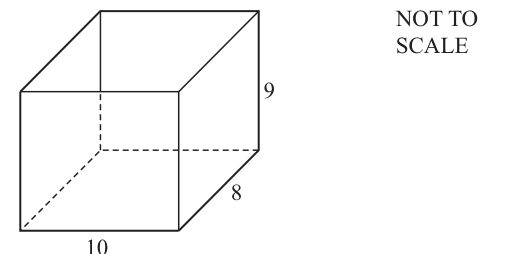
The diagram shows an empty container.
The container is a cuboid of width , length and height .
Water drips into the container at a rate of millilitres per second.
Find the time, in seconds, it takes to fill the container.
______
Approach
Find the volume of the cuboid, convert it to millilitres, and divide by the dripping rate to obtain the time in seconds.
Working
The volume of a cuboid is given by the product of its width, length, and height:
Since is equivalent to , the container holds of water.
The water drips in at a rate of per second, so the time to fill the container is:
Answer
120
Walkthrough
The problem asks for the time required to fill a cuboid-shaped container with water. First, we calculate the capacity of the container by multiplying its three dimensions: width, length, and height. This gives the volume in cubic centimetres. Because is exactly equal to , the numerical value of the volume in is also the volume in millilitres. Finally, we divide the total volume in millilitres by the rate at which water enters the container (in per second) to find the total time in seconds.
Key Takeaways
- The volume of a cuboid is calculated as .
- is equivalent to , so volume in cubic centimetres can be directly used as volume in millilitres.
- Time = .
Common Mistakes
- Forgetting to convert cubic centimetres to millilitres (though numerically they are the same, the units must be consistent with the given rate).
- Multiplying the rate by the volume instead of dividing.
- Using the wrong dimensions or omitting one dimension when calculating the volume.
Things to Be Careful About
- Ensure the units of volume match the units of the rate. Here, and are directly interchangeable.
- The final answer must be in seconds, as requested.
- The diagram is marked "NOT TO SCALE", so do not attempt to measure lengths from the drawing; use only the given numerical values.
Work out .
Give your answer as a mixed number in its simplest form.
______
Approach
Convert both mixed numbers into improper fractions, find a common denominator for the two fractions, add them together, and finally convert the resulting improper fraction back into a mixed number in its simplest form.
Working
First, convert to an improper fraction:
Next, convert to an improper fraction:
Now we need to add these two fractions:
Find a common denominator for 3 and 4. The lowest common multiple is 12. Convert both fractions:
Add the two fractions:
Finally, convert back into a mixed number. Divide 77 by 12:
So the answer is:
The fraction cannot be simplified further as 5 and 12 have no common factors.
Answer
6 5/12
Walkthrough
We are asked to add two mixed numbers: and . Mixed numbers can be tricky to add directly because you have to deal with whole parts and fractional parts simultaneously. A reliable method is to first turn them into improper fractions (where the numerator is larger than the denominator).
To turn into an improper fraction, multiply the whole number () by the denominator () and add the numerator (). This gives . Place this over the original denominator to get .
Similarly, for , multiply the whole number () by the denominator () and add the numerator (). This gives . Placing this over the original denominator gives .
Now we must add and . We cannot simply add the top and bottom numbers; we must make the denominators (the bottom numbers) the same. The smallest number that both 3 and 4 divide into is 12.
To change to something over 12, we multiply the top and bottom by 4, giving . To change to something over 12, we multiply the top and bottom by 3, giving .
Now we can just add the top numbers (numerators): . The bottom number stays 12, so we have .
The question asks for a mixed number, so we convert back. How many times does 12 go into 77? It goes in 6 times (), with 5 left over (). So the mixed number is . Since 5 and 12 share no common factors, this is in its simplest form.
Key Takeaways
- Converting mixed numbers to improper fractions makes addition much easier.
- Always find a common denominator before adding or subtracting fractions.
- If the final answer needs to be a mixed number, remember to divide the numerator by the denominator to find the whole part and the remainder.
Common Mistakes
- Adding whole numbers and fractions separately without converting properly (e.g., getting by adding tops and bottoms directly).
- Forgetting to change BOTH the numerator and the denominator when finding equivalent fractions (e.g., writing instead of ).
- Calculation errors when multiplying the numerator and denominator to find the common denominator.
- Failing to simplify the final improper fraction back into a mixed number if requested.
Things to Be Careful About
- Make sure your final answer is in the correct format. The question specifically asks for a "mixed number in its simplest form". An improper fraction like might earn partial marks (M1) but not full credit (B2 cao).
- Ensure the fractional part of your mixed number is fully simplified (e.g., don't leave it as if it can be reduced to ).
- Double-check your multiplication: is indeed , and is .
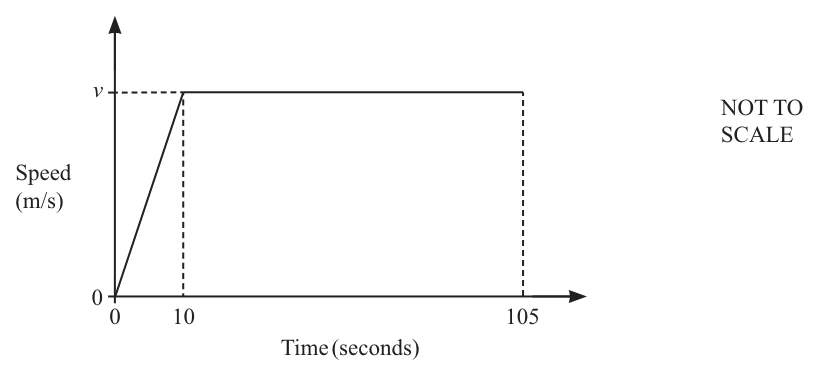
Lia cycles in 105 seconds.
The diagram shows the speed–time graph for this journey.
Approach
The total distance travelled is equal to the area under the speed–time graph. The graph consists of a triangular section from to and a rectangular section from to . Together, these form a trapezium with parallel sides along the time axis and the constant speed line.
Working
The area of a trapezium is given by:
where and are the lengths of the parallel sides and is the perpendicular height between them.
From the graph:
- The bottom parallel side (along the time axis) has length .
- The top parallel side (the constant speed portion) has length .
- The height is the constant speed .
Equating the area to the total distance of :
Answer
8
Walkthrough
The problem gives the total distance () and a speed-time graph. A fundamental principle in kinematics is that the distance travelled is the area under the speed-time graph. The graph starts at the origin, rises linearly to a speed at , and then stays constant at until . The region under this graph is a trapezium. The parallel sides of the trapezium are horizontal: the bottom side is the total time, , and the top side is the duration at constant speed, which is . The height of the trapezium is the maximum speed, . We set the area formula equal to and solve for .
Key Takeaways
- The area under a speed-time graph represents the distance travelled.
- Composite shapes under graphs (like a triangle plus a rectangle) can often be treated as a single trapezium for area calculation.
- Identifying the parallel sides and height of a trapezium on a graph requires reading the axis values correctly.
Common Mistakes
- Calculating the area as a triangle only (forgetting the rectangular part at the end), which would give .
- Using the wrong parallel side lengths, such as using instead of for the top side.
- Forgetting to subtract from to find the length of the constant-speed segment.
Things to Be Careful About
- Ensure the area units match the distance units (metres here).
- The mark scheme accepts the equation , showing that identifying the top side as is the key step.
- Working must be shown (nfww) to earn the method marks.
Approach
Acceleration is defined as the rate of change of speed. On a speed-time graph, this corresponds to the gradient (slope) of the line. During the first seconds, the graph is a straight line from to .
Working
Using the value from part (a), the coordinates are and .
The gradient is:
Answer
0.8
Walkthrough
The question asks for the acceleration during the first seconds. Acceleration is the rate of change of speed, which is represented by the gradient of the speed-time graph. The graph is a straight line from the origin to . We use the value calculated in part (a). The change in speed is , and the change in time is . Dividing the change in speed by the change in time gives the acceleration.
Key Takeaways
- On a speed-time graph, the gradient of a straight line segment represents the acceleration during that time interval.
- Acceleration can be calculated as .
Common Mistakes
- Using the total time () instead of the time interval () for the acceleration calculation.
- Forgetting to use the value of from part (a) and trying to calculate acceleration without it.
- Confusing acceleration with the total distance or average speed.
Things to Be Careful About
- The mark scheme allows as an answer, but is the standard decimal form. Both are acceptable.
- Follow-through (FT) marks are awarded if a different value for was used in part (a), as long as the correct method (their ) is applied.
The cumulative frequency diagram shows information about journey times.
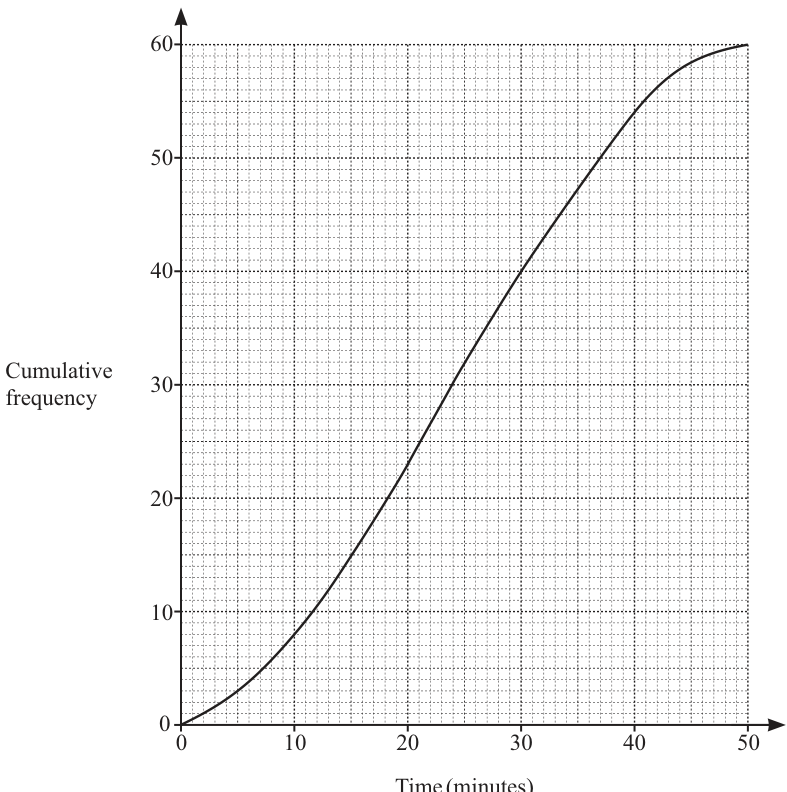
Use the cumulative frequency diagram to find an estimate for
Approach
The median is the value corresponding to half the total cumulative frequency. Read this value from the graph.
Working
Total cumulative frequency is . Half of this is .
Draw a horizontal line from on the cumulative frequency axis to the curve, then a vertical line down to the time axis.
The corresponding time is minutes.
Answer
24
Walkthrough
The cumulative frequency diagram shows the running total of frequencies. To find the median, we need the value of the variable (time) at which half the total frequency has been reached. The total frequency is the maximum value on the cumulative frequency axis, which is . Half of is . By drawing a horizontal line from on the vertical axis to the curve and then a vertical line down to the horizontal axis, we read the median time as minutes.
Key Takeaways
- The median from a cumulative frequency diagram is found at half the total frequency.
- Always read horizontally from the cumulative frequency axis and vertically from the curve to the variable axis.
Common Mistakes
- Reading from the wrong axis (e.g., reading the time first and then going up to the wrong cumulative frequency).
- Forgetting to halve the total frequency before reading the median.
- Rounding incorrectly when reading off the graph.
Things to Be Careful About
- Ensure you read the cumulative frequency axis (vertical) first to find half the total, then read the variable axis (horizontal) for the median value.
- Readings from graphs are estimates, so allow a reasonable tolerance (e.g., to for the median), but the mark scheme accepts .
Approach
To find the number of journeys that took 20 minutes or more, find the cumulative frequency at 20 minutes and subtract it from the total frequency.
Working
Total frequency is .
From the graph, at time minutes, the cumulative frequency is .
Number of journeys taking 20 minutes or more .
Answer
37
Walkthrough
The question asks for the number of journeys that took minutes or more. The cumulative frequency at minutes gives the number of journeys that took minutes or less. To find the number of journeys that took minutes or more, we subtract the cumulative frequency at minutes from the total frequency. From the graph, at time minutes, the cumulative frequency is approximately . The total frequency is . Therefore, the number of journeys is .
Key Takeaways
- Cumulative frequency at a given value represents the number of observations up to that value.
- The number of observations greater than a value is found by subtracting the cumulative frequency at that value from the total frequency.
Common Mistakes
- Reading the frequency at minutes instead of the cumulative frequency.
- Forgetting to subtract from the total frequency to find the number of journeys above the threshold.
- Misreading the cumulative frequency value from the graph.
Things to Be Careful About
- The mark scheme awards a method mark (B1) for stating the cumulative frequency at minutes (e.g., ), even if the final subtraction is incorrect.
- Ensure you subtract the cumulative frequency at the given time from the total frequency, not the other way around.
- Readings from graphs are estimates, so a value like is expected to earn the method mark.
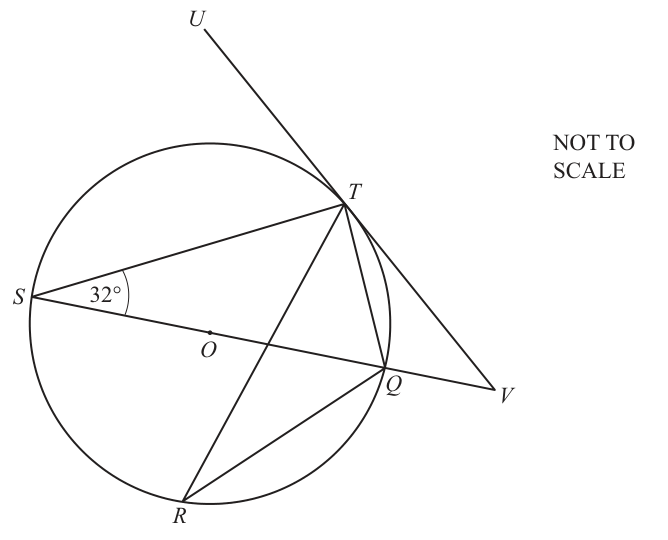
Points , , and lie on a circle, centre .
is a tangent to the circle at .
is a straight line.
Angle .
Find angle .
Give a geometrical reason to explain your answer.
Angle = ______ because ______
Approach
Identify the arc subtended by the given angle and find the other angle subtended by the same arc on the circumference.
Working
The angles and are both subtended by the arc and lie in the same segment of the circle.
By the circle theorem, angles in the same segment are equal.
Answer
Angle because angles in the same segment are equal.
32, angles in the same segment are equal
Walkthrough
The question asks for given that . Both of these angles are on the circumference of the circle and subtend the same arc . They are on the same side of the chord , meaning they lie in the same segment. The circle theorem states that angles in the same segment are equal, so must also be .
Key Takeaways
- Angles subtended by the same arc at the circumference are equal if they lie in the same segment.
- Always identify the arc and the chord that define the segment when applying this theorem.
Common Mistakes
- Confusing angles in the same segment with angles at the centre (which are twice the angle at the circumference).
- Giving a reason that is too vague, such as "they are angles in a circle". The mark scheme requires the specific theorem: "angles in the same segment are equal".
Things to Be Careful About
- The question asks for both the value and the geometrical reason. Both are required for full marks.
- Ensure the reason is stated precisely as the standard circle theorem.
Approach
Recognise that is a diameter since the straight line passes through the centre . Use the angle in a semicircle theorem to find , then use the angle sum of to find .
Working
Since is a straight line passing through the centre , is a diameter of the circle.
The angle subtended by a diameter at the circumference is , so:
In , the sum of the interior angles is :
Substitute the known values ( and ):
Answer
Angle .
58
Walkthrough
First, observe that the line passes through the centre , meaning is a diameter. A key circle theorem states that the angle subtended by a diameter at any point on the circumference is a right angle. Therefore, .
Next, look at . We now know two of its angles: and (given as ). The sum of angles in any triangle is , so we can find the third angle by subtracting the other two from :
Key Takeaways
- A straight line through the centre of a circle is a diameter, and it subtends a angle at the circumference.
- Once a right angle is established in a triangle, the other two acute angles must sum to .
Common Mistakes
- Forgetting that is a diameter and not using the angle.
- Rounding or writing the answer to an incorrect number of significant figures; angles in this context are typically exact integers.
Things to Be Careful About
- The mark scheme specifically looks for the step identifying . Make sure this is shown clearly in the working.
Approach
Use the alternate segment theorem to find , then use angles on a straight line and the angle sum of to find .
Working
is a tangent to the circle at , and is a chord.
By the alternate segment theorem, the angle between the tangent and the chord equals the angle in the alternate segment:
Since is a straight line, and are supplementary:
In , the sum of the interior angles is :
Substitute the known values:
Answer
Angle .
26
Walkthrough
The tangent touches the circle at , and is a chord drawn from the point of tangency. The alternate segment theorem states that the angle between a tangent and a chord through the point of contact is equal to the angle in the alternate segment. Here, the angle between tangent and chord is , and the angle in the alternate segment is (or ). Thus, .
Next, we need another angle in . We know from part (b). Since is a straight line, and form a linear pair and add to :
Finally, use the angle sum of to find :
Key Takeaways
- The alternate segment theorem links the angle between a tangent and a chord to an angle on the circumference.
- Angles on a straight line add to , which is useful for finding exterior angles of triangles.
Common Mistakes
- Applying the alternate segment theorem to the wrong chord or tangent angle.
- Forgetting that is a straight line and trying to use directly in without finding the supplementary angle .
- Arithmetic errors when subtracting from .
Things to Be Careful About
- The mark scheme accepts alternative routes, such as finding and then using to find . Both methods are valid.
- Ensure all angle values used in the final triangle calculation are clearly derived.
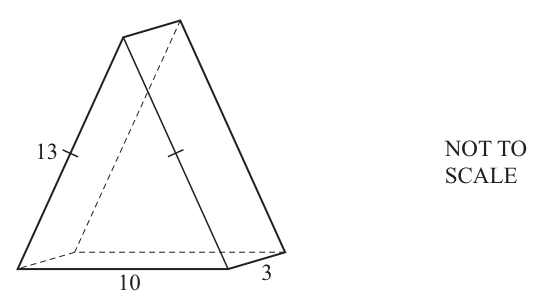
The diagram shows a prism.
The cross-section of the prism is an isosceles triangle with sides , and base .
The length of the prism is .
Approach
To find the volume of the prism, we first need the area of its triangular cross-section. The cross-section is an isosceles triangle with sides , and . We can find its height by splitting it into two right-angled triangles and using Pythagoras' theorem. Then we multiply the cross-sectional area by the length of the prism.
Working
The base of the isosceles triangle is , so the perpendicular height bisects the base into two segments of .
Let be the height of the triangle. By Pythagoras' theorem:
The area of the triangular cross-section is:
The volume of the prism is the cross-sectional area multiplied by its length ():
Answer
The volume of the prism is , as required.
180 cm^3
Walkthrough
The volume of any prism is given by the formula: Volume = Area of cross-section × length. The cross-section here is an isosceles triangle with sides 13 cm, 13 cm and base 10 cm. To find its area, we need its height. Because the triangle is isosceles, dropping a perpendicular from the apex to the base bisects the base, creating two right-angled triangles with hypotenuse 13 cm and base 5 cm. Using Pythagoras' theorem (), we find the height is 12 cm. The area of the triangle is then . Multiplying by the prism length of 3 cm gives a volume of 180 cm³.
Key Takeaways
- The volume of a prism is the area of its uniform cross-section multiplied by its length.
- In an isosceles triangle, the perpendicular height from the apex bisects the base, allowing the use of Pythagoras' theorem to find the height.
Common Mistakes
- Forgetting to halve the base before applying Pythagoras' theorem (using 10 instead of 5).
- Using the wrong formula for the area of a triangle (e.g., forgetting the factor).
- Multiplying the triangle's perimeter or side lengths instead of its area by the prism's length.
Things to Be Careful About
- Ensure all lengths are in the same units (cm) before calculating area and volume.
- The question asks to 'show that', so the final line of working must explicitly state or conclude with the target value of .
- Pythagoras' theorem requires the square of the hypotenuse (the longest side, 13) to be equal to the sum of the squares of the other two sides.
A mathematically similar prism has a volume of .
The cross-section of this prism is an isosceles triangle with base .
Calculate the value of .
= ______
Approach
For mathematically similar solids, the ratio of their volumes is equal to the cube of the linear scale factor. We can find the volume ratio, take the cube root to get the linear scale factor, and then use it to find the unknown base length .
Working
The volume of the original prism is and the volume of the similar prism is .
The ratio of the volumes is:
The linear scale factor is the cube root of the volume ratio:
This means all lengths in the new prism are times the corresponding lengths in the original prism. The original base is , so:
Alternatively, setting up the ratio directly:
Solving for :
Answer
20
Walkthrough
When two solids are mathematically similar, their corresponding lengths are in the ratio (the linear scale factor), their areas are in the ratio , and their volumes are in the ratio . Here, the volume ratio is . To find the linear scale factor, we take the cube root of 8, which is 2. This means every length in the new prism is twice the corresponding length in the original prism. Since the original base is 10 cm, the new base is cm.
Key Takeaways
- For similar solids, Volume ratio = (Linear scale factor).
- To find a length from a volume ratio, take the cube root of the volume ratio to get the linear scale factor, then multiply the original length by this factor.
Common Mistakes
- Confusing the volume ratio with the linear ratio (e.g., assuming ).
- Taking the square root instead of the cube root when finding the linear scale factor from a volume ratio.
- Setting up the ratio incorrectly, such as instead of using the cube root.
Things to Be Careful About
- Always verify whether the given ratio is for lengths, areas, or volumes, as the relationship to the linear scale factor changes accordingly (, , or ).
- Ensure the cube root is calculated correctly; , not 4.
- The question asks for the value of , so the final answer should be just the number (20), though including the unit (cm) is good practice in working.
Write as a fraction.
______
Approach
To convert the recurring decimal into a fraction, we can use the algebraic method. Let equal the given number. We then multiply by powers of 10 to shift the decimal point so that the recurring parts align, allowing us to subtract one equation from the other to remove the recurring digit.
Working
Let . This means:
We want to create another equation where the repeating part starts at the same position as in (1), but shifted. Multiplying (1) by 10 moves the decimal point just before the repeating '4':
Now, multiply (1) by 100 to move the decimal point past the first '4' as well (or simply notice that multiplying (2) by 10 gives ):
Subtract equation (2) from equation (3). The recurring parts () cancel out:
Solve for :
The fraction cannot be simplified further because 13 is a prime number and does not divide 90.
Answer
13/90
Walkthrough
The problem asks to write the recurring decimal as a fraction. This notation means , where the digit 4 repeats infinitely.
- Define the variable: Let
- Shift the decimal point: We need to create a second equation such that when we subtract it from the first (or vice versa), the infinite repeating tail disappears.
- Multiply by 10 to get
- Multiply by 100 to get
- Subtract: Subtracting from eliminates the recurring part.
- Solve: Divide by 90 to isolate .
- Check for simplification: 13 is prime and does not divide 90, so the fraction is in its simplest form.
An alternative approach mentioned in some mark schemes is splitting the decimal: . Finding a common denominator gives .
Key Takeaways
- The algebraic method for converting recurring decimals involves multiplying by powers of 10 to align the repeating digits.
- Subtracting the aligned equations removes the recurring part, leaving a linear equation.
- Always check if the final fraction can be simplified.
Common Mistakes
- Forgetting to subtract correctly (e.g., doing instead of ).
- Misinterpreting the scope of the dot notation (e.g., treating it as ).
- Failing to simplify the fraction if possible (though is already simple).
- Arithmetic errors when calculating or .
Things to Be Careful About
- Ensure you multiply by the correct power of 10. If only one digit repeats after the decimal, multiplying by 10 once puts the repeat immediately after the decimal, and multiplying by 100 puts it again. The difference between these multipliers is , which becomes the denominator.
- The question requires an exact fractional answer, not a decimal approximation.
- Mark scheme note: "oe" means any equivalent form is accepted, but usually this implies the simplified fraction.
Solve .
= ______
Approach
To solve , we first determine the expression for the composite function by substituting into . Then we set this expression equal to 5 and solve for .
Working
The functions are given as:
The composite function means . We substitute the entire expression for wherever there is an in :
Expand the brackets:
Simplify:
Now set :
Subtract 11 from both sides:
Multiply both sides by 2:
Divide by 3:
Alternatively, using the inverse method shown in the mark scheme:
Answer
-4
Walkthrough
The problem asks us to find the value of that satisfies the condition where the composite function equals 5.
First, recall that is read as "h of g of x" or . This means we take the output of the inner function and use it as the input for the outer function .
Given and , we substitute into :
Next, we simplify this expression. Distribute the 3 across the terms inside the parentheses:
So, . Combining the constants gives:
We are told that , so we set up the equation:
To isolate , subtract 11 from both sides:
Multiply both sides by 2 to remove the denominator:
Finally, divide by 3:
Key Takeaways
- Composite Function Notation: always means . The function written second (on the left) is applied last.
- Substitution: When substituting an expression into another, use brackets if the substituted expression has more than one term to avoid sign errors.
- Linear Equations: Solving involves isolating the variable through inverse operations (subtracting constants, dividing coefficients).
Common Mistakes
- Order of Composition: Students sometimes calculate instead of , leading to the wrong equation ( plugged into ).
- Bracket Errors: Forgetting to bracket when substituting into , e.g., writing instead of . This results in incorrect constant terms.
- Arithmetic with Negatives: Subtracting 11 from 5 incorrectly as positive 6 or failing to carry the negative sign through the steps.
- Inconsistent Method: Trying to solve without simplifying the composite function first can lead to messy algebra.
Things to Be Careful About
- Check Your Work: Substitute back into the original functions. . . The result matches.
- Fraction Arithmetic: Ensure you handle the fraction correctly during multiplication and division steps.
- Sign Errors: Pay close attention to signs when expanding brackets or moving terms across the equals sign.
Write as a single fraction in its simplest form.
______
Approach
Find a common denominator for the two algebraic fractions, rewrite each fraction with this denominator, then subtract the numerators and simplify.
Working
The denominators are and . Their lowest common denominator is .
Rewrite each fraction with denominator :
Subtract the numerators, keeping the common denominator:
Answer
27/(14x)
Walkthrough
We start with two fractions with different denominators, and . Before subtracting, both fractions must be written over the same denominator. The smallest denominator that both and divide into is .
Multiply the first fraction by and the second fraction by . These multiplications do not change the value of either fraction, but they give both fractions the common denominator :
Now subtract the numerators, keeping the denominator unchanged:
The fraction is already in simplest form because and have no common factor.
Key Takeaways
- Algebraic fractions are combined in the same way as numerical fractions: find a common denominator first.
- The variable is part of the denominator, so the lowest common denominator of and is .
- When subtracting fractions with the same denominator, subtract only the numerators and keep the denominator unchanged.
- A fraction is in simplest form when the numerator and denominator have no common factor.
Common Mistakes
- Trying to subtract the fractions without first writing them with a common denominator.
- Forgetting to multiply the numerator when scaling the denominator, for example writing instead of .
- Subtracting the denominators as well as the numerators.
- Giving an unsupported final answer: the mark scheme awards a method mark for showing the equivalent fractions and , so working must be shown.
Things to Be Careful About
- The value is not allowed, since the original fractions would have zero denominators.
- Keep the denominator as one term, , throughout the subtraction.
- This is a non-calculator question, so show the by-hand scaling clearly: multiply numerator and denominator by for the first fraction and by for the second.
- The final answer must be a single fraction in simplest form; is the required exact form.
Approach
Write as a power of the prime base , then apply the fractional index using the power rule . Finally, convert the resulting negative index into a reciprocal.
Working
Since ,
Using :
Using :
Answer
1/9
Walkthrough
We are asked to evaluate . The key is to connect the base with the denominator of the fractional index: is . Then apply the law
so . Multiplying by gives , leaving . A negative index means the reciprocal: , so . This is the exact fractional value, not a rounded decimal.
Key Takeaways
This question tests the index laws for negative and fractional powers. The most useful steps are always: rewrite a base as a prime power, then multiply the exponents, then apply any negative index by taking the reciprocal.
Common Mistakes
- Forgetting the negative sign and giving , since .
- Taking a square root before a cube root, or mixing up and .
- Giving a decimal such as instead of the exact fraction .
Things to Be Careful About
This is the non-calculator paper, so the answer must be presented exactly as a fraction. The mark scheme gives a method mark for reaching or , so show that intermediate line. Be especially careful with the negative index: it turns the entire result into its reciprocal.
Approach
Apply the index separately to the numerical factor and to the term, using and .
Working
First:
Then:
Combining these:
Answer
1/10 x^50
Walkthrough
The expression is . We can apply the exponent to each factor separately using
so it becomes . For the constant factor, raising to the power is the same as taking the square root, and , so we get . For the variable factor, use , multiplying by to obtain . The simplified final answer is .
Key Takeaways
This question checks two fundamental index laws: powers in a product can each be raised to the exponent separately, and a power raised to another power is found by multiplying exponents. It also connects fractional powers to roots, particularly being the square root.
Common Mistakes
- Applying the exponent only to and leaving the coefficient as .
- Treating after taking the power as correctly but forgetting to convert to .
- Writing .
- Writing the coefficient as is correct; writing would be wrong because the power does not multiply the coefficient.
Things to Be Careful About
The final answer should be given in exact form, prefer to . The coefficient and the exponent must be simplified correctly. The mark scheme awards one method mark for arriving at a form like or with non-zero , so keep the and parts visible.
The table shows some values for .
Approach
Substitute and into the given expression to find the missing table values.
Working
For :
For :
Answer
The missing values in the table are (for ) and (for ).
0, 4
Walkthrough
The table provides several pairs for the function , but two -values are missing. To find them, we simply replace with the given value in the formula and calculate. For , we compute , then , and finally . For , we compute , then , and finally . These complete the set of points needed to sketch the graph in part (b).
Key Takeaways
Substituting numerical values into an algebraic expression and correctly handling negative numbers and indices. Evaluating when is negative yields a negative result.
Common Mistakes
- Forgetting that and instead writing . This is a sign error with odd powers of negative numbers.
- Mistaking as instead of . Multiplying two negative numbers gives a positive result.
- Arithmetic errors when adding the three terms together.
Things to Be Careful About
Always show the substitution step clearly so method marks are awarded. Pay close attention to the sign of when is negative; an odd power preserves the negative sign. The mark scheme awards one mark for each correct value (B1 each), so both and are required for full credit.
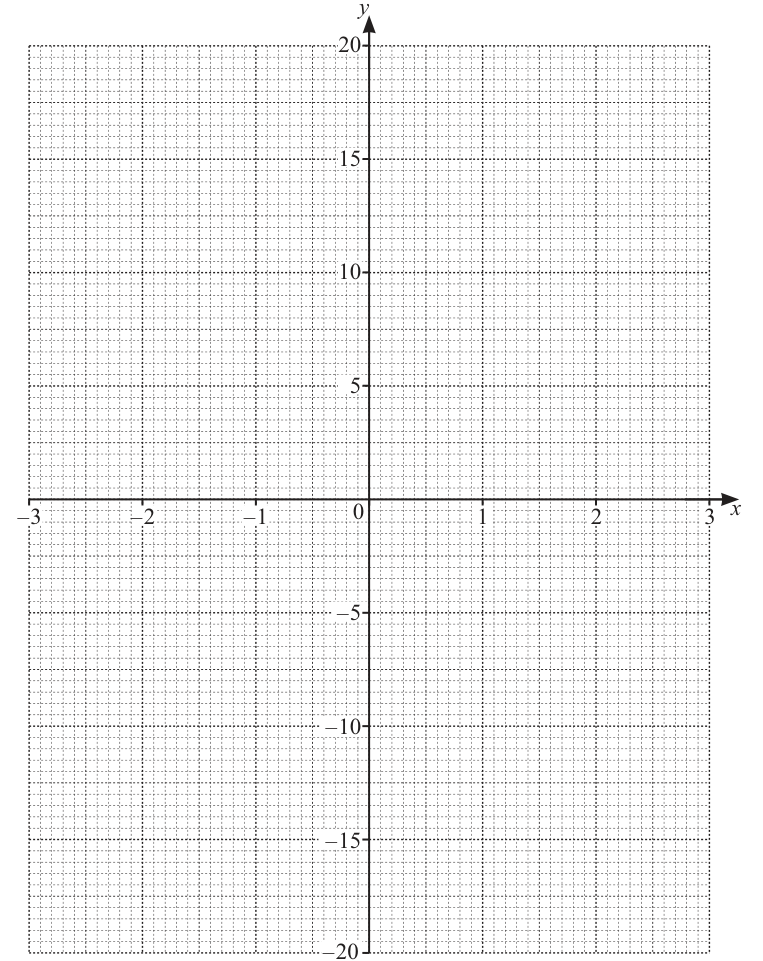
Approach
Use the completed table from part (a) to obtain seven coordinate pairs. Plot each point on the provided grid, then join them with a smooth, continuous curve that reflects the shape of a cubic function.
Working
The seven points to plot are:
, , , , , , .
The curve rises from the bottom left, passes through , crosses the -axis at , reaches a local maximum near , dips to a local minimum near , rises again through , and ends at .
Answer
A smooth cubic curve passing through all seven plotted points.
Graph drawn with points (-3, -16), (-2, 0), (-1, 4), (0, 2), (1, 0), (2, 4), (3, 20) joined by a smooth curve
Walkthrough
Part (b) asks you to draw the graph of over the range . The grid provided has the -axis from to and the -axis from to , which perfectly accommodates all the values in the table. Plot each of the seven pairs: , , , , , , and . Once the points are plotted, draw a smooth curve through them. A cubic graph has a characteristic 'S' shape; here it rises from the bottom left, curves up to a local maximum around , curves down to a local minimum around , and then rises steeply to the top right. The mark scheme gives follow-through marks based on how many points are correctly plotted, so accuracy in plotting is essential.
Key Takeaways
Drawing a graph from a table of values requires accurate plotting of coordinates and joining them with a smooth curve that matches the expected function type. For cubics, look for the local maximum and minimum to guide the curve's shape.
Common Mistakes
- Plotting points incorrectly, especially negative -values or large values like and . Ensure you read the axes correctly; the -axis has major gridlines every units.
- Joining the points with straight line segments instead of a smooth curve. The graph of a cubic function is smooth and continuous.
- Not extending the curve to the boundaries of the given range and .
Things to Be Careful About
The mark scheme awards marks based on the number of correctly plotted points (B3FT for 6 points, B2FT for 4 points, B1FT for 2 points) and a correct curve. Even if the curve is slightly off, correct points will still earn marks. Ensure your curve is smooth and does not have sharp corners at the plotted points. The -axis scale is every units, so is slightly below the line, and is exactly on the top gridline.
By drawing a suitable line on the grid, find the solutions of the equation .
= ______ or = ______ or = ______
Approach
We are given the curve and asked to solve . We can rewrite the equation to match the form of the curve by subtracting the two expressions to find a linear equation whose intersections with the curve give the solutions.
Working
Subtract the target equation from the curve equation:
So we draw the straight line on the same grid.
Points on the line :
- When , (0, 1)
- When , (1, 5)
- When , (-1, -3)
- When , (-2, -7)
- When , (2, 9)
- When , (-3, -11)
The line intersects the curve at three points. Reading the -coordinates of these intersections from the graph:
- The leftmost intersection is between and , approximately at .
- The middle intersection is between and , approximately at .
- The rightmost intersection is between and , approximately at .
Answer
The solutions are or or .
Acceptable ranges from the mark scheme:
- to
- to
- to
x = -2.7, x = 0.1, x = 2.6
Walkthrough
Part (c) asks to solve using the graph drawn in part (b). Since we already have the curve , we need to find a straight line that, when intersected with this curve, gives the solutions to the target equation. We do this by setting the curve equation equal to a line equation and matching terms.
If and we want to solve , we can subtract the second from the first:
.
So we draw the line . We find a few points on this line to draw it accurately: , , , etc. When we draw this line on the grid, it crosses the cubic curve at three points. The -coordinates of these intersection points are the solutions to the equation .
Reading from the graph:
- The first intersection is near (between and ).
- The second intersection is near (between and ).
- The third intersection is near (between and ).
Key Takeaways
When asked to solve an equation using a given graph, rearrange the equation to express it as the intersection of the given curve and a simple straight line. The -coordinates of the intersection points are the solutions.
Common Mistakes
- Drawing the wrong line. For example, drawing or . The sign and constant must be correct: .
- Reading the intersections incorrectly. Ensure you are reading the -coordinate (horizontal axis) at the point where the line crosses the curve, not the -coordinate.
- Not drawing the line long enough to show all three intersections. The line extends from the bottom left to the top right of the grid.
Things to Be Careful About
The mark scheme allows a range of acceptable values for each intersection: to , to , and to . This is because graphical reading is inherently approximate. Ensure your line is drawn with a ruler and is truly straight. The mark scheme gives M2 for a ruled line , M1 for a short or unruled line, and A2 for three correct values (or A1 for two). If only M1 is scored, SC1 is awarded for three correct solutions. Always use a ruler for the line to maximize method marks.
Approach
Use to combine the first two surds, then simplify the square root and collect like surds.
Working
Simplify by extracting the square factor :
Now add the like surds:
Answer
5√3
Walkthrough
Start with . First multiply the two surds together under one square root: . Then simplify by writing , so . The expression is now . Since both terms are like surds, add their coefficients: , giving .
Key Takeaways
Surds can be multiplied by combining them under one root. To simplify a surd, look for the largest square factor. Only like surds can be added or subtracted.
Common Mistakes
- Stopping at without simplifying; the mark scheme gives a method mark for or , but the final answer must be .
- Trying to add and before multiplying; they are not like surds.
- Forgetting that is when collecting like terms.
Things to Be Careful About
This is a non-calculator question, so leave the answer in exact surd form. Do not give a decimal approximation. The final answer must be .
Approach
Multiply the numerator and denominator by the conjugate to rationalise the denominator, then simplify.
Working
Expand the denominator using the difference of two squares:
So
Expanding gives the equivalent form
Answer
-3(2 + √5)
Walkthrough
To rationalise a denominator of the form , multiply by the conjugate . Here the conjugate is . Multiplying by does not change the value because it is equal to . The numerator becomes . The denominator is a difference of two squares: . Therefore the whole fraction is , which may also be written as .
Key Takeaways
Rationalising a denominator removes the surd from the denominator. The conjugate turns the denominator into a difference of two squares, so the surd terms cancel. A negative denominator must be handled by changing all signs in the numerator.
Common Mistakes
- Forgetting to multiply the numerator by the same conjugate.
- Expanding the denominator incorrectly; the cross terms and cancel, leaving .
- Leaving the answer as without simplifying the division by .
- Giving a decimal approximation instead of the exact surd form.
- Not realising that , and are all accepted.
Things to Be Careful About
The mark scheme awards a method mark for multiplying by the conjugate, a mark for the expanded denominator , and a final mark for the simplified answer. On the non-calculator paper, show the expansion by hand. Any of the three equivalent final forms is accepted.
The diagram shows a rectangle and a triangle.
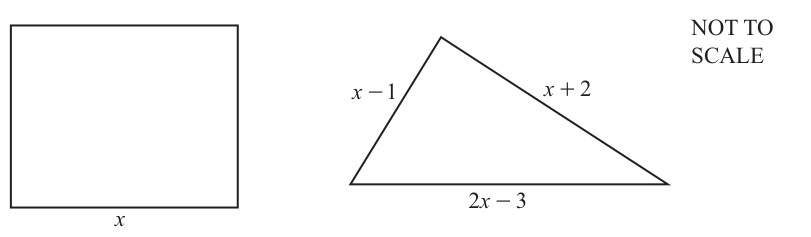
The length of the rectangle is and the area of the rectangle is .
The triangle has sides of length , and .
Approach
The area of a rectangle is given by the product of its length and width. Rearrange this formula to solve for the width.
Working
Substitute the given values:
Divide both sides by :
Answer
30/x
Walkthrough
The area of a rectangle is calculated by multiplying its length by its width. The problem gives the area as and the length as . To find the width, we divide the area by the length, giving .
Key Takeaways
The relationship between the area, length, and width of a rectangle: , so .
Common Mistakes
Forgetting to divide the area by the length, or writing the expression as instead of .
Things to Be Careful About
The answer must be an expression in terms of . Do not attempt to evaluate it yet; part (b) will require using this expression.
The perimeter of the rectangle is equal to the perimeter of the triangle.
Form an equation in and show that it simplifies to .
Approach
Write an expression for the perimeter of the rectangle using the width found in part (a), and an expression for the perimeter of the triangle by summing its three sides. Equate the two perimeters and simplify to obtain the required quadratic equation.
Working
Perimeter of the rectangle:
Perimeter of the triangle:
Equate the two perimeters:
Expand the left-hand side:
Multiply the entire equation by to remove the algebraic fraction:
Rearrange all terms to one side:
Divide the entire equation by :
This matches the required form.
Answer
x^2 - x - 30 = 0
Walkthrough
First, calculate the perimeter of the rectangle. Using the width and length , the perimeter is . Next, calculate the perimeter of the triangle by adding its three side lengths: . Equating these gives . Expanding the brackets yields . To clear the fraction, multiply every term by , resulting in . Rearranging all terms to the right-hand side gives . Finally, dividing by simplifies this to .
Key Takeaways
When forming equations from geometry, carefully write out all perimeter or area expressions before equating them. Clearing algebraic fractions by multiplying through by the denominator is a standard technique to convert rational equations into polynomials.
Common Mistakes
Forgetting to multiply every term by when clearing the fraction, which leaves a stray term. Expanding incorrectly as instead of . Sign errors when rearranging terms to one side of the equation.
Things to Be Careful About
The mark scheme requires full working to be shown; do not skip steps when clearing the fraction or rearranging the equation. Ensure the final equation is exactly with no common factors remaining.
Approach
Factorise the quadratic equation into two linear factors, then set each factor to zero to find the values of .
Working
Find two numbers that multiply to and add to . These numbers are and .
Set each factor equal to zero:
Answer
6 or -5
Walkthrough
To solve , we look for two numbers that multiply to give the constant term () and add to give the coefficient of (). The numbers and satisfy these conditions because and . Thus, the quadratic factorises as . Setting each bracket to zero gives or .
Key Takeaways
Factorising quadratics of the form requires finding two numbers that multiply to and add to . Always check by expanding the factors.
Common Mistakes
Choosing numbers that multiply to but forget the negative sign, such as and (which add to ). Writing the factors as , which expands to , the wrong sign for the middle term.
Things to Be Careful About
Both values of must be stated. Although will be rejected later because a length cannot be negative, both roots must be found here as the question simply asks to solve the equation.
Approach
Since represents a length in the diagram, must be positive. Discard the negative root and use . Substitute this value into the perimeter expression for the rectangle (or the triangle) to find the numerical perimeter.
Working
From part (c), or . Since is a length, .
Perimeter of the rectangle:
Substitute :
(Alternatively, using the triangle perimeter: .)
Answer
22
Walkthrough
The equation in part (b) was based on the geometric shapes, so must represent a valid physical length. This means , so we reject and use . Substitute into the perimeter expression for the rectangle: . You can verify this using the triangle's perimeter expression: .
Key Takeaways
When solving equations derived from geometric contexts, always check whether both algebraic solutions are physically meaningful. Lengths, areas, and other physical quantities must be positive.
Common Mistakes
Forgetting to reject the negative root , or substituting into the perimeter formula, which would give an incorrect or nonsensical result. Calculation errors when evaluating .
Things to Be Careful About
Include the unit in the final answer if the question asks for it (the blank is followed by , so just the number is needed, but be aware of units). Ensure you use the correct value of from the valid physical context.
Factorise.
______
Approach
The expression is a cubic polynomial. The first step is to look for a common factor in all three terms. After extracting the common factor, we are left with a quadratic expression which can be factorised by finding two numbers that multiply to give the product of the coefficient of and the constant term, and add to give the coefficient of .
Working
Step 1: Extract the common factor.
All three terms contain an . We factor out :
Step 2: Factorise the quadratic .
We need to split the middle term () into two terms. To do this, we multiply the coefficient of (which is ) by the constant term (which is ):
We look for two numbers that multiply to and add to (the coefficient of the middle term). The pairs of factors of are:
- and (sum )
- and (sum )
- and (sum )
- and (sum )
- and (sum )
- and (sum ) ✓
The numbers are and . So we rewrite as :
Now we group the terms in pairs and factorise each pair:
Notice that is a common bracket. We factor this out:
Step 3: Combine with the initial common factor.
Don't forget the we took out at the very beginning:
Answer
x(2x - 1)(3x + 4)
Walkthrough
This question requires factorising a cubic expression. Since there is no single formula for factorising cubics directly, we break the problem down into smaller, standard algebraic tasks.
First, we examine the three terms: , , and . We look for a 'common factor'—a number or variable that divides into every term evenly. Here, is present in all three terms, so we pull it out to the front of the bracket. This simplifies the expression inside the bracket from a degree-3 polynomial to a degree-2 polynomial (a quadratic): . This corresponds to the M1 mark for extracting .
Next, we must factorise the quadratic . A reliable method for quadratics where the leading coefficient is not 1 is 'splitting the middle term'. We calculate the product of the outer coefficients ( and ), which is . We then find two numbers that multiply to but add up to the middle coefficient, . These numbers are and . We replace with .
Then, we use 'grouping'. We put the first two terms in one bracket and the last two in another: and . We factorise these individually. From the first group, we take out to get . From the second group, we take out to get . Because both groups now share the identical bracket , we can pull that bracket out as well, leaving . Finally, we attach the original to the front.
Key Takeaways
- Always check for a common factor first. It makes the remaining polynomial simpler and easier to handle.
- Splitting the middle term is a robust technique for factorising quadratics like when . Find factors of that sum to .
- Grouping allows you to reveal hidden common brackets within a four-term polynomial.
- Verification: You can check your answer by expanding the brackets. . Multiplying by gives the original expression.
Common Mistakes
- Forgetting the common factor: Students often factorise the quadratic part correctly to get but forget to include the they pulled out at the start. This usually results in only partial credit (M1).
- Incorrect splitting: Choosing the wrong pair of factors for (e.g., using and which sum to instead of ) leads to incorrect grouping and final brackets.
- Sign errors: When factoring out negative numbers or handling the signs during grouping (e.g., writing instead of ), which can make the common bracket disappear.
- Arithmetic errors: Miscalculating the product or the sum of the factors.
Things to Be Careful About
- Show your working clearly. The mark scheme awards marks for intermediate steps (M1 for extracting , M1 for the correct split/grouping setup). Writing just the final answer without showing the split might result in lost method marks if the final answer is wrong.
- Non-calculator component: Ensure you perform the multiplication and addition of integers mentally or on paper carefully, as calculators are not permitted.
- Final form: Ensure the answer is fully factorised into linear brackets multiplied by the common factor.
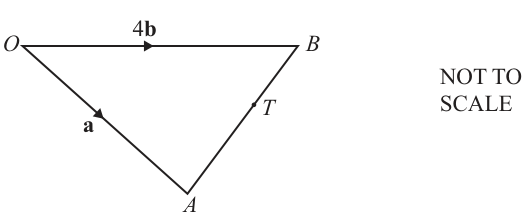
The diagram shows triangle .
and .
is a point on such that .
Approach
Use the triangle rule for vector subtraction: to go from to , go from to and then from to .
Working
Substitute the given vectors:
Answer
4b - a
Walkthrough
To find the vector from to , we can use the path . This gives . Since and , we simply add them to get . This is equivalent to the standard formula .
Key Takeaways
When finding a vector between two points, subtract the position vector of the starting point from the position vector of the ending point: .
Common Mistakes
- Writing (reversing the order of subtraction).
- Forgetting the negative sign when subtracting a vector.
Things to Be Careful About
The answer must be written exactly as or . Order does not matter, but the signs must be correct.
Approach
Point lies on such that . This means . We can find the position vector by adding and .
Working
Substitute from part (a):
Now find :
Expand the bracket:
Collect the terms ():
Factor out :
This matches the required expression.
Answer
Shown as required.
Shown as required
Walkthrough
Since divides in the ratio , the segment is of the total segment . Therefore, . We already know from part (a). To find the position vector of (which is ), we start at , go to (), and then go to (). Adding these gives . Expanding and collecting like terms yields , which factors neatly to .
Key Takeaways
When a point divides a line segment in a ratio , the vector from the start of the segment to that point is of the total vector. Always add this to the position vector of the starting point.
Common Mistakes
- Using the wrong fraction (e.g., instead of for ).
- Algebra errors when collecting terms: remembering that .
- Forgetting to factor out the common fraction at the end to match the required form.
Things to Be Careful About
The question asks to "show that", so you must finish at exactly the printed target . Do not start from the target and work backwards. Show all algebraic steps clearly to earn the method marks.
Approach
We are given . We can find using the vector addition . Once we have , we compare it to to find the ratio .
Working
Substitute and :
Expand the second term:
The terms cancel out:
Since lies on and , the remaining vector is:
The ratio of lengths is the ratio of the magnitudes of these vectors:
Answer
3 : 1
Walkthrough
We know from part (b) and are given . To find , we rearrange the vector addition rule: , so . Substituting the expressions and simplifying, the components cancel out completely, leaving . Since and is on , the segment must be the remainder: . Thus, the ratio is .
Key Takeaways
When a point lies on a line segment defined by a vector, its position vector will be a scalar multiple of that vector. Comparing these scalar multiples gives the ratio in which the point divides the segment.
Common Mistakes
- Sign errors when subtracting (forgetting to distribute the negative sign to both terms inside the bracket).
- Calculating incorrectly (e.g., adding instead of subtracting from ).
- Giving the ratio as (which would be ) instead of .
Things to Be Careful About
Ensure you are finding , not . The question asks for the ratio in which divides , which requires finding the length of the second segment .