Mathematics (Syllabus D) 4024/22 — October/November 2024
Cambridge O-Level · Calculator · worked solutions for every part, with the mark scheme
Topics Number · Algebra and Graphs · Mensuration · Trigonometry · Geometry · Statistics · +1 more
These are the contents of a bag of mixed fruit.
| Pineapple | |
|---|---|
| Mango | |
| Papaya |
Calculate the mass of mango as a percentage of the total mass of the mixed fruit.
______ %
Approach
To find the mass of mango as a percentage of the total mass, we first need to calculate the total mass of all the fruits in the bag. Then, we express the mass of the mango as a fraction of this total and multiply by to get the percentage.
Working
First, calculate the total mass of the mixed fruit:
Next, write the mass of the mango () as a fraction of the total mass ():
Convert this fraction to a percentage by multiplying by :
Simplify the calculation:
Answer
The mass of mango is of the total mass.
35
Walkthrough
The question asks for the mass of the mango relative to the entire contents of the bag, expressed as a percentage.
Step 1: Find the whole. We are given three separate masses. To compare any single part to the "total," we must first add these parts together. grams. This is our denominator.
Step 2: Form the ratio. The numerator is the specific part we are interested in: the mango, which is grams. So the ratio is .
Step 3: Convert to percentage. A percentage is simply a ratio out of . Multiplying the fraction by gives us the answer. .
Key Takeaways
When asked for a part as a percentage of a total, always ensure you have calculated the full total first. Do not just use the other numbers provided in the table; add them all up.
Common Mistakes
- Forgetting to add all three weights to get the total mass (e.g., using as the total).
- Calculating the percentage of pineapple or papaya instead of mango.
- Arithmetic errors in the final multiplication or division.
Things to Be Careful About
- Ensure you are answering the specific question asked (mango vs total). It is easy to rush and pick the wrong number from the table.
- Check your addition carefully. , and .
Tom makes a drink by mixing juice and water in the ratio .
He makes litres of this drink.
Calculate the amount of juice Tom uses.
Give your answer in millilitres.
______
Approach
Tom mixes juice and water in the ratio . The total volume of the drink is given in litres, but the answer is required in millilitres. We should first convert the total volume to millilitres, then divide this amount according to the ratio parts.
Working
First, convert the total volume of the drink from litres to millilitres:
The ratio of juice to water is . This means there are equal parts (or shares) in total.
Calculate the value of one part:
The amount of juice corresponds to parts. Calculate the volume of juice:
Answer
420
Walkthrough
We are given a total mixture volume and a ratio of ingredients. The key is to split the total volume into the same number of equal parts as defined by the ratio.
Step 1: Unit consistency. The final answer requires millilitres, but the input is in litres. litre equals ml. So, litres becomes ml.
Step 2: Total parts. The ratio means for every units of juice, there are units of water. The whole drink consists of units.
Step 3: Division. Divide the total volume ( ml) by the total number of units () to find the size of one unit. ml.
Step 4: Final calculation. Juice is units. Multiply the size of one unit by : ml.
Key Takeaways
Always check the units required for the final answer. If they differ from the given units, convert early. When dividing a total by a ratio, remember to add the ratio numbers together to find the total number of parts.
Common Mistakes
- Dividing by only one of the ratio numbers (e.g., dividing by or directly without adding them).
- Forgetting to convert litres to millilitres.
- Calculating the amount of water instead of juice.
Things to Be Careful About
- The question explicitly asks for the answer in millilitres. Providing the answer in litres ( L total -> L juice) would likely lose accuracy marks depending on the specific marking scheme rules, though usually, unconverted units are penalized. Always match the requested unit.
The cost of a fruit drink is directly proportional to the amount of juice it contains.
A fruit drink containing of juice costs $1.50.
Calculate the cost of a fruit drink containing of juice.
$ ______
Approach
The cost is directly proportional to the amount of juice. This means we can find the cost per ml of juice (the constant of proportionality) using the given pair of values, and then use that rate to calculate the cost for the new amount.
Working
Given:
Amount of juice =
Cost = $1.50
Find the cost per ml:
Now, calculate the cost for of juice by multiplying the cost per ml by :
Simplify the calculation:
Alternatively, using cross-multiplication logic for direct proportion:
Answer
2.10
Walkthrough
"Directly proportional" means that if one quantity doubles, the other doubles. We can model this with a constant rate. Here, the rate is dollars per ml.
Step 1: Find the unit rate. Divide the known cost by the known volume. . This tells us how much each ml costs.
Step 2: Apply the rate. Multiply this unit cost by the new volume ( ml).
Calculation tip: It is often easier to simplify the fraction before multiplying. Both are divisible by . and . So we are calculating . , and .
Key Takeaways
For direct proportion problems, finding the "unit value" (cost per item, speed per hour, etc.) is a reliable method. Set up the relationship .
Common Mistakes
- Inverting the ratio (multiplying by instead of ).
- Arithmetic errors when dividing decimals.
Things to Be Careful About
- Currency format. The answer is in dollars. While is numerically correct, reflects standard currency formatting. The mark scheme accepts , so either is fine, but be aware of significant figures or decimal places if specified.
Kofi has a bag containing nuts and raisins.
There are of raisins in the bag.
The remaining of the mass in the bag is nuts.
Calculate the mass of nuts in the bag.
______
Approach
We know the mass of raisins and the percentage of nuts. Since the bag contains only nuts and raisins, the percentage of raisins plus the percentage of nuts must equal . We can use the known mass of raisins and its corresponding percentage to find the total mass, or directly relate the raisin mass to the nut mass.
Working
The mass of nuts is of the total mass. Therefore, the mass of raisins represents the remaining percentage:
We are given that the mass of raisins is . So, of the total mass is .
Let be the total mass.
Solve for the total mass :
To make the division easier, multiply numerator and denominator by :
Calculate :
So, the total mass of the bag is .
Now, calculate the mass of nuts. We can do this by subtracting the mass of raisins from the total:
Alternatively, calculate of :
Answer
465
Walkthrough
This is a reverse percentage problem. Usually, we are given a total and asked to find a percentage of it. Here, we are given a part (raisins) and told what percentage the other part (nuts) is.
Step 1: Find the percentage of the known part. If nuts are , raisins must be .
Step 2: Link percentage to value. We know corresponds to g. This allows us to find or the full .
Step 3: Find the total. g.
Step 4: Find the target value. The question asks for the mass of nuts. Nuts are of the total. g. Or simply g.
Key Takeaways
In problems involving parts of a whole, the percentages of all parts must add up to . If you know the percentage of one part, you immediately know the percentage of the rest.
Common Mistakes
- Assuming the g corresponds to the (nuts) instead of the remaining portion (raisins). The text says " g of raisins" and " ... is nuts".
- Calculating the total mass and stopping there.
- Arithmetic errors in dividing by a decimal ().
Things to Be Careful About
Read carefully: " g of raisins" is the data point. " ... is nuts" is the constraint. Do not mix them up. is NOT of the total.
The mass of mixed nuts and seeds in a bag is , correct to the nearest .
The mass of nuts in the bag is , correct to the nearest .
Calculate the upper bound and the lower bound of the mass of seeds in the bag.
Upper bound = ______
Lower bound = ______
Approach
The mass of seeds is the total mass minus the mass of nuts. To find the upper bound of the mass of seeds, we need the largest possible total mass and the smallest possible mass of nuts. To find the lower bound of the mass of seeds, we need the smallest possible total mass and the largest possible mass of nuts.
Working
Step 1: Determine the bounds for the total mass.
The total mass is , correct to the nearest .
The accuracy is , so the error interval is half of this: .
Step 2: Determine the bounds for the mass of nuts.
The mass of nuts is , correct to the nearest .
The accuracy is , so the error interval is half of this: .
Step 3: Calculate the bounds for the mass of seeds.
Let be the mass of seeds. .
To maximize (Upper Bound), we take the maximum Total and minimum Nuts:
To minimize (Lower Bound), we take the minimum Total and maximum Nuts:
Answer
Upper bound =
Lower bound =
Upper bound = 157.5, Lower bound = 142.5
Walkthrough
Bounds problems require careful attention to whether you are adding/subtracting or multiplying/dividing quantities, and whether you want the maximum or minimum result.
Here, Seeds = Total - Nuts.
To get the biggest possible amount of seeds, imagine the bag is heavier than stated (Total is high) and the nuts are lighter than stated (Nuts is low). High minus Low gives the biggest difference.
To get the smallest possible amount of seeds, imagine the bag is lighter than stated (Total is low) and the nuts are heavier than stated (Nuts is high). Low minus High gives the smallest difference.
Calculating the Bounds:
- Total: Nearest 10g. Half-step is 5g. Range: .
- Nuts: Nearest 5g. Half-step is 2.5g. Range: .
Final Calculation:
- UB:
- LB:
Key Takeaways
For addition/subtraction of bounds:
- Upper Bound of Sum/Difference = Max(A) +/- Min(B)
- Lower Bound of Sum/Difference = Min(A) +/- Max(B)
Note the swap: to maximize a subtraction, you subtract the smaller number.
Common Mistakes
- Using the same accuracy for both items (e.g., treating the nuts as nearest 10g).
- Adding the bounds instead of subtracting them (e.g., doing ).
- Reversing the logic for UB/LB (subtracting the upper bound of nuts from the upper bound of total yields an incorrect middle value).
Things to Be Careful About
Check the accuracy of each measurement individually. "Nearest 10g" implies a tolerance of . "Nearest 5g" implies a tolerance of . Mixing these up is a very common error.
The table shows the age and value of 10 cars of the same model.
| Age (years) | 3 | 3 | 4 | 4 | 5 | 5 | 5 | 6 | 8 | 8 |
|---|---|---|---|---|---|---|---|---|---|---|
| Value ($) | 5500 | 6200 | 4200 | 4000 | 4000 | 3700 | 4500 | 3000 | 1500 | 2000 |
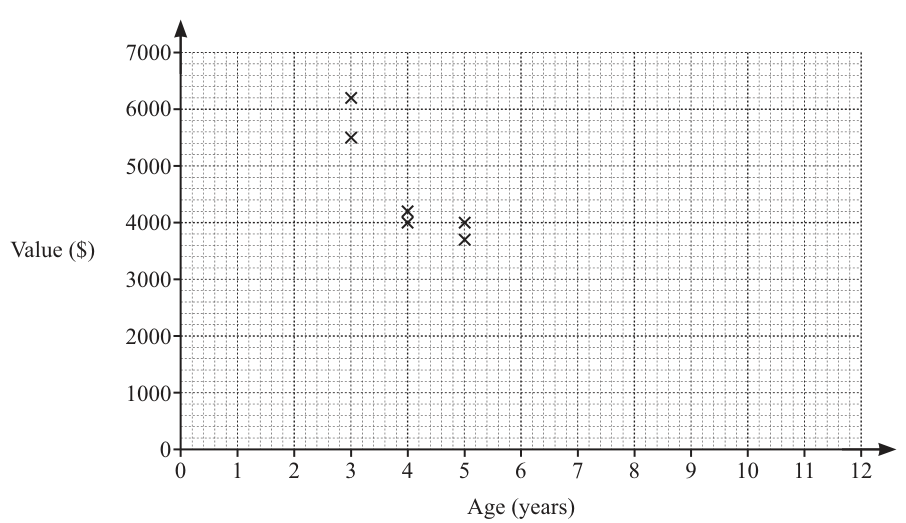
Approach
Identify the remaining data pairs from the table and plot them accurately on the scatter diagram.
The remaining data pairs to plot are:
Working
- For : go to on the horizontal axis and up to halfway between and on the vertical axis.
- For : go to on the horizontal axis and up to on the vertical axis.
- For : go to on the horizontal axis and up to halfway between and on the vertical axis.
- For : go to on the horizontal axis and up to on the vertical axis.
Answer
Plot the four points , , , and on the scatter diagram.
4 points plotted at (5, 4500), (6, 3000), (8, 1500), and (8, 2000)
Walkthrough
The table lists pairs of values representing the age and value of cars. The first points plotted are , , , , , and .
The remaining points from the table are:
Using the grid:
- Each major horizontal grid mark represents year, subdivided into small squares.
- Each major vertical grid mark represents $1000, with small squares per $1000 (meaning each small square is $100).
Plot each of the points with a small neat cross or dot.
Key Takeaways
- On a scatter diagram, each data item is plotted as a single point .
- Always check the scale on both axes to ensure points are placed precisely.
Common Mistakes
- Plotting at incorrect vertical grid intervals (e.g. misinterpreting the grid subdivisions for $500).
- Forgetting to plot one of the duplicate -values (e.g. only plotting one point at ).
Things to Be Careful About
- Ensure all points are plotted clearly and accurately using a sharp pencil.
Approach
Using a straight ruler, draw a single straight line that follows the downward linear trend of the plotted points, balancing roughly equal numbers of points above and below the line.
Working
The points show a negative correlation. A suitable line of best fit passes approximately through and .
Answer
A single ruled straight line of best fit drawn through the data points.
Ruled line of best fit drawn
Walkthrough
A line of best fit represents the general relationship between two variables on a scatter diagram:
- It must be drawn using a straight edge / ruler (not freehand).
- It should follow the trend (negative gradient here, as value decreases with age).
- It should have approximately the same number of points above it as below it, spread out along the line.
- It does not need to pass through the origin .
Key Takeaways
- A line of best fit must always be a single, straight, ruled line.
- It should extend across the range of the data points.
Common Mistakes
- Joining the dots point-to-point instead of drawing a single straight line.
- Drawing the line freehand without a ruler.
- Forcing the line to pass through the origin .
Things to Be Careful About
- Ensure the line spans the full range of plotted -values (at least from to ).
Use your line of best fit to find an estimate for the value of a car of this model that is 7 years old.
$ ______
Approach
Locate on the horizontal axis, move vertically to meet the line of best fit, then read the corresponding value on the vertical axis.
Working
From the line of best fit at , read the vertical coordinate:
(Any reading accurately taken from the candidate's drawn line of best fit is accepted, typically in the range $2400 to $2800).
Answer
2600
Walkthrough
To estimate the value of a -year-old car:
- Find on the horizontal 'Age (years)' axis.
- Draw a vertical line up to intersect your line of best fit.
- From that intersection point, look horizontally across to read the value on the vertical 'Value ($)' axis.
- Write down this value (a typical line of best fit gives a value around $2600).
Key Takeaways
- Estimating within the data range using a line of best fit is called interpolation.
- The mark is awarded on follow-through from the candidate's own line drawn in part (a)(ii).
Common Mistakes
- Reading from the scatter points rather than from the drawn line of best fit.
- Misreading the vertical scale subdivisions.
Things to Be Careful About
- Clearly read the value directly from your own line of best fit.
Jay has a car of this model that is 12 years old and he wants to find its value.
Explain why Jay should not use this scatter diagram to find an estimate for the value of this car.
______ because ______
Approach
State why using the line of best fit for an age of years is unreliable, referencing extrapolation beyond the given data range.
Working
The data collected only covers car ages from to years.
An age of years is outside the range of the given data (extrapolation).
Extending the line to years would also result in an impossible negative value for the car.
Answer
years is outside the range of the given data (extrapolation).
12 is outside the range of the data
Walkthrough
The given data only contains cars aged between and years old. Predicting values outside this range is called extrapolation.
Extrapolation is unreliable because:
- The linear trend may not continue beyond years.
- If the line of best fit is extended to years, it crosses the horizontal axis and gives a negative value, which is impossible for the value of a car.
- The line of best fit does not extend as far as .
Giving any one of these reasons earns the mark.
Key Takeaways
- Interpolation (estimating within the data range) is generally reliable.
- Extrapolation (estimating outside the data range) is unreliable because the trend may change or produce unrealistic results.
Common Mistakes
- Stating vague reasons such as "because 12 is too old" without explaining that it is outside the data set or gives a negative value.
Things to Be Careful About
- Ensure the explanation clearly refers to the data range or the unrealistic/negative value produced.
Jay records the distances travelled by 50 cars.
The frequency table shows the results.
| Distance ( thousand km) | ||||
|---|---|---|---|---|
| Frequency | 8 | 14 | 11 | 17 |
Work out the fraction of the cars that have travelled more than .
Give your answer in its simplest form.
______
Approach
Find the number of cars that travelled more than by adding the frequencies for the intervals where . Then divide by the total number of cars () and simplify the fraction to its lowest terms.
Working
The intervals with are and .
Number of cars:
Total number of cars .
Fraction:
Divide numerator and denominator by :
Answer
14/25
Walkthrough
- Identify the intervals that represent distances greater than ( thousand km):
- has a frequency of
- has a frequency of
- Calculate the total number of cars with :
- Form the fraction of the total cars:
- Simplify the fraction by dividing both the numerator and denominator by their greatest common divisor, :
Key Takeaways
- To find a fraction of a total from grouped data, identify all groups satisfying the condition, sum their frequencies, and divide by the total frequency.
- Always simplify fractions to their simplest form when asked.
Common Mistakes
- Leaving the answer unsimplified as .
- Only including one of the intervals (e.g. only using or only ).
Things to Be Careful About
- The question specifies "simplest form", so will not score the mark without simplification.
Approach
Find the position of the median item for cars and determine which class interval contains this position using cumulative frequency.
Working
Total frequency .
The median position is:
Calculate the cumulative frequencies:
- Interval :
- Interval :
- Interval :
Since the value is in , the through values lie in the interval .
Therefore, the value lies in .
Answer
50 < d <= 60
Walkthrough
- The median is the middle value. For , the median position is (or ).
- Find the cumulative frequencies by running a cumulative total:
- Up to : cars
- Up to : cars
- Up to : cars
- Up to : cars
- The car falls after the car and before the car, which corresponds to the interval .
Key Takeaways
- To find the median interval of grouped data, find and locate which group contains that cumulative frequency.
Common Mistakes
- Picking the interval with the highest frequency (), which is the modal interval, not the median interval.
- Picking the interval with the median label/middle row rather than finding the median of the cumulative frequency.
Things to Be Careful About
- Write the interval exactly as printed in the table: .
Approach
To estimate the mean of grouped data, find the midpoint of each class interval, multiply each midpoint by its corresponding frequency, sum these products, and divide by the total frequency ().
Working
Find the midpoint () for each interval:
Calculate :
Calculate the estimated mean:
Answer
55.9
Walkthrough
For grouped continuous data, the exact values are unknown, so we use the midpoint of each interval as the representative value.
-
Find the midpoint of each interval:
-
Multiply each midpoint by its frequency ():
-
Sum the products ():
- Divide by the total frequency ():
Key Takeaways
- Formula for the estimated mean of grouped data:
where represents the midpoint of each class interval and is the frequency.
Common Mistakes
- Using interval widths instead of midpoints.
- Using upper bounds or lower bounds instead of midpoints.
- Dividing by (the number of classes) instead of (total frequency).
Things to Be Careful About
- The intervals have unequal widths (, , , ), so calculate each midpoint carefully rather than assuming a uniform step size.
- The unit "thousand km" is already given on the answer line, so write rather than .
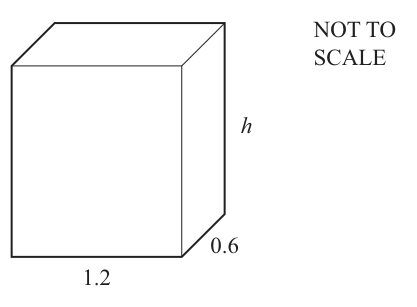
The diagram shows a tank.
The tank is a cuboid with length , width and height .
The volume of the tank is .
Approach
Use the formula for the volume of a cuboid, , substitute the given dimensions, and solve for .
Working
Answer
2.5
Walkthrough
The tank is a cuboid with dimensions length , width , and height .
The volume of a cuboid is given by the formula:
Substitute the known values into the equation:
Calculate the product of and :
Divide both sides by to find :
Key Takeaways
- Volume of a cuboid is calculated as .
- Ensure all given dimensions share consistent units (all are in metres here).
Common Mistakes
- Arithmetic errors when dividing decimals by hand or entering them into a calculator.
- Confusing the volume formula with surface area.
Things to Be Careful About
- Ensure the answer is written clearly as without changing the unit.
Fuel is pumped into the empty tank at a rate of per minute.
Calculate the time taken to fill the tank to of its volume.
Give your answer in minutes and seconds.
______ minutes ______ seconds
Approach
First calculate of the total volume of . Then divide this target volume by the pumping rate of to obtain the time in minutes, and finally convert any decimal part of a minute into seconds.
Working
Calculate of the total volume:
Calculate the time taken in minutes:
Convert the decimal minutes to minutes and seconds:
So the time taken is .
Answer
8 minutes 6 seconds
Walkthrough
- Find the required volume to fill, which is of the tank's total volume of :
- The fuel is pumped at a constant rate of per minute. Divide the required volume by the pumping rate to get the time in minutes:
Alternatively, find the total time to fill the tank () and take of that time:
- Convert into minutes and seconds. The integer part is . The fractional part is , which converts to seconds by multiplying by :
Thus, the total time is and .
Key Takeaways
- .
- When converting a decimal minute to seconds, multiply the fractional part by , not .
Common Mistakes
- Converting minutes directly to or instead of multiplying by .
- Calculating time for volume instead of .
Things to Be Careful About
- Ensure both the minutes and seconds slots are filled correctly with integers ( and ).
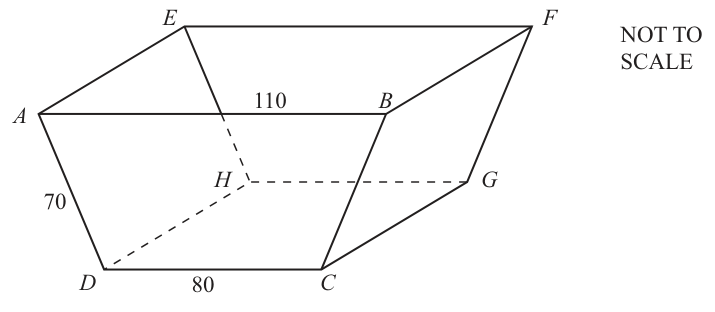
The diagram shows a tank with an open top.
The tank is a prism with trapezium as its cross-section.
, and .
The base of the tank is a square.
Calculate the total surface area of the outside of the tank.
______
Approach
The tank is an open-topped prism whose external surface consists of faces:
- Two congruent trapezoidal cross-sections ( and ).
- One square base ().
- Two congruent sloping rectangular sides ( and ).
(The top face is open and not included.)
First, use Pythagoras' theorem on the symmetrical isosceles trapezium to determine its perpendicular height .
Then calculate and sum the areas of the 5 exterior faces.
Working
Step 1: Find the perpendicular height of the trapezium
Trapezium is an isosceles trapezium with parallel sides and , and non-parallel sides .
The horizontal overhang on each side is:
Using Pythagoras' theorem to find the perpendicular height :
Step 2: Calculate the area of the two trapezoidal faces
Step 3: Calculate the area of the base and side faces
The base is a square of side (since and the base is square, the prism length is ):
The two sloping rectangular side faces ( and ) each have dimensions :
Step 4: Total surface area
Rounding to 3 significant figures gives (or to the nearest integer, ).
Answer
30600
Walkthrough
-
Identify the faces of the open-topped tank:
- The top rectangular face is open, so it has no material and is excluded from the surface area calculation.
- The front face and back face are identical isosceles trapeziums.
- The bottom face is a square base of dimensions . This confirms the length of the prism along the parallel edges () is .
- The two inclined side faces and are rectangles with side lengths and .
-
Find the height of the cross-section:
- Dropping perpendiculars from and to line divides into three segments: a middle section equal to and two equal right-angled triangle bases at each end of length .
- By Pythagoras' theorem:
- Compute the area of the faces:
- Two trapeziums:
- Square base:
- Two sloping sides:
- Sum the areas:
- Given to 3 significant figures, this is .
Key Takeaways
- To calculate the area of an isosceles trapezium when only the slant side and parallel lengths are given, use Pythagoras' theorem to find the perpendicular height.
- Always check whether a container is closed or open-topped so that irrelevant faces are not added.
- The base being a square gives the depth/length of the prism ().
Common Mistakes
- Adding the top face () when the question clearly states the tank has an "open top".
- Using the slant height directly in the trapezium area formula instead of computing the perpendicular height .
- Calculating the base of the right triangle as instead of dividing by to get .
Things to Be Careful About
- Keep unrounded values in your calculator (e.g. ) during intermediate steps to prevent premature rounding errors.
Anya buys 4 shirts and 3 hats.
She pays $100 and receives $21.50 in change.
Each shirt costs the same amount.
Each hat costs $13.50.
Work out the cost of one shirt.
$ ______
Approach
Work out the total amount Anya spent, subtract the money spent on hats, and divide the remainder by 4 to find the cost of one shirt.
Working
She pays $100 and receives $21.50 change, so the total spent is:
The 3 hats cost:
The 4 shirts together cost:
So one shirt costs:
Answer
The cost of one shirt is $9.50.
$9.50
Walkthrough
Anya starts with $100 but gets $21.50 back, so the amount actually spent is found by subtracting the change from the money handed over. The hats are bought in threes at $13.50 each, so multiply $13.50 by 3 to find the total hat cost. Subtract this from the total spent, because the remaining $38.00 must be the total cost of the 4 shirts. Finally divide by 4, since all shirts cost the same amount, to find the cost of one shirt.
Key Takeaways
This question uses a single flow: total paid minus change gives total spent; total spent minus hat cost gives total shirt cost; division by the number of shirts gives one shirt. It also tests keeping money amounts as decimals with two places.
Common Mistakes
- Using $100 as the total spent without subtracting the $21.50 change.
- Forgetting to multiply the hat price by 3.
- Subtracting the hats from $100 or $21.50 instead of from the total spent.
- Dividing the whole total spent by 4 instead of dividing after subtracting the hats.
- Writing the answer as 9.5 without the dollar sign or with too many decimal places; use $9.50 for money.
Things to Be Careful About
All quantities are in dollars, so no unit conversion is needed. The mark scheme awards M1 for either $100 − $21.50 or 3 × $13.50, and M2 for the combined calculation $100 − $21.50 − 3 × $13.50. Show these intermediate values so both available method marks are earned. Give the final answer as a money amount.
The exchange rate between dollars ($) and euros (€) is $1 = €0.91.
Anya buys a new camera for $150.
She sees the same camera for sale online for €140.
Calculate the difference between the price in dollars and the price in euros.
Give your answer in dollars, correct to the nearest cent.
$ ______
Approach
Convert the online euro price into dollars, then subtract Anya's dollar price.
Working
Since $1 = €0.91, dividing an amount in euros by 0.91 converts it to dollars:
To the nearest cent:
The difference is:
Answer
The difference is $3.85.
$3.85
Walkthrough
The exchange rate is given as $1 = €0.91, which means one dollar is worth 0.91 euros. To change a price in euros into dollars, use the reverse: for every 0.91 euros there is 1 dollar, so divide the euro amount by 0.91. Applying this to €140 gives 153.846... dollars. The question asks for the difference in dollars, so round this converted price to the nearest cent before subtracting, giving $153.85. Subtracting Anya's $150 price leaves $3.85.
Key Takeaways
Exchange rate conversions require dividing by the rate when going from the second currency back to the base currency. Always identify which currency is given and which is required before choosing whether to multiply or divide.
Common Mistakes
- Multiplying €140 by 0.91 instead of dividing; this uses the exchange rate in the wrong direction.
- Comparing €140 with $150 without converting to the same currency.
- Rounding 153.846 to 154 before subtracting, giving $4.00 instead of $3.85; nearest cent rounding should be to two decimal places.
- Omitting the dollar sign in the final answer.
Things to Be Careful About
The answer must be correct to the nearest cent, so give it to two decimal places. The mark scheme accepts $3.85 cao, with M1 for the conversion 140 ÷ 0.91. This is a calculator component, so decimal division is expected, but showing the division establishes the method mark.
Anya invests $600 in a savings account.
The account pays compound interest at a rate of per year.
At the end of 3 years the total interest is $21.86.
Calculate the value of .
= ______
Approach
Use the compound interest formula. Let , so the amount after 3 years is . Solve for , then convert it back to .
Working
After 3 years the account contains:
So
Let . Then:
Divide by 600:
Take the cube root:
Since :
Answer
(the interest rate is 1.2% per year).
1.2
Walkthrough
The total amount at the end of 3 years is the original $600 plus the $21.86 interest, i.e. $621.86. With compound interest at per year, the multiplier each year is , so after three years the multiplier is . Write . To find the growth factor, divide both sides by 600; this gives . Taking the cube root recovers , because the money is compounded for 3 years. Subtracting 1 leaves , and multiplying by 100 converts this decimal to the percentage rate .
Key Takeaways
Compound interest questions are best solved using the growth multiplier and the formula . To find an unknown rate, isolate , then take the th root. The problem also reinforces that interest is added to the principal to find the total amount.
Common Mistakes
- Using $21.86 as the amount instead of $621.86.
- Taking a square root instead of a cube root, because the investment is for 3 years.
- Dividing $21.86 by 3 and treating that as the yearly interest; this ignores compounding.
- Giving an answer of 1.012 or 0.012 as ; is the percentage, so the growth factor must be converted by subtracting 1 and multiplying by 100.
- Stopping at without finding .
Things to Be Careful About
The mark scheme awards M1 for and M2 for the cube root ; the final answer is nfww, so all working must be shown. Use the cube root, not a square root, and be careful to use the total amount $621.86 rather than only the interest. Since this is a calculator component, the decimal evaluations are acceptable.

Mandeep has these 9 number cards.
She takes one of the 9 cards at random, notes the number and replaces it.
Find the probability that the card shows an odd number.
______
Approach
Count the number of odd cards and divide by the total number of cards to find the probability.
Working
The 9 cards show the numbers: 1, 1, 2, 2, 2, 5, 6, 7, 8.
Identify the odd numbers on the cards:
1, 1, 5, 7.
There are 4 odd cards out of a total of 9 cards.
Answer
4/9
Walkthrough
The question asks for the probability of picking a card with an odd number from a set of 9 cards. Probability is calculated as the number of favourable outcomes divided by the total number of possible outcomes. First, list all the numbers on the cards: 1, 1, 2, 2, 2, 5, 6, 7, 8. Next, identify which of these are odd numbers: 1, 1, 5, and 7. Count them to get 4 favourable outcomes. The total number of cards is 9. Divide the number of odd cards by the total number of cards to get the probability .
Key Takeaways
- Probability of a single event is the ratio of favourable outcomes to total outcomes.
- Always count the total number of items in the sample space carefully, including duplicates.
Common Mistakes
- Forgetting to count duplicate numbers (e.g., counting only one '1' or one '2').
- Misidentifying even and odd numbers (e.g., thinking 6 is odd).
Things to Be Careful About
- The card is replaced, but for part (a) this does not affect the single-event probability.
- Give the answer as a fraction in its simplest form if possible, though is already simplified.
Mandeep takes one of the 9 cards at random, notes the number and replaces it.
She then takes a second card at random.
Find the probability that both cards show the number 1.
______
Approach
Since the first card is replaced, the two events are independent. Calculate the probability of drawing a 1 on the first draw, and multiply it by the probability of drawing a 1 on the second draw.
Working
The cards are: 1, 1, 2, 2, 2, 5, 6, 7, 8.
Probability of drawing a 1 on the first draw:
There are two 1s out of 9 cards.
Because the card is replaced, the total number of cards remains 9, and there are still two 1s.
Probability of drawing a 1 on the second draw:
Since the events are independent:
Answer
4/81
Walkthrough
Mandeep draws a card, notes the number, and replaces it before drawing a second card. This means the two draws are independent events; the outcome of the first draw does not affect the probabilities of the second draw. First, find the probability of drawing a '1' on the first draw. There are two '1' cards out of nine total cards, so the probability is . Because the card is replaced, the second draw has the exact same conditions: two '1' cards out of nine total cards, giving a probability of . To find the probability of both events happening, multiply the individual probabilities: .
Key Takeaways
- When an item is replaced, the probabilities for subsequent draws remain unchanged.
- For independent events, multiply their individual probabilities to find the combined probability.
Common Mistakes
- Forgetting to replace the card in the denominator for the second probability (using 8 instead of 9).
- Adding the probabilities instead of multiplying them.
Things to Be Careful About
- The word 'replaces' is crucial; it means the events are independent.
- Ensure the fraction cannot be simplified further.
Mandeep takes two of the 9 cards at random without replacement.
She calculates the product of the two numbers shown.
Find the probability that the product is less than 5.
______
Approach
Mandeep takes two cards without replacement. List all pairs of cards whose product is less than 5. Calculate the probability for each pair and sum them. Alternatively, count the number of favourable combinations and divide by the total number of combinations.
Working
The cards are: 1, 1, 2, 2, 2, 5, 6, 7, 8.
We need the product of two cards to be less than 5. The possible products less than 5 are 1, 2, and 4. This means the cards must be chosen from the set {1, 1, 2, 2, 2}.
Method 1: Counting combinations
Total number of ways to choose 2 cards from 9:
Favourable outcomes (pairs with product < 5):
- Two 1s: . There is way.
- One 1 and one 2: . There are ways.
- Two 2s: . There are ways.
Total favourable combinations = .
Method 2: Using probabilities
We can pick two cards from the 5 cards that are 1 or 2. The probability of picking two such cards (without replacement) is:
Alternatively, summing the specific ordered pairs:
Answer
5/18
Walkthrough
Mandeep takes two cards without replacement, so the probabilities change after the first draw. We need the product of the two numbers to be less than 5. Looking at the available numbers (1, 1, 2, 2, 2, 5, 6, 7, 8), any card with a number 5 or greater will make the product 5 or more if paired with any other card (since the smallest other card is 1, and ). Thus, both cards must be chosen from the five cards that show 1 or 2.
Using the combination approach: there are total ways to pick 2 cards. The number of ways to pick 2 cards from the five cards that are 1 or 2 is . All these 10 pairs have products less than 5 (specifically: , , ). The probability is , which simplifies to .
Using the probability approach: the probability the first card is 1 or 2 is . Given that, there are 4 such cards left out of 8 total cards, so the probability the second card is also 1 or 2 is . Multiplying these gives .
Key Takeaways
- When without replacement, the total number of items decreases by 1 for the second draw.
- Identifying the subset of items that satisfy a condition (product < 5) simplifies the calculation.
- Combinations can be used to count outcomes efficiently.
Common Mistakes
- Forgetting that the events are dependent (without replacement) and using instead of for the second draw.
- Missing combinations like .
- Including pairs like , which is not less than 5.
Things to Be Careful About
- 'Without replacement' means the denominator for the second probability is 8, not 9.
- The inequality is strict (), so a product of exactly 5 is not included.
- Ensure fractions are simplified to their lowest terms.
Approach
Substitute into and evaluate.
Working
Answer
-8.25
Walkthrough
The table needs the value of when . We substitute into the formula .
First evaluate the expression inside the brackets:
- So
Then multiply by :
Key Takeaways
Substitution into a polynomial expression is a direct evaluation — always work from the inside out (brackets first, then multiplication).
Common Mistakes
- Forgetting the negative sign on when computing , giving instead of .
- Dropping the negative when computing at , giving instead of .
- Arithmetic errors in — remember it is , not .
Things to Be Careful About
The answer is expected as a decimal () since the other table entries are given in decimal form. Keep the sign correct throughout.
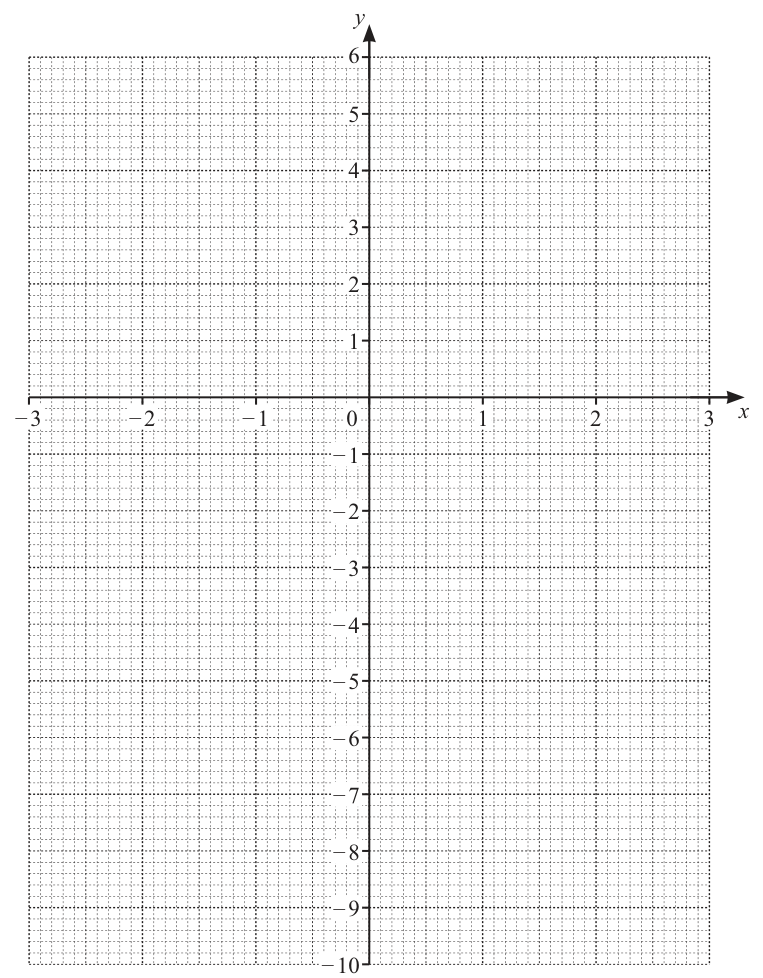
Approach
Plot all seven points from the completed table on the given grid, then join them with a smooth curve appropriate to a cubic function.
Working
The completed table is:
Answer
A smooth cubic curve passing through , , , , , , , with a local maximum near and a local minimum near .
Smooth cubic curve through (-3, -8.25), (-2, 0), (-1, 1.75), (0, 0), (1, -2.25), (2, -2), (3, 3.75) with local max near (-1.1, 1.8) and local min near (1.5, -2.6)
Walkthrough
The student has already computed the -value at in part (a). All seven points are now known:
Plot each point on the grid. Then join them with a smooth curve. Since the function is a cubic with a positive leading coefficient, the curve rises to the right and falls to the left. It has a local maximum (between and ) and a local minimum (between and ). Do NOT join the points with straight line segments — a cubic is a smooth curve.
Key Takeaways
When graphing a polynomial, always plot several points and join them with a smooth curve. The end behaviour of a cubic with positive leading coefficient is: as and as .
Common Mistakes
- Joining points with straight lines instead of a smooth curve.
- Misplotting — it is near the bottom of the grid.
- Not recognising the turning points; the curve should clearly show a peak near and a valley near .
- Forgetting that the curve is continuous — do not break it at the -intercepts.
Things to Be Careful About
The grid has -axis from to and -axis from to , with gridlines every on and every on . Read coordinates carefully. The mark scheme awards marks for correctly plotted points (B2FT for 6 or 7 correct, B1FT for 4 or 5) and then a mark for the smooth curve.
The equation has exactly two solutions.
Use your graph to find the possible values of .
= ______ or = ______
Approach
The equation is equivalent to finding where the horizontal line meets the graph of . A horizontal line meets a cubic in exactly two points only when it passes through a turning point (local maximum or local minimum). So must equal the -value at the local maximum or the -value at the local minimum.
Working
From the graph drawn in part (b):
- The local maximum occurs near , where .
- The local minimum occurs near , where .
Reading from the graph:
(Values read from the student's own graph are accepted within a reasonable tolerance.)
Answer
k ≈ 1.8 or k ≈ -2.6
Walkthrough
The equation asks: for which values of does the horizontal line intersect the cubic graph in exactly two points?
A horizontal line generally meets a cubic in 1 or 3 points. It meets in exactly 2 points only when it is tangent to the curve at a turning point — that is, when equals the -value at a local maximum or a local minimum. At these values, one of the three intersection points merges into a double root.
From the graph drawn in part (b), identify the highest point of the dip (local max) and the lowest point of the rise (local min):
- Local maximum: near , the graph peaks at approximately .
- Local minimum: near , the graph bottoms out at approximately .
So or (reading from the student's graph; the mark scheme allows a tolerance based on what the student actually plotted).
Key Takeaways
A horizontal line intersects a cubic in exactly two points if and only if equals the -value at a turning point. This is a key graphical interpretation of turning points.
Common Mistakes
- Reading the -coordinate of the turning point instead of the -coordinate. The question asks for , which is a -value.
- Giving only one value when two are required (both the max and min must be found).
- Not reading from their own graph — the mark scheme follows through from the student's drawn curve.
Things to Be Careful About
The answer must be read from the student's own graph (strict follow-through). The mark scheme awards B1 for each turning point value, dependent on a correctly drawn positive cubic with visible max and min. Typical expected readings are approximately and .
By drawing a suitable line on the grid, find the solutions of .
= ______ , = ______ , = ______
Approach
We need to solve . Divide both sides by to make the left-hand side match the function from the graph:
So we draw the line on the same grid and read off the -coordinates where it intersects the cubic.
Working
The line passes through:
Draw this straight line on the grid.
The line intersects the cubic at three points. Reading the -coordinates from the graph:
(More precisely: , , .)
Answer
x ≈ -2.5, x ≈ 0.3, x ≈ 2.5
Walkthrough
The equation to solve is . We want to use the graph of , so we rearrange the equation to make the left-hand side match this expression.
Divide both sides by :
Factor the left side:
This is on the right-hand side. So we draw the straight line on the same grid as the cubic and find where they intersect.
The line has gradient and -intercept . Key points on the line within the grid:
- When , → point
- When , → point
- When , → point
- When , → point
- When , → point
Draw this line. It crosses the cubic at three points. Reading the -coordinates:
- Left intersection: (acceptable range to )
- Middle intersection: (acceptable range to )
- Right intersection: (acceptable range to )
Key Takeaways
To solve an equation graphically using a given curve, rearrange it so one side matches the curve's expression. The other side then becomes a line (or another curve) to draw. The solutions are the -coordinates of the intersection points.
Common Mistakes
- Not dividing by 4 correctly, leading to the wrong line equation.
- Drawing the line instead of (forgetting to divide both sides by 4).
- Reading the -coordinates of intersections instead of the -coordinates.
- Only finding two intersections when there are three.
- Not showing the line drawn on the grid (the mark scheme requires M2 for the correct line).
Things to Be Careful About
The mark scheme awards M2 for drawing the correct line (or equivalent forms like with ). A1 is awarded for two correct solutions (dependent on at least M1 being earned). After M0, SC1 is awarded for all three correct solutions. The acceptable ranges for the three -values are approximately to , to , and to . Working must be shown (www/nfww implied by the mark scheme structure).
Approach
To solve for , we need to isolate it on one side of the equation. We do this by first removing the constant term and then dividing by the coefficient.
Working
Start with the given equation:
Subtract from both sides (Method Mark M1):
Divide both sides by :
Answer
9/4
Walkthrough
We are asked to find the value of . The equation is . Since is multiplied by and has added to it, we reverse these operations in the opposite order. First, subtract from both sides to move the constant term. This leaves . Next, divide both sides by to leave by itself. The result is the fraction .
Key Takeaways
When solving linear equations, perform inverse operations to isolate the variable. Always apply the same operation to both sides of the equals sign.
Common Mistakes
- Subtracting from incorrectly.
- Forgetting to divide by at the end (answering instead of ).
- Dividing by instead of the whole term .
Things to Be Careful About
Ensure you show the step or similar to secure the method mark (M1). The final answer can be left as an improper fraction () or written as a decimal (), both are accepted (oe).
Approach
First, expand the bracket to remove the parentheses. Then, treat as the unknown variable and solve the resulting linear equation.
Working
Expand the bracket in the equation:
Multiply the terms inside the bracket by :
Subtract from both sides:
Divide by :
Alternative Method:
Divide both sides by first:
Rearrange to solve for :
Answer
-2
Walkthrough
The equation is . We can solve this by expanding the bracket first: and , giving . Then subtract from both sides to get . Finally, divide by to find . Alternatively, noticing that is divisible by , we can divide the entire equation by immediately to get , which is often quicker.
Key Takeaways
Expanding brackets is a standard first step when variables are inside parentheses. Remember that multiplying a negative term (like ) by a positive number results in a negative term.
Common Mistakes
- Expanding incorrectly, e.g., writing instead of .
- Sign errors when rearranging, such as thinking implies (forgetting the negative sign).
- Adding to both sides but messing up the signs on the other side.
Things to Be Careful About
Watch out for negative signs. A common trap is forgetting that means . The method mark (M1) is awarded for correct expansion or isolation steps like .
Approach
We need to list all integers that fall strictly between and . Note the inequality symbols: means "greater than or equal to" and means "strictly less than".
Working
Convert the lower bound to a decimal or mixed number to make it easier to visualize on a number line:
The inequality is:
This means must be greater than or equal to AND strictly less than .
Let's check integers starting from the lower bound:
- Is included? No, because .
- Is included? Yes, because .
- Is included? Yes.
- Is included? Yes.
- Is included? Yes.
- Is included? No, because the inequality is (strictly less than), so is excluded.
The integers are .
Answer
-1, 0, 1, 2
Walkthrough
The problem asks for integers satisfying . First, recognize that is . The symbol includes the boundary, so any integer greater than works. The first integer after is . The upper bound is , but the symbol excludes . So we count up from until we reach . The list is .
Key Takeaways
Always convert fractions to decimals or visualize them on a number line to avoid confusion with negative numbers. Pay close attention to whether the inequality is strict ( or ) or inclusive ( or ).
Common Mistakes
- Including in the answer set (the most common error due to missing the strict inequality).
- Starting at (thinking is greater than ).
- Listing non-integers or skipping numbers.
Things to Be Careful About
The marking scheme awards partial credit (B1) for getting 3 out of 4 correct with no extras, or 4 correct with 1 extra. However, aiming for the exact set is necessary for full marks. Ensure you write "integers" clearly if the context wasn't already specified in the question stem, though here it is.
Approach
To make the subject, we must isolate on one side of the equation. Since appears in the numerator and denominator, we first eliminate the fraction by cross-multiplying.
Working
Given:
Cross-multiply (Method Mark M1 - elimination of fraction):
Group all terms containing on one side. Add to both sides (Method Mark M1 - isolation of terms):
Factorise out of the left-hand side (Method Mark M1 - factorising):
Divide by to complete the rearrangement:
Answer
4y/(3y+1)
Walkthrough
We start with . To get rid of the fraction, multiply both sides by the denominator . This gives . Now, look at where is. It is multiplied by on the left, and it is subtracted on the right. We need to bring them together. Add to both sides: . Now factor out : . Finally, divide by the bracket to leave alone.
Key Takeaways
When the subject variable appears on both sides of an equation (even implicitly in different terms), you must group those terms together before you can isolate the variable. Factorisation is the key step to pull the variable out.
Common Mistakes
- Forgetting to distribute the to both terms in the numerator during cross-multiplication (e.g., writing ).
- Moving to the wrong side and getting stuck.
- Failing to factorise as , leaving it as .
Things to Be Careful About
Check your final answer by substituting simple values back into the original and rearranged formulas if possible. The mark scheme requires three specific method marks: eliminating the fraction, isolating terms, and factorising/completing. All three must be shown.
Approach
To simplify the algebraic fraction, we must factorise both the numerator and the denominator completely, then cancel any common factors.
Working
Numerator:
First, take out the common factor of :
Recognize as a difference of two squares ():
Denominator:
Factorise by grouping. Group the first two terms and the last two terms:
Factor out from the first group and from the second:
Now factor out the common binomial :
Combine and Cancel:
Cancel the common factor :
Expand the numerator if required (optional, but equivalent):
Answer
(6x+3y)/(x+4)
Walkthrough
The expression is a complex fraction. Step 1 is to factorise the top part (numerator). Notice both terms share a . Pull it out: . Inside the bracket, we have a square minus a square, which splits into . Step 2 is to factorise the bottom part (denominator). There are four terms, suggesting 'factorising by grouping'. Split it into and . Factor out from the first pair and from the second. You will see appearing in both, allowing you to write . Step 3 is to cancel from the top and bottom.
Key Takeaways
Always look for a highest common factor (HCF) before attempting more complex factorisation methods. Recognizing the 'difference of two squares' pattern is crucial for quick simplification. For four-term denominators, grouping is the standard technique.
Common Mistakes
- Missing the HCF of in the numerator.
- Incorrectly factorising as or similar.
- Sign errors in the denominator grouping (e.g., factoring out instead of leading to mismatched brackets).
- Cancelling terms that are not factors (e.g., cancelling from and individually).
Things to Be Careful About
The mark scheme offers partial credit (B1/B2) for seeing correct partial factorisations. Make sure your working clearly shows the factorised forms of the numerator and denominator separately before cancelling. The final answer must be fully simplified.
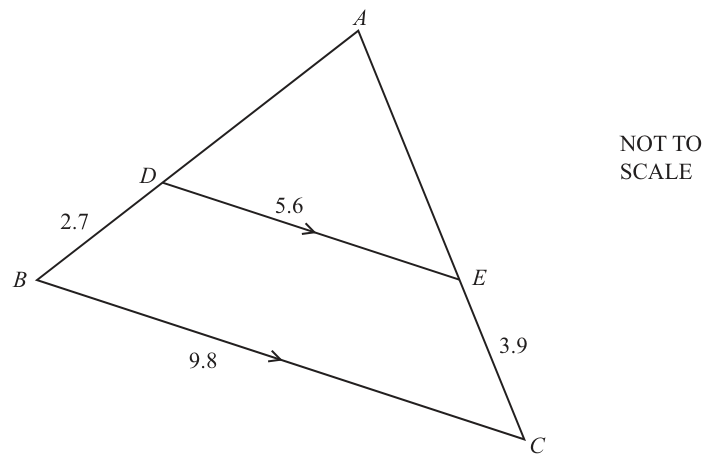
and are straight lines.
is parallel to .
, , and .
Complete the missing angles and reasons to show that triangle is similar to triangle .
In triangle and triangle ,
angle = angle ______ because common angle
angle = angle ______ because ______
angle = angle ______ because ______
As the three pairs of angles are equal, triangle is similar to triangle .
Approach
Use the properties of parallel lines cut by a transversal and the fact that the two triangles share a vertex to identify the three pairs of equal angles.
Working
In triangle and triangle :
because it is the common angle.
Since is parallel to and is a transversal:
because they are corresponding angles.
Since is parallel to and is a transversal:
because they are corresponding angles.
As all three pairs of angles are equal, triangle is similar to triangle by AAA.
Answer
angle = angle because common angle
angle = angle because corresponding angles
angle = angle because corresponding angles
DAE; ADE, corresponding angles; AED, corresponding angles
Walkthrough
To prove two triangles are similar, we need to show that their corresponding angles are equal. The first angle is obvious: both triangles share the angle at vertex , so .
For the other two angles, we use the fact that is parallel to . When a transversal line crosses two parallel lines, the corresponding angles are equal. Here, acts as a transversal crossing and , making and corresponding angles. Similarly, acts as a transversal, making and corresponding angles.
With all three pairs of angles matching, the triangles are similar by the Angle-Angle-Angle (AAA) criterion.
Key Takeaways
- Parallel lines cut by a transversal create equal corresponding angles.
- Triangles that share a vertex and have parallel bases are similar.
- Similarity can be proven using the AAA (Angle-Angle-Angle) criterion.
Common Mistakes
- Writing the wrong angle for the common angle (e.g., writing instead of for the second blank).
- Confusing corresponding angles with alternate interior angles or co-interior angles. Remember, corresponding angles are in the same relative position at each intersection.
- Forgetting to write the reason "corresponding angles" or writing an incomplete reason.
Things to Be Careful About
- Ensure the angles are written in the correct order to match the vertices of the similar triangles ().
- The reasons must be exact: "common angle" and "corresponding angles".
Approach
Since triangle is similar to triangle , the ratios of their corresponding sides are equal. Use this property to set up an equation for and another for , then solve each.
Working
The sides of triangle are , , and . The corresponding sides of triangle are , , and .
We are given:
, , , .
Since lies on , .
Since lies on , .
Using the ratio of corresponding sides :
Cross-multiply to solve for :
Similarly, using the ratio :
Cross-multiply to solve for :
Answer
and
AD = 3.6 cm, AE = 5.2 cm
Walkthrough
Because the triangles are similar, the ratio of any two corresponding sides is constant. We can equate the ratio of the smaller triangle's side to the larger triangle's corresponding side.
For : The side in the small triangle corresponds to side in the large triangle. We know and , . Setting up the proportion allows us to solve for .
Cross-multiplying gives . Subtracting from both sides leaves , so .
For : The side corresponds to . Setting up and solving gives , so , meaning .
Key Takeaways
- In similar triangles, the ratio of corresponding sides is equal.
- When a side of the larger shape is split into two parts, express the full side as the sum of those parts before setting up the ratio.
- Cross-multiplication and algebraic rearrangement are needed to solve for the unknown segment length.
Common Mistakes
- Using the wrong side in the ratio (e.g., instead of ).
- Forgetting to add the segment lengths to get the full side length of the larger triangle.
- Arithmetic errors when cross-multiplying or dividing.
Things to Be Careful About
- Ensure all lengths are in the same units (they are all in cm here).
- Show clear algebraic steps for eliminating the fraction, as marks are awarded for the correct rearrangement leading to the answer.
Approach
In triangle , all three side lengths are now known: , , and . Use the cosine rule to calculate angle .
Working
The cosine rule states:
Rearranging to solve for :
Substitute the values for triangle , where we want to find :
Rounding to 3 significant figures:
Answer
Angle =
76.7 degrees
Walkthrough
We have a triangle with all three sides known (, , ). When you know three sides and need to find an angle, the cosine rule is the appropriate tool.
The formula is , where is the side opposite the angle you want to find. Here, the side opposite is . The adjacent sides are and .
Plugging in: . Calculating the numerator gives . The denominator is . Dividing gives approximately . Taking the inverse cosine yields , which rounds to .
Key Takeaways
- The cosine rule relates the lengths of the sides of a triangle to the cosine of one of its angles.
- Use the form when finding an angle from three known sides.
- Always identify the side opposite the angle you are finding and place it as the negative term in the numerator.
Common Mistakes
- Using the wrong side as the negative term in the numerator (e.g., subtracting instead of ).
- Forgetting to use the inverse cosine function () after finding the cosine value.
- Rounding too early in the calculation, which can lead to an incorrect final angle.
Things to Be Careful About
- The question asks for the angle, so you must use , not just leave the cosine value.
- Respect the accuracy demand: 3 significant figures is standard unless otherwise stated, giving .
Approach
Find the full side lengths and of triangle , then use the sine area formula with the angle (which is the same as ) calculated in part (c).
Working
First, calculate the side lengths of triangle :
The angle is the same as , so .
Using the area formula for a triangle given two sides and the included angle:
Rounding to 3 significant figures:
Answer
27.9 cm^2
Walkthrough
To find the area of triangle , we can use the formula , where and are two sides and is the included angle.
We already know from part (c). The sides forming this angle are and . From part (b), we know and , so . Similarly, and , so .
Substituting into the formula: . This gives approximately , which rounds to .
Key Takeaways
- The area of a triangle can be calculated using two sides and the sine of the included angle: .
- Always ensure you are using the full side lengths of the triangle in question, not just the segments from the smaller similar triangle.
- The angle at the common vertex is the same for both similar triangles.
Common Mistakes
- Using the sides of the smaller triangle ( and ) instead of the larger triangle ( and ), which would give the area of triangle ().
- Forgetting to add the segment lengths to get the full side lengths and .
- Rounding the angle too early before taking the sine, which can cause a slight discrepancy in the final area.
Things to Be Careful About
- Use the unrounded value of the angle () when calculating the sine to maintain accuracy.
- The final answer should be given to 3 significant figures as per standard accuracy demands, yielding .
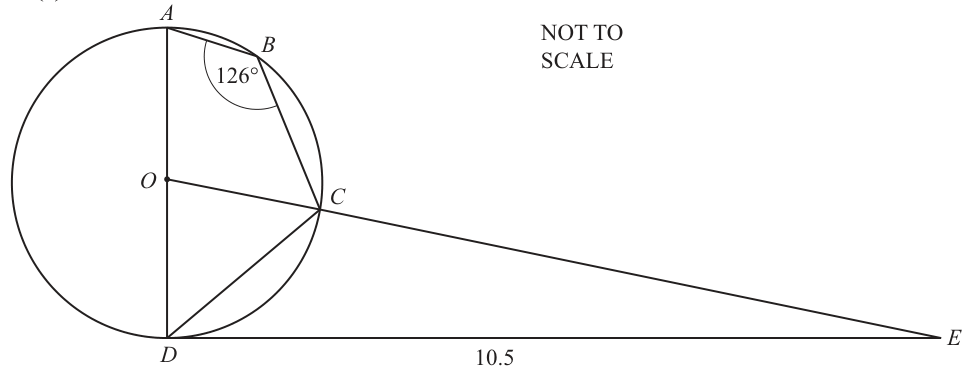
and are points on a circle, centre .
and are straight lines.
is a tangent to the circle at .
Angle and .
Calculate the radius of the circle.
______
Approach
Use circle theorems to find the angle and confirm that . Then apply the tangent ratio in the right-angled triangle to calculate the radius .
Working
Since is a cyclic quadrilateral, opposite angles sum to :
Since is a straight line passing through the centre , . In , , so it is isosceles and . The angle at the centre is:
Alternatively, the reflex angle at the centre is , giving interior , and since is a straight line, .
Since is a tangent to the circle at , the radius is perpendicular to the tangent:
In right-angled triangle , (as is a straight line). Using the tangent ratio:
Solving for :
Answer
3.41
Walkthrough
First, recognise that is a cyclic quadrilateral, so its opposite angles and add up to . This gives . Since lies on , is the same angle. Triangle is isosceles because and are both radii, so the base angles are equal ( each), leaving . Alternatively, use the angle at the centre theorem: the reflex angle is twice (), so interior , and .
Next, apply the tangent-radius theorem: is tangent at , so . Since is a straight line, . In the right-angled triangle , the tangent ratio relates the opposite side ( cm) to the adjacent side (the radius ). Rearranging gives cm.
Key Takeaways
- Opposite angles in a cyclic quadrilateral sum to .
- The angle at the centre is twice the angle at the circumference on the same arc.
- A tangent to a circle is perpendicular to the radius at the point of tangency.
- Trigonometric ratios in right-angled triangles can be used to find unknown lengths once angles are established via circle theorems.
Common Mistakes
- Forgetting that opposite angles in a cyclic quadrilateral sum to instead of being equal.
- Using the wrong angle in the tangent ratio (e.g., using or instead of ).
- Forgetting that the tangent is perpendicular to the radius, leading to incorrect triangle setup.
- Rounding the radius too early before calculating the final answer.
Things to Be Careful About
- The answer must be given to 3 significant figures as is standard unless stated otherwise.
- Ensure the angle used in the trigonometric ratio is the correct one inside the right-angled triangle (, not or ).
- Working must be shown to earn method marks; simply writing the answer scores no marks.
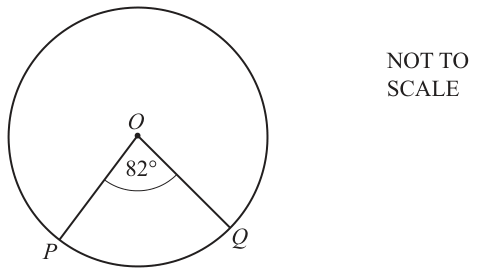
and are points on a different circle, centre .
The angle of the minor sector is .
The length of the minor arc is .
Calculate the area of the major sector.
______
Approach
Use the arc length formula to find the radius of the circle. Then calculate the area of the major sector using the reflex angle and the radius found.
Working
The arc length formula is:
Substitute and :
Solve for :
The angle of the major sector is:
The area of the major sector is:
Answer
63.1
Walkthrough
Start with the arc length formula . Substitute the given minor arc length cm and minor angle to solve for the radius . This gives cm. Keep this value unrounded in subsequent calculations to avoid rounding errors.
Next, find the angle of the major sector by subtracting the minor angle from : . Use the sector area formula with the major angle and the unrounded radius. This gives cm.
Key Takeaways
- The arc length formula relates arc length, central angle, and radius.
- The major sector angle is minus the minor sector angle.
- The sector area formula uses the central angle and radius squared.
- Always keep intermediate values unrounded to ensure accuracy in the final answer.
Common Mistakes
- Using the minor angle instead of the major angle when calculating the area of the major sector.
- Rounding the radius too early (e.g., using instead of ), which can lead to a final answer slightly off.
- Confusing the arc length formula with the sector area formula.
- Forgetting to multiply by in the arc length formula (using instead of ).
Things to Be Careful About
- The final answer must be given to 3 significant figures: cm.
- Use the unrounded radius value in the area calculation to avoid compounding rounding errors.
- Ensure the angle used in the area formula is the reflex angle (), not the minor angle ().
The cost of apples is cents per kilogram.
Mina spends $9 on apples.
Approach
Convert the total amount spent from dollars to cents, then divide by the cost per kilogram in cents to get the mass.
Working
Convert $9 to cents:
The cost of apples is cents per kilogram. Therefore, the mass of apples is:
Answer
900/x
Walkthrough
Mina spends $9 on apples, and the cost per kilogram is given in cents (). To keep the units consistent, we first convert $9 to cents by multiplying by 100, giving cents.
The mass purchased is found by dividing the total amount spent by the price per kilogram:
Key Takeaways
- Always align units before forming an algebraic expression (convert dollars to cents when the rate is in cents).
Common Mistakes
- Forgetting to convert dollars to cents, giving an incorrect expression such as .
Things to Be Careful About
- Ensure the final algebraic expression is written with in the denominator as required.
The cost of pears is 40 cents per kilogram more than the cost of apples.
Mina spends $9 on pears.
The mass of pears Mina receives is less than the mass of apples.
Form an equation in and show that it simplifies to .
Approach
Express the mass of pears in terms of , set up an equation showing that the mass of apples minus the mass of pears is , and clear algebraic denominators to simplify to the target quadratic equation.
Working
The cost of pears is cents per kilogram.
Mina spends $9 (which is cents) on pears, so the mass of pears is:
The mass of pears is less than the mass of apples:
Multiply the entire equation by to eliminate the fractions:
Expand both sides:
Divide every term by (or multiply by ):
Answer
x^2 + 40x - 48000 = 0
Walkthrough
- Find the mass of pears: pears cost 40 cents more per kilogram than apples, so their unit price is cents/kg. Since Mina spends $9 ( cents), the mass of pears is .
- Form the equation: we are given that pears weigh less than apples. Therefore, , giving:
- Clear the denominators: multiply every term by the common denominator :
- Expand and collect like terms:
- Rearrange to standard quadratic form and divide through by :
This precisely matches the required equation.
Key Takeaways
- For "show that" questions, each step of algebraic manipulation must be clearly written out without skipping intermediate expansions.
- Multiplying across by the common denominator is the most reliable way to clear fractions.
Common Mistakes
- Subtracting in the wrong order, e.g. , which leads to incorrect signs.
- Forgetting to multiply the right-hand side () by .
Things to Be Careful About
- All signs and division by must be shown clearly to gain full marks on a proof question.
Approach
Factorise the quadratic expression by finding two numbers that multiply to and add up to , or apply the quadratic formula.
Working
Find two numbers with a product of and a sum of . These numbers are and .
Factorise the quadratic:
Set each factor equal to zero:
Alternatively, using the quadratic formula:
Answer
x = 200 or x = -240
Walkthrough
We need to solve .
Using factorisation:
Look for two numbers that add to and multiply to . Since , we test and :
This gives:
Solving gives or .
Both the quadratic formula and completing the square are equally valid alternative methods.
Key Takeaways
- When solving pure quadratic equations in an exam, both positive and negative solutions must be stated unless the question asks specifically for a real-world quantity.
Common Mistakes
- Discarding the negative root in this part (the question asks to solve the algebraic equation, so both solutions are required).
- Sign errors in factorisation, such as writing .
Things to Be Careful About
- Double check the square root if using the quadratic formula.
Narinder buys of apples and of pears.
Work out the total amount he pays in dollars.
$ ______
Approach
Use the positive root as the cost per kilogram of apples in cents. Determine the cost per kilogram of pears, calculate the total cost in cents, and convert the result to dollars.
Working
Since cost cannot be negative, :
- Cost of apples
- Cost of pears
Calculate the cost for of apples and of pears in cents:
Convert to dollars:
Answer
4.92
Walkthrough
- Select the meaningful physical value: since price cannot be negative, choose cents per kg for apples.
- Find the unit price of pears: pears cost cents more per kg, so their price is cents per kg.
- Compute the cost for each fruit:
- Apples:
- Pears:
- Sum the total: .
- Convert to dollars: divide by to obtain $4.92.
Key Takeaways
- Always convert the final answer to the requested unit (dollars, not cents).
- In contextual problems, reject negative solutions that have no physical meaning.
Common Mistakes
- Forgetting to convert the answer from cents to dollars, giving instead of .
- Using the apple price () for both apples and pears.
Things to Be Careful About
- Ensure the dollar symbol is already present on the answer line, so only write the numerical value
4.92.