Mathematics (Syllabus D) 4024/12 — October/November 2024
Cambridge O-Level · Non-calculator · worked solutions for every part, with the mark scheme
Topics Number · Algebra and Graphs · Statistics · Geometry · Transformations and Vectors · Mensuration · +2 more
Write 43.07862 correct to 3 decimal places.
______
Approach
To round to 3 decimal places, identify the digit in the third decimal place (the thousandths place) and the digit immediately following it (the ten-thousandths place). If the following digit is 5 or greater, increase the third decimal digit by 1; otherwise, leave it unchanged.
Working
The number is .
- Identify the first three digits after the decimal point: , , and . The digit in the third decimal place is .
- Look at the next digit to the right (the fourth decimal place): .
- Since , we round up the previous digit () by adding .
The digits before the rounded position remain unchanged. Therefore, the first three decimal digits become .
Answer
43.079
Walkthrough
Rounding to a specific number of decimal places involves looking at the digit immediately to the right of the desired precision.
Here, we want 3 decimal places. The digits are:
- 1st decimal place:
- 2nd decimal place:
- 3rd decimal place:
- 4th decimal place:
The rule is: if the digit to the right (the 4th decimal place) is 5 or more, we round up the last retained digit. If it is less than 5, we keep the last retained digit as it is.
In this case, the digit to the right is . Since , we add 1 to the digit in the 3rd decimal place ().
So, the number becomes .
Key Takeaways
- Identify the target place value: Count from the decimal point to find which digit needs to be rounded.
- Check the neighbor: Look at the digit immediately to the right of the target place.
- Apply the rule: Round up if the neighbor is , otherwise round down (keep same).
- Preserve preceding zeros: Do not drop leading zeros after the decimal point when rounding (e.g., do not write 43.79).
Common Mistakes
- Incorrectly dropping zeros: Writing instead of . The zero in the hundredths place is significant for the decimal position.
- Rounding too early or incorrectly: Confusing the digit to round with the digit to check. For example, seeing the 6 and thinking it rounds the 7 instead of the 8.
- Off-by-one errors: Adding 1 incorrectly (e.g., ).
Things to Be Careful About
- Ensure you count exactly 3 places after the decimal point.
- Remember that 'cao' (correct answer only) means no working is shown, but the logic must be sound. A common trap is misidentifying the decimal positions (tenths, hundredths, thousandths).
- The number has more than 3 decimal places, so truncation (simply cutting off digits) is incorrect; proper rounding is required.
At midnight the temperature is .
At 11 am the next day the temperature is .
Find the increase in temperature from midnight to 11 am.
______
Approach
To find the increase in temperature, subtract the initial temperature from the final temperature.
Working
Initial temperature =
Final temperature =
Subtracting a negative is equivalent to adding a positive:
Answer
19
Walkthrough
The problem asks for the 'increase' in temperature. This means we need to calculate the difference between the higher (final) value and the lower (initial) value.
- Identify the starting value: The temperature at midnight is .
- Identify the ending value: The temperature at 11 am is .
- Set up the subtraction: .
- Perform the calculation: When you subtract a negative number, it becomes addition. So, becomes .
- Calculate the sum: .
The total rise is 19 degrees.
Key Takeaways
- An 'increase' or 'difference' is found by subtracting the original value from the new value.
- Subtracting a negative integer is mathematically equivalent to adding its positive counterpart (e.g., ).
Common Mistakes
- Sign errors: Treating the subtraction as . This ignores the negative sign of the initial temperature.
- Order of subtraction: Calculating , which gives the wrong direction of change.
Things to Be Careful About
- Ensure you interpret 'increase' correctly as a magnitude of change from the lower bound to the upper bound.
- Double-check signs when dealing with temperatures below zero.
Write these numbers in order of size, starting with the smallest.
______ , ______ , ______ , ______ , ______
smallest
Approach
To compare these numbers easily, we convert every number into its decimal equivalent. This allows us to compare them digit by digit directly.
Working
Convert each number:
- : Performing the division gives or .
- : To convert a percentage to a decimal, divide by . So, .
- : This is already in decimal form. We can write it as for easier comparison.
- : To convert this fraction, we can multiply the numerator and denominator by to get a denominator of . .
- : This is already in decimal form.
Now list the decimal equivalents:
Compare the values:
- is the smallest.
- is the next smallest ().
- is next ().
- is next ().
- is the largest.
Ordering the original expressions from smallest to largest:
Answer
0.6, 0.606, 16/25, 66%, 2/3
Walkthrough
The key to ordering numbers presented in mixed formats (fractions, percentages, and decimals) is to unify them into a single format. Decimals are usually the easiest because our place-value system makes comparing them intuitive.
- Convert Fractions: For , we perform long division (). Since goes into six times with a remainder of , the pattern repeats indefinitely, giving (or ). For , notice that . Multiplying both top and bottom by gives , which is exactly . This avoids needing to do division.
- Convert Percentages: A percentage is literally 'per hundred'. So means , which moves the decimal point two places to the left, resulting in .
- Align Decimal Places: Write all numbers with the same number of decimal places to avoid errors. Using three decimal places is sufficient here:
- (rounded for visual check, though strictly )
- Compare: Look at the digits from left to right. The tenths digit is for all. The hundredths digit determines the order for most: comes first (), then (), then (). Between and , the thousandths digit is less than , so is smaller than . Similarly, is smaller than .
Key Takeaways
- Always convert mixed number types to a common format before comparing.
- Common fraction-to-decimal conversions (like thirds and quarters/hundredths) should be memorized or quickly derived.
- When converting percentages, remember to move the decimal point two places to the left.
Common Mistakes
- Rounding too early: Treating as exactly might make it look larger than (), but even is clearly larger than . However, if one rounded down incorrectly or compared vs poorly, mistakes occur. The mark scheme awards partial credit (B1) for four correct pairs, implying close calls are possible.
- Ignoring the repeating nature of : Writing instead of could lead to thinking and are equal, or ordering them incorrectly relative to each other.
- Decimal alignment errors: Comparing and without padding zeros might lead some students to think is smaller because it has fewer significant digits, or confuse the position of the last digit.
Things to Be Careful About
- Exactness: On the non-calculator component, you must show the method (division or multiplication to get a denominator of 100). Do not just guess the decimal value.
- Order direction: The question asks for "starting with the smallest". Ensure your final list begins with the lowest value () and ends with the highest ().
- Formatting: The final answer requires the original forms (, not ; , not ).
Simplify.
Approach
Use the laws of indices to simplify the expression. First, combine the terms in the numerator using the product law (), then divide by the term in the denominator using the quotient law (). Finally, rewrite the result with a positive index if necessary.
Working
The expression is:
Step 1: Simplify the numerator using the product law for indices ().
So the fraction becomes:
Step 2: Simplify the fraction using the quotient law for indices ().
Step 3: Convert the negative exponent to a positive one. The rule is .
Both and are correct simplified forms.
Answer
1/t^3
Walkthrough
This question asks us to simplify an algebraic fraction involving powers of the same base variable . We rely on two fundamental rules of indices (exponents):
- Product Law: When multiplying terms with the same base, add the exponents. Here, we have multiplied by . So, , giving us in the numerator.
- Quotient Law: When dividing terms with the same base, subtract the exponent of the denominator from the exponent of the numerator. Here, we have divided by . So, , giving us .
A negative exponent indicates a reciprocal. Therefore, is equivalent to . This is the standard form for a simplified answer unless a negative index is explicitly allowed.
Key Takeaways
- Always look for opportunities to apply index laws before attempting other methods.
- Remember that and .
- A negative index means "take the reciprocal": .
Common Mistakes
- Adding instead of subtracting: Students might incorrectly calculate in the denominator or numerator.
- Subtracting in the wrong order: Calculating and writing instead of . It is crucial to remember that the top exponent minus the bottom exponent determines the sign.
- Leaving the answer as : While mathematically correct, exam boards often prefer positive indices for final answers. Both are usually accepted, but is safer.
Things to Be Careful About
- Ensure you are applying the correct law for multiplication vs. division.
- Check the signs carefully when subtracting exponents ( results in a negative number).
- The mark scheme accepts both and , so either form is valid.
Approach
Understand the relationship between square roots and squaring. Squaring a square root cancels out the operations, returning the original number under the radical.
Working
The expression is:
By definition, is the number which, when squared, gives . Therefore:
Applying this to our specific case where :
Alternatively, you can think of it as:
Answer
6
Walkthrough
This question tests the fundamental definition of a square root. The symbol denotes the principal (positive) square root. If you take a number, find its square root, and then square that result, you end up back where you started. Mathematically, the square and the square root are inverse operations. Thus, simply removes the square root sign, leaving the number inside, which is 6.
Key Takeaways
- Squaring and taking a square root are inverse operations.
- for any non-negative number .
- .
Common Mistakes
- Confusing with multiplication: Thinking the answer is (treating the square as a coefficient).
- Calculating incorrectly: Some might multiply instead of squaring the root.
- Sign errors: Forgetting that the principal square root is always positive, so the answer must be positive 6, not .
Things to Be Careful About
- The notation means "the square of the square root of 6". Do not confuse this with (which is also 6) or .
- The mark scheme specifies "cao" (correct answer only), meaning no working is strictly required for marks, but understanding the concept prevents simple slips.
A group of people are asked what type of holiday they prefer.
The table gives information about the results.
| Type of holiday | Number of people | Pie chart angle |
|---|---|---|
| Camping | 15 | |
| Beach | 45 | |
| Cruise | 20 | |
| Hiking | 10 |
Approach
Find the total number of people surveyed, then use the given Camping data to find the degrees per person. Multiply this by the number of people for each holiday type to find the missing pie chart angles.
Working
Total number of people = .
Degrees per person = .
Beach angle = .
Cruise angle = .
Hiking angle = .
Check: .
Answer
The missing pie chart angles are , , and .
180°, 80°, 40°
Walkthrough
First, we calculate the total number of people surveyed by adding up the numbers for each holiday type: . Next, we use the information given for Camping: 15 people correspond to a pie chart angle of . This allows us to find the angle for 1 person, which is . We then multiply this value by the number of people for each of the other holidays to find their respective angles: Beach is , Cruise is , and Hiking is . Finally, we verify that all angles add up to : .
Key Takeaways
When working with pie charts, the total angle is always . You can find the angle per unit (or per person) by dividing a known angle by its corresponding quantity, then multiply this by the other quantities to find their angles. Always check that the angles sum to .
Common Mistakes
- Forgetting to calculate the total number of people first and trying to use the angles directly without finding the degrees per person.
- Not checking that the final angles add up to .
- Writing the angles without the degree symbol .
Things to Be Careful About
- Ensure the angles are in degrees and include the symbol.
- The mark scheme accepts alternative methods such as finding the fraction of the total (e.g., ) or using the proportion where is the number of people for each holiday.
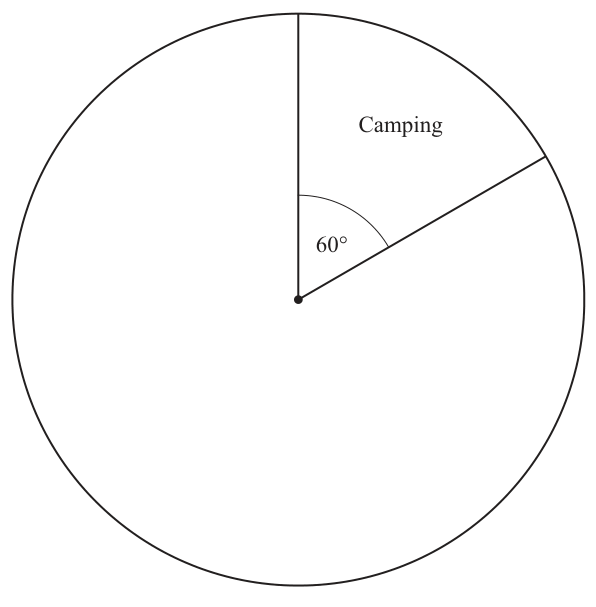
Approach
Using the angles calculated in part (a), draw the remaining sectors in the pie chart. Ensure the angles add up to and label each sector with the correct holiday type.
Working
Camping is already drawn with .
Draw Beach as a semicircle () adjacent to Camping.
Draw Cruise as an sector adjacent to Beach.
Draw Hiking as a sector adjacent to Cruise, which closes the circle ().
Answer
A completed pie chart with sectors Camping (), Beach (), Cruise (), and Hiking ().
Pie chart with sectors Camping 60°, Beach 180°, Cruise 80°, Hiking 40°
Walkthrough
The pie chart already has the Camping sector drawn with an angle of . Using the angles calculated in part (a), we add the remaining sectors in sequence. Beach has an angle of , which is exactly half the circle, so we draw a diameter to create this semicircle. Next, we add the Cruise sector with an angle of adjacent to Beach. Finally, we add the Hiking sector with an angle of , which should perfectly close the circle since . Each sector must be clearly labelled with its corresponding holiday type.
Key Takeaways
A completed pie chart must have all sectors labelled and their angles must sum to exactly . When drawing, it is often easiest to start with the largest sector (Beach, ) to create a straight line, then add the remaining sectors sequentially.
Common Mistakes
- Drawing sectors with incorrect angles that do not match the calculated values.
- Forgetting to label the sectors with the holiday names.
- Not ensuring the sectors fit together perfectly to form a complete circle ().
Things to Be Careful About
- The mark scheme gives follow-through marks if the angles in the table add up to , even if there was an earlier error.
- Ensure sectors are drawn accurately and labelled clearly to avoid losing marks.
A laptop costs $800.
In a sale, the cost is reduced by 15%.
Work out the cost of the laptop in the sale.
$ ______
Approach
The laptop's original cost is $800. The sale reduces this price by 15%. We can find the sale price by calculating 15% of $800 and subtracting it from the original price, or by directly calculating 85% of the original price.
Working
Method 1: Calculate the discount first
Calculate 15% of $800:
The discount is $120.
Subtract the discount from the original price:
Method 2: Calculate the remaining percentage
If the price is reduced by 15%, the customer pays:
Calculate 85% of $800:
Answer
The cost of the laptop in the sale is $680.
680
Walkthrough
We are given an original price of $800 and a discount rate of 15%. The goal is to find the final sale price.
Step 1: Understand the reduction. A 15% reduction means the new price is 15% less than the old price. This leaves 85% of the original value (since ).
Step 2: Perform the calculation. There are two common ways to do this:
- Find the discount amount ( of ) and subtract it from .
of is calculated as . Since , this becomes . Then . - Find the remaining percentage () and multiply by the original price.
of is calculated as . Since , this becomes .
Both methods yield the same result. The mark scheme accepts either the working for or .
Key Takeaways
- To reduce a quantity by a percentage, you can either calculate the percentage amount and subtract, or calculate the remaining percentage and multiply.
- Calculating percentages of round numbers like 800 is often easier by dividing by 100 first to get 1%, then multiplying by the required percentage.
Common Mistakes
- Adding the percentage instead of subtracting (calculating ).
- Calculating only the discount amount ($120) and forgetting to subtract it from the original price.
- Arithmetic errors when multiplying or .
Things to Be Careful About
- Ensure you are calculating a reduction, not an increase.
- Check that your final answer makes sense (it should be less than $800).
Work out .
Give your answer as a mixed number in its simplest form.
______
Approach
To add and , we must first find a common denominator so that the fractions represent parts of the same whole size. The least common multiple (LCM) of the denominators 4 and 6 will serve as this common denominator.
Working
First, determine the LCM of 4 and 6:
Next, convert each fraction to an equivalent fraction with a denominator of 12:
For , multiply both numerator and denominator by 3:
For , multiply both numerator and denominator by 2:
Now add the two fractions:
The question requires the answer as a mixed number in simplest form. Divide the numerator by the denominator:
So,
The fraction is already in its simplest form because 7 is prime and does not divide 12.
Answer
1 7/12
Walkthrough
Adding fractions with different denominators requires making the denominators the same. This is done by finding a common multiple of the original denominators. Here, the smallest such number (the Least Common Multiple) for 4 and 6 is 12.
We then adjust the numerators proportionally. Since we multiplied the denominator 4 by 3 to get 12, we must also multiply the numerator 3 by 3 to keep the value unchanged (). Similarly, since we multiplied the denominator 6 by 2 to get 12, we multiply the numerator 5 by 2 ().
With the denominators now identical, we simply add the top numbers (numerators): . The result is . Because the numerator is larger than the denominator, this is an improper fraction. To convert it to a mixed number, we ask how many times 12 goes into 19. It goes in 1 time, with 7 left over. Thus, the integer part is 1 and the fractional part is .
Key Takeaways
- Always find a common denominator before adding or subtracting fractions.
- Multiplying the numerator and denominator by the same number creates an equivalent fraction without changing its value.
- An improper fraction (numerator > denominator) should be converted to a mixed number if requested.
Common Mistakes
- Adding numerators and denominators directly (e.g., ), which is mathematically incorrect.
- Using a common denominator that is not the LCM (e.g., 24) but failing to simplify the final answer correctly.
- Forgetting to convert the final improper fraction into a mixed number when explicitly asked.
Things to Be Careful About
- Ensure the final mixed number is in simplest form. In this case, check if the fractional part can be reduced further (it cannot).
Sophia walks at an average speed of .
Work out the time Sophia takes to walk .
Give your answer in hours and minutes.
______ hours ______ minutes
Approach
We are given the distance Sophia walks and her average speed. We need to find the time taken using the relationship between distance, speed, and time. The answer must be in hours and minutes.
Working
First, recall the formula relating distance (), speed (), and time ():
Rearranging for time:
Substitute the given values: and .
Calculate the value of this fraction:
This means Sophia takes 3 full hours plus of an hour. To convert the fractional part into minutes, multiply by 60 (since there are 60 minutes in 1 hour):
Alternatively, converting the total time directly:
Since , this is 3 hours and 15 minutes.
Answer
3 hours 15 minutes
Walkthrough
- Identify the knowns: Sophia walks a distance of at a speed of .
- Choose the correct formula: The fundamental relationship is . Since we want to find the time, we rearrange it to .
- Perform the division: Performing the division gives hours.
- Convert units: The question asks for the answer in hours and minutes.
- The integer part is , so that is 3 hours.
- The decimal part is hours. To convert this to minutes, multiply by 60 (the number of minutes in an hour):
- Combine them: 3 hours 15 minutes.
Key Takeaways
- Always check the required units for your final answer. If the input is in km/h but the output needs minutes, a conversion step is essential.
- Remember the formula triangle: Time = Distance / Speed.
- To convert decimal hours to minutes, always multiply the decimal part by 60, not 100.
Common Mistakes
- Division Error: Dividing by instead of by .
- Unit Conversion: Multiplying the decimal part by 100 (treating it like a percentage) instead of 60.
- Ignoring Units: Forgetting to include "hours" or "minutes" in the final statement if explicit writing is required, though the blanks here guide the format.
Things to Be Careful About
- Ensure you divide distance by speed, not speed by distance.
- When converting hours, remember that an hour has 60 minutes, so , not .
- The mark scheme accepts as a method step (M1), showing that converting total minutes first is also a valid path.
A sequence of patterns is made using crosses and circles.
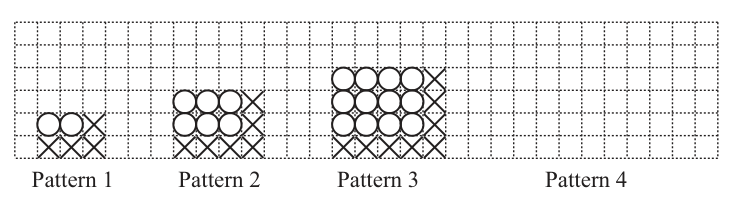
Approach
Observe the dimensions of the circle grid and the arrangement of crosses in the first three patterns, then extend this to Pattern 4.
Working
Pattern 1 has a grid of circles and crosses.
Pattern 2 has a grid of circles and crosses.
Pattern 3 has a grid of circles and crosses.
Following this rule, Pattern 4 must have a grid of circles (4 rows and 5 columns) and crosses.
The crosses form an L-shape along the right and bottom edges of the circle grid: crosses to the right of the circles and crosses below the circles.
Answer
A grid of circles with crosses arranged in an L-shape along the right and bottom edges.
A 4x5 grid of circles with 10 crosses arranged in an L-shape along the right and bottom edges.
Walkthrough
By examining the first three patterns, we can see that Pattern has a grid of circles with dimensions rows by columns. The number of circles is therefore . The crosses are arranged in an L-shape around the right and bottom edges of this grid. For Pattern , there are crosses to the right of the circles and crosses below the circles, giving a total of crosses.
For Pattern 4, we substitute : the grid of circles is (20 circles), and the number of crosses is . The drawing shows 4 rows of 5 circles, with 4 crosses to the right and 6 crosses along the bottom row.
Key Takeaways
Patterns in sequences can often be understood by breaking them into geometric components. Identifying the dimensions of sub-shapes (like the circle grid here) helps predict future terms.
Common Mistakes
- Drawing the wrong number of rows or columns for the circle grid (e.g., a or grid instead of ).
- Miscounting the crosses, forgetting that the bottom row has one more cross than the number of rows.
Things to Be Careful About
When drawing pattern sequence questions, ensure the shape is drawn clearly and the counts of each element match the expected values. The mark scheme accepts a correct drawing even if the exact style varies slightly, as long as the dimensions and counts are right.
Complete the table for Pattern 4 and Pattern 5.
| Pattern number () | 1 | 2 | 3 | 4 | 5 |
|---|---|---|---|---|---|
| Number of crosses | 4 | 6 | 8 | ||
| Number of circles | 2 | 6 | 12 |
Approach
Use the rules established from the first three patterns to find the number of crosses and circles for Patterns 4 and 5.
Working
Crosses: The number of crosses follows the linear pattern .
For Pattern 4 (): .
For Pattern 5 (): .
Circles: The number of circles follows the pattern .
For Pattern 4 (): .
For Pattern 5 (): .
Answer
| Pattern number () | 1 | 2 | 3 | 4 | 5 |
|---|---|---|---|---|---|
| Number of crosses | 4 | 6 | 8 | 10 | 12 |
| Number of circles | 2 | 6 | 12 | 20 | 30 |
Pattern 4: 10 crosses, 20 circles; Pattern 5: 12 crosses, 30 circles
Walkthrough
The number of crosses increases by 2 each time (4, 6, 8...), which is a linear sequence with a common difference of 2. The formula is . Substituting and gives 10 and 12.
The number of circles is 2, 6, 12... The differences between terms are 4, 6... The second differences are constant at 2, indicating a quadratic sequence. The pattern is . For , this is . For , this is .
Key Takeaways
Linear sequences have a constant first difference, while quadratic sequences have a constant second difference. Recognizing these patterns allows you to fill in missing terms in a table.
Common Mistakes
- Assuming the number of circles increases by a constant amount (e.g., adding 4 or 6 each time) instead of recognizing the quadratic growth.
- Miscalculating or .
Things to Be Careful About
Ensure the values are placed in the correct columns for Pattern 4 and Pattern 5. The table requires both crosses and circles for both patterns.
The expression for the number of crosses in Pattern is .
Find the number of crosses in Pattern 35.
______
Approach
Substitute into the given expression for the number of crosses, .
Working
Answer
72
Walkthrough
The question provides the formula for the number of crosses in Pattern as . To find the number of crosses in Pattern 35, simply replace with 35 and evaluate the expression.
, and .
Key Takeaways
When an expression for the nth term is given, finding a specific term is a matter of direct substitution and arithmetic.
Common Mistakes
- Forgetting to multiply 2 by 35 before adding 2 (order of operations error).
- Using the wrong expression (e.g., using the circles formula instead of the crosses formula).
Things to Be Careful About
Follow the order of operations: multiply first, then add. The answer is a simple integer, so no units or special formatting are required.
Approach
Examine the sequence for the number of circles: and find a relationship with the pattern number .
Working
List the number of circles for each :
- For , circles
- For , circles
- For , circles
- For , circles
- For , circles
In each case, the number of circles is the product of and .
Alternatively, using the method of differences:
First differences: , , ,
Second differences: , ,
Since the second difference is constant (), the sequence is quadratic and has the form where , so .
The expression is . Substituting gives , and gives . Solving these gives and .
Thus, the expression is , which can be factored as .
Answer
n(n + 1)
Walkthrough
The number of circles is for . We can factor each of these numbers to find a pattern:
The first factor is always , and the second factor is always . Therefore, the expression for the number of circles in Pattern is .
Using the method of differences confirms this: the constant second difference of indicates a quadratic sequence .
Key Takeaways
Factoring the terms of a sequence can reveal a simple product pattern. If factoring is not immediately obvious, the method of differences (finding constant second differences) is a reliable way to derive the quadratic nth term.
Common Mistakes
- Assuming the sequence is linear and adding a constant difference.
- Writing but not accepting it if the mark scheme expects the factored form (though both are generally accepted in 4024 unless specified).
- Forgetting that starts at 1, not 0.
Things to Be Careful About
The question asks for an expression in terms of . Both and are correct. Ensure the expression is fully simplified and clearly written.
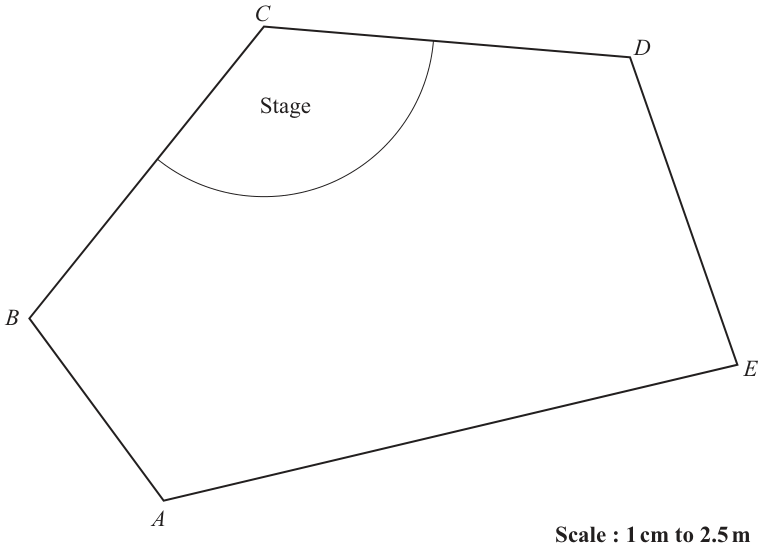
The scale drawing shows a field .
The field contains a stage that is a sector of a circle, centre .
The scale is to .
Approach
Measure the radius of the stage sector (the distance from centre to the circular arc) on the printed diagram using a ruler in centimetres. Then, multiply this measurement by the scale factor of to obtain the actual radius.
Working
Measuring the radius on the scale diagram gives:
Using the scale :
Answer
7.5
Walkthrough
- Use a ruler to measure the distance from the centre to any point on the curved arc of the stage. The measurement should lie between and (nominal measurement is ).
- The scale is given as to . To convert the measured diagram length into the actual length in metres, multiply the measurement by .
- Multiplying by gives . Any answer in the range to (corresponding to measurements in the range to ) is accepted.
Key Takeaways
- For scale drawings, always measure accurately with a ruler to the nearest millimetre.
- Convert diagram lengths to actual lengths by multiplying by the unit scale factor.
Common Mistakes
- Measuring the distance from , , , or instead of the centre .
- Dividing by instead of multiplying by .
- Forgetting to convert the measurement to actual metres using the scale.
Things to Be Careful About
- Check that your measurement starts precisely at the vertex and goes directly to the arc along a straight line (such as along edge or ).
The rest of the field is split into two zones, zone 1 and zone 2.
Zone 1 and zone 2 do not include the stage.
Zone 1 is the region that is nearer to than to .
Using compasses and a straight edge only, construct the boundary between zone 1 and zone 2.
Approach
The boundary between points nearer to line than to line is the angle bisector of . Construct this bisector using a compass and straight edge, ensuring construction arcs are visible, and extend the line until it meets the boundary of the stage.
Working
- Place the compass point at vertex and draw an arc that cuts the line segment and the line segment .
- From each of the two intersection points, draw two intersecting arcs inside the angle using an equal compass radius.
- Using a straight edge, draw a straight line from vertex through the intersection of these two arcs, continuing until it reaches the arc of the stage.
Answer
Straight line bisecting angle constructed with correct arcs and ending at the stage boundary.
Straight line bisecting angle AED constructed with correct arcs and ending at the stage boundary
Walkthrough
- The locus of points equidistant from two intersecting lines (here and ) is the angle bisector of the angle between them (). Points on one side of this bisector are closer to , while points on the other side are closer to .
- To construct the bisector:
- Place the compass point at and draw arcs crossing both and .
- From these intersection points, use compasses to make intersecting arcs within the angle.
- Draw a straight line from through the intersection point of the arcs.
- Stop or continue the line where it meets the boundary of the stage, as the stage is not part of zone 1 or zone 2.
Key Takeaways
- The locus of points equidistant from two straight lines meeting at a vertex is the bisector of the angle formed by those lines.
- Construction marks (arcs) must be clearly visible to earn full method marks.
Common Mistakes
- Drawing the bisector by eye using a protractor without showing compass construction arcs (loses the construction mark).
- Constructing the perpendicular bisector of a segment instead of the angle bisector of .
Things to Be Careful About
- Ensure construction arcs are drawn neatly and clearly.
- Do not erase construction arcs.
Approach
Zone 1 is defined as the region that is nearer to than to , excluding the stage. This corresponds to the region bounded by , , part of , the arc of the stage, and the constructed angle bisector from .
Working
- The bisector divides the field outside the stage into two zones.
- The region on the side of line contains points closer to than to .
- Shade this entire region between , , the circular arc of the stage, and the constructed line from , leaving the stage and zone 2 unshaded.
Answer
The region between , , the arc of the stage, and the angle bisector of shaded.
The region between EA, AB, the arc of the stage, and the angle bisector of angle AED shaded
Walkthrough
- Zone 1 consists of all points in the field that are:
- Outside the circular sector labeled 'Stage'.
- Closer to the boundary than to , meaning on the -side of the constructed angle bisector.
- Therefore, shade the region bounded by line segment , line segment , the lower part of up to the stage arc, the circular arc of the stage, and the angle bisector line.
Key Takeaways
- Always check exclusion conditions (e.g., 'do not include the stage').
- Identify which side of an angle bisector is closer to a given line by looking at the adjacent side.
Common Mistakes
- Shading inside the stage sector.
- Shading the side closer to instead of .
Things to Be Careful About
- Ensure the shading is neat and fills only the required zone without crossing into the stage.
The field is used for a concert.
Tickets for the concert cost $30.75 each.
Work out the cost of 8 tickets.
$ ______
Approach
Multiply the price of one ticket by the number of tickets ().
Working
Carrying out the multiplication:
Answer
246
Walkthrough
- To find the total cost of tickets at $30.75 each, calculate .
- Breaking down the calculation:
- Total
- The total cost is $246.
Key Takeaways
- Mental arithmetic or hand multiplication can often be split into integer and fractional/decimal parts for easy computation on non-calculator papers.
Common Mistakes
- Errors in decimal place placement when multiplying by .
Things to Be Careful About
- The question already provides the $ symbol, so write only the numerical value .
Factorise.
______
Approach
To factorise the expression , we look for the highest common factor (HCF) shared by both terms. We then place this HCF outside a pair of parentheses and divide each term inside the original expression by this HCF to determine what remains inside.
Working
First, examine the coefficients: and . Both numbers are divisible by .
Next, examine the variables: and . Both terms contain at least one .
Therefore, the highest common factor is .
Now, factor out :
Write the HCF outside the brackets and the results of the division inside:
Answer
The fully factorised form is:
2m(2m - 7)
Walkthrough
Factorising is the reverse process of expanding brackets. Instead of multiplying terms out, we are looking for a quantity that divides into every term in the expression evenly.
- Identify the numerical factor: Look at the numbers and . The largest number that divides both of them is .
- Identify the variable factor: Look at the algebraic parts and . Since , the lowest power of present in all terms is .
- Combine to find the HCF: The Highest Common Factor is .
- Divide and place in brackets: Divide the original terms by .
Place these results inside the brackets next to the HCF: .
Key Takeaways
- Always check both the numerical coefficient and the variable part when finding the HCF.
- Ensure that when you expand your answer (), you get back the original question (). This is a good way to verify your work.
Common Mistakes
- Partial factorisation: Forgetting to include the variable in the HCF (writing just instead of ).
- Arithmetic errors: Incorrectly dividing by or mismanaging the negative sign (e.g., writing instead of ).
- Leaving terms behind: Writing which expands to , missing the factor of on the first term.
Things to Be Careful About
- The mark scheme awards partial credit (B1) for incomplete factorisations such as or . However, the final answer must be fully factorised to receive full marks (A1). Ensure every term inside the bracket cannot be divided by any further common factor.
Here is a list of numbers.
Write down the number in the list that is irrational.
______
Approach
An irrational number cannot be written as a fraction of two integers. Simplify each expression and check whether it can be written as a rational number. The only one that cannot is the square root of a non-perfect square.
Working
Evaluate the powers and root:
Now classify each number:
Since is not a perfect square, cannot be written as an exact fraction.
Answer
√5
Walkthrough
We need to decide which of the six numbers is irrational. An irrational number cannot be written as a fraction of two integers. Start by simplifying the expressions that look like powers or roots. , so it is rational. , so it is rational. , so it is rational. simplifies to , so it is rational. is already a fraction, so it is rational. That leaves . Since is not a perfect square, cannot be written as a fraction, so it is irrational.
Key Takeaways
- A rational number can be written as a fraction of two integers.
- Square roots of non-perfect squares are irrational.
- Powers with exponent equal (for a non-zero base), and negative exponents give reciprocals.
Common Mistakes
- Thinking is irrational because it contains a square root sign; it simplifies to .
- Thinking ; it equals .
- Thinking ; it equals .
- Confusing with a non-terminating decimal; it simplifies to .
Things to Be Careful About
- The answer must be exactly (cao); no equivalent decimal is needed.
- This is a non-calculator paper, but no calculator is needed here — just simplify each item by hand.
- An irrational number is not just “a number with a square root sign”; only roots of non-perfect squares are irrational.
Evaluate.
Give your answer in standard form.
______
Approach
Both terms are powers of . To subtract them, rewrite both with the same power of (or as ordinary numbers), then convert the result back to standard form.
Working
Rewrite using as the common power:
Subtract the two numbers:
Convert to standard form by writing :
Answer
4.2 × 10^7
Walkthrough
The two terms are not in the same form because one is multiplied by and the other by . Before subtracting, make the powers of match.
Rewrite as , since . Now both terms have the same power of , so subtract the coefficients directly:
The result is not yet in standard form, because the coefficient is not between and . Convert it by writing :
An equivalent route is to rewrite as , giving .
The answer is .
Key Takeaways
- To add or subtract numbers in standard form, first adjust them to the same power of .
- Standard form requires a coefficient with , multiplied by an integer power of .
- Moving the decimal point one place to the left increases the power of by .
Common Mistakes
- Subtracting coefficients without aligning powers of , e.g. treating as or .
- Leaving the answer as , which is not standard form.
- Misplacing the decimal point when converting, such as writing instead of .
- Giving or without converting to standard form; these may earn partial credit but not the final answer.
Things to Be Careful About
- This is the non-calculator component, so show the adjustment by hand: .
- The final answer is cao: it must be exactly . The mark scheme allows B1 for seeing the figures or for an answer of the form with , and M1 for adjusting both numbers to the same power of (or writing and ).
- Make sure the coefficient in standard form satisfies ; here it is .
The lowest common multiple (LCM) of 120 and 126 is 2520.
Write 2520 as a product of its prime factors.
______
Approach
To write the Lowest Common Multiple (LCM) as a product of its prime factors, we need to include every prime factor present in the original numbers, raised to the highest power that appears in any of those numbers.
Working
We are given:
The LCM is formed by taking the highest power of each prime base found in these factorisations:
- For the prime , the powers are and . The highest is .
- For the prime , the powers are and . The highest is .
- For the prime , it appears only in with power . So we take (or just ).
- For the prime , it appears only in with power . So we take (or just ).
Multiplying these together gives the prime factorisation of the LCM:
We can verify this: . This matches the given LCM.
Answer
2^3 x 3^2 x 5 x 7
Walkthrough
The problem asks us to express the number 2520 (which is the LCM of 120 and 126) as a product of its prime factors. We are already provided with the prime factorisations of 120 and 126.
The rule for finding the LCM from prime factorisations is to take each unique prime factor involved and raise it to the highest exponent that appears in the factorisations of the individual numbers.
- Identify all unique primes: Looking at and , the primes involved are 2, 3, 5, and 7.
- Find the highest power for each:
- Prime 2: Appears as in 120 and in 126. Max power is 3. So we use .
- Prime 3: Appears as in 120 and in 126. Max power is 2. So we use .
- Prime 5: Appears as in 120 and not in 126. Max power is 1. So we use .
- Prime 7: Appears as in 126 and not in 120. Max power is 1. So we use .
- Combine them: Multiply these selected factors together.
Result: .
Key Takeaways
- The LCM contains all prime factors present in the numbers.
- The exponent for each prime in the LCM is the maximum of its exponents in the individual numbers.
- Index notation () is preferred over repeated multiplication () unless specified otherwise, though both are mathematically correct.
Common Mistakes
- Listing the lowest power instead of the highest (this would give the HCF, not the LCM).
- Omitting a prime factor that appears in only one of the numbers (e.g., forgetting the 5 or the 7).
- Multiplying the numbers together () instead of combining their factors correctly.
Things to Be Careful About
- Ensure you identify the highest power. A common error is to just list the factors once without checking the exponents.
- The mark scheme accepts both index form () and expanded form (). Index form is generally more concise and standard for this type of question.
Each interior angle of a regular polygon is .
Find the number of sides of the polygon.
______
Approach
The easiest way to find the number of sides is to use the exterior angle. The interior and exterior angles of any polygon lie on a straight line, so they add up to . Once we have the exterior angle, we can divide the total sum of exterior angles () by it to get the number of sides.
Working
First, calculate the size of one exterior angle:
For any convex polygon, the sum of the exterior angles (taken one at each vertex) is always . For a regular polygon with sides, all exterior angles are equal. Therefore:
Substitute the value we found:
Alternatively, using the interior angle formula :
Multiply both sides by :
Expand the brackets:
Rearrange to group terms:
Divide by 20:
Answer
The polygon has 18 sides.
18
Walkthrough
A regular polygon has sides and angles that are all equal. To find the number of sides given an interior angle, we can look at the relationship between the interior and exterior angles.
At any corner (vertex) of a polygon, the interior angle and the exterior angle form a straight line. A straight line measures . So, if the interior angle is , the exterior angle must be:
Another key property of polygons is that if you walk around the outside of any polygon, turning at each corner, you make exactly one full turn when you return to your starting point. This means the sum of the exterior angles of any polygon is always .
Since the polygon is regular, every exterior angle is the same size (). To find out how many corners (and therefore sides) there are, we simply ask: "How many times does fit into ?"
So, there are 18 sides.
Key Takeaways
- Interior + Exterior = : These two angles are supplementary.
- Sum of Exterior Angles: The sum of the exterior angles of any polygon is always .
- Regular Polygons: In a regular polygon, the number of sides can be found by .
Common Mistakes
- Subtracting from : Some students confuse complementary angles with supplementary ones. Remember that interior and exterior angles are on a straight line, so they add to , not .
- Using the wrong sum formula: Confusing the sum of interior angles () with the sum of exterior angles ().
- Calculation errors: Dividing 360 by the interior angle () instead of the exterior angle ().
Things to Be Careful About
- Make sure to state the final answer clearly as a whole number representing the count of sides.
- When using the interior angle formula method, be careful with algebraic manipulation (expanding brackets and collecting like terms).
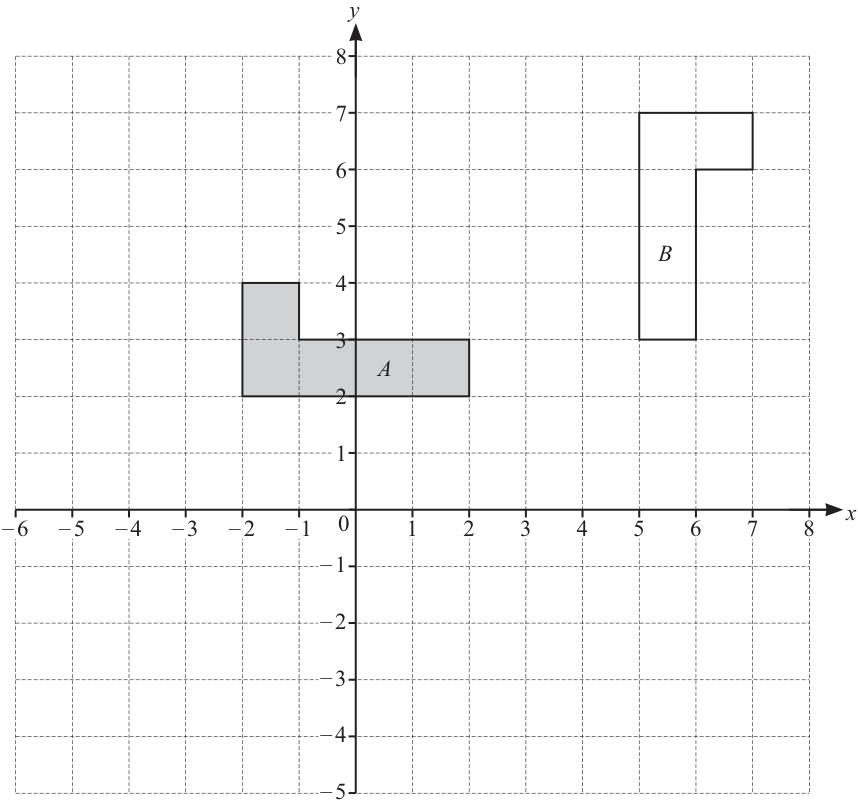
Approach
To translate shape by the vector , add to the -coordinate and to the -coordinate of each vertex.
Working
The vertices of shape are , , , , , and .
Applying the translation :
The new vertices are , , , , , and .
Answer
Draw the translated shape with vertices at , , , , , and .
Shape drawn with vertices at (1, -1), (2, -1), (2, -2), (5, -2), (5, -3), (1, -3)
Walkthrough
The problem asks for the image of shape after a translation by the vector . This means every point on the shape moves 3 units to the right and 5 units down. We take each vertex of shape and apply this change: add 3 to the -coordinate and subtract 5 from the -coordinate. For example, the vertex becomes . We do this for all six vertices to get the new coordinates: , , , , , and . Plotting these points and joining them in the same order as the original shape gives the translated image.
Key Takeaways
- A translation vector adds to the -coordinates and to the -coordinates of all points.
- The shape and orientation remain unchanged; only the position changes.
Common Mistakes
- Forgetting to change the sign of the -component (e.g., adding 5 instead of subtracting 5).
- Adding the vector components to the wrong coordinates (e.g., adding 3 to and -5 to ).
- Not drawing the complete shape or connecting the vertices incorrectly.
Things to Be Careful About
- Ensure the coordinates are calculated correctly; a small arithmetic error shifts the entire shape.
- The final answer is a drawing, so accuracy in plotting is essential for full marks.
Approach
Compare shape and shape . They are congruent but have different orientations. Shape is oriented horizontally and shape vertically, suggesting a rotation. To find the centre and angle, we can test a point and its image, or use the property that the centre lies on the perpendicular bisector of the line joining a point and its image.
Working
Let's test a rotation of clockwise. Pick a vertex on , say . Its corresponding vertex on (top-left of the long vertical side) is .
If the centre is , rotating by clockwise about gives .
Set this equal to :
Adding the equations: . Substituting back: .
So the centre is . Let's verify with another point. Vertex on should map to on .
Vector from to is . Rotating clockwise gives . Adding to centre: . This matches.
Answer
Rotation clockwise about the centre .
Rotation 90 degrees clockwise about centre (4, 1)
Walkthrough
First, observe the shapes. Shape is an L-shape lying mostly flat, while shape is an L-shape standing up. This change in orientation indicates a rotation. To confirm, we can check if a rotation maps the vertices. Let's guess a clockwise rotation. We need to find the centre .
Take a vertex from , for example . Looking at the corresponding position on (the top-left corner of the main vertical block), the point is . For a clockwise rotation about , the point maps to . Substituting and :
Solving these simultaneous equations gives and . So the centre is .
We verify with another point, say on . The vector from to is . Rotating this vector clockwise gives . Adding this to the centre gives , which is indeed a vertex on .
Key Takeaways
- To describe a rotation fully, you must state the type (rotation), the angle and direction ( clockwise), and the centre coordinates.
- The centre of rotation can be found by solving equations derived from the rotation formula or by constructing perpendicular bisectors of lines joining corresponding points.
Common Mistakes
- Forgetting to state the centre coordinates (a partial description scores no marks).
- Getting the direction wrong (e.g., saying anticlockwise when it is clockwise).
- Not verifying the centre with a second point.
Things to Be Careful About
- A full description requires three pieces of information: type, angle/direction, and centre. Missing any one costs a mark.
- Ensure the angle is specified as and the direction clearly as clockwise.
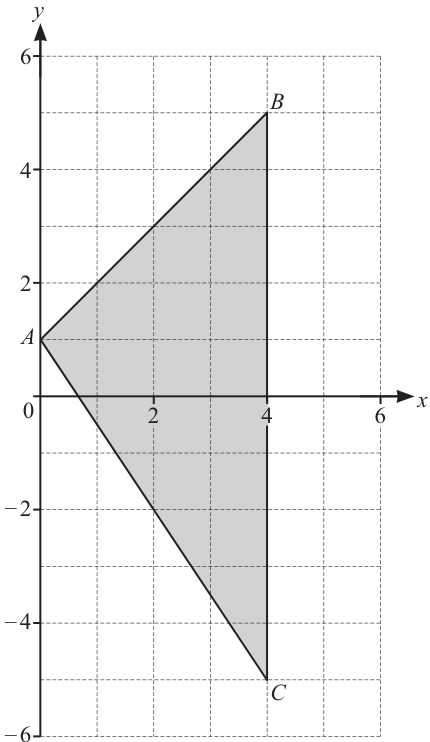
The diagram shows a shaded triangle, , drawn on a square grid.
The equation of the line is .
The shaded region inside triangle is defined by three inequalities.
One of these inequalities is .
Find the other two inequalities.
______
______
Approach
Identify the equations of the lines forming the other two boundaries of the triangle, then determine the correct inequality sign based on the shaded region.
Working
Line AB:
Passes through and .
The y-intercept is , so the equation is .
The shaded region is below this line, so the inequality is .
Line BC:
Passes through and .
This is a vertical line with equation .
The shaded region is to the left of this line, so .
Since the triangle is also bounded by the y-axis () at vertex , the full inequality is .
Answer
y <= x + 1, 0 <= x <= 4
Walkthrough
The shaded region is bounded by three lines. One is given as , which is the line . We need to find the inequalities for lines and .
First, consider line . It passes through and . The gradient is . The y-intercept is , giving the equation . Since the shaded region lies below this line, the inequality is .
Next, consider line . It passes through and . Both points have an x-coordinate of , so this is the vertical line . The shaded region is to the left of this line, meaning values are less than or equal to . Additionally, the leftmost point of the triangle is on the y-axis where , so . Combining these gives .
Key Takeaways
- The equation of a line can be found using two points: where is the gradient and is the y-intercept.
- Vertical lines have equations of the form .
- The direction of an inequality is determined by which side of the boundary line the shaded region lies.
Common Mistakes
- Calculating the gradient incorrectly (e.g., instead of ).
- Forgetting the part of the inequality for the vertical boundary, writing only . The mark scheme awards a follow-through mark (SC1) if both are correct but one is missing, but full marks require the full range.
- Writing the inequality for line as by misinterpreting the shaded side.
Things to Be Careful About
- Ensure the inequality signs match the boundary lines (solid lines mean or , dashed lines mean or ). Here all boundaries are solid.
- The mark scheme accepts on its own as a B1, but is the complete and correct description of the region's x-bounds.
- Always verify your inequality by testing a point inside the shaded region, such as : is true, and is true.
Approach
Use the formula for the area of a triangle: . Choose the vertical side as the base to make calculation straightforward.
Working
Base:
Side is vertical along the line , from to .
Height:
The perpendicular distance from vertex to the line () is the horizontal distance.
Area:
Answer
20
Walkthrough
To find the area of triangle , we identify a base and the corresponding perpendicular height. The side is vertical, making it an excellent choice for the base.
The coordinates of are and are . The length of is the difference in y-coordinates: cm. This is our base.
The height is the perpendicular distance from the opposite vertex to the line containing the base. Since lies on the vertical line , the perpendicular distance is the horizontal distance from to , which is cm.
Applying the area formula: cm.
Key Takeaways
- When a side of a triangle is horizontal or vertical on a grid, it is convenient to use it as the base.
- The height is always the perpendicular distance from the opposite vertex to the line containing the base.
Common Mistakes
- Using the wrong height (e.g., using the y-coordinate of instead of the horizontal distance to ).
- Forgetting to multiply by in the area formula.
- Counting grid squares incorrectly.
Things to Be Careful About
- The grid is in cm, so the area is in cm. The question asks for the answer in cm.
- Ensure the height is perpendicular to the base. If using as the base, the height must be horizontal.
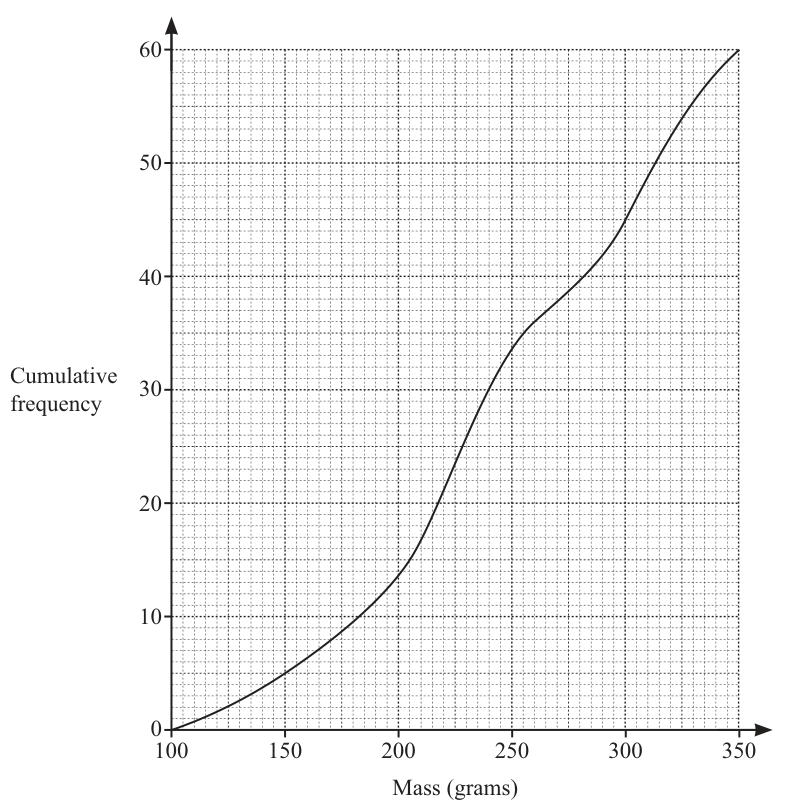
Lin records the masses, in grams, of 60 onions.
The cumulative frequency diagram shows her results.
Approach
The interquartile range is the difference between the upper quartile (UQ) and the lower quartile (LQ). For a total frequency of 60, the LQ is at cumulative frequency and the UQ is at cumulative frequency . Read these masses from the cumulative frequency diagram and subtract.
Working
Total frequency = 60.
Lower quartile position:
Upper quartile position:
From the cumulative frequency diagram:
- At cumulative frequency 15, the mass is approximately 205 g. So LQ = 205 g.
- At cumulative frequency 45, the mass is 300 g. So UQ = 300 g.
Interquartile range = UQ - LQ
Answer
95
Walkthrough
The interquartile range (IQR) measures the spread of the middle 50% of the data. To find it from a cumulative frequency diagram, we first locate the positions of the lower quartile (LQ) and upper quartile (UQ) on the vertical cumulative frequency axis.
For a dataset of onions:
- The LQ is at the position: .
- The UQ is at the position: .
Next, draw horizontal lines from cumulative frequencies 15 and 45 across to the curve, then drop vertical lines down to the horizontal mass axis to read the corresponding values. From the diagram, the mass at CF = 15 is about 205 g, and the mass at CF = 45 is 300 g.
Finally, subtract the LQ from the UQ to get the IQR: g.
Key Takeaways
- Quartile positions on a cumulative frequency graph are found at and on the cumulative frequency axis.
- The interquartile range is always calculated as Upper Quartile Lower Quartile.
- Reading values from a graph requires drawing horizontal lines to the curve first, then vertical lines to the relevant axis.
Common Mistakes
- Using (which gives 30) for the upper quartile instead of (which gives 45).
- Reading the cumulative frequency axis as ordinary frequency.
- Forgetting to subtract the LQ from the UQ to get the IQR, and instead just reporting one of the quartile values.
Things to Be Careful About
- Accuracy when reading from the graph is essential. The mark scheme accepts 205 for the LQ and 300 for the UQ, giving an IQR of 95. Small reading errors (e.g., 200 or 210) will lose the accuracy mark.
- Always show the subtraction step () to earn the method mark for the IQR calculation.
An onion is large if its mass is at least grams.
24 of the 60 onions are large.
Find the value of .
= ______
Approach
An onion is large if its mass is at least grams. This means 24 onions have mass . The remaining onions have mass . Find the number of onions with mass less than , then read the corresponding mass from the cumulative frequency diagram.
Working
Total number of onions = 60.
Number of large onions (mass ) = 24.
Number of onions with mass less than :
From the cumulative frequency diagram, find the mass at cumulative frequency 36.
At cumulative frequency 36, the mass is approximately 260 g.
Therefore, .
Answer
260
Walkthrough
The question states that 24 of the 60 onions are large, meaning their mass is at least grams. We need to find the threshold mass .
The cumulative frequency diagram shows how many onions have a mass less than or equal to a given value. If 24 onions have mass , then the number of onions with mass is the total minus the large ones:
Now, locate cumulative frequency 36 on the vertical axis. Draw a horizontal line to the curve and then a vertical line down to the horizontal mass axis. The value read is approximately 260 g.
This means 36 onions have a mass less than 260 g, and the remaining 24 onions have a mass of at least 260 g. Thus, .
Key Takeaways
- When a problem gives the number of items above a threshold, use the complementary frequency (total above) to find the cumulative frequency to read from the graph.
- Cumulative frequency always represents the number of items below (or equal to) a given value.
Common Mistakes
- Trying to find the mass corresponding to cumulative frequency 24 directly, instead of using the complementary frequency .
- Misreading the graph by dropping a vertical line to the cumulative frequency axis instead of the mass axis.
Things to Be Careful About
- The mark scheme awards a method mark (B1) for showing the calculation or simply seeing 36. Always show this working.
- Read the mass axis carefully; at CF = 36, the value is 260, not 250 or 270.
The diagram shows two mathematically similar mugs.
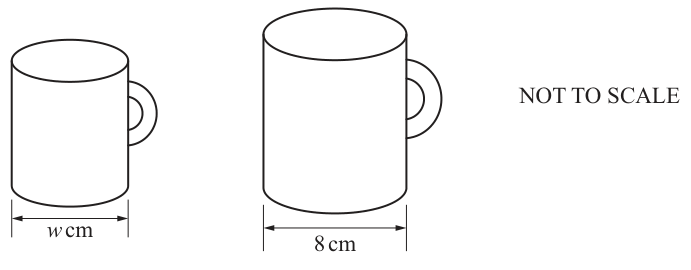
The small mug has width and holds when full.
The large mug has width and holds when full.
Find the value of .
= ______
Approach
For two mathematically similar solids, the ratio of their volumes is the cube of the ratio of their corresponding linear dimensions. We can set up an equation using the given volumes and widths to find .
Working
The volume ratio of the small mug to the large mug is .
The linear scale factor from the large mug to the small mug is .
Since volume scales as the cube of the linear dimension:
Simplify the volume fraction by dividing the numerator and denominator by :
Take the cube root of both sides:
Multiply both sides by to solve for :
Answer
6
Walkthrough
The question involves two mathematically similar mugs. A key property of similar solids is that the ratio of their volumes is equal to the cube of the ratio of their corresponding linear dimensions (such as width, height, or radius).
First, we identify the volume ratio. The small mug holds and the large mug holds . The ratio of the small volume to the large volume is .
Next, we identify the linear scale factor. The width of the small mug is and the width of the large mug is . The ratio of the small width to the large width is .
We equate the cube of the linear scale factor to the volume ratio:
To make the arithmetic easier, we simplify the fraction by cancelling the common factor of , giving .
Taking the cube root of both sides gives:
Finally, we multiply both sides by to isolate :
Key Takeaways
- For similar solids, the volume ratio is the cube of the linear scale factor: .
- To find a linear dimension from a volume ratio, always take the cube root of the volume ratio.
- Simplifying fractions before taking roots makes the calculation much easier and reduces the chance of arithmetic errors.
Common Mistakes
- Forgetting to take the cube root and using the volume ratio directly as the linear scale factor, leading to an incorrect answer of .
- Attempting to take the cube root of without simplifying first, which can lead to arithmetic mistakes.
- Mixing up the ratio order (e.g., using instead of ), though this will still yield the correct final answer if applied consistently.
Things to Be Careful About
- Units: The volumes are given in millilitres () and the widths in centimetres (). Since , the units are compatible and no conversion is needed for the ratio.
- Exact form: The answer is an exact integer (), so no rounding is required. If the answer had been a non-integer, it would need to be given to an appropriate number of significant figures or as an exact surd/fraction depending on the question's instructions.
- The diagram is marked 'NOT TO SCALE', so candidates must rely entirely on the mathematical relationships rather than measuring the diagram.
Approach
Use the index law for powers raised to another power: , and apply the exponent to both the numerical coefficient and the variable.
Working
We are given:
Apply the outer exponent to each factor inside the bracket:
First, evaluate . We know that , so:
Next, simplify the variable part by multiplying the exponents:
Calculate the new exponent:
So:
Combine the results:
Answer
8a^{15}
Walkthrough
The question asks us to simplify an expression with a fractional exponent applied to a term containing both a number and a variable. The key is to use two main index laws:
- Power of a Product: . This allows us to take the exponent to both the and the separately.
- Power of a Power: . This tells us to multiply the existing exponent by the new one.
For the number , we need to find . A fractional exponent means taking the -th root and then raising to the power of . So, . Since , the fourth root of is . Then . Alternatively, write as : .
For the variable , we simply multiply the exponents: . Thus, the term becomes .
Combining these gives .
Key Takeaways
- When a bracket contains multiple factors raised to a power, apply the power to EACH factor.
- To evaluate a fractional power , you can find the -th root first, then raise to the -th power.
- Always check if the base number is a perfect power (like ) to make fractional exponent calculations easier.
Common Mistakes
- Forgetting to apply the exponent to the coefficient .
- Adding the exponents instead of multiplying them (e.g., writing ).
- Incorrectly calculating (e.g., doing or incorrectly).
- Not simplifying the final answer to the form .
Things to Be Careful About
- Ensure the final answer is in its simplest form ( rather than ).
- Remember that the mark scheme accepts intermediate forms like (where ) or just seeing not as the final answer, but you should always provide the fully simplified result.
Approach
Expand the product of two binomials by multiplying every term in the first bracket by every term in the second bracket (often called the FOIL method). Then, combine any like terms.
Working
Multiply the terms:
- First:
- Outer:
- Inner:
- Last:
Write out the expanded expression:
Identify and collect the like terms. The middle terms and are like terms because they both contain :
Substitute this back into the expression:
There are no other like terms to combine.
Answer
8c^2 + 30cd - 27d^2
Walkthrough
This question requires expanding two brackets containing variables. The most reliable method is to multiply each term in the first bracket by each term in the second bracket.
Let's break it down step-by-step:
- Multiply by to get .
- Multiply by to get .
- Multiply by to get .
- Multiply by to get .
After expanding, we have four terms: .
The next step is simplification. We look for 'like terms', which are terms that have exactly the same variable parts. Here, and are like terms. We add their coefficients: . So, they become .
The terms and do not have matching variable partners, so they remain as they are.
The final simplified expression is .
Key Takeaways
- Expansion of results in .
- Pay close attention to signs (positive and negative) during multiplication.
- Only terms with identical variables and powers can be combined (collected).
Common Mistakes
- Sign errors: e.g., forgetting that is negative, or is positive.
- Forgetting to multiply the coefficients (e.g., writing as or ).
- Failing to collect like terms at the end.
- Creating extra terms or missing terms during expansion.
Things to Be Careful About
- The mark scheme awards a method mark (M1) for getting three correct terms from the initial expansion (), even if the final combination is wrong. However, the final answer must be fully simplified.
- Ensure the order of terms does not matter, but standard practice is descending powers of the first variable ().
The inverse of a matrix is given by
and are positive integers and .
The determinant of matrix is 20.
Find .
= ______
Approach
For a matrix, the inverse swaps the leading diagonal, negates the other diagonal, and divides by the determinant. Since the determinant is given as 20 and the inverse carries a factor of , we equate the two expressions entry by entry to recover in terms of and . Then the determinant condition gives an equation for and , which we solve using the fact that they are positive integers with .
Working
Consider a general matrix:
Its inverse is:
Since , the scalar factor is . The given inverse is:
Equating the two expressions:
Comparing entries:
So:
Now use :
Since and are positive integers with , and 13 is prime, the only factor pair is , .
Therefore:
Answer
A = [[13, -7], [1, 1]]
Walkthrough
The key to this problem is knowing the formula for the inverse of a matrix. For a matrix
the inverse is obtained by swapping and , negating and , and dividing by the determinant :
Since the determinant of is given as 20, and the inverse is written with a factor of , the matrix inside the brackets must be exactly the swapped-and-negated version of . By comparing the four entries, we recover in terms of and : the top-left entry of is , the top-right is , the bottom-left is , and the bottom-right is .
Next, we use the determinant condition. The determinant of is , and this must equal 20. So . Since and are positive integers with , and 13 is prime, the only factor pair is and . Substituting gives the final answer.
Key Takeaways
- The inverse of a matrix swaps the leading diagonal, negates the other diagonal, and divides by the determinant.
- The determinant of a matrix is the product of the leading diagonal minus the product of the other diagonal.
- When a product of two positive integers is a prime number, the only factor pair is 1 and the prime itself.
Common Mistakes
- Forgetting to negate both off-diagonal entries when forming the inverse — this would give the wrong signs in .
- Swapping and : the condition forces and , not the other way round.
- Forgetting that the determinant of appears as the denominator in the inverse formula — since it is 20, the factor matches.
Things to Be Careful About
- The condition is essential: it tells you which factor of 13 is and which is .
- The determinant of is 20, which is why the inverse carries the factor .
- The determinant equation may be written in equivalent forms (e.g. ); the mark scheme accepts any equivalent form, seen or implied.
- This is a non-calculator question; the arithmetic is simple (factorising 13), so no calculator is needed.
- The answer must be given as a matrix with the correct entries in the correct positions.
Approach
Substitute into , then simplify.
Working
Answer
-11
Walkthrough
The function is defined by the rule . To find , replace every in the rule with . This gives . First multiply by to get , then subtract to get . Finally divide by to obtain . The negative sign is carried through correctly at each step.
Key Takeaways
This question tests the meaning of function notation: means apply the rule of to the input . It also checks careful arithmetic with negative numbers and fractions.
Common Mistakes
A common error is to write as instead of , because subtracting from gives . Another is to forget the division by or to divide only one term by .
Things to Be Careful About
Keep the negative signs aligned: , and . The answer is an integer, so no fraction or decimal simplification is needed. On the non-calculator paper, this substitution and simplification must be done by hand.
Approach
Write , interchange and , then rearrange to make the subject. Rename as .
Working
Let
For the inverse, swap the roles of and :
Multiply both sides by :
Add to both sides:
Divide by :
So
Answer
f^{-1}(x) = (2x + 1)/3
Walkthrough
To find the inverse of a function, we reverse the operations. Write the function as . The inverse is found by swapping and , because the inverse maps outputs back to inputs. This gives . Now solve for : multiply by , add , then divide by . This yields , so .
Key Takeaways
The inverse function undoes the original function. The method of swapping variables and rearranging is standard for linear functions. It also reinforces changing the subject of a formula.
Common Mistakes
A common mistake is to stop after swapping variables without solving for . Another is to rearrange incorrectly, for example writing instead of . The mark scheme awards a method mark for the correct first step, so showing or is important.
Things to Be Careful About
The answer is an equivalent form, so is accepted; do not simplify incorrectly to . The variable in the final inverse is , not . On the non-calculator paper, the rearrangement must be shown by hand.
Approach
First evaluate . Then write the resulting value as a power of and compare with to find .
Working
Simplify the numerator:
So
Since , we need
Write as a power of :
Therefore
and so
Answer
-2
Walkthrough
Start by substituting into . The numerator becomes . Dividing this by gives . The equation is now . Since , the bases match and the exponents must be equal, so .
Key Takeaways
This question combines function notation with index laws. It shows that evaluating a function can produce a fraction, and that solving an equation like requires writing both sides with the same base.
Common Mistakes
A common error is to compute as correctly but then forget to divide by , giving instead of . Another is to write as instead of . The mark scheme gives partial credit for reaching or .
Things to Be Careful About
Remember that , not . Also, the division by in applies to the whole numerator, so . On the non-calculator paper, the fraction arithmetic must be shown by hand.
A theatre offers a singing lesson (), a dancing lesson () and an acting lesson ().
A group of 40 people are asked which lessons they take part in.
Some of the results are shown in the Venn diagram.
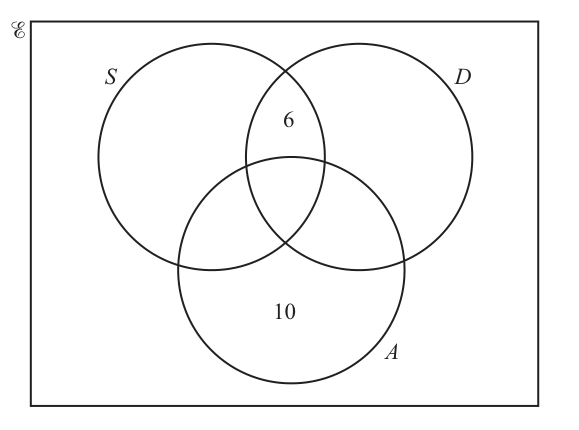
All 40 people take part in at least one lesson.
3 people take part in a singing lesson and an acting lesson but not a dancing lesson.
7 people take part in a dancing lesson only.
19 people take part in a singing lesson.
4 times as many people take part in a singing lesson only as those who take part in all three lessons.
Use this information to complete the Venn diagram.
Approach
Let represent the number of people taking all three lessons (). The number taking only a singing lesson is given as . We can form an equation using the total number of people in the singing lesson (), which is 19.
Working
The total in is the sum of its four disjoint regions:
So the number taking all three lessons is , and the number taking only a singing lesson is .
The total number of people is 40, and everyone takes at least one lesson (so the outside region is 0). Summing the known regions:
The remaining region is only:
Answer
The completed Venn diagram has the following values:
- only: 8
- only: 7
- only: 10
- only: 6
- only: 3
- only: 4
- : 2
- Outside: 0
S only: 8, D only: 7, A only: 10, S∩D only: 6, S∩A only: 3, D∩A only: 4, S∩D∩A: 2, Outside: 0
Walkthrough
The problem gives us a Venn diagram with three sets (S, D, A) and several known values, but leaves some regions blank. We are told that 19 people take a singing lesson, and that the number taking only singing is 4 times the number taking all three. By letting the number taking all three be , we can express the number taking only singing as . Adding up all the disjoint regions inside the S circle gives the total for S, which allows us to form the equation . Solving this gives , so the all-three region is 2 and the S-only region is 8. Finally, since all 40 people are inside the circles, we sum the known regions (8 + 7 + 10 + 6 + 3 + 2 = 36) and subtract from 40 to find the missing D∩A region, which is 4.
Key Takeaways
- When a Venn diagram has a relationship between two unknown regions (e.g., one is a multiple of another), define a variable for one and express the other in terms of it.
- The total for a set is the sum of all its disjoint internal regions.
- The universal set total is the sum of all disjoint regions across the entire diagram, including outside the sets.
Common Mistakes
- Forgetting that the total in a set (like S = 19) includes the intersections, not just the 'only' region.
- Adding the intersection values incorrectly or missing a region when summing to the universal total.
- Not realising that 'all 40 people take part in at least one lesson' means the region outside all circles is 0.
Things to Be Careful About
- Ensure all regions inside the Venn diagram sum exactly to the universal total (40).
- When writing the final answer for a diagram completion, clearly state the value for each region so the marker can verify the work.
- The mark scheme awards method marks for forming the equation and finding the values, so show the algebraic steps clearly.
Approach
The subset with 10 people is the region inside circle A but outside circles S and D. This is the set 'A only'.
Working
In set notation, 'A only' means an element is in A, and not in S, and not in D. This is written as the intersection of A with the complements of S and D:
Answer
A ∩ S' ∩ D'
Walkthrough
The number 10 is located in the region that is inside circle A but outside both circles S and D. In set theory, this is the set of elements that belong to A but not to S and not to D. The complement of S is written as , and the complement of D is . The intersection of A, , and gives exactly this region.
Key Takeaways
- 'Only' in a Venn diagram context corresponds to intersecting the set with the complements of all other sets involved.
- Set notation for 'A only' in a three-set Venn diagram is .
Common Mistakes
- Writing or which, while mathematically equivalent, may not match the expected format in some mark schemes (though 'oe' usually accepts equivalent forms, the intersection form is standard).
- Forgetting to include the complement of one of the other sets (e.g., writing only, which would include the region).
Things to Be Careful About
- Ensure the notation is precise: use for intersection and for complement.
- The mark scheme accepts or equivalent, but be careful with parentheses if using union/subtraction.
is the point and is the point .
Approach
To find the midpoint of the line segment , we calculate the average of the x-coordinates and the average of the y-coordinates of the endpoints and .
Working
Let and .
The midpoint is given by:
Substitute the values:
So the coordinates are .
Answer
(-2, 1)
(-2, 1)
Walkthrough
The midpoint of a line segment connects the exact center between two points. To find its position on the coordinate plane, we simply take the mean (average) of the x-values and the mean of the y-values separately.
For the x-coordinate: add and to get , then divide by to get .
For the y-coordinate: add and to get , then divide by to get .
This gives us the point .
Key Takeaways
The midpoint formula is . It relies on basic arithmetic with negative numbers.
Common Mistakes
Adding the coordinates incorrectly, especially signs (e.g., or ). Forgetting to divide by 2.
Things to Be Careful About
Ensure you match the correct x's together and the correct y's together. Check signs carefully when adding negative numbers.
Approach
First, determine the gradient (slope) of the line passing through and . Then, use the property that perpendicular lines have gradients whose product is (negative reciprocals) to find the gradient of the required line. Finally, use the point-slope form or substitute the known point and new gradient into to find the y-intercept and write the full equation.
Working
Step 1: Find the gradient of ()
Using and :
Step 2: Find the gradient of the perpendicular line ()
The gradient of a line perpendicular to another is the negative reciprocal of the original gradient.
Step 3: Find the equation of the line
The line passes through point and has gradient . We can use the equation .
Substitute , , and :
Solve for :
To subtract, write as :
Now substitute and back into :
Alternatively, using point-slope form :
Answer
y = -1/3x + 11/3
Walkthrough
- Calculate Gradient of PQ: The gradient formula is . Taking as and as , we compute . This simplifies to . Note that the order must be consistent (either or ).
- Perpendicular Gradient: Two lines are perpendicular if their gradients multiply to . If , then , so . This is the "negative reciprocal" rule.
- Find Equation: Use . We know . We also know the line passes through , meaning when , . Substitute these into the equation: . This becomes . Subtracting from gives . Thus, . The final equation is .
Key Takeaways
- Gradient formula: .
- Perpendicular gradient relationship: .
- Finding : Substitute a known point and the calculated into .
Common Mistakes
- Swapping and in the gradient calculation (calculating ).
- Sign errors when subtracting negative coordinates (e.g., becoming instead of ).
- Forgetting the negative sign when taking the reciprocal (writing instead of ).
- Arithmetic errors when solving for (e.g., adding instead of subtracting fractions).
Things to Be Careful About
- Show working for the gradient calculation clearly to secure method marks.
- Ensure the final answer is in the standard linear form unless otherwise specified.
- On Component 1 (Non-calculator), keep answers in fraction form rather than decimal approximations.
The table shows the times each of 110 students take to travel to school one day.
| Time ( minutes) | ||||
|---|---|---|---|---|
| Frequency | 30 | 25 | 35 | 20 |
Complete the histogram to show this information.
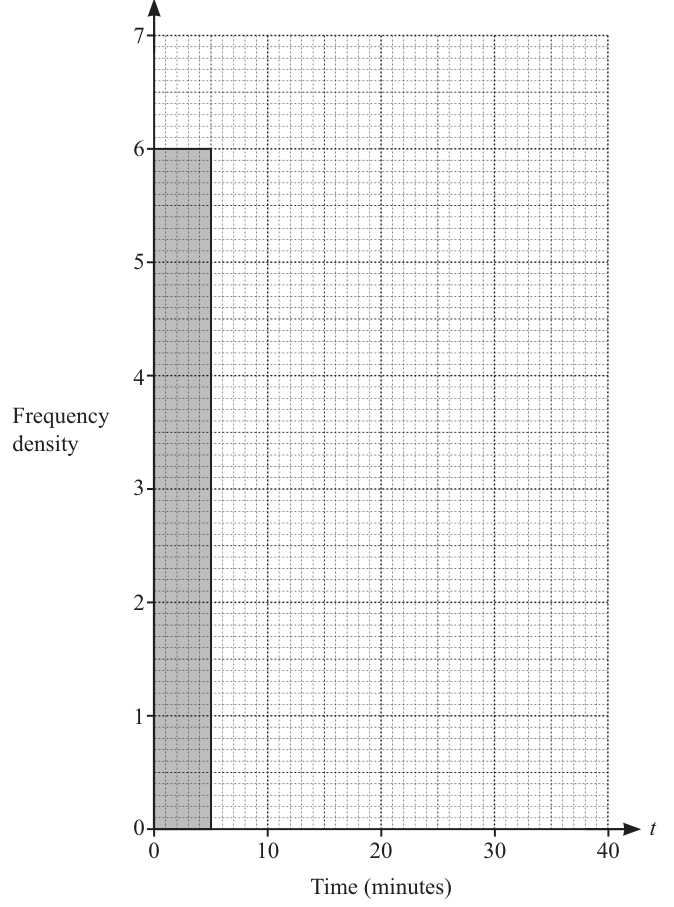
Approach
To complete the histogram, we need to calculate the frequency density for each class interval using the formula , then draw rectangles with the corresponding widths and heights on the grid.
Working
For :
For :
For :
Answer
The histogram is completed by drawing three additional rectangles:
- From to with height .
- From to with height .
- From to with height .
Histogram with bars for 5<t<=10 at height 5, 10<t<=20 at height 3.5, and 20<t<=40 at height 1.
Walkthrough
A histogram uses frequency density on the vertical axis, not frequency. Frequency density is calculated by dividing the frequency by the class width. The first bar () is already drawn with a height of 6, which matches . We apply the same formula to the remaining intervals. For , the width is 5 and frequency is 25, so the density is 5. For , the width is 10 and frequency is 35, giving a density of 3.5. For , the width is 20 and frequency is 20, giving a density of 1. These values are then plotted as rectangles on the grid with their respective widths and heights.
Key Takeaways
- Always use frequency density, not frequency, for the vertical axis of a histogram with unequal class widths.
- Frequency density is found by dividing frequency by class width: .
- The width of each rectangle must match the class interval, and the height must match the calculated frequency density.
Common Mistakes
- Using the frequency (25, 35, 20) as the height of the bars instead of the frequency density.
- Miscalculating the class width, especially for the interval where the width is 20, not 2.
- Drawing rectangles that do not touch each other (histogram bars for continuous data must be adjacent with no gaps).
- Not extending the final bar to correctly, stopping at or misreading the axis.
Things to Be Careful About
- The vertical axis is labelled 'Frequency density', not 'Frequency'. Check the axis labels before plotting.
- The class intervals are continuous and adjacent, so the rectangles must share their vertical boundaries (e.g., the bar for must start exactly where the bar for ends, at ).
- Accuracy in drawing is important; heights of 3.5 and 1 must be read precisely from the grid lines.
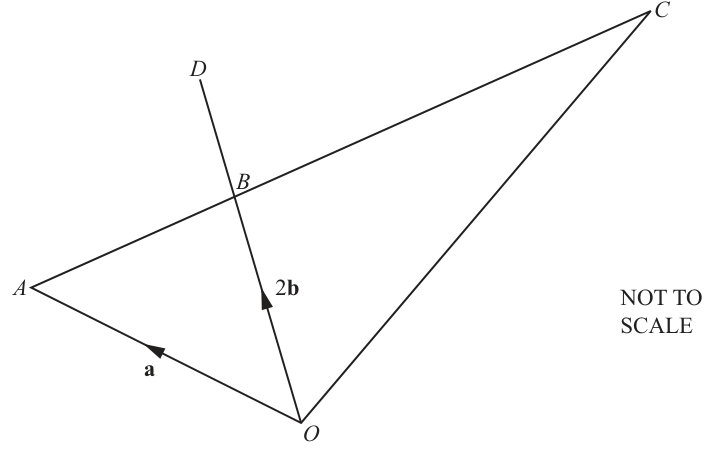
In the diagram,
, and .
is a straight line.
Approach
Use the triangle law of vector addition to express as the difference between the position vectors of and .
Working
Substitute the given expressions and :
Answer
2b - a
Walkthrough
To find the vector from to , we can travel from back to the origin , and then from to . This gives the path , which is equivalent to . Substituting the given values and immediately yields the result .
Key Takeaways
The vector can always be found by subtracting the position vector of the starting point from the position vector of the end point: .
Common Mistakes
- Writing by reversing the order of subtraction.
- Forgetting the negative sign when reversing the direction of a vector (e.g., using instead of ).
Things to Be Careful About
Always check the direction of the arrow. means starting at and ending at , so 's position vector comes first in the subtraction.
Approach
Use the given ratio to express as a multiple of . Then, find by adding vectors along the path .
Working
Since , , and are collinear and , the vector is three times the vector :
Substitute from part (a):
Now, find using the path :
Substitute and :
Combine like terms:
Answer
8b - 3a
Walkthrough
The problem gives the ratio . Since the points are on the same line and in that order, the vector from to is three times the vector from to . We calculated in part (a), so . To find , we can travel from to and then from to . Adding and gives . An alternative valid route is to use , where , leading to .
Key Takeaways
When points are collinear and given in a ratio, you can scale the vector between them to find other vectors on the same line. Vector addition is path-independent, so you can choose any route (like or ) to reach the destination.
Common Mistakes
- Assuming instead of (forgetting that ).
- Making sign errors when distributing the scalar 3 into .
- Incorrectly adding the vectors, such as (mixing up the coefficients of and ).
Things to Be Careful About
The question asks to "show that", so you must display the working that leads to . Just writing the final answer will not earn full marks. Ensure all vector symbols (, ) are bold or have arrows, depending on the required notation, and that the final expression matches the target exactly.
Approach
Since is a straight line, must be a scalar multiple of . Express in terms of this unknown scalar and the given vectors, then equate it to to solve for by comparing coefficients.
Working
Since , , and are collinear, there exists a scalar such that:
Now, express using the path :
Substitute and :
We are given that . Substitute from part (b):
Equate the two expressions for :
Since and are non-parallel vectors, we can equate their coefficients on both sides.
Equating the coefficients of :
Solve for :
Answer
1/3
Walkthrough
The key to this part is using the fact that is a straight line. This means is parallel to , so we can write for some number . This gives . We are also told . Because and are not parallel, the only way these two expressions can be equal is if the coefficients of match and the coefficients of match. Looking at the terms: , which immediately gives . (We could also find by matching the terms: , so , meaning is further along the line than ).
Key Takeaways
When a vector is expressed as a linear combination of two non-parallel vectors in two different ways, you can equate the corresponding coefficients to form simultaneous equations. Collinearity with the origin allows you to introduce a scalar multiplier for the position vector.
Common Mistakes
- Assuming is parallel to instead of .
- Forgetting that and trying to add them.
- Not realizing that equating coefficients is valid because and are non-parallel; trying to solve for both and without separating the components.
Things to Be Careful About
The question asks for the value of , not or the position of . Ensure you only solve for what is asked. Also, remember that and must be non-parallel for the coefficient comparison to be valid; the diagram confirms they are not parallel.