Mathematics (Syllabus D) 4024/21 — May/June 2024
Cambridge O-Level · Calculator · worked solutions for every part, with the mark scheme
Topics Number · Geometry · Algebra and Graphs · Statistics · Mensuration · Trigonometry · +2 more
The cost of a ticket to watch a basketball match is $67.60 .
The total money received from ticket sales for one match is $1 183 000.
Find the number of tickets sold for this match.
______
Approach
The total money received is equal to the price of one ticket multiplied by the number of tickets sold. Therefore the number of tickets is the total divided by the ticket price.
Working
Answer
tickets.
17500
Walkthrough
The total ticket money comes from multiplying the cost of one ticket by the number of tickets. To find the number of tickets, undo this multiplication by dividing the total money by the ticket price.
The result is a whole number, so it makes sense as a number of tickets.
Key Takeaways
- Identify the relationship between the total value, the unit price, and the quantity.
- Use division when the quantity is unknown and the total and unit price are known.
Common Mistakes
- Multiplying the total money by the ticket price instead of dividing.
- Rounding the result: the division here is exact, so the answer should be exactly , not a decimal approximation.
Things to Be Careful About
- Check that the answer is a whole number, since the number of tickets sold cannot be a fraction.
- Use the exact ticket price ; rounding it before dividing would give an incorrect ticket count.
The cost of one ticket at $67.60 is 4% more than the cost of one ticket last year.
Calculate the cost of one ticket last year.
$ ______
Approach
Let be the cost of one ticket last year. This year's price is 4% more than last year's price, so it is of .
Working
Answer
65.00
Walkthrough
The statement "4% more than last year" means the current price is last year's price plus 4% of last year's price. So the current price is of last year's price.
If last year's price is , then
To reverse the 4% increase, divide by :
The previous price is therefore 65.00.
Key Takeaways
- A percentage increase must be interpreted as multiplying the original value by .
- To undo an increase, divide by that multiplier rather than subtracting the same percentage.
Common Mistakes
- Calculating of and subtracting it from . That would be incorrect, because the original price is not .
- Dividing by , which would incorrectly treat the increase rate as the total multiplier.
- Giving an unsupported answer: the question shows working must be clear.
Things to Be Careful About
- The expression should be shown, as this earns the main method mark.
- Answer in the required form: the blank asks for a money value, so give rather than just an unformulated number.
The number of seats in the basketball stadium is 20 545.
The number of seats sold for the first match of the season is 19 340.
Calculate the percentage of the seats in the stadium that are sold.
______ %
Approach
The percentage of seats sold is the number of seats divided by the number of seats in the stadium, multiplied by 100.
Working
Answer
94.1%
Walkthrough
The fraction of seats sold is
multiply this fraction by 100 to obtain it as a percentage.
The exact value is , so a suitable answer is or .
Key Takeaways
- A percentage is a fraction out of 100.
- For a proportion, set the part over the whole, then multiply by 100.
Common Mistakes
- Dividing the total number of seats by the number sold, which gives a number greater than 100.
- Multiplying by before dividing instead of working out first.
- Giving the answer as a fraction or decimal without the percentage sign.
Things to Be Careful About
- The denominator should be the total number of seats, , not the number sold.
- Both and are acceptable; the question does not demand a particular number of decimal places.
A team plays 41 matches.
For the 41 matches, the mean number of seats sold per match is 16 440.
The total number of seats sold for the first 21 matches is 329 000.
Calculate the mean number of seats sold per match for the last 20 matches.
______
Approach
First find the total number of seats sold over all 41 matches by multiplying the mean by 41. Then subtract the total for the first 21 matches and divide by the remaining 20 matches.
Working
Answer
seats per match
17252
Walkthrough
Since the mean number of seats sold per match over 41 matches is , the total number sold over those 41 matches is
The total for the first 21 matches is already given as . Therefore the total sold in the last 20 matches is
Finally, divide this remaining total by the number of remaining matches, 20:
So the mean seats sold per match over the last 20 matches is .
Key Takeaways
- The mean can be used in reverse to find the total: mean = total ÷ number of values.
- When some part of the data is known, subtract the known total from the full total.
Common Mistakes
- Finding the mean of the two given numbers and instead of working with totals.
- Dividing the total for the last 20 matches by 41 or by 21 instead of 20.
- Forgetting to subtract before dividing.
Things to Be Careful About
- The total of the last 20 matches must be divided by 20, not by the number of matches remaining as given.
- The final answer is an integer here, so no rounding is necessary.
The table shows the salaries of three basketball players.
| Basketball player | Salary ($) |
|---|---|
| Stephen | |
| Joe | |
| Tristan |
Approach
Write both salaries using the same power of 10, subtract, then express the answer in standard form.
Working
Tristan:
Stephen:
Answer
or
28130000
Walkthrough
The salary of Tristan is , which is . Stephen's salary is . Now both values have the same power of 10, so their coefficients can be subtracted directly:
Since is not standard form, rewrite it as , or as the ordinary number .
Key Takeaways
- Standard form subtraction requires equal powers of 10.
- A number in standard form must have its first part between 1 and 10 before multiplying by a power of 10.
Common Mistakes
- Subtracting from directly without aligning the powers.
- Writing as the final answer because it is not standard form.
- Misreading the sign: Tristan's salary is greater than Stephen's, so the difference is positive.
Things to Be Careful About
- Check to see whether the ordinary number form or the standard form is expected; the mark scheme accepts both.
- Ensure the subtraction is done from Tristan's salary to Stephen's salary, not the reverse.
The total Joe earns is his salary plus a bonus of $x.
The total he earns is 102.5% of his salary.
Calculate the value of .
= ______
Approach
Joe's total of his salary. Calculate the total, then subtract the actual salary to find the bonus .
Working
Total earnings:
So the bonus is:
Answer
107250
Walkthrough
The total Joe earns is of his salary. Write this as a decimal multiplier:
.
Then the total is
The bonus is the total minus the salary:
So the value of is 107250.
Key Takeaways
- A percentage above 100% means that the quantity is increased and the total is the salary plus the bonus.
- Subtracting the original value from the increased value yields the increase itself.
Common Mistakes
- Subtracting from incorrectly and applying directly without converting to decimal.
- Forgetting to multiply by when working with standard form.
- Answering with (the total) instead of the bonus.
Things to Be Careful About
- The mark scheme accepts a method that uses the equation
- Alternatively, the simplest route is to recognise that is of and compute
- The answer can also be given in standard form as .
The temperature at midday was recorded at ten different heights on a mountain.
The results are shown in the table.
| Height (m) | 300 | 825 | 600 | 425 | 900 | 100 | 1250 | 1450 | 1125 | 1350 |
|---|---|---|---|---|---|---|---|---|---|---|
| Temperature (°C) | 3.0 | 0.0 | 1.2 | 3.5 |
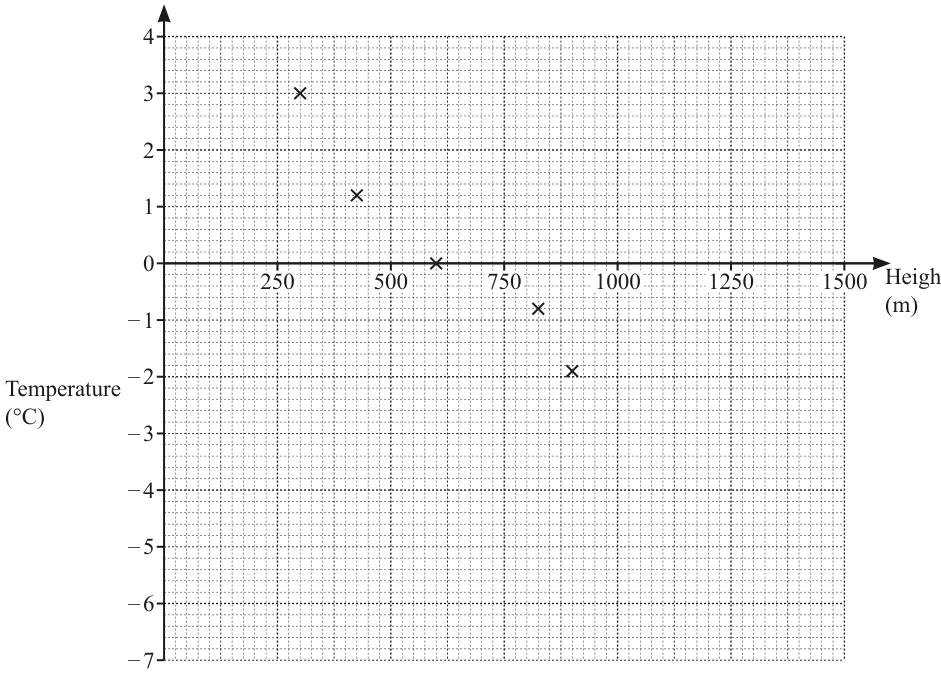
Approach
Five points have already been plotted. The remaining five points from the table are:
Each point is plotted as a cross at the intersection of its height (x-axis) and temperature (y-axis) values.
Working
Answer
All five remaining points plotted correctly on the scatter diagram.
Points plotted at (100, 3.5), (1125, -4.0), (1250, -4.6), (1350, -3.8), (1450, -6.4)
Walkthrough
The table gives ten (height, temperature) pairs. The first five — (300, 3.0), (825, -0.8), (600, 0.0), (425, 1.2), (900, -1.9) — are already shown as crosses on the grid. We must plot the remaining five.
Reading from the table:
- Height 100 m, Temperature 3.5 °C → point (100, 3.5)
- Height 1250 m, Temperature -4.6 °C → point (1250, -4.6)
- Height 1450 m, Temperature -6.4 °C → point (1450, -6.4)
- Height 1125 m, Temperature -4.0 °C → point (1125, -4.0)
- Height 1350 m, Temperature -3.8 °C → point (1350, -3.8)
Each point is marked with a cross at the correct grid intersection. The x-axis has major lines every 250 m and minor subdivisions every 50 m; the y-axis has major lines every 1 °C and minor subdivisions every 0.2 °C. Points like (1125, -4.0) fall exactly on the midpoint between 1000 and 1250, and (1350, -3.8) is two minor subdivisions above -4.0.
Key Takeaways
- Scatter diagrams plot one variable on each axis; the order matters (height on x, temperature on y here).
- Every data pair must be plotted; missing even a few points loses marks.
Common Mistakes
- Swapping the coordinates (plotting temperature on the x-axis and height on the y-axis).
- Misreading negative temperatures as positive.
- Plotting to the wrong minor subdivision on the axes.
Things to Be Careful About
- The axes are labelled clearly: Height (m) on the horizontal axis, Temperature (°C) on the vertical axis.
- Negative temperatures are below the x-axis; make sure points like -4.6 are plotted below 0.
- Accuracy of plotting is assessed by whether 3 or 4 of the remaining points are correct (B1).
Approach
As height increases, temperature decreases. The points trend from the top-left to the bottom-right of the scatter diagram.
Working
The overall trend is downward from left to right, which indicates negative correlation.
Answer
Negative
Walkthrough
Look at the completed scatter diagram. At low heights (around 100–300 m), temperatures are positive (3.0 °C to 3.5 °C). At high heights (around 1250–1450 m), temperatures are strongly negative (-4.0 °C to -6.4 °C). As one variable (height) increases, the other variable (temperature) decreases. This is the definition of negative correlation.
Key Takeaways
- Negative correlation means that as x increases, y decreases (downward trend from left to right).
- Positive correlation means both increase together (upward trend).
- No correlation means no discernible pattern.
Common Mistakes
- Writing "strong negative" when only "negative" is required — the question asks for the type, not the strength.
- Writing "inverse" — while related, the expected answer in 4024 is "negative".
Things to Be Careful About
- The mark scheme accepts simply "Negative". Do not over-qualify unless asked.
Approach
A line of best fit should pass through the centre of the data cloud, with roughly equal numbers of points above and below it, and extending across the full range of the data.
Working
A straight ruled line is drawn from approximately (0, 4.5) to (1500, -6.5), passing through the middle of the plotted points.
Answer
A straight ruled line of best fit drawn through the scatter diagram.
Straight ruled line of best fit drawn through the scatter diagram
Walkthrough
The line of best fit is a straight line that summarises the overall trend. It should:
- Pass through the central region of the data points.
- Have roughly equal numbers of points above and below it.
- Extend across the full range of the data (from about 100 m to 1450 m).
- Not necessarily pass through any specific point.
A reasonable line passes near (0, 4.5) and (1500, -6.5), giving a slope of about -11/1500 ≈ -0.0073 °C per metre.
Key Takeaways
- A line of best fit is a straight ruled line (not a curve, not connecting points).
- It should not be forced through the origin unless the data justifies it.
- The line must be ruled with a straight edge.
Common Mistakes
- Drawing a curve instead of a straight line.
- Drawing a line that connects individual points (a jagged line).
- Not extending the line across the full range of data.
- Forcing the line through the origin (0, 0) — there is no reason for temperature to be 0 at height 0.
Things to Be Careful About
- The line must be ruled with a ruler — freehand lines may not be accepted.
- The exact position of the line varies between candidates, so part (iv) is answered from each candidate's own line.
Another reading is taken at a height of 1000 m.
Use your line of best fit to estimate the temperature at this height.
______ °C
Approach
Locate 1000 m on the horizontal axis, move vertically up to the line of best fit, then move horizontally to read the temperature on the vertical axis.
Working
At height m, the line of best fit is at approximately °C. (Any reading between -2.5 and -3.2 °C is acceptable, depending on the exact line drawn.)
Using the approximate line from (0, 4.5) to (1500, -6.5):
Answer
(Acceptable range: approximately to °C, depending on the candidate's line of best fit.)
-2.8
Walkthrough
To estimate the temperature at 1000 m:
- Find 1000 on the horizontal (height) axis.
- Move vertically up from 1000 until you meet the line of best fit.
- From that intersection, move horizontally to the left to read the temperature on the vertical axis.
On the line drawn in diagram-2, this gives approximately -2.8 °C. Since different candidates will draw slightly different lines of best fit, the mark scheme accepts any reasonable reading from the student's own line (typically between -2.5 and -3.2 °C).
Key Takeaways
- Estimation from a line of best fit is an interpolation task.
- The answer depends on the candidate's own line, so there is a range of acceptable answers.
- Always read from the line, not from the data points (unless the line passes exactly through a point).
Common Mistakes
- Reading the value from a data point near 1000 m instead of from the line of best fit. (There is no data point at exactly 1000 m.)
- Reading the wrong axis.
- Not using a ruler to read off the value accurately.
Things to Be Careful About
- The mark scheme explicitly states follow-through from the ruled line of best fit. A candidate who drew a poor line will get a correspondingly different (but still accepted) answer.
- The answer must be in °C and given to a reasonable number of decimal places (typically 1 or 2).
The table summarises the times taken by 80 adults to climb the mountain.
| Time taken ( hours) | |||||
|---|---|---|---|---|---|
| Frequency | 8 | 15 | 20 | 23 | 14 |
Approach
For grouped data, estimate the mean by using the midpoint of each class interval as the representative value, multiplying by the frequency, summing these products, and dividing by the total frequency.
Working
The class intervals and their midpoints are:
| Class | Midpoint | Frequency | |
|---|---|---|---|
| 8 | |||
| 15 | |||
| 20 | |||
| 23 | |||
| 14 |
Total frequency:
Sum of :
Estimated mean:
Rounding to 3 significant figures:
Answer
7.88
Walkthrough
The data is given in grouped form with unequal class widths. To estimate the mean:
-
Find the midpoint of each class. The midpoint is the average of the lower and upper class boundaries.
- For : midpoint =
- For : midpoint =
- For : midpoint = (note: this class has width 0.5, not 1.0)
- For : midpoint =
- For : midpoint = (this class has width 2.0)
-
Multiply each midpoint by its frequency to get .
-
Sum all values and divide by the total frequency (80).
The key trap here is that the class widths are not all equal (0.5, 1.0, 1.0, 2.0), so you must be careful with the midpoints. The midpoint of is 7.75, not 7.5 or 8.0.
Key Takeaways
- For grouped data, always use class midpoints to estimate the mean.
- Unequal class widths do not affect the mean calculation — only the midpoint and frequency matter.
- The estimated mean is not the exact mean; it is an approximation based on the assumption that all values in a class equal the midpoint.
Common Mistakes
- Using the lower or upper class boundary instead of the midpoint.
- Forgetting that has midpoint 7.75 (not 7.5 or 8).
- Adding the frequencies incorrectly (total should be 80).
- Arithmetic errors in multiplying midpoints by frequencies.
- Rounding too early — keep full precision until the final division.
Things to Be Careful About
- The mark scheme accepts 7.88 or 7.884... — give at least 3 significant figures.
- The class has width 0.5, and has width 2.0. These unequal widths matter for the histogram in part (ii) but not for the mean calculation.
A histogram is drawn to show this information.
The height of the bar representing is 8 mm.
Calculate the height of the bar representing .
______ mm
Approach
In a histogram with unequal class widths, the bar height is proportional to the frequency density (frequency divided by class width), not the frequency itself.
Working
Step 1: Find the frequency density of the first bar.
For :
- Frequency = 8
- Class width = hour
- Frequency density =
The bar height is 8 mm, so the scale is:
Step 2: Calculate the frequency density for .
- Frequency = 23
- Class width = hour
- Frequency density =
Step 3: Convert to bar height.
Answer
46
Walkthrough
In a histogram, when class widths are unequal, the bar height represents frequency density, not frequency. Frequency density is defined as:
From the given bar:
- Class : frequency = 8, width = 1.0
- Frequency density =
- Bar height = 8 mm
- Therefore: 1 mm on the y-axis = 1 unit of frequency density
For the required bar:
- Class : frequency = 23, width = 0.5
- Frequency density =
- Bar height = mm
Key Takeaways
- In a histogram with unequal class widths, bar height ∝ frequency density.
- Frequency density = frequency ÷ class width.
- Always use the given bar to establish the scale before calculating other bar heights.
Common Mistakes
- Using frequency directly instead of frequency density (would give 23 mm, which is wrong).
- Using the wrong class width (e.g., using 1.0 instead of 0.5 for the class ).
- Forgetting to establish the scale from the given bar first.
Things to Be Careful About
- The class has width 0.5, which is half the width of most other classes. This makes its frequency density much larger than its frequency would suggest.
- The answer is 46 mm — a whole number, which is a good sanity check.
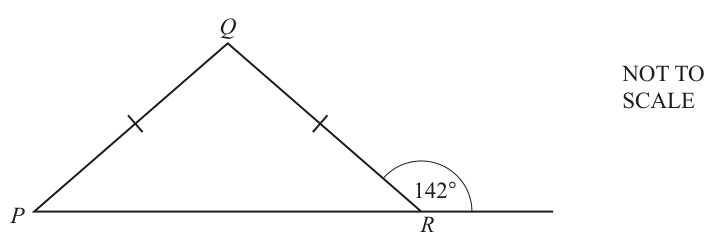
Triangle is isosceles with .
The exterior angle of the triangle at is .
Calculate angle .
= ______
Approach
The exterior angle at and the interior angle lie on a straight line, so they add to . Since , the base angles and are equal. Finally, use the angle sum of a triangle to find .
Working
Since , triangle is isosceles, so:
The angles in triangle add to :
Answer
104°
Walkthrough
First, we find the interior angle at . The exterior angle () and the interior angle are on a straight line, meaning they are supplementary and add up to . Subtracting from gives .
Next, we use the property of isosceles triangles. Because sides and are equal, the angles opposite them — and — must be equal. Therefore, is also .
Finally, we apply the triangle angle sum theorem. The three angles in triangle must total . Subtracting the two base angles () from leaves for the apex angle .
Key Takeaways
- Angles on a straight line add to .
- In an isosceles triangle, the base angles (opposite the equal sides) are equal.
- The interior angles of a triangle always sum to .
Common Mistakes
- Assuming the exterior angle equals the sum of the two opposite interior angles without first finding the interior angle at . (Note: The exterior angle theorem states the exterior angle equals the sum of the two opposite interior angles, so . Since , then . This is a valid alternative route, but the mark scheme specifically awards method marks for the approach).
- Forgetting that the base angles are the ones opposite the equal sides.
- Adding the angles incorrectly or subtracting from the wrong total.
Things to Be Careful About
- The exterior angle is at , not at . Ensure you subtract from to get the interior angle , not assume .
- Always include the degree symbol in your final answer if the question uses it, though numerical answers are often accepted without it.
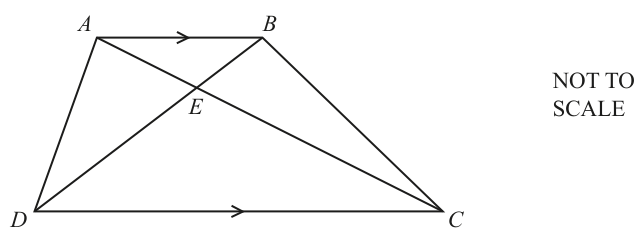
The diagonals of trapezium meet at .
Show that triangle is similar to triangle .
Give a reason for each statement you make.
Approach
To prove triangle is similar to triangle , we need to show that all three corresponding angles are equal. We can find these using the properties of vertically opposite angles and alternate angles formed by the parallel sides and cut by the diagonals acting as transversals.
Working
In triangles and :
Since and is a transversal:
Since and is a transversal:
Since all three pairs of corresponding angles are equal:
Answer
Triangle is similar to triangle by AAA similarity.
Triangle ABE is similar to triangle CDE (AAA)
Walkthrough
We are asked to prove that triangle is similar to triangle . Similarity in triangles can be proven if all three corresponding angles are equal (AAA criterion).
First, look at the intersection point . The diagonals and cross at , forming two pairs of vertically opposite angles. Therefore, .
Next, use the fact that is parallel to . The diagonal acts as a transversal cutting these parallel lines. The angles and are alternate angles (forming a Z-shape), so they are equal.
Similarly, the diagonal acts as a second transversal. The angles and are alternate angles, so they are equal.
With three pairs of equal angles established, the triangles are similar by the AAA (Angle-Angle-Angle) criterion.
Key Takeaways
- Vertically opposite angles are equal when two lines intersect.
- Alternate angles are equal when a transversal cuts two parallel lines.
- Triangles are similar if all three corresponding angles are equal (AAA similarity).
Common Mistakes
- Stating "corresponding angles" instead of "alternate angles" for the angles formed by the parallel lines and transversals. Corresponding angles are in the same relative position at each intersection, which is not the case here.
- Forgetting to provide a reason for each angle equality. The mark scheme explicitly requires a reason for each statement.
- Concluding similarity based on only one or two pairs of angles without stating the AAA criterion.
Things to Be Careful About
- Always name the angles correctly using three letters where the vertex is in the middle (e.g., , not ).
- Ensure the reasons match the angle relationships: "vertically opposite angles" for the angles at , and "alternate angles" for the angles between the parallel lines and .
- The mark scheme awards marks for two correct pairs with reasons, or one correct pair with a reason, but stating all three is the most robust approach.
Two of the factors of 50 are square numbers.
One of these square numbers is 1.
Find the other square number that is a factor of 50.
______
Approach
List the factors of 50 and identify which of them are perfect squares.
Working
The factors of 50 are
Perfect square factors from this list: and .
It is stated that one square factor is , so the other square factor is
Answer
25
Walkthrough
List all the positive factors of 50: , , , , , . A square factor must be a perfect square. Here and are perfect squares, so the factors and are the square factors. Since the question already names , the other square factor is .
Key Takeaways
- The answer tests recognition of factors and perfect squares.
- Listing all factors of a small number is a reliable first step.
Common Mistakes
- Confusing factors with multiples of 50.
- Thinking that a square number such as , or is a factor of 50 when it is not.
- Forgetting that is a square number.
Things to Be Careful About
- Check both conditions: the number must divide 50 exactly and must equal for an integer .
- No unit is required. The result is a single number, .
The numbers and are written as the product of their prime factors, where and are positive integers.
Approach
For two numbers written in prime factor form, the HCF is the product of the primes common to both numbers, each raised to the smaller index.
Working
The primes common to and are and .
For the prime : compare and . Since , the smaller index is , giving .
For the prime : compare and . Since is positive, , so the smaller index is , giving .
The primes and are not in both numbers, so they are not part of the HCF.
Therefore,
Answer
2^(x-1) * 3^y
Walkthrough
The HCF must divide both and . A prime can appear in the HCF only if it is a factor of both numbers. Here appears only in and appears only in , so neither is included. The common primes are and .
For the prime , the exponents are and . Since is positive, , so take the smaller exponent .
For the prime , the exponents are and . Since , take the smaller exponent .
Multiplying the selected prime powers gives the HCF.
Key Takeaways
- HCF uses the primes common to every number and takes the smallest index for each common prime.
- Comparing variable indices is the same idea as comparing numerical indices.
Common Mistakes
- Including or , because a prime must appear in both factorisations to be in the HCF.
- Choosing the larger index or ; these indices are used for the LCM, not the HCF.
Things to Be Careful About
- Since and are positive integers, the inequalities and are correct.
- The answer should remain as a product of prime powers in terms of and .
Approach
The LCM of two numbers in prime factor form includes every prime that appears in either number, raised to the larger index.
Working
For each prime, choose the larger index:
- Prime : and ; the larger is , so include .
- Prime : and ; the larger is , so include .
- Prime : appears only in , so include .
- Prime : appears only in , so include .
Therefore,
Answer
2^(x+3) * 3^(2y) * 5 * 7
Walkthrough
The LCM must be divisible by both and . It therefore needs every prime factor that appears in either number, and each prime must appear with the largest index required by either factorisation.
For prime , the indices are and , so take because it is larger.
For prime , the indices are and , so take .
The prime occurs only in , so it is included once. The prime occurs only in , so it is included once.
Multiplying these prime powers gives the LCM.
Key Takeaways
- The LCM uses every distinct prime factor from the numbers, each with the largest index.
- The HCF and LCM differ: HCF uses only common primes and smaller indices; LCM uses all primes and larger indices.
Common Mistakes
- Using the smaller indices for the LCM; that gives the HCF.
- Omitting or because they do not appear in both numbers. The LCM includes primes that appear in any of the numbers.
- Writing instead of ; the larger index for is .
Things to Be Careful About
- The final expression must contain all four prime factors: , , and .
- The answer is expected in terms of and , so it is left as a product of prime powers, not evaluated as a number.
Two companies move boxes.
Company charges $0.50 for each box plus a fixed fee of $125.
Company charges only a fixed fee of $350.
Find the number of boxes moved when Company charges the same as Company .
______
Approach
We need to find the number of boxes where the total cost for Company equals the total cost for Company . We will define a variable for the number of boxes, write an expression for each company's charge, set them equal to form an equation, and solve for the variable.
Working
Let be the number of boxes moved.
The cost for Company is $0.50 per box plus a fixed fee of $125:
The cost for Company is a fixed fee of $350:
Set the costs equal to each other:
Subtract 125 from both sides:
Divide by 0.50 (which is equivalent to multiplying by 2):
Answer
450
Walkthrough
First, we translate the word problem into mathematical expressions.
- Company A has a variable cost ($0.50 per box) and a fixed cost ($125). If is the number of boxes, the total is .
- Company B has only a fixed cost ($350).
To find when they charge the same amount, we equate the two expressions: . This is a standard linear equation. To isolate , we first remove the constant term (+125) by subtracting 125 from the right side (). Then, we divide by the coefficient of (0.50). Dividing by 0.50 is the same as multiplying by 2, giving .
Key Takeaways
- Variable vs Fixed Costs: Understand that 'per item' costs depend on quantity (variable), while flat fees do not (fixed).
- Equating Quantities: When asked for the point where two different schemes result in the same value, setting their expressions equal is the correct method.
Common Mistakes
- Forgetting to include the fixed fee in Company A's expression (writing just ).
- Adding instead of subtracting when moving the 125 across the equals sign.
- Arithmetic errors with decimals (e.g., calculating incorrectly).
Things to Be Careful About
- Ensure you use the correct currency symbol if required, though the numerical answer is the primary requirement here.
- Check your answer by plugging back into both original expressions: . It matches.
The maximum mass a van can carry is exactly .
The van carries boxes each of mass , correct to the nearest kilogram.
Find the upper bound for the number of boxes this van can carry.
______
Approach
To find the maximum number of boxes the van can carry, we must consider the scenario that allows the most boxes to fit. Since the total mass limit is fixed, the boxes must be as light as possible to allow more of them to be carried. Therefore, we use the lower bound of the mass of a single box.
Working
The mass of a box is given as , correct to the nearest kilogram.
This means the actual mass satisfies:
The lower bound of the mass of one box is .
The maximum mass the van can carry is exactly . Let be the number of boxes. The total mass of boxes must be less than or equal to :
To find the largest possible integer , we divide the total capacity by the smallest possible mass per box (the lower bound):
Calculate the division:
Since the calculation results in an exact integer, and any box heavier than the lower bound would reduce the count, the maximum number of boxes is 220.
Answer
220
Walkthrough
This is a bounds problem involving discrete items (boxes).
- Identify Bounds: The mass is to the nearest kg. The upper bound is and the lower bound is .
- Logical Reasoning: We want the maximum number of boxes. If every box were heavy (near ), fewer would fit. If every box were light (near ), more would fit. To find the theoretical maximum capacity, we assume every box weighs the minimum possible amount, which is the lower bound ().
- Calculation: Divide the total weight limit () by the minimum weight per box ().
- Discrete Constraint: Since 220 is an integer, exactly 220 boxes of mass weigh exactly . Any real box weighing slightly more than would mean we could carry fewer than 220. Thus, 220 is the strict upper bound for the count.
Key Takeaways
- Maximizing Count: To maximize the number of items within a fixed total limit, use the lower bound of the individual item size/mass.
- Minimizing Count: Conversely, to find the minimum number of items needed to exceed a limit, use the upper bound of the individual item.
- Exact Integers: If the division yields an exact integer, that is the answer. If it yielded a decimal (e.g., 220.9), we would take the floor (220) because you can't have a fraction of a box.
Common Mistakes
- Using the upper bound of the mass (): This calculates the minimum number of boxes required to reach a certain weight, or the maximum number if you assumed they were heaviest, which minimizes the count.
- Rounding up the final answer: You cannot carry 220.1 boxes. You must round down (floor) for discrete objects, unless the question asks for the next whole unit to cover a distance/weight.
- Ignoring the 'nearest kg' implication and using exactly 4 kg.
Things to Be Careful About
- 'Correct to the nearest...': Always check the precision. Nearest kg 0.5 margin. Nearest 10g 5g margin.
- 'Exactly': The van's limit is exact, so no bounds apply to the 770 figure itself.
A lorry contains boxes of three sizes , and .
The ratio of the number of boxes .
The ratio of the number of boxes .
The lorry contains 72 boxes of size .
Find the total number of boxes in the lorry.
______
Approach
We are given two ratios involving the same category (Size ): and . We need to combine these into a single ratio . Once combined, we can use the known number of boxes to find the value of one 'part' of the ratio, and then calculate the total number of boxes.
Working
Given:
To combine these, the term for must be the same in both ratios. The least common multiple of 2 and 5 is 10.
Scale the first ratio () by multiplying by 5:
Scale the second ratio () by multiplying by 2:
Now we have a consistent ratio for :
We are told there are 72 boxes of size . In our ratio, corresponds to 8 parts.
Let be the multiplier for the ratio parts. Then:
Now find the total number of boxes. The total number of parts is:
Total boxes = :
Alternatively, calculate each size individually:
- Total =
Answer
477
Walkthrough
-
Combine Ratios: We have and . The link is . In the first ratio, is 2 units. In the second, is 5 units. To make them compatible, we multiply the first ratio by 5 and the second by 2, so becomes 10 in both.
- becomes .
- becomes .
- Combined: .
-
Find the Multiplier: We know the actual number of boxes is 72. In the ratio, is represented by 8 parts. So, 8 parts = 72 boxes. One part = boxes.
-
Calculate Total: The total number of boxes corresponds to the sum of all ratio parts: parts.
Total boxes = .
Key Takeaways
- Common Term Method: When combining two ratios and , always equalize the terms using the LCM.
- Parts Method: Converting the specific known quantity to a 'value per part' is often faster than solving for individual variables first.
Common Mistakes
- Adding the ratios directly (), which is incorrect because the scales are different.
- Forgetting to sum all three parts () to get the total, stopping at just finding or .
- Arithmetic errors in multiplication ().
Things to Be Careful About
- Ensure the order of the letters in the final combined ratio matches the question ().
- Double-check that the sum of the calculated individual quantities () equals the calculated total ().
Approach
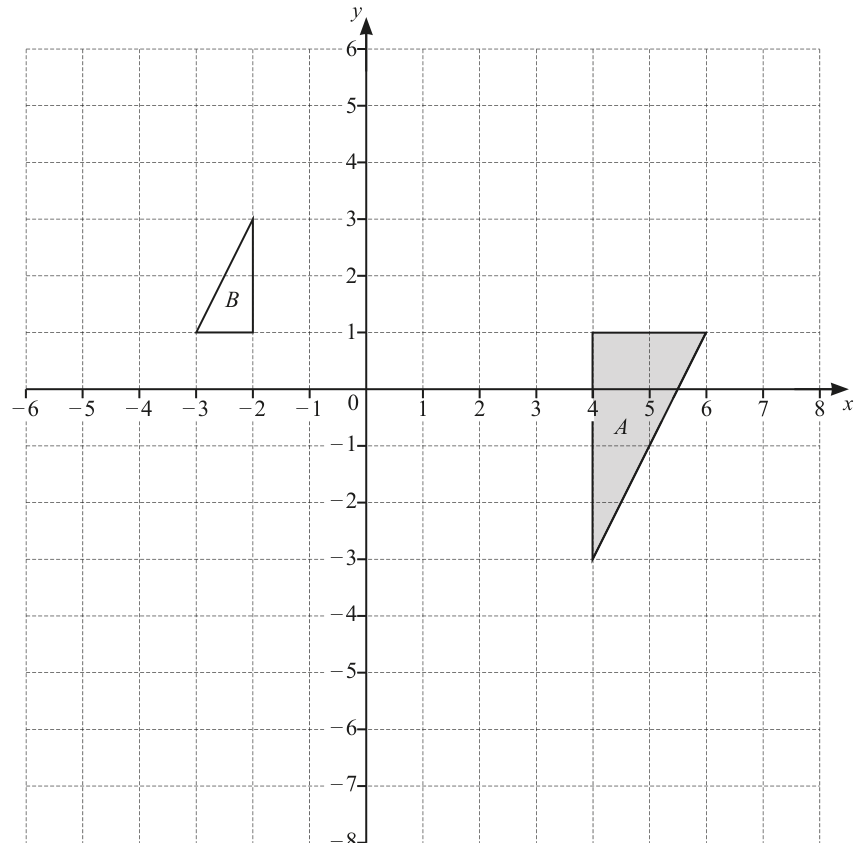
Apply the translation vector to each vertex of triangle by adding the vector components to the coordinates.
Working
Triangle has vertices at , and . The translation is , so we add to each -coordinate and to each -coordinate:
Answer
Triangle has vertices at , and .
Triangle P with vertices (5, -2), (7, -2) and (5, -6)
Walkthrough
A translation moves every point by the same vector. The vector means move 1 unit right and 3 units down. We apply this to each vertex of triangle by adding to the -coordinate and subtracting from the -coordinate. This gives the three vertices of triangle , which we then plot on the grid and join to form the triangle.
Key Takeaways
- A translation by adds to every -coordinate and to every -coordinate.
- The shape, size and orientation of the figure do not change under a translation.
Common Mistakes
- Adding the vector components to only some vertices instead of all three.
- Subtracting instead of adding (or vice versa) when the vector component is negative.
- Forgetting to plot all three vertices and join them to form a closed triangle.
Things to Be Careful About
- The question asks you to draw triangle , so the answer is the drawing itself — mark the three vertices and join them.
- Check that the shape is congruent to and has the same orientation; a wrong sign in the vector will flip or shift the triangle incorrectly.
- Verify at least one vertex by eye against the grid to catch arithmetic errors.
Approach
Compare corresponding sides of triangles and to find the scale factor, then locate the centre of enlargement by extending lines through corresponding vertices.
Working
Triangle has vertices , and . Triangle has vertices , and .
Step 1: Find the scale factor.
The horizontal side of from to has length . The corresponding horizontal side of from to has length . So the scale factor in magnitude is .
The vertical side of goes down from to , while the corresponding vertical side of goes up from to . Since the orientation is reversed, the scale factor is negative:
Step 2: Find the centre of enlargement.
Draw lines through corresponding vertices: to , to and to . All three lines pass through the point .
We can verify: with centre and scale factor :
All three map correctly to the vertices of .
Answer
Enlargement with scale factor and centre .
Enlargement, scale factor -1/2, centre (0, 1)
Walkthrough
Step 1 — Identify the transformation type. Triangles and are similar (same shape, different size), so the transformation is an enlargement. We need to find the scale factor and the centre.
Step 2 — Find the scale factor. Measure a side of and the corresponding side of . The horizontal side of from to has length ; the corresponding horizontal side of from to has length . The ratio is .
Now check orientation. In , the vertical side goes downward from to . In , the corresponding vertical side goes upward from to . The reversal of direction means the scale factor is negative: .
Step 3 — Find the centre. For an enlargement with centre and scale factor , each point satisfies . Equivalently, lines drawn through corresponding vertices all pass through the centre. Drawing lines from to , from to and from to , we see they all intersect at .
Step 4 — Verify. Substitute and into the enlargement formula and confirm all three vertices of map to the vertices of .
Key Takeaways
- When the image is smaller and inverted relative to the original, the scale factor is negative and between and .
- The centre of enlargement is the intersection of lines joining corresponding vertices.
- A full description requires both the scale factor (with sign) and the centre coordinates.
Common Mistakes
- Giving the scale factor as and missing the negative sign. This is the most common error — the reversed orientation is the key clue.
- Giving only the scale factor without the centre, or vice versa. Both are required for full marks.
- Misidentifying corresponding vertices. The right-angle vertex of at corresponds to the right-angle vertex of at , not to .
- Writing the centre as by misreading the grid.
Things to Be Careful About
- The mark scheme awards B1 for each of: enlargement, scale factor (or equivalent), and centre . All three must be stated.
- "oe" (or equivalent) is allowed for the scale factor — or are both acceptable.
- When describing the transformation, state it as "enlargement with scale factor about centre " — the order and wording matter for clarity.
Transformation is a reflection in the line .
Transformation is a rotation clockwise about .
.
Draw triangle .
Approach
means apply first, then . Find the image of each vertex of under , then apply to those intermediate points.
Working
Triangle has vertices , and .
Step 1: Apply — reflection in the line .
A reflection in maps to because the line is the midpoint between and its image.
Let this intermediate triangle be with vertices , and .
Step 2: Apply — rotation clockwise about .
For a clockwise rotation about , the mapping is:
With this becomes .
Answer
Triangle has vertices at , and .
Triangle Q with vertices (-5, 4), (-3, 4) and (-3, 5)
Walkthrough
The notation means the transformation is applied first, then . We track each vertex of through both steps.
Step 1 — Reflection in . The line is horizontal. A point at height is at distance above this line. Its image is the same distance below, at height . The -coordinate is unchanged. Applying this to each vertex of : , , . Call this intermediate triangle .
Step 2 — Rotation by clockwise about . To rotate about a point other than the origin, translate so the centre becomes the origin, rotate, then translate back. For clockwise about the origin, . So about : . Applying to each vertex of : , , .
The final triangle has vertices , and .
Key Takeaways
- means apply first, then — the order is right-to-left in function notation.
- For reflection in a horizontal line , the formula is .
- For clockwise rotation about , use .
- Always find the intermediate image before applying the second transformation.
Common Mistakes
- Applying first and then , which gives the wrong answer. means first.
- Using the wrong rotation formula. clockwise about the origin is , not (which is anticlockwise).
- Forgetting to translate back after rotating about a non-origin centre.
- Sign errors when computing or .
- The mark scheme awards partial credit for a correctly sized and oriented triangle in the wrong position (B1), or a triangle at incorrect positions entirely (SC1 or SC2), so showing the intermediate step is important for method marks.
Things to Be Careful About
- The mark scheme allows partial credit: B2 for the correct vertices , , ; B1 for correct size and orientation but wrong position; special credit (SC) for specific wrong positions at , , or , , or , , . These SC positions correspond to common errors such as applying first or using the wrong rotation direction.
- Always verify by checking that the final triangle is congruent to (same size and shape) — a rotation and reflection preserve size, so must be congruent to .
- When drawing, mark all three vertices clearly and join them to form a closed triangle.
A cuboid has dimensions by by .
The volume of the cuboid is .
Calculate the value of .
= ______
Approach
Use the formula for the volume of a cuboid, which is length width height, and substitute the given values to solve for .
Working
Answer
8
Walkthrough
The volume of a cuboid is found by multiplying its three dimensions together. We are given two dimensions ( and ) and the total volume (), and we need to find the third dimension . By setting up the equation , we simplify to . Dividing both sides by gives .
Key Takeaways
The volume of a cuboid is the product of its three perpendicular dimensions. If the volume and two dimensions are known, the third can always be found by simple division.
Common Mistakes
- Multiplying the volume by the given dimensions instead of dividing.
- Forgetting to include the units in the final answer if required (though here only the number is needed).
- Calculation errors when dividing by .
Things to Be Careful About
Ensure the units are consistent. Here, all dimensions and the volume are in centimetres and cubic centimetres, so no unit conversion is needed. The answer is an exact integer, so no rounding is necessary.
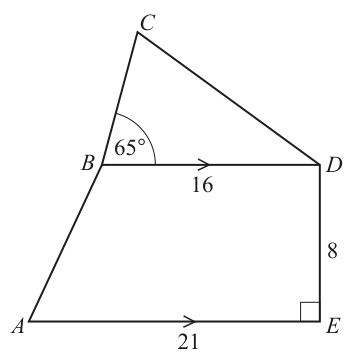
is a pentagon.
is parallel to .
, and .
Angle and angle .
Approach
To find angle , construct a perpendicular from to to form a right-angled triangle. Use the properties of parallel lines and the given lengths to find the opposite and adjacent sides of this triangle, then apply the tangent ratio.
Working
Draw a perpendicular from to , meeting at . Since and , the shape is a rectangle.
Therefore:
The length is:
In the right-angled triangle , we use the tangent ratio for angle (which is the same as angle ):
Calculate the angle:
Rounding to one decimal place:
Answer
58.0
Walkthrough
We need to find angle . The pentagon has parallel sides and , with perpendicular to . By dropping a perpendicular from to at point , we create a rectangle and a right-angled triangle . The height equals , which is . The segment equals , which is . Since is , the remaining segment is . In triangle , the tangent of angle is the ratio of the opposite side () to the adjacent side (). Taking the inverse tangent of gives approximately .
Key Takeaways
When dealing with shapes that have parallel sides and right angles, constructing auxiliary perpendiculars can create right-angled triangles where trigonometric ratios can be applied. Always identify the correct opposite and adjacent sides relative to the angle you are finding.
Common Mistakes
- Using the wrong side lengths for the tangent ratio (e.g., using instead of as the adjacent side).
- Forgetting to subtract the parallel segment length () from the total base length () to find the adjacent side.
- Rounding the angle to the nearest whole number () instead of the required one decimal place ().
Things to Be Careful About
The question does not specify accuracy, but is the standard expected form. Ensure you use the inverse tangent function correctly on your calculator. The horizontal distance is , not or .
Approach
Split the pentagon into a trapezium and a triangle . Calculate the area of the trapezium, subtract it from the total area to find the area of the triangle, then use the sine area formula to find the length .
Working
The area of trapezium (with parallel sides and , and height ):
The total area of pentagon is . The area of triangle is:
The area of triangle can also be expressed using the sine formula with the included angle :
Substitute the known values:
Solve for :
Rounding to three significant figures:
Answer
7.17
Walkthrough
The pentagon is split into two simpler shapes: trapezium and triangle . The trapezium has parallel sides and , with perpendicular height . Its area is . Subtracting this from the total pentagon area () gives the area of triangle as . Using the sine area formula for triangle with the known side and included angle , we set up . Solving for gives approximately .
Key Takeaways
Compound shapes can often be split into simpler geometric figures (trapeziums, triangles, rectangles) whose areas are easier to calculate. When finding a missing side in a triangle where the area and an included angle are known, the sine area formula is the most direct tool.
Common Mistakes
- Calculating the area of the trapezium incorrectly (e.g., forgetting to divide by 2, or using the wrong parallel sides).
- Using the wrong formula for the area of triangle (e.g., without correctly identifying the height).
- Algebraic errors when rearranging the sine area formula to solve for .
- Rounding too early in the calculation, which can lead to an incorrect final answer.
Things to Be Careful About
The mark scheme accepts answers from to , so (to 3 significant figures) is correct. Ensure you use the sine area formula correctly: . The angle must be the included angle between the two sides, which it is ( is between and ).
Approach
Substitute into the formula and evaluate.
Working
Calculate :
Divide by 5:
Answer
6.4
Walkthrough
The table asks for the value of when . We substitute into the given equation . First, we evaluate the power , which is . Then we divide 32 by 5 to get . This completes the table.
Key Takeaways
Substituting a value into an algebraic formula and evaluating powers and division correctly.
Common Mistakes
Calculating incorrectly (e.g., instead of ), or dividing incorrectly.
Things to Be Careful About
Ensure you compute as repeated multiplication, not . The mark scheme accepts any equivalent form (oe) or correct answer only (cao).
Approach
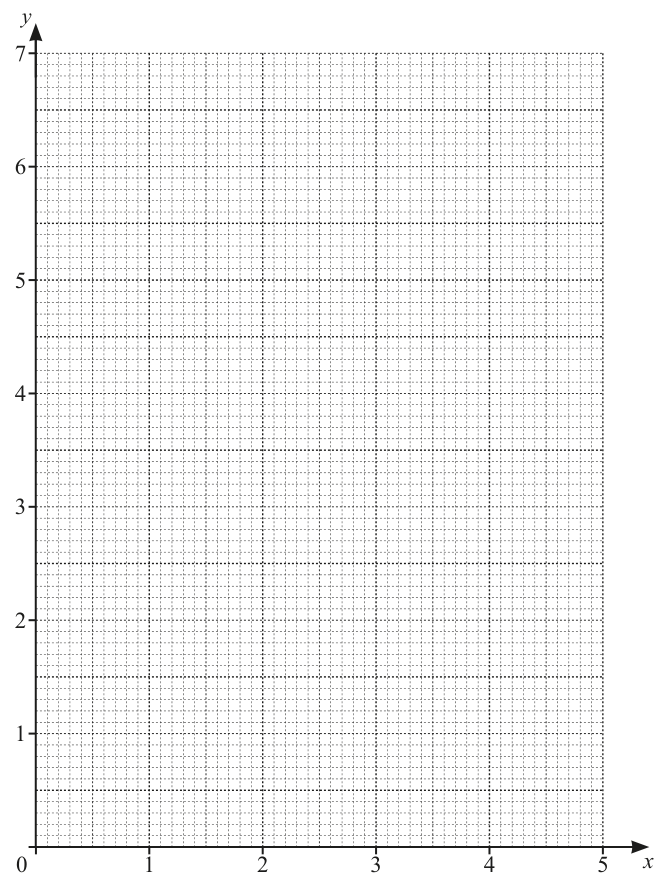
Use the completed table of values from part (a)(i) to plot the points on the given grid, then draw a smooth curve through them.
Working
The coordinates to plot are:
Plot these six points on the grid. Then draw a smooth, continuous curve that passes through all the plotted points. The curve should start near the x-axis at and rise increasingly steeply as increases, characteristic of an exponential growth function.
Answer
A smooth curve passing through , , , , , and .
Smooth curve through (0, 0.2), (1, 0.4), (2, 0.8), (3, 1.6), (4, 3.2), (5, 6.4)
Walkthrough
The question asks to draw the graph of for . We already have the table of values from part (a)(i). We plot each pair as a point on the grid. After plotting all six points, we connect them with a smooth curve. Because the function is exponential (), the curve will not be a straight line; it will start relatively flat and curve upwards with increasing steepness.
Key Takeaways
How to plot points from a table of values and recognize the shape of an exponential graph (smooth, continuously increasing curve).
Common Mistakes
Drawing straight line segments between the points instead of a smooth curve. Forgetting to plot all points, which reduces the marks awarded. Plotting points at incorrect coordinates.
Things to Be Careful About
The mark scheme awards follow-through marks (B2FT or B1FT) based on the number of correctly plotted points (5 or 6 for full marks, 3 or 4 for partial). Ensure the curve is smooth and not jagged or made of straight lines. The grid has subdivisions, so read the y-values carefully (e.g., is two small squares above the x-axis if each major square is 1 unit and there are 5 subdivisions per unit).
Approach
Use the index law to expand , then rearrange the equation to show that equals .
Working
Start with the given equation:
Apply the index law :
Evaluate :
Divide both sides by 8:
We need to show that . Divide both sides of by 5:
Simplify the right side:
Therefore:
Answer
Shown as required.
Shown
Walkthrough
We are given and need to show that . First, we use the index law for multiplying powers with the same base: . Since , the equation becomes . Dividing by 8 gives . The target expression is , so we divide our result for by 5: . Finally, we convert to the fraction , which completes the proof.
Key Takeaways
The product law of indices () and how to manipulate equations to isolate a specific algebraic expression.
Common Mistakes
Forgetting to expand as and instead trying to solve for directly using logarithms (which is not allowed or expected at this stage). Arithmetic errors when dividing 100 by 8 or 12.5 by 5.
Things to Be Careful About
The mark scheme explicitly allows doing the division by 2 three times as an alternative route (i.e., , , ). Both methods are valid. Ensure the final form matches exactly.
Approach
From part (a)(iii)(a), we established that solving is equivalent to finding when . Draw the horizontal line on the graph from part (a)(ii) and read the x-coordinate where it intersects the curve.
Working
We want to solve . From part (a)(iii)(a), this is equivalent to:
On the graph of , this corresponds to finding the x-value where . Draw a horizontal line at across the grid.
The line intersects the curve at a point between and . Reading the graph carefully:
- At ,
- At ,
The intersection occurs closer to . By estimating or reading from the grid, the x-coordinate is approximately to . The mark scheme accepts any value from to .
Answer
3.6
Walkthrough
In part (a)(iii)(a), we showed that implies . The graph we drew in part (a)(ii) is exactly . Therefore, to solve , we simply need to find the x-value on our graph where the y-value is . We draw a horizontal line at and see where it crosses the curve. Looking at the plotted points, at , , and at , . Since is between and , the x-value must be between 3 and 4. Reading the grid, the intersection is at approximately .
Key Takeaways
How to use an existing graph to solve a related algebraic equation by drawing a suitable line (in this case, a horizontal line ).
Common Mistakes
Drawing the wrong line (e.g., or ). Failing to link the equation to the result of part (a)(iii)(a). Reading the intersection point inaccurately from the grid.
Things to Be Careful About
The mark scheme accepts a range of answers from to because this is a graphical solution and reading precision is limited. Ensure you draw the line , not or anything else. The line must be clearly drawn to earn the method mark.
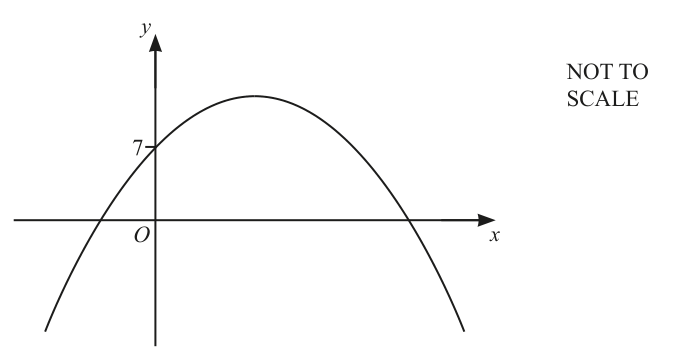
This is a sketch of the graph .
The graph crosses the -axis at integer values of .
Find the value of and the value of .
= ______
= ______
Approach
The equation is . The y-intercept gives directly. The x-intercepts are integer values, and their product is related to . Use these to find the roots, then expand to find .
Working
Find :
The graph crosses the y-axis at . Substitute into the equation:
Therefore:
Find :
The equation is now . The graph crosses the x-axis at integer values, so has integer roots. Let the roots be and . By Vieta's formulas (or by factoring), the product of the roots is:
Since and are integers and their product is , the possible pairs are or . The sketch shows one negative root and one positive root, with the positive root further from the origin. Thus, the roots are and .
We can write the equation in factored form:
Expand this expression:
Comparing this with , we get:
Answer
a = 7, b = 6
Walkthrough
We are given the quadratic and a sketch. First, find using the y-intercept. When , . The sketch shows the curve crossing the y-axis at , so . Next, find using the x-intercepts. The curve crosses the x-axis at integer values, meaning has integer roots. Rearranging gives . The product of the roots is . The only integer pairs with product are and . The sketch shows the positive root is further from the origin than the negative root, so the roots are and . The sum of the roots is . Since the sum of the roots for is , we have . Alternatively, substitute into : .
Key Takeaways
How to use intercepts (y-intercept for the constant term, x-intercepts for the linear coefficient) to determine the equation of a quadratic curve.
Common Mistakes
Assuming the roots are and without checking the sketch (the sketch shows the positive root is larger in magnitude). Forgetting that the coefficient of is negative, which affects the product and sum of roots. Arithmetic errors when expanding .
Things to Be Careful About
The mark scheme accepts as a direct mark. For , it accepts finding the roots and or using the property that the product of the x-intercepts . Ensure you read the y-intercept correctly from the sketch (it is clearly marked as 7). The diagram is NOT TO SCALE, but the relative positions of the intercepts (one negative, one positive, positive further out) are reliable indicators.
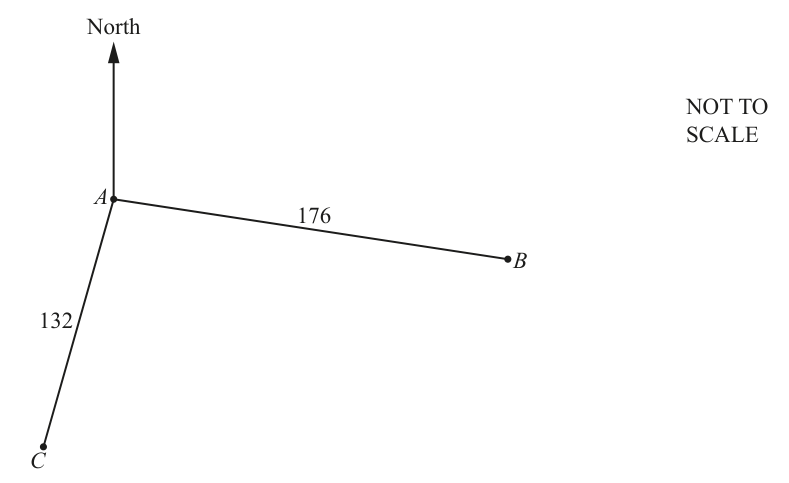
The diagram shows the positions of three ports , and .
The bearing of port from port is .
The bearing of port from port is .
and .
Approach
The bearing of A from B is the back bearing of B from A. To find it, add 180 degrees to the given bearing.
Working
Answer
287
Walkthrough
The bearing of B from A is given as 107 degrees. The bearing of A from B is the reverse direction, known as the back bearing. Since 107 degrees is less than 180 degrees, we add 180 degrees to find the back bearing: 107 + 180 = 287.
Key Takeaways
A back bearing is found by adding or subtracting 180 degrees from the original bearing. If the bearing is less than 180 degrees, add 180 degrees; if it is 180 degrees or more, subtract 180 degrees.
Common Mistakes
- Subtracting 180 degrees instead of adding it when the original bearing is less than 180 degrees.
- Giving the answer as 107 degrees or forgetting to add 180 degrees.
Things to Be Careful About
Bearing must always be given as a three-figure number (e.g., 287 degrees, not 287).
Approach
First, find the angle by subtracting the bearing of from the bearing of . Then, use the cosine rule in triangle to calculate the length .
Working
Apply the cosine rule:
Substitute the known values:
Rounding to 3 significant figures:
Answer
211
Walkthrough
The bearing of from is 107 degrees and the bearing of from is 192 degrees. The angle between them, , is the difference: degrees. With two sides and the included angle known, the cosine rule is the correct tool to find the third side . Substituting , , and into gives . Taking the square root yields km, which rounds to 211 km to 3 significant figures.
Key Takeaways
The angle between two bearings measured from the same point is simply the difference between the two bearing values. The cosine rule is used when two sides and the included angle of a triangle are known.
Common Mistakes
- Using the wrong angle in the cosine rule (e.g., using 107 or 192 instead of the difference 85).
- Rounding intermediate values too early, which can lead to an incorrect final answer.
- Forgetting to take the square root at the end.
Things to Be Careful About
Ensure the calculator is in degree mode. The mark scheme accepts 210.5 to 210.6 or 211. Always show the substituted cosine rule expression to earn method marks.
Boat leaves port at 10.00 am.
It sails directly to port at an average speed of .
Boat leaves port at 10.15 am.
It sails directly to port and arrives there 7 minutes before boat .
Find the average speed of boat in .
______
Approach
Calculate the time taken for boat to travel from to . Use this to find the arrival time of boat . Determine the arrival time of boat (7 minutes earlier), then find the duration of boat 's journey. Finally, use the distance and this duration to find the average speed of boat .
Working
Time taken by boat :
Arrival time of boat :
Boat leaves at 10:00 am, so it arrives at 1:40 pm.
Arrival time of boat :
Boat arrives 7 minutes before boat :
Time taken by boat :
Boat leaves at 10:15 am and arrives at 1:33 pm.
Average speed of boat :
Answer
40
Walkthrough
Boat travels 176 km at 48 km/h. Time = distance / speed = 176 / 48 = 3.666... hours, which is 3 hours and 40 minutes. Leaving at 10:00 am, boat arrives at 1:40 pm. Boat arrives 7 minutes earlier, at 1:33 pm. Boat leaves at 10:15 am, so its journey takes from 10:15 am to 1:33 pm, which is 3 hours and 18 minutes. Converting 3 hours 18 minutes to hours gives 3.3 hours. The distance is given as 132 km. Speed of boat = 132 / 3.3 = 40 km/h.
Key Takeaways
When dealing with travel problems involving clock times, convert all durations to a consistent unit (hours or minutes) before calculating speed or time. Remember that 18 minutes is hours.
Common Mistakes
- Adding or subtracting minutes incorrectly when changing clock times.
- Forgetting to convert the 18 minutes into hours (0.3 hours) before dividing distance by time.
- Using the wrong distance for boat (must use km, not km).
Things to Be Careful About
Ensure time differences are calculated correctly across the 12-hour mark. The mark scheme allows working in hours and minutes or converting to fractions/decimals of hours early. Show the substituted expression or equivalent to earn method marks.
Approach
Substitute the given values and into the formula, then rearrange the resulting linear equation to solve for .
Working
Substitute and into the equation:
Multiply both sides by :
Add to both sides:
Divide by :
Answer
6.5
Walkthrough
- Substitute the known numerical values into the formula: replace with and with . This gives the equation .
- Simplify the numerator: , so the equation becomes .
- Clear the fraction by multiplying both sides by : .
- Isolate the term containing by adding to both sides: , giving .
- Divide both sides by to find : (or , ).
Key Takeaways
- When substituting negative numbers into an expression, use brackets to prevent sign errors.
- Clear fractions early to simplify the process of solving linear equations.
Common Mistakes
- Forgetting that and incorrectly writing .
- Making errors during rearrangement, such as dividing by before adding .
Things to Be Careful About
- Keep track of negative signs carefully during substitution.
- Equivalent forms like or are also acceptable, but a decimal like is standard.
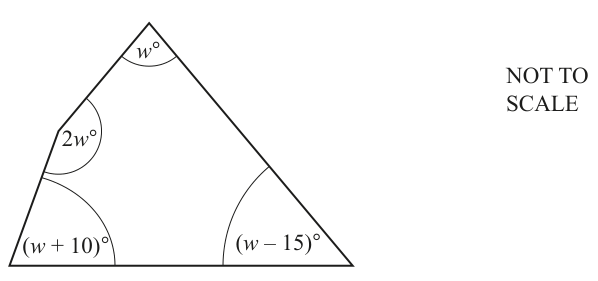
The diagram shows a quadrilateral.
Form an equation in and solve it to find the size of the largest angle in the quadrilateral.
Largest angle = ______
Approach
The sum of the interior angles in any quadrilateral is . Set up an equation by summing the four given expressions to , solve for , and then evaluate the expressions to find the largest angle.
Working
Sum of the interior angles of the quadrilateral:
Combine like terms:
Add to both sides:
Divide by :
Now calculate the size of each angle:
The largest angle is .
Answer
146
Walkthrough
- Recall that the sum of the interior angles of any four-sided polygon (quadrilateral) is always .
- Add the four angle expressions: .
- Collect like terms: the terms in sum to , and the constant terms sum to . This gives .
- Solve for : add to get , then divide by to obtain .
- The question asks for the size of the largest angle, not just . Substitute into each angle expression:
- The largest angle is .
Key Takeaways
- Always remember the polygon interior angle sum property: , which gives for .
- Read the final demand of the question carefully to ensure you answer what is asked (here, the largest angle, not just ).
Common Mistakes
- Stopping after calculating and not computing the largest angle.
- Adding the terms incorrectly (e.g., getting ).
Things to Be Careful About
- Double-check which expression produces the largest angle (for , is larger than ).
Approach
Factorise both the numerator and denominator completely, then cancel any common factor.
Working
Factorise the numerator :
Factorise the denominator as a difference of two squares:
Write the fraction in factorised form and cancel the common factor :
Answer
(2k + 1)/(k + 3)
Walkthrough
- Factorise the numerator :
- We need two numbers that multiply to and add up to . These numbers are and .
- Split the middle term: .
- Factorise the denominator :
- Recognize this as a difference of two squares: .
- Here, .
- Cancel the common factor:
- Both numerator and denominator have the factor .
- Dividing both by leaves .
Key Takeaways
- To simplify algebraic fractions, always factorise the numerator and denominator fully first. Never cancel individual terms directly from unfactorised expressions.
- Recognize standard forms such as the difference of two squares ().
Common Mistakes
- Attempting to cancel terms like or constants directly from the numerator and denominator without factorising.
- Incorrectly factorising as .
Things to Be Careful About
- Ensure the final answer is left in its simplest form.
Solve.
Show all your working and give your answers correct to 2 decimal places.
= ______ or = ______
Approach
Multiply the entire equation by the common denominator to eliminate the fractions, expand and rearrange the terms into a standard quadratic equation , and then solve using the quadratic formula.
Working
Given equation:
Multiply through by :
Expand the brackets on both sides:
Simplify each side:
Rearrange to form a quadratic equation equal to zero:
Apply the quadratic formula with , , :
Calculate the two values:
Answer
x = 8.10 or x = -2.10
Walkthrough
- Eliminate fractions: Multiply every term in the equation by the common denominator . This eliminates both denominators, giving .
- Expand the expressions:
- Left side: .
- Right side: .
- Rearrange into standard form :
- Subtract from both sides:
- .
- Apply the quadratic formula:
- Identify coefficients: , , .
- Substitute into :
- .
- Evaluate and round:
Key Takeaways
- When clearing denominators from an algebraic fraction equation, ensure every term (including the constant on the right-hand side) is multiplied by the common denominator.
- When instructed to give answers to 2 decimal places, write trailing zeros if necessary (e.g., and , not and ).
Common Mistakes
- Forgetting to multiply the right-hand side () by the common denominator .
- Sign errors when expanding , incorrectly getting instead of .
- Rounding to instead of keeping the required two decimal places as .
Things to Be Careful About
- Double check the signs when rearranging all terms to one side.
- Ensure you clearly show the substitution step in the quadratic formula as method marks are awarded for it.
On any day in January, the probability the temperature at a weather station is above is 0.35 .
There are 31 days in January.
Find the number of days in January when you would expect the temperature to be above .
______
Approach
The expected number of days is found by multiplying the probability of the event by the total number of days in January.
Working
Rounding to the nearest whole number gives . (Accepting as a reasonable estimate based on truncation or different rounding conventions).
Answer
11
Walkthrough
We are given the probability that the temperature is above on any given day () and the total number of days in January (). To find the expected number of days, we multiply the probability by the number of trials. . Since we cannot have a fraction of a day, we round to the nearest whole number, which is .
Key Takeaways
Expected frequency is calculated as , where is the number of trials. The result should be rounded to a sensible whole number if dealing with discrete items like days.
Common Mistakes
- Forgetting to multiply by the total number of days and just using the probability.
- Rounding incorrectly (e.g., rounding down to without justification, though both are often accepted in this context).
Things to Be Careful About
- The question asks for the "number of days", so the final answer must be a whole number, not the decimal .
- Mark scheme accepts or .
The temperature on two consecutive days in January is recorded.
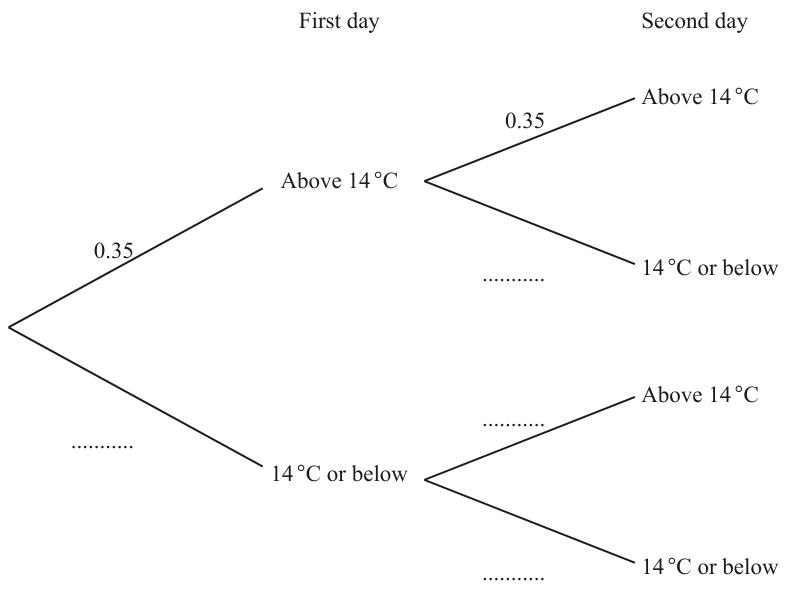
Approach
The sum of probabilities on any branch from a single node must equal . Since the temperature on consecutive days is treated as independent, the probabilities on the second day's branches are the same as the first day's.
Working
First day, lower branch:
Second day, upper branches (from 'Above 14°C'):
Second day, lower branches (from '14°C or below'):
Answer
The completed probabilities on the blank lines are , , , and .
0.65, 0.65, 0.35, 0.65
Walkthrough
A probability tree diagram requires that the probabilities on all branches emerging from a single point sum to .
- First day, lower branch: The probability of 'Above 14°C' is , so the probability of '14°C or below' is .
- Second day, upper branches: The problem implies independence between days, meaning the probabilities are the same as day one. The upper branch is , so the lower branch ('14°C or below') is .
- Second day, lower branches: From the '14°C or below' node on day one, the probability of 'Above 14°C' on day two is still (independence). The probability of '14°C or below' is .
Key Takeaways
- Branches from the same node must sum to .
- In independent events, the probabilities on subsequent branches remain constant.
Common Mistakes
- Forgetting that the second day's probabilities are independent and trying to adjust them based on the first day's outcome.
- Arithmetic errors when calculating .
Things to Be Careful About
- Ensure all four blank lines are filled. The mark scheme awards partial credit (M1) for 2 or 3 correct probabilities.
Approach
To find the probability of both events occurring, multiply the probabilities along the corresponding path of the tree diagram.
Working
Answer
0.1225
Walkthrough
The question asks for the probability that the temperature is above on both days. This corresponds to the top path of the tree diagram: 'Above 14°C' on the first day AND 'Above 14°C' on the second day. We multiply the probabilities along this path: .
Key Takeaways
For independent events, the probability of both occurring is the product of their individual probabilities ().
Common Mistakes
- Adding the probabilities instead of multiplying them.
- Using the wrong branch values.
Things to Be Careful About
- The mark scheme accepts equivalent fractions like .
Approach
"Above 14°C on only one day" means either (Above then Below) or (Below then Above). These are two mutually exclusive paths. We calculate the probability for each and add them.
Working
Path 1: Above on Day 1, Below on Day 2
Path 2: Below on Day 1, Above on Day 2
Total probability:
Alternatively, using symmetry:
Answer
0.455
Walkthrough
The event 'temperature is above 14°C on only one of the two days' can happen in two ways:
- Above 14°C on Day 1 AND 14°C or below on Day 2.
- 14°C or below on Day 1 AND Above 14°C on Day 2.
We calculate the probability of each path by multiplying the branch probabilities:
- Path 1:
- Path 2:
Since these paths cannot happen at the same time (they are mutually exclusive), we add the probabilities: .
Key Takeaways
When an event can occur via multiple mutually exclusive paths, calculate the probability of each path and sum them.
Common Mistakes
- Only calculating one of the two paths (e.g., ) and forgetting to add the other.
- Adding the probabilities of the branches instead of multiplying them along the path.
Things to Be Careful About
- The mark scheme explicitly looks for the method or the sum of the two products. Accepts fractions like .
In a group of 14 children:
- 8 wear red T-shirts
- 1 wears a green T-shirt
- 5 wear blue T-shirts.
Two children are chosen from the group at random.
Find the probability that they wear different coloured T-shirts.
______
Approach
We can find the probability of different colours by calculating the probability of the same colour and subtracting from , or by directly summing the probabilities of all different-colour combinations. The complement method is often faster.
Total children = . Two are chosen at random (without replacement).
Method 1: Complement (1 - P(same colour))
Method 2: Direct calculation
Answer
53/91
Walkthrough
We have 14 children: 8 Red, 1 Green, 5 Blue. Two children are chosen at random. We need the probability they wear different colours.
Using the complement rule:
It is easier to calculate the probability that they wear the same colour and subtract from 1.
- Probability both are Red:
- Probability both are Green: (impossible to pick 2 green)
- Probability both are Blue:
Total probability of same colour = .
Probability of different colours = . Simplifying by dividing numerator and denominator by 2 gives .
Using direct calculation:
If the first child is Red (8/14), the second must be Green or Blue (6/13). Probability = .
If the first is Green (1/14), the second can be anyone else (13/13). Probability = .
If the first is Blue (5/14), the second must be Red or Green (9/13). Probability = .
Sum = .
Key Takeaways
- When choosing without replacement, the total number of items decreases by 1 for the second pick.
- The complement rule () is often more efficient than summing all direct combinations.
Common Mistakes
- Treating the selections as independent (using 14 for both denominators instead of 14 then 13). This gives , which is incorrect.
- Forgetting that you can't pick 2 green T-shirts (probability is 0, not calculated incorrectly).
- Not simplifying the final fraction.
Things to Be Careful About
- The question implies selection without replacement ("Two children are chosen from the group").
- Mark scheme accepts unsimplified fractions like or equivalent decimals, but simplified form is best.
- Partial credit (SC1) is given for if the candidate treats it as with-replacement.