Mathematics (Syllabus D) 4024/11 — May/June 2024
Cambridge O-Level · Non-calculator · worked solutions for every part, with the mark scheme
Topics Number · Algebra and Graphs · Geometry · Mensuration · Statistics · Probability · +3 more
G R A N T
From this word write down the letters which have
Approach
We examine each letter in the word individually to determine if it possesses a line of symmetry (reflectional symmetry). A line of symmetry divides a shape into two identical halves that are mirror images of each other.
Working
Let's check each letter:
- : The standard capital letter does not have any line of symmetry. No vertical or horizontal fold produces matching halves.
- : The standard capital letter does not have any line of symmetry.
- : The capital letter has one vertical line of symmetry down the centre. If you fold it vertically along the middle, the left side mirrors the right side.
- : The capital letter does not have a line of symmetry (it has rotational symmetry, but not reflectional symmetry).
- : The capital letter has one vertical line of symmetry down the centre. Folding it vertically aligns the two halves perfectly.
Thus, the letters with a line of symmetry are and .
Answer
A and T
Walkthrough
The question asks for letters from the word "GRANT" that have a line of symmetry. We look at each letter:
- G: Has no line of symmetry.
- R: Has no line of symmetry.
- A: Has a vertical line of symmetry through the peak and base.
- N: Has no line of symmetry (rotational only).
- T: Has a vertical line of symmetry through the stem.
Therefore, the correct letters are A and T.
Key Takeaways
- Understanding what a line of symmetry is: a line that divides a figure into two congruent parts that are mirror images.
- Familiarity with the symmetries of capital letters.
Common Mistakes
- Identifying rotational symmetry instead of line symmetry (e.g., choosing N).
- Missing one of the symmetric letters.
Things to Be Careful About
- Ensure you are looking for line (reflectional) symmetry, not rotational symmetry.
- Standard capital letter forms are assumed unless specified otherwise.
Approach
We examine each letter in the word to see if it has rotational symmetry. Rotational symmetry means the letter looks the same after being rotated by some angle less than around its centre. For most capital letters, we check for order 2 rotational symmetry ( rotation).
Working
Let's check each letter:
- : Does not look the same after a rotation.
- : Does not look the same after a rotation.
- : Does not look the same after a rotation (it would be upside down).
- : If you rotate the capital letter by , it looks exactly the same. The top-left vertical stroke moves to the bottom-right, and the diagonal connects them identically.
- : Does not look the same after a rotation (the flat top becomes a flat bottom).
Thus, the only letter with rotational symmetry is .
Answer
N
Walkthrough
The question asks for letters from the word "GRANT" that have rotational symmetry. We check each letter by imagining rotating it :
- G: Not the same.
- R: Not the same.
- A: Not the same.
- N: Yes, it maps onto itself after rotation.
- T: Not the same.
So the answer is N.
Key Takeaways
- Rotational symmetry means a shape coincides with itself after rotation by an angle less than .
- Many capital letters have order 1 (no rotational symmetry) or order 2 ().
Common Mistakes
- Confusing line symmetry with rotational symmetry (e.g., saying A has rotational symmetry).
- Missing N because students often associate symmetry only with lines.
Things to Be Careful About
- Remember that rotational symmetry includes turns, not just full circles.
- Standard capital letter forms are assumed.
At the start of the day the mass of a bird is .
Later in the day the mass of this bird is .
Calculate the increase in the mass of the bird.
Give your answer in grams.
______
Approach
First, determine the increase in mass in kilograms by subtracting the initial mass from the later mass. Then, convert this difference from kilograms to grams.
Working
Calculate the difference:
Convert the increase from kilograms to grams. We know that .
Alternatively, we could convert both masses to grams first:
Answer
65
Walkthrough
The question asks for the increase in the bird's mass in grams. The masses are given in kilograms (kg). There are two main ways to solve this: finding the difference in kg first and then converting, or converting to grams first and then finding the difference.
Method 1: Subtract first, then convert
- Subtract: Find the difference between the final mass and the initial mass.
- Convert: To change kilograms to grams, multiply by 1000 because there are 1000 grams in 1 kilogram.
Method 2: Convert first, then subtract
- Convert: Change both masses into grams immediately.
- Subtract: Calculate the difference.
Both methods lead to the same result. Method 2 avoids decimal arithmetic which can sometimes be prone to error, but Method 1 is often quicker if you are comfortable with decimals.
Key Takeaways
- Always check the units required for the answer. If the question asks for grams but gives kilograms, a conversion step is necessary.
- . Multiplying by 1000 moves the decimal point three places to the right.
- When subtracting decimals, align the decimal points vertically to ensure accuracy.
Common Mistakes
- Forgetting to convert the final answer to grams.
- Incorrect decimal subtraction (e.g., misaligning digits).
- Dividing by 1000 instead of multiplying when converting kg to g.
- Rounding errors (though none are needed here as the answer is exact).
Things to Be Careful About
- Ensure you read the unit in the question carefully ('grams' not 'kilograms').
- In non-calculator papers, showing the multiplication by 1000 clearly helps secure method marks if the final calculation is wrong.
- The mark scheme accepts answers where the student converts to grams first ( and seen), so either approach is valid.
Work out.
Approach
Multiply the digits as if they were whole numbers, then count the total number of decimal places in the factors to determine where the decimal point goes in the answer.
Working
First, ignore the decimal points and multiply by :
Now look at the original numbers. has one decimal place, and has two decimal places. The total number of decimal places is:
We need to place the decimal point in our result () so that there are three decimal places. We pad with zeros on the left:
Answer
0.006
Walkthrough
To multiply decimals without a calculator, treat them as integers first. Multiplying by gives . Next, count how many digits appear after the decimal point in the original question. In , there is one digit. In , there are two digits. Adding these together (), we get three decimal places required in the final answer. Starting from the right of the number , we move the decimal point three places to the left. Since only has one digit, we add leading zeros to fill the space: .
Key Takeaways
- Multiply the non-zero digits normally.
- The number of decimal places in the answer equals the sum of the decimal places in the factors.
- Leading zeros are necessary if the product is small.
Common Mistakes
- Giving the answer as or by miscounting the decimal places.
- Writing without any decimal point.
Things to Be Careful About
- This is a non-calculator paper. Ensure you show the logic of counting decimal places rather than just guessing. The mark scheme accepts 'oe' (other equivalent forms), but is the standard form.
Approach
Convert the percentage into a fraction and multiply it by the given number.
Working
can be written as the fraction .
To find of , we calculate:
We can simplify this multiplication. Notice that and share a factor of :
Or simply reduce to :
Divide by :
Answer
6
Walkthrough
The word 'of' in mathematics indicates multiplication. So ' of ' means . First, convert the percentage to a fraction by placing it over : . Then multiply this fraction by . You can calculate and then divide by to get . Alternatively, simplify before multiplying: divided by is , and . Another easy way for specific percentages is to find () and () and add them together ().
Key Takeaways
- ' of ' translates to .
- Simplifying fractions before multiplying reduces the size of the numbers involved.
Common Mistakes
- Multiplying by and forgetting to divide by (getting ).
- Confusing 'of' with addition.
Things to Be Careful About
- Ensure the final answer is an integer if the calculation results in one. No units are specified in the question text, so just the number is required.
Approach
Apply the rule that subtracting a negative number is equivalent to adding the corresponding positive number.
Working
The expression is:
Two consecutive minus signs become a plus sign:
Add the numbers together:
Answer
32
Walkthrough
This question tests the rules for operating with negative numbers. A key rule is that subtracting a negative value is the same as adding a positive value. Think of it like debt: if you have dollars and someone removes a debt of dollars from you, your net worth increases by . Mathematically, becomes . So the problem changes from to . Adding these gives .
Key Takeaways
- Subtracting a negative is adding a positive: .
- Adding two positive integers results in a larger positive integer.
Common Mistakes
- Treating it as and getting .
- Getting confused by the double negative and performing subtraction instead of addition.
Things to Be Careful About
- Pay close attention to the sign before the bracket. The minus sign outside and the minus sign inside cancel each other out.
is a triangle with and .
Using a ruler and compasses only, construct triangle .
has been drawn for you.
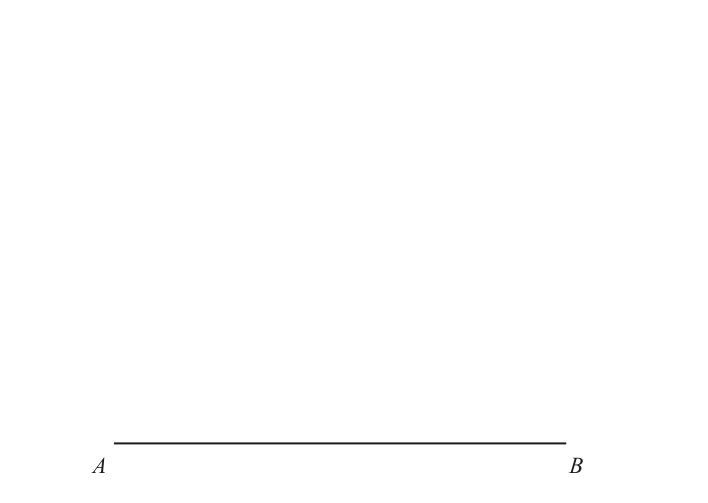
Approach
To construct triangle with and given the base , use a compass to draw arcs from and with radii equal to the required side lengths. The intersection of these arcs above will be vertex .
Working
-
Place the compass point on and set the radius to (the length of ). Draw an arc above the line .
-
Place the compass point on and set the radius to (the length of ). Draw another arc above the line that intersects the first arc.
-
Label the intersection point of the two arcs as .
-
Use a ruler to draw straight lines and to complete the triangle.
Answer
Triangle is constructed with vertex at the intersection of the arc of radius from and the arc of radius from .
Triangle constructed with vertex C at the intersection of arcs of radius 5 cm from A and 10 cm from B
Walkthrough
The question asks for a construction using ruler and compasses only, given two side lengths and and the base already drawn.
-
Arc from A: Set the compass to . Place the needle at and draw an arc. This arc represents all possible locations for that are exactly from .
-
Arc from B: Set the compass to . Place the needle at and draw an arc that crosses the first arc. This arc represents all possible locations for that are exactly from .
-
Intersection: The point where the two arcs cross is the only point that is simultaneously from and from . Label this point .
-
Complete the triangle: Draw straight lines from to and from to using the ruler.
Key Takeaways
- In an SSS (side-side-side) construction, two arcs are drawn from the endpoints of the given base line, with radii equal to the other two side lengths.
- The intersection of these arcs locates the third vertex.
- Construction arcs should be drawn lightly and clearly, as they are part of the working that earns marks.
Common Mistakes
- Forgetting to draw the construction arcs; the mark scheme requires "intersecting arcs" to be visible to award the method mark.
- Drawing arcs with the wrong radii (e.g., using from instead of ).
- Not extending the arcs sufficiently to ensure a clear intersection point.
- Drawing the final triangle lines too thick, obscuring the construction arcs.
Things to Be Careful About
- Use a sharp pencil for construction work to ensure precision.
- The mark scheme awards B1 for an acceptable vertex clearly indicated with no or incorrect arcs, but full marks require the correct intersecting arcs.
- Always draw construction arcs lightly so they can be distinguished from the final triangle edges.
Approach
Place the centre of a protractor at vertex , with the baseline along . Read the angle where the line crosses the protractor scale.
Working
The angle is measured directly from the constructed triangle. The value will depend on the exact length of printed in the original question paper. For example, if , the theoretical angle is .
Answer
Angle = measured value from construction (accept to if )
Measured from construction (accept 75° to 77° if AB = 10 cm)
Walkthrough
After constructing the triangle in part (a), the candidate must measure angle using a protractor.
- Place the centre hole of the protractor exactly on vertex .
- Align the baseline of the protractor with the line segment .
- Read the angle where the line crosses the protractor scale. Ensure you use the correct scale (the one that starts at at and increases towards ).
Key Takeaways
- Protractor measurement requires careful alignment of the centre and baseline.
- In construction questions, small measurement errors are expected and accepted within a tolerance (usually ).
Common Mistakes
- Placing the protractor centre on the wrong point (e.g., on instead of ).
- Reading the wrong scale on the protractor (inner vs outer).
- Not aligning the baseline exactly along .
Things to Be Careful About
- The mark scheme states "Their angle ", meaning the answer is accepted based on the candidate's own construction. If the construction in part (a) was slightly inaccurate, the measured angle in part (b) will still be marked correct as long as it is within of the true value for that construction.
- Always state the measured value clearly; do not leave the answer blank.
The table shows information about a class of 28 students and the distances they live from their school.
| Boys | Girls | |
|---|---|---|
| Distance of or less | 11 | |
| Distance of more than | 3 | 6 |
Approach
The table provides information about the distances boys and girls live from school. We know the total number of students is 28. We can calculate the number of girls who live or less by subtracting the known counts from the total.
Working
First, let's sum up all the students whose positions are already filled in the table:
- Boys living or less:
- Boys living more than :
- Girls living more than :
Total known students = .
The total number of students in the class is given as . Let be the number of girls living or less.
Solving for :
So, there are girls who live or less.
Answer
The missing value in the table is .
| Boys | Girls | |
|---|---|---|
| Distance of or less | 11 | 8 |
| Distance of more than | 3 | 6 |
8
Walkthrough
The problem gives a two-way table with one missing entry. The key piece of information is that the total number of students in the class is 28. A two-way table aggregates data such that the sum of all cells equals the grand total.
Step 1: Identify the known values. We have 11 boys within 1 km, 3 boys further away, and 6 girls further away.
Step 2: Sum these known values. . This represents all the students we currently know about in the table.
Step 3: Use the grand total to find the missing part. Since the total must be 28, the remaining students (the girls within 1 km) must make up the difference between 20 and 28.
Step 4: Calculate the difference. . This is the number we insert into the table.
Key Takeaways
In any two-way table or contingency table, the sum of all individual category counts must equal the total population size provided. If one cell is missing, you can always find it by subtracting the sum of the other cells from the total.
Common Mistakes
- Adding the wrong combination of numbers (e.g., adding only the column totals if they were complete, but here rows/columns are incomplete).
- Misreading the total number of students (e.g., using the number of boys instead of the total class size).
Things to Be Careful About
Ensure you include ALL given numbers in your initial sum. In this case, the 'Girls' column was incomplete, so you had to use the row-wise breakdown plus the one known girl count to reach the total.
A student is chosen at random from the class.
Write down the probability that the student lives more than from the school.
______
Approach
The probability of an event is defined as the number of favorable outcomes divided by the total number of possible outcomes. Here, the event is choosing a student who lives more than from the school.
Working
-
Identify the total number of outcomes:
The problem states there are 28 students in the class. So, the denominator is . -
Identify the number of favorable outcomes:
We need the number of students who live more than from the school. Looking at the table row for "Distance of more than ":
- Boys:
- Girls:
Total students living more than = .
- Calculate the probability:
The fraction cannot be simplified further because and , so they share no common factors.
Answer
9/28
Walkthrough
Probability is calculated as .
First, determine the denominator. The question asks for a probability based on choosing a student from the whole class, so the total number of outcomes is the total class size, which is 28.
Next, determine the numerator. We are interested in students who live "more than ". We look at the specific row in the table labeled "Distance of more than ". This row contains two groups: Boys (3) and Girls (6). To get the total number of favorable students, we add these together: .
Finally, write the ratio as a fraction: . Check if it simplifies. The factors of 9 are 1, 3, 9. None of these divide evenly into 28. Thus, the fraction is in its simplest form.
Key Takeaways
When calculating probability from a table, ensure you sum across the relevant categories (rows or columns) to get the correct count for the event. Do not just pick a single number from the table unless the event refers to exactly that cell.
Common Mistakes
- Using only the number of boys or only the number of girls who live far away, ignoring the other gender.
- Using the total number of boys or girls as the denominator instead of the total class size.
- Failing to simplify the fraction if possible (though is already simple, this is a common error in similar problems).
Things to Be Careful About
Read the condition carefully: "more than " excludes those who live or less. Make sure you select the correct row from the table.
Approach
Identify terms containing the same variable (like terms) and combine their coefficients.
Working
The expression is:
Group the terms together and the terms together:
Combine the coefficients for : , so we have .
Combine the coefficients for : , so we have .
Answer
5r + 10s
Walkthrough
To simplify an algebraic expression, we look for 'like terms'. Like terms are terms that contain exactly the same variables raised to the same powers. In this expression, we have terms with '' and terms with ''.
First, we identify the terms: and . Note that is effectively . We add these coefficients together: . This gives us .
Next, we identify the terms: and . We add these coefficients together: . This gives us .
Finally, we write the combined terms together to form the simplified expression.
Key Takeaways
Only like terms can be added or subtracted. You cannot combine and into a single term because they represent different unknown quantities.
Common Mistakes
Adding the coefficients of different variables (e.g., writing or ). Forgetting that means .
Things to Be Careful About
Ensure you keep track of the signs (+ or -) attached to each term when grouping them.
Bananas cost cents each.
Apples cost cents each.
Write an expression for the total cost of 7 bananas and 5 apples.
______
Approach
Translate the words into mathematical operations. 'Cost of items' is found by multiplying the quantity by the price per item. The total cost is the sum of the costs of individual items.
Working
Price of one banana = cents.
Quantity of bananas = 7.
Total cost of bananas = cents.
Price of one apple = cents.
Quantity of apples = 5.
Total cost of apples = cents.
Total cost = Cost of bananas + Cost of apples
Answer
7x + 5y
Walkthrough
We need to find an expression for the total cost. The problem gives us the unit price for two different items and the number of each item bought.
For the bananas, there are 7 of them, and each costs cents. Therefore, the cost for all bananas is times , written as .
For the apples, there are 5 of them, and each costs cents. Therefore, the cost for all apples is times , written as .
The total cost is the sum of these two amounts. So we add and .
Key Takeaways
Multiplication in algebra is often implied by placing a number next to a letter (e.g., means ).
Common Mistakes
Writing the expression as (multiplying the prices instead of adding the total costs), or forgetting to multiply the quantity by the price.
Things to Be Careful About
The question asks for an expression, not a numerical value, since the prices ( and ) are unknown variables. Do not try to solve for specific numbers.
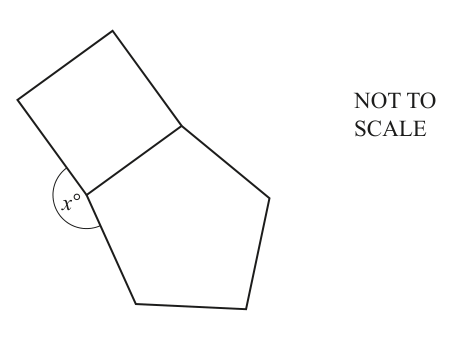
A square and a regular pentagon are joined along one edge as shown in the diagram.
Calculate the value of .
= ______
Approach
The angle is at a vertex where a square and a regular pentagon meet. The three angles at this vertex — the interior angle of the square, the interior angle of the pentagon, and — must sum to because they are angles around a point. We calculate the interior angles of the square and the regular pentagon, then subtract their sum from .
Working
The interior angle of a square is .
The interior angle of a regular pentagon with sides is:
The angles around the shared vertex sum to :
Answer
162
Walkthrough
The problem asks for the value of , which is the angle between a side of a square and a side of a regular pentagon that share a common vertex. At this vertex, three angles meet: the interior angle of the square, the interior angle of the regular pentagon, and the angle . Because these three angles go all the way around the point, they must add up to .
First, we identify the interior angle of the square, which is a standard value of .
Next, we find the interior angle of the regular pentagon. A regular pentagon has sides. The formula for the interior angle of a regular -sided polygon is . Substituting gives .
Finally, we set up the equation for the angles around the point: . Solving for gives .
Key Takeaways
- The interior angle of a regular -sided polygon is given by .
- Angles around a single point always sum to .
Common Mistakes
- Using the exterior angle formula () and forgetting to subtract it from to get the interior angle.
- Forgetting that angles around a point sum to and instead adding the angles to .
- Miscalculating the interior angle of the pentagon (e.g., using as the interior angle instead of the exterior angle).
Things to Be Careful About
- Ensure you are using the interior angle of the pentagon (), not the exterior angle (), when summing the angles around the vertex.
- The diagram is marked NOT TO SCALE, so do not estimate visually; rely entirely on the geometric properties and calculations.
Ahmed invests $4000 at a rate of per year simple interest.
Calculate the value of the investment after 2 years.
$ ______
Approach
The problem asks for the total value of an investment after a certain period with simple interest. We use the formula to find the interest earned, where is the principal amount, is the annual interest rate in percent, and is the time in years. The final value is the sum of the principal and the interest.
Working
Given:
Principal () = $4000
Rate () =
Time () = years
First, calculate the simple interest earned per year or total over the period. Since it is simple interest, the interest is constant each year.
Calculate the yearly interest:
Multiply by the number of years (2):
So, the total interest earned is $120.
Now, add the interest to the original principal to get the final value:
Answer
4120
Walkthrough
The problem involves calculating the future value of an investment under simple interest conditions. Simple interest means that the interest is calculated only on the original principal amount, not on any accumulated interest from previous periods.
-
Identify the variables:
- Principal (): The initial amount invested, which is $4000.
- Rate (): The annual interest rate, which is .
- Time (): The duration of the investment, which is years.
-
Calculate the Interest:
The formula for simple interest is .
Substitute the values: .
First, find of . To do this, divide by to get , then multiply by . . This is the interest for one year.
Since the investment is for years, multiply the yearly interest by : . So, the total interest is $120. -
Calculate the Final Value:
The question asks for the value of the investment, which includes both the original money and the interest earned.
Add the interest to the principal: .
Key Takeaways
- Simple interest is calculated only on the principal amount.
- The formula for simple interest is .
- The total value of the investment is Principal + Interest.
- Be careful to distinguish between "interest earned" and "total value".
Common Mistakes
- Calculating compound interest instead of simple interest (using ).
- Forgetting to add the interest back to the principal to find the final value.
- Arithmetic errors when calculating percentages.
Things to Be Careful About
- Ensure you use the correct formula for simple interest, not compound interest.
- Check if the question asks for the interest amount or the total accumulated value.
- In non-calculator papers, ensure you can perform the percentage calculations manually (e.g., finding of ).
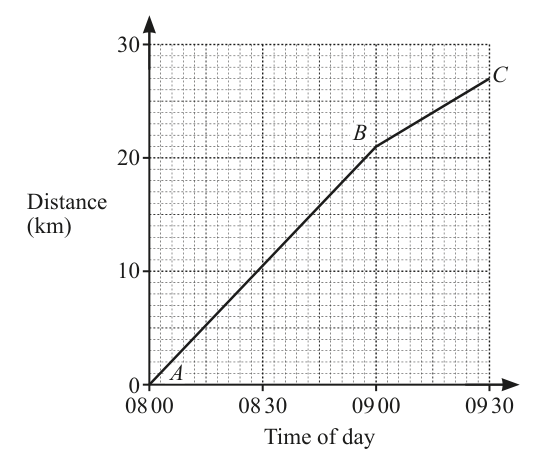
The diagram shows the distance–time graph of a cyclist for the first two stages of a race, and .
Work out the average speed of the cyclist for the second stage, .
______
Approach
Identify the distance travelled and the time taken for stage from the graph, then apply the formula .
Working
From the graph, point is at at and point is at at .
Distance for stage :
Time for stage :
Average speed for stage :
Answer
12
Walkthrough
The question asks for the average speed during stage . Average speed is calculated by dividing the total distance travelled by the total time taken. First, read the coordinates of points and from the distance-time graph. Point is at and , while point is at and . The distance covered between and is the difference in their vertical coordinates: . The time taken is the difference in their horizontal coordinates: from to , which is minutes. Since speed is required in , convert minutes to hours. Finally, divide the distance by the time: .
Key Takeaways
- The gradient of a distance-time graph represents speed.
- Always ensure the units of time and distance are consistent before calculating speed.
- Reading values from a graph requires identifying the correct coordinates on both axes.
Common Mistakes
- Reading the coordinates of incorrectly (e.g., using instead of ), which gives a distance of and an incorrect speed of .
- Forgetting to convert minutes to hours, resulting in a speed of or calculating .
- Calculating the speed for the entire journey instead of just stage .
Things to Be Careful About
- The mark scheme awards a method mark for stating either the correct distance () or the correct time ( mins) before applying the formula.
- The answer must be in , so the time in minutes must be converted to hours by dividing by .
- When reading graphs, ensure you are reading the exact values at the intersection of the grid lines.
A bus travels at an average speed of .
Work out the time the bus takes to travel .
______
Approach
Use the formula with the given values.
Working
Answer
2.5
Walkthrough
The question provides the average speed () and the distance to be travelled (). To find the time taken, rearrange the standard speed formula to . Substitute the given values: . Performing the division gives hours.
Key Takeaways
- The relationship between speed, distance, and time is fundamental: .
- You can rearrange this formula to find any of the three quantities if the other two are known.
- Always check that the units are consistent (e.g., distance in and speed in gives time in hours).
Common Mistakes
- Multiplying distance by speed instead of dividing, giving .
- Forgetting to include the unit in the final answer when asked.
- Rounding to or when an exact decimal is possible and expected.
Things to Be Careful About
- The mark scheme accepts or any equivalent form (oe), so would also be correct.
- Ensure the final answer is in the requested unit (), which matches the unit of speed () and distance () naturally.
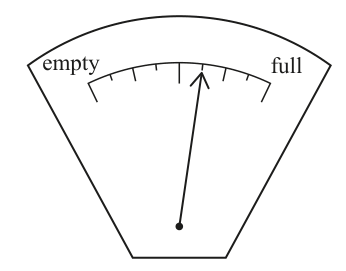
The diagram shows the fuel gauge of a car.
This car has 40 litres of fuel in the tank.
Calculate the amount of fuel that the tank contains when it is full.
______
Approach
The fuel gauge has 8 equal divisions from empty to full. The needle points to the 5th mark from empty, meaning the tank is full. We are given that this amount is litres. We need to find the total capacity of the full tank.
Working
To find the total capacity, divide by (or multiply by the reciprocal ):
Answer
64
Walkthrough
First, examine the fuel gauge diagram. The scale runs from 'empty' to 'full' and is divided into 8 equal sections. The needle is pointing to the 5th mark from the 'empty' end, which tells us that the tank is currently full. The problem states that the current amount of fuel is litres. This means of the total tank capacity equals litres. To find the full capacity, we divide the known amount () by the fraction it represents (), which is the same as multiplying by . Calculating gives litres.
Key Takeaways
- How to read a fraction from a segmented diagram.
- How to find a whole quantity when given a fractional part of it.
Common Mistakes
- Counting the divisions incorrectly (e.g., counting from 'full' instead of 'empty', or miscounting the total number of divisions).
- Multiplying by instead of dividing, which would give the amount for of a smaller tank.
- Forgetting that the answer must be in litres.
Things to Be Careful About
- Always verify the total number of divisions on the gauge; here it is , not . The fraction is , not .
- The mark scheme requires the exact integer value ; do not round or add unnecessary decimal places.
The car uses litres of fuel for every travelled.
Calculate the amount of fuel that the car will use on a journey of .
______
Approach
The car's fuel consumption rate is litres per km. We need to calculate the fuel used for a journey of km. Since km is exactly times km, we can simply multiply the fuel amount by .
Working
Answer
16.2
Walkthrough
The problem gives a rate of fuel consumption: litres for every km. The journey is km long. Notice that km is a multiple of km; specifically, . Therefore, the car will use times the amount of fuel it uses for km. Multiply by to get litres.
Key Takeaways
- How to use a given rate (litres per km) to calculate total consumption for a different distance.
- Recognising simple scaling factors (e.g., is times ) to simplify calculations.
Common Mistakes
- Multiplying by directly without dividing by first, leading to an answer of .
- Dividing by instead of multiplying.
- Confusing the rate direction (e.g., km per litre instead of litres per km).
Things to Be Careful About
- The unit is litres, and the mark scheme expects the exact value . No rounding is necessary here as the calculation results in a clean decimal.
Tom’s pet eats of a tin of food each day.
Tom needs food for his pet for 12 days.
Calculate the number of tins of food Tom needs to buy.
______
Approach
Calculate the total amount of food needed in tins by multiplying the daily consumption by the number of days. Then convert the improper fraction to a whole number or mixed number to determine how many tins must be purchased.
Working
Tom's pet eats of a tin each day. The number of days is .
Total food required:
Multiply the numerator by :
Convert the improper fraction into a mixed number:
This means Tom needs tins of food. Since he cannot buy partial tins, he must buy enough to cover the full amount. Therefore, he needs to buy tins.
Answer
8
Walkthrough
First, we need to determine the total quantity of food required for the 12-day period. We are given that the pet eats of a tin per day. To find the total, we multiply the daily rate by the number of days:
Performing the multiplication involves multiplying the integer by the numerator , while keeping the denominator unchanged:
Next, we interpret this result. The fraction can be converted to a mixed number or decimal. Dividing by gives with a remainder of , so:
Since Tom needs to buy whole tins, and tins would only provide tins worth of food (which is less than the required ), he must purchase the next whole number of tins. Thus, he buys tins.
Key Takeaways
- Multiplying a fraction by an integer: Multiply the numerator by the integer and keep the denominator the same ().
- Interpreting fractional results in real-world contexts: If the result represents discrete items that cannot be bought in fractions, round up to the next whole number if there is any remainder.
Common Mistakes
- Forgetting to multiply the numerator by the days (e.g., writing instead of ).
- Rounding incorrectly: Simply rounding down to would leave the pet short of food. The mark scheme awards M1 for , so showing the exact value is crucial even if the final answer requires rounding up.
- Arithmetic errors in .
Things to Be Careful About
- Ensure you show the intermediate step as it corresponds to Method Mark 1 (M1) in the marking scheme.
- The question asks for the number of tins to buy, implying a practical constraint (you can't buy 0.2 of a tin). Always check if the context requires rounding up, down, or to the nearest whole number.
Solve.
= ______
Approach
Expand the two sets of brackets, combine the terms and the constant terms separately to simplify the equation into the form , then divide by to find .
Working
Start with the given equation:
Expand the brackets. Multiply every term inside each bracket by the number outside:
Collect the terms together ( and ) and the constant terms together ( and ):
Simplify the sums:
Subtract from both sides to isolate the term:
Divide both sides by :
Answer
7/13
Walkthrough
The problem asks us to solve a linear equation where the variable is contained within two different sets of brackets. The first step in such problems is always to remove the brackets (expand). We multiply the terms inside the first bracket by , giving . Then we multiply the terms inside the second bracket by , giving .
Once expanded, the equation becomes . At this stage, we must group 'like terms'. This means putting all terms containing on one side and all plain numbers (constants) on the other. and are like terms; adding them gives . and are constants; adding them gives . The simplified equation is now .
To find , we need it to stand alone. Since is currently being added to , we subtract from both sides of the equals sign. leaves on the right, so we have . Finally, because is multiplied by , we divide both sides by to get the final answer.
Key Takeaways
- Expansion: Always distribute the multiplier to every term inside the bracket, paying close attention to signs (e.g., ).
- Like Terms: Only add or subtract terms that are identical (e.g., with , constants with constants). You cannot add and directly.
- Inverse Operations: To isolate a variable, do the opposite of what is happening to it. Addition is undone by subtraction; multiplication is undone by division.
Common Mistakes
- Incomplete Expansion: Forgetting to multiply the constant inside the bracket (e.g., writing as instead of ).
- Sign Errors: Making mistakes with negative numbers during expansion (e.g., ) or when collecting constants ().
- Adding Across the Equals Sign: Adding to the left side but forgetting to subtract it from the right side.
- Incorrect Division: Writing instead of (flipping the numerator and denominator).
Things to Be Careful About
- Accuracy: Ensure you expand both brackets correctly before simplifying.
- Form: The mark scheme expects the answer as an exact fraction (). Do not round this to a decimal unless explicitly asked to do so.
- Non-Calculator Component: On Paper 1, arithmetic must be shown clearly. Steps like should be visible.
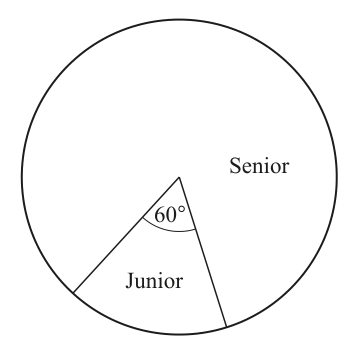
The pie chart shows the proportion of junior members and senior members at a gym.
There are 120 more senior members than junior members.
Calculate the total number of junior and senior members at the gym.
______
Approach
The total angle in a pie chart is . The junior sector is , so the senior sector is . The difference between these two sectors corresponds to the 120 more senior members than junior members. We can use this to find the number of members per degree, then calculate the total.
Working
Angle for senior members:
Difference in angle between senior and junior members:
This represents 120 members. The number of members per degree is:
Total number of members (corresponding to ):
Answer
180
Walkthrough
A pie chart represents a whole as . The junior sector is given as , so the senior sector must be . The problem states there are 120 more senior members than junior members. The difference in their sector angles is . This angular difference of directly corresponds to the numerical difference of 120 members. By finding how many members each degree represents (), we can scale up to the full of the pie chart to find the total number of members: .
Key Takeaways
- The total angle in a pie chart is always .
- The ratio of quantities in a pie chart is equal to the ratio of their central angles.
- Differences in quantities can be found by taking the difference in their corresponding angles.
Common Mistakes
- Subtracting from 100 instead of 360 to find the senior angle.
- Assuming the sector represents 60 members instead of using the ratio.
- Forgetting to add the junior and senior members together at the end, giving only the junior or senior count.
Things to Be Careful About
- Always remember a full circle is , not 100 (which is for percentages).
- Ensure you are using the difference in angles () to match the difference in numbers (120), not the junior angle () to the senior number (120).
- The final answer is the TOTAL number of members, not just the number of junior or senior members.
Solve the simultaneous equations.
Show all your working.
= ______
= ______
Approach
We have two simultaneous equations:
To eliminate , we can multiply equation (1) by so that the coefficient of becomes , matching the magnitude in equation (2).
Working
Multiply equation (1) by :
Now add equation (2) and equation (3) to eliminate :
Divide by :
Substitute into equation (2):
Rearrange to solve for :
Answer
x = 4, y = -1/3
Walkthrough
The problem asks us to find the values of and that satisfy both equations simultaneously. The most direct method here is elimination.
-
Aligning coefficients: We look at the coefficients of . In equation (1), it is , and in equation (2), it is . If we multiply equation (1) by , the term becomes . This allows us to cancel out the terms when we add the modified equation (1) to equation (2).
-
Eliminating: Adding and results in . The constants and sum to . This leaves a simple single-variable equation: .
-
Solving: Dividing by gives .
-
Substitution: To find , we plug back into one of the original equations (equation (2) was chosen as it looked slightly simpler). Solving involves subtracting from both sides to get , then dividing by to get .
Key Takeaways
- When solving simultaneous equations by elimination, ensure the coefficients of the variable you want to remove are equal in magnitude but opposite in sign (for addition) or identical in sign (for subtraction).
- Always substitute your answer back into an original equation to verify it works (e.g., check with equation (1): ).
Common Mistakes
- Arithmetic errors: Forgetting to multiply the entire right-hand side of the equation when scaling (e.g., getting instead of ).
- Sign errors: Incorrectly adding or subtracting negative numbers, especially when dealing with the constant terms or the final division for .
- Incorrect substitution: Substituting the value of into the wrong equation or making algebraic mistakes during the rearrangement.
Things to Be Careful About
- Accuracy: The mark scheme accepts 'oe' (other equivalent) forms like , but simplifying to is standard practice.
- Working: Show all steps clearly ('nfww' - no follow-through without working). The marks are awarded for the method (M1) and the correct answers (A2). A0 SC1 is available only for correct answers with no working shown.
By writing each number correct to one significant figure, estimate the value of
______
Approach
To estimate the value of the expression , we first round each number in the expression to one significant figure. Then, we substitute these rounded values back into the expression and calculate the result.
Working
Step 1: Round each number to one significant figure.
- The number starts with the digit 2. The next digit is 8, so we round up. To one significant figure, .
- The number starts with the digit 3. The next digit is 9, so we round up. To one significant figure, .
- The number starts with the digit 1. The next digit is 9, so we round up. To one significant figure, .
Step 2: Substitute the rounded values into the original expression.
The expression becomes:
Step 3: Evaluate the components.
- Calculate the square root: .
- Calculate the square: .
Step 4: Perform the multiplication and division.
Substitute these values back into the fraction:
Calculate the numerator:
Now divide by the denominator:
Answer
The estimated value is 15.
15
Walkthrough
The problem asks for an estimate of a numerical expression. Estimation in mathematics often involves simplifying complex or precise numbers into easier-to-handle values to get a quick approximate answer. The standard method here is to round each component to one significant figure.
First, look at the numerator's factors:
- : We keep only the first non-zero digit (2) and look at the second digit (8). Since 8 is 5 or greater, we round the 2 up to 3. So, .
- : We cannot easily take the square root of 396.5 mentally. Instead, we first round the number inside the square root. The first digit is 3, and the second is 9. Rounding 396.5 to one significant figure gives 400. Now, taking the square root is easy because 400 is a perfect square (). So, .
Next, look at the denominator:
3. : We first round the base number 1.92. The first digit is 1, and the second is 9. Rounding to one significant figure gives 2. Then we square this rounded value: .
Finally, put it all together into the fraction:
Multiply the top numbers: . Divide by the bottom number: .
The mark scheme awards marks for identifying the correct rounded values (B1 for two out of three correct rounds) and the final calculated estimate (A1 for 15).
Key Takeaways
- One Significant Figure: This means keeping only the first non-zero digit and rounding the rest based on the next digit. Zeros used as placeholders (like in 400) are not counted as significant figures in this context; they just show the magnitude.
- Estimation Strategy: Simplify the numbers before doing the operations. It is much easier to calculate than .
- Order of Operations: When estimating a power like , you can either round the base first () or evaluate then round (). Both lead to the same result here, but rounding the base is generally the intended method for simple estimation unless specified otherwise.
Common Mistakes
- Incorrect Rounding: Rounding 2.87 to 2 instead of 3, or 1.92 to 1 instead of 2. Remember that if the digit after the significant figure is 5 or more, round up.
- Rounding the Square Root: Trying to round directly. You must round the radicand (the number inside) first to find a compatible perfect square.
- Calculation Errors: Making arithmetic mistakes when multiplying or dividing the simplified numbers (e.g., calculating incorrectly).
- Using Too Many Figures: Carrying forward too many decimal places defeats the purpose of estimation and may lead to a different answer than expected by the "one significant figure" rule.
Things to Be Careful About
- Significant Figures vs Decimal Places: Ensure you are rounding to significant figures, not decimal places. For example, 2.87 to one decimal place is 2.9, but to one significant figure is 3.
- Placeholder Zeros: When rounding 396.5 to one significant figure, the answer is 400, not 4. The zeros are crucial to maintain the correct order of magnitude.
- Mark Scheme Specifics: The mark scheme explicitly looks for the intermediate rounded values (, , ). Showing these steps clearly is important for earning partial credit (B1) even if the final calculation is wrong.
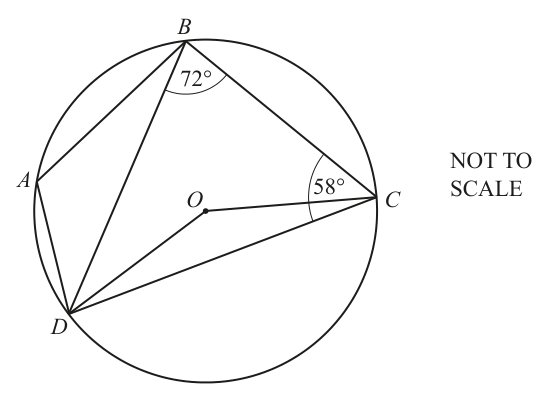
and are points on the circumference of a circle centre .
Angle and angle .
Approach
Points , , , and all lie on the circumference of the circle, making a cyclic quadrilateral. In a cyclic quadrilateral, opposite angles are supplementary.
Working
Substitute the given value :
Answer
Angle because angles in opposite segments are supplementary.
122°, angles in opposite segments are supplementary
Walkthrough
Since all four points , , , and lie on the circle, the quadrilateral is cyclic. A fundamental circle theorem states that opposite angles in a cyclic quadrilateral are supplementary, meaning they add up to . The angles and are opposite angles. We are given , so we subtract this from to find .
Key Takeaways
- A cyclic quadrilateral is a four-sided shape whose vertices all lie on a single circle.
- Opposite angles in a cyclic quadrilateral always sum to .
Common Mistakes
- Forgetting that the angles must sum to and instead adding or subtracting incorrectly.
- Using the wrong pair of angles; only diagonally opposite angles (like and , or and ) are supplementary.
Things to Be Careful About
- The mark scheme accepts the reason as "angles in opposite segments are supplementary". Ensure the reason is stated clearly and matches the theorem exactly. No working is required for this part, but the calculation must be correct.
Approach
The angle subtended by an arc at the centre of a circle is twice the angle subtended by the same arc at the circumference. Arc is subtended by at the centre and by at the circumference.
Working
Substitute the given value :
Answer
Angle .
144
Walkthrough
Identify the arc that both angles and subtend. Both angles open up to arc . The angle at the centre () is always twice the angle at the circumference () when they subtend the same arc. Multiply by to get .
Key Takeaways
- The angle at the centre theorem: angle at centre = angle at circumference (on the same arc).
- Always ensure both angles are subtended by the exact same arc and are on the same side of the chord.
Common Mistakes
- Using the wrong angle at the circumference (e.g., using instead of for arc ).
- Forgetting to multiply by .
Things to Be Careful About
- The answer is a pure number in degrees; do not include the degree symbol unless specifically asked. The mark scheme expects just .
Approach
Triangle is formed by two radii and , making it an isosceles triangle. We can find the base angles and using the sum of angles in a triangle. Then, is found by subtracting from the given .
Working
In triangle , (radii of the circle), so .
The sum of angles in triangle is :
We are given . From the diagram, :
Answer
Angle .
40
Walkthrough
First, look at triangle . Since is the centre and and are on the circumference, and are both radii. This makes triangle isosceles, meaning the base angles and are equal. We know the angle at the top, (from part b(i)). Subtract this from and divide by to find . Finally, the given angle is split into and . Subtract from to get .
Key Takeaways
- Lines from the centre to the circumference are radii and are equal in length, creating isosceles triangles.
- Base angles of an isosceles triangle are equal, and the sum of angles in any triangle is .
- Angles can be split into parts and subtracted to find unknown angles.
Common Mistakes
- Forgetting that and trying to solve triangle without recognizing it is isosceles.
- Subtracting the wrong angle or adding instead of subtracting when splitting .
Things to Be Careful About
- Follow through with the value of from part b(i). If a candidate gets wrong in part b(i), they can still earn method marks for correctly calculating using their incorrect value. The mark scheme awards for the correct method: .
The table shows the time that each of 60 children spends in a play area.
| Time ( mins) | |||||
|---|---|---|---|---|---|
| Frequency | 4 | 7 | 8 | 24 | 17 |
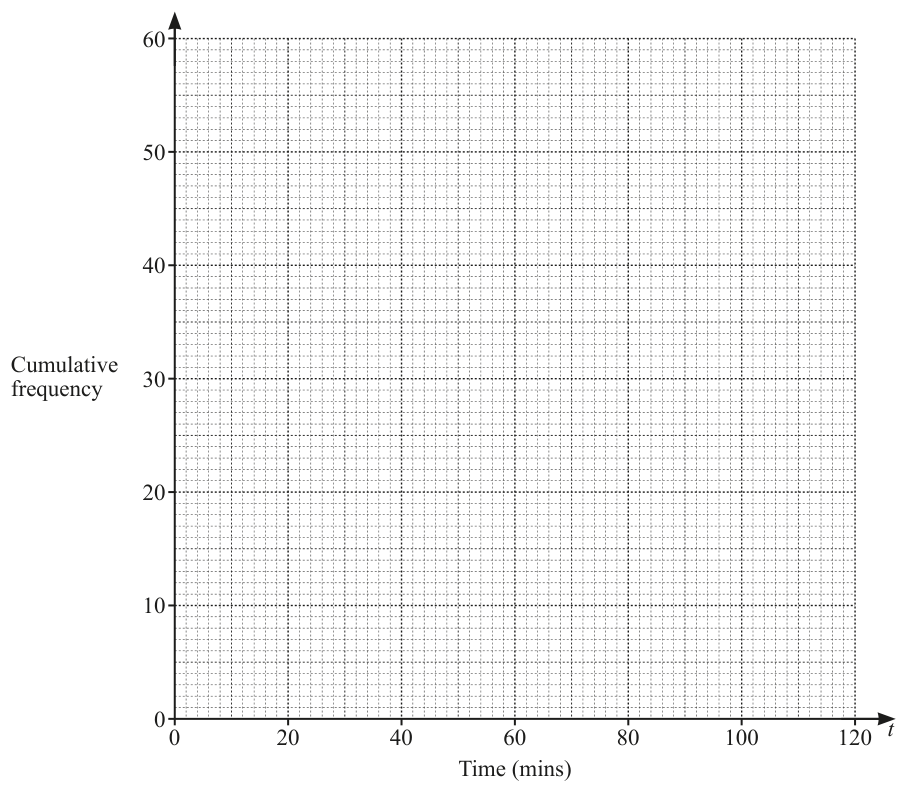
Approach
To draw a cumulative frequency diagram, first calculate the cumulative frequency at the upper boundary of each class interval by adding frequencies successively. Then plot these points on the given grid and join them with a smooth increasing curve.
Working
Step 1: Calculate cumulative frequencies
| Time ( mins) | Upper boundary | Frequency | Cumulative frequency |
|---|---|---|---|
| 10 | 4 | 4 | |
| 40 | 7 | 4 + 7 = 11 | |
| 60 | 8 | 11 + 8 = 19 | |
| 90 | 24 | 19 + 24 = 43 | |
| 120 | 17 | 43 + 17 = 60 |
The curve should also start at since no children spend 0 minutes in the play area.
Step 2: Plot points and draw the curve
Plot the following coordinates on the grid:
Join these points with a smooth, increasing curve (an ogive). Ensure the curve does not have any sharp corners or decrease at any point.
Answer
A cumulative frequency diagram with the points , , , , , plotted and joined by a smooth increasing curve.
Cumulative frequency curve through (0,0), (10,4), (40,11), (60,19), (90,43), (120,60)
Walkthrough
The cumulative frequency diagram is built by accumulating the frequencies from the lowest class to the highest. We start at 0 cumulative frequency at time 0. At the end of the first class (), 4 children have finished, so we plot . At , we add the next 7 children, giving , so we plot . Continuing this process: at , ; at , ; at , . These five points, plus the origin , are plotted on the grid. A smooth curve is drawn through them to represent the cumulative distribution.
Key Takeaways
- Cumulative frequency is the running total of frequencies up to a given value.
- Points are plotted at the upper class boundary against the cumulative frequency.
- The curve must be smooth and always increasing (non-decreasing).
Common Mistakes
- Plotting at the lower class boundary instead of the upper class boundary.
- Forgetting to start the curve at .
- Drawing a straight line graph (polygon) instead of a smooth curve.
- Making the curve decrease at any point.
- Misreading the cumulative frequency axis (e.g., reading frequency instead of cumulative frequency).
Things to Be Careful About
- Ensure the curve is smooth; sharp corners at the plotted points are incorrect.
- The final cumulative frequency must match the total number of children ().
- When reading values from the diagram later, use horizontal lines from the cumulative frequency axis and vertical lines down to the time axis.
Use your diagram to estimate
Approach
The median is the value at the middle of the data set. For children, the median position is . Draw a horizontal line from cumulative frequency 30 to the curve, then read the corresponding time on the horizontal axis.
Working
Median position:
Locate on the cumulative frequency axis. Move horizontally to the curve and then vertically down to the time axis.
From the diagram, at cumulative frequency , the time is approximately minutes.
(Interpolation check: between (CF=19) and (CF=43), the CF range is over minutes. We need more cumulative frequency. . So .)
Answer
(Accept any value between 73 and 75 minutes based on diagram reading.)
74
Walkthrough
The median splits the data into two equal halves. With 60 children total, the median is at the 30th child. On the cumulative frequency graph, we find 30 on the vertical axis, draw a horizontal line to intersect the curve, and then drop a vertical line to the horizontal axis to read the time. Reading from the curve, this falls at approximately 74 minutes.
Key Takeaways
- The median position for data points is .
- Read the median value from the cumulative frequency curve by finding the time corresponding to the median cumulative frequency.
Common Mistakes
- Using the wrong position for the median (e.g., using instead of ).
- Reading the cumulative frequency value instead of the time value at the end of the horizontal line.
- Not allowing for the natural variation in diagram reading (mark schemes accept a range).
Things to Be Careful About
- The question asks to 'estimate' using the diagram, so an exact interpolated value is not required, but must be consistent with the drawn curve.
- Ensure the reading is taken from the correct axis (time, not cumulative frequency).
Approach
The interquartile range (IQR) is the difference between the upper quartile (UQ) and the lower quartile (LQ). For , the LQ is at position and the UQ is at position . Read these values from the curve and subtract.
Working
Lower Quartile (LQ):
Position:
Locate 15 on the cumulative frequency axis. Move horizontally to the curve and vertically down to the time axis.
At CF = 15, the time is minutes.
(Interpolation check: between (CF=11) and (CF=19), range is 8 over 20 mins. Need . . .)
Upper Quartile (UQ):
Position:
Locate 45 on the cumulative frequency axis. Move horizontally to the curve and vertically down to the time axis.
At CF = 45, the time is approximately minutes.
(Interpolation check: between (CF=43) and (CF=60), range is 17 over 30 mins. Need . . .)
Interquartile Range:
Answer
(Accept any value between 42 and 45 minutes based on diagram reading.)
43.5
Walkthrough
The interquartile range measures the spread of the middle 50% of the data. We find the lower quartile at the 15th value (25% of 60) and the upper quartile at the 45th value (75% of 60). Reading from the cumulative frequency curve, the 15th value occurs at 50 minutes, and the 45th value occurs at approximately 93.5 minutes. Subtracting the lower quartile from the upper quartile gives the IQR.
Key Takeaways
- LQ position is and UQ position is .
- IQR is calculated as UQ minus LQ.
- Both quartiles must be read from the same cumulative frequency curve.
Common Mistakes
- Confusing the positions of LQ and UQ.
- Reading the cumulative frequency value instead of the time value.
- Forgetting to subtract LQ from UQ (giving just one quartile value).
- Using incorrect quartile positions (e.g., using for LQ).
Things to Be Careful About
- Allow for diagram reading variation; mark schemes accept a range (typically or minutes).
- Ensure follow-through marks are applied if earlier readings are incorrect but consistent with the drawn curve.
Approach
To find the number of children who spend more than 80 minutes, first read the cumulative frequency at minutes from the diagram. Then subtract this value from the total number of children (60).
Working
Step 1: Read cumulative frequency at
Locate 80 on the time axis. Move vertically up to the curve and horizontally to the cumulative frequency axis.
At , the cumulative frequency is approximately 35.
(Interpolation check: between (CF=19) and (CF=43), range is 24 over 30 mins. From 60 to 80 is 20 mins. . CF = .)
Step 2: Calculate number of children > 80 minutes
Total children = 60
Answer
(Accept any value between 23 and 27 based on diagram reading.)
25
Walkthrough
The cumulative frequency at a given time tells us how many children spent up to that time in the play area. To find how many spent more than 80 minutes, we find the cumulative frequency at 80 minutes and subtract it from the total number of children. Reading from the graph at , the cumulative frequency is about 35. Subtracting this from 60 gives 25 children who spent more than 80 minutes.
Key Takeaways
- Cumulative frequency at a value gives the count of observations less than or equal to that value.
- To find the number greater than a value, subtract the cumulative frequency at that value from the total frequency.
Common Mistakes
- Reading the cumulative frequency and using it as the final answer (forgetting to subtract from the total).
- Reading the wrong axis (reading time from the vertical axis or cumulative frequency from the horizontal axis).
- Misreading the graph at (e.g., reading 30 or 40 instead of 35).
Things to Be Careful About
- The question asks for the number of children, not a percentage or proportion.
- Ensure the reading at is consistent with the curve drawn in part (a). Mark schemes apply follow-through if the reading is consistent with the student's own curve.
In this table, is directly proportional to .
| 12 | 48 | ||
|---|---|---|---|
| 2 | 7 |
Calculate the value of and the value of .
= ______
= ______
Approach
Since is directly proportional to , we can write the relationship as for some constant . We use the first column of values () to calculate , then substitute into the equation to find (when ) and (when ).
Working
Step 1: Find the constant of proportionality,
Substitute and :
So the formula connecting and is .
Step 2: Calculate
In the second column, and . Substitute these into the formula:
Step 3: Calculate
In the third column, and . Substitute these into the formula:
Divide both sides by 3:
Take the square root of both sides:
(Note: In the context of many syllabi, the positive root is often accepted unless specified otherwise, but mathematically both are valid. The mark scheme accepts or just .)
Answer
(or )
a = 147, b = 4
Walkthrough
The question states that is directly proportional to . This means there is a constant multiplier such that .
First, we need to find this constant . We look at the table for a complete row where both and are known numbers. The first column gives when . Substituting these into our formula:
Dividing by 4 gives . Now we know the specific rule for this table is .
Next, we find . The second column tells us that when , . Using our rule:
Finally, we find . The third column tells us that when , . Using the rule again:
Divide by 3:
Square root both sides:
(Strictly , but typically the positive value is the expected answer in this context unless domain restrictions apply).
Key Takeaways
- Direct Proportion: If is directly proportional to , write .
- Finding : Always use a complete pair of values from the data to solve for .
- Using the Formula: Once you have the formula with the known , substitute any other given value to find the unknown.
Common Mistakes
- Incorrect Proportionality Statement: Writing instead of . This leads to wrong values for everything.
- Order of Operations: For calculating , forgetting to square before multiplying by (e.g., doing instead of ).
- Arithmetic Errors: Multiplication errors like or square root errors for .
- Ignoring the Square Root: Forgetting that implies could be negative, though usually the positive root is sufficient in basic tables.
Things to Be Careful About
- Ensure you square the value before multiplying by .
- When solving for from , remember to take the square root.
- Check your arithmetic carefully, especially large multiplications like .
Approach
The function is defined as . To find , substitute into the expression.
Working
Answer
17
Walkthrough
The notation asks us to evaluate the function when the input is 11. We replace every instance of in the formula with 11. This gives , which is 22. Subtracting 5 from 22 leaves 17.
Key Takeaways
Function notation represents an operation performed on . Evaluating it means plugging in the specific value given inside the brackets.
Common Mistakes
- Multiplying by the wrong number (e.g., ).
- Arithmetic errors in subtraction ().
Things to Be Careful About
Ensure you substitute the correct value. In this case, , not or any other number.
Approach
To find the inverse function , we follow these steps:
- Replace with .
- Swap the roles of and (replace with and with ).
- Rearrange the resulting equation to make the subject.
- Replace with .
Working
Step 1: Write as .
Step 2: Swap and .
Step 3: Make the subject.
Add 5 to both sides:
Divide by 2:
Step 4: Write in inverse function notation.
(Note: This can also be written as )
Answer
(x + 5)/2
Walkthrough
An inverse function reverses the operation of the original function. If maps to , then maps back to . The standard algebraic method is to treat as , swap and to reflect the reversal of input/output, and then solve for the new .
Starting with , swapping gives . We then isolate by adding 5 to get , and dividing by 2 to get . Finally, we label this result .
Key Takeaways
- The inverse function undoes what does.
- Swapping and is the key geometric/algebraic step that reflects the function across the line .
Common Mistakes
- Forgetting to swap and . Just solving for without swapping first yields , which looks similar but isn't formally derived via the standard variable swap method (though mathematically equivalent if you just rename variables at the end). The mark scheme explicitly awards a mark for seeing or equivalent intermediate forms.
- Incorrectly isolating . For example, dividing only the 2x by 2 and forgetting the 5.
Things to Be Careful About
The final answer must be in terms of . Ensure you replace with at the very end. The form is preferred but is also acceptable (oe).
Approach
We are asked to solve . Since , we substitute this expression into the equation, collect all terms on one side to form a quadratic equation equal to zero, and then solve for .
Working
Set the expressions equal:
Rearrange to form a standard quadratic equation . Subtract and add 5 to both sides:
Simplify:
Factorise the quadratic. We need two numbers that multiply to and add to . These numbers are and .
Set each factor to zero to find the solutions:
Answer
3 or -2
Walkthrough
This question combines function evaluation with solving quadratic equations. First, we use the definition of to create an equation involving only : . The goal is to solve for . We move all terms to one side to set the equation to zero. Subtracting and adding 5 from both sides simplifies the left-hand side to 0 and transforms the right-hand side into . Now we have a standard quadratic equation. We factorise by finding factors of -6 that sum to -1, which are -3 and +2. Setting each bracket to zero gives the two possible values for .
Key Takeaways
- When solving , substitute the expression for and rearrange into a polynomial equation.
- Always check your sign changes when moving terms across the equals sign.
- Factorisation requires finding two numbers with the correct product and sum.
Common Mistakes
- Errors in rearranging the equation (e.g., getting ).
- Incorrect factorisation (e.g., signs mixed up like ).
- Forgetting the negative root ().
Things to Be Careful About
The mark scheme awards marks for the correct quadratic form () and for the method used to solve their quadratic. Ensure the final equation is set to 0 before factorising. The answers are exact integers, so no rounding is needed.
The matrix satisfies the equation
Find .
= ______
Approach
Treat the matrix equation like an ordinary linear equation: collect all terms on one side, then divide by the scalar coefficient to find .
Working
Start with
Subtract from both sides:
Multiply the matrix by :
Divide both sides by :
Answer
[[10, 0], [15, -5]]
Walkthrough
The equation is a matrix equation, but the same rules of algebra apply as for numbers. We want to isolate .
First, subtract from both sides. This removes it from the right-hand side:
Since , we get
Next, evaluate the scalar multiplication on the right. Multiplying a matrix by means multiplying every element by :
Finally, divide both sides by , which is the same as multiplying by , to get the matrix . Dividing a matrix by a scalar means dividing every element by that scalar:
Key Takeaways
- Matrix equations can be solved using the same inverse operations as ordinary equations.
- Scalar multiplication multiplies every element of the matrix by the scalar.
- Dividing by a scalar divides every element of the matrix by that scalar.
- The answer can be checked by substituting back into the original equation.
Common Mistakes
- Subtracting from only one side, or subtracting incorrectly.
- Multiplying only some elements of the matrix by instead of all four elements.
- Forgetting to divide every element by at the final step.
- Giving the intermediate matrix as the final answer; this is , not .
Things to Be Careful About
- The mark scheme awards B1 for three correct elements of the final matrix, or for the intermediate matrix . So showing the intermediate step can earn partial credit even if the final division is wrong.
- This is a non-calculator paper, so the scalar multiplications and divisions must be done by hand, but they are simple.
- Matrix equality works element by element, so once the equation is reduced to , each element of is half the corresponding element of the right-hand side.
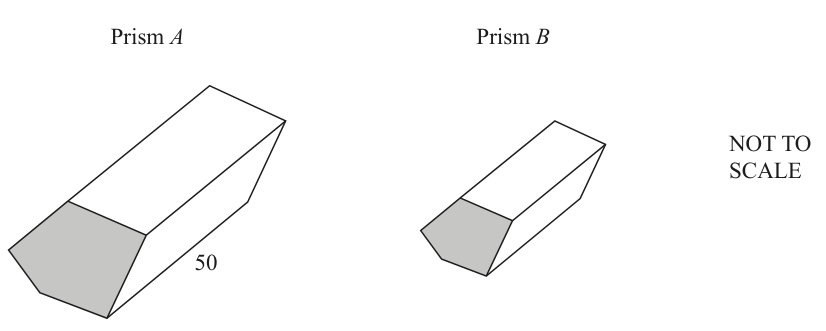
Prism and prism are mathematically similar.
In the diagram, the cross-sections of the prisms are shaded.
The volume of prism is .
The length of prism is .
The area of the cross-section of prism is .
Calculate the length of prism .
______
Approach
Find the cross-sectional area of prism A using its volume and length. Then use the ratio of the cross-sectional areas to find the linear scale factor between the two similar prisms, and apply it to prism A's length to find prism B's length.
Working
The volume of a prism is given by the formula:
For prism A, substitute the given values to find the area of its cross-section:
Since prism A and prism B are mathematically similar, the ratio of their cross-sectional areas equals the square of the linear scale factor ():
Take the square root to find the linear scale factor from A to B:
Multiply the length of prism A by the linear scale factor to find the length of prism B:
Answer
20
Walkthrough
First, we need the area of the cross-section of prism A. We are given its volume () and its length (). Since the volume of any prism equals the cross-sectional area multiplied by its length, we divide the volume by the length to get .
Next, we use the fact that the two prisms are mathematically similar. For similar shapes, the ratio of their corresponding areas is equal to the square of the linear scale factor (). We have the cross-sectional area of A () and the cross-sectional area of B (), so the area scale factor from A to B is .
To find the linear scale factor , we take the square root of the area scale factor: . This means every length on prism B is times the corresponding length on prism A.
Finally, we multiply the length of prism A () by the linear scale factor () to find the length of prism B, which is .
Key Takeaways
- The volume of a prism is calculated as .
- For mathematically similar solids, the ratio of corresponding areas is the square of the linear scale factor ().
- The linear scale factor is the square root of the area scale factor.
Common Mistakes
- Using the area ratio () directly as the linear scale factor instead of taking its square root.
- Confusing the area scale factor with the volume scale factor (which would be ).
- Forgetting to calculate the area of prism A's cross-section first and trying to use the volume ratio directly with the given area of B.
Things to Be Careful About
- The diagram is marked NOT TO SCALE, so do not attempt to measure lengths or areas from the image.
- Ensure units are consistent: volumes are in , areas in , and lengths in .
- Remember that for similar solids, area ratio is and volume ratio is . Here we only need the area and length (linear) relationship, so is sufficient; the volume of prism B is not required and should not be calculated.
Rearrange the formula to make the subject.
= ______
Approach
The formula is given as a fraction. To make the subject, we must first remove the fraction by multiplying both sides by the denominator . Then, we expand the brackets, group all terms containing on one side of the equation, factorise , and divide to isolate .
Working
Multiply both sides by :
Expand the left-hand bracket:
Rearrange to collect terms with on the left and other terms on the right. Subtract from both sides and add to both sides:
Factorise the left-hand side by taking out :
Divide both sides by to make the subject:
Answer
(5b + 3a)/(a - 2)
Walkthrough
- Eliminate the fraction: The original equation has in the denominator. We clear this by multiplying every term by . This gives .
- Expand: Distribute the across the bracket to get .
- Group terms: We need all terms on one side. Subtract from both sides and add to both sides to get .
- Factorise: Factor out from the left side: .
- Isolate: Divide by to solve for : .
Key Takeaways
- When changing the subject of a formula where the subject is in the denominator, always multiply by that denominator first.
- Always check if you can cancel common factors before multiplying; here, nothing cancels, so direct multiplication is required.
- Remember to change the sign when moving terms across the equals sign (e.g., becomes , becomes ).
Common Mistakes
- Forgetting to distribute the multiplier to all terms (e.g., writing instead of expanding correctly).
- Incorrectly grouping terms (e.g., keeping terms on opposite sides).
- Failing to factorise before dividing.
- Dividing only part of the numerator or denominator by .
- Sign errors when rearranging (e.g., instead of ).
Things to Be Careful About
- Ensure the final answer is in the simplest form. Check if and share any common factors (they do not in general).
- The mark scheme allows 'oe' (other equivalent forms), such as .
is a line segment joining and .
Approach
Let the coordinates of be . Since is the midpoint of where is , we use the midpoint formula:
Working
Set up the equation for the x-coordinate:
Multiply by 2:
Add 2:
Set up the equation for the y-coordinate:
Multiply by 2:
Subtract 5:
Answer
(4, 1)
Walkthrough
The problem states that point B is the midpoint of the line segment AC. The midpoint formula calculates the average of the x-coordinates and the average of the y-coordinates of the endpoints.
For the x-coordinate: We know the midpoint x is 1, and one endpoint x is -2. So, . Solving this gives .
For the y-coordinate: We know the midpoint y is 3, and one endpoint y is 5. So, . Solving this gives .
Key Takeaways
- The midpoint of points and is given by .
- To find an endpoint given the midpoint and the other endpoint, you can reverse the averaging process by multiplying the midpoint coordinate by 2 and subtracting the known endpoint coordinate.
Common Mistakes
- Adding instead of subtracting when solving for the missing coordinate.
- Mixing up the x and y values.
Things to Be Careful About
- Ensure the order of subtraction is consistent if using vector methods (). Here, .
Approach
The distance between two points and is given by:
We are given that the length , so we need to calculate .
Working
Coordinates: and .
Calculate the difference in x:
Square it:
Calculate the difference in y:
Square it:
Sum the squares:
So, .
Answer
13
Walkthrough
To find the value of , we use the distance formula which is derived from Pythagoras' theorem. The horizontal distance between A and B is the difference in their x-coordinates, and the vertical distance is the difference in their y-coordinates. These form the legs of a right-angled triangle, with the line segment AB as the hypotenuse.
Horizontal leg: . Square: .
Vertical leg: . Square: .
Hypotenuse squared (): .
Key Takeaways
- The distance formula allows calculation of the square of the distance directly without taking the square root until the end.
- Squaring a negative number results in a positive number, so the sign of the difference does not matter for the final result.
Common Mistakes
- Forgetting to square the differences.
- Making sign errors when subtracting negative coordinates (e.g., instead of ).
- Forgetting that is the value inside the square root, not the length itself.
Things to Be Careful About
- The question asks for , not . Check the required format carefully.
Find the equation of the line perpendicular to that passes through .
Give your answer in the form .
= ______
Approach
- Find the gradient (slope) of the line segment .
- Determine the gradient of the line perpendicular to . Perpendicular gradients have a product of (negative reciprocal).
- Use the point-slope form or substitute the gradient and the given point into to find the y-intercept .
Working
Step 1: Gradient of AB
Step 2: Gradient of perpendicular line
Let be the gradient of the perpendicular line.
Step 3: Find the equation
The equation is of the form . The line passes through , so substitute and :
So the equation is:
Answer
y = 3/2x + 8
Walkthrough
First, we calculate the gradient of the line AB. Gradient is defined as 'rise over run', or the change in y divided by the change in x. Using points A(-2, 5) and B(1, 3):
Change in y = 3 - 5 = -2.
Change in x = 1 - (-2) = 3.
Gradient of AB = -2/3.
Next, we find the gradient of a line perpendicular to AB. Two lines are perpendicular if the product of their gradients is -1. This means the new gradient is the negative reciprocal of the original. The reciprocal of -2/3 is -3/2. The negative of that is 3/2. So the new gradient is 3/2.
Finally, we need the specific equation of the line. We know the form is , where . We also know the line passes through point A(-2, 5). By plugging these x and y values into the equation, we can solve for the constant (the y-intercept).
simplifies to , so .
Key Takeaways
- Gradient formula: .
- Perpendicular gradient rule: If is the gradient of a line, the gradient of a perpendicular line is .
- To find the equation of a line, you need its gradient and one point on it. Substituting the point into allows you to find .
Common Mistakes
- Calculating the gradient as (inverting rise and run).
- Finding the negative reciprocal incorrectly (e.g., just changing the sign but not flipping the fraction, or vice versa).
- Arithmetic errors when substituting negative coordinates (e.g., forgetting that is negative).
Things to Be Careful About
- The mark scheme accepts equivalent forms like , but the final answer must be in the form . Make sure to expand and simplify correctly.
- Ensure fractions are handled carefully during substitution.
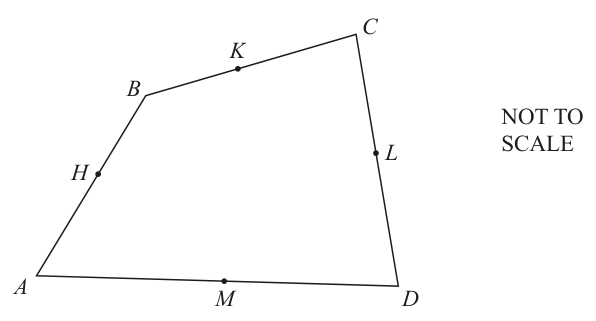
is a quadrilateral.
and are the midpoints of and respectively.
, and .
Express, as simply as possible, in terms of and or and
Approach
To find , travel along the path from to via . Since and are midpoints of and , the vectors and are exactly half of and .
Working
By vector addition:
Answer
a + b
Walkthrough
We want the vector from to . The most direct path uses the vertices already given in the problem: go from to , then from to . Because is the midpoint of , the vector is exactly half of , which gives . Similarly, is the midpoint of , so is half of , giving . Adding these two vectors along the path gives .
Key Takeaways
When a point is the midpoint of a side of a polygon, the vector from an endpoint to that midpoint is exactly half the vector of the full side. Vector addition along a path () is the fundamental tool for combining these.
Common Mistakes
- Forgetting that is in the same direction as (so it is , not ).
- Adding and directly instead of their halves.
- Writing the answer as by missing the midpoint halving step.
Things to Be Careful About
The question asks for the answer "as simply as possible". is the simplest form. Always check the direction of each half-vector to ensure signs are correct.
Approach
To find , travel from to via . This path is . We know , and we can find by going .
Working
Substitute the given values:
Now add :
Rearranging:
This can also be written as .
Answer
-2a - 2b + 2d
Walkthrough
We need the vector from to . We are given , , and . The path uses only known vectors. First, is the reverse of , so it is . Next, is the reverse of , so it is . Finally, is given as . Adding these along the path gives . Alternatively, you can use the closed-loop rule: , and substitute to solve for .
Key Takeaways
Any vector between two points can be found by adding vectors along any path connecting them. Reversing a vector means negating it (multiplying by ). The sum of vectors around a closed loop is always the zero vector.
Common Mistakes
- Forgetting to negate and when going .
- Using instead of in the closed-loop equation.
- Leaving the answer as without rearranging or factoring, though both forms are acceptable.
Things to Be Careful About
The mark scheme accepts or . Both are fully simplified. Ensure all three vectors , , and appear with correct signs.
Approach
To find , travel from to via . The path is . Both and are midpoints, so these are half-vectors of and respectively.
Working
Substitute the result from part (b) for :
Now add the two vectors along the path:
Answer
a + b
Walkthrough
We want the vector from to . The most straightforward path is . Since is the midpoint of , is half of , which is . Since is the midpoint of , is half of . Note that is the reverse of , so . Using the answer from part (b), , we get . Adding and gives . Notice that is parallel to and equal in length to , which is a known property of the midpoint quadrilateral (Varignon's theorem).
Key Takeaways
Midpoint vectors often simplify nicely because the terms cancel out. Always use the result from a previous part if it saves work. The vector connecting midpoints of two sides of a triangle is parallel to the third side and half its length; this question is a generalisation of that idea.
Common Mistakes
- Forgetting that is half of , not , leading to a sign error.
- Forgetting to negate when finding .
- Not cancelling the terms at the end, leaving an unnecessarily complex answer.
Things to Be Careful About
This part is worth 2 marks: one for the correct vector route (M1) and one for the final simplified answer (A1). Make sure to show the path clearly so the method mark is awarded. The final answer is deceptively simple; do not assume you can skip the working.