Mathematics (Syllabus D) 4024/22 — May/June 2021
Cambridge O-Level · Calculator · worked solutions for every part, with the mark scheme
Topics Algebra and Graphs · Number · Mensuration · Trigonometry · Statistics · Probability · +3 more
The price of an electric drill is $78.
In a sale, the price is reduced by 15%.
Calculate the sale price.
$ ______
Approach
To calculate the sale price after a reduction, find of the original price of $78 and subtract it from $78, or multiply $78 directly by .
Working
Calculate the discount amount:
Subtract the discount from the original price:
Answer
66.30
Walkthrough
- Identify the original price and the percentage decrease: The original price of the drill is $78 and it is reduced by .
- Calculate the reduction (discount): Find of $78 by multiplying . This means the price is reduced by $11.70.
- Find the sale price: Subtract the reduction from the original price:
Alternatively, you can multiply directly by the multiplier for a decrease:
Key Takeaways
- A percentage decrease can be found either by calculating the decrease amount and subtracting it, or by multiplying directly by .
- Currency answers with one decimal place like are conventionally written with two decimal places as , although both and are accepted.
Common Mistakes
- Adding the instead of subtracting it (giving $89.70).
- Leaving the discount amount ($11.70) as the final answer instead of finding the sale price.
Things to Be Careful About
- Ensure the discount is subtracted from the original price, not added.
- Since this is a money problem, keep track of decimal points carefully.
The exchange rate between dollars ($) and euros (€) is $1 = €0.85.
Michael changes $100 to euros.
He buys a clock costing €58.99.
He changes the remaining money back to dollars.
Calculate the amount, in dollars, he has left.
$ ______
Approach
Convert $100 to euros by multiplying by the exchange rate of , subtract the cost of the clock in euros, and then convert the remaining euros back to dollars by dividing by .
Working
Convert $100 to euros:
Subtract the cost of the clock to find the remaining euros:
Convert euros back to dollars:
Answer
30.60
Walkthrough
- Convert dollars to euros: The exchange rate is $1 = €0.85. To convert $100 to euros, multiply by :
- Deduct the cost of the clock: Michael spends €58.99, so calculate the remaining money in euros:
- Convert the remaining euros back to dollars: Since $1 = €0.85, to convert from euros back to dollars, divide by the exchange rate :
Alternatively, convert the cost of the clock to dollars first () and subtract from $100:
Key Takeaways
- To convert from the base currency (dollars) to the target currency (euros), multiply by the rate.
- To convert from the target currency (euros) back to the base currency (dollars), divide by the rate.
Common Mistakes
- Multiplying instead of dividing when converting euros back to dollars (e.g., computing ).
- Mixing units by subtracting euros directly from dollars ().
Things to Be Careful About
- Ensure you perform the conversion before or after the subtraction using the correct operation (multiply to get euros, divide to get dollars).
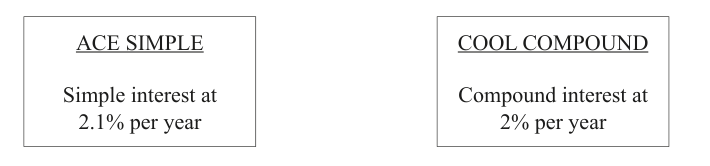
Pietro invests $3500 in the Ace Simple account for 4 years.
Eliana invests $3500 in the Cool Compound account for 4 years.
At the end of the 4 years, who has more money in their account and by how much?
______ by $ ______
Approach
Calculate the total amount in Pietro's account using the simple interest formula, calculate the total amount in Eliana's account using the compound interest formula, compare the two amounts, and find the difference.
Working
Pietro (Simple Interest at per year for years):
Eliana (Compound Interest at per year for years):
Comparison:
Comparing the totals:
Pietro has more money in his account.
Difference:
Rounding to decimal places gives (or using rounded intermediate values).
Answer
Pietro by 5.49
Walkthrough
- Calculate Pietro's total (Simple Interest):
- Principal , Rate , Time years.
- Simple interest earned:
- Total amount in Pietro's account:
- Calculate Eliana's total (Compound Interest):
- Principal , Rate , Time years.
- Total amount using the compound interest formula :
- Determine who has more and find the difference:
- Pietro has $3794 and Eliana has $3788.51.
- Pietro has more money.
- Difference in amounts:
Key Takeaways
- Simple interest is calculated on the original principal every year: . The total is .
- Compound interest adds the interest to the principal at each compounding period: , which directly gives the total amount.
Common Mistakes
- Adding the principal again to the compound interest formula result (i.e. computing ).
- Using simple interest for both accounts or compound interest for both accounts.
- Premature rounding during compound interest calculation which might lead to inaccurate final differences.
Things to Be Careful About
- Ensure you state both parts of the required answer: the person's name (Pietro) and the numerical difference ($5.48 or $5.49).
The rest of this paper
11 more questions- Q2Statistics5M
- Q3Algebra and Graphs8M
- Q4Statistics · Probability7M
- Q5Number7M
- Q6Coordinate Geometry · Algebra and Graphs10M
- Q7Mensuration · Trigonometry · Algebra and Graphs13M
- Q8Algebra and Graphs8M
- Q9Mensuration · Trigonometry · Geometry7M
- Q10Geometry · Trigonometry · Mensuration9M
- Q11Probability · Algebra and Graphs9M
- Q12Transformations and Vectors · Algebra and Graphs · Number9M