Mathematics (Syllabus D) 4024/21 — May/June 2018
Cambridge O-Level · Calculator · worked solutions for every part, with the mark scheme
Topics Number · Algebra and Graphs · Geometry · Mensuration · Trigonometry · Probability · +3 more
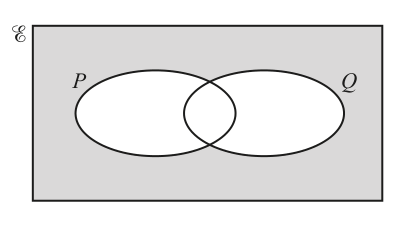
Use set notation to describe the shaded region in the Venn diagram.
______
Approach
Identify the unshaded and shaded areas. The two circles together represent the union . The shaded region consists of all elements outside both circles, which is the complement of their union.
Working
The set containing all elements in either or or both is .
The region shaded is everything outside , which is represented as:
Alternatively, by De Morgan's laws, this is the region outside and simultaneously outside :
Answer
(P ∪ Q)'
Walkthrough
- Look at the two circles labelled and . The combined area inside either circle represents the union of the two sets, written as .
- The shaded region covers the area of the universal set that lies completely outside both circles.
- The complement of a set refers to all elements not in that set, indicated with an apostrophe/prime symbol ().
- Therefore, everything outside is written as . Equivalently, it can be written as the intersection of elements not in and not in , which is .
Key Takeaways
- denotes the union ("or").
- denotes the intersection ("and").
- denotes the complement ("not").
- The region outside the union of two sets is .
Common Mistakes
- Confusing union with intersection , e.g. incorrectly writing , which would represent everything outside just the overlap.
- Forgetting parentheses when taking the complement of a union: writing means "elements in or outside ", not "outside both and ".
Things to Be Careful About
- Either or is acceptable, but ensure brackets and prime symbols are placed accurately.
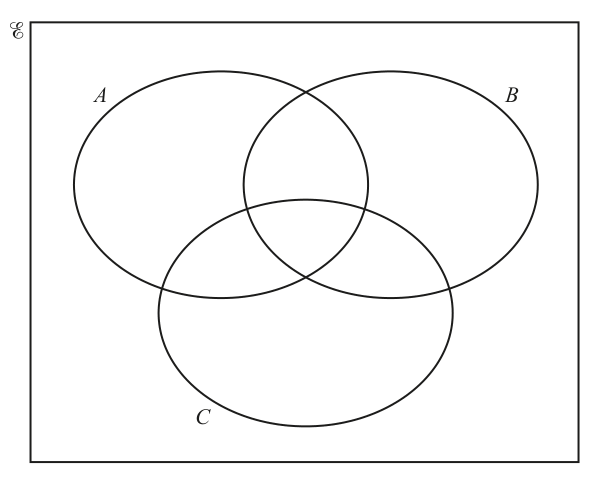
Show this information on the Venn diagram below.
Approach
First, list the elements belonging to the universal set and each of the sets , , and . Then determine the exact region in the Venn diagram for every integer from to .
Working
Given:
List the elements of each set:
- Factors of within :
- Multiples of within :
- Square numbers within :
Now place each number into its unique region:
- In all three sets ():
- In and only ():
- In and only ():
- In and only (): none
- In only ():
- In only ():
- In only ():
- Outside all three sets ():
Answer
Venn diagram completed with elements: A only: {3}; B only: {8, 10}; C only: {9}; A and B only: {2, 6, 12}; A and C only: {1}; B and C only: empty; A, B and C: {4}; Outside: {5, 7, 11}
Walkthrough
- Define the sets explicitly from the universal set :
- Set (factors of ):
- Set (multiples of / even numbers):
- Set (square numbers):
- Identify intersections starting from the central triple intersection:
- Numbers appearing in , , and : is a factor of , a multiple of , and a square number. Place in the centre region ().
- Numbers in and but not : . Place these in the region common to and only.
- Numbers in and but not : . Place in the region common to and only.
- Numbers in and but not : none.
- Identify elements unique to each set:
- Set only:
- Set only:
- Set only:
- Identify elements in neither , , nor :
- Check remaining numbers: are not in any of the three sets. Place them in the region outside the three circles, inside the rectangle.
Key Takeaways
- Always start filling a 3-set Venn diagram from the innermost intersection () and work outwards.
- Verify that every element of the universal set appears exactly once in the diagram.
Common Mistakes
- Repeating elements across multiple sections rather than placing them exclusively in intersection regions.
- Forgetting elements that do not belong to any subset (e.g. ) and omitting them from the rectangle.
- Missing factors of 12 (often missing or ).
Things to Be Careful About
- Ensure all 12 elements are accounted for with no duplicates.
Find .
______
Approach
Find the set of elements that belong to both and , which corresponds to the entire overlap of circles and , and count how many elements it contains.
Working
The elements in are the elements present in both and :
Counting the number of elements:
Answer
4
Walkthrough
- The notation means "the number of elements in the intersection of set and set ".
- The intersection includes all elements that lie inside circle and inside circle simultaneously (this includes both the region for and only, and the central region for , , and ).
- The elements in this intersection are and .
- There are elements in total, so .
Key Takeaways
- asks for the count (cardinality) of set , not the list of elements.
- comprises all elements in the overlap between circle and circle , regardless of whether they also belong to .
Common Mistakes
- Listing the elements instead of giving the count .
- Excluding the central element (confusing with ).
Things to Be Careful About
- Give a single integer as the answer representing the count.
Find .
______
Approach
Identify the region described by . This means elements that are inside set and NOT inside set or set (i.e. elements in only).
Working
First, identify :
Its complement contains all elements outside and :
Intersecting with :
Counting the elements:
Answer
1
Walkthrough
- The expression represents everything that is outside both circle and circle .
- Intersecting this with , written as , isolates the part of circle that does not touch or . This is the " only" region.
- Looking at the Venn diagram, the only element in the " only" region is .
- The notation asks for the number of elements in this set, which is .
Key Takeaways
- is the formal set notation for the elements that belong exclusively to set .
Common Mistakes
- Writing the element itself () rather than the number of elements ().
- Misinterpreting the complement bracket and including elements outside the entire diagram.
Things to Be Careful About
- Ensure the final answer is the integer count of elements.
One subset in the Venn diagram in part (b)(i) has no elements.
Use set notation to describe this subset.
______
Approach
Inspect the Venn diagram from part (b)(i) to locate the region that contains no elements, then write the standard set notation for that specific region.
Working
Looking at the 8 distinct regions in the Venn diagram:
- has
- has
- has
- has
- has
- has
- has
- (the region representing elements in and but not ) contains no elements.
In set notation, this subset is:
Answer
A' ∩ B ∩ C
Walkthrough
- From the completed Venn diagram in part (b)(i), check each of the 8 disjoint regions.
- The region corresponding to elements in and but not (the overlap between circles and excluding circle ) has no numbers written in it.
- To describe this region in set notation:
- It is inside , so we include .
- It is inside , so we include .
- It is outside , so we include .
- Combining these with the intersection symbol gives (or ).
Key Takeaways
- A specific single region in a 3-set Venn diagram is described as the intersection of three sets, where sets containing the region are unprimed and sets not containing the region are primed ().
Common Mistakes
- Writing , which represents the entire overlap of and (including , which is in ). The subset with no elements is specifically the part outside , so must be included.
- Writing or the empty set symbol: the question asks to describe the subset using set notation involving and , not just state that it is empty.
Things to Be Careful About
- Ensure is explicitly included to exclude the central region where is located.
Write 540 as the product of its prime factors.
______
Approach
Use successive division by prime numbers or a factor tree to break down into its prime factors, then write the result in index form.
Working
Divide successively by prime numbers:
Collect the prime factors:
Answer
2^2 × 3^3 × 5
Walkthrough
- Start dividing by the smallest prime number, :
- (no longer divisible by 2)
- Move to the next prime number, :
- (no longer divisible by 3)
- Move to the next prime number, :
- Count the number of times each prime factor appears:
- appears twice ()
- appears three times ()
- appears once ( or )
- Write the final answer as the product in index notation: .
Key Takeaways
- Prime factorisation expresses a composite number as a product of prime numbers.
- Index notation is the standard form for presenting prime factorisations.
Common Mistakes
- Leaving non-prime factors in the final product (e.g. ).
- Arithmetic errors when dividing by 3 (e.g. ).
- Forgetting to write the answer in index form.
Things to Be Careful About
- Ensure all bases are prime numbers.
is the smallest possible integer such that is a square number.
Find , giving your answer as the product of its prime factors.
______
Approach
For to be a square number, all powers of its prime factors must be even integers. Find the minimal value of , determine the prime factorisation of , and take its square root by halving each index.
Working
From part (c)(i):
To make all powers even, the power of needs one more factor of (to become ), and the power of needs one more factor of (to become ).
Thus, the smallest integer is:
Then the square number is:
Now find the square root by halving all powers:
Answer
2 × 3^2 × 5
Walkthrough
- A number is a perfect square if and only if all the exponents in its prime factorisation are even.
- The prime factorisation of is .
- The power of is (already even).
- The power of is (odd), so we need one more to make it .
- The power of is (odd), so we need one more to make it .
- Therefore, the smallest integer multiplier is .
- The product is .
- To find , divide each exponent by :
- The question specifies giving the answer as the product of its prime factors, so the result is (which evaluates to ).
Key Takeaways
- To make a number a square number, multiply by the missing prime factors needed to make every exponent even.
- Taking the square root of a prime-factorised number corresponds to halving every exponent.
Common Mistakes
- Evaluating the numerical answer as and forgetting to leave it as a product of prime factors as demanded by the question.
- Finding (which is ) instead of finding .
- Giving instead of taking its square root.
Things to Be Careful About
- Check the question demand: "giving your answer as the product of its prime factors". Do not write just .
The rest of this paper
10 more questions- Q2Number6M
- Q3Algebra and Graphs11M
- Q4Probability8M
- Q5Algebra and Graphs · Geometry10M
- Q6Geometry · Number11M
- Q7Mensuration · Algebra and Graphs · Number11M
- Q8[Legacy] Matrices · Transformations and Vectors7M
- Q9Mensuration · Trigonometry9M
- Q10Number · Geometry · Trigonometry · Mensuration8M
- Q11Algebra and Graphs · Coordinate Geometry9M