Mathematics (Syllabus D) 4024/22 — May/June 2015
Cambridge O-Level · Calculator · worked solutions for every part, with the mark scheme
Topics Algebra and Graphs · Number · Mensuration · Geometry · Trigonometry · Statistics · +3 more
Section A [52 marks]
Answer all questions in this section.
Simplify.
______
Approach
Find a common denominator for the two fractions, which is . Expand the numerators by multiplying each by the necessary factor, then combine and simplify.
Working
Multiply the first fraction by and the second by :
Expand the numerators:
Collect like terms in the numerator:
Answer
(17x + 13) / 6
Walkthrough
To add two algebraic fractions, we first need a common denominator. The denominators are and , so the least common denominator is . We multiply the numerator and denominator of the first fraction by and the second by to achieve this common denominator. This gives us . Next, we expand the brackets in the numerators: , , , and . Combining these over the single denominator gives . Finally, we collect the terms () and the constant terms () to get the simplified result .
Key Takeaways
When adding algebraic fractions, always find the lowest common denominator first. Be careful with the signs when expanding the numerators, especially when multiplying by negative constants.
Common Mistakes
- Forgetting to multiply the entire numerator by the scaling factor (e.g., writing instead of ).
- Sign errors when combining the constants (e.g., , not ).
- Not simplifying the final fraction if possible (here it is already in simplest form).
Things to Be Careful About
The mark scheme specifies "cao" (correct answer only), meaning no method marks are awarded if the final answer is wrong. Ensure all expansion steps are shown clearly to avoid arithmetic mistakes. The answer must be presented as a single fraction , not as separate terms like .
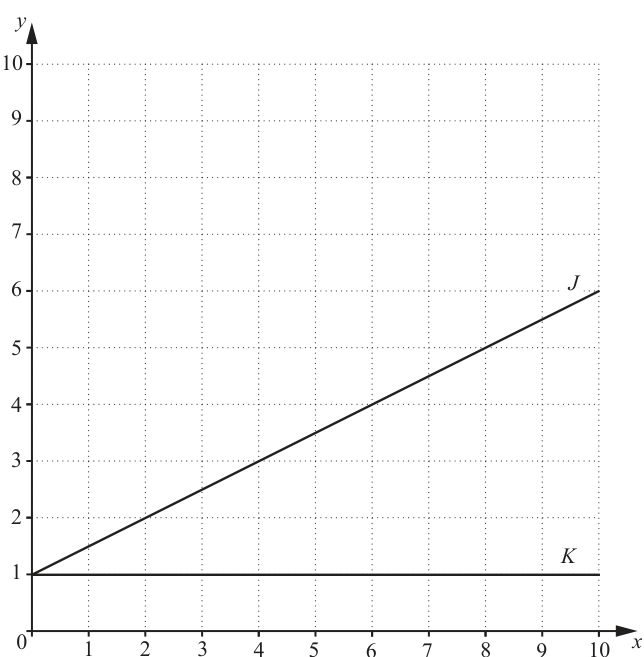
Find the gradient of line .
______
Approach
Identify two points on line from the graph and use the gradient formula .
Working
From the graph, line passes through and .
Answer
1/2
Walkthrough
The gradient (or slope) of a straight line is the change in divided by the change in between any two points on the line. From Fig. 1, we can clearly read that line passes through the -intercept and the point . Using the formula , we calculate .
Key Takeaways
The gradient formula is fundamental for finding the slope of a line from a graph. Always pick points where the line crosses grid intersections to ensure accuracy.
Common Mistakes
- Reading the coordinates incorrectly (e.g., swapping and values).
- Calculating instead of .
- Not simplifying the fraction to its lowest terms.
Things to Be Careful About
Ensure you are reading the coordinates from the correct axes. The mark scheme accepts or . Both are correct, but fractions are generally preferred in exact form.
Write down the equation of line .
______
Approach
Line is a horizontal line. The equation of any horizontal line is , where is the -intercept.
Working
From the graph, line crosses the -axis at and is parallel to the -axis.
Answer
y = 1
Walkthrough
Line is drawn horizontally across the graph, passing through for all values of . The equation of a horizontal line is always , where is the constant -value. Since the line crosses the -axis at , the equation is simply .
Key Takeaways
Horizontal lines have a gradient of and their equation is . Vertical lines have an undefined gradient and their equation is .
Common Mistakes
- Writing the equation as (confusing horizontal and vertical lines).
- Adding unnecessary terms like when is the expected simplified form.
Things to Be Careful About
The mark scheme specifies "final answer" only, meaning no working is required. Simply write .
Draw a line, , through such that the area enclosed between , and is .
Approach
The region enclosed by lines , , and forms a triangle. Line is and line is , which intersect at . Line passes through on line . Calculate the required height of the triangle to achieve an area of , then find the corresponding point on line to draw line .
Working
The base of the triangle lies along line from to , so the base length is .
Area of triangle =
The height is the vertical distance from line () to the third vertex on line . Thus, the -coordinate of the third vertex is .
Substitute into the equation of line ():
The third vertex is . Draw line from to .
Answer
Line drawn from to .
Line from (6, 1) to (4, 3)
Walkthrough
First, identify the vertices of the triangle. Lines and intersect at . Line must pass through , which lies on line . This means two vertices of the triangle are and , giving a horizontal base of length along line . The area of the triangle is given as . Using the formula , we have , which gives . The height is the perpendicular distance from the base (line , ) to the third vertex, which must lie on line . Therefore, the -coordinate of the third vertex is . To find the -coordinate, substitute into the equation of line . From part (i), the gradient is and the -intercept is , so the equation is . Solving gives . The third vertex is . Draw a straight line from to .
Key Takeaways
When a problem involves finding a line to enclose a specific area, identify the fixed vertices first, use the area formula to find missing dimensions, and then use the equations of the given lines to locate the exact coordinates.
Common Mistakes
- Assuming the triangle is right-angled and misidentifying the base and height.
- Calculating the height incorrectly (e.g., using instead of ).
- Forgetting that the third vertex must lie on line , not just anywhere at .
Things to Be Careful About
The mark scheme awards 1 mark for the correct line from to . Ensure the line is drawn accurately on the grid. The area must be exactly , which corresponds to a height of units on this grid.
Find the equation of line .
______
Approach
Use the two points on line , and , to calculate its gradient, then use the point-slope form to find the equation.
Working
Points on : and .
Using point and in :
Answer
y = -x + 7
Walkthrough
Line passes through and . First, calculate the gradient . Next, use the point-slope formula with the point and . This gives , which simplifies to , and finally .
Key Takeaways
To find the equation of a line when two points are known, calculate the gradient first, then use one of the points to find the -intercept or use the point-slope form directly.
Common Mistakes
- Sign errors when calculating the gradient (e.g., instead of ).
- Algebra errors when expanding and rearranging the equation (e.g., instead of ).
- Not writing the equation in the form .
Things to Be Careful About
The mark scheme awards B1 for any equation with gradient and/or intercept . Ensure the final answer is clearly stated as . Working must be shown (www) to earn the method marks.
The line is perpendicular to line at .
Find the coordinates of the point where line crosses the -axis.
______
Approach
Line is perpendicular to line . The gradient of is , so the gradient of is the negative reciprocal, . Use the point and to find the equation of , then find where it crosses the -axis (set ).
Working
Gradient of : .
Gradient of (perpendicular to ): .
Line passes through with :
To find the -intercept, set :
The line crosses the -axis at .
Answer
(0, 6)
Walkthrough
First, recall that the product of the gradients of two perpendicular lines is . Since the gradient of line is , the gradient of line is . Line passes through , so use the point-slope form with and . This gives , which simplifies to . The -intercept occurs where , so . The coordinates of the point where line crosses the -axis are .
Key Takeaways
Perpendicular lines have gradients that are negative reciprocals of each other (). To find where a line crosses the -axis, set in the equation and solve for .
Common Mistakes
- Forgetting the negative sign when finding the perpendicular gradient (e.g., using instead of ).
- Algebra errors when expanding (e.g., instead of ).
- Reading the -intercept from the graph incorrectly instead of calculating it.
Things to Be Careful About
The mark scheme awards B1 for a line from with -intercept between and (supported by an incorrect equation), or for the correct unsimplified equation . The final answer must be the coordinates . Ensure working is shown to earn the method marks.
The rest of this paper
10 more questions- Q2Algebra and Graphs · Number8M
- Q3Statistics7M
- Q4Geometry · Mensuration · Algebra and Graphs9M
- Q5Trigonometry11M
- Q6Number8M
- Q7Algebra and Graphs12M
- Q8Geometry · Trigonometry12M
- Q9Algebra and Graphs · Trigonometry · Mensuration12M
- Q10Transformations and Vectors · Geometry · Mensuration12M
- Q11Probability · Statistics · Number12M