Mathematics (Syllabus D) 4024/11 — May/June 2013
Cambridge O-Level · Non-calculator · worked solutions for every part, with the mark scheme
Topics Number · Mensuration · Geometry · Algebra and Graphs · Trigonometry · Statistics · +3 more
In this shape all the lengths are in centimetres.
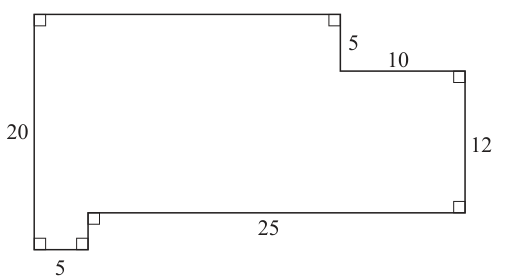
Work out
the perimeter,
______
Approach
To find the perimeter, determine the missing side lengths using the horizontal and vertical dimensions of the rectilinear shape, then sum all boundary edges.
Working
First, find the total horizontal width:
The missing top-left horizontal edge is:
Next, find the vertical step height near the bottom left:
Now, sum all the boundary side lengths:
Answer
100
Walkthrough
- A rectilinear shape has all right angles, which means its boundary consists entirely of horizontal and vertical segments.
- The total horizontal distance along the bottom is given by . The top edges must also add up to . Since the lower-step top edge is , the upper-step top edge is .
- The total vertical height on the left is . Moving right, the top drops down by , leaving a height of above the main horizontal base. Since the rightmost vertical edge is , the vertical step up at the bottom left must be .
- Summing all the horizontal segments () and all the vertical segments () gives a total perimeter of .
Key Takeaways
- For any rectilinear shape, opposite parallel components must sum to the same total span.
- The perimeter is the total distance around the outside edge of the shape.
Common Mistakes
- Forgetting the inner step edges ( and ) when summing the perimeter.
- Treating the shape as a simple rectangle of without accounting for the inward steps.
Things to Be Careful About
- Ensure every side is accounted for by tracing around the perimeter systematically in one direction.
the area.
______
Approach
Split the compound shape into three vertical rectangles, calculate the area of each, and add them together.
Working
Divide the shape into three vertical sections from left to right:
-
Left rectangle:
-
Middle rectangle:
-
Right rectangle:
Sum the three areas:
Answer
475
Walkthrough
- To find the total area of a compound shape made of perpendicular sides, split it into simpler rectangular sections.
- Splitting vertically:
- The leftmost vertical strip has width and height , giving an area of .
- The middle section has a width of and a height from the base line of , giving an area of .
- The rightmost section has width and height , giving an area of .
- Alternatively, subtract missing corner cutouts from a bounding rectangle:
- Both methods yield .
Key Takeaways
- Compound areas can be found either by splitting into smaller rectangles or by subtracting missing regions from an enclosing rectangle.
- The subtraction method is often faster and less prone to arithmetic mistakes.
Common Mistakes
- Using incorrect dimensions for the sub-rectangles (e.g., using the full width of instead of subtracting the overlap).
- Confusing perimeter and area calculations.
Things to Be Careful About
- Ensure no overlapping regions are counted twice when adding separate rectangles.
The rest of this paper
24 more questions- Q2Number2M
- Q3Mensuration2M
- Q4Number2M
- Q5Geometry · Trigonometry2M
- Q6Number2M
- Q7Mensuration · Number2M
- Q8Trigonometry2M
- Q9Number3M
- Q10Algebra and Graphs3M
- Q11Geometry3M
- Q12Number3M
- Q13Algebra and Graphs · Mensuration3M
- Q14Geometry3M
- Q15Geometry3M
- Q16Geometry3M
- Q17Number3M
- Q18Statistics4M
- Q19Mensuration · Number4M
- Q20Number4M
- Q21Algebra and Graphs4M
- Q22Transformations and Vectors4M
- Q23Coordinate Geometry · Algebra and Graphs5M
- Q24[Legacy] Matrices · Number6M
- Q25Algebra and Graphs6M