Mathematics (Syllabus D) 4024/11 — May/June 2012
Cambridge O-Level · Non-calculator · worked solutions for every part, with the mark scheme
Topics Number · Algebra and Graphs · Geometry · Probability · Mensuration · Coordinate Geometry · +1 more
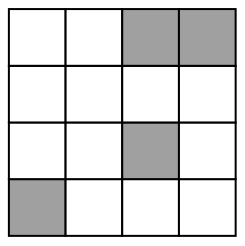
On the diagram below, shade two more squares to make a pattern that has rotational symmetry of order 2.
Approach
Rotational symmetry of order 2 means the pattern looks identical after a 180° rotation about the center of the grid. For a 4×4 grid, the center is the intersection of the middle grid lines. A square in row , column (counting from 1 at the top-left) maps to row , column . We find the images of the four already-shaded squares and shade the ones that are not yet shaded.
Working
The four already-shaded squares are at coordinates (row, column):
- (1, 3) and (1, 4) in the top row
- (3, 3) in the third row
- (4, 1) in the bottom-left corner
Applying the 180° rotation rule :
- (1, 3) maps to (4, 2)
- (1, 4) maps to (4, 1) — already shaded
- (3, 3) maps to (2, 2)
- (4, 1) maps to (1, 4) — already shaded
The two squares that must be shaded to complete the pattern are (2, 2) and (4, 2). These are the squares in row 2 column 2 and row 4 column 2.
Answer
Shade the squares at row 2 column 2 and row 4 column 2.
Shade row 2 column 2 and row 4 column 2
Walkthrough
Rotational symmetry of order 2 means the shape looks exactly the same after being rotated by 180° around its center. For a 4×4 grid, the center of rotation is the exact middle point where the grid lines cross. To find where each shaded square must have a partner, we rotate each one 180° around this center. A square in the top row (row 1) must have a partner in the bottom row (row 4), and a square in column 3 must have a partner in column 2. Specifically, a square at maps to . The existing shaded squares at (1, 4) and (4, 1) are already partners of each other, as are the squares on the diagonal at (3, 3) which maps to itself. The remaining shaded square at (1, 3) needs a partner at (4, 2), and the square at (3, 3) needs a partner at (2, 2). Shading these two missing squares completes the 180° rotational symmetry.
Key Takeaways
- Rotational symmetry of order 2 is equivalent to 180° rotational symmetry.
- On an even-by-even grid, the center of rotation is the intersection of the central grid lines.
- Every shaded square must have a corresponding shaded square at its rotated position, unless it lies on the center point itself.
Common Mistakes
- Rotating about a corner or edge instead of the center of the grid.
- Forgetting that a square on the axis of rotation (here, the center point) maps to itself and does not require a new partner.
- Shading squares that do not correspond to the exact 180° rotation of the existing pattern.
Things to Be Careful About
- The question asks for rotational symmetry of order 2, which is strictly 180° rotation, not 90° (order 4) or reflection.
- Ensure exactly two squares are shaded; shading more or fewer will not achieve the required symmetry.
- The answer is a diagram, so precision in identifying the correct grid cells is essential.
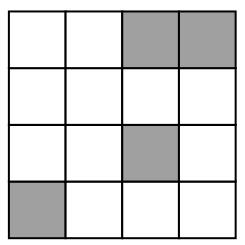
On the diagram below, shade two more squares to make a pattern that has only one line of symmetry.
Approach
We need to add exactly two shaded squares so that the final pattern has exactly one line of symmetry. We test the four possible lines of symmetry for a 4×4 grid: the vertical midline, the horizontal midline, the main diagonal, and the anti-diagonal. For each, we find the reflected images of the four already-shaded squares and count how many new squares must be shaded.
Working
The four already-shaded squares are at (row, column): (1, 3), (1, 4), (3, 3), (4, 1).
Test 1: Vertical midline (between columns 2 and 3)
Reflection maps .
Images: (1, 2), (1, 1), (3, 2), (4, 4). Four new squares needed. Rejected.
Test 2: Horizontal midline (between rows 2 and 3)
Reflection maps .
Images: (4, 3), (4, 4), (2, 3), (1, 1). Four new squares needed. Rejected.
Test 3: Main diagonal (top-left to bottom-right, )
Reflection maps .
Images: (3, 1), (4, 1) [already shaded], (3, 3) [on diagonal], (1, 4) [already shaded].
Only one new square needed: (3, 1). We have two squares to shade, so we could add a second square on the diagonal, e.g., (2, 2). However, this risks creating additional symmetry or is less straightforward.
Test 4: Anti-diagonal (top-right to bottom-left, )
Reflection maps .
- (1, 3) maps to (2, 4)
- (1, 4) maps to (1, 4) — on the line of symmetry
- (3, 3) maps to (2, 2)
- (4, 1) maps to (4, 1) — on the line of symmetry
Exactly two new squares are needed: (2, 4) and (2, 2). Shading these completes the anti-diagonal symmetry. Checking the other lines: the pattern is not symmetric about the vertical, horizontal, or main diagonal. Thus, this pattern has exactly one line of symmetry.
Answer
Shade the squares at row 2 column 2 and row 2 column 4.
Shade row 2 column 2 and row 2 column 4
Walkthrough
To have exactly one line of symmetry, we must find a line such that reflecting the existing shaded squares across it requires exactly two new shaded squares, and the resulting pattern does not accidentally gain a second line of symmetry. Testing the vertical and horizontal midlines requires four new squares each, so they are eliminated. Testing the main diagonal requires only one new square, leaving us with an extra square to place, which complicates ensuring only one line of symmetry. Testing the anti-diagonal (from top-right to bottom-left) is perfect: the squares at (1, 4) and (4, 1) lie on this line and reflect to themselves. The square at (3, 3) reflects to (2, 2), and the square at (1, 3) reflects to (2, 4). These are exactly two unshaded squares. Shading (2, 2) and (2, 4) completes the anti-diagonal symmetry. A quick check confirms no vertical, horizontal, or main diagonal symmetry is created, so the pattern has exactly one line of symmetry.
Key Takeaways
- When asked for exactly one line of symmetry, test all candidate lines and count how many new shaded squares each requires.
- Squares that lie on the line of symmetry reflect to themselves and do not require new partners.
- Always verify that the completed pattern does not accidentally gain a second line of symmetry.
Common Mistakes
- Choosing a line of symmetry that requires more or fewer than two new shaded squares.
- Failing to check that the final pattern does not have additional lines of symmetry (e.g., creating a pattern with both vertical and horizontal symmetry by mistake).
- Confusing the main diagonal with the anti-diagonal when mapping reflections.
Things to Be Careful About
- The question specifies "only one line of symmetry", so the final pattern must not be symmetric about any other axis.
- The answer is a diagram; ensure the two shaded squares are placed precisely to achieve the intended single line of symmetry.
The rest of this paper
24 more questions- Q2Number2M
- Q3Number2M
- Q4Algebra and Graphs2M
- Q5Number2M
- Q6Number2M
- Q7Number2M
- Q8Geometry2M
- Q9Number2M
- Q10Algebra and Graphs3M
- Q11Number3M
- Q12Number3M
- Q13Number3M
- Q14Probability3M
- Q15Number3M
- Q16Number3M
- Q17Number · Mensuration3M
- Q18Algebra and Graphs4M
- Q19Algebra and Graphs4M
- Q20Coordinate Geometry4M
- Q21Statistics4M
- Q22Algebra and Graphs · Number5M
- Q23Algebra and Graphs5M
- Q24Geometry6M
- Q25Algebra and Graphs6M