Mathematics (Syllabus D) 4024/21 — October/November 2011
Cambridge O-Level · Calculator · worked solutions for every part, with the mark scheme
Topics Algebra and Graphs · Geometry · Mensuration · Trigonometry · Probability · Number · +4 more
is a triangle in which , and .
is the point on such that .
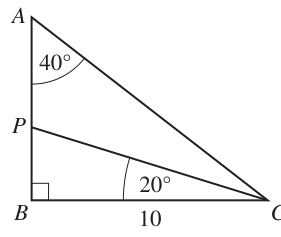
Calculate
,
______
Approach
In right-angled triangle , the right angle is at , the angle at is , and the adjacent side . Use the tangent ratio to find the opposite side .
Working
Answer
3.64
Walkthrough
We are given right-angled triangle with the right angle at . The angle and the adjacent side . We need to find the opposite side . The tangent ratio relates the opposite and adjacent sides of a right-angled triangle: . Substituting the known values gives , so . Evaluating this on a calculator gives approximately , which rounds to to 3 significant figures.
Key Takeaways
The tangent ratio is used when you know one acute angle and the adjacent side, and need to find the opposite side in a right-angled triangle.
Common Mistakes
- Using the wrong trigonometric ratio (e.g., sine or cosine instead of tangent).
- Forgetting to round to the required accuracy (3 significant figures is standard unless stated otherwise).
- Using degrees instead of radian mode on the calculator.
Things to Be Careful About
Ensure your calculator is in degree mode. The mark scheme accepts as the method mark, so showing the substituted expression before the final value is important. Answers should be given to at least 3 significant figures.
,
______
Approach
In right-angled triangle , the right angle is at , the angle at is , and the opposite side . Use the tangent ratio to find the total length , then subtract to find .
Working
Answer
8.28
Walkthrough
First, consider the larger right-angled triangle . The angle , the opposite side , and we need the adjacent side . Using the tangent ratio: , which gives . This is equivalent to (since ). Calculating this gives . Since lies on , we have . Substituting the values: , which rounds to .
Key Takeaways
When a point lies on a side of a triangle, you can find the segment lengths by calculating the total side length using trigonometry and then subtracting the known portion.
Common Mistakes
- Using instead of (mixing up opposite and adjacent).
- Carrying forward an unrounded value from part (a) incorrectly, or using a rounded value that introduces error.
- Forgetting that and instead trying to find directly from triangle without enough information.
Things to Be Careful About
Show the substituted expression or to earn the method mark. Use unrounded values from previous parts in intermediate calculations to avoid rounding errors. Round the final answer to 3 significant figures.
the perimeter of triangle .
______
Approach
In right-angled triangle , use the cosine ratio to find the hypotenuse , then add , , and to find the perimeter of triangle .
Working
Answer
24.3
Walkthrough
The perimeter of triangle is the sum of its three sides: . We already know and . We need to find , the hypotenuse of right-angled triangle . Using the cosine ratio: , so . Adding the three sides: , which rounds to .
Key Takeaways
The perimeter of a triangle is the sum of its three side lengths. When one side is unknown, use the appropriate trigonometric ratio (sine, cosine, or tangent) to find it before summing.
Common Mistakes
- Using sine instead of cosine to find (e.g., is incorrect because is adjacent to , not opposite).
- Adding instead of when calculating the perimeter of triangle .
- Rounding intermediate values too early, which can lead to answers like instead of .
Things to Be Careful About
The mark scheme awards method marks for finding and for summing their answer to part (a) plus plus their . Use unrounded values for and in the final addition to ensure accuracy. Round the final perimeter to 3 significant figures.
The rest of this paper
10 more questions- Q2Algebra and Graphs11M
- Q3Geometry8M
- Q4Probability8M
- Q5Geometry · Mensuration9M
- Q6Number · Algebra and Graphs9M
- Q7Geometry · Mensuration12M
- Q8Algebra and Graphs12M
- Q9Trigonometry · Algebra and Graphs · Mensuration12M
- Q10Statistics12M
- Q11Transformations and Vectors · [Legacy] Matrices · Coordinate Geometry · Geometry12M