The language, used precisely
“
understand the terms function, domain, range, one-one function, inverse function and composition of functions.
A function has three parts, and a question can ask about any of them.
- The rule — what happens to the input, e.g. .
- The domain — the set of inputs you are allowed to use, e.g. . It is given to you; it is not something you work out.
- The range — the set of outputs the rule actually produces from that domain. This one you do work out.
Domain lives on the -axis, range lives on the -axis. Almost every notation error in this topic comes from mixing those up.
The domain x ⩾ 1 is marked along the x-axis and the range f(x) ⩾ 2 up the y-axis. Read each off the axis it belongs to.
Reading a function definition
Every functions question opens by defining the functions, and the definition is dense. Learn to unpack it slowly, because everything later depends on it.
- is the name of the function. It is a label, like a name on a machine.
- is the output when you feed in . It is not "f times x".
- is the rule.
- is the domain — the fence.
Two notations mean exactly the same thing, and papers use both:
Read the second as " maps to ". Older papers prefer the arrow form; recent ones prefer the bracket form. Nothing about the mathematics changes.
You will also meet , which reads " is a real number" and means the domain is every number there is — no fence at all. That is a signal worth noticing: if the domain is all of and the rule is a quadratic, the function is certainly not one-one, so a later part will restrict it before asking for an inverse.
The notation that costs marks
When you state a range, name the output: write or . Writing is marked wrong, because is the input. When you state a domain, name the input: .
Mark schemes say this explicitly — one 2023 scheme reads "Do not accept " for a range, and another "Not " where was wanted.
One-one and many-one
A function is one-one if different inputs always give different outputs. If two inputs share an output it is many-one, and it has no inverse — given the output you could not say which input it came from.
A many-one function is not broken — it just cannot be reversed. Restricting the domain until only one arrow arrives at each output is what makes an inverse possible.
The horizontal line test
On a graph: if any horizontal line meets the curve more than once, the function is many-one. fails it; for passes, because you have thrown away the left half.
The quickest one-one argument: always going the same way
There is a second test, and in the exam it is usually the faster one.
A function is increasing on its domain if the graph only ever goes up as you move right, and decreasing if it only ever goes down. Either way the curve never doubles back, so a horizontal line can never catch it twice.
Increasing on its domain one-one. Decreasing on its domain one-one.
A function fails to be one-one only when it turns round — and a curve turns round at a turning point: the top or bottom of a bend, like the vertex of a parabola. That gives you a rule of thumb that decides almost every exam case in one glance:
- No turning point inside the domain one-one.
- A turning point strictly inside the domain many-one.
So for is many-one: it has a minimum at , which is inside the domain, and the curve comes down and then goes back up. But for is one-one: the turning point is now at the edge of the domain, not inside it, so the curve only ever rises.
Answering “does f⁻¹ exist? Give a reason”
This is usually a 1-mark question, and it wants one clean sentence. Any of these earns the mark:
- "Yes — is one-one."
- "Yes — is a decreasing function" (or increasing).
- "Yes — it passes the horizontal line test."
- "No — is not one-one" / "it is many-one".
What earns nothing: "yes, because you can rearrange it", or "no, because it's a quadratic". The reason must be about one-one-ness, not about the algebra.
Explaining, in words, why a function is one-one
The function is defined by for .
Sketch the graph of and explain why is a one-one function. You are not required to find the coordinates of any intersections with the axes.
Show full working
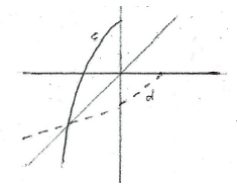
The mark scheme's sketch. The solid curve (labelled c) is the answer to this part; the dashed curve and the line y = x belong to the next part of the question.
- 1
First work out what the unrestricted curve looks like. The coefficient of is , which is negative, so the parabola opens downwards — it has a maximum, not a minimum.
Always settle the direction of opening before anything else. It decides where the turning point is relative to the domain.
- 2
Find where the turning point is. Part (a) of this question completed the square (the working is the first exercise of the next section): The bracket is zero when , so the maximum is at .
- 3
Now compare that with the domain. The domain is , and the turning point sits at , which is outside it — to the right of everything we are allowed to use.
This single comparison is the whole question. Turning point outside the domain ⇒ the curve never turns round ⇒ one-one.
- 4
So on we are only ever on the left-hand arm of the downward parabola, which is rising all the way from bottom-left up to the point .
- 5
The sketch. Draw only that rising arm: it comes up from the bottom left, stops at , and does not turn over. At , , so the curve ends at on the positive -axis. The curve therefore lives in the second and third quadrants only.
The mark scheme awards its first mark for exactly that: “graph appearing in second and third quadrants only”. Drawing the whole parabola loses it.
- 6
The explanation. Say it in terms of inputs and outputs: each -value on the curve comes from exactly one -value, or equivalently any horizontal line meets the curve at most once.
The mark scheme accepts the horizontal line test but explicitly says to ignore the vertical line test — that tests whether it is a function at all, which was never in doubt.
A curve rising from the bottom left and stopping at , drawn in the second and third quadrants only. Reason: the maximum is at , which is outside the domain , so the curve is increasing throughout and each output comes from exactly one input.
Whenever a question restricts a quadratic and then asks "explain why it is one-one", the answer is always the same shape: locate the vertex, show it is not inside the domain, conclude the curve never turns back.
" is a function, so it has an inverse"
" is one-one, so it has an inverse"
Every rule with a fence is a function. Only the one-one ones can be reversed.
Using the vertical line test to justify one-one
Using the horizontal line test
The vertical test only checks that the rule gives one output per input — i.e. that it is a function at all. One-one is about the other direction.
Writing the domain of as "" when the question already stated
The domain is whatever the question printed:
The domain is given, never deduced. Working out 'where the formula is defined' answers a question CAIE did not ask.
Your turn
Three short ones. In each case the marks are for naming the right idea in the right words, not for algebra — so write full sentences, and always say which of domain and range you are talking about.
- 14 marks
The function is defined by for .
(a) Write down the domain of .
(b) Find the range of , using correct notation.
(c) Is one-one? Give a reason.Stuck? Show hint
For (b), the rule is linear, so the outputs run in a straight line between the outputs at the two ends of the domain. Watch what the minus sign in does to the order.
Show solution
- 1
(a) The domain is read straight off the definition, with no work at all:
Written with x, because the domain is a set of inputs.
- 2
(b) Substitute the left-hand end of the domain, :
- 3
Substitute the right-hand end, :
- 4
So the two extreme outputs are and . Because the rule is linear, every value in between is also produced, and nothing outside.
A straight line has no turning points, so it sweeps steadily from one end value to the other — no output can be skipped and none can be exceeded.
- 5
Write the range in increasing order, in terms of the output:
The gradient is negative, so the larger input gave the smaller output. Writing “7 ⩽ f(x) ⩽ −11” is a real and common slip.
- 6
(c) The graph of is a straight line with gradient . A straight line has no turning point, so it is decreasing throughout its domain and can never take the same value twice.
- 7
So yes, is one-one, because it is a decreasing function.
Answer(a) (b) (c) Yes — it is a decreasing (linear) function, so no output is repeated.
- 1
- 29709/12 O/N 2022 Q9(c)1 mark
The function is defined by for .
Given that the graph of has a minimum point when , explain whether or not has an inverse.
Stuck? Show hint
You are handed the position of the turning point. The only thing left to decide is whether it lies inside the domain.
Show solution
- 1
The domain is . The minimum point is at , and , so the turning point lies inside the domain.
- 2
That means the curve falls until and then rises again. Values on the way down are repeated on the way up — for instance and , the same output from two different inputs.
Producing an actual repeated pair is not required for the mark, but it is the clearest possible evidence and takes ten seconds.
- 3
A repeated output means is many-one, so it cannot be reversed: given the output you could not say which input it came from.
AnswerNo. The minimum at lies inside the domain , so the curve turns round and is many-one, not one-one. A many-one function has no inverse.
- 1
- 39709/12 O/N 2025 Q9(b)1 mark
The function is defined by for .
(In part (a) of this question you showed, by differentiating, that is a decreasing function.)
State whether exists. Give a reason for your answer.
Stuck? Show hint
Do not try to analyse that formula. The one fact carried over from part (a) is all the question needs.
Show solution
- 1
From part (a), is decreasing: its graph falls all the way across the domain.
Part (a) used differentiation, which comes later in Paper 1. For this part you only need its conclusion.
- 2
A decreasing function never turns back upwards, so it can never return to an output it has already produced. Every output therefore comes from exactly one input, which is precisely what one-one means.
- 3
One-one functions can be reversed, so exists.
AnswerYes, exists, because is a decreasing function on its domain and is therefore one-one.
- 1
Functions usually comes as one long structured question near the end of the paper, in several short parts that move through range, composite, inverse and a graph. The algebra in each part is short; the marks that get lost are mostly lost on notation — the wrong letter in a range, or a missing reason.
The rest of this note
Can you do all of these?
State the range of for , using the right letter
State the range of for — and explain why it is not
Find the range of for , getting the inequality signs the right way round
State the range of for , with at one end and at the other
Explain why for has no inverse, and how to fix it
Answer "does exist? Give a reason" in one sentence that mentions one-one-ness
Form and for two given functions and see that they differ
Form , and evaluate without building the algebraic composite
Solve by both routes, and reject the root that breaks the domain
Say when a composite cannot be formed, in one sentence naming both sets
Find the range of a composite such as , and use a given range to find a constant
Recover from , and recover from
State the least for which is one-one on
Find when appears twice, e.g.
Invert a restricted quadratic and justify which square-root branch you kept
Write the domain of without doing any new algebra
Write down in terms of and , in the correct order
Sketch from a given curve, with the mirror line drawn and the asymptotes swapped
Find where meets without finding
Describe fully the sequence taking to , in order
Say which axis is reflected in, and which axis is reflected in
Apply a printed sequence of three transformations to an equation, one step at a time
Write "stretch in , then reflect in the -axis" as an equation in terms of
Describe both ways round, and write a graph change as
Follow a single point, such as a minimum, through a sequence of transformations
Invert for using