The modulus function
“
understand the meaning of |x|, sketch the graph of y = |ax + b| and use relations such as |a| = |b| ⇔ a² = b² and |x – a| < b ⇔ a – b < x < a + b when solving equations and inequalities. Graphs of y = |f(x)| and y = f(|x|) for non-linear functions f are not included.
is the size of with the sign thrown away: and . So is never negative, and two different inputs can give the same output ( and both give ) — which is precisely why modulus equations and inequalities always involve two cases.
There is a second reading of that makes this whole section easier, and it is worth adopting now:
Distance has no sign, which is exactly the property has. And the reading extends: is the distance from to . Once you see it that way, the second relation in the syllabus stops being something to memorise:
and a point within of obviously lies between and . Nothing to recall — just read it.
|x − a| is the distance from x to a, so |x − a| < b means x is within b of a: an open interval centred on a, reaching b either side.
Reading a modulus as a distance
(a) Solve . (b) Solve .
Show full working
- 1
(a) Read it as a distance: the number is within of . So it lies strictly between and :
This is the relation |X| < b ⇔ −b < X < b, with the whole bracket 2x − 5 playing the part of X.
- 2
Add to all three parts:
Whatever you do to the middle, do to both ends — the chain stays true.
- 3
Divide all three parts by :
- 4
Check an inside value, : . True. Check an outside value, : , not less than . The interval is right.
- 5
(b) "More than from " is exactly the opposite: everything outside the interval of part (a). The ends and give exactly, so they are excluded too:
A “less than” modulus gives one interval; a “greater than” modulus gives two separate pieces. Never write the second as a single chain.
(a) (b) or
With a modulus on one side and a plain positive number on the other, you never need to square or split — just read off the interval.
Sketch the line first, then fold everything below the x-axis upwards. The corner sits where the bracket is zero — for y = |ax + b| that is x = −b/a.
The graph explains the algebra. is the line with its negative half flipped upwards, so it is made of two straight pieces, joined at a corner where the bracket is zero. Those two pieces are the two cases:
- to the right of the corner the bracket is already positive, so ;
- to the left it is negative, so .
Every technique below is a way of handling those two pieces without having to draw them.
- — squaring kills both moduli at once, and squares cannot introduce a sign error.
- — a single modulus below a number gives one interval, centred on .
Which one you reach for is decided by how many moduli you can see.
Why squaring is allowed — and when it is not
Squaring is not a legal move on inequalities in general: is true, but is not. It becomes legal the moment both sides are known to be non-negative, because squaring preserves order on non-negative numbers.
That is exactly the situation when both sides carry a modulus. and cannot be negative, so
is safe in both directions — and it disposes of both moduli in one step.
Put a bare expression on one side, though, and the guarantee is gone. In the left-hand side may well be negative, and where it is, the inequality is automatically true; squaring would quietly lose that. Squaring gives , which is wrong — the true answer is .
Mark schemes do allow you to square such an equation just to find the critical values, but then you must reject any false ones (here ) and read the region from a sketch. Sketching first is cleaner. So the rule is mechanical:
What the question looks like | What to do | Why |
|---|---|---|
, or | Square both sides | Both sides are non-negative, so order survives |
, with a positive number | Two cases: and | Squaring works too, but two cases is faster |
or , with a positive number | Read it as a distance: , or or | No squaring or cases needed |
against a linear expression such as | Sketch both graphs, find where the line crosses each arm, read the region off the sketch | The line can be negative, so squaring may give the wrong region or false critical values |
with negative | No solutions — stop | is never negative |
Count the moduli, then check whether the other side is guaranteed non-negative. That one check decides the whole method.
A modulus equation, two ways
Solve .
Show full working
- 1
Route 1: square. Both sides are moduli, so both are non-negative and squaring is safe:
- 2
Expand the left-hand side:
- 3
Expand the right-hand side:
- 4
Put them back and move everything to the left:
- 5
Collect like terms: , , :
- 6
Divide by :
Dividing out a common factor first keeps the numbers small and the factorising obvious.
- 7
Factorise: so or .
- 8
Route 2: two cases. Two numbers with the same size are either equal or negatives of each other. So either
- 9
First case: subtract and add to both sides: .
- 10
Second case: expand the bracket, . Add and add to both sides: , so .
- 11
Check both answers in the original. : and . : and . Both work.
Both routes always agree. Squaring is more mechanical; two cases is quicker when the numbers are simple.
or
- 1
Two moduli? Square both sides. becomes . Both sides are non-negative, so the inequality direction survives.
This is the only case where squaring is automatically safe — that is why examiners write both sides with a modulus.
- 2
Move everything to one side and factorise. is a difference of two squares: . Or just expand into a three-term quadratic — the mark scheme accepts either.
- 3
Find the critical values. These are the where the two graphs cross.
- 4
Decide which side. Test a value, or sketch. A quadratic with positive coefficient is negative between its roots and positive outside them.
Getting the critical values but stating the wrong region is the single commonest way to lose the last mark here.
- 5
Write the answer in the form the question implies. One interval, or two separate inequalities joined by "or" — never a chain that runs backwards.
Solve the inequality .
Show full working
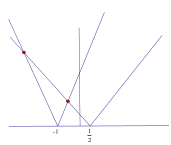
Mark-scheme figure (graphical alternative method): y = |2x − 1| and y = 3|x + 1| sketched on the same axes, corners at x = ½ and x = −1, with their two crossing points marked.
- 1
Both sides carry a modulus, so both sides are non-negative and we may square. Square the whole right-hand side, the included:
Writing 3(x + 1)² instead of 3²(x + 1)² is the classic slip — the mark scheme calls it “invisible brackets”.
- 2
Evaluate :
- 3
Expand the left-hand side:
- 4
Expand the bracket on the right:
- 5
Multiply that by :
- 6
Put the two expansions back into the inequality:
- 7
Subtract from both sides, so the term stays positive:
Moving everything to the side with the bigger x² keeps the quadratic U-shaped, which makes the region easy to read.
- 8
Find the critical values: solve . Look for two numbers with product and sum : they are and . Split the middle term:
- 9
Factorise in pairs:
- 10
Set each factor to zero: gives ; gives .
- 11
Decide the region. is a U-shaped parabola crossing the axis at and , so it is positive outside those roots. We need it positive:
- 12
Test one value from each region in the original inequality. (outside): and ; is true, so it belongs. (between): and ; is false, so it does not.
A test value in each region confirms the side you chose — it takes seconds and guards the final mark.
or
The mark scheme is unusually explicit: “Do not condone ⩽ for <. Allow ‘or’ but not ‘and’. −2/5 < x < −4 scores A0.” Two inequalities, strict, joined by “or”.
- 1
Sketch the V. Mark the corner (where the bracket is zero) and the -intercept.
Most recent Paper 3 modulus questions ask for this sketch as part (a) — it is worth a mark on its own.
- 2
Add the line roughly in the right place, using its gradient and intercept.
- 3
Write each arm as an ordinary line. Right arm: the bracket unchanged. Left arm: the bracket with every sign changed.
- 4
Find each crossing by setting the line equal to one arm and solving the linear equation. Keep an answer only if it lies on that arm's side of the corner.
A crossing found with the right-arm formula but lying left of the corner is not a real crossing — the right arm does not exist there.
- 5
Read the region off the sketch. Where is the V above or below the line? That gives one interval or two.
- 6
The same sketch counts roots. The solutions of are the -coordinates where the two graphs cross, so "show the equation has one root" means "show the graphs cross once" — even when the other graph is a curve such as .
When the question gives you a sketch first
(a) Sketch the graph of , where is a positive constant.
(b) Solve the inequality .
Show full working
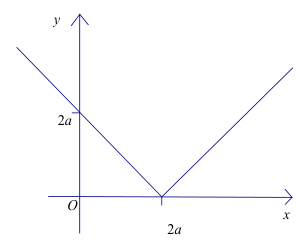
Mark-scheme figure: the expected sketch for (a).
Sketch for (b), drawn with a = 1: the line meets the V only once, on the left arm. To the left of that crossing the line is below the V, so the answer is a single interval.
- 1
(a) Find the corner. The bracket is zero when , i.e. . Since , the corner is on the positive -axis.
- 2
Find the -intercept. Put :
- 3
Draw the two arms. For the graph is (gradient ); for it is (gradient ), passing through and continuing into negative .
The mark scheme wants 2a marked on both axes, the left arm extending past the y-axis, and no numerical value given to a.
- 4
(b) Only one modulus here, and the other side is not a modulus — so squaring is not safe. Use the sketch method above: treat each arm of the V as its own line, one case at a time.
Squaring would lose every x where 2x − 3a is negative — exactly where the inequality is automatically true — and would add a false critical value, x = a.
- 5
Case , where . The inequality becomes
- 6
Subtract from both sides:
- 7
Add to both sides: But this case needs , and no number is both below and at least (because ). So this case gives nothing — reject .
- 8
Case , where . The inequality becomes
- 9
Add to both sides:
- 10
Add to both sides:
- 11
Divide by : Every such is also below (because ), so the whole of this piece is allowed.
- 12
Check against the sketch. The line meets the left arm at and lies below the V to the left of that point. Test : is true. Test : is false. So the solution is the single interval .
(a) A V-shape with vertex , meeting the -axis at (b)
A parameter a does not change the method — treat it as a positive number and carry it. The mark scheme gives nothing in (b) if a is replaced by a number, and a stray x < a from the rejected case must be clearly discarded.
The 3 multiplies the modulus, so squaring the whole right-hand side squares the 3 too: 3² = 9.
Answer written as
or
That chain describes the region between the crossings — the exact set where the inequality fails.
Squaring
Sketch the V and the line, and solve arm by arm
Squaring only preserves an inequality when both sides are known to be non-negative. A bare linear expression is not — here squaring gives a < x < 5a/3 instead of x < 5a/3.
Modulus is the most predictable skill in this topic: it is almost always Q1 or Q2, worth 3–5 marks, and an inequality far more often than an equation. Ten of the nineteen asked for a sketch first and the inequality second — that is now more common than the two-moduli squaring question. The sketch is there to stop you squaring when you should be reading crossings off a graph.
Your turn
One of each kind: two moduli you square, a line against a modulus, a parameter to carry through, a sketch-then-solve question, a modulus equation, and counting roots from a sketch.
- 19709/32 M/J 2023 Q14 marks
Solve the inequality .
Stuck? Show hint
Two moduli on either side — that is the signal to square both sides in one move.
Show solution
- 1
Two moduli, so square both sides:
The 2 sits outside a modulus that is about to be squared, so it becomes 2² = 4 — the same trap as the 3² in the worked example above.
- 2
Evaluate :
- 3
Expand the left-hand side:
- 4
Expand the bracket on the right:
- 5
Multiply that by :
- 6
Put both expansions into the inequality:
- 7
Subtract from both sides:
- 8
Find the critical values with the quadratic formula for . Name the pieces: , , .
- 9
Compute the discriminant: and .
- 10
Substitute into :
- 11
Take each sign: and .
- 12
Decide the region. is U-shaped, so it is positive outside its roots — and positive is what we need: or .
- 13
Test values. (outside): and ; is true. (between): and ; is false. The region is confirmed.
Answeror
- 1
- 29709/32 O/N 2023 Q1(b)4 marks
Solve the inequality .
Stuck? Show hint
The left-hand side carries no modulus, so squaring is not automatically safe here — decide whether it can be negative before you touch it.
Show solution
- 1
Only one modulus, and the other side is a bare expression that could be negative — squaring is not automatically safe. Split into cases on the sign of (one case for each arm of the V).
4x − 2 changes sign at x = ½, so that is where the two cases divide.
- 2
Case , where . The inequality becomes
- 3
Subtract from both sides:
- 4
Add to both sides: Every also satisfies , so this piece survives.
- 5
Case , where . The inequality becomes
- 6
Add to both sides:
- 7
Subtract from both sides:
- 8
Divide by : and , so the whole of this piece is allowed.
- 9
Combine the two surviving pieces, and test a value between them. : and ; is false, so the gap between and is correctly excluded.
The two pieces are separate intervals, so join them with “or”. The mark scheme gives A0 for “x < 1/7 and x > 3”, and for the backwards chain 1/7 > x > 3.
Answeror
- 1
- 39709/33 M/J 2022 Q14 marks
Find, in terms of , the set of values of satisfying the inequality where is a positive constant.
Stuck? Show hint
Treat exactly like a positive number throughout — it never changes which method applies, only the arithmetic.
Show solution
- 1
Two moduli, so square both sides, squaring the with its bracket:
- 2
Expand the bracket on the left:
- 3
Multiply by :
- 4
Expand the right-hand side:
- 5
Put both into the inequality:
- 6
Subtract from both sides:
- 7
Find the critical values from with the quadratic formula. Name the pieces: , , .
- 8
Discriminant: and , because .
- 9
Substitute:
- 10
Take each sign: and .
Carrying a symbolically through the quadratic formula is exactly like carrying a number — keep it as a factor. Replacing a by a number caps the question at 2 marks out of 4.
- 11
Decide the region. is U-shaped, so it is negative between its roots, and negative is what we need: Test , which lies between: and , and is true.
Answer - 1
- 49709/33 M/J 2025 Q14 marks
(a) Sketch the graph of , where is a positive constant.
(b) Hence or otherwise solve the inequality .Stuck? Show hint
Put the line y = x + 5a on your sketch. Its y-intercept 5a is above the V's intercept 2a — so where must the V be below the line?
Show solution
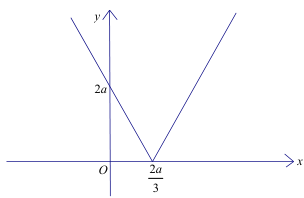
Mark-scheme figure: the expected sketch for (a).
- 1
(a) Corner: gives , so the corner is .
- 2
-intercept: put , . Draw a V through these two points, arms extending into both quadrants above the -axis.
- 3
(b) Write the two arms as lines. Right of the corner: . Left of the corner: .
- 4
Right-arm crossing: set . Subtract and add : , so . This is to the right of , so it really is on the right arm.
- 5
Left-arm crossing: set . Subtract and subtract : , so . This is to the left of , so it really is on the left arm.
- 6
Read the region. At the V is at height and the line at , so the V is below the line there — and lies between the two crossings. So the V is below the line exactly between them.
The line has gradient 1, less steep than either arm (±3), so it meets each arm once and the V climbs above it on both sides.
Answer(a) A V with corner and -intercept (b)
- 1
- 59709/31 O/N 2021 Q14 marks
Solve the equation , giving your answers correct to 3 decimal places.
Stuck? Show hint
Treat 5ˣ as a single positive quantity. The right-hand side is positive, so the modulus equation splits into two ordinary equations.
Show solution
- 1
The right-hand side is always positive, so means the inside, , equals either or :
This is the |A| = k case from the table, with k = 5ˣ — a positive quantity, even though it contains x.
- 2
First equation: expand, . Subtract and add : , so .
- 3
Second equation: expand, . Add and add : , so .
- 4
Solve by taking logarithms: , so
- 5
Solve the same way:
A negative answer is fine: 5ˣ = 4/5 is less than 1, so x must be negative.
Answeror
- 1
- 69709/32 M/J 2025 Q6(a)2 marks
By sketching a suitable pair of graphs, show that the equation has only one root in the interval .
Stuck? Show hint
Sketch both sides as separate graphs on the same axes. The roots of the equation are where the graphs cross — count the crossings between x = 0 and x = π.
Show solution
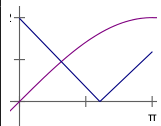
Mark-scheme figure: the expected pair of sketches for 0 < x < π.
- 1
Sketch : a V with its corner at and -intercept . At it has risen only to .
- 2
Sketch for : it starts at when and rises steadily to at .
Over this interval ½x runs from 0 to π/2, so the sine is always increasing.
- 3
Left of the corner () the V falls from to while the sine curve rises from to . One graph starts above the other and ends below it, so they cross exactly once there.
- 4
Right of the corner () the V is at most while the sine curve is at least . They cannot meet.
- 5
So the graphs cross once, and the equation has only one root in . Mark the crossing on the sketch and say so.
The mark scheme needs the intersection marked (or stated) as the root — the sketch alone is not enough for the second mark.
AnswerOne intersection of and in , so one root
- 1
Polynomial division
“
divide a polynomial, of degree not exceeding 4, by a linear or quadratic polynomial, and identify the quotient and remainder (which may be zero).
Division questions on Paper 3 are almost always phrased the same way: "Find the quotient and remainder when … is divided by …", usually for 3 marks — one for starting the division correctly, one for the quotient, one for the remainder.
The words mean exactly what they mean for numbers. gives quotient and remainder , because , and the remainder is smaller than the divisor . Polynomials work the same way, with "smaller" meaning lower degree (the degree is the highest power of ). Everything rests on this one identity:
Dividend = divisor × quotient + remainder. The remainder always has lower degree than the divisor — that is the rule that tells you when to stop dividing.
It is the same algorithm you used on numbers
Dividing by , you ask "how many s in ?", write the above, subtract , bring down the next digit, repeat. Polynomial division is that algorithm with powers of in place of place value.
The only change is what "how many times does it go in" means. You are no longer comparing sizes — you are matching leading terms (the term with the highest power of , e.g. in ). At every step:
Divide, multiply back, subtract. The subtraction always wipes out the leading term, so what is left has a lower degree each time — which is why the process must eventually stop.
- 1
Write both polynomials in descending powers, filling every gap with a zero term. becomes .
The columns are doing your bookkeeping. A missing column is how a term silently ends up in the wrong place.
- 2
Divide the leading terms. . That is the first term of the quotient.
- 3
Multiply the whole divisor by it, and write the result underneath, lined up by power.
- 4
Subtract. The leading term cancels by construction — if it does not, you have made an arithmetic slip.
Subtracting a negative is where most sign errors happen. Change every sign and add, rather than subtracting in your head.
- 5
Repeat with what is left. Stop the moment its degree drops below the divisor's.
- 6
Name both parts. The line of terms you collected on top is the quotient; the leftover is the remainder.
One full division by a linear divisor
Find the quotient and remainder when is divided by .
Show full working
- 1
No powers are missing, so the dividend is ready: .
- 2
Cycle 1 — divide. Leading term of the dividend over leading term of the divisor: . Write as the first term of the quotient.
- 3
Multiply the whole divisor by :
- 4
Subtract it from the first two terms: Bring down the next term, , to get .
2x² − (−2x²) = 4x². The x³ terms cancel, as they always must.
- 5
Cycle 2 — divide. . That is the next quotient term.
- 6
Multiply:
- 7
Subtract: Bring down to get .
−5x − (−8x) = −5x + 8x = 3x.
- 8
Cycle 3 — divide. .
- 9
Multiply:
- 10
Subtract:
- 11
has degree , lower than the divisor's degree , so stop. The quotient is what was written on top: . The remainder is .
- 12
Check with the identity: which is the dividend.
Multiplying back is the quickest way to catch a sign slip in any subtraction.
Quotient , remainder
Keep this answer in mind: the remainder was 7, and 2³ + 2(2²) − 5(2) + 1 is also 7. That is no coincidence — it is the remainder theorem, which comes next in this note.
Stop when what is left has lower degree than the divisor.
- dividing by a linear : the remainder is a number;
- dividing by a quadratic : the remainder is linear, — and it is meant to still have an in it.
Expecting a number when you divided by a quadratic is the most common error in this section.
The reason is worth a sentence: if the leftover still had degree as high as the divisor, you could divide once more. So "cannot divide any further" and "degree has dropped below the divisor's" are the same statement.
Two methods, and when each one wins
There is a second route, and Paper 3 mark schemes explicitly allow it. Instead of dividing, write down the shape of the answer and compare coefficients:
The degrees are forced: quotient degree dividend degree divisor degree, and the remainder has lower degree than the divisor (here, at most linear). Expand, match coefficients power by power, and read off the letters.
The same division, by comparing coefficients
Use the identity method to find the quotient and remainder when is divided by .
Show full working
- 1
Degree divided by degree gives a quadratic quotient, starting ; the remainder is a number . So
- 2
Expand the product:
- 3
Compare coefficients: , so .
- 4
Compare coefficients: , so .
- 5
Compare constants: , so .
The same quotient x² + 4x + 3 and remainder 7 as the long division — two routes, one answer.
Quotient , remainder
Long division | Comparing coefficients | |
|---|---|---|
Best when | The divisor is linear, or you want to see the working unfold | The divisor is quadratic, or has gaps like |
Main risk | Sign errors in the repeated subtraction | Setting up the wrong degrees at the start |
Speed | Steady — same effort every time | Fast if the divisor has missing terms, since most products are zero |
Self-check | Multiply back at the end | Substitute a value such as into both sides |
Both earn full marks. If a divisor like x² + 5 has a missing x term, comparing coefficients is usually the quicker of the two.
Write in the missing powers
Cambridge often picks dividends with gaps. Recent Paper 3 divisions included , , and — every one of them missing terms.
Before dividing, write as Column alignment does the rest of the work for you.
Find the quotient and remainder when is divided by .
Show full working
- 1
Fill the gaps: .
- 2
Divide the leading terms: . This is the first term of the quotient.
- 3
Multiply the whole divisor by it:
- 4
Subtract that from the dividend:
0x³ − (−2x³) = +2x³: subtracting a negative term is where the sign slips happen.
- 5
Divide the new leading term: , the next quotient term.
- 6
Multiply:
- 7
Subtract:
- 8
Divide again: , the last quotient term.
- 9
Multiply:
- 10
Subtract:
- 11
has degree , less than the divisor's degree , so stop. The quotient is the three terms collected on top, ; the remainder is .
Quotient , remainder
Check by multiplying back: (x² − x + 2)(2x² + 2x − 2) + (−6x + 5) should rebuild 2x⁴ + 1. Ten seconds, and it catches every sign slip.
The identity method — often faster
Find the quotient and remainder when is divided by .
Show full working
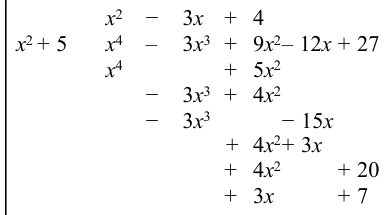
Mark-scheme figure: the same division set out as long division.
- 1
Write down the shape of the answer. Degree 4 ÷ degree 2 gives a quadratic quotient and a linear remainder:
The mark scheme explicitly allows this as an alternative to long division, and awards the same first mark for it.
- 2
Multiply out term by term. From : . From : .
- 3
Add and group by powers:
- 4
Compare coefficients: .
- 5
Compare coefficients: .
- 6
Compare coefficients: . Substitute : , so .
- 7
Compare coefficients: . Substitute : , so .
- 8
Compare constants: . Substitute : , so .
- 9
Read off: quotient , remainder . Check with : left side ; right side .
Quotient , remainder
The mark scheme notes that swapping the two labels — calling 3x + 7 the quotient — costs the final mark even though both expressions are right. Label them.
Division appears in two guises. Four times it was a short opener (Q1 or Q2). Seven times it was part (a) of a Q7–Q10 question, setting up an integral or a differential equation: 9709/33 O/N 2024 Q9 divided by and then integrated the result, and 9709/32 M/J 2025 Q10 divided by before integrating by parts. In those long questions, a wrong quotient spoils everything after it — so always multiply back to check.
Why integration questions divide first
A fraction whose top has degree at least that of its bottom cannot be integrated as it stands. Dividing turns it into quotient + remainder/divisor, and each of those pieces is a standard integral. For example, dividing by gives quotient and remainder , so and both pieces can now be integrated (see Integration). Same identity, used for a different purpose.
Your turn
The first is routine long division. The second has a quadratic divisor. The third is the one nearly everyone gets wrong first time — read the divisor carefully. The last turns the question round: the remainder is given and the dividend has unknowns.
- 19709/33 O/N 2025 Q23 marks
Find the quotient and the remainder when is divided by .
Stuck? Show hint
Write in every missing power before you divide: .
Show solution
- 1
Fill the gaps: .
- 2
Divide the leading terms: .
- 3
Multiply: .
- 4
Subtract, and bring down :
- 5
Divide: .
- 6
Multiply: .
- 7
Subtract, and bring down :
−2x² − (−3x²) = +x²: the two minus signs make a plus.
- 8
Divide: .
- 9
Multiply: .
- 10
Subtract, and bring down :
- 11
Divide: .
- 12
Multiply: .
- 13
Subtract: Degree degree , so stop. Check with the remainder theorem: .
AnswerQuotient , remainder
- 1
- 29709/33 M/J 2023 Q23 marks
Find the quotient and remainder when is divided by .
Stuck? Show hint
The divisor is quadratic, so the remainder must come out linear, not a bare number.
Show solution
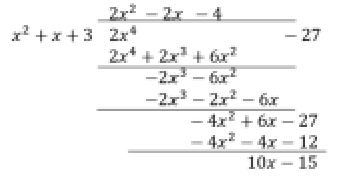
Mark-scheme figure: the long division set out in full.
- 1
Fill the gaps: .
- 2
Divide the leading terms: .
- 3
Multiply: .
- 4
Subtract:
- 5
Divide: .
- 6
Multiply: .
- 7
Subtract:
Each of the three terms flips sign as it is subtracted: −6x² + 2x² = −4x², and 0x + 6x = 6x.
- 8
Divide: .
- 9
Multiply: .
- 10
Subtract:
- 11
has degree degree , so stop. Quotient , remainder .
AnswerQuotient , remainder
- 1
- 39709/32 M/J 2025 Q10(a)2 marks
Find the quotient and remainder when is divided by .
Stuck? Show hint
The dividend and the divisor have the same degree. That does not stop you dividing — it just makes the quotient a constant.
Show solution
- 1
Both and have degree , so this is the borderline case: the quotient is a constant, not zero, and the remainder has degree below .
It is tempting to say 'the divisor is bigger, so the quotient is 0' — but bigger leading coefficient is not the same as higher degree. Compare degrees, not sizes.
- 2
Write the identity with an unknown constant quotient and remainder :
- 3
Expand the right-hand side:
- 4
Compare coefficients:
- 5
Compare constants:
- 6
Check the degree rule: the remainder has degree , less than the divisor's degree , so this is a valid place to stop. Check the identity: .
AnswerQuotient , remainder
- 1
- 49709/32 F/M 2023 Q35 marks
The polynomial , where and are constants, is denoted by . When is divided by the remainder is .
Find the values of and .
Stuck? Show hint
Use the identity method with an unknown quotient 2x² + Ax + B. The remainder is given, so write it in as 3x + 2.
Show solution
- 1
Degree divided by degree gives a quadratic quotient. Its leading term must be (because ), so write it as . The identity is
There are four unknowns, A, B, a and b. The x⁴ terms already match (2 = 2), and the other four powers give exactly four equations.
- 2
Expand the product one term of the first bracket at a time. .
- 3
.
- 4
.
- 5
Add the three lines and the remainder , grouping by powers:
- 6
Compare constants: , so .
Start with the equation that has only one unknown in it.
- 7
Compare coefficients: . Substitute : , so .
- 8
Compare coefficients: .
- 9
Compare coefficients: .
- 10
Check with . Left: . Right: . They agree.
Answer,
- 1
The factor and remainder theorems
“
use the factor theorem and the remainder theorem, e.g. to find factors and remainders, solve polynomial equations or evaluate unknown coefficients. Including factors of the form (ax + b) in which the coefficient of x is not unity, and including calculation of remainders.
These two theorems are the reason you rarely have to divide. Both fall out of the division identity in one line.
Divide a polynomial by the linear expression . The divisor has degree , so the remainder has degree — it is just a number, call it , the same number for every :
The matters: this is an identity, true for every value of , not an equation to solve. So you are free to substitute anything you like. Substitute the one value that makes the bracket vanish, :
The entire quotient — however monstrous — is multiplied by zero and disappears. What is left is the remainder theorem: the remainder on dividing by is just .
The factor theorem is the special case . " divides exactly" and "" say the same thing, so testing a factor costs one substitution instead of a whole division. And since also means is a root, factors and roots are two views of one fact.
Remainder theorem — the remainder on dividing by (x − a)
Factor theorem — the special case R = 0
For a divisor (ax + b): use the root of ax + b = 0
The (ax + b) case is the one they test
The syllabus goes out of its way to say "including factors of the form in which the coefficient of is not unity", and Paper 3 uses , and constantly.
For you substitute , not or . Set the bracket to zero and solve it — every time, even when it looks obvious.
The reason is the same one-line argument as before. Writing the substitution that kills the bracket is whatever solves — that is, . Nothing about the argument cared that the coefficient of was .
So the habit to build is: do not look for the root, solve for it. Write in the margin, get , and substitute that. It costs three seconds and removes the single most common source of lost marks in this section.
One consequence worth noticing: the values you substitute are usually fractions, so will contain and . Multiply the whole equation through by the largest denominator immediately — the mark scheme wants "a correct equation with powers evaluated", and clean integers make the simultaneous solve far safer.
If a question asks you to factorise but does not tell you a factor, search for one: try (values that divide the constant term) until . Paper 3 almost always gives you the factor, but this is how you would find it.
Both theorems on one polynomial
Let .
(a) Show that is a factor of .
(b) Hence factorise completely and solve .
(c) Find the remainder when is divided by .
(d) Solve the inequality .
Show full working
- 1
(a) Solve : the value to test is .
- 2
Substitute:
- 3
Since , the factor theorem says is a factor.
One substitution has replaced a whole long division. That is what the factor theorem is for.
- 4
(b) Find the other factor, a quadratic , by writing
The leading term 2x² is forced: x times it must give 2x³.
- 5
Compare constants: on the right the constant is . So , giving .
- 6
Compare coefficients: on the right they come from and , so , giving .
- 7
Check with the coefficient: gives . ✓ So
- 8
Factorise the quadratic: two numbers with product and sum are and :
- 9
So . Set each factor to zero: , , .
- 10
(c) Solve : the value to substitute is — not and not .
- 11
Evaluate the powers first: and .
- 12
Substitute:
- 13
Add: , and .
- 14
(d) Use the factorised form from (b): , with roots , and . These split the number line into four regions.
A product can only change sign where one of its factors is zero — so between the roots the sign stays fixed.
- 15
Find the sign far to the right. For a large , every bracket is positive, so for .
- 16
Each root comes from a factor that appears only once (none is squared), so the sign flips as you pass it. Moving left: positive for , negative for , positive for , negative for .
- 17
Check one region with a number. : . ✓
- 18
So when or .
(a) (b) ; (c) (d) or
Every factor-theorem question is a variation on these moves: substitute to test a factor, divide to find the rest, substitute the root of (ax + b) to get a remainder — and, once factorised, read off where the polynomial is positive or negative.
The cubic from the example above. With a positive x³ term it starts below the axis on the far left and ends above it on the far right, changing sign at each root — so it is negative for x < −2 and for ½ < x < 3.
For the factor , evaluating
Substitute the root of the divisor, i.e. the solution of 2x − 1 = 0.
For the factor , evaluating
x + 7 = 0 gives x = −7. The sign flips.
"" and stopping
", therefore is a factor"
In a “show that” question, say what the zero proves. Without the conclusion the argument is unfinished.
- 1
Turn each condition into an equation. "Divisible by " means . "Leaves remainder 12 on division by " means .
- 2
Evaluate the powers immediately. The mark scheme gives a mark for "a correct equation with powers evaluated" — leaving unevaluated can cost it.
Clear the fractions here too: multiplying through by 4 or 8 now prevents most of the arithmetic errors later.
- 3
Solve the pair simultaneously.
- 4
If asked to factorise, divide by the known factor and factorise the quotient.
The polynomial is denoted by . It is given that is divisible by and that when is divided by the remainder is .
Find the values of and .
Show full working
- 1
Divisible by : solve to get . By the factor theorem, .
- 2
Substitute :
- 3
Evaluate the powers, and :
- 4
Multiply every term by to clear the fractions:
- 5
Collect the numbers:
- 6
Remainder on division by : solve to get . By the remainder theorem, .
- 7
Substitute :
- 8
Evaluate the powers, and :
- 9
Collect the numbers (, then subtract from both sides):
- 10
Subtract (2) from (1) to eliminate :
- 11
Divide by : .
- 12
Substitute into (2): , so . Check in (1): . ✓
,
The mark scheme awards a mark for each correct equation before you solve them — so write both equations down cleanly even if the algebra afterwards goes wrong.
Paper 3 sometimes factorises a polynomial in part (a) and then, in the last part, hands you the same polynomial with something else in place of — for example , or an equation in .
Nothing new is needed. Write (or ), notice it is the polynomial you have already factorised, and read off the values of . Then solve each value (or each value) — rejecting any that are impossible, such as or .
Show, divide, then solve the disguised version
Let .
(a) Show that is a factor of .
(b) Find the quotient when is divided by .
(c) Hence solve the equation for .
Show full working
- 1
(a) Solve : the value to substitute is .
- 2
Substitute:
- 3
Evaluate the powers: and .
- 4
Evaluate each term: , , , and .
- 5
Add them in order: ; ; .
- 6
Since , the factor theorem says is a factor of .
In a “show that”, every value must be on the page — the mark scheme allows no errors in this one line of arithmetic.
- 7
(b) Long division by . Divide the leading terms: .
- 8
Multiply: .
- 9
Subtract, and bring down :
- 10
Divide: .
- 11
Multiply: .
- 12
Subtract, and bring down :
- 13
Divide: .
- 14
Multiply: .
- 15
Subtract: . The remainder is , as part (a) promised, and the quotient is the three terms on top: .
- 16
(c) Spot the disguise: with , the equation is exactly . So use (b):
“Hence” tells you to reuse the factorisation, not to start again with the trig equation.
- 17
Factorise the quadratic. Two numbers with product and sum are and :
- 18
So , or . Put back:
- 19
Reject : a cosine always lies between and .
- 20
: the calculator gives . Cosine is also positive in the fourth quadrant, giving .
- 21
: the calculator gives . The other angle with the same cosine is .
cos θ = cos(360° − θ), so every cosine value in the range gives a pair of angles.
(a) , so is a factor (b) (c)
The mark scheme also accepts (b) by comparing coefficients in f(x) ≡ (x + 7)(Ax² + Bx + C). In (c) it wants all four angles and no others; answers in radians score at most 2 of the 3 marks.
Occasionally — not just — is a factor of . That is really two facts disguised as one, and both are usable:
- , exactly as before — is a root;
- as well.
The second one is a curve-sketching fact: a repeated root means the curve touches the -axis at rather than crossing it, and touching means the tangent there is horizontal — the gradient is . So one repeated-factor condition hands you two equations, just like the "two conditions" method above. This is the mark scheme's main method, and Paper 3 usually sets it up with a part (a) that proves it using the product rule.
There is also a purely algebraic route that needs no calculus. If is a factor of , the other factor must be linear, and its leading term must be . So write expand, and compare coefficients — the terms find , then the and constant terms give and .
Your turn
A warm-up, the standard two-condition question with a twist, the repeated-factor idea with its proof, and two factorise-then-solve-an-inequality questions — one with a quadratic factor that never changes sign, one with three linear factors.
- 19709/31 M/J 2023 Q10(a)2 marks
The polynomial is denoted by . Show that is a factor of .
Stuck? Show hint
x + 3 = 0 gives the value to substitute — and remember to write the concluding sentence.
Show solution
- 1
gives , so evaluate :
- 2
Evaluate each term: , , , and .
- 3
Add them in order: ; ; .
- 4
Since , is a factor of .
The final accuracy mark is for p(−3) = 0 “and hence the given result” — so write the conclusion, not just the zero.
Answer, so is a factor
- 1
- 29709/31 O/N 2024 Q15 marks
The polynomial , where and are constants, is denoted by . It is given that is a factor of . When is divided by the remainder is equal to times the remainder when is divided by . Find the values of and .
Stuck? Show hint
Turn each sentence into an equation before you touch the algebra: one from the factor, one from p(4) = 3p(2).
Show solution
- 1
is a factor: solve to get . By the factor theorem, :
- 2
Evaluate the powers, and :
- 3
Combine the numbers, , and move them across:
- 4
Multiply every term by :
- 5
The remainder on dividing by is :
- 6
The remainder on dividing by is :
- 7
"Equal to 3 times" puts the on :
The 3 multiplies the remainder from (x − 2). Attaching it to p(4) instead gives a different, wrong pair of values.
- 8
Expand the right-hand side:
- 9
Subtract from both sides:
- 10
Divide by :
- 11
Substitute (2) into (1):
- 12
Expand:
- 13
Subtract : . Divide by : .
- 14
Substitute into (2): . Check in (1): . ✓
Answer,
- 1
- 39709/32 O/N 2025 Q57 marks
(a) It is given that , where and are polynomials. Show that is a factor of .
(b) It is given that is a factor of , where and are constants. Find the values of and .Stuck? Show hint
(a) Differentiate with the product rule and look for a common factor. (b) Part (a) says a repeated root at gives both and .
Show solution
- 1
(a) is a product, so use the product rule with and .
- 2
Differentiate each piece: by the chain rule, and .
- 3
Assemble :
- 4
Both terms contain , so take it out: The bracket is a polynomial, so is a factor of .
Equivalently, f′(a) = 0 — which is the fact part (b) uses.
- 5
(b) Let . Since is a factor, part (a) with gives two conditions: and .
A plain (x − a) factor gives only f(a) = 0. It is the square that supplies the second condition.
- 6
Substitute into :
- 7
Evaluate the powers, and :
- 8
Combine the numbers and move them across:
- 9
Differentiate term by term ( is a constant, so it disappears):
- 10
Substitute into :
- 11
Solve: , so .
This second equation only involves p, so it settles p immediately — no simultaneous solving needed.
- 12
Substitute into (1):
- 13
Add : .
- 14
Check: , which matches with , .
Answer(a) (b) ,
- 1
- 49709/32 O/N 2022 Q26 marks
The polynomial , where is a constant, is denoted by . It is given that is a factor of .
(a) Find the value of .
(b) When has this value, solve the inequality .Stuck? Show hint
After factorising, check whether the quadratic factor can ever be zero. If it cannot, it never changes sign — so the sign of p(x) is decided by the linear factor alone.
Show solution
- 1
(a) Solve : the value to substitute is .
- 2
Evaluate the powers: and .
- 3
Set :
- 4
Combine: , so and .
- 5
(b) Now . Find the quadratic factor by writing
- 6
Compare constants: , so .
- 7
Compare coefficients: , so and .
- 8
Check with the coefficient: . ✓ So
- 9
Test the quadratic factor for real roots. Its discriminant is so is never zero. Its coefficient is positive, so it is always positive.
The mark scheme gives a method mark specifically for showing this. Completing the square also works: x² − 2x + 3 = (x − 1)² + 2, which is at least 2.
- 10
So has the same sign as . It is negative exactly when , i.e. .
Answer(a) (b)
- 1
- 59709/32 F/M 2025 Q910 marks
The polynomial is denoted by , where and are constants. It is given that is a factor of , and when the first derivative is divided by the remainder is .
(a) Find the values of and .
(b) When and have the values found in part (a), factorise completely.
(c) Hence solve the inequality .Stuck? Show hint
The remainder theorem works on any polynomial — including p′(x). So the second condition is simply p′(3) = 72.
Show solution
- 1
(a) is a factor, so :
- 2
Collect and divide by : , so
- 3
Differentiate term by term:
- 4
The remainder when is divided by is , by the remainder theorem:
Do not confuse this with the repeated-factor trick — here p′(3) is 72, not 0, because (x − 3) is only a single factor.
- 5
Rearrange:
- 6
Subtract (1) from (2): , so . Then from (1): .
- 7
(b) Now . Write
- 8
Compare constants: , so .
- 9
Compare coefficients: , so . Check the coefficient: . ✓
- 10
Factorise : two numbers with product and sum are and : So .
“Completely” means down to linear factors — stopping at (x − 3)(6x² + 7x − 3) loses the last mark.
- 11
(c) The roots are , and . The coefficient is positive, so, exactly as in the sketch earlier in this section, the signs from left to right are .
- 12
Check the middle-right region with : . ✓ So for or .
Answer(a) , (b) (c) or
- 1
Partial fractions
“
recall an appropriate form for expressing rational functions in partial fractions, and carry out the decomposition, in cases where the denominator is no more complicated than (ax + b)(cx + d)(ex + f), (ax + b)(cx + d)², (ax + b)(cx² + d). Excluding cases where the degree of the numerator exceeds that of the denominator.
First, do it forwards
Add and the way you always have. Common denominator, combine the tops:
Two simple fractions went in; one complicated fraction came out. Notice what happened to the denominator — it became the product of the two original denominators, and the numerator ended up with degree one less.
Partial fractions is that process run backwards. You are handed and asked to recover the and it came from.
Why anyone bothers
Because is nearly useless and is easy. You cannot integrate the first as it stands, and you certainly cannot expand it as a series. Each piece on the right, though, is a standard object:
That is the whole reason this topic exists, and it is why partial fractions is the most frequently examined skill in this topic — 28 questions in five years. It is almost never the point of the question; it is the step that makes the real question possible.
The skill itself is short: write down the right form, then find the constants. Writing the wrong form costs a mark immediately and usually breaks everything after it, so the form is where the care belongs.
The three denominators the syllabus permits, and the form each one demands. The number of unknown constants always equals the degree of the denominator — a free check before you start.
- Distinct linear factors — one constant over each.
- A repeated linear factor — you need both and . Missing the first is the classic error. Watch for in a denominator: it is the repeated factor , so needs .
- An irreducible quadratic — "irreducible" means it cannot be factorised — its numerator is linear, , not a constant.
Is that quadratic really irreducible?
Check the discriminant before you commit to a form. with both and positive can never be zero for real , so anything like , or is irreducible on sight. Anything with an term deserves :
- : , a perfect square — so it factorises, into , and you need two linear pieces, not a quadratic one.
- : — no real roots, so it stays whole.
Getting this wrong is expensive: you would write the wrong form, and the constants then refuse to come out consistently.
Why each form looks the way it does
The forms are not arbitrary. Each one is the smallest set of pieces that can rebuild any numerator the denominator allows.
Repeated linear factors need both terms. It is tempting to write only and be done. But run it forwards: combines to — a numerator that can be any linear expression. Drop the term and your numerator can only ever be a constant, so most fractions become unreachable. You need both.
An irreducible quadratic needs a linear numerator. Over the numerator is allowed to be anything of degree less than — that is , not just . Writing leaves one constant too few to match every numerator, so the equations contradict each other and will not solve.
That gives a free consistency check, and it is the fastest one available:
Denominator | Form | Constants | Degree |
|---|---|---|---|
2 | 2 | ||
3 | 3 | ||
3 | 3 | ||
3 | 3 |
The number of unknown constants always equals the degree of the denominator. If those two numbers disagree, your form is wrong — check it before spending any time solving.
The cover-up shortcut
Once the fractions are cleared, substituting a root of the denominator collapses almost everything. From
putting kills the term outright and hands you , so — in one line, with no simultaneous equations. Putting does the same for .
The name comes from doing it without writing the identity at all: to find , cover up in the original denominator and evaluate what is left at :
It works for every distinct linear factor, and for the highest power of a repeated one. It cannot reach the lower power of a repeated factor, or the over a quadratic — those have no real root to substitute, so finish them by comparing coefficients.
- 1
Write the form with letters, then multiply both sides by the whole denominator to clear the fractions. The result is an identity — true for every .
- 2
Substitute the root of each distinct linear factor (the cover-up idea). Each one hands you a constant immediately.
- 3
For a repeated factor , cover up the squared one to get the constant over . The one over has to wait.
Substituting the root leaves the lower-power term multiplied by zero as well, so it cannot be isolated this way.
- 4
Compare the highest power to pick up what is left. In the repeated case, the coefficients usually give the last constant in one line.
- 5
Or substitute a convenient spare value, normally , which turns the identity into pure arithmetic.
x = 0 is free — you already know every bracket's value there — and it is the standard way to finish an irreducible-quadratic split.
- 6
Check with one more value, say , in both the original fraction and your answer. Thirty seconds, and it catches sign errors that would otherwise propagate into part (b).
The whole process on a simple fraction
Express in partial fractions.
Show full working
- 1
Read the denominator: two distinct linear factors, degree . So the form has two constants:
- 2
Multiply every term by . On the left the whole denominator cancels. In the first fraction cancels, leaving ; in the second cancels, leaving :
This line is an identity, so any value of x may be substituted — we pick values that make terms vanish.
- 3
Substitute , the root of . Brackets: and , so the term vanishes. Left: . Right: .
- 4
Equation: , so .
- 5
Substitute , the root of . Brackets: and , so the term vanishes. Left: . Right: .
- 6
Equation: , so .
- 7
Check with a spare value, . Original: . Answer: . ✓
This is exactly the pair of fractions we added at the start of this section — the process really does run the addition backwards.
Improper fractions: divide first
A fraction is improper when its numerator's degree is at least its denominator's — like for numbers. The syllabus excludes numerators of higher degree than the denominator — but equal degree is fair game, and Cambridge uses it.
If the top and bottom have the same degree, divide first. Here , and so and the form you need gains a constant term: Spot it by comparing the highest powers before you do anything else.
Improper — and the denominator needs factorising
Express in partial fractions.
Show full working
- 1
Both top and bottom are degree 2, so this is improper: the form needs a constant term as well as the fractions.
- 2
Factorise the denominator. Look for two numbers with product and sum : they are and . Split the middle term:
- 3
Factorise in pairs:
Two distinct linear factors — so once the constant is split off, it is the simplest of the three forms.
- 4
The form is therefore
- 5
Multiply every term by :
- 6
Substitute , the root of . Brackets: and , so the and terms vanish.
- 7
Left-hand side at : . Right-hand side: .
- 8
Equation: . Divide by : .
- 9
Substitute , the root of . Brackets: and , so the and terms vanish.
- 10
Left-hand side at : . Right-hand side: .
- 11
Equation: . Multiply by : .
- 12
No root of the denominator isolates , so compare coefficients. Left: . Right: only has an term, namely . So , giving .
A is the quotient from the division — the same 3 you would get by dividing the polynomials directly.
- 13
Check with : original ; decomposition . ✓
The mark scheme gives the very first mark for merely stating the correct form. Write it down before you calculate anything.
Repeated linear factor
Let . Express in partial fractions.
Show full working
- 1
Denominator degree is , so expect three constants:
- 2
Multiply every term by :
- 3
Substitute , the root of . Brackets: and , so the and terms vanish.
- 4
Left-hand side at : . Right-hand side: .
- 5
Equation: . Divide by : .
- 6
Substitute , the root of . Brackets: and , so and the and terms vanish.
- 7
Left-hand side at : . Right-hand side: .
- 8
Equation: . Multiply by : .
- 9
has no root of its own, so compare coefficients. Left: . Right: gives ; gives ; gives none. So
Substituting x = 3 kills the B term as well as the A term, which is why B always needs this extra comparison.
- 10
Substitute : . Subtract : . Divide by : .
- 11
Check with : original ; decomposition . ✓
The mark scheme also accepts A/(1+2x) + (Dx+E)/(3−x)². A form with a term missing loses the form mark and caps the question at 2 out of 5.
Irreducible quadratic factor
Let . Express in partial fractions.
Show full working
- 1
is always at least (discriminant ), so it has no real roots. It is irreducible and takes a linear numerator:
- 2
Multiply every term by :
- 3
Substitute , the root of . Brackets: and , so the term vanishes.
- 4
Left-hand side at : . Right-hand side: .
- 5
Equation: . Divide by : .
- 6
Expand the second product so its coefficients are visible:
- 7
Compare coefficients. Left: . Right: from , plus . So . Substitute : , so .
- 8
Compare constants. Left: . Right: from , plus . So . Substitute : , so and .
Comparing constants is the same as putting x = 0 — both are standard ways to finish an irreducible-quadratic split.
- 9
Check with the unused coefficient: left ; right . ✓
Writing C/(2x²+3) instead of (Bx+C)/(2x²+3) loses the form mark immediately, and the remaining constants then will not solve consistently.
Only three of the 28 stopped at the decomposition. The rest went on to expand in ascending powers of (11 times), integrate (11 times) or solve a differential equation (3 times). Distinct linear factors were the most common denominator (12), then an irreducible quadratic (10), then a repeated factor (6); 6 of the 28 were improper and needed a constant term.
Several recent ones (9709/32 F/M 2024 Q10, 9709/33 O/N 2024 Q8, 9709/33 M/J 2025 Q7) carry a positive constant through the whole question. Nothing changes — treat as a number, and substitute roots like exactly as you would .
Your turn
One of each denominator type, then three linear factors with a parameter. Write the form down first every time, before you calculate a single constant.
- 19709/33 O/N 2025 Q10(a)2 marks
Express in partial fractions.
Stuck? Show hint
The denominator is a difference of two squares — factorise it before choosing the form.
Show solution
- 1
Factorise: .
Written as one block, 1 − 9y² hides that it is really two distinct linear factors — always check for a disguised factorisation first.
- 2
Two distinct linear factors, so:
- 3
Multiply every term by :
- 4
Substitute , the root of . Brackets: and . Equation: , so .
- 5
Substitute , the root of . Brackets: and . Equation: , so .
Keep the variable as y throughout — the mark scheme withholds the accuracy mark if the answer is written in x.
Answer - 1
- 29709/32 M/J 2023 Q9(a)5 marks
Let . Express in partial fractions.
Stuck? Show hint
Repeated factor — you need three terms, not two: one over (2 − x) and one over (2 − x)².
Show solution
- 1
Repeated linear factor, so three constants:
- 2
Multiply every term by :
- 3
Substitute . Brackets: and . Left-hand side: . Right-hand side: .
- 4
Equation: , so .
- 5
Substitute . Brackets: and , so . Left-hand side: . Right-hand side: .
- 6
Equation: . Multiply by : .
- 7
Compare coefficients. Left: . Right: from , and from . So .
Cover-up reaches A and C directly because each has a real root to substitute; the middle constant B never has one, so it always comes from comparing coefficients.
- 8
Substitute : . Add : . Divide by : .
- 9
Check with : original ; decomposition . ✓
Answer - 1
- 39709/31 O/N 2024 Q7(a)5 marks
Let . Express in partial fractions.
Stuck? Show hint
2 + x² is irreducible — check its discriminant if you are not sure — so its numerator needs an x term.
Show solution
- 1
has no real roots (it is plus a positive number), so it is irreducible and needs a linear numerator:
- 2
Multiply every term by :
- 3
Substitute . Brackets: and . Left-hand side: . Right-hand side: .
- 4
Equation: , so .
- 5
Expand the second product:
- 6
Compare coefficients: . Substitute : , so .
- 7
Compare constants: . Substitute : , so .
- 8
Check with the coefficient: left ; right . ✓
Answer - 1
- 49709/32 F/M 2024 Q10(a)5 marks
Let , where is a positive constant.
Express in partial fractions.
Stuck? Show hint
Three distinct linear factors, so three constants, and each has its own root to substitute. The roots contain a — that is fine.
Show solution
- 1
Three distinct linear factors, so three constants:
Do not combine (2a + x)(2a − x) into 4a² − x² — that is a reducible quadratic, and the mark scheme gives only 2 of 5 marks for that form.
- 2
Multiply every term by the whole denominator:
- 3
Substitute , the root of . Brackets: and ; the and terms vanish. Equation: , so .
- 4
Substitute , the root of . Brackets: and ; the and terms vanish. Equation: , so .
- 5
Substitute , the root of . Brackets: and ; the and terms vanish.
- 6
Equation: . Multiply both sides by : .
The a² on each side cancels, so all three constants come out as plain numbers.
Answer - 1
The binomial series for rational n
“
use the expansion of (1 + x)ⁿ, where n is a rational number and |x| < 1. Finding the general term in an expansion is not included. Adapting the standard series to expand e.g. (2 − ½x)⁻¹ is included, and determining the set of values of x for which the expansion is valid in such cases is also included.
At AS you expanded for a positive integer , and the expansion stopped. Allow to be negative or fractional and it never stops — it becomes an infinite series, and it is only true when is small enough.
Both of those changes come from the same place, so it is worth seeing where.
Why it used to stop, and why it no longer does
Look at the coefficients as a chain of falling factors:
Each new term multiplies by one more bracket, each a step smaller than the last. With the brackets run — and once a bracket hits zero, that term and every term after it is zero. The series stops on its own, after terms. That is the AS binomial, and it is exact.
Now take . The brackets run
and never hit zero, because you can never step down from a fraction onto in whole steps. Same for : the brackets are , marching away from zero. Nothing terminates it, so the expansion is a genuinely infinite series and you stop where the question tells you to.
That is also why the notation changes. counts ways of choosing things from — meaningless for . The falling-factor formula still makes perfect sense, so that is the one that survives, and it is why the mark schemes insist that "symbolic coefficients are not sufficient".
The binomial series
It is in the formula booklet — but the |x| < 1 condition and how to adapt it are not, and those are what get examined.
What "valid" actually means
An infinite series only has a value if the terms shrink fast enough to settle on one. The simplest case makes this concrete. Put :
At the terms are — halving each time, and the running total closes in on . The series works.
At the terms are — growing, and the partial sums swing further apart for ever. Meanwhile , a perfectly ordinary number the series has no hope of reaching.
So is not red tape; outside it the series is simply false. This is why "state the set of values of for which the expansion is valid" is a real question with a real answer — and it is usually one easy mark.
The same series at two values of x. Inside |x| < 1 the terms shrink and the running totals settle on (1 + x)⁻¹; outside it they grow and the totals never settle, so the expansion is false there.
Expansion | First four terms | Valid for |
|---|---|---|
Worth recognising rather than memorising — every Paper 3 expansion reduces to one of these once the bracket has been rearranged to start with 1.
- 1
Force a to the front. Factor out the constant term of the bracket: .
The standard series is only stated for (1 + something). Everything else is a rearrangement into that shape.
- 2
Apply the power to the constant too. sits outside as a plain number — becomes , not .
- 3
Name the replacement. Let , and expand with the falling-factor coefficients.
Naming it stops you substituting a bare x into a series whose variable is really bx/a — the commonest structural error here.
- 4
Substitute back, squaring carefully. : the sign and the coefficient are both inside the square.
- 5
Multiply by the constant you took out, and only then simplify.
- 6
State validity from the bracket: , i.e. , which rearranges to . A polynomial factor multiplying the whole thing, like the in , never restricts it.
The routine on the syllabus's own example
Expand in ascending powers of , up to and including the term in , and state the set of values of for which the expansion is valid.
Show full working
- 1
Force a to the front by taking out of the bracket:
Dividing the second term by 2 as well: ½x ÷ 2 = ¼x. Check by multiplying back: 2 × ¼x = ½x.
- 2
Apply the power to both parts:
- 3
Name the pieces: and .
- 4
Work out the coefficients from the falling brackets , , :
- 5
Work out the powers of :
An odd power of a negative is negative; an even power is positive.
- 6
Multiply each coefficient by its power of :
- 7
Multiply by the taken out:
- 8
Validity: the series for needs , so . Multiply by : .
The condition comes from X, the whole thing that replaced x in the standard series — not from x itself.
, valid for
Check the first term: put x = 0 and the original is 2⁻¹ = ½. The expansion must start with the same number.
Factor out first
Expand in ascending powers of , up to and including the term in , simplifying the coefficients.
Show full working
- 1
Factor out of the bracket: , so
- 2
Evaluate :
The single most common error is — the 9 must be square-rooted too.
- 3
Name the pieces for : here and . The first term is .
- 4
Second term, :
- 5
Coefficient of the third term: , so
- 6
Square :
- 7
Third term, coefficient times :
- 8
Collect the bracket's expansion:
- 9
Multiply every term by the outside:
Stopping before this multiplication earns only a special-case 2 marks out of 4 in the published scheme.
The mark scheme says “Do not ISW” — examiners will not ignore working written after a correct answer. If you reach the right expansion and then keep “simplifying” it into something wrong, you lose the mark. Stop when you are done.
A product — expand, then multiply out
Expand in ascending powers of , up to and including the term in , simplifying the coefficients.
Show full working
- 1
is already a polynomial, so only needs the series. Name the pieces: and . The bracket already starts with . The first term is .
- 2
Second term, :
- 3
Coefficient of the third term:
- 4
Square :
Square the whole of −2x, including the minus and the 2: (−2x)² = 4x², not −2x².
- 5
Third term:
- 6
Collect the three terms:
- 7
Multiply the series by the :
- 8
Multiply the series by the , keeping only powers up to : (the term would give , which is not wanted).
The x of (3 + x) only needs the first two terms of the series — anything further is already past x².
- 9
Add like terms. Constant: . : . : .
Expand to one more term than you think you need before multiplying out — it is the cheapest insurance against dropping an x² contribution.
Coefficient only, plus the validity set
(a) Find the coefficient of in the expansion of .
(b) State the set of values of for which the expansion in part (a) is valid.
Show full working
- 1
(a) Write the root as a power and factor out:
- 2
Evaluate :
- 3
Name the pieces: and . The first term is .
- 4
Second term, :
- 5
Coefficient of the third term:
- 6
Square :
- 7
Third term:
- 8
Multiply the bracket's expansion by the taken out:
- 9
Only the terms of are wanted. times the term:
Picking off just the two contributing products is much faster than expanding everything — and it is exactly what the mark scheme rewards.
- 10
times the term:
- 11
Add the two, over a common denominator of :
- 12
(b) Validity comes from the expanded bracket alone: , so , i.e. . The factor is a polynomial and never restricts anything.
(a) (b) , i.e.
Part (b) is one mark for one line — and it is the mark most often left blank. The condition always comes from the bracket you expanded, never from the polynomial factor.
Quotients: turn division into a negative power
Anything divided by a bracket is a product with a negative power, and a square root is a power of . So a quotient such as becomes two ordinary expansions multiplied together. Expand each one to the power you need, then multiply, keeping only terms up to that power — exactly as for the products above.
The index applies to the factored-out constant as well.
Square the coefficient and the sign, not just the x.
Validity of is
, so
The condition applies to whatever replaced x in the standard series.
Leaving coefficients as or
Write the products out and simplify
Mark schemes state that symbolic coefficients are not sufficient for the method mark.
Your turn
A product with a negative fractional index, a coefficient-only question one term further out than usual, a bracket whose inside is x² rather than x — the classic trap — a question that runs backwards from given coefficients, and the square root of a quotient.
- 19709/32 M/J 2025 Q25 marks
(a) Expand in ascending powers of , up to and including the term in , simplifying the coefficients.
(b) State the set of values of for which the expansion is valid.Stuck? Show hint
Expand on its own first, to three terms, before multiplying by (6 − x).
Show solution
- 1
(a) Expand using , with and . The first term is always .
- 2
The second term is :
- 3
Coefficient of the third term: , so
(−3/2) × (−5/2) is positive: two negatives multiply to give a positive, so this coefficient is +15/8.
- 4
Square :
- 5
Third term:
- 6
Collect the three terms: .
- 7
Multiply the series by the :
- 8
Multiply the series by the , keeping only powers up to :
- 9
Add like terms. Constant: . : . : .
- 10
(b) Validity comes from the bracket that was expanded: means , so , i.e. .
Answer(a) (b)
- 1
- 29709/31 M/J 2023 Q34 marks
Find the coefficient of in the binomial expansion of .
Stuck? Show hint
You need the x² and x³ terms of the square root's expansion — one term further than the usual 'up to x²' question.
Show solution
- 1
Write . Name the pieces: and .
- 2
Decide which terms are needed. In , an comes only from and from . So find the series' and terms.
When a question asks for one coefficient only, resist expanding the whole product — pick out just the pairs of terms whose powers add to the one you want.
- 3
term. Coefficient: and , so the term is .
- 4
term. The coefficient is , with and :
- 5
Cube : . So the term is .
- 6
The two contributions: and .
- 7
Add them: , so the coefficient is .
Answer - 1
- 39709/31 M/J 2022 Q25 marks
(a) Expand in ascending powers of , up to and including the term in , simplifying the coefficients.
(b) State the set of values of for which the expansion is valid.Stuck? Show hint
Treat x² as the variable being substituted — the series still runs in powers of that inner term, so 'up to x⁴' means only two nonzero terms after the first.
Show solution
- 1
(a) Force a to the front by factoring out :
- 2
Evaluate :
The power −2 applies to the 2 as well as the bracket: 2⁻² = ¼. Leaving it as 2, or writing 4, are both common slips.
- 3
Expand using , with and . The first term is always .
- 4
The second term is :
X here is a whole x² block, not x — so this 'second term' of the series is already the x² term of the final answer, and the next one will be the x⁴ term, with nothing in between.
- 5
Coefficient of the third term: , so
- 6
Square :
- 7
Third term:
- 8
Collect the three terms: .
- 9
Multiply every term by the taken out earlier:
- 10
(b) Validity comes from the bracket: means , so .
- 11
Multiply by : , i.e. .
Answer(a) (b)
- 1
- 49709/31 O/N 2021 Q66 marks
When , where and are constants, is expanded in ascending powers of , the coefficients of and are and respectively.
Find the values of and .
Stuck? Show hint
Expand the square root to the x² term first. Then, for each power, collect every product that gives it — each one becomes an equation in a and b.
Show solution
- 1
Write and name the pieces: , . The first term is .
- 2
Second term, :
- 3
Third term. Coefficient: . Square : . Multiply: .
- 4
So
- 5
Multiply by , keeping only the products that give or . The terms: and , total .
- 6
The terms: and , total .
Each power of x in the product collects one piece from each bracket whose powers add up to it — list them all before adding.
- 7
Set each coefficient equal to the given value:
- 8
Add (1) and (2) to eliminate : , so .
- 9
Substitute into (1): , so and .
Answer,
- 1
- 59709/33 O/N 2022 Q25 marks
Expand in ascending powers of , up to and including the term in , simplifying the coefficients.
Stuck? Show hint
Rewrite as , expand each bracket to the term, then multiply.
Show solution
- 1
Rewrite the root of a quotient as a product of powers:
- 2
First bracket: , . First term . Second term: .
- 3
Third term of the first bracket. Coefficient: . . Product: . So
- 4
Second bracket: , . First term . Second term: .
- 5
Third term of the second bracket. Coefficient: . . Product: . So
n − 1 = −½ − 1 = −3/2. With a negative n, recompute the falling brackets carefully — they get more negative, not less.
- 6
Multiply , keeping terms up to . Constant: .
- 7
terms: .
- 8
terms: .
Three different pairs give an x² term — list every pair whose powers add to 2 before adding.
Answer - 1
The signature question: decompose, then expand
“
Adapting the standard series to expand e.g. (2 − ½x)⁻¹ is included, and determining the set of values of x for which the expansion is valid in such cases is also included.
Partial fractions and the binomial series are mostly examined together. Eleven times in five years, Paper 3 asked for a partial fraction decomposition in part (a) and an expansion of the same function in part (b) — sometimes with a one-mark part (c) on validity — for 8 to 11 marks in total.
Expanding the original fraction directly is close to impossible. Split it up and each piece is a one-line binomial. That is the entire point of the pairing.
Why the split is what unlocks it
Try to expand as it stands and there is nowhere to begin: the binomial series expands a bracket to a power, and this is a ratio of two polynomials. There is no power to work with.
Decompose it, though, and every piece is a bracket to a power — you just have to see it:
A denominator is a negative power. That single re-reading turns each fraction into a bracket the binomial series can expand, and the whole question becomes routine.
The shape is unmistakable once you have seen it twice:
Let .
(a) Express in partial fractions. [5]
(b) Hence obtain the expansion of in ascending powers of , up to and including the term in . [5]
"Hence" is the instruction that matters: part (b) is meant to be built on part (a). The mark scheme follows through on your own constants for the expansion marks, so part (b) earns most of its marks even if part (a) was wrong — only the final answer mark needs the correct constants. Never abandon it.
Three habits that make part (b) safe
- Rewrite each piece so its bracket starts with 1, taking the constant out with its sign and its power — for example .
- Expand each piece separately to the same power, then add like powers: constants with constants, with , with .
- Keep the answer in ascending powers and stop where the question says.
Validity when several pieces are added
Each piece has its own validity condition, taken from its own bracket. The sum is only correct where every piece's series works at once — so the answer is the narrowest of the intervals.
For example, suppose part (a) gave .
- needs .
- needs , i.e. .
- needs , i.e. .
All three hold only when , so that is the validity of the whole expansion.
Each piece brings its own interval of validity. The sum is only trustworthy where all of them hold at once, so the narrowest interval decides the answer.
The full 10-mark question
Let .
(a) Express in partial fractions. [5]
(b) Hence obtain the expansion of in ascending powers of , up to and including the term in . [5]
Show full working
- 1
(a) This is the irreducible-quadratic example worked step by step in the partial fractions section above: form ; gives , so ; comparing gives , so ; comparing constants gives , so :
- 2
(b) First piece. Factor out of the denominator so the bracket starts with :
Factor out −2, not 2 — the sign has to come out with it or every term below is wrong.
- 3
Rewrite the fraction as a constant times a power:
- 4
Name the pieces: , . The first term is .
- 5
Second term, :
- 6
Third term. Coefficient: .
- 7
Square : . Multiply by the coefficient: .
- 8
Collect:
- 9
Multiply every term by :
- 10
Second piece. Factor out of the denominator: so
- 11
Name the pieces: , . First term ; second term . The next term contains , which is an term, so stop:
This is the step students most often get wrong: an x² inside the bracket means the series has no x term, and its second term is already the x² term you keep.
- 12
Multiply by term by term: ; ; ; and is an term, so drop it. Result: .
- 13
Multiply every term by the :
- 14
Add the constants of the two expansions: .
- 15
Add the coefficients over a common denominator of : .
- 16
Add the coefficients over a common denominator of : .
(a) (b)
The mark scheme marks the two expansions “follow through” — it checks them against your own A, B and C, not the correct ones. Even if part (a) went wrong, do part (b) with the constants you got; only the final answer mark needs the correct constants.
The other ending: integrate instead
When part (b) says "hence find " rather than "hence expand", the same decomposition feeds integration instead (see Integration):
and a piece splits again into an part and an part. Same first step, different second half — which is why partial fractions is worth over-practising.
Recent examples worth working through in full: 9709/33 M/J 2022 Q7 (irreducible quadratic), 9709/33 M/J 2023 Q10 (repeated linear), 9709/31 O/N 2023 Q10 (repeated linear, with validity) and 9709/31 O/N 2025 Q10 (improper, then irreducible quadratic). The structure is identical every time; only the denominator type moves.
Your turn
Three full pairs, in increasing order of how many things they combine. The last one needs a division step before the partial fractions even start.
- 19709/33 O/N 2024 Q88 marks
Let , where is a positive constant.
(a) Express in partial fractions. [3]
(b) Hence obtain the expansion of in ascending powers of , up to and including the term in . [4]
(c) State the set of values of for which the expansion in part (b) is valid. [1]Stuck? Show hint
Treat a exactly like a positive number throughout — it never changes the method, only the letters in the answer.
Show solution
- 1
(a) Two distinct linear factors:
- 2
Multiply every term by :
- 3
Substitute , the root of . Brackets: and . Equation:
- 4
Multiply both sides by : .
- 5
Substitute , the root of . Brackets: and . Equation:
- 6
Divide by : . So
- 7
(b) First piece. Factor out of the denominator: , so
- 8
Second piece. Factor out: , so
- 9
Both pieces have . Then and , so
- 10
First piece, : and , giving . Multiply by :
- 11
Second piece, : and , giving . Multiply by :
- 12
Add the constants: .
- 13
Add the coefficients over a common denominator of : .
- 14
Add the coefficients over a common denominator of : .
Combine each power of x separately across the two expansions — never add a term from one series to a different power from the other.
- 15
(c) Each expansion has its own condition. First: , so . Second: , so .
- 16
The sum is valid only where both hold, so take the narrower interval: .
Outside the narrower interval one of the two series stops converging, and then so does their sum.
Answer(a) (b) (c)
- 1
- 29709/31 O/N 2023 Q1011 marks
Let .
(a) Express in partial fractions. [5]
(b) Hence obtain the expansion of in ascending powers of , up to and including the term in . [5]
(c) State the set of values of for which the expansion in (b) is valid. [1]Stuck? Show hint
A repeated factor in part (a) means three separate binomial expansions to combine in part (b).
Show solution
- 1
(a) Repeated linear factor, so three constants:
- 2
Multiply every term by :
- 3
Substitute , the root of . Brackets: and , so . Left-hand side: . Right-hand side: .
- 4
Equation: . Multiply by : .
- 5
Substitute , the root of . Brackets: and . Left-hand side: . Right-hand side: .
- 6
Equation: . Divide by : .
- 7
Compare coefficients. Left: (there is no in ). Right: from , and from . So .
- 8
Substitute : , so . Therefore
- 9
(b) First piece: the bracket already starts with , so .
- 10
Second piece: , so
- 11
Third piece: , so
The last term needs 4 taken out of (2+x)² — that is 2² = 4, not 2.
- 12
For the pieces are and , so
Both the first and second pieces have n = −1, so this pattern serves them both.
- 13
First piece, : and , giving .
- 14
Multiply by the :
- 15
Second piece, and : , , giving
- 16
Third piece, and . First term . Second term:
n = −2 gives a different coefficient pattern from the two n = −1 pieces above it — always recompute n(n−1)/2! rather than reusing the previous piece's numbers.
- 17
Coefficient of the third term:
- 18
Square : . Third term: . So
- 19
Multiply every term by :
- 20
Add the constants: .
- 21
Add the coefficients over a common denominator of : .
- 22
Add the coefficients over a common denominator of : .
- 23
(c) needs , i.e. . Both expansions need , i.e. . All must hold at once, so the narrower interval wins: .
Answer(a) (b) (c)
- 1
- 39709/31 O/N 2025 Q1011 marks
Let .
(a) Express in partial fractions. [6]
(b) Hence obtain the expansion of in ascending powers of , up to and including the term in . [5]Stuck? Show hint
Check the degrees before doing anything else — numerator and denominator are both degree 3, so this is improper and needs dividing first.
Show solution
- 1
(a) Compare degrees. Multiply out the denominator: This has degree — the same as the numerator — so is improper.
Spotting the equal degrees before starting is what tells you a constant term belongs in the form — miss it and the decomposition will not solve.
- 2
Divide the leading terms: . That is the whole quotient.
- 3
Subtract the denominator from the numerator: So
- 4
The remaining fraction is proper (degree over degree ). is always positive, so it is irreducible and needs a linear numerator:
- 5
Multiply every term by :
- 6
Substitute , the root of . Brackets: and . Left-hand side: . Right-hand side: .
- 7
Equation: . Divide by : .
- 8
Expand the second product:
- 9
Compare coefficients: . Substitute : , so .
- 10
Compare constants: . Substitute : , so and .
- 11
Check with the coefficient: left ; right . ✓ So
- 12
(b) First fractional piece. Factor out: , so
Keep the minus sign attached to this piece all the way through — it flips the sign of every term it produces.
- 13
Expand with , , using : and , giving
- 14
Multiply every term by :
- 15
Second fractional piece. Factor out: , so
- 16
Expand with , : first term , second term . The next term, , is an term, so stop:
- 17
Multiply by term by term: ; is an term, so drop it; ; . Result:
The −3 reaches the x² term of the series, so the product has an x² term even though the series itself stopped at x²; the MS expects all three of these terms.
- 18
Multiply every term by :
- 19
Add the constants of all three pieces (the from the division, then the two expansions), over a common denominator of :
- 20
Add the coefficients over a common denominator of :
- 21
Add the coefficients over a common denominator of :
Answer(a) (b)
- 1
Everything on one page
Two moduli — square both sides
One modulus below a number
Division identity; deg r < deg d
Remainder on dividing by (ax + b)
Distinct linear factors
Repeated linear factor
Irreducible quadratic factor
Binomial series, valid for |x| < 1
Adapting it; valid for |x| < |a/b|
Can you do all of these?
Sketch y = |ax + b| and say where the corner is
Solve |A| < |B| by squaring, and give the answer as two inequalities when it is two
Know when squaring is not allowed, and sketch the V and the line (or split into cases) instead
Solve |A| < k by reading it as a distance: −k < A < k
Solve a modulus equation by squaring or by the two cases A = ±B
Show how many roots an equation has by sketching both sides and counting crossings
Divide a quartic by a quadratic, writing in the missing powers first
Say what degree the remainder must have before starting
Find unknown coefficients from a given remainder by comparing coefficients
Use p(−b/a) = 0 for a factor (ax + b) with a ≠ 1
Turn two divisibility/remainder conditions into two simultaneous equations
For a repeated factor (x − a)², use both p(a) = 0 and p'(a) = 0
Solve p(x) < 0 by factorising: alternate signs between single roots, or show a quadratic factor is always positive
Solve the same polynomial in disguise (in cos θ or 3ʸ) using its factorisation, rejecting impossible values
Write the correct partial fraction form for all three denominator types
Spot an improper fraction and divide before decomposing
Expand (1 + x)ⁿ for negative and fractional n without nCr notation
Factor out the constant so the bracket starts with 1, applying the power to it
State the set of values of x for which an expansion is valid
Expand a product or quotient of brackets (including a square root of a quotient) as a product of powers
Decompose then expand each piece, and add them in ascending order
State the validity of a combined expansion as the narrowest interval of its pieces