Functional groups and homologous series
“
define the term hydrocarbon as a compound made up of C and H atoms only … understand that alkanes are simple hydrocarbons with no functional group … understand that the compounds in the table on pages 29 and 30 contain a functional group which dictates their physical and chemical properties
Why organic chemistry is learnable
There are millions of carbon compounds, far too many to learn one at a time. Luckily, most of them are made of two parts: a skeleton of carbon and hydrogen atoms that does very little, and a small reactive group of atoms attached to it. That reactive group is the functional group. It decides how the molecule behaves: what it reacts with, and many of its physical properties too. Two molecules with the same functional group react in the same way, even if their skeletons are very different sizes.
Hydrocarbons, and the alkanes with no functional group
A hydrocarbon is a compound made up of carbon and hydrogen atoms only.
The simplest hydrocarbons are the alkanes (methane , ethane , propane , …). They contain only C–C and C–H single bonds and have no functional group. This is why alkanes are so unreactive: C–C and C–H bonds are strong and almost non-polar, so there is no weak or charged site for another species to attack.
Every other class in this course can be pictured as an alkane skeleton with a functional group in place of a hydrogen atom (or, for alkenes, a C=C double bond in the chain).
Homologous series: a family with one functional group
A homologous series is a family of compounds that:
- have the same functional group,
- fit the same general formula — a formula written with , such as , that gives every member when you put in a value of ,
- differ from one member to the next by ,
- have similar chemical properties (set by the functional group), and
- show a gradual trend in physical properties such as boiling point, which rises as the chain gets longer.
The alcohols show this well: methanol , ethanol , propan-1-ol , … Each has one more than the one before, all fit , and all react in the same way because all carry .
When asked to define a homologous series, give two points: the same general formula (or "differ by ") and similar chemical properties.
The nine functional groups at AS. The four gold ones all contain C=O. Alkanes have none of these.
Homologous series | Functional group | General formula | Example |
|---|---|---|---|
alkene | C=C | CₙH₂ₙ (n ≥ 2) | propene, CH₃CH=CH₂ |
halogenoalkane | C–X (X = F, Cl, Br, I) | CₙH₂ₙ₊₁X | 1-chloropropane, CH₃CH₂CH₂Cl |
alcohol | –OH (hydroxyl) | CₙH₂ₙ₊₁OH | propan-1-ol, CH₃CH₂CH₂OH |
aldehyde | –CHO (carbonyl at the end of the chain) | CₙH₂ₙ₊₁CHO | propanal, CH₃CH₂CHO |
ketone | C=O with a carbon on each side | RCOR′ | propanone, CH₃COCH₃ |
carboxylic acid | –COOH (carboxyl) | CₙH₂ₙ₊₁COOH | propanoic acid, CH₃CH₂COOH |
ester | –COO– | RCOOR′ | methyl propanoate, CH₃CH₂COOCH₃ |
amine (primary) | –NH₂ | CₙH₂ₙ₊₁NH₂ | propylamine, CH₃CH₂CH₂NH₂ |
nitrile | –C≡N | CₙH₂ₙ₊₁CN | propanenitrile, CH₃CH₂CN |
The AS functional groups. R and R′ stand for alkyl groups (R can sometimes be H); X stands for a halogen atom.
Aldehyde or ketone? Look for the H on the C=O carbon
Aldehydes and ketones both contain , but they are different functional groups. In an aldehyde the carbon of the has a hydrogen on it (, always at the end of a chain). In a ketone that carbon has a carbon group on each side and no hydrogen. On a drawn structure, checking for that hydrogen is the whole test.
Finding every functional group in one molecule
Lactic acid has the structure . Identify every functional group present.
Show full working
- 1
Go along the chain one carbon at a time. The first carbon, , has only C–H and C–C bonds. It is part of the skeleton, not a functional group.
Checking carbon by carbon stops you missing a second group once you have spotted the first.
- 2
The middle carbon, , carries an group: this is an alcohol group.
An –OH on a carbon that has no C=O is an alcohol. The same OH attached to a C=O would be part of a –COOH instead.
- 3
The last carbon, , has a and an on the same carbon: this is a carboxylic acid group.
Students often split –COOH into 'a ketone and an alcohol'. When C=O and O–H share one carbon, it is one group: carboxylic acid.
Alcohol (–OH) and carboxylic acid (–COOH).
A molecule can carry several functional groups. Check every carbon, not just the first group you see.
Primary, secondary and tertiary
Alcohols and halogenoalkanes are sorted into three types. Find the carbon that carries the (or the halogen), then count how many other carbon atoms are bonded to that carbon:
| Carbons bonded to the C–OH (or C–X) carbon | Type | Example |
|---|---|---|
| 1 (or 0, for methanol) | primary | propan-1-ol, |
| 2 | secondary | propan-2-ol, |
| 3 | tertiary | 2-methylpropan-2-ol, |
The type matters because the three kinds react differently, for example when they are oxidised (Hydroxy Compounds note) or when a halogenoalkane is attacked (Halogen Compounds note). Amines in this syllabus are primary only ().
Classifying alcohols and halogenoalkanes
Classify each as primary, secondary or tertiary: (i) butan-2-ol, ; (ii) 1-bromo-2-methylpropane, ; (iii) 2-chloro-2-methylbutane, .
Show full working
- 1
(i) The C–OH carbon is C2. It is bonded to C1 and C3: two carbons, so butan-2-ol is secondary.
- 2
(ii) The C–Br carbon is the carbon. It is bonded to one carbon only (the CH carbon), so this is primary.
The branch is on the next carbon along, not on the C–Br carbon, so it does not change the count. Only atoms bonded directly to the C–X carbon count.
- 3
(iii) The C–Cl carbon is bonded to , the methyl branch and : three carbons, so this is tertiary.
(i) secondary (ii) primary (iii) tertiary
Circle the carbon with the OH or halogen, then count only the carbons touching it.
Alcohol type and carbonyl type on a skeletal formula
Compound X contains an alcohol group and a carbonyl group. Which row is correct?
Options
| type of alcohol group | type of carbonyl group | |
|---|---|---|
| A | primary | aldehyde |
| B | primary | ketone |
| C | tertiary | aldehyde |
| D | tertiary | ketone |
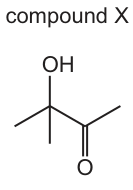
Skeletal formula of compound X.
Show full working
- 1
Classify the alcohol. The carbon carrying is bonded to two methyl carbons (the two line ends) and to the carbon: three carbons, so the alcohol is tertiary.
In a skeletal formula every line end is a CH₃ carbon, so the two short lines on that carbon are two carbons.
- 2
Classify the carbonyl. The carbon is bonded to the alcohol carbon and to a methyl carbon, with no hydrogen on it: it is a ketone.
This is the callout test above: no H on the C=O carbon means ketone.
- 3
Combine the two answers: tertiary alcohol and ketone, which is row D.
D (tertiary alcohol, ketone)
Alcohol type and carbonyl type are two separate checks on two different carbons. Do each on its own evidence.
Your turn
- 1
State the functional group in each compound and name its homologous series: (i) (ii) (iii) .
Stuck? Show hint
In each formula, look at the atoms that are not just CH₃ or CH₂.
Show solution
- 1
(i) : carboxylic acid.
C=O and OH on the same carbon make one carboxyl group.
- 2
(ii) : halogenoalkane.
Any halogen atom on an alkane skeleton makes a halogenoalkane.
- 3
(iii) : nitrile.
The CN at the end of a formula is the nitrile group, with a C≡N triple bond.
Answer(i) carboxylic acid (ii) halogenoalkane (iii) nitrile
- 1
- 29701/22 O/N 2025 Q3(a)2 marks
The alkanes are a homologous series of organic molecules. Alkanes are generally unreactive and are commonly used as fuels.
Define homologous series.
Stuck? Show hint
One mark is about the formula, one is about the chemistry.
Show solution
- 1
Formula point: a family of compounds with the same general formula (each member differs from the next by ).
Either wording earns this mark: 'same general formula' or 'molecular formulae differ by CH₂'.
- 2
Chemistry point: the members have similar chemical properties (they react in the same way).
The chemical properties are similar because the functional group is the same. Writing only 'same functional group' without 'similar chemical properties' risks losing this mark.
AnswerA family of compounds with the same general formula (differing by CH₂) and similar chemical properties.
- 1
- 3
Classify each as primary, secondary or tertiary: (i) propan-2-ol, ; (ii) 2-methylbutan-2-ol, ; (iii) 1-iodobutane, .
Stuck? Show hint
Count the carbons bonded directly to the carbon carrying OH or I.
Show solution
- 1
(i) The C–OH carbon is bonded to two carbons: secondary.
- 2
(ii) The C–OH carbon is bonded to , the methyl branch and : three carbons, tertiary.
- 3
(iii) The C–I carbon is at the end of the chain, bonded to one carbon: primary.
Primary/secondary/tertiary works the same way for halogenoalkanes as for alcohols.
Answer(i) secondary (ii) tertiary (iii) primary
- 1
- 49701/22 O/N 2024 Q4(d)(ii)1 mark
Compound E is the only isomer of 1,2-dibromoethane. Alkaline hydrolysis of E gives compound F.
Name the homologous series that F belongs to.
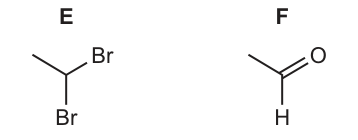
Fig. 4.4 as printed with the question.
Stuck? Show hint
Look at the C=O carbon in F. Is there a hydrogen on it?
Show solution
- 1
Find the functional group in F: a on the end carbon of the chain.
- 2
That carbon carries one carbon group and one hydrogen (), so F is an aldehyde (it is ethanal).
An H on the C=O carbon means aldehyde; two carbon groups would mean ketone.
AnswerAldehyde.
- 1
The rest of this note
Can you do all of these?
Define hydrocarbon and homologous series, state that alkanes have no functional group, and identify every functional group in a structure
Classify an alcohol or halogenoalkane as primary, secondary or tertiary
Convert between name, structural, displayed and skeletal formulae, and read the molecular and empirical formula off any of them, checking the H count with rings and double bonds
Name compounds of every AS functional group up to six carbons (esters six plus six; esters and nitriles straight-chain), and draw a structure from its name
Describe a skeleton as straight-chained, branched or cyclic; give the hybridisation, shape, bond angle and σ/π bonds at any carbon; explain why ethene is planar
Define structural isomers and deduce every chain, positional and functional group isomer of a formula, using symmetry to avoid repeats
Define stereoisomers; test C=C bonds and rings for cis/trans isomerism, explaining it by restricted rotation; find chiral centres in chains and rings; count stereoisomers as 2ⁿ
Use homolytic/heterolytic fission, free radical, initiation/propagation/termination, nucleophile/electrophile, addition/substitution/elimination/hydrolysis/condensation and [O]/[H] correctly
Name the four mechanism types, and draw and read curly arrows that start on a lone pair or bond and end where the pair goes, with dipoles, lone pairs and charges