Meet the alcohols
“
classify alcohols as primary, secondary and tertiary alcohols, to include examples with more than one alcohol group
What an alcohol is
An alcohol is a compound in which a hydroxyl group, , is bonded to a saturated carbon atom. Alcohols with one –OH have the general formula : an alkane, , with one H replaced by OH.
To name an alcohol, find the longest chain that contains the C–OH carbon, number it so the –OH gets the lowest number, and use the ending -ol: is ethanol; is propan-2-ol; is 2-methylpropan-1-ol (the longest chain through the C–OH carbon is three carbons, numbered from the OH end). When there is more than one –OH, keep the e of the alkane and add di- or tri- with a number for each group: is ethane-1,2-diol (used as antifreeze), is propane-1,2,3-triol (glycerol).
The –OH group has two bonds that react, and knowing which one breaks sorts out the whole topic:
- the O–H bond breaks when sodium reacts, when the alcohol is oxidised (together with a C–H bond on the same carbon), when it forms an ester, and when it acts as an acid;
- the C–O bond breaks when –OH is swapped for a halogen and when water is removed to make an alkene.
The hydroxyl group and its two reactive bonds, and how to classify an alcohol by counting the carbons bonded to the C–OH carbon.
Primary, secondary and tertiary
Find the carbon that carries the –OH. Count the carbon atoms bonded directly to it:
- primary (1°): one other carbon (or none, in methanol) — ethanol , butan-1-ol
- secondary (2°): two — propan-2-ol , butan-2-ol
- tertiary (3°): three — 2-methylpropan-2-ol
Another way to see it: the C–OH carbon of a primary alcohol carries two H atoms, a secondary carries one H, and a tertiary carries none.
When a molecule has more than one –OH, classify each –OH separately. In ethane-1,2-diol both –OH groups are on end carbons, so both are primary. Glycerol, , has two primary –OH groups and one secondary. Citric acid has one tertiary –OH as well as three groups.
This is the same count you used for halogenoalkanes. Here it decides what happens on oxidation: primary alcohols can go to an aldehyde and then a carboxylic acid, secondary alcohols to a ketone, and tertiary alcohols are not oxidised. The “Oxidation: products and colour changes” section explains why.
Classifying a mixed set
Classify each alcohol as primary, secondary or tertiary, giving systematic names:
(i) (ii) (iii) (iv)
Show full working
- 1
(i) Classify. The C–OH carbon is the end , bonded to one carbon → primary.
Always find the C–OH carbon first and count only the carbons bonded to it. The rest of the chain doesn't matter for the class.
- 2
(i) Name. The longest chain through the C–OH carbon is (four carbons), with a methyl branch. Numbering from the OH end puts OH on C1 and the methyl on C2 → 2-methylbutan-1-ol.
The chain must contain the C–OH carbon. Students often count only the three carbons written in a row and miss that the branch point can lead into a longer chain.
- 3
(ii) The C–OH carbon is bonded to an ethyl group on each side → two carbons → secondary. Five-carbon chain, OH on C3 from either end → pentan-3-ol.
Two carbons attached means secondary, however big those groups are.
- 4
(iii) The C–OH carbon carries two methyl groups and an ethyl group → three carbons → tertiary. Longest chain through it: four carbons, with OH and a methyl both on C2 → 2-methylbutan-2-ol.
A tertiary C–OH carbon has no H on it. Check that as a second test: here it is bonded to C, C, C and O.
- 5
(iv) Each of the two middle carbons carries an –OH and is bonded to two carbons → both –OH groups are secondary. Four-carbon chain with OH on C2 and C3 → butane-2,3-diol.
With two –OH groups, classify each one on its own. The name keeps the 'e' of butane and adds 'diol' with both position numbers.
(i) primary, 2-methylbutan-1-ol (ii) secondary, pentan-3-ol (iii) tertiary, 2-methylbutan-2-ol (iv) diol, both –OH secondary, butane-2,3-diol
Hydrogen bonding: boiling points and solubility
The O–H bond is very polar, and the oxygen has two lone pairs. So the H of one alcohol molecule is attracted to a lone pair on the O of another: a hydrogen bond between molecules (AS Chemical Bonding). This explains two physical properties.
- Boiling points are high. Ethanol ( = 46) boils at 78 °C, but propane ( = 44) boils at −42 °C. Both have similar van der Waals' forces, but only ethanol also has hydrogen bonds to break when it boils. Aldehydes and ketones cannot form hydrogen bonds with each other (they have no O–H), so they boil lower than the alcohols they come from. That is why an aldehyde can be distilled off as soon as it forms (see “Oxidation: products and colour changes”).
- Small alcohols dissolve in water. Alcohol molecules form hydrogen bonds with water molecules, so methanol, ethanol and propanol mix with water in any proportion. As the hydrocarbon chain gets longer, more of the molecule cannot hydrogen bond, and solubility falls.
More –OH groups mean more hydrogen bonds: ethane-1,2-diol boils at 197 °C and glycerol at 290 °C.
Your turn
- 19701/14 M/J 2025 Q271 mark
Which row shows a primary, a secondary and a tertiary alcohol?
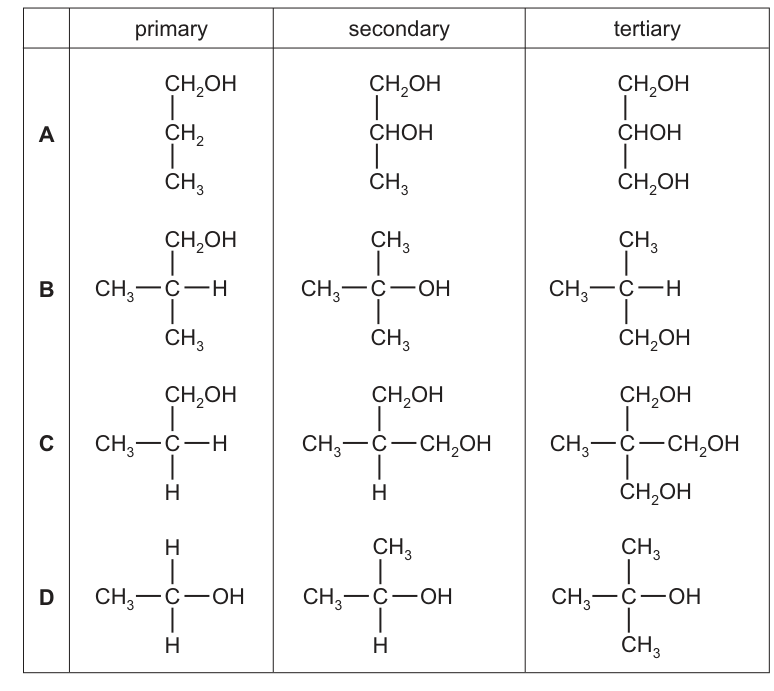
Options A–D as printed with the question.
Stuck? Show hint
For each drawn structure, ignore its column label and recount yourself — the wrong rows mislabel at least one structure.
Show solution
- 1
Row A: the primary entry is propan-1-ol ✓, and the secondary entry, , does have a secondary –OH on its middle carbon ✓. But the tertiary entry is glycerol, : its –OH groups are primary and secondary, none tertiary ✗.
Check every entry in a row. One wrong entry is enough to reject the row.
- 2
Row B: the primary entry is 2-methylpropan-1-ol, ✓. But the secondary entry is : its C–OH carbon is bonded to three carbons, so it is tertiary ✗.
Count the carbons on the C–OH carbon yourself; don't trust the column heading.
- 3
Row C: the primary entry is propan-1-ol ✓. The secondary entry has a central carbon carrying H, CH₃ and two groups. That central carbon has no –OH; both –OH groups are on end carbons, so both are primary ✗. The tertiary entry has the same problem.
In a polyol, look at which carbon each –OH is actually on. A carbon with three branches is not tertiary unless the –OH is on that carbon.
- 4
Row D: ethanol — C–OH carbon bonded to one carbon, primary ✓. Propan-2-ol — bonded to two, secondary ✓. 2-methylpropan-2-ol, — bonded to three, tertiary ✓. Answer D.
Every wrong row mixes correct structures with one mislabelled one, so classify each structure on its own before choosing.
AnswerD — ethanol (primary), propan-2-ol (secondary), 2-methylpropan-2-ol (tertiary)
- 1
- 24 marks
Propan-1-ol, ( = 60), boils at 97 °C. Butane, ( = 58), boils at −1 °C.
(a) Explain the difference in boiling points.
(b) Propan-1-ol mixes completely with water, but hexan-1-ol is only slightly soluble. Explain why.Stuck? Show hint
Similar Mr means similar van der Waals' forces. What extra force does only the alcohol have?
Show solution
- 1
(a) Name the extra force. Propan-1-ol molecules form hydrogen bonds between the H of one O–H group and a lone pair on the O of another molecule.
Say what forms the hydrogen bond (O–H hydrogen to an O lone pair). 'It has hydrogen bonds' with no detail can lose the mark.
- 2
(a) Compare with butane. Butane has only van der Waals' forces, similar in size to propan-1-ol's because the values are nearly equal. Hydrogen bonds are stronger, so more energy is needed to separate propan-1-ol molecules → higher boiling point.
Always link the stronger force to 'more energy needed to overcome it'. The forces broken on boiling are between molecules, not the covalent bonds inside them.
- 3
(b) Propan-1-ol forms hydrogen bonds with water molecules, so it mixes with water.
Solubility answers need 'with water': the alcohol must hydrogen bond to the water molecules.
- 4
(b) Hexan-1-ol has the same single –OH but a much longer hydrocarbon chain, which cannot hydrogen bond with water. So much less of the molecule interacts with water, and solubility is low.
One –OH group can only carry a short chain into water. Each extra CH₂ makes the molecule less like water.
Answer(a) propan-1-ol has hydrogen bonds between molecules (as well as van der Waals' forces, similar to butane's); more energy needed to overcome them (b) propan-1-ol hydrogen bonds with water; hexan-1-ol's long hydrocarbon chain cannot, so it is much less soluble
- 1
The rest of this note
Can you do all of these?
I can name alcohols, including diols and triols, and classify each –OH as primary, secondary or tertiary
I can explain the high boiling points and water solubility of small alcohols using hydrogen bonding
I can give reagents and conditions for all six ways to make an alcohol, and write reduction equations with [H]
I can write equations for combustion and for the reaction with sodium, and use gas volumes to find the number of –OH groups
I can give the five reagent sets that replace –OH by a halogen, the PCl₅ equation and its observation
I can predict the oxidation products of primary, secondary and tertiary alcohols, choose distillation or reflux, write [O] equations and state the colour changes
I can balance [O] equations for molecules with several groups: one H₂O for each alcohol group oxidised, none for an aldehyde → acid
I can use the tri-iodomethane test to find a CH₃CH(OH)– group, name both products, and combine it with the dichromate test to identify an alcohol
I can give conditions for dehydration and list every alkene formed, including cis/trans isomers
I can give conditions for esterification, write the equation and name the ester
I can explain why alcohols are weaker acids than water, why ethoxide is a stronger base than hydroxide, and which reagents react with alcohols (Na yes; NaOH and Na₂CO₃ no)