Reversible reactions and dynamic equilibrium
“
understand what is meant by a reversible reaction … understand what is meant by dynamic equilibrium in terms of the rate of forward and reverse reactions being equal and the concentration of reactants and products remaining constant … understand the need for a closed system in order to establish dynamic equilibrium.
A reaction that runs both ways
Most equations so far have used a single arrow, : the reaction goes one way. A reversible reaction is written with a double arrow, , because it can go both ways. Reactants turn into products (the forward reaction), and under the same conditions products turn back into reactants (the reverse reaction). Both reactions happen at the same time, in the same container.
Colourless splits into brown , and two molecules can collide and join back into .
What "dynamic equilibrium" actually means
Start a reversible reaction with only reactants present. At first the forward reaction has plenty of reactant, so it is fast. The reverse reaction has no product to work with, so its rate is zero. As the reaction goes on, reactant is used up, so the forward rate falls. Product builds up, so the reverse rate rises. Eventually the two rates become equal.
Dynamic equilibrium is the state reached at that point. Learn both ways of describing it, word for word:
- the rate of the forward reaction equals the rate of the reverse reaction, and
- the concentrations of reactants and products remain constant (constant, not equal to each other).
Neither description says the reaction has stopped. Both reactions are still happening, at the same rate, so each substance is made exactly as fast as it is used up. That is why it is called dynamic: the molecules keep changing, but the overall amounts do not.
Forward rate falls, reverse rate rises, and the moment they become equal is dynamic equilibrium — both stay constant and non-zero from then on.
Why a closed system is essential
Dynamic equilibrium can only be reached in a closed system: one where no substance can escape and none can be added. Suppose a gas product could escape into the air. Its concentration would keep falling as it left, so it could never become constant, and the reverse reaction could never catch up with the forward one. The reaction would simply keep going forward until a reactant ran out.
So "reversible" and "at dynamic equilibrium" are not the same thing. A reaction can be reversible (able to go both ways) but never reach equilibrium, because the system is not closed.
Stating the definition and the condition needed
(i) State what is meant by dynamic equilibrium.
(ii) Identify the condition necessary to establish dynamic equilibrium.
Show full working
- 1
(i) The rate of the forward reaction equals the rate of the reverse reaction (or: the concentrations of reactants and products remain constant).
The mark scheme accepts either description. "The reaction has stopped" or "the amounts are equal" gets no mark.
- 2
(ii) A closed system.
Only in a closed system can no substance escape, so the concentrations can become constant.
(i) Rate of forward reaction = rate of reverse reaction (or: concentrations of reactants and products remain constant). (ii) A closed system.
This definition is asked often, for 1–2 marks. Learn the exact wording.
Sketching the reverse rate from a given forward-rate curve
NO and NO₂ react at 25 °C to give N₂O₃: , . The reaction is reversible and reaches equilibrium in a closed system.
Fig. 2.1 shows how the rate of the forward reaction changes with time. Initially, the rate of the reverse reaction is zero. Complete Fig. 2.1 to sketch how the rate of the reverse reaction changes with time.
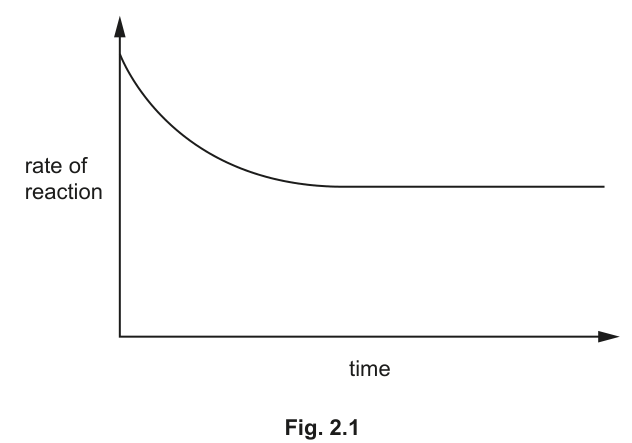
Fig. 2.1 as printed with the question.
Show full working
- 1
Start the curve at .
The question says the reverse rate is zero at the start: there is no product yet to react backwards.
- 2
End the curve on the same horizontal line as the flat part of the forward curve.
At equilibrium the forward and reverse rates are equal, so the two lines must finish at the same height.
- 3
Join the two with a smooth curve that rises and levels off at the same time as the forward curve becomes flat.
A reverse curve still rising after the forward curve is flat would mean the rates are not yet equal when the system is supposed to be at equilibrium.
A curve starting at (0, 0), rising smoothly and levelling off on the same horizontal line as the forward-rate curve.
A "sketch the reverse rate" question tests the definition: start at zero, finish level with the forward curve.
Distinguishing "reversible" from "in dynamic equilibrium"
When a sample of ammonium chloride is warmed it decomposes into ammonia and hydrogen chloride gas: (reaction 1). When the mixture of hot ammonia and hydrogen chloride gases hit a cold surface, a white solid of ammonium chloride reforms. Which statements are correct? 1 Reaction 1 is in dynamic equilibrium. 2 Reaction 1 is reversible. 3 Reaction 1 is an endothermic reaction. A 1, 2 and 3 are correct B 1 and 2 only are correct C 2 and 3 only are correct D 1 only is correct
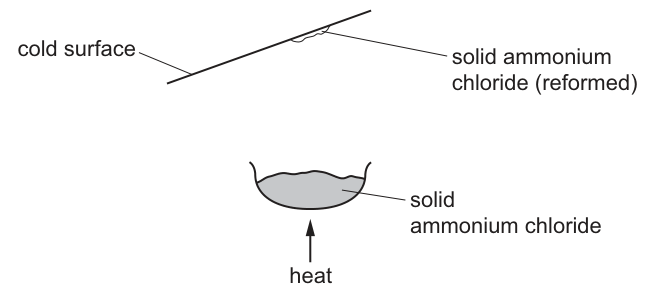
Fig. 33.1 as printed with the question.
Show full working
- 1
Statement 3: the solid only decomposes when it is warmed, so reaction 1 takes in heat from the surroundings. It is endothermic. Statement 3 is correct.
The reverse reaction happens on a cold surface and gives out heat. A reaction that needs heating to go forward and goes back on cooling is endothermic in the forward direction.
- 2
Statement 2: the gases turn back into solid on the cold surface, so the reaction can go both ways. It is reversible. Statement 2 is correct.
Reversible only means the reverse reaction can happen. It says nothing yet about equilibrium.
- 3
Statement 1: the forward reaction happens in the hot part of the tube and the reverse reaction in the cold part. The gases move from one place to the other, so the two reactions are never happening together under the same conditions. The mixture is not at dynamic equilibrium. Statement 1 is not correct.
This is the difference taught above: a reaction can be reversible without being at equilibrium. Equilibrium needs both reactions going on together, in one closed system.
C (2 and 3 only)
When a question separates "reversible" from "at dynamic equilibrium", check whether both reactions happen together in one closed system under the same conditions.
Your turn
- 1
A student says: "At equilibrium, the amounts of reactants and products are always equal." Explain why this statement is incorrect, and give the correct description of what stays constant at equilibrium.
Stuck? Show hint
Constant and equal are different claims — check which one the definition actually makes.
Show solution
- 1
The definition says the concentrations of reactants and products remain constant. It does not say they are equal.
Constant means not changing with time. Equal means the same size. These are different ideas.
- 2
An equilibrium mixture can be mostly products, or mostly reactants. What makes it an equilibrium is that the amounts stop changing, because the forward and reverse rates are equal.
Giving the correct description as well as the error is what earns the marks in an "explain" question.
Answer"Constant" does not mean "equal". At equilibrium the amounts of reactants and products can be very different; what is true is that they stay constant (forward rate = reverse rate).
- 1
- 2
Hydrogen gas and iodine vapour are sealed in a glass container and heated: . Explain why this system, unlike the ammonium chloride tube above, can reach dynamic equilibrium.
Show solution
- 1
The sealed container is a closed system: no , or can escape, and nothing is added.
A closed system is the condition needed for dynamic equilibrium.
- 2
All three gases are mixed together at the same temperature, so the forward and reverse reactions happen together. As builds up, the reverse rate rises until it equals the forward rate, and the concentrations then stay constant.
In the ammonium chloride tube the two reactions happened in different places at different temperatures, so their rates could never balance.
AnswerIt is a closed system with all three gases together at one temperature, so the reverse rate can rise until it equals the forward rate. In the ammonium chloride tube the two reactions happen in different parts of the tube.
- 1
The rest of this note
Can you do all of these?
Define dynamic equilibrium (either form) and state that it needs a closed system
Apply Le Chatelier's principle to concentration, pressure, temperature and catalyst changes, and tell a smaller volume apart from adding an inert gas
State that only temperature changes the value of Kc or Kp, and say whether K goes up or down from the sign of ΔH
Write a Kc or Kp expression from a balanced equation, and derive its units by cancelling
Calculate mole fractions and partial pressures from equilibrium amounts and a total pressure
Build an ICE table in moles, then convert to concentrations or partial pressures, and calculate Kc, Kp or an equilibrium amount
Describe and explain the temperature, pressure and catalyst used in the Haber and Contact processes
Describe the Brønsted–Lowry theory, and identify the acid, base and both conjugate pairs in an equation
Define strong and weak acids and bases, and explain the differences in reaction with a metal, pH and conductivity
Sketch the four pH titration-curve shapes, place the equivalence point, and choose a suitable indicator from given ranges