Period 3 physical property trends
“
describe qualitatively (and indicate the periodicity in) the variations in atomic radius, ionic radius, melting point and electrical conductivity of the elements … explain the variation in melting point and electrical conductivity in terms of the structure and bonding of the elements.
One period, one lap of the whole table
Period 3 runs : three metals, then silicon (a semiconductor, between metal and non-metal), then four non-metals. Periodicity means that a property changes with the same shape across every period. If you learn the shape across Period 3, you can expect the same shape across Period 2 or Period 4.
Atomic radius: falls all the way across
You met this in the AS Atomic Structure note (“Atomic and ionic radius”). Crossing Period 3, each element has one more proton in the nucleus and one more electron in the same outer shell (n = 3). The inner shells do not change, so the shielding stays about the same. The larger nuclear charge therefore pulls the outer shell in more strongly, and the atomic radius falls from sodium to chlorine.
Mark schemes want both halves: nuclear charge increases AND shielding is similar, so there is stronger attraction between the nucleus and the outer electrons.
Atomic radius shrinking steadily across Period 3 — reused from the AS Atomic Structure note, since the cause (rising nuclear charge, unchanged shielding) is identical.
Ionic radius: two separate shrinking runs, not one
Ionic radius does not follow one smooth line. The metals (Na, Mg, Al) lose their outer electrons and keep only two shells (the neon arrangement, 10 electrons). The non-metals (P, S, Cl) gain electrons and keep three shells (the argon arrangement, 18 electrons). So the ions form two separate groups. Ions in a group with the same number of electrons are called isoelectronic.
- : all 10 electrons. The nuclear charge rises (11, 12, 13 protons) on the same electrons, so the radius shrinks from to .
- : all 18 electrons. Same reason: the radius shrinks from to .
Every anion is bigger than every cation, because the anions have one more occupied shell than the cations. So the pattern is: shrink across the cations, a big jump up, then shrink across the anions.
A quick check on an invented pair: compare and . Magnesium loses 2 electrons and keeps 2 shells; sulfur gains 2 electrons and has 3 shells. is much bigger, because it has one more shell, even though sulfur has more protons.
Ionic radius across Period 3: two separate shrinking runs (10-electron cations, 18-electron anions), with a jump between them — not one continuous trend.
Melting point and conductivity: the same three structures decide both
Both properties come from the structure and bonding of each element, so build that picture once and use it twice.
- Na, Mg, Al — giant metallic. Positive ions sit in a lattice surrounded by a "sea" of delocalised electrons. From Na to Mg to Al, each atom gives more delocalised electrons (1, then 2, then 3) and forms a smaller ion with a bigger charge. Both make the metallic bonding stronger, so the melting point rises from Na to Al. Conductivity also rises, because there are more delocalised electrons to carry charge.
- Si — giant covalent (mark schemes also say giant molecular). Every silicon atom is joined to four others by strong covalent bonds all through the solid, like diamond in the AS States of Matter note. Melting means breaking a huge number of strong covalent bonds, so silicon has the highest melting point in the period. Its bonding electrons are held in fixed covalent bonds, not delocalised, so silicon conducts very poorly. It is a semiconductor.
- P, S, Cl, Ar — simple molecular (argon is single atoms). They exist as small molecules, , and , held to each other only by weak van der Waals' forces. The strong covalent bonds inside each molecule do not break on melting. So the melting points are low. They have no delocalised electrons and no ions, so they do not conduct.
Within the simple molecular group, the order is S > P > Cl > Ar. is the biggest molecule, with the most electrons, so it has the strongest van der Waals' forces. comes next, then , then single Ar atoms.
Melting point and electrical conductivity across Period 3: both rise from Na to Al; silicon's giant covalent solid has the highest melting point but conducts very poorly; both are low across the simple-molecular non-metals.
Explaining why magnesium melts higher than sodium
Sodium melts at 98 °C and magnesium at 650 °C. Explain the difference in terms of structure and bonding.
Show full working
- 1
Name the structure and bonding of both. Sodium and magnesium are both giant metallic: positive ions in a sea of delocalised electrons.
Always start by naming the structure. It tells the examiner which kind of attraction has to be overcome when the solid melts.
- 2
Compare the ions. Sodium forms ; magnesium forms , which has a bigger charge and is smaller.
A bigger charge on a smaller ion attracts the delocalised electrons more strongly.
- 3
Compare the delocalised electrons. Each Na atom gives 1 electron to the sea; each Mg atom gives 2.
More delocalised electrons per ion means more attraction holding the lattice together.
- 4
Link to energy. So the metallic bonding in magnesium is stronger, and more energy is needed to overcome it. Magnesium has the higher melting point.
The final mark is for the link: stronger attraction → more energy needed to melt. Students often stop after describing the ions and never make this link.
Both are giant metallic. is smaller and more highly charged than , and Mg gives 2 delocalised electrons per atom (Na gives 1), so the attraction between the ions and the delocalised electrons is stronger in Mg, and more energy is needed to melt it.
Explaining the conductivity trend in the mark scheme's words
Elements in Period 3 of the Periodic Table show trends in their properties. The relative electrical conductivities of the Period 3 elements are shown in Fig. 1.1. Explain why there is an increase in conductivity from Na to Al and why P, S and Cl are non-conductors of electricity.
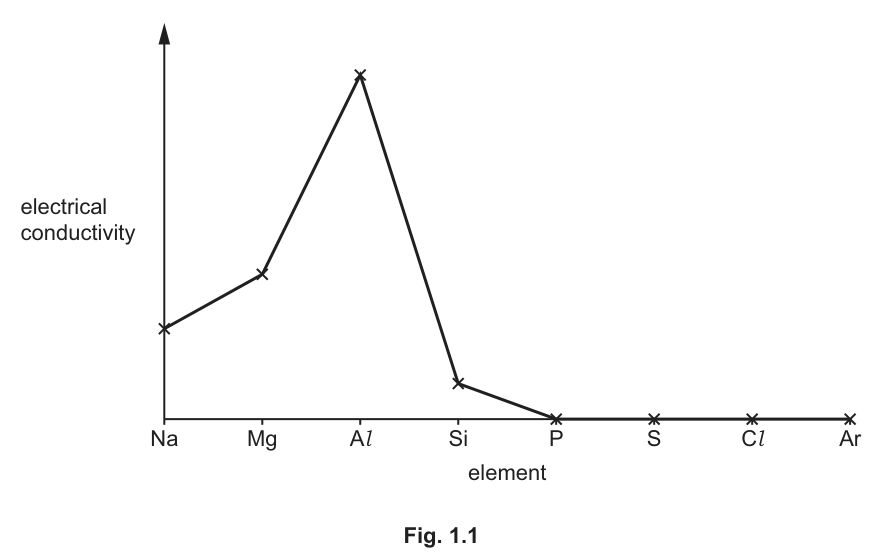
Fig. 1.1 as printed with the question.
Show full working
- 1
Say what carries the current in Na, Mg and Al: delocalised electrons that can move through the structure.
Conduction needs a charged particle that can move. Name it: "delocalised electrons", not just "electrons" or "it is a metal".
- 2
Say why P, S and Cl do not conduct: they are simple molecular, with no delocalised electrons and no ions, so there are no mobile charge carriers.
In this mark scheme, this goes with the step above to earn the first mark. The contrast (Na–Al have them, P–Cl do not) must be clear.
- 3
Say why conductivity increases from Na to Al: the number of delocalised electrons increases, 1 per Na atom, 2 per Mg atom, 3 per Al atom.
This is the second mark. "More delocalised electrons" must be stated; saying only "Al is a better metal" earns nothing.
Na to Al: delocalised electrons can move through the structure, and the number of delocalised electrons per atom increases (1 → 2 → 3) from Na to Al. P, S, Cl: no delocalised electrons (or mobile charge carriers) are present, so they cannot conduct.
"Explain conductivity" always wants a MOBILE CHARGE CARRIER named explicitly (delocalised electrons in a metal, ions in solution/molten ionic compounds) — never just "it's a metal" or "it's covalent" on their own.
Explaining the big drop in melting point from Si to P, S and Cl
Fig. 2.1 shows the variation in melting point of the Period 3 elements Si to Cl. The Period 3 elements Si to Cl are all non-metals. Explain why there is a large difference between the melting point of Si and the melting points of P, S and Cl.
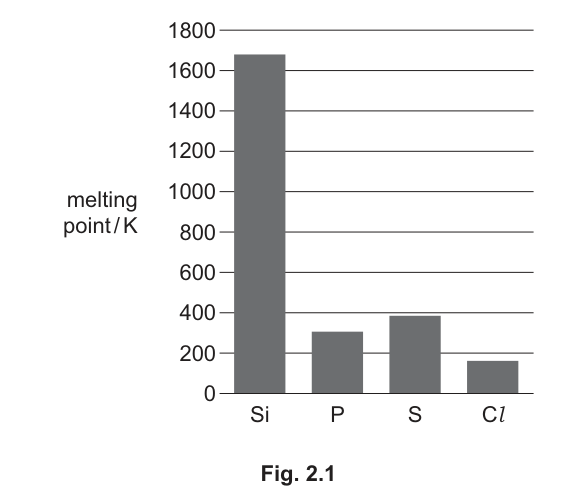
Fig. 2.1 as printed with the question.
Show full working
- 1
Say what breaks when silicon melts. Silicon is giant covalent, so melting breaks many strong covalent bonds.
First mark: name the strong covalent bonds that are broken in Si.
- 2
Say what is overcome when P, S or Cl melts. Each is simple molecular, so melting only overcomes the weak van der Waals' forces between molecules. The covalent bonds inside the molecules do not break.
Second mark: weak van der Waals' forces. A common error is to say the covalent bonds in P₄ or Cl₂ break on melting — they do not.
Si has (many) strong covalent bonds that must be broken; P, S and Cl have only weak van der Waals' forces between molecules to overcome — far less energy is needed.
"Large difference in melting point" between a giant structure and a simple molecular one is always explained by naming what actually has to break in each case — strong bonds throughout a lattice versus weak forces between separate molecules — never just "one is giant and one isn't".
Combining melting point AND conductivity to pick out one element in a three-way comparison
Which set of three elements contains a single element that has both the highest melting point and the lowest electrical conductivity of the three elements in the set? A magnesium, aluminium and silicon B aluminium, silicon and phosphorus C sodium, magnesium and aluminium D silicon, phosphorus and chlorine
Show full working
- 1
Test option A: Mg, Al, Si. Si (giant covalent) has the highest melting point of the three. Mg and Al are metals and conduct well; Si has no delocalised electrons and conducts poorly, so Si also has the lowest conductivity. One element, Si, has both.
Check each option against both conditions, using the structure of each element.
- 2
Test option B: Al, Si, P. Si has the highest melting point, but P (simple molecular, no conduction) has the lowest conductivity. Two different elements, so B fails.
Once a non-metal from P onwards is in the set, it will have the lowest conductivity — so Si cannot win both.
- 3
Test option C: Na, Mg, Al. Al has the highest melting point, but Al is also the best conductor; Na has the lowest conductivity. C fails.
Across the metals, melting point and conductivity rise together, so the highest-melting metal is never the worst conductor.
- 4
Test option D: Si, P, Cl. Si has the highest melting point, but P and Cl conduct even less than Si. D fails.
This question rewards checking the FULL condition — one element with both properties — rather than finding the top of one list and the bottom of the other and assuming they match.
A (magnesium, aluminium and silicon)
When a question asks for ONE element satisfying TWO conditions at once, check both conditions land on the exact same element — don't just find the top of one list and the bottom of the other and assume they match.
Using atomic and ionic radius data to identify elements
The atomic radii and ionic radii for three elements in Period 3 are shown.
| atomic radius / nm | ionic radius / nm | |
|---|---|---|
| element X | 0.118 | 0.053 |
| element Y | 0.099 | 0.180 |
| element Z | 0.160 | 0.072 |
Using this data, which statement is correct? A Element X has lower electrical conductivity than element Y. B Element Y has a higher melting point than element X. C Element Y and element Z react to form an ionic compound. D Element Z forms ionic compounds by gaining electrons.
Show full working
- 1
Decide which elements form cations and which form anions. X: ionic radius is much smaller than atomic radius , so X loses electrons (a metal). Z: is smaller than , so Z also loses electrons (a metal). Y: is much bigger than , so Y gains electrons (a non-metal).
Losing a whole shell makes the ion much smaller than the atom; gaining electrons makes it bigger. Read this before trying to name the elements.
- 2
Name the elements. Z has the largest atom of the three, so it is further left than X: Z is Mg (, 0.072 nm) and X is Al (, 0.053 nm, the smallest cation). Y's large anion matches (0.180 nm).
Atomic radius falls across the period, so the bigger metal atom is the one further left.
- 3
Test A. X (Al) is a metal and conducts well; Y (Cl) does not conduct. X has the higher conductivity, so A is false.
Metals have delocalised electrons; simple molecular chlorine has none.
- 4
Test B. Y (Cl₂) is simple molecular with a very low melting point; X (Al) is metallic with a high one. B is false.
Weak van der Waals' forces versus strong metallic bonding.
- 5
Test C. Y (Cl, non-metal) and Z (Mg, metal) react by electron transfer to form ionic . C is true.
A reactive metal and a reactive non-metal form an ionic compound.
- 6
Test D. Z (Mg) is a metal and forms ionic compounds by losing electrons. D is false.
The radius data already told you this in the first step: Z's ion is smaller than its atom.
C (element Y and element Z react to form an ionic compound)
A big DROP from atomic to ionic radius signals a cation (metal, loses electrons); a big RISE signals an anion (non-metal, gains electrons) — read that first, before trying to identify the specific element.
Your turn
- 1
Explain why has a smaller ionic radius than , even though aluminium loses three electrons (more than sodium's one) to form its ion.
Stuck? Show hint
Both ions end up with the same number of electrons — so what's different between them is only the number of protons.
Show solution
- 1
Both and have exactly 10 electrons (the neon configuration) — losing different numbers of electrons from different starting atoms lands both ions on the same electron count.
- 2
With the same 10 electrons, the ion with the greater nuclear charge pulls those electrons in more tightly. (13 protons) has a greater nuclear charge than (11 protons).
- 3
So 's greater nuclear charge, acting on the same 10 electrons, pulls them in closer than 's smaller nuclear charge does — is the smaller ion.
Answerand are isoelectronic (both 10 electrons), so ionic radius is decided purely by nuclear charge — Al's greater nuclear charge (13 protons vs 11) pulls the same 10 electrons in more tightly, making smaller.
- 1
- 2
Silicon has by far the highest melting point of any Period 3 element, yet it is a very poor electrical conductor — far worse than sodium, which melts at under a tenth of silicon's temperature. Explain why these two facts are not contradictory.
Stuck? Show hint
Melting point and conductivity are testing two different things about the bonding electrons: how strongly held they are, and how free they are to move.
Show solution
- 1
Silicon's very high melting point comes from its giant covalent structure: every atom is joined to its neighbours by strong covalent bonds extending through the whole solid, and melting requires breaking a huge number of these strong bonds.
- 2
Silicon's poor conductivity comes from a separate fact about the same electrons: the bonding electrons in a covalent bond are localised between two specific atoms, not free to move through the structure — there are no delocalised electrons or free ions available to carry a current.
- 3
Sodium's electrons are the opposite on both counts: only weakly held (metallic bonding with just one delocalised electron per atom, giving a low melting point), but genuinely free to move (hence good conductivity despite the low melting point).
- 4
So melting point measures how STRONGLY the structure's particles are held together, while conductivity measures whether charge carriers are FREE TO MOVE — silicon scores high on the first and low on the second, precisely because its electrons are strongly bonded but not delocalised.
AnswerMelting point depends on bond STRENGTH (silicon's covalent bonds are very strong, hence very high MP); conductivity depends on whether charge carriers are FREE TO MOVE (silicon's electrons are localised in fixed covalent bonds, not delocalised, hence poor conductivity) — the two properties test different things about the same electrons.
- 1
- 32 marks
Explain why the ionic radius of phosphorus () is much larger than the ionic radius of aluminium ().
Stuck? Show hint
What does each atom do to form its ion, and how many shells are left?
Show solution
- 1
Aluminium loses 3 electrons to form ; phosphorus gains 3 electrons to form .
First point: say which way the electrons move for each element.
- 2
() has two occupied shells; () has three. So has one fewer shell.
Second point: the extra shell is the main reason for the size difference. Talking only about nuclear charge misses it — P actually has more protons than Al, yet its ion is bigger.
AnswerAl loses 3 electrons (Al³⁺) while P gains 3 electrons (P³⁻), so Al³⁺ has one fewer occupied shell than P³⁻.
- 1
The rest of this note
Can you do all of these?
Explain the atomic radius trend (falling across the period) and the ionic radius pattern (two separate shrinking runs — 10-electron cations, 18-electron anions — with a jump between them)
Explain the melting point and conductivity trends using structure and bonding: metallic (Na–Al, both rising) → giant covalent (Si, MP spikes, conductivity collapses) → simple molecular (P–Ar, both stay low)
Write balanced equations, with state symbols, for the Period 3 elements reacting with oxygen, with chlorine, and (Na, Mg only) with water, and describe what you see (flame colours, Mg + cold water vs steam)
State and explain the oxidation-number pattern (Na +1 → S +6) in terms of valence-shell electron count
Explain with electronegativity difference why Na and Mg form ionic oxides and chlorides, P and S covalent ones, Al₂O₃ is ionic but AlCl₃ is mainly covalent, and SiO₂ is giant covalent; suggest bonding from observations
Write the equations of the oxides with water and give the pH (Na₂O 12–14, MgO 8–10, P₄O₁₀/SO₂/SO₃ 0–4), and explain why Al₂O₃ and SiO₂ give no pH data (insoluble)
Write equations for the basic oxides/hydroxides with acid, the acidic oxides with NaOH, and Al₂O₃ / Al(OH)₃ with both acid and NaOH; define amphoteric
Distinguish simple dissolving (NaCl pH 7, MgCl₂ 6.5) from hydrolysis (AlCl₃, SiCl₄, PCl₅: steamy HCl fumes, pH 0–4), and write the hydrolysis equations
Use a chain of clues (radius, conductivity, oxidation number, solubility, hydrolysis, amphoteric test) to identify an unknown element, and predict properties of an element in a given group