Enthalpy change, reaction pathways, and the named ΔH types
“
understand that chemical reactions are accompanied by enthalpy changes and these changes can be exothermic (ΔH is negative) or endothermic (ΔH is positive) … construct and interpret a reaction pathway diagram … define and use the terms: standard conditions … enthalpy change with particular reference to: reaction, ΔHr, formation, ΔHf, combustion, ΔHc, neutralisation, ΔHneut
Enthalpy change: a sign tells you the direction of energy flow
Enthalpy, , is the heat energy stored in a system at constant pressure. You can never measure itself, only how much it changes. A reaction's enthalpy change, , is the products' enthalpy minus the reactants': , usually in . Its sign tells you which way the energy flows:
- Exothermic: energy is released to the surroundings, so the products have less enthalpy than the reactants. is negative, and the surroundings get warmer.
- Endothermic: energy is absorbed from the surroundings, so the products have more enthalpy than the reactants. is positive, and the surroundings get cooler.
The sign always describes the reacting chemicals. In an exothermic reaction they lose energy ( negative), so a thermometer in the surroundings goes up. Students often get this backwards.
Reversing a change reverses the sign of with the same size, because the start and end levels simply swap.
Change | Sign of ΔH | Why |
|---|---|---|
Combustion (burning in oxygen) | negative | fuels release heat |
Neutralisation, | negative | the mixture warms up |
Breaking a bond | positive | energy is needed to pull bonded atoms apart |
Making a bond | negative | energy is released as atoms bond |
Melting (s → l) and boiling (l → g) | positive | energy is needed to overcome forces between particles |
Freezing (l → s) and condensing (g → l) | negative | the reverse of melting and boiling, so the sign flips |
Signs worth knowing without being told. Boiling needs much more energy than melting, because nearly all the intermolecular forces are overcome when a liquid becomes a gas, but only a few when a solid melts.
Reading and drawing a reaction pathway diagram
A reaction pathway diagram (also called an energy profile) plots enthalpy on the vertical axis against the reaction's progress on the horizontal axis. Three features appear on every one:
- A horizontal line for the reactants, at their own enthalpy level.
- A horizontal line for the products, at their own enthalpy level.
- A curve joining them that rises to a peak in between. The height of the peak above the reactants is the activation energy, : the minimum energy colliding particles need before they can react. Every reaction has a positive , whether it is exothermic or endothermic.
An exothermic reaction pathway: reactants sit higher than products (ΔH negative), but the curve still climbs over the activation-energy hump first. "Downhill overall" does not mean the reaction starts without an energy input.
An endothermic reaction pathway: reactants sit lower than products (ΔH positive). Eₐ and ΔH both start from the reactants line.
The most common labelling error on a pathway diagram
is measured from the reactants up to the peak. is measured from the reactants to the products. Both arrows start at the reactants line, never at the peak. Each arrow needs an arrowhead pointing the right way (up for ; down for an exothermic , up for an endothermic one).
The reverse reaction on the same diagram
Read the same diagram from right to left and you have the reverse reaction. It starts at the products line and climbs to the same peak, because it goes through the same highest-energy arrangement of atoms. So:
- of the reverse reaction has the same size and the opposite sign.
- of the reverse reaction is the height of the peak above the products line.
For an exothermic forward reaction, the products sit lower, so the reverse climb is longer:
Demonstration. A forward reaction has and .
- The reverse is (same size, sign flipped).
- The reverse is : the back up from the reactants' level to the peak, plus the from the products' level up to the reactants' level.
Activation energies are always positive. For an exothermic forward reaction, (reverse) is always bigger than (forward); for an endothermic forward reaction it is always smaller (but still above zero).
The demonstration's numbers on one diagram: the forward reaction climbs 50 from the reactants; the reverse reaction climbs 50 + 30 = 80 from the lower products line to the same peak.
Choosing the correctly labelled pathway for a reverse reaction
The equation for the formation of ammonium chloride is shown. Which diagram shows the correctly labelled reaction pathway diagram for the decomposition of ammonium chloride?
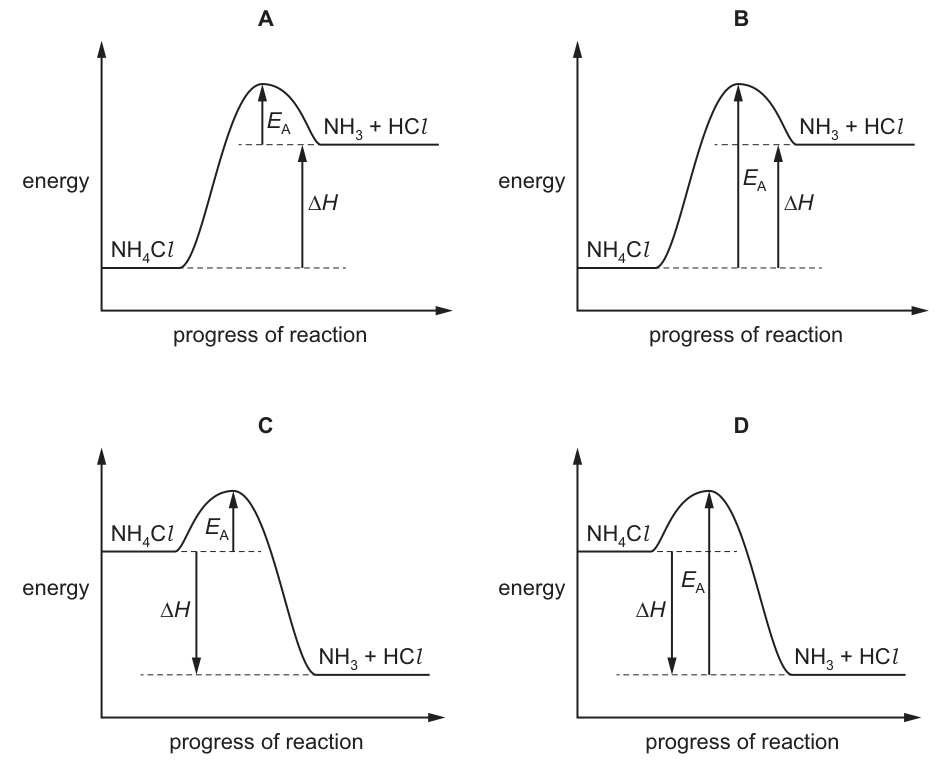
Options A–D as printed with the question.
Show full working
- 1
The given equation is the formation of , and it is exothermic (). Decomposition is the reverse reaction: .
Read which direction the question asks about before looking at the diagrams. The given ΔH is for the other direction.
- 2
Reversing a reaction reverses the sign of : decomposition is endothermic, .
The enthalpy of each substance doesn't change, so the gap between them keeps its size and only the sign flips.
- 3
So (the reactant now) must sit lower than . That rules out C and D, which draw it higher.
Endothermic means the products end up above the reactants.
- 4
Between A and B, check where starts. In A the arrow starts at the products level; in B it starts at the line and goes up to the peak.
Eₐ is always measured from the reactants up to the peak. A shows the activation energy of the reverse (formation) reaction instead.
B
When a question reverses a given reaction, flip the sign of ΔH and swap which side is drawn higher. Eₐ and ΔH still both start from the (new) reactants.
Constructing a pathway diagram from scratch, given only ΔH
Separate samples of and react with to produce the same products, as shown in the table.
| reaction | equation | ΔH / kJ mol⁻¹ |
|---|---|---|
| 1 | ||
| 2 |
Complete the reaction pathway diagram in Fig. 2.1 for reaction 2.
Label the diagram to show the enthalpy change, , and the activation energy, .
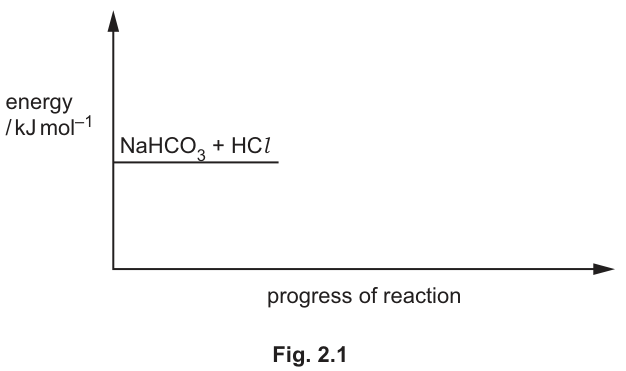
Fig. 2.1 as printed with the question.
Show full working
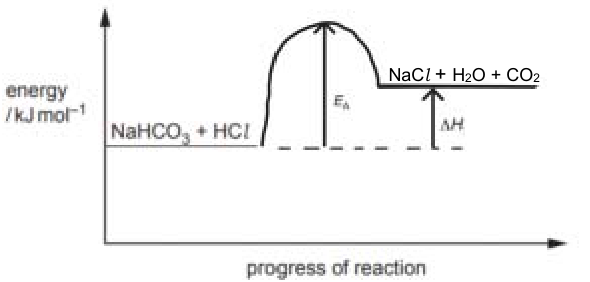
The mark scheme's completed Fig. 2.1.
- 1
Read the sign of : positive, so reaction 2 is endothermic. The products line must be drawn above the given reactants line.
The sign of ΔH decides everything else on the sketch, so read it first.
- 2
Draw a curve rising from the reactants, over a hump, and levelling off at the higher products line.
The MS gives a mark for an endothermic profile that includes the hump. A curve going straight up to the products line, with no peak above it, loses that mark.
- 3
Draw an upward arrow from the reactants line to the top of the hump and label it .
Eₐ is its own marking point: an arrow from the reactants to the peak.
- 4
Draw an upward arrow from the reactants line to the products line and label it (or ).
Third marking point. The ΔH arrow starts at the reactants, not at the peak.
An endothermic profile with a hump (products above reactants); an Eₐ arrow from reactants to the peak; a ΔH₂ (+27.2) arrow from reactants to products. All three correct for 2 marks, two for 1 mark.
Reading forward and reverse values off a pathway diagram
The reaction pathway for the forward reaction of a reversible reaction is shown.
Which statement is correct?
Options
A The activation energy of the reverse reaction is .
B The enthalpy change for the forward reaction is .
C The enthalpy change for the forward reaction is .
D The enthalpy change for the reverse reaction is .
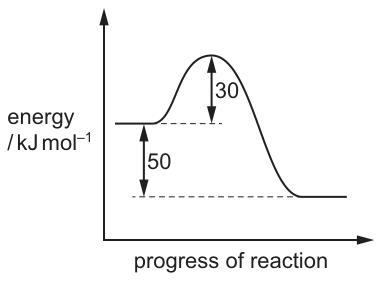
Fig. 9.1 as printed with the question.
Show full working
- 1
Read the diagram. The arrow runs from the reactants line up to the peak, so .
An arrow from the reactants to the peak is always the activation energy.
- 2
The arrow runs from the reactants line down to the products line, so .
The products are lower, so the forward reaction is exothermic and ΔH is negative. This rules out B and C, which give positive forward values.
- 3
The reverse reaction has the same size of with the opposite sign: , not . This rules out D.
D mixes up the activation-energy arrow with the enthalpy-change arrow.
- 4
State the relationship: .
The reverse reaction climbs from the products line to the same peak.
- 5
Substitute: .
Subtracting a negative ΔH adds its size. On the diagram, this is the 50 from the products up to the reactants' level plus the 30 up to the peak.
A
Label every arrow on a given diagram as Eₐ or ΔH, with its sign, before you read the options.
Your turn
- 1
Sketch and label a reaction pathway diagram for an exothermic reaction, showing and .
Stuck? Show hint
Reactants sit higher than products for an exothermic reaction. Both labelled quantities start from the reactants line.
Show solution
- 1
Draw the reactants line higher than the products line.
Exothermic: the products have less enthalpy than the reactants.
- 2
Draw a curve rising from the reactants, over a peak, down to the products.
Even an exothermic reaction must first get over the activation-energy barrier.
- 3
Draw an arrow from the reactants line up to the peak and label it .
Eₐ always starts at the reactants.
- 4
Draw an arrow from the reactants line down to the products line and label it (negative).
The arrow points down because enthalpy falls. Starting it at the peak is the most common error.
AnswerReactants above products; Eₐ from reactants up to the peak; ΔH (negative) from reactants down to products.
- 1
- 29701/11 O/N 2023 Q151 mark
The forward reaction of a reversible reaction is exothermic and has an activation energy of .
The reverse reaction proceeds by a mechanism that is the exact reverse of the mechanism of the forward reaction.
Which statement about the activation energy of the reverse reaction is correct?
A The activation energy for the reverse reaction is equal to .
B The activation energy for the reverse reaction is greater than but less than .
C The activation energy for the reverse reaction is equal to .
D The activation energy for the reverse reaction is greater than .Stuck? Show hint
Sketch an exothermic profile. Which line is lower, and how far is it from the peak?
Show solution
- 1
An activation energy can never be negative, so A is wrong.
Eₐ is an energy barrier that has to be climbed, so it is always positive.
- 2
The forward reaction is exothermic, so the products line is below the reactants line.
Negative ΔH means the products have less enthalpy.
- 3
The reverse reaction climbs from the lower products line to the same peak, so its climb is longer: , and is negative, so .
Same mechanism reversed means the same peak. B and C would need the products to be level with or above the reactants.
AnswerD
- 1
- 39701/13 O/N 2024 Q101 mark
Three processes are described.
Which statement is correct?
A None of the processes have a positive enthalpy change.
B Only process 1 has a positive enthalpy change.
C Only process 2 has a positive enthalpy change.
D Only process 3 has a positive enthalpy change.Show solution
- 1
Process 1 is neutralisation: exothermic, negative.
A neutralisation mixture always warms up.
- 2
Process 2 is the combustion of methane: exothermic, negative.
Every combustion releases heat.
- 3
Process 3 is condensation (gas → liquid): exothermic, negative.
Intermolecular forces form as the gas condenses, releasing energy. It is the reverse of boiling, which is endothermic. Thinking "cooling down, so endothermic" leads to the wrong answer D.
AnswerA
Standard conditions, and the four named enthalpy changes
The same reaction gives out a slightly different amount of heat at different temperatures and pressures, so values are compared under fixed standard conditions: () and . The symbol (as in ) means "measured under standard conditions".
Each substance is then in its standard state: its normal physical state at and . For example carbon is , hydrogen and oxygen are and , bromine is , and water and ethanol are liquids.
Four enthalpy changes have their own names. Each one fixes one mole of a particular substance:
Name | Symbol | Definition |
|---|---|---|
Enthalpy change of reaction | the enthalpy change when the amounts of reactants shown in the equation react together, under standard conditions | |
Enthalpy change of formation | the enthalpy change when one mole of a compound is formed from its elements in their standard states, under standard conditions | |
Enthalpy change of combustion | the enthalpy change when one mole of a substance is burned completely in oxygen (or burned in excess oxygen), under standard conditions | |
Enthalpy change of neutralisation | the enthalpy change when an acid and a base react to form one mole of water, under standard conditions |
Formation fixes one mole of the product, combustion one mole of the substance burned, neutralisation one mole of water. Mark schemes look for the words in bold.
Writing the equation that matches a definition
Exam questions often ask which equation "represents" or . Check three things:
- Exactly one mole of the substance the definition fixes. Fractions such as are fine on the other side if that is what balancing needs.
- Elements in their standard states (for ): , not ; , not .
- The right state symbol for the substance itself at .
Demonstration. For of water: . Writing is balanced but forms two moles, so its is . Writing is the wrong state.
One consequence: forming an element in its standard state from itself involves no change at all, so of any element in its standard state is zero (for example , , ). You will use this in every Hess's law calculation.
Why ΔHneut sometimes needs dividing by more than one
A reaction pathway diagram for the reaction of aqueous sodium hydroxide and dilute sulfuric acid is shown.
What is the value of the enthalpy change of neutralisation, ?
Options
A
B
C
D
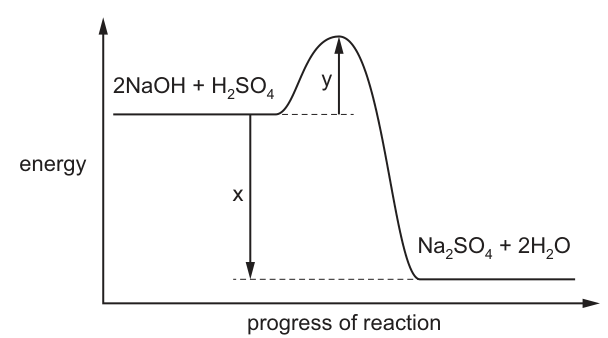
The reaction pathway diagram as printed with the question.
Show full working
- 1
Write the balanced equation for this reaction:
The definition is per mole of water, so you need to know how much water this diagram shows.
- 2
On the diagram, runs from the reactants up to the peak, so is the activation energy. It is not part of .
This rules out B and D, which subtract y.
- 3
runs from the reactants down to the products, so is the enthalpy change for the equation as written, which forms two moles of water.
A pathway diagram shows ΔH for the amounts in its own equation.
- 4
is per one mole of water, so divide by 2: .
This rules out A, which is the value for two moles of water.
C — x/2
Before quoting a ΔHneut, ΔHf or ΔHc from a diagram or equation, check how many moles of the fixed substance it shows. If it is not exactly one, scale the value.
Choosing the equation for a standard enthalpy change of formation
Which equation represents the standard enthalpy change of formation, , for ethanol?
Options
A
B
C
D
Show full working
- 1
Count the atoms in one molecule of ethanol, : C, H, O.
The H in the OH group is easy to miss. Counting only the 5 in C₂H₅ gives 2½ H₂ (options A and B).
- 2
Balance from the elements in their standard states: , (6 H atoms), (1 O atom). This rules out A and B.
One mole of product is fixed, so fractions on the element side are allowed.
- 3
Choose the state of ethanol at : it is a liquid, so . This rules out C.
The standard state of the compound matters too. Ethanol boils at 78 °C, so it is a liquid at 25 °C.
D
Check the three things in order: one mole of product, elements in their standard states with correct balancing, and the product's state symbol.
Your turn
- 1
Write a definition for the standard enthalpy change of formation of methane, , and write the equation it refers to, with state symbols.
Show solution
- 1
Definition: the enthalpy change when one mole of methane is formed from its elements in their standard states, under standard conditions.
The two points a mark scheme looks for are "one mole of compound formed" and "from its elements in their standard states".
- 2
Equation:
Carbon is a solid and hydrogen a diatomic gas at 298 K. Methane is a gas.
AnswerThe enthalpy change when 1 mol CH₄(g) forms from its elements in their standard states, C(s) + 2H₂(g), under standard conditions.
- 1
- 29701/21 O/N 2021 Q1(b)(i)2 marks
Define enthalpy change of combustion.
Show solution
- 1
The enthalpy change when one mole of a compound (substance) …
First marking point: one mole of the substance burned.
- 2
… burns completely in oxygen (or burns in excess oxygen).
Second marking point. "Burns in oxygen" without "completely" or "excess" does not score.
AnswerThe enthalpy change when one mole of a compound burns completely in oxygen (or in excess oxygen).
- 1
- 39701/12 M/J 2024 Q101 mark
Which equation has an enthalpy change equal to the standard enthalpy of formation of sodium oxide?
A
B
C
DShow solution
- 1
Exactly one mole of must form. This rules out A (half a mole) and D (two moles).
A and D are balanced, but their ΔH is ½ × and 2 × ΔHf.
- 2
Check the balancing of B: it has 1 Na on the left but 2 Na in , and 2 O atoms on the left but only 1 on the right. B is not balanced.
An unbalanced equation cannot represent any enthalpy change.
- 3
C: is balanced, forms one mole, and uses the elements in their standard states.
All three checks pass.
AnswerC
- 1
The rest of this note
Can you do all of these?
State whether a reaction or change of state is exothermic or endothermic from the sign of ΔH
Construct and interpret a reaction pathway diagram, with Eₐ and ΔH arrows both starting from the reactants
Find Eₐ of the reverse reaction from Eₐ(forward) and ΔH
Define standard conditions, ΔHr, ΔHf, ΔHc and ΔHneut, using the mark-scheme key words
Pick the equation that matches a definition: one mole, elements in standard states, correct state symbols
Scale a ΔH when an equation or diagram does not show exactly one mole of the fixed substance
Calculate ΔHr from bond energies, using the bonds-that-change shortcut, and work back to an unknown bond energy
Explain the difference between an exact and an average bond energy
Calculate ΔH from calorimetry data for a fuel or a reaction in solution: total volume as mass, moles of the limiting reagent, J → kJ, sign
Suggest why a simple calorimetry experiment gives a less exothermic value, and how to improve it
Construct a Hess cycle from ΔHf or ΔHc data, combine given equations, and use bond energies in a cycle